

XBOW went onto HackerOne’s US leaderboard, competed against human researchers on public programs, and finished first.
So you already believe autonomous AI can find real bugs. What stays open is whether one autonomous web-app tester is the whole answer to your program.
Four things usually send a security lead looking past XBOW.
The scope stops at the web tier. Documented coverage is web applications and their APIs, which leaves your network, your cloud accounts and your internal Active Directory outside it.
It proves the exploit but leaves the code alone. You get a working proof of concept, though nothing ever goes near the source that created the flaw.
You cannot read a price. Pricing is scoped to your environment on request with no free tier underneath it, so nothing tells you what a test costs until you have spoken to someone.
No human signs the report. Which is fine until an auditor or an enterprise customer asks who tested, and then it is not.
CodeAnt AI sits at the top on its own, because it is the only platform here that proves the exploit and then fixes the code that produced it, and our CodeAnt AI vs XBOW comparison covers that head-to-head in detail.
Below it, nine tools are sorted into three groups. Pick the group that matches your reason for looking, then read the three tools inside it.
What XBOW Is Genuinely Best At
A list that pretends XBOW is weak would be useless to you. So here is the honest version: it is a strong product with public evidence behind it, and some buyers should stop reading here and sign the contract.
Thousands of agents under one coordinator. XBOW runs a five-stage loop of learn, map, coordinate, attack and prove, with short-lived agents working a target in parallel while a coordinator decides what to try next.
Proof discipline the competition struggles to copy. Because discovery and validation are separated, a deterministic validator has to reproduce the exploit before the finding ever reaches your queue.
Evidence an engineer can act on immediately. What lands carries a working proof-of-concept plus full request and response detail, across chains documented as far as 48 steps.
A public record that survives scrutiny. Utku Sen, a security researcher who approached the claims skeptically, wrote that if XBOW “managed to find valid bugs across multiple programs using ‘just their software’, that’s impressive,” and added that “topping the VDP leaderboard is still not an easy thing to do.”
Chaining that practitioners single out. Moderna’s Deputy CISO praised it as “something no other product is doing well in the web space.”
Standing and funding as of July 2026. XBOW ranks as the top autonomous system on Microsoft’s MSRC leaderboard. And on the back of a $120M Series C raised in March 2026, it is deployed across Fortune 500 and 150-plus security teams.
Delivery without a scoping cycle. Lightspeed returns an audit-ready report inside five days in blackbox, whitebox or greybox mode, and reports map to SOC 2, ISO 27001, HIPAA and 40-plus frameworks.
Continuous coverage on Enterprise. A REST API and webhooks fire a test on merge or before a deploy, rather than when a window opens.
Model routing with no migration project. Each task goes to whichever frontier model handles it best. And because new models get adopted as they ship, the engine improves without you doing anything.
When You Should Just Buy XBOW
Three conditions make XBOW the right purchase.
Your product is a web application and its APIs, full stop. If nothing in your risk register lives on a corporate network, that is exactly the shape of company XBOW was designed for.
You cannot or will not share source code. Because black-box exploration makes no assumptions about architecture, XBOW fits the normal position of assessing a third-party SaaS vendor or a target you do not own.
Board reporting needs an externally verifiable name. Leaderboard placement is a credential you can put in a slide without explaining your methodology.
Five things weaken the case.
The depth of the findings is contested. A veteran practitioner described the HackerOne badges as “some of the more basic things you can find with automation,” and HackerOne’s co-founder has noted that business-logic flaws remain hard for AI.
SaaS only, with nothing to plug into. There is no self-hosted option and no named CI, SCM or ticketing integrations.
The headline benchmarks are dated. Those figures come from mid-2024.
You still supply the starting point. The CEO has acknowledged that you have to “give it a URL to start with, possibly… some additional information like credentials.”
Every route to a price ends at a form. All pricing calls to action land on a contact form, which is the subject of the next section.
How XBOW Prices Against the Field
The short version: XBOW no longer publishes a price. But it did once. And the figures its pricing page carried before that change were unusually specific for a category where almost nobody prints a number at all.
Lightspeed Plus, $4,000 per test. XBOW stated that this delivered the depth of a two-week manual penetration test.
Lightspeed Premium, $8,000 per test. Anchored the same way, to a four-week manual engagement.
Enterprise, on request. The one tier that always needed a conversation.
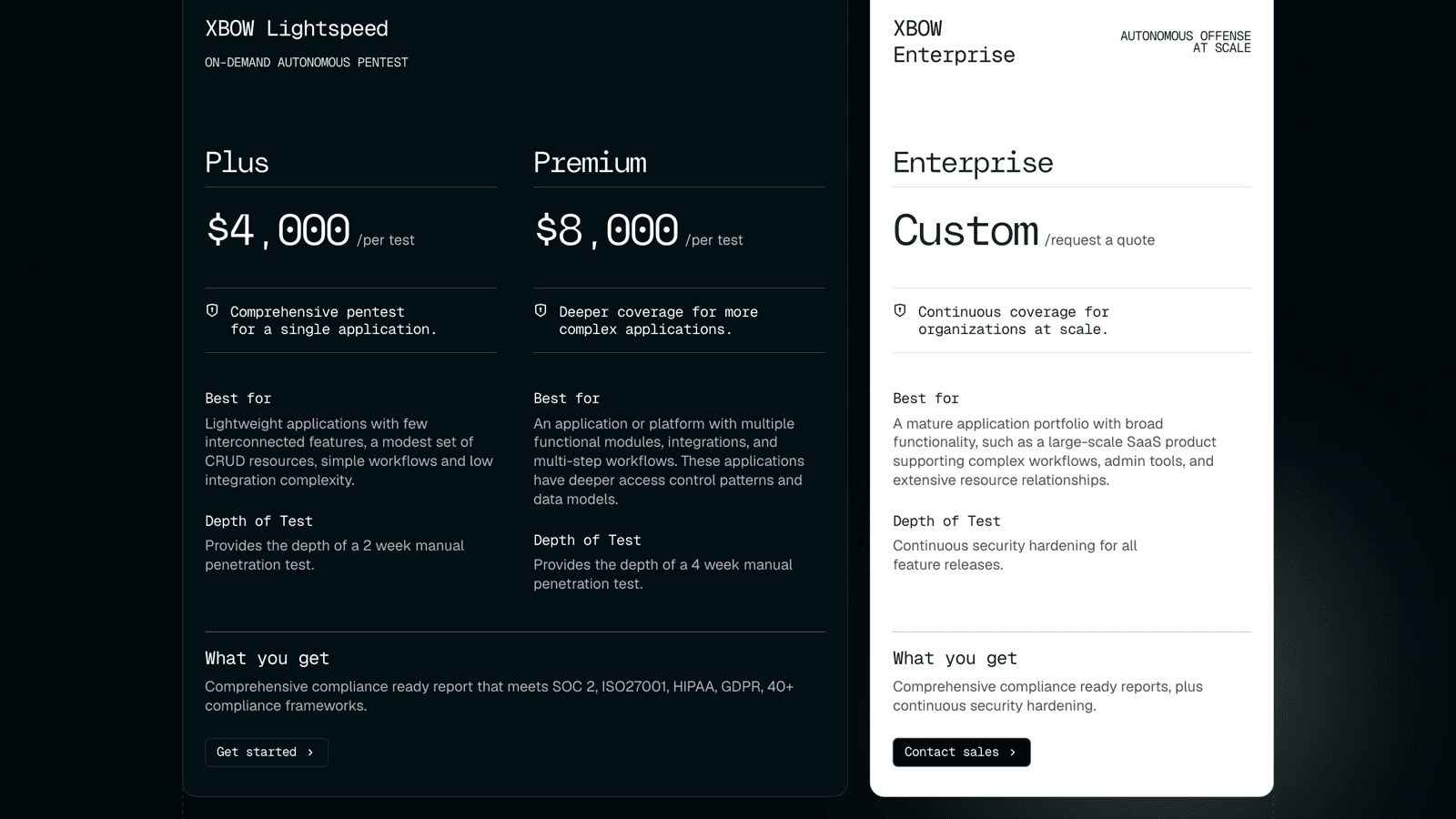
So those anchors handed you a day rate you could hold against a consultancy proposal without doing arithmetic of your own.
As of July 2026 the XBOW pricing page carries no figures at all, describing “usage-based pricing that scales with your coverage, not a fixed annual engagement” and scoping the number to your environment behind a “Request Pricing” form.
Usage-based scoping is a defensible model, and it may well land cheaper for a small surface. But what it takes away is the ability to compare anything before you talk to someone.
What the Rest of the Field Charges
A second question sits underneath the number, which is what you owe when the test finds nothing. And capacity-priced testing bills for the work whatever the outcome, which moving to usage-based scoping does not change.
Tool | Published pentest price | Billed even when nothing is found |
|---|---|---|
XBOW | None published as of July 2026, scoped on request | Yes |
CodeAnt AI | $0 engagement fee, billed on exploitable High and Critical findings | No, a clean application costs nothing |
€3,500 or $4,000 fixed per assessment, or a Rightsized test | No on Rightsized, under a published “No High or Critical Finding = Don’t Pay” guarantee | |
€3,000 per Nova test, one test covers one URL | Yes | |
From $3,500 per white-box test for subscribers, same-day, no quote cycle | Yes | |
$1,999 per target per year on Pentest Auto, $5,999 on Pentest Expert | Yes |
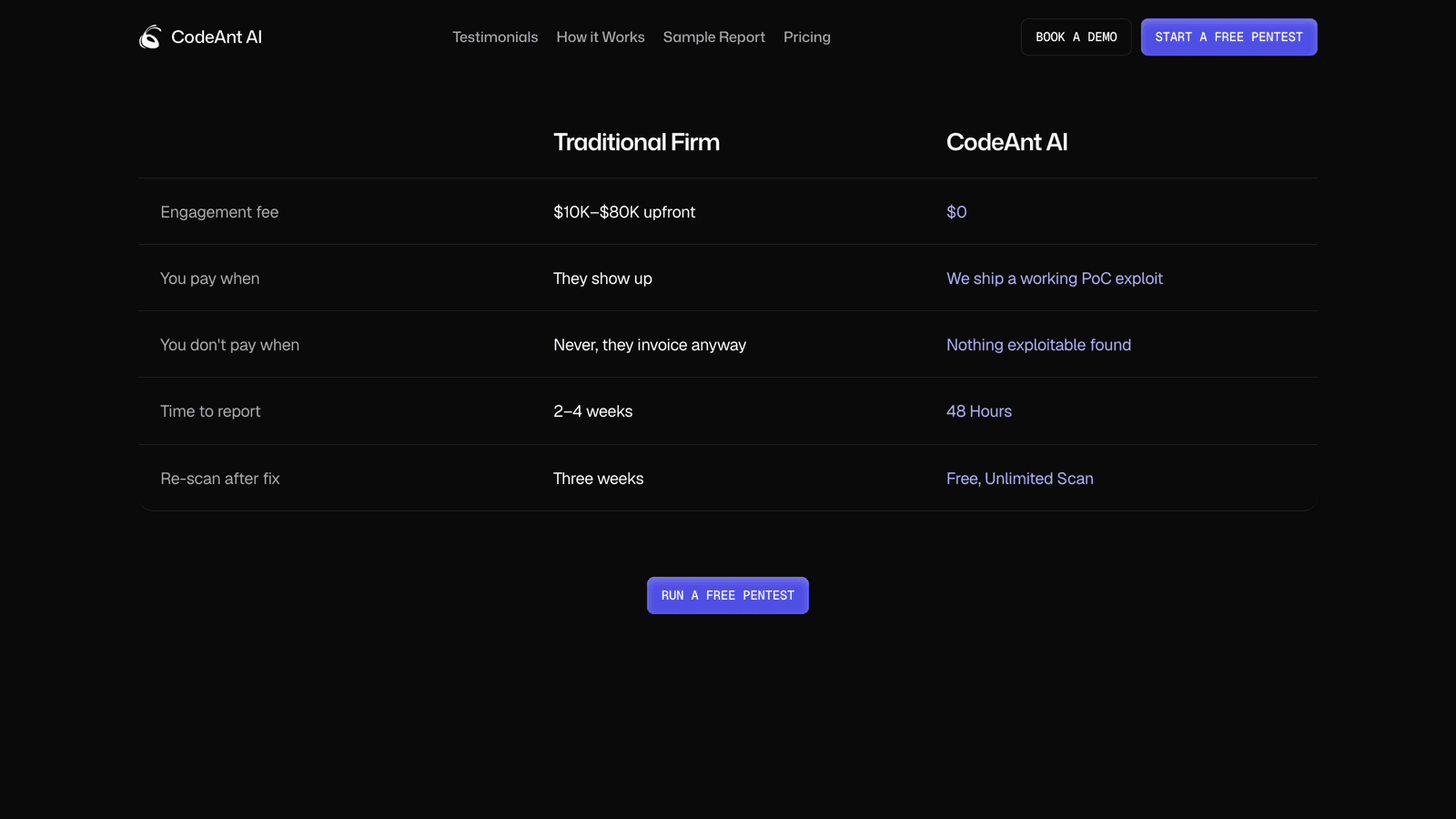
Only two models on this list break the capacity habit. Both are in the table above, and our breakdown of how much penetration testing costs puts them against wider market rates.
One more line item deserves attention before you compare totals, which is whether you can see the output before a purchase order clears.
XBOW. No free trial, so there is no way to judge output quality in advance.
Intruder. A free-forever tier covering five infrastructure licences and three users.
Aikido Security. A permanent free Developer plan for two users.
NodeZero. A self-serve 30-day trial that drops to read-only afterwards.
CodeAnt AI. A 14-day trial covering 100 PR reviews with unlimited seats.
The 10 Best XBOW Alternatives at a Glance
Grouped and ranked by how directly each one closes a specific XBOW limitation, not by how good the tool is in the abstract. CodeAnt AI leads because it closes the code-remediation gap that none of the other nine touch.
# | Tool | The XBOW limit it closes | Surface it reaches | Published entry price |
|---|---|---|---|---|
1 | CodeAnt AI | Proves the exploit and fixes the code behind it | Repositories, web apps, APIs, pull requests | $24 / user / month, pentest billed on findings |
2 | Hadrian | Scope you never declared | External estate, web, APIs, cloud | €3,000 per Nova test, one URL |
3 | NodeZero (Horizon3.ai) | Internal network and Active Directory | Internal, external, cloud, identity, Kubernetes | Quote only, 30-day free trial |
4 | Unlimited test frequency across the estate | Internal, external, cloud | None published | |
5 | Astra Security | A certified human behind the report | Web app, API, cloud | $1,999 / year per target |
6 | Attestation letters and multi-surface human testing | Web, mobile, API, network, cloud, desktop | Custom quote, Cobalt Credits | |
7 | Federal-grade accreditation | Web, host, API, mobile, cloud | From $4,181 per Sara pentest | |
8 | Intruder | A free way to start and a self-serve report | Internet-facing estate, cloud, internal on Pro | Free tier, then $239 / month |
9 | Per-seat pricing and pre-merge testing | Running application and APIs in CI | $10 / user / month | |
10 | Aikido Security | Contingent pricing and code-side coverage | Code, cloud, containers, runtime | Free Developer plan, then $350 / month |
The One That Proves the Exploit and Then Fixes the Code
1. CodeAnt AI
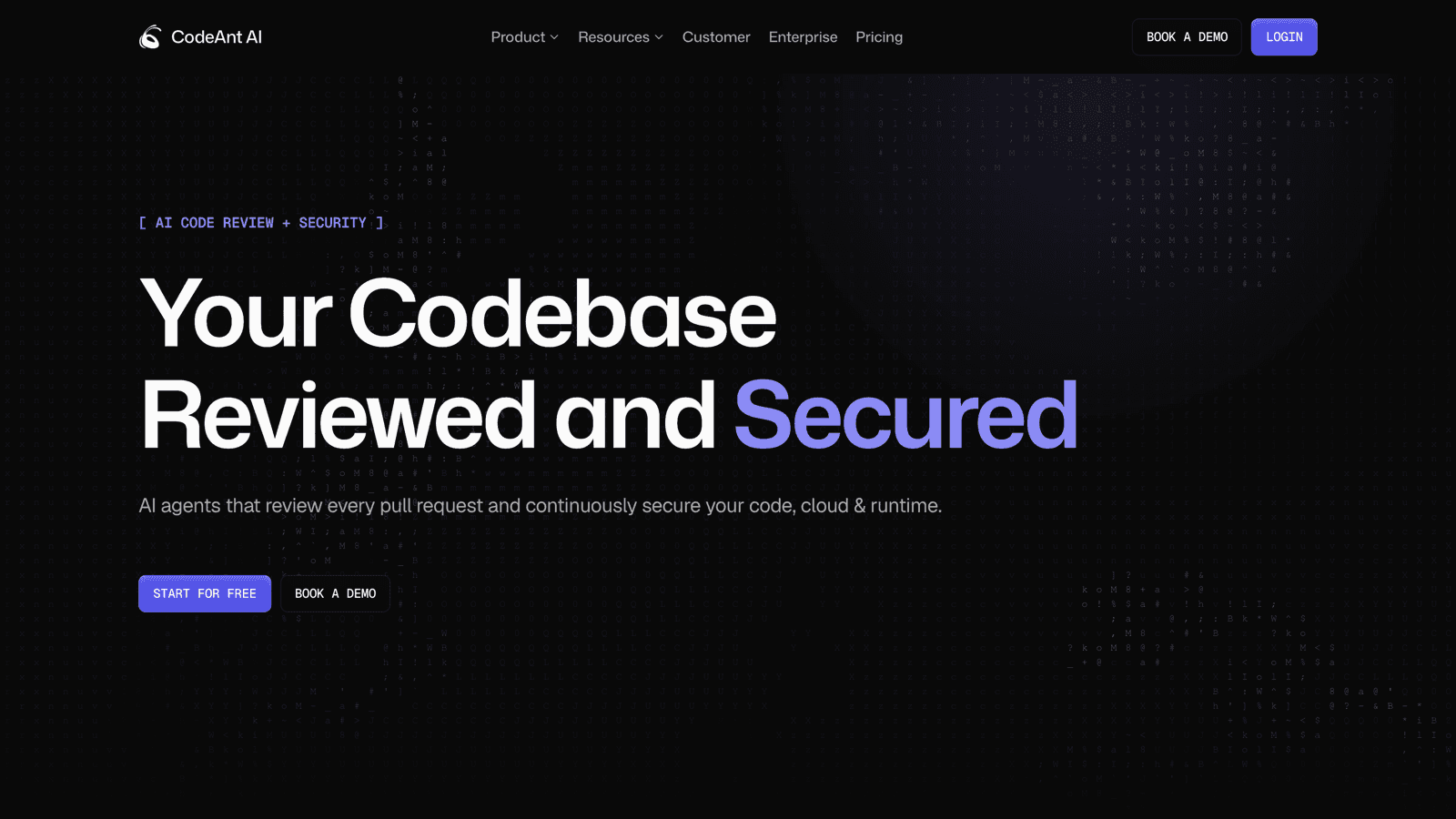
Every other tool on this list ends where XBOW ends, with a validated finding handed to your engineering team. CodeAnt AI is a defensive and offensive security platform that unifies AI code review, SAST and agentic pen testing.
So the same system that proved the exploit also reviews the pull request that would reintroduce it.
Defensive review accumulates months of intelligence about your authentication patterns, middleware configuration, API flows and Git history. Which means the offensive agents start a test holding all of it, rather than cold against a URL.
Three testing tracks then run in parallel instead of one. Blackbox maps what is publicly reachable, Whitebox traces source code and Git history, and Graybox with Code Memory tests authenticated business logic using what the other two learned.
For how those modes differ in practice, the AI penetration testing guide walks through each one.
What it does that XBOW doesn’t
Fixes the class, not just the instance. SAST, SCA, secret detection and IaC checks run inline on every pull request across 30-plus languages, so the flaw a pentest would surface in November gets stopped in July.
Reads what black-box testing cannot see. Recovering AWS credentials committed in 2023, deleted in 2024 and never rotated takes Git access. So does tracing a 200ms race condition between a Stripe webhook and a database commit.
Bills outcomes rather than capacity. There is a $0 engagement fee and you pay only for exploitable High and Critical findings, so a clean application costs nothing to test, whatever a scoped XBOW engagement quotes at.
Ships the audit file, not just the report. An eight-document evidence package comes with every engagement, covering retest verification, per-finding timelines, TSC control mapping, regulatory exposure analysis, a data deletion certificate and a compliance attestation letter.
Retests without a new invoice. Re-scans after a fix are free and unlimited. And the SOC 2 or ISO 27001 grade report returns within 48 hours rather than five days.
Publishes disclosure work you can verify. Three CVE disclosures at CVSS 9.8, 9.3 and 5.3 sit on public record, with CVE-2026-28292 and CVE-2026-29000 verified on NVD, and CodeAnt AI is a VulnCheck CNA partner.
What it costs
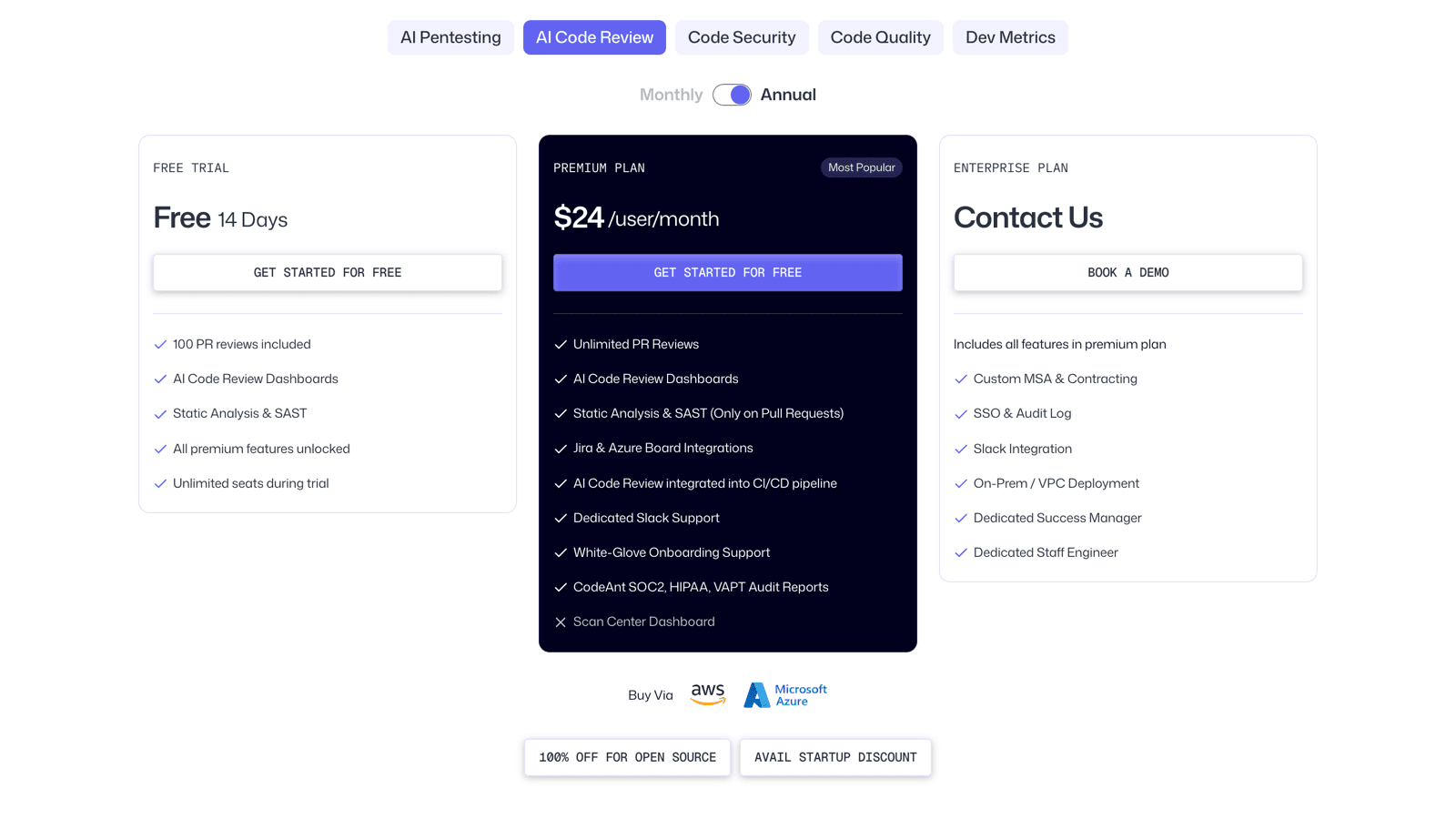
AI code review, $24 per user per month. That is the annual billing rate, and it is printed on the site rather than quoted on a call.
Public repositories, free. No seat count and no trial clock attached.
Pentesting, $0 to start. Billing attaches to exploitable High and Critical findings, with the model laid out on the AI pentesting page.
Trial, 14 days and 100 PR reviews. Seats are unlimited for the duration.
Where it falls short
No human signs the engagement. A buyer who needs a CREST-accredited name is buying a different delivery model.
The internal network is not part of the offering. Active Directory exploitation sits outside scope, which is why NodeZero and Pentera appear further down this page.
The review base is shorter than the incumbents here. CodeAnt AI rates 4.8 on G2 and 4.7 on Gartner. One mid-market G2 reviewer found suggestions “too cautious or sometimes it needs manual adjustments, also onboarding takes time,” while a Gartner Peer Insights reviewer in IT services called the feedback “highly accurate” for “issues with edge cases, missed logic.” So use the trial rather than the star count.
Best for: teams that liked what XBOW proved but got tired of shipping the same vulnerability class back into production three months later.
If You Want XBOW’s Autonomy Across More Than Web Apps
These three keep what you like about XBOW, which is agents attacking autonomously and proving what they find. What changes is the map they are allowed to walk, because XBOW’s documentation scopes it to web apps and their APIs, with mobile, cloud, network and binary testing still on the roadmap.
2. Hadrian
The precondition | XBOW | Hadrian |
|---|---|---|
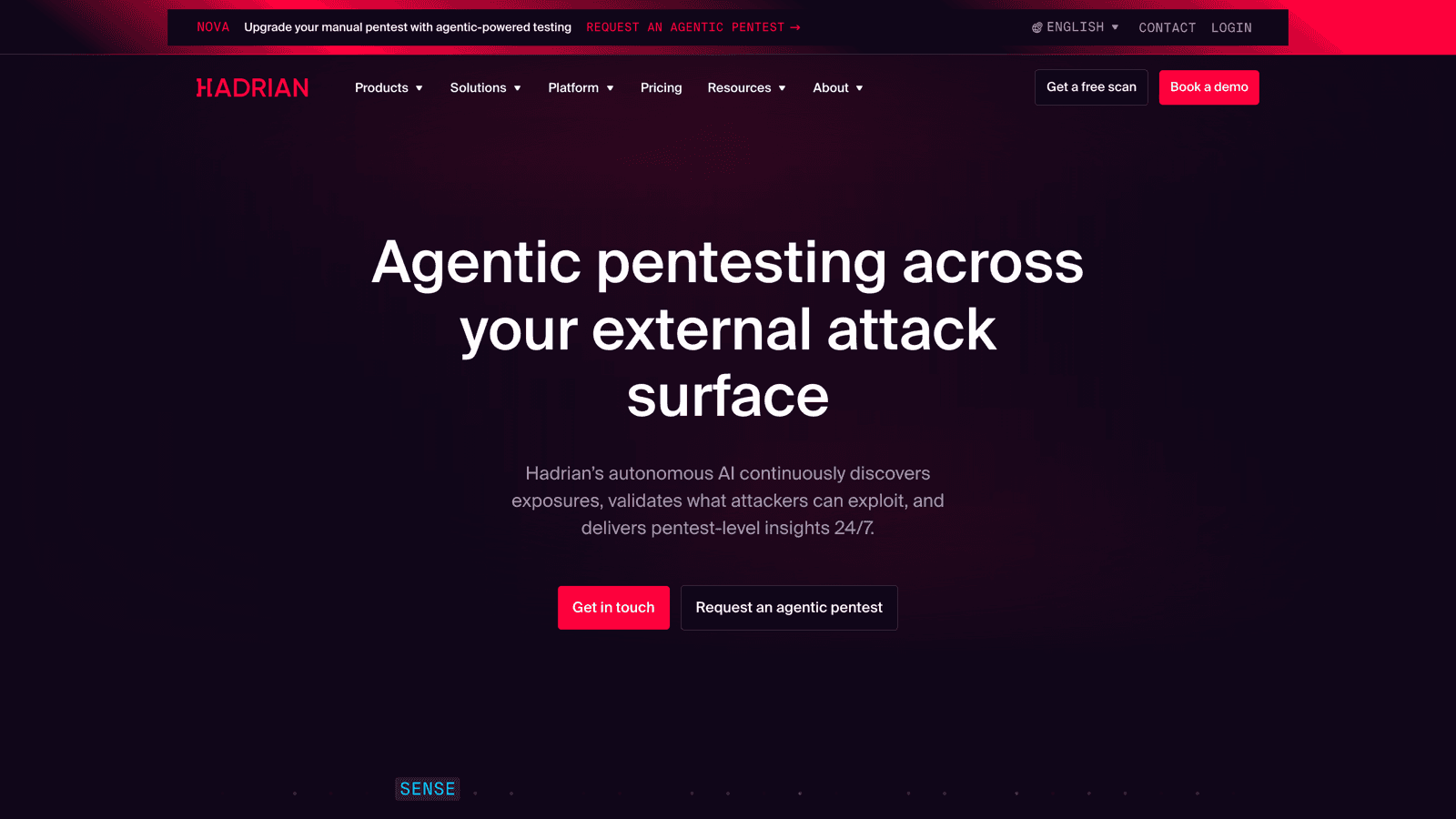
What you have to hand it before it starts | A URL, and possibly credentials | Nothing at all |
Who decides the scope | You do, by declaring it | Its Sense engine does, by discovering it |
That difference is the whole reason Hadrian ranks second. Because its Sense engine runs hourly passive scans with machine learning trained by ethical hackers to confirm asset ownership, it can fire event-driven tests the moment an asset changes rather than waiting on a scheduled window.
Because only the checks matching the fingerprinted technology run, contextually gated scanning keeps the noise down. WordPress probes never waste cycles against an SAP instance.
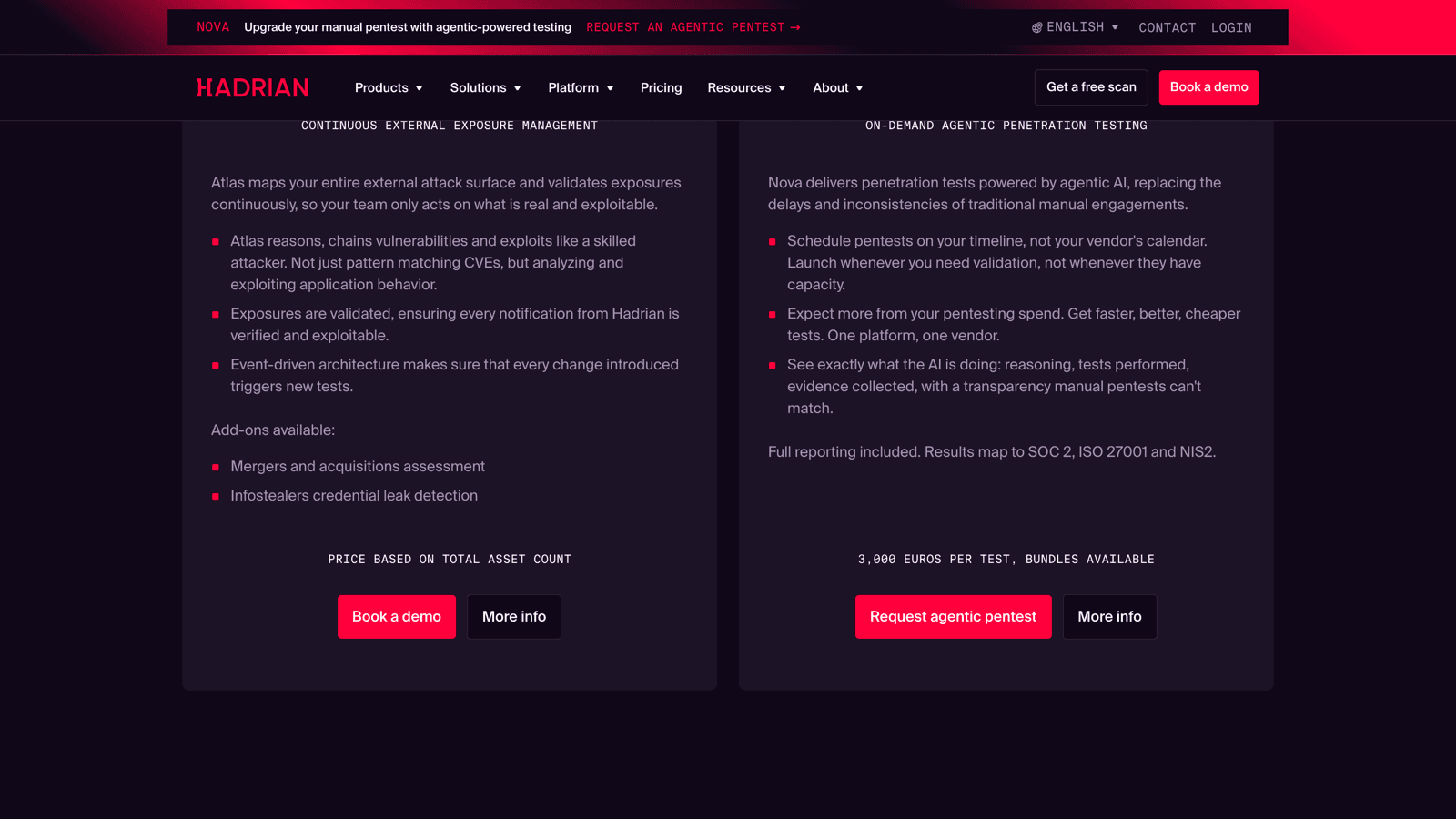
Nova is the on-demand pentest layer, hitting web apps, APIs and cloud and returning validated findings inside 24 to 48 hours. Our external penetration testing methodology guide covers what a discovery-first engagement should include.
Where it goes past XBOW
Zero-scope discovery. You declare nothing and Hadrian finds the estate the way an adversary would, which answers the question of whether the scope you named is the scope you have.
Confirmed split from potential. Verified Risks separates the two and attaches step-by-step reproduction to every confirmed item, with an AI Orchestrator claiming 99% noise elimination.
Prioritisation drawn from live threat data. Ranking pulls on asset criticality, CISA KEV data and dark-web monitoring rather than raw severity alone.
Cloud inside the pentest scope. Nova tests cloud environments alongside web and API targets and maps output to SOC 2, ISO 27001 and NIS2.
A cheaper unit and a free look. Nova runs €3,000 per test against one URL, and a conditional free external scan is available over email.
One enterprise G2 reviewer contrasted it with prior tools whose false positives “costed a lot of time to investigate,” saying that “when Hadrian reports a vulnerability you know it is real.”
Another, at mid-market, described real-time visibility into risks their team “would have to wait until a penetration test to discover.”
Even so, Nova’s terms state that Hadrian “does not warrant that Nova will identify every vulnerability,” and pentest entitlements expire at contract year end with no rollover. The review corpus is thin too, at four G2 entries, with reviewers flagging “missing reporting or exporting functionalities.”
Best for: acquisitive or sprawling organisations where nobody can confidently list every internet-facing asset, which is precisely the input XBOW requires you to have.
3. NodeZero (Horizon3.ai)
If the surface you are worried about is a corporate domain rather than a web app, NodeZero is the direct answer.
Coverage XBOW never claims
Active Directory and credential attacks. Password audits, misconfiguration exploitation and credential reuse across a domain, none of which a web-app tester attempts.
Everything else at the entry tier. Agentless autonomous pentests run across internal, external, AWS, Azure Entra ID, Kubernetes, segmentation and insider-threat scenarios.
Control validation, not just vulnerability discovery. An Endpoint Security Effectiveness test deploys a RAT and reports whether your EDR blocked, alerted or missed it entirely.
Rapid Response on new CVEs. Production-safe exploits for newly disclosed vulnerabilities often land within hours, routing findings to ServiceNow, Jira, Splunk and Microsoft Sentinel.
Unlimited frequency and FedRAMP High. The subscription includes unlimited autonomous pentests, and Horizon3.ai holds FedRAMP High authorization.
If XBOW’s proof discipline is what sold you, the evidence philosophy here will feel familiar. Horizon3.ai states that exploitability gets “confirmed or ruled out with evidence, not vendor advisories or CVSS scores from vulnerability scanners that just check versions.”
Because 1-Click Verify re-runs a remediation and then retains the proof for 12 months on internal environments, the evidence survives to whichever audit window comes next. Our roundup of the best continuous pentest tools puts that cadence in context.
Brent Hamlin, an infrastructure manager writing on PeerSpot, summarised the workflow as “set it, scope it, and let it go,” while Rudolf Oyakhire reported that “the deployment is very easy, taking under ten minutes.” Horizon3.ai also took a Gartner Peer Insights Customers’ Choice in 2025.
Where it stops
Here the gaps run the opposite way from XBOW’s, because there are no code rows anywhere in the packaging matrix, GitHub shows up only as a ticketing destination, and web application pentesting still sits behind an early-access waitlist.
Useful features are tier-gated too, since recurring scheduled pentests need Core or above and reporting analytics are Elite-only.
And price is quote-only. One senior security engineer cited “high cost for low-yield real attacks,” while Oyakhire noted a “learning curve for advanced features” alongside the observation that “cost may challenge smaller organizations.”
Best for: teams whose next questionnaire asks about internal network and Active Directory exploitation, where XBOW’s scope statement ends the conversation immediately.
4. Pentera

Pentera solves the frequency problem that per-test pricing creates. Testing is agentless, runs remotely or on-premises, and carries no cap on how often you validate the estate.
Coverage is contracted as a whole rather than scoped piece by piece. Pentera Core, Surface and Cloud validate internal, external and cloud environments under one agreement. And because a published do-no-harm policy carries configurable range, scope, time and stealth settings, you test production without booking a window.
The frequency argument
No agents and no frequency limit. Validate after every change rather than rationing tests against a budget line.
Measured time savings. An education-sector reviewer reported saving “approximately 45% of the hours we used to spend on manual penetration testing.”
Internal depth XBOW does not attempt. Lateral movement and control validation across a corporate estate is the core product rather than a roadmap item.
Reporting built for a boardroom. One reviewer valued that “attack path visualization gives me the ability to communicate with leadership and the board,” and Pentera Peer answers questions about findings in natural language.
The cost picture is the inverse of the transparency XBOW used to offer.
What you can find out | Where it comes from |
|---|---|
Nothing on the pricing page | It returns a 404 |
$100,000 and $400,000 a year, representative licences | An analyst whitepaper Pentera itself hosts, not a list price |
“The product has become very expensive” | A director writing on PeerSpot |
No trial and no free tier | There is no self-serve route in at all |
Two more limits matter for an XBOW buyer. Nothing runs before a merge, since every Pentera product tests a running environment and it ships no SAST or SCA, only ingesting other tools’ code findings into Resolve.
Its SOC 2 and SOC 3 reports cover Surface and Resolve rather than the full platform, and Pentera states outright that it “does not certify compliance or claim FedRAMP authorization.”
Reviewers flagged navigation “which seems slower” and that “cloud testing capabilities need enhancement.” For the compliance side in more depth, see our Pentera versus CodeAnt AI writeup.
Best for: large regulated enterprises where the binding constraint is how often you are allowed to test, not what a single test costs.
Autonomy Beyond Web Apps, Compared
Question | Hadrian | NodeZero | Pentera |
|---|---|---|---|
Surfaces reached beyond web and API | Full external estate plus cloud | Internal, cloud, identity, Kubernetes, segmentation | Internal, external, cloud |
How scope is set | Discovered automatically, nothing declared | You scope it once, agentless | Contracted across Core, Surface and Cloud |
Test frequency | Hourly passive plus event-driven on change | Unlimited pentests inside the subscription | Uncapped, against a credit meter |
Retest evidence | Re-validated when the asset changes | 1-Click Verify, proof retained 12 months | Re-run at will, no published retention |
Published price | €3,000 per Nova test, Atlas on asset count | Quote only across Flex, Core, Pro, Elite | None, pricing page returns a 404 |
Free way in | Conditional free external scan by email | 30-day self-serve trial, then read-only | None |
If You Need Evidence a Human Signed
This group exists because of a question XBOW cannot answer. When an auditor, an enterprise customer or a procurement team asks who performed the test, “thousands of short-lived agents” is not what the form expects.
Astra is the cheapest published route to a certified tester, Cobalt issues the attestation letter procurement asks for by name, and Synack carries the accreditation stack that federal work demands.
5. Astra Security
Human evidence XBOW cannot issue
A certificate with credentials attached. CREST, OSCP and CERT-In backing on a publicly verifiable pentest certificate, with SOC 2, ISO 27001 and PCI reporting included.
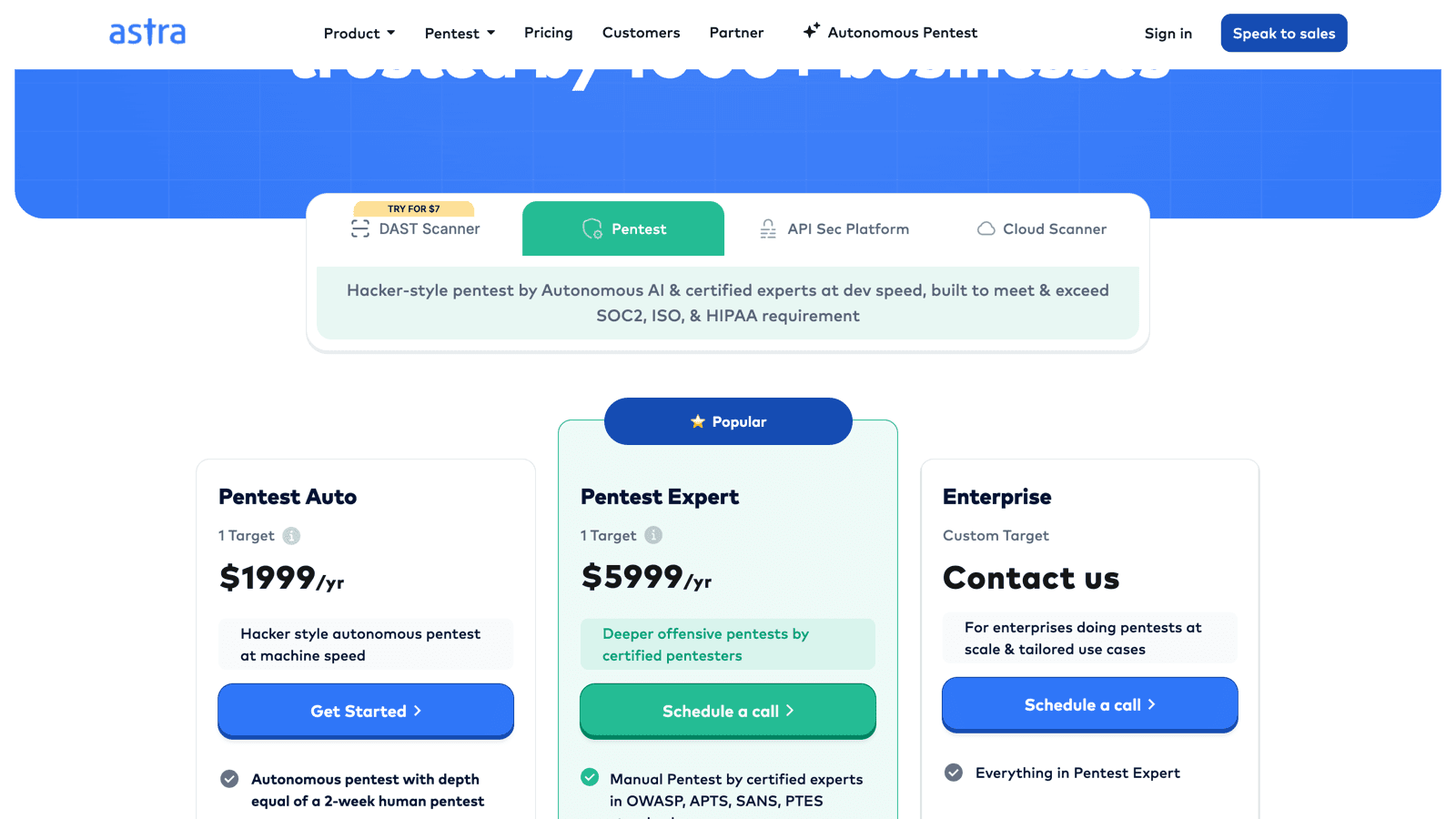
A price you can budget annually. Pentest Auto is $1,999 per year per target and Pentest Expert is $5,999, both printed on the page, where one app plus its APIs and cloud counts as a single target.
Fixes pushed into the editor. An MCP integration sends a codebase-specific fix prompt into Cursor, Claude Code or Copilot when a vulnerability is confirmed.
Astra runs an automated scanner first, then puts OSCP, CEH, CRTP and CREST-certified testers on the same dashboard, returning manual findings with proof-of-concept videos in 10 to 15 working days. So it is slower than XBOW’s five days, though the delay is what buys you the signature.
An authorization matrix maps user-level privileges across more than 15,000 authenticated test cases, including discovery of shadow, zombie and orphan endpoints. And the DAST layer runs 10,000-plus test cases against the OWASP Top 10 while handling TOTP MFA through custom login scripts.
The cloud scanner adds a surface XBOW leaves out entirely, with more than 400 agentless detectors across AWS, Azure and GCP and a first report inside ten minutes. See our Astra comparison page and the CodeAnt AI vs Astra Security breakdown for how the offensive models diverge.
An IT-services co-founder said “the vulnerability scan is great but it was the manual pen test which was better,” adding that “pen tests can be shockingly expensive and Astra is a very low price,” and a DevSecOps reviewer praised “clear, actionable reports that made remediation easier.”
Where the automated half gets weaker
A financial-services security officer wrote on Capterra that “the accuracy of the automated scanner can be made more efficient,” and a senior director noted “there are some actions that cannot be carried out in the UI and require contact to service.”
Astra’s flagship Autonomous Pentest also remains waitlist-only. And nothing here reads a repository to find issues, so source-code analysis stays somebody else’s job.
Best for: teams that need a signed certificate this quarter without a procurement cycle, and can absorb a two-week wait for the manual pass.
6. Cobalt
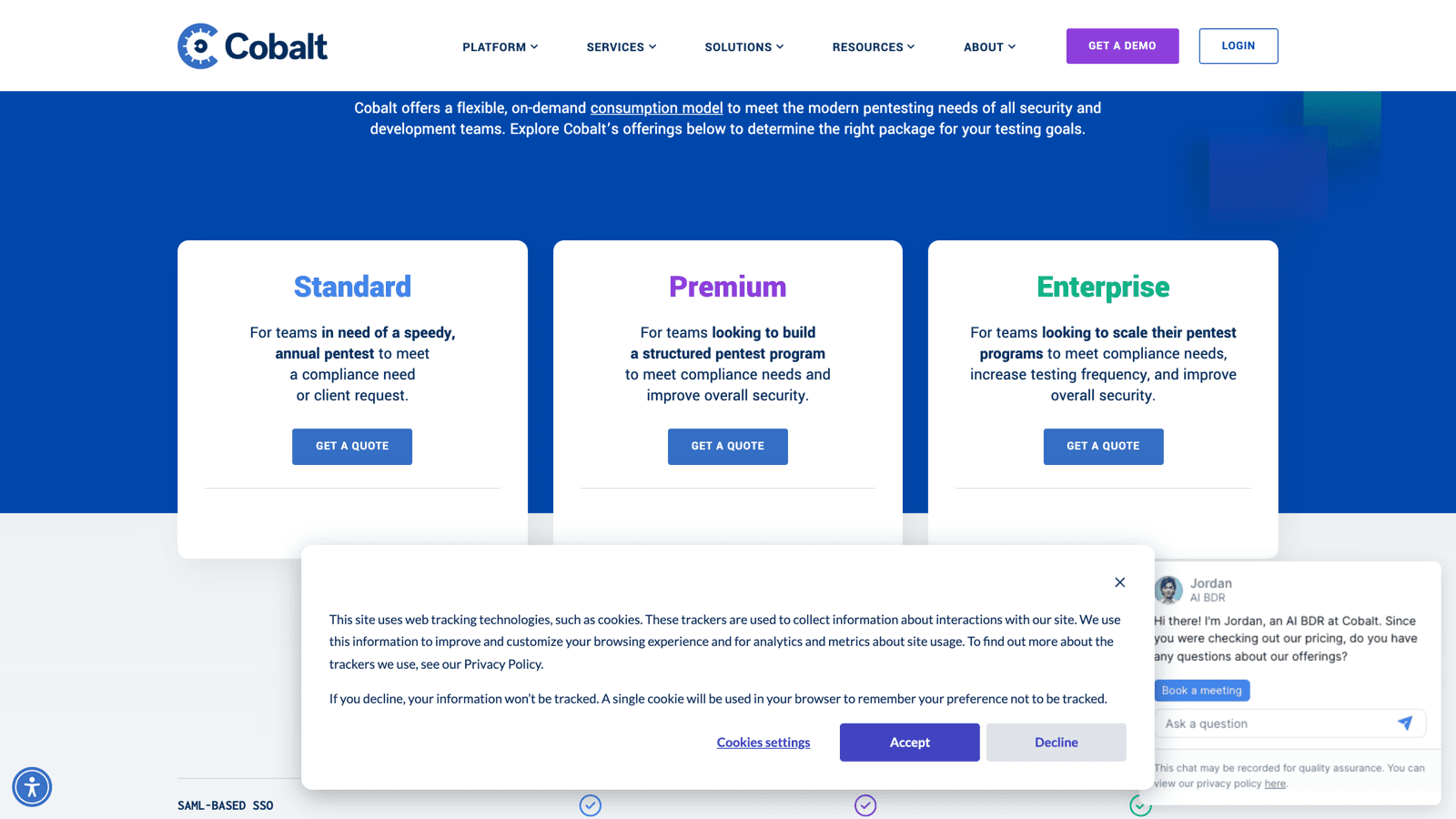
Cobalt invented pentest as a service and still sets the reference point for it. Where Astra gives you a certificate, Cobalt gives you an audit-quality attestation letter.
It also holds SOC 2 Type II, ISO 27001 and CREST accreditation on its own side rather than only in its testers’ credentials.
Underneath that sits Cobalt Core, a bench of more than 450 vetted freelance testers who average 11 years of experience and carry OSCP, OSWE, CREST and roughly 30 other certifications.
Engagements can launch in as little as 24 hours, with start SLAs of three, two or one business day by tier. For how that delivery model works, read our CodeAnt AI vs Cobalt comparison and the pentest as a service explainer.
What a named tester buys you
The artifact procurement asks for. Audit-quality attestation letters issued to customers, which no autonomous report substitutes for.
Business-logic judgment. Human-led secure code review pairs automated SAST and SCA with expert validation, aimed squarely at the flaw class skeptics say AI still misses.
Retesting that outlives the engagement. Individual findings retest free for 6 to 12 months against a 7-day platform SLA, with the pricing FAQ committing to unlimited on-demand retests during the contract.
Surfaces XBOW does not test. Published per-asset methodologies cover web, API, mobile, network, cloud, desktop and AI or LLM targets, all scoped through a four-step wizard.
Arpit G., a senior staff engineer, wrote on G2 that Cobalt delivers “actionable findings that are easy for engineers to understand and fix” and that working with testers makes security “feel collaborative rather than audit-driven.”
The commercial model is where it gets awkward, because there is no number on the page at all.
The buying mechanic | What it means for you |
|---|---|
Custom quote built on Cobalt Credits | Each credit is eight hours of tester time at an undisclosed unit price |
Five-credit minimum | Michał M., a security specialist, wrote on G2 that he dislikes “that there is a minimum of five credits” for tests needing far less |
Credits expire with the contract year | Rollover is capped at 10%, and only on Enterprise |
Standard tier excludes Jira and GitHub | Workflow integration is a reason to move up a tier |
Still, the output itself draws criticism. Osher L. said “the reporting and the interface of the reports could be better.”
Best for: security leads whose largest customer or auditor names the attestation letter as a requirement, and whose scope covers more than a web application.
7. Synack
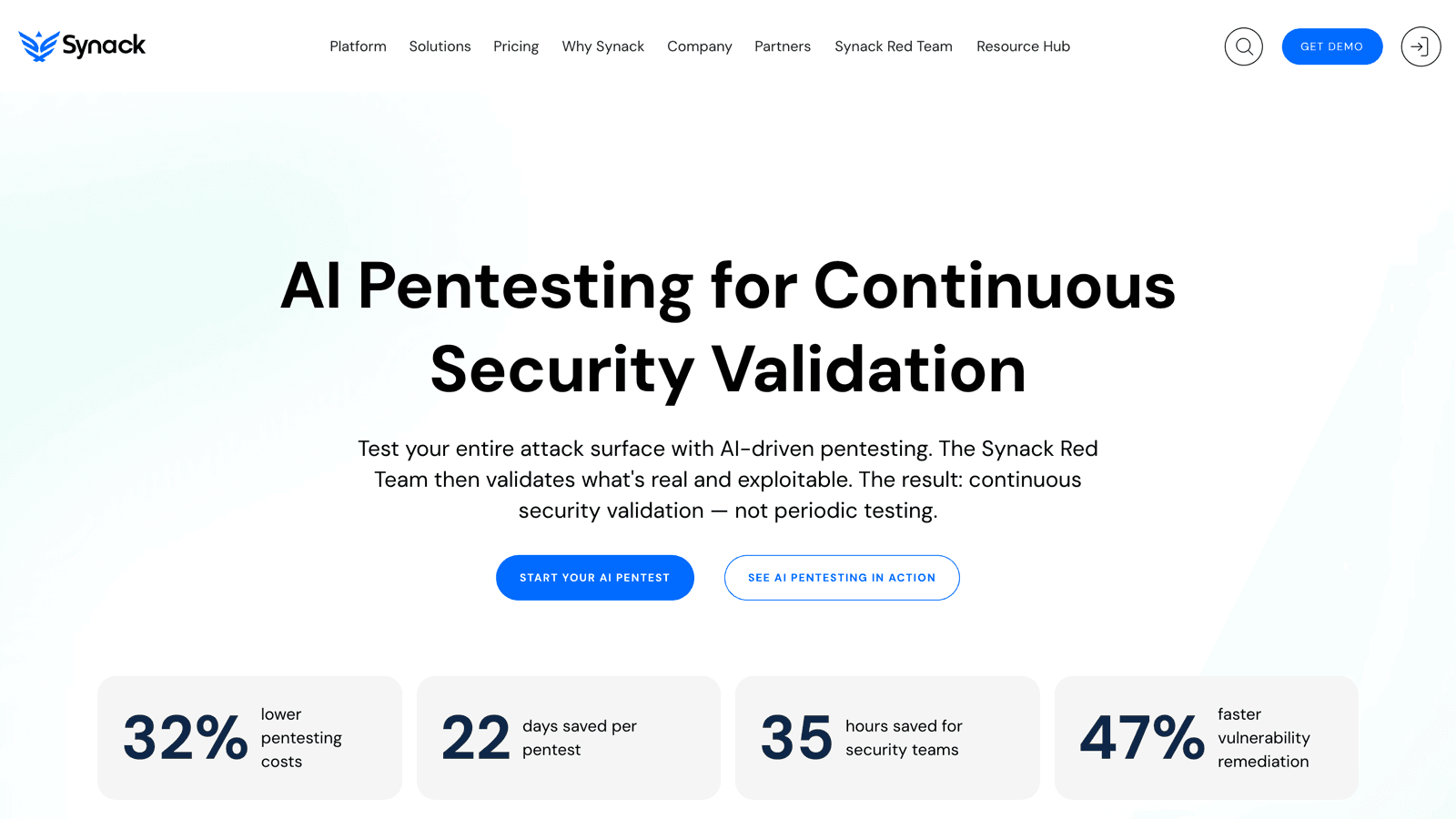
Synack is the answer when the compliance bar is federal. It holds FedRAMP Moderate authorization covering 325 NIST controls, ISO 27001, and testing at DoD impact levels 4, 5 and 6, none of which XBOW carries.
So the delivery blends AI and humans, in the order this group implies. A Sara AI agent widens coverage and Sara Triage strips 99.98% of scanner noise from ingested Tenable and Qualys output, then the Synack Red Team confirms what is genuinely exploitable.
That bench runs 1,500-plus researchers through a five-step process with under 10% acceptance. And oversight is unusually strong, since every researcher’s traffic runs through the LaunchPoint VPN with full packet capture and a one-click pause on any assessment.

Package | Published starting price |
|---|---|
Sara AI pentest | $4,181 |
SynackST | $10,283 |
Synack14 | $27,120 |
Platform subscription | A separate line item on top of any of the above |
Publishing those figures at all is more transparency than most human-led platforms offer. From there, engagements run point-in-time or on rolling 14, 90 and 365-day cadences across web, host, API, mobile and cloud.
Credentials that clear a federal gate
Accreditation XBOW has no equivalent for. FedRAMP Moderate, ISO 27001 and DoD impact levels 4 through 6, with OWASP and NIST 800-53 mission checklists generated on demand.
Remediation detail engineers learn from. Todd E. said on G2 that “Synack explains exactly how each flaw was exploited and provides a full detailed explanation on how to remediate,” calling it “like getting secure code training for free.”
Findings quality that analysts notice. A principal technology architect wrote on Gartner Peer Insights that “I continue to be impressed with the quality of Synack’s findings, which speaks to the quality of their security researchers.”
The same G2 reviewer called the launch “a little slow to spin up” and warned that scoping gets “more complicated when API and/or multiple testing accounts are involved.” Tests are prepaid credits that expire one year from purchase, usually bought through a purchase order.
Sara’s own scope is narrower than the platform’s. It covers external web and host assets only, and it cannot handle MFA, OTP or CAPTCHA. Nor does Synack review source code at all, which leaves exactly the gap XBOW leaves.
Best for: public-sector and regulated enterprises where FedRAMP appears in the contract, and a procurement-led purchase is normal rather than an obstacle.
Human-Signed Evidence, Compared
Evidence question | Astra Security | Cobalt | Synack |
|---|---|---|---|
Who signs the work | OSCP, CEH, CRTP and CREST-certified testers | Cobalt Core, 450-plus vetted testers, 11-year average | Synack Red Team, 1,500-plus, under 10% accepted |
Artifact produced | Verifiable pentest certificate, SOC 2, ISO and PCI reporting | Audit-quality attestation letter | NIST 800-53 and OWASP mission checklists |
Accreditation held by the vendor | CREST and CERT-In backing | SOC 2 Type II, ISO 27001, CREST | FedRAMP Moderate, ISO 27001, DoD IL 4 to 6 |
Time to findings | 10 to 15 working days for the manual pass | Start in 24 hours, roughly 14-day engagements | Slow to spin up, then rolling 14 to 365 days |
Retest terms | One re-scan on Auto, two on Expert | Free per finding for 6 to 12 months, 7-day SLA | Inside the engagement window |
Entry cost | $1,999 / year per target | Quote only, five-credit minimum | $4,181 plus a separate platform fee |
If You Need a Number Before a Sales Call
Not every objection to XBOW is about capability. Sometimes the product is right and the purchase order is impossible, because nothing on the site tells you the cost, there is no free tier to prove value with, and no way to spread the spend across a team.
Intruder starts free and sells a report self-serve, StackHawk charges $10 a seat and runs before the merge, and Aikido bundles the code side with a pentest you only pay for when it finds something.
8. Intruder
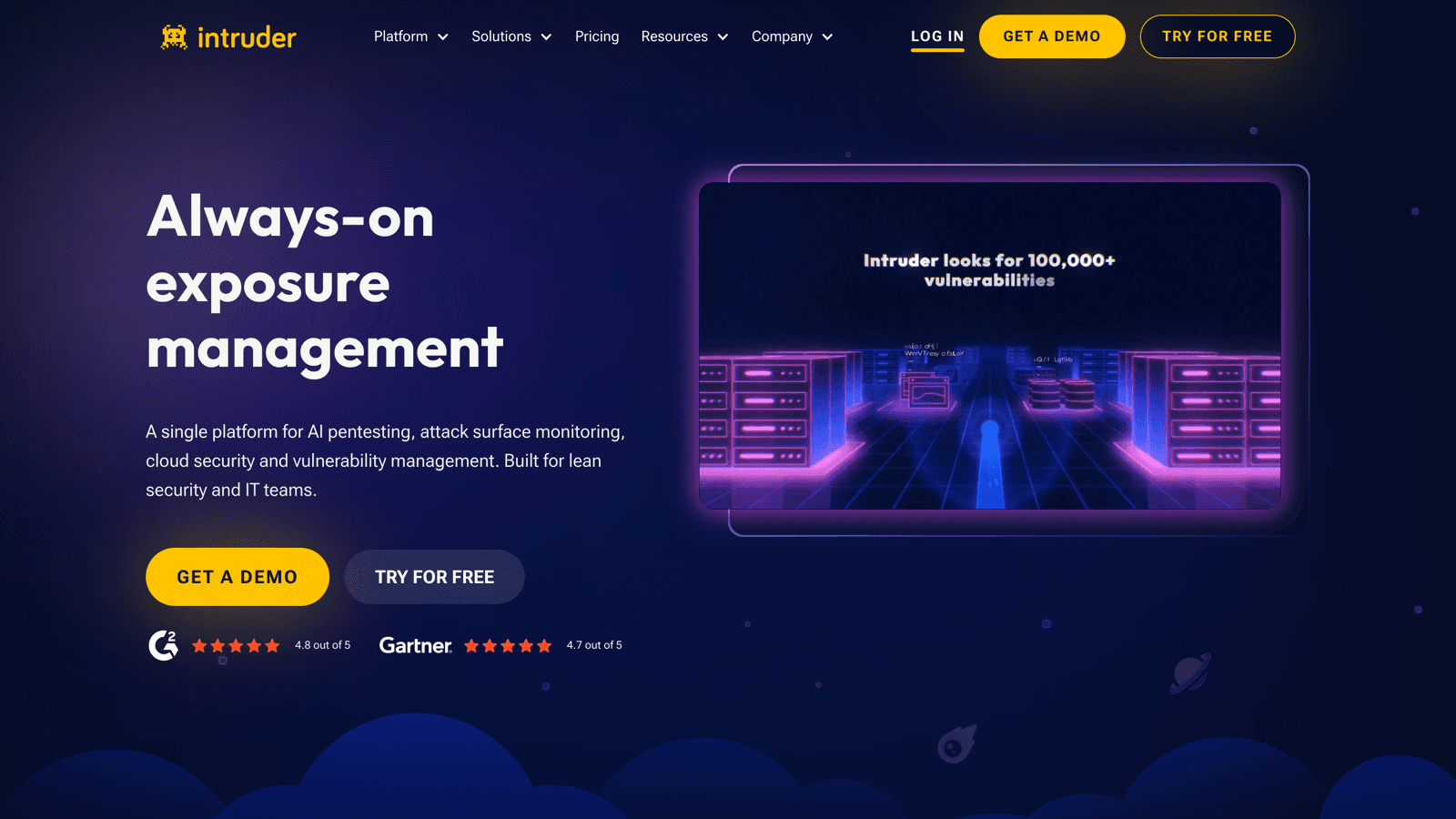
Intruder is the cheapest honest path to an auditor-acceptable report, and you can price the whole thing before you speak to anyone.
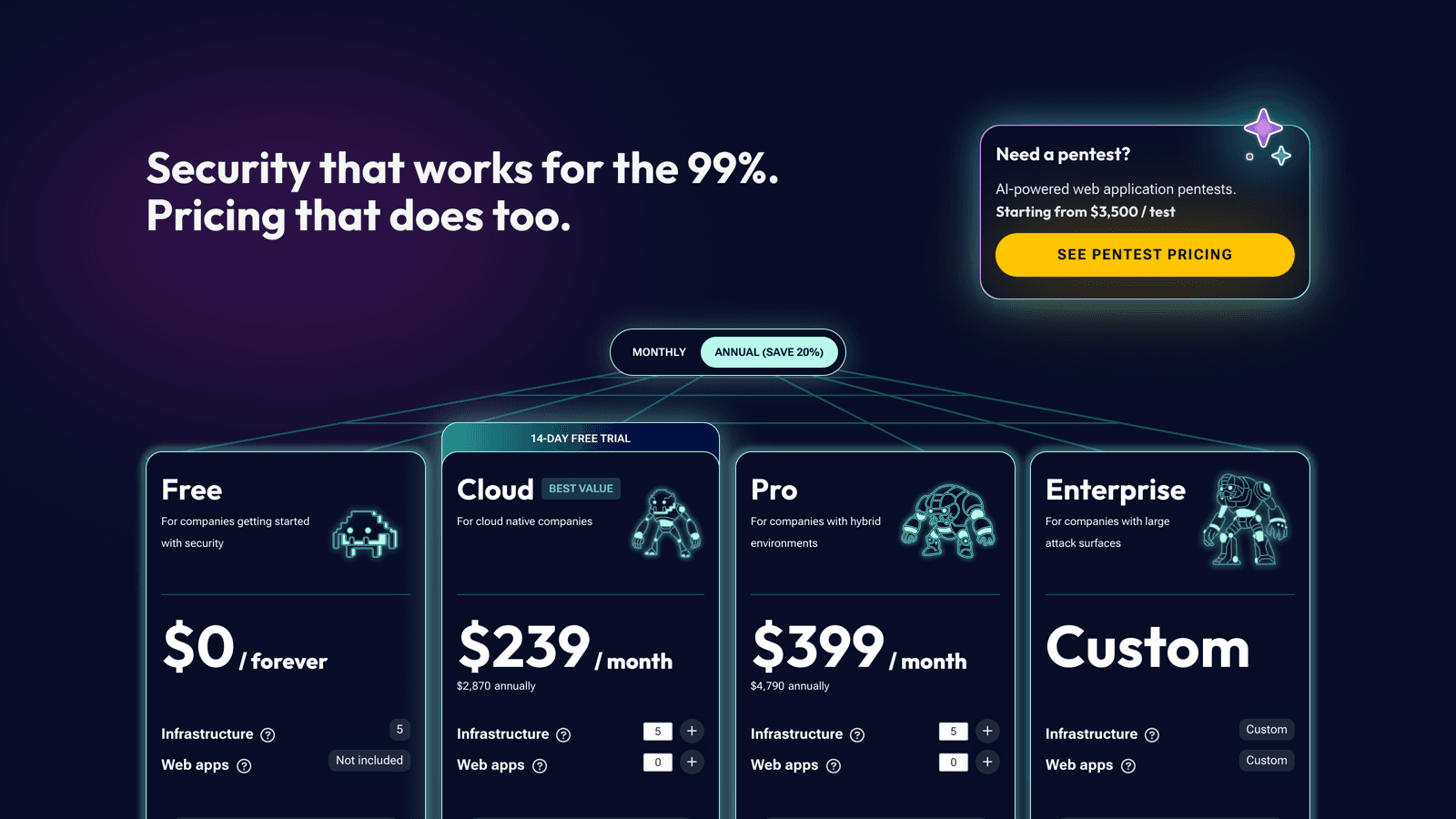
Free forever. Five infrastructure licences and three users cost nothing, so you can evaluate before anyone signs anything.
Cloud, $239 per month. Billed annually at $2,870.
Pro, $399 per month. Billed annually at $4,790, with internal scanning included.
White-box pentest, from $3,500 per test. That is the subscriber rate, or $4,000 as a one-off, delivered same-day against XBOW’s five days.
The pentest connects GitHub or GitLab and needs no quote cycle, so you know the cost and the timeline before committing to anything. And the subscription underneath it covers ground XBOW never visits.
OpenVAS, Nuclei, Tenable Nessus and OWASP ZAP run behind one interface with more than 18,800 external checks on Pro. Emerging Threat Scans fire within hours of a disclosure, and CloudBot automatically scans new AWS, GCP, Azure and Cloudflare assets as they appear.
Secret detection reaches shipped code rather than source, recognising more than 850 token formats and extracting them from JavaScript bundles in single-page applications.
And for teams with no security specialist on staff, GregAI acts as a virtual analyst that prioritises findings and writes plain-language remediation.
Reviewers value the filtering, and the corpus has volume behind it at 4.8 on G2 across 207 reviews plus a place in G2’s 2026 Best Software Awards.
Nic H., an operations director, wrote on G2 that “rather than overwhelming us with low-value noise, it highlights vulnerabilities that genuinely matter and explains why they are important.”
An enterprise reviewer called it “our number one, 100% vulnerability assessment tool,” saying it replaced both open-source Nessus and Tenable with a setup that “was super easy.”
The catches worth knowing
A scanned target consumes a licence for 30 days and does not release it early on deletion or cancellation, internal scanning requires Pro, and attack surface view and Rapid Response are Enterprise-only.
One integration lags behind the rest, and an enterprise reviewer noted “the Azure integration for Intruder is definitely still a little bit immature.” Even so, depth against a determined agentic tester was never the claim here.
Best for: lean security or IT teams that need continuous coverage and an on-demand report, with a free path to prove the tool before a budget conversation happens.
9. StackHawk
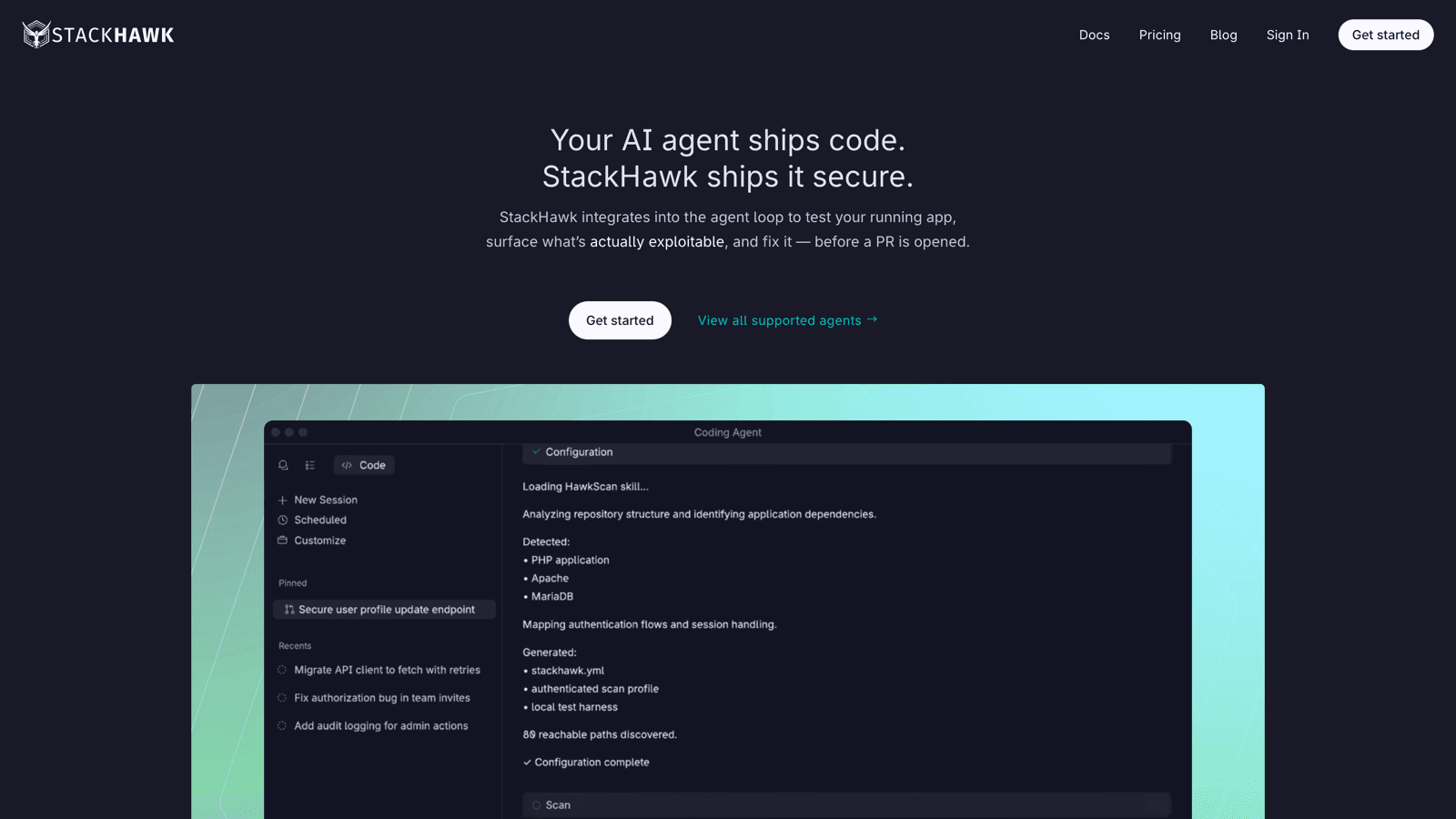
StackHawk moves the test earlier than XBOW can reach. HawkScan runs as a native binary inside GitHub Actions, GitLab, Jenkins and CircleCI, configured by a versioned stackhawk.yml and spun up and down per scan.
So your running application gets attacked before the pull request merges. Protocol coverage is deeper than most dynamic scanners too, with REST, GraphQL, gRPC, JSON-RPC, SOAP and WebSocket all supported.
There is also a real MCP handshake that fuzzes each tool call for injection and disclosure issues, and API Discovery maps endpoints from connected repositories and generates OpenAPI specs. For what each approach actually proves, see our comparison of AI pentesting versus traditional DAST.
A different place in the lifecycle
Ten dollars a seat, unlimited apps. Wingman is $10 per user per month with 50 agentic scans per user, a number you can approve without a scoping call.
One install teaches your coding agents to scan. Claude Code, Cursor, Codex and Copilot can scan, remediate with full source context, then rescan to verify, so a finding is closed and re-proven before review.
Testing on every pipeline run. Evidence gets generated continuously rather than on a purchase, and a security-operations manager credited its reporting on “code running live” toward reaching PCI certification.
Data-flow awareness on Scale. On the Scale tier it inventories apps and APIs straight from source, then marks the places PII, PCI or HIPAA data pools up.
A solid independent rating. StackHawk holds 4.6 on G2 across 68 reviews, and David M. called onboarding “one of the best I’ve seen.”

What StackHawk is | What it is not |
|---|---|
A $10 per seat pre-merge scanner for the running app and its APIs | A pentest product, since no tier offers one and it cannot replace the artifact XBOW hands you |
Deep on API protocols and agent workflows | A static analyser, since it points you at Semgrep, Snyk Code and CodeQL instead |
Cloud-deployed and quick to onboard | Self-hostable, and the Hosted Scanner is being deprecated in favour of Cloud Deployment |
Free to evaluate for 14 days | Free permanently, unlike Intruder and Aikido |
An AWS Marketplace reviewer said flatly that “authenticated scans can be frustrating,” and a DevOps engineer judged the pipeline-dependency setup to still need “refinement.”
Best for: API-heavy teams shipping with coding agents, who would rather catch it pre-merge every day than buy proof of it quarterly.
10. Aikido Security
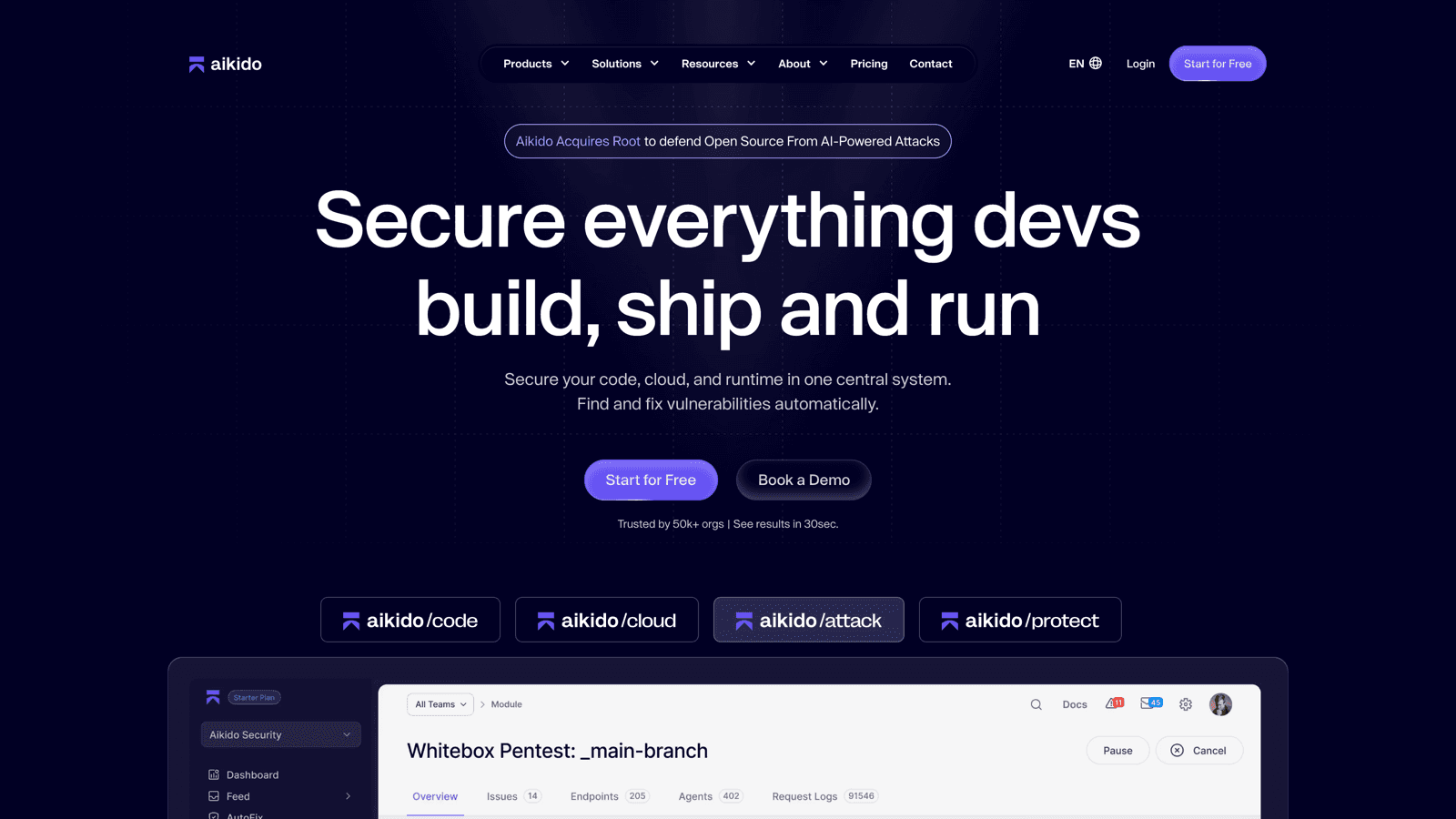
Aikido answers the pricing objection with a guarantee rather than a discount, and every figure is printed on the page rather than scoped on a call.
What you are buying | What it costs |
|---|---|
Standard Pentest | A fixed €3,500 or $4,000 per assessment |
Rightsized Pentest | Nothing at all when no High or Critical finding lands |
Aikido Infinite, continuous testing | $16 per agent dispatched on every deploy |
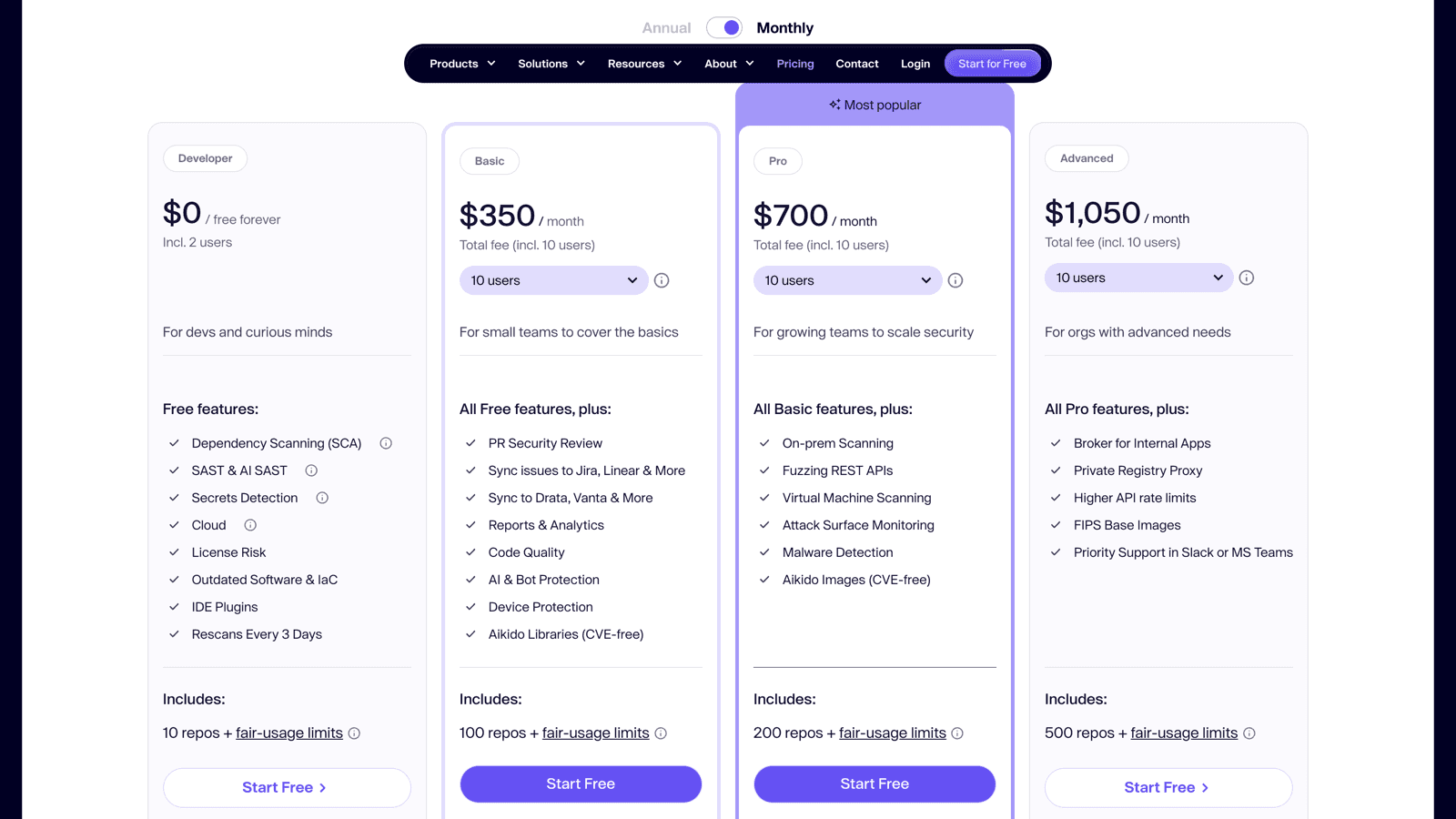
Platform tiers, ten users bundled | $350, $700 or $1,050 a month |
Developer plan | Free permanently for two users |
Around that sits a platform XBOW deliberately does not build. SAST across 20-plus languages, SCA with reachability triage, secret scanning through Git history, IaC checks, CSPM, container, VM and Kubernetes scanning plus the Zen in-app firewall all run under those published tiers.
An Opengrep-based engine filters findings through reachability and exploitability with a claimed 90% false-positive reduction. And connectors reach GitHub, GitHub Enterprise Server, GitLab, self-managed GitLab, Bitbucket and Azure DevOps. See CodeAnt AI vs Aikido Security for the direct matchup.
Where the meter changes shape
Pay nothing when the app is clean. Capacity-priced testing bills the same either way, and the Rightsized Pentest does not.
Continuous testing you can model. Per-deploy agent pricing lets you forecast against release frequency instead of guessing at an annual number.
Code coverage XBOW omits entirely. Repository scanning finds the vulnerability before it ships, which no black-box tester can do.
Marc Lehr of GEA wrote that “in just 45 minutes, we onboarded 150+ developers with Aikido,” and Christian Schmidt, VP Security and IT at Go Autonomous, said “with Aikido, the triaging is just… done.”
Cornelius at n8n put the same point in terms of what stopped happening, writing that “with 92% noise reduction, we got used to ‘the quiet’ quickly,” and calling it “a massive productivity and sanity boost.”
Three caveats belong in the evaluation.
The offensive layer is automated and self-scoped. Rightsized tests are scoped by Aikido’s own analysis, so this does not match the leaderboard-verified depth you came here from.
Most praise is first-party. The quotes above come from Aikido’s own customer pages rather than a large independent corpus.
Growth forces a tier jump. Each tier bundles ten users with hard caps on repositories, containers, domains and cloud accounts.
Best for: teams that want one forecastable security bill covering scanning and the pentest, with a contingent option when the scope is genuinely low risk.
Published Pricing and Free Entry, Compared
Buying question | Intruder | StackHawk | Aikido Security |
|---|---|---|---|
What the meter counts | Licences, one target locks one for 30 days | Seats, unlimited apps per seat | Flat tier with caps, or $16 per agent |
Free entry | Free forever, 5 licences and 3 users | 14-day trial only | Developer plan, 2 users, permanent |
Cheapest paid step | $239 / month Cloud, billed annually | $10 / user / month Wingman | $350 / month Basic, 10 users bundled |
Pentest artifact available | Yes, from $3,500, same-day, self-serve | No pentest product or tier | Yes, $4,000 fixed or contingent Rightsized |
When testing happens | Continuously against the live estate | On every pipeline run, pre-merge | Continuous scanning, per-deploy agents |
Reads your source code | Only inside the white-box pentest | For API discovery and agent fixes, no SAST | Yes, SAST, SCA, secrets and IaC |
Which One to Call First
Route by the sentence you would use to explain the problem to your CFO, not by the tool that scored highest.
“We keep paying to be told about the same bug class.” Start with CodeAnt AI. The pentest and the pull-request review sit on one intelligence layer, and the engagement costs nothing when nothing exploitable is found.
“We cannot name every internet-facing asset.” Hadrian discovers the estate before it tests it, which is the one precondition XBOW cannot waive.
“Our risk isn’t in the web app any more.” If the exposure is a corporate domain, NodeZero covers internal and Active Directory exploitation at its entry tier.
“We need to test far more often than we can afford to.” Pentera removes the frequency cap and charges accordingly, which suits a large regulated enterprise.
“The auditor asked who performed the test.” Astra is the fastest published route to a certified human and a verifiable certificate.
“Procurement named an attestation letter.” That is Cobalt, and no autonomous report will satisfy the request.
“The contract names FedRAMP.” That is Synack, and none of the others carry the equivalent.
“I can’t start a budget conversation without a number.” Intruder’s free tier and $3,500 self-serve report get you an artifact without a purchase order.
“I want this running before the merge, on a seat I can approve.” StackHawk turns runtime testing into a $10 seat that runs on every pipeline execution.
“Only pay if you find something.” Aikido will run the pentest and charge nothing if the application comes back clean.
“None of the above, XBOW fits.” Then buy XBOW. A web and API product, no source code to share, and a board that wants an externally verifiable name is exactly the brief it was built for.
Whichever way you go, decide what you want the test to change. A report proving an exploit is worth something. But a program where that finding cannot come back next quarter is worth considerably more.
If the second outcome is the one you want, connect a repository to CodeAnt AI, run the first pentest and the first pull-request review together, and compare what comes back against your last XBOW report.
Our guides on continuous versus annual pentesting and the best AI penetration testing tools cover the wider field if you want more ground before deciding.

