

CodeAnt’s AI penetration testing connects pull-request findings to runtime exploit evidence and remediation. Hadrian begins outside the organization, where Atlas discovers internet-facing assets and Nova pentests a scoped external web application.
Choose CodeAnt AI when developers need source-aware AppSec and fix guidance. Choose Hadrian when the security team needs continuous discovery and validation across an external estate.
TL;DR: CodeAnt AI vs Hadrian
Buyer question | CodeAnt AI | Hadrian |
|---|---|---|
Primary starting point | Code, dependencies, secrets, IaC, cloud configuration, applications, and runtime | Internet-facing assets and external exposures |
Pre-merge controls | SAST, SCA, secret scanning, and IaC checks | Not documented in the public Hadrian materials reviewed |
Offensive testing | Black-box, white-box, and gray-box/code-memory pentesting | Atlas continuous external validation plus Nova on-demand agentic pentesting |
Best fit | Engineering-led AppSec that needs findings tied to code and fixes | SOC or exposure-management teams that need outside-in asset discovery and verified risk |
Pricing signal, as of July 31, 2026 | One pentest scan included; Low/Medium findings free; High/Critical findings unlock on payment | Atlas quote based on asset count; Nova €3,000 per test, with bundles available |
CodeAnt addresses a blind spot in a repository or delivery pipeline. Hadrian addresses a blind spot in the external asset inventory.
How we compared CodeAnt AI and Hadrian
I reviewed the vendors’ official pages and terms available on July 31, 2026. I did not test either platform, so this comparison makes no claims about detection rate or false positives.
The comparison follows six jobs that expose where the products overlap and where they do not:
Discover the attack surface.
Catch weaknesses before merge.
Validate exploitability.
Deliver evidence to the fix owner.
Retest the fix.
Produce an audit-ready record.
This model separates static analysis from dynamic application testing. It also uses the defined testing activities in the OWASP Web Security Testing Guide as a neutral reference.
What is CodeAnt AI?
CodeAnt AI connects repository context with offensive testing. Its pre-deployment suite documents SAST on pull requests and software composition analysis.
The same suite includes secret scanning and IaC checks. Its runtime layers extend from DAST and cloud security into agentic pentesting.
Combining source analysis with penetration testing keeps application context available after a finding crosses from the delivery pipeline into offensive validation. This creates a path from the vulnerable implementation to exploit evidence and then back to the developer responsible for the fix.
CodeAnt defines black-box testing around public behavior. Its white-box mode uses source context, while gray-box testing retains code memory; the pentesting-mode guide explains those scope boundaries.
The pentesting page promises a SOC 2 or ISO 27001 PDF report within 48 hours and supports fix reverification. Buyers should validate the report format and retest workflow with a sample application before treating either promise as a procurement requirement.
What is Hadrian?
Hadrian targets the external attack surface. Atlas discovers internet-facing assets and fingerprints the technologies running on them.
Atlas also tests exposures, with passive scans running hourly and asset changes triggering new tests according to Hadrian’s materials. Nova provides an on-demand agentic pentest for one external web application.
This outside-in scope resembles an external penetration testing methodology, not a repository control. It also places Hadrian primarily on the offensive side of the defensive and offensive security boundary.
The public Hadrian materials reviewed do not document repository ingestion or pull-request checks. They also do not describe a source-control scanning suite that covers code weaknesses and dependencies alongside secrets and IaC.
That statement is limited to the public product scope available on July 31, 2026. It does not establish whether Hadrian offers private or planned capabilities.
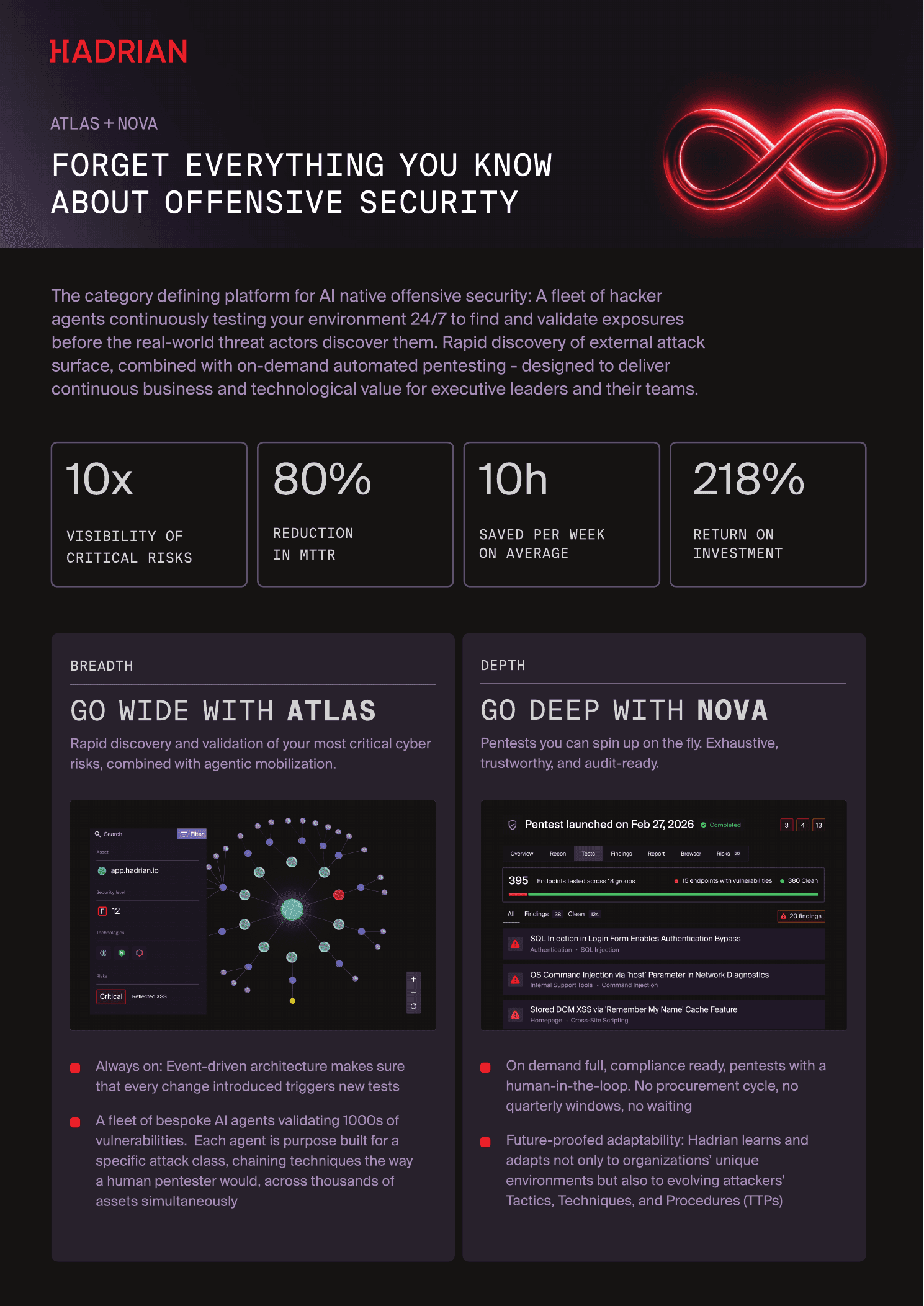
*Official Hadrian Atlas + Nova datasheet, retrieved July 31, 2026. The product cards show how Hadrian packages continuous breadth separately from on-demand depth.*
CodeAnt AI vs Hadrian feature comparison
Starting point: source context or outside-in discovery
CodeAnt starts with engineering-controlled artifacts such as repositories and infrastructure definitions. This approach aligns with the NIST Secure Software Development Framework, which places security practices inside software development.
CodeAnt can therefore attach continuous code security scanning to delivery workflows before an application becomes externally reachable. The developer receives the finding in the system where the vulnerable change originated.
Hadrian starts with assets visible from the internet. Atlas can discover that surface without a fixed inventory and initiate testing after it observes a change.
Choose Hadrian’s starting point when the first unresolved question is which assets the organization exposes. The contrast with annual pentesting helps teams decide whether asset changes require ongoing monitoring between scheduled assessments.
Pre-merge application security
CodeAnt’s SAST identifies code-level findings in pull requests and supplies fix guidance. Its SCA examines vulnerable packages, then adds CVSS severity and EPSS exploit-probability context to prioritization.
Secret scanning checks version-control changes and can block a build when it detects an active secret. IaC scanning covers Terraform and CloudFormation templates, along with Kubernetes manifests, before deployment.
These controls separate first-party logic from the third-party components covered by software composition analysis. Teams can use the CWE catalog to keep weakness names consistent across findings and reports.
Hadrian’s reviewed public pages do not describe an equivalent pre-merge suite. CodeAnt is the documented choice when the purchase must place application-security gates in Git and CI.
External attack-surface discovery
Atlas finds internet-facing assets without requiring a complete CMDB. Event-driven testing starts when Hadrian observes a change to an asset.
That workflow is suited to an estate where acquisitions create unmanaged domains or decentralized cloud accounts produce unknown services. A pilot should give the platform known domains while withholding one controlled asset, then record whether it discovers that asset and attributes ownership correctly.
CodeAnt documents attack-surface mapping and cloud threat detection with context from code and infrastructure definitions. Use the cloud infrastructure security checklist to define which asset types and ownership evidence the pilot must return.
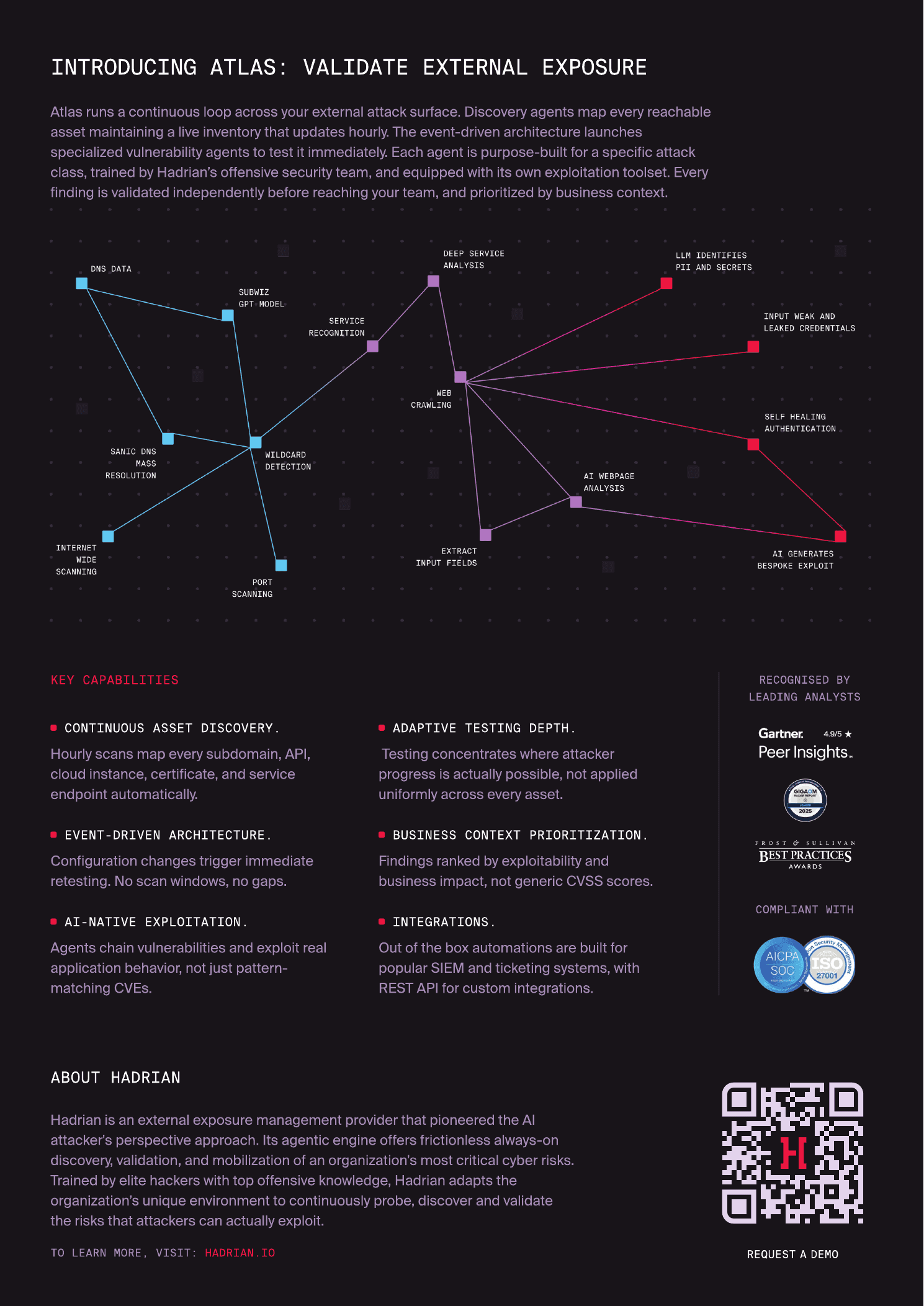
*Official Hadrian Atlas datasheet, retrieved July 31, 2026. The diagram separates continuous discovery from the specialized validation agents that test newly observed services.*
Exploit validation and evidence
CodeAnt documents exploit simulation and attack-path mapping, followed by step-by-step remediation. Hadrian separates potential risks from verified risks and says Nova findings include validation evidence plus reproduction steps.
A pilot finding should identify the affected asset and its exploit preconditions. The same record should carry the exploit evidence through impact assessment and ownership to the final retest.
The automated pentesting checklist provides a reusable evidence structure. The OWASP Application Security Verification Standard supplies neutral control identifiers for the resulting record.
Severity estimates impact, while exploitation data estimates likelihood. CodeAnt documents EPSS context for code and dependency findings.
Hadrian says its planning layer considers asset criticality and threat intelligence. It also considers CISA Known Exploited Vulnerabilities data and dark-web monitoring.
For CVE-level findings, check active exploitation against the CISA KEV catalog. The CodeAnt vulnerability database can then connect the identifier to package-level context.
Pentest depth and scope
CodeAnt offers black-box testing of public behavior and white-box testing with source context. Its gray-box mode uses code memory to retain implementation context during offensive testing.
Source context can connect an external exploit path to validation logic or dependency usage. CodeAnt’s AI penetration testing methodology describes the sequence from reconnaissance through reporting.
Hadrian assigns breadth to Atlas and depth to Nova. Atlas continuously validates external exposure, while Nova runs an on-demand pentest.
Hadrian’s terms define one Pentest Entitlement as one pentest of one Target. A Target is one external web application identified by a single URL.
Before estimating entitlements, map authentication domains and redirects to the target URL. Then ask Hadrian which connected APIs or hosts require another target under the contract.
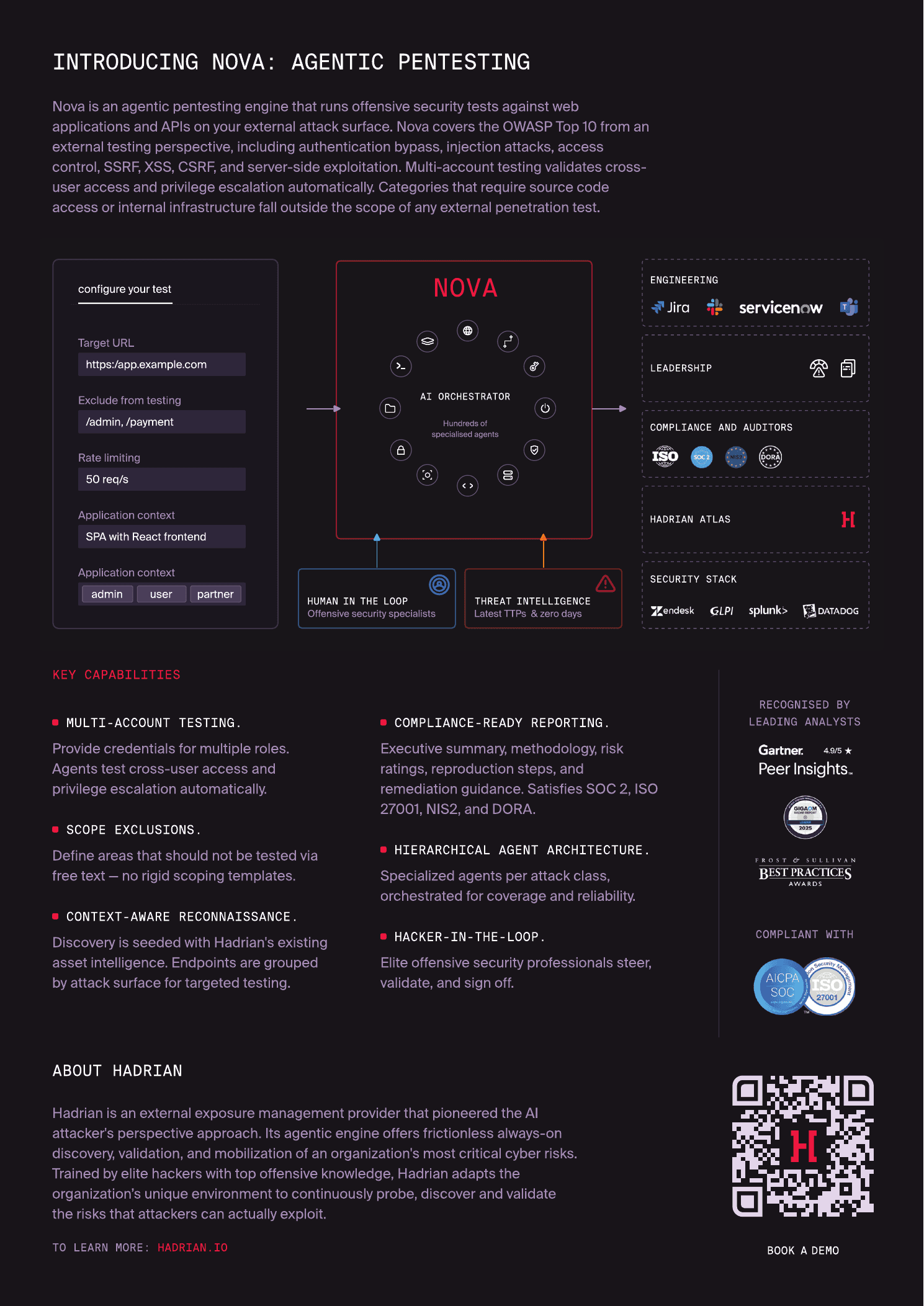
*Official Hadrian Nova datasheet, retrieved July 31, 2026. Its workflow illustrates the scope inputs and downstream recipients that buyers should test during a pilot.*
Agentic testing can increase cadence and repeatability. Expert testers remain relevant when the assessment includes novel business logic or social engineering, while physical tests and specialized red-team objectives sit outside the documented automated workflow.
The AI pentesting provider evaluation helps separate repeatable automated coverage from objectives that require an expert-led engagement.
Remediation and integrations
CodeAnt can surface source findings before merge. Its public pages describe AI-generated fixes and reverification, which keep the fix loop close to Git and CI.
Check the CodeAnt integration catalog against one real Git provider and one ticketing system. Then test the team’s chat tool and CI control as separate handoffs instead of treating an integration logo as proof of a complete workflow.
Hadrian routes findings into security operations. Its official integration page names Jira and ServiceNow for work management, while GLPI and Zendesk extend the ticketing options.
Hadrian also names Slack and Microsoft Teams for communication. The listed operational integrations include SentinelOne and Datadog, with HubSpot also present on the page.
The Attack workflow supports assigning a risk lead and sharing a risk without granting full platform access. It records a risk timeline and a remediation retest.
Measure how many handoffs a confirmed finding needs before a code owner can reproduce it and verify the fix. Application security posture management centralizes findings, while explicit steps to reproduce preserve the evidence required at each handoff.
Reporting and compliance
CodeAnt says its pentest produces an audit-grade PDF mapped to SOC 2 or ISO 27001 within 48 hours. Hadrian says Nova reporting maps to SOC 2 and ISO 27001, with NIS2 also included.
Hadrian’s terms define Nova output as findings and validation evidence. They also specify reproduction steps and a pentest report.
A framework mapping does not guarantee auditor acceptance. Ask the auditor to review the testing method and scope statement, then confirm that the finding evidence and retest record meet the engagement requirement.
The AI pentesting compliance guide turns those concerns into review questions. CodeAnt’s interactive pentest sample report provides an artifact the auditor can inspect before purchase.
CodeAnt AI vs Hadrian pricing and packaging
As of July 31, 2026, CodeAnt’s pricing page says one full AI pentest scan is included. Low and Medium findings are free, while High and Critical findings require payment to unlock.
The page does not publish the unlock price. A written quote should define what counts as a scan and a target, then state whether retests or a platform subscription add another charge.
Atlas pricing depends on total asset count and requires a quote. Nova starts at €3,000 per test, with bundles available.
Hadrian’s terms state that one test covers one target URL. Entitlements apply for the contractual year and unused entitlements do not roll over.
Normalize both quotes around the assets each platform meters. For CodeAnt, establish repository and developer counts before adding the expected number of release or audit tests.
For Hadrian, count external applications and separate target URLs before applying the asset-based Atlas quote. Add retests to both models and record any paid add-ons separately.
The penetration testing cost guide explains these cost categories. Only the written vendor quotes can supply the actual annual total.
Operational limits: where each platform pulls ahead
CodeAnt connects source or configuration findings with runtime exploit evidence and pull-request remediation. Its pre-merge controls support a DevSecOps testing workflow without requiring a separate external engagement for every release.
Hadrian is better aligned with organizations that lack a complete internet-facing inventory. Atlas supplies zero-scope discovery and continuous validation, while Nova adds a scoped application pentest.
Hadrian’s detailed documentation is login-gated, so a pilot must establish API limits and Nova operating constraints. Its terms state that Hadrian controls Nova’s technical configuration and does not warrant detection of every weakness.
CodeAnt’s public pricing page omits the numeric pentest charge. Put every undocumented price or operating limit into the procurement questionnaire before comparing totals.
Which one should you pick?
Pick CodeAnt AI when the required loop starts with code or configuration and ends with a developer reverify. Pick Hadrian when the loop begins with external discovery and must carry a verified exposure through ownership to retest.
Some programs need both loops. Assign one system of record to each job with an enterprise AI pentesting and code-security plan, then remove duplicate runtime coverage from the quotes.
When CodeAnt AI is the better fit
CodeAnt is the better fit when SAST and SCA must run before merge. It also covers teams that need secret scanning and IaC checks in the same delivery workflow.
Its source-aware and code-memory pentesting modes suit engineering-owned remediation. Choose it when web application security with source-aware testing is the architectural goal rather than outside-in asset discovery.
When Hadrian is the better fit
Hadrian is the better fit when the first question is which internet-facing assets exist. Atlas can keep discovering as domains and services change, giving a central SOC a verified-risk workflow across a broad estate.
Nova suits an organization that can scope each on-demand web-application test to one target URL. This model favors an agentless cloud-hosted service over repository controls.
A practical CodeAnt AI vs Hadrian pilot checklist
Run external-discovery and application-security tracks separately so one product is not scored on a job it does not claim to perform:
Define authority and scope. Record permitted targets and testing controls in a pentest authorization and statement of work.
Test external discovery. Provide known domains and withhold one controlled asset. Record discovery time and ownership confidence, then examine duplicates and false associations.
Test the delivery pipeline. Use a sandbox repository with approved security fixtures mapped to the OWASP Top 10. Record which pipeline stage catches each fixture.
Test offensive evidence. Use an authorized staging application. Score proof quality and reproduction steps, then verify exploit preconditions and safety controls.
Test remediation. Route findings to real owners and apply fixes. Rerun the test without rebuilding the evidence manually; the automated pentesting mistakes checklist exposes weak retest loops.
Test reporting. Ask the auditor to review both sample reports before treating a framework mapping as sufficient.
Normalize the quote. Calculate twelve months of usage across each vendor’s billing unit. Include unused entitlements and add-ons.
The winning pilot should preserve one evidence trail from initial discovery to the verified fix. It should also price every production asset against a billing unit defined in the contract.

