

CodeAnt AI and Intruder both cover runtime and exposure security, but they start from different assets. Intruder fits infrastructure-led vulnerability programs, while CodeAnt fits teams that want pre-merge code security connected to DAST and post-deployment exploit validation.
SAST and DAST cover different testing stages: static analysis tests code before release, while live testing detects runtime behavior and deployment exposure. This comparison uses official documentation and pricing available on July 31, 2026; it is not a hands-on detection benchmark.
TL;DR
Decision | CodeAnt AI | Intruder |
|---|---|---|
Best fit | Product and AppSec teams securing code, cloud, and live applications in one workflow | Security and infrastructure teams running continuous vulnerability management across external, cloud, internal, container, web-app, and API targets |
Before merge | SAST, SCA, secrets, IaC, SBOM, PR review, IDE, CLI, and CI controls | The core platform is centered on asset and vulnerability scanning; source-connected white-box testing is sold through the AI-pentest product |
After deployment | Attack-surface mapping, authenticated DAST, and black-box, white-box, and grey-box agentic pentesting | External and internal vulnerability scans, cloud posture checks, container scanning, authenticated DAST, attack-surface monitoring, and white-box AI pentests |
Continuous exposure monitoring | Covers public exposure and cloud/runtime surfaces | More explicit infrastructure operations: cloud asset sync, emerging-threat scans, new-service monitoring, and plan-based port coverage |
Pentest pricing | One scan included; low and medium findings stay free; high and critical findings unlock on payment; $0 engagement fee | $3,500 per test for platform subscribers or $4,000 one-off |
Pick it when | The fix should land in the same developer workflow that introduced the risk | The first question is “Which assets and services are exposed or unpatched right now?” |
How we compared CodeAnt AI and Intruder
I compared each vendor’s official product and pricing documentation. The evaluation follows the security lifecycle from prevention through licensing.
No authenticated account or common test corpus was available, so this article makes no claims about detection rate or false-positive rate. A valid benchmark would require identical test configuration and success criteria.
Choose CodeAnt when source code and the developer workflow are in scope, particularly when a finding must move from PR detection to live proof and back to a code fix. Choose Intruder when infrastructure inventory and continuous exposure monitoring drive the program.
Pilot both when secure-development controls and infrastructure vulnerability management have separate owners. NIST’s Secure Software Development Framework recommends integrating security practices into the SDLC, a responsibility that remains after an external scanner is deployed.
What is CodeAnt AI?
CodeAnt AI connects repository analysis with pull-request review. It delivers feedback in the IDE and through the CLI, while CI pipelines provide another enforcement point.
Its pre-merge analysis covers SAST and software composition analysis.
The same workflow includes secret scanning and IaC analysis. Cloud-configuration checks and deployed-application testing extend that context into an offensive layer with authenticated DAST and more than 500 exploit agents.
This shared context lets teams detect source-level issues before merge and reuse repository context during runtime testing. CodeAnt also publishes EPSS scores and percentiles for vulnerability prioritization.
FIRST defines EPSS as the estimated probability that a published CVE will be exploited in the next 30 days. Its EPSS FAQ says EPSS is an input to risk analysis, not a complete risk score.
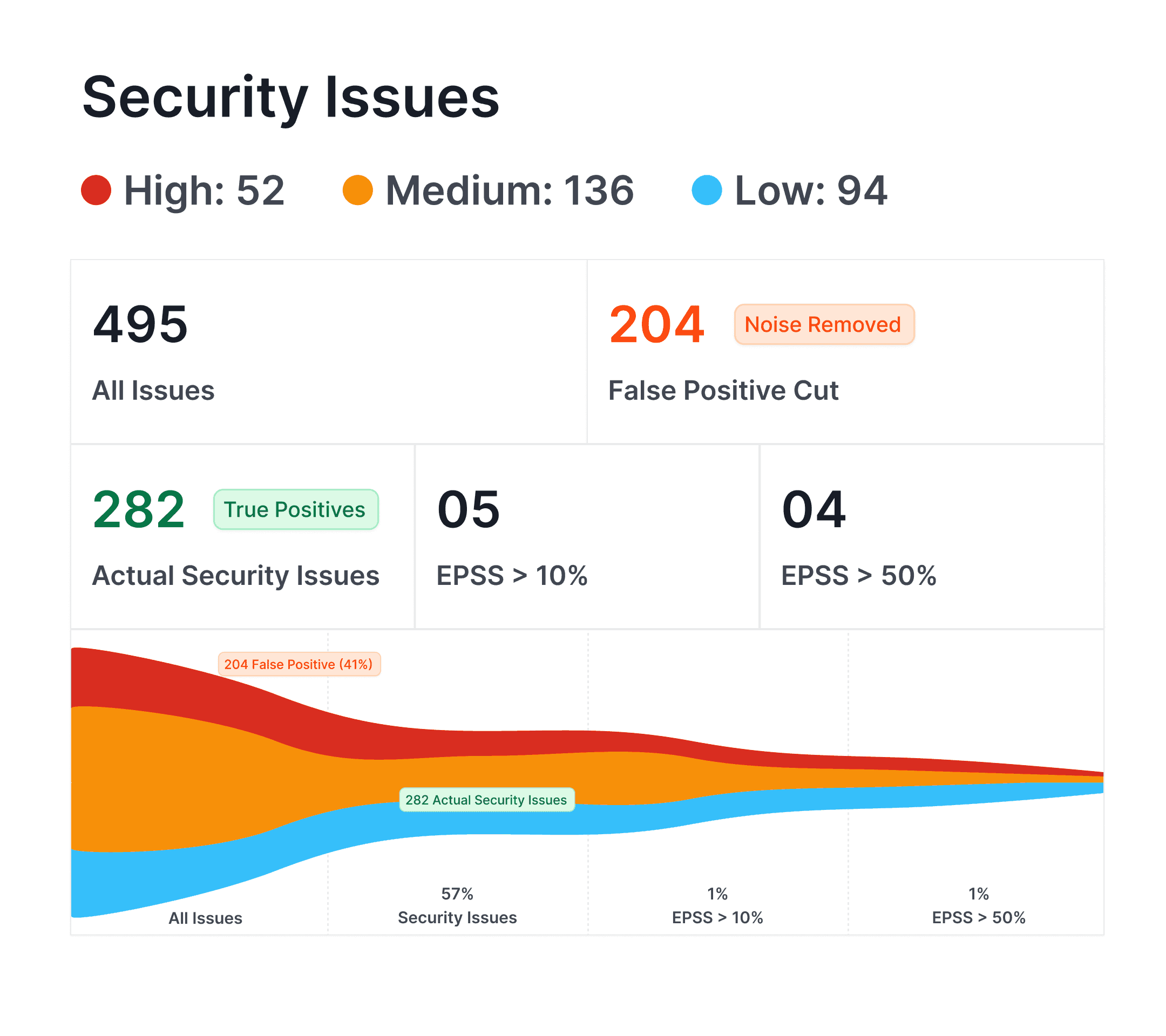
*CodeAnt’s public SAST page shows issue counts and EPSS thresholds in one prioritization view. The displayed numbers are product-page examples, not test results from this article.*
What is Intruder?
Intruder is a continuous vulnerability-management platform for external infrastructure and cloud environments. It also covers container images plus web applications and APIs.
Pro and Enterprise extend coverage to internal Windows and Linux devices. The same plans support macOS.
Scheduled and ad hoc scanning operates alongside continuous asset management and reporting.
Intruder’s scanner engine varies by plan. Free uses Nuclei, while Cloud uses OpenVAS with Nuclei.
Pro uses Tenable Nessus. Enterprise combines Nessus and Nuclei.
Its internal scanner requires an agent on each supported computer and does not cover network devices such as routers or switches.
Intruder sells its source-connected AI pentest separately. It connects to GitHub or GitLab for white-box web-application testing and produces an audit-ready report the same day.
That engagement accepts application context and credentials, but it is priced per test. It is not positioned as a continuous software-development security workflow.
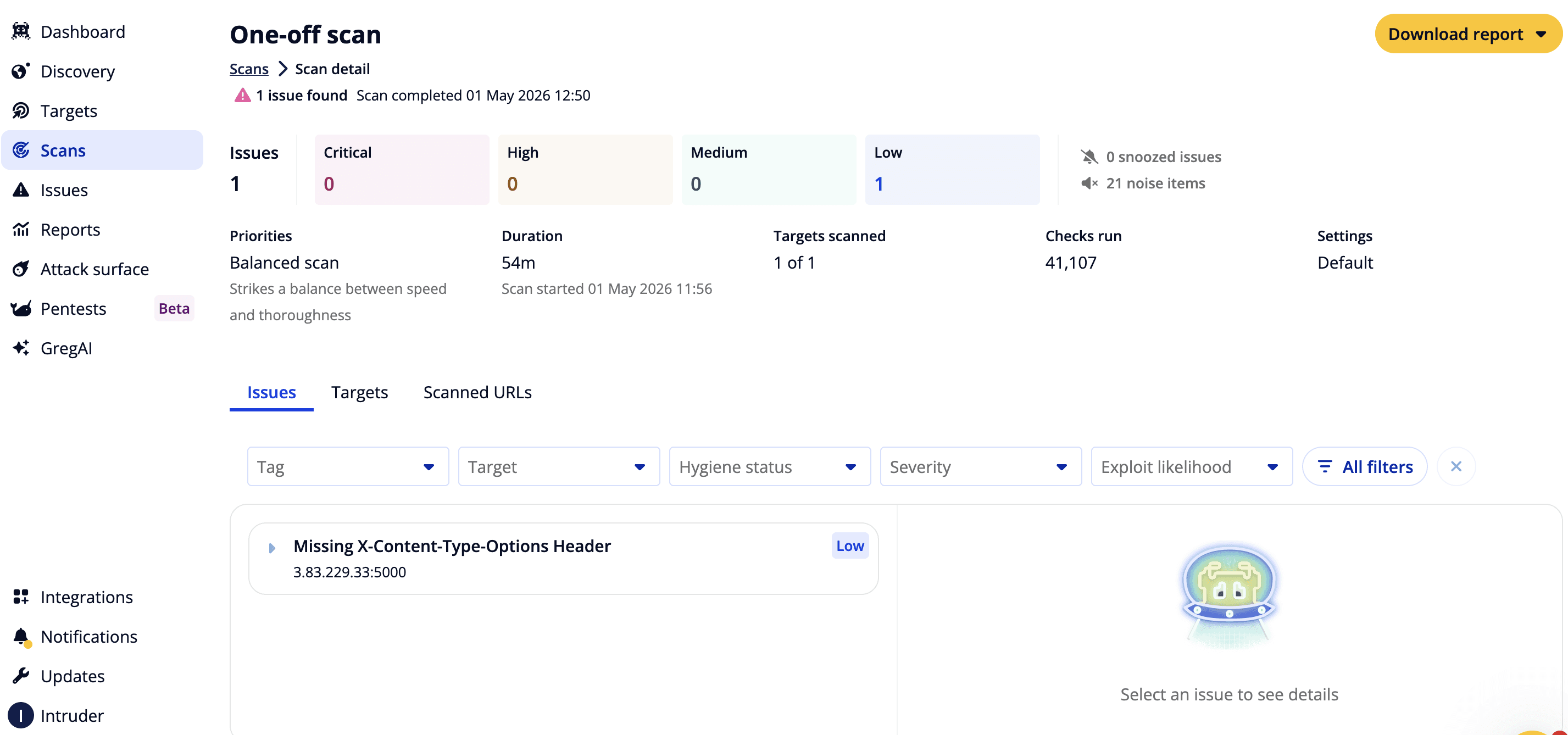
*Intruder’s May 2026 help-center screenshot documents a completed scan’s severity totals and target state. It also shows scan controls and report export.*
CodeAnt AI vs Intruder feature comparison
1. Preventing vulnerabilities before merge
CodeAnt runs its documented source and configuration analyses before merge. Findings reach inline pull-request feedback and CI/CD review before security quality gates run.
CodeAnt also covers SBOM generation and dependency-risk context.
Intruder’s continuous platform starts with deployed targets and asset inventories. Its engineering integrations route findings, but they do not provide continuous first-party source analysis on the pull request that introduced a flaw.
The continuous code-security scanning guide explains why scan cadence alone does not create a pre-merge control. Intruder’s separately sold white-box AI pentest can read a connected GitHub or GitLab repository for a source-informed assessment.
Choose Intruder’s engagement when the required deliverable is an audit-ready source-informed test. Choose CodeAnt when source analysis must run continuously inside the development workflow.
Winner for this job: CodeAnt AI.
2. Discovering and monitoring exposed assets
Intruder cloud sync imports new external IPs and hostnames from AWS and Azure. Google Cloud is also supported.
It removes decommissioned assets and can scan new assets when they appear.
Cloud-security checks run weekly on Free and daily on paid plans. Network monitoring expands from ports 80 and 443 on Free to all ports on Enterprise, with intermediate limits on Cloud and Pro.
Emerging Threat Scans can test active licensed external targets when Intruder identifies a newly disclosed vulnerability with critical impact potential. Each target receives an explicit result state.
Enterprise adds unknown-asset discovery and new-service scans. It also includes more than 1,000 attack-surface checks.
CodeAnt connects public exposure to source and runtime evidence for applications the team develops. Intruder is stronger for diverse infrastructure and endpoint inventories.
Use a vulnerability-scanner selection checklist to define scope requirements before comparing plans.
Winner for this job: Intruder for infrastructure breadth and explicit scan operations; CodeAnt for connecting an application’s exposure back to its code.
3. Testing running web applications and APIs
Both products document authenticated testing.
Intruder’s Application license adds authenticated and unauthenticated DAST for web apps and APIs. Its help center documents multiple injection families, including SQL and XSS.
The application entry point must match the licensed target. Converting an Application license back to Infrastructure requires removing authentication and following the documented license-release rules.
CodeAnt documents authenticated DAST in black-box and white-box modes. It also supports grey-box testing.
Its source-informed mode carries repository knowledge into offensive testing instead of separating source analysis from runtime behavior.
The AI pentesting versus traditional DAST guide compares the evidence each method produces.
Intruder’s AI pentest narrows the source-context gap by connecting GitHub or GitLab for white-box testing. For the same seeded flaw, require:
the vulnerable route and reproduction steps;
request/response evidence and source trace;
working exploit conditions and suggested fix; and
a retest result.
A result without exploit conditions or retest state cannot show whether remediation closed the seeded path.
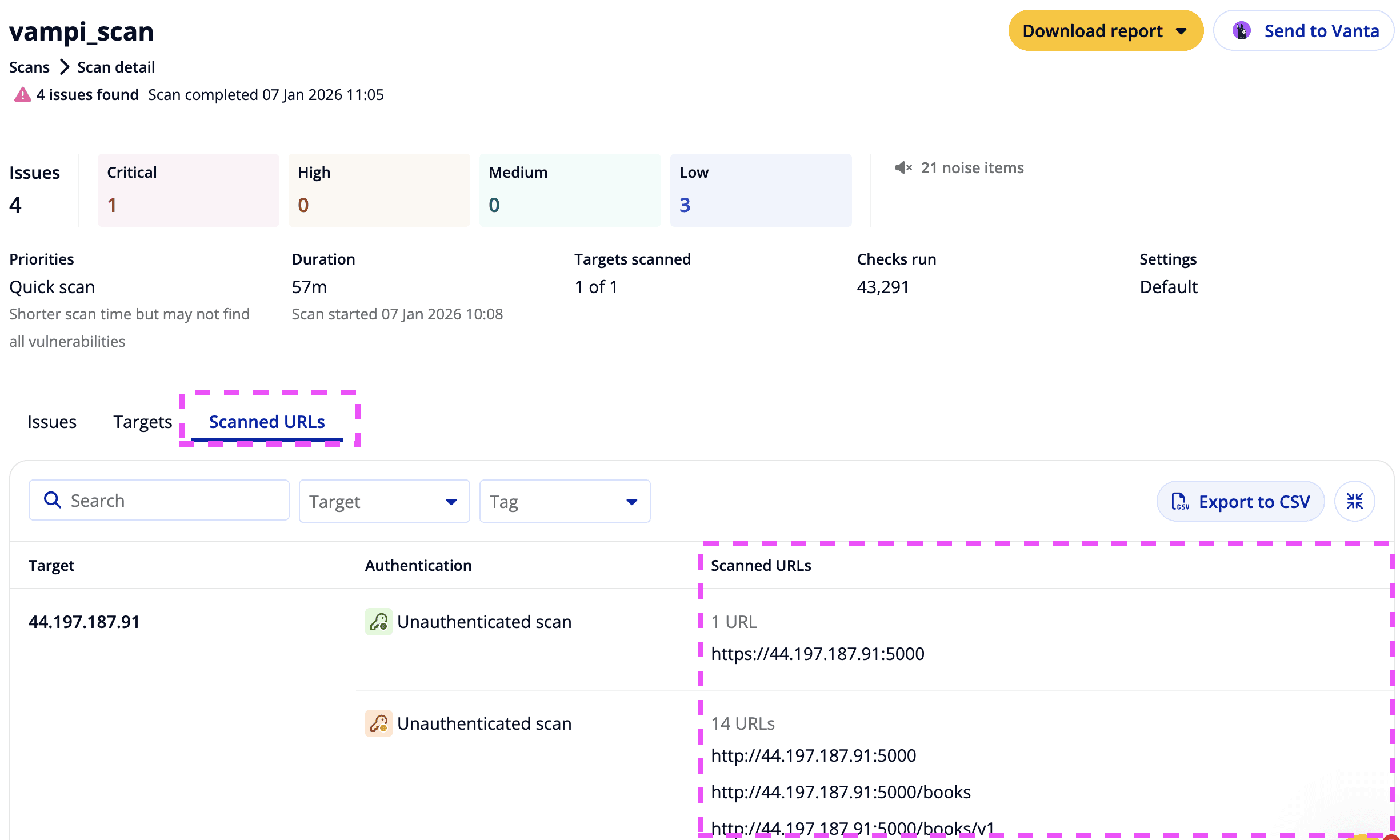
*Intruder’s July 2026 help-center screenshot shows the scanned-URL tab and export control. That is useful coverage evidence, but a URL inventory is not proof that every business-logic path was tested.*
Winner for this job: Conditional. Intruder fits recurring DAST inside an infrastructure-vulnerability program; CodeAnt fits application teams that want runtime evidence connected to the SDLC.
4. Prioritizing risk without flattening it to severity
CodeAnt combines attack paths and EPSS with severity and vulnerability classifications. FIRST’s guidance says EPSS estimates exploitation probability but does not account for business or asset context.
CodeAnt’s EPSS implementation guide shows how to use the score without replacing asset context.
Intruder combines internet-exposure context with a cyber-hygiene score and remediation scans. Emerging Threat Scans and the attack-surface view add timing and asset state.
GregAI investigation credits vary by plan. Free includes one credit, and Cloud includes five.
Pro includes ten credits. Enterprise includes fifty.
Compare the evidence delivered to the owner:
vulnerable code or dependency context;
exposed host and port;
live request and exploit proof; and
remediation and retest evidence.
Record these artifacts separately because code ownership and asset exposure can send the same vulnerability to different remediation queues.
Winner for this job: CodeAnt for code and dependency context; Intruder for exposed-asset and scan-state context.
5. Fixing findings and proving the fix
CodeAnt places findings and suggested fixes in developer workflows, including steps of reproduction and a fix-in-IDE workflow. Its paid review plan lists Jira and Azure Boards, while its SCM tooling covers the major repository platforms.
CodeAnt’s pentesting page ties the paid outcome to a working proof of concept. It promises a report within 48 hours and free unlimited rescans.
Buyers can review the public pentest sample-report surface and sample security report before requesting an audit-specific example.
Intruder supports remediation scans and routes issues to engineering and service-management systems. Its API manages targets and scan results.
Drata and Vanta integrations move scan evidence into compliance workflows. Messaging and SIEM integrations handle notifications and monitoring.
CodeAnt provides the shorter path from a source finding to a code change. Intruder provides broader routing for infrastructure and compliance operations.
Use a source-code audit checklist to verify that a routed ticket includes reproduction and remediation evidence.
6. Deployment and data boundaries
CodeAnt documents deployment on-premises or inside a customer-controlled cloud. Its enterprise page also documents governance and data-retention controls.
Intruder is a managed platform that uses limited cloud-account permissions for discovery and posture checks. Internal endpoint coverage requires an agent on each supported device, while Enterprise expands access control and attack-surface coverage.
Procurement should map these data flows:
source code and repository metadata;
credentials and authenticated web traffic;
asset inventory and scan output;
exploit artifacts and logs; and
tickets.
CodeAnt publishes dedicated pages for cloud-configuration analysis and its security dashboard. It documents organization-wide reporting separately.
Contracts should specify data-lifecycle and support-access terms.
CodeAnt AI vs Intruder pricing and packaging
The pricing meters are different enough that a one-line “cheaper” verdict would be misleading.
CodeAnt AI pricing
As of July 31, 2026, CodeAnt pricing lists:
Product | Published entry point |
|---|---|
Free trial | 14 days, 100 PR reviews, all premium features, and unlimited seats during the trial |
AI Code Review | $24 per user per month, with unlimited PR reviews, PR SAST, dashboards, CI/CD integration, and Scan Center |
Enterprise | Custom; adds contracting, SSO, audit logs, on-prem/VPC deployment, and dedicated support |
AI Pentesting | One full scan included; low and medium findings remain free; high and critical findings unlock on payment |
The pentesting page states a $0 engagement fee and charges when CodeAnt delivers a working proof-of-concept exploit. It also promises a 48-hour report and free unlimited rescans.
Model the finding-based meter against expected assessment cadence and finding mix. The SAST pricing guide separates licensing cost types, while the continuous-versus-annual pentesting guide compares engagement and recurring-program budgets.
Intruder pricing
Intruder publishes its Free plan and its license mechanics, while the live Cloud calculator depends on target counts and Pro/Enterprise require sales involvement in the rendered page:
Product | Published entry point |
|---|---|
Free | Five infrastructure targets; weekly external scans; one cloud account; two container images; ports 80/443; one AI investigation credit; three users |
Cloud | Base fee plus per-target pricing; adds web-app/API testing, emerging-threat scans, daily cloud checks for three accounts, top-10-port monitoring, GregAI, five investigation credits, and 15+ integrations |
Pro | Sales-led annual plan; adds ten cloud accounts, internal agent scanning, top-50-port monitoring, and ten investigation credits |
Enterprise | Custom; adds all-port monitoring, unknown-asset discovery, 1,000+ attack-surface checks, unlimited cloud accounts, and fifty investigation credits |
AI pentest | $3,500 per test for platform subscribers or $4,000 one-off |
Intruder charges a base fee plus a per-target fee. A target license remains consumed for 30 days after a scan, which affects ephemeral assets and short-lived application tests.
Annual billing advertises a 20% saving, excluding VAT.
Budget the recurring scanner and AI pentest separately. The penetration testing as a service guide separates platform fees from assessment deliverables.
A pentest authorization versus SOW comparison identifies authorization and delivery terms that the platform price does not define.
Operational limits and where each product pulls ahead
CodeAnt pulls ahead when the vulnerability starts in code
CodeAnt covers development-stage controls that Intruder’s core platform does not publish as an equivalent stack. Its line-level PR review combines SAST and SCA with secrets and IaC analysis.
SBOM coverage handles dependency inventory. IDE and CLI feedback return findings to developers.
Quality gates enforce the result in the delivery workflow.
Its strongest use case is software the buyer owns and can connect to defensive and offensive testing. The SAST explainer and SCA explainer define the first-party code and dependency boundaries.
CodeAnt’s deepest value requires repository and workflow integration. Intruder’s target and agent model fits non-repository assets and employee endpoints more directly.
Intruder pulls ahead when the program is organized around assets and recurring scans
Intruder defines recurring scan and asset-lifecycle operations across varied infrastructure. Security teams can monitor exposure independently of application releases.
Free does not include authenticated web-app DAST. Internal scanning is limited to Pro or Enterprise and to the device that runs the agent.
The endpoint agent does not scan routers or switches. Coverage and analysis limits change by tier.
For cloud-heavy estates, add the cloud pentest checklist to the plan comparison. It expands the pilot beyond assets that happened to consume scanner licenses.
Neither product removes the need for scope design
An “OWASP Top 10” statement does not define specific test cases or evidence requirements. Use the OWASP Web Security Testing Guide to define cases, then confirm which ones require manual review.
Which one should you pick?
CodeAnt organizes work around a change from source to deployed exploit. Intruder organizes work around an asset and its changing exposure.
If both backlogs are material, consolidation should not be the starting goal. Compare the handoff points using a DevSecOps automated-pentesting workflow, then decide whether one platform can own them without dropping evidence.
When CodeAnt is the better fit
Choose CodeAnt when you own the application code and need pre-merge source and configuration checks inside existing developer workflows. It also fits pentests that use source context to investigate complex application risk.
CodeAnt can connect a live exploit to the responsible code path and a retest. Its customer-cloud and on-premises deployment options address source-data boundary requirements.
Before committing, use the AI pentesting provider questions to evaluate provider controls and deliverables.
When Intruder is the better fit
Choose Intruder when the primary inventory consists of externally reachable systems and endpoint assets. It favors cloud asset sync and recurring network scans over pull-request controls.
Intruder can automatically check licensed active targets for newly disclosed threats. Its higher plans add internal device scanning and route evidence into compliance operations.
For audit-driven purchases, distinguish scanner output from accepted evidence. The AI pentesting compliance guide maps scope and evidence requirements.
When using both is reasonable
Use both when AppSec owns pre-merge controls and security operations owns infrastructure exposure. Define one source of truth for each finding class before rollout.
A dependency CVE and an exploitable route can represent the same underlying risk. Ownership rules prevent duplicate signals from becoming stale tickets.
A SAST tool-consolidation framework scores missing controls and workflow cost. The continuous pentest tool guide applies the same discipline to runtime coverage and CI/CD evidence.
A concrete pilot checklist
Run a two-week pilot against the same authorized application and a representative infrastructure slice. The deeper penetration-testing process can supply the scoping details, and an automated-pentesting checklist can keep setup and evidence capture consistent; the comparison needs these minimum controls:
Define the asset set. Include:
- one internet-facing app; - one authenticated API; - one cloud account; - one container image; and - supported endpoint agents if internal scanning is in scope.
Seed known cases. Add:
- a vulnerable dependency; - an exposed test secret; - an IaC misconfiguration; - an unsafe first-party code path; - a web-authorization flaw; and - a deliberately exposed service. Keep the expected result and cleanup procedure private from the tools.
Hold scope constant. Keep these inputs identical:
- roles and credentials; - API schema and scan window; - throttling and exclusions; and - non-destructive testing rules. Record them in a signed pentest authorization letter before either tool sends attack traffic.
Capture complete evidence. Record:
- the detection surface and affected asset; - the request/response or code path; - severity and exploitability evidence; - owner and suggested fix; and - ticket and retest state. The confirmed-pentest workflow provides one evidence model.
Measure workflow outcomes. Compare:
- seeded-case detection and unsupported cases; - analyst review and developer reproduction time; - duplicate findings; - routing and verification time; and - report usability. Do not generalize one scan-duration result into a universal speed claim.
Model the real bill. Price each meter separately:
- seats and platform modules; - target and application licenses; - cloud accounts and internal devices; - AI investigation credits; - pentest assessments and finding unlocks; and - the renewal term.
Test failure modes. Include:
- an unreachable endpoint; - an expired credential; - an ephemeral cloud asset; - a scanner timeout; - a revoked repository token; and - a fixed issue that must disappear on retest.
Set the decision threshold before scanning. Define:
- required seeded-case detections; - required developer artifacts; - acceptable false-positive review load; and - non-negotiable deployment boundaries. The continuous-pentesting requirements guide adds acceptance criteria for operating and evidence requirements.

