

StackHawk is the focused option for developer-run DAST against a running application or API. CodeAnt AI is designed for teams that want runtime testing connected to source-code analysis and software-supply-chain controls through one pentesting and code-security platform.
The choice starts with the object you need to test. StackHawk sends tests to an executable target, while CodeAnt can also inspect the source and dependencies before deployment; static and dynamic testing answer different questions.
This comparison uses official documentation and public packaging available on July 31, 2026. It does not claim that either product detects more vulnerabilities because no controlled detection benchmark was performed.
TL;DR
Decision area | CodeAnt AI | StackHawk |
|---|---|---|
Core model | Defensive and offensive platform spanning code, supply chain, cloud, and runtime | Runtime-first DAST and API testing, extended with source-based discovery and agent workflows |
Native pre-merge coverage | AI code review plus native SAST, SCA, secret, and IaC checks | Agent can use repository context to configure scans and fix runtime findings |
Runtime testing | DAST plus black-box, white-box, and gray-box agentic pentesting | HawkScan for web applications, APIs, LLM interfaces, and business-logic workflows |
Best fit | Teams consolidating preventive controls with offensive validation | Teams prioritizing developer-operated DAST and API runtime coverage |
Published entry price | Premium at $24 per user each month; offensive unlock pricing is not fixed publicly | Wingman at $10 per user each month with 50 scans per user |
Enterprise packaging | Contact sales | Scale through contact sales |
Choose StackHawk when a running service is the primary test object and the desired workflow is scan, fix, then rescan. Choose CodeAnt when one policy must cover both pre-merge risk and deployed attack paths.
The products can operate together, but the overlap needs a named owner. A combined deployment is defensible only when StackHawk’s specialist runtime workflow adds enough depth to justify another finding queue and contract.
How we compared CodeAnt AI and StackHawk
OWASP defines DAST as security testing performed against a running application through simulated attacks. OWASP’s security-testing lifecycle places that activity beside source analysis rather than treating the two as substitutes.
We therefore compared the products through four operating jobs. The first is preventing vulnerable changes before merge, and the second is testing reachable behavior after the application can run.
The remaining jobs are remediation and program governance. Remediation covers the path from finding to verified fix, while governance covers policy and evidence across teams.
Source-aware discovery can improve the input to a dynamic scan. A coding agent can also repair a runtime finding, but the test that produced the finding still exercised a deployed or locally running target.
Relative speed and accuracy are outside this comparison. Those results depend on the target’s state and test data as well as its authentication setup, so buyers need a controlled pilot rather than a feature-count verdict.
What is CodeAnt AI?
CodeAnt AI is a defensive and offensive application-security platform. The defensive workflow begins with source-code security analysis and AI pull-request review, which place findings near the proposed change.
Its software-supply-chain controls include software composition analysis for third-party packages and secrets detection for exposed credentials. Infrastructure-as-code checks examine deployment definitions, while repository quality gates determine whether a change can proceed.
The platform also provides developer-tool integrations so those results can enter existing engineering workflows. A central security dashboard aggregates the program view, and cloud-configuration checks extend that view beyond repositories.
The offensive workflow tests deployed attack surfaces through DAST and agentic pentesting. Black-box testing starts from externally visible behavior, while white-box analysis uses source context to examine internal code paths.
Gray-box testing combines runtime access with code knowledge during authenticated attack paths. That model can connect a runtime weakness to the route and code path that produced it instead of leaving the developer with an isolated HTTP symptom.
This breadth defines CodeAnt’s buying boundary. A team that only wants repeatable runtime scans may not need its preventive code and supply-chain controls.
What is StackHawk?
StackHawk is a developer-oriented DAST and API-security platform built around HawkScan. The scanner reads a stackhawk.yml configuration, discovers paths on a running target, executes security tests, then sends results to the platform for triage.
Teams can run HawkScan on a developer machine or in CI. StackHawk also documents cloud deployment, which gives programs another way to reach environments that should not depend on a local workstation.
A SAST-and-DAST tool comparison should keep these layers separate. HawkScan derives its security findings from runtime behavior even when repository context helps configure the scan.
StackHawk documents testing for conventional web applications and several API protocol families. Each protocol uses its own discovery inputs rather than one generic crawler.
The platform also documents remote MCP servers and LLM interfaces. Multi-user business-logic testing addresses workflows where the vulnerability emerges from a sequence of actions rather than one malformed request.
StackHawk Scale connects source repositories to map APIs and attach sensitive-data context. Its portfolio reporting then shows which discovered applications have runtime test coverage.
Agent skills add repository context to this process. A coding agent can generate the configuration and run HawkScan, then inspect the structured finding before editing the repository and rescanning.
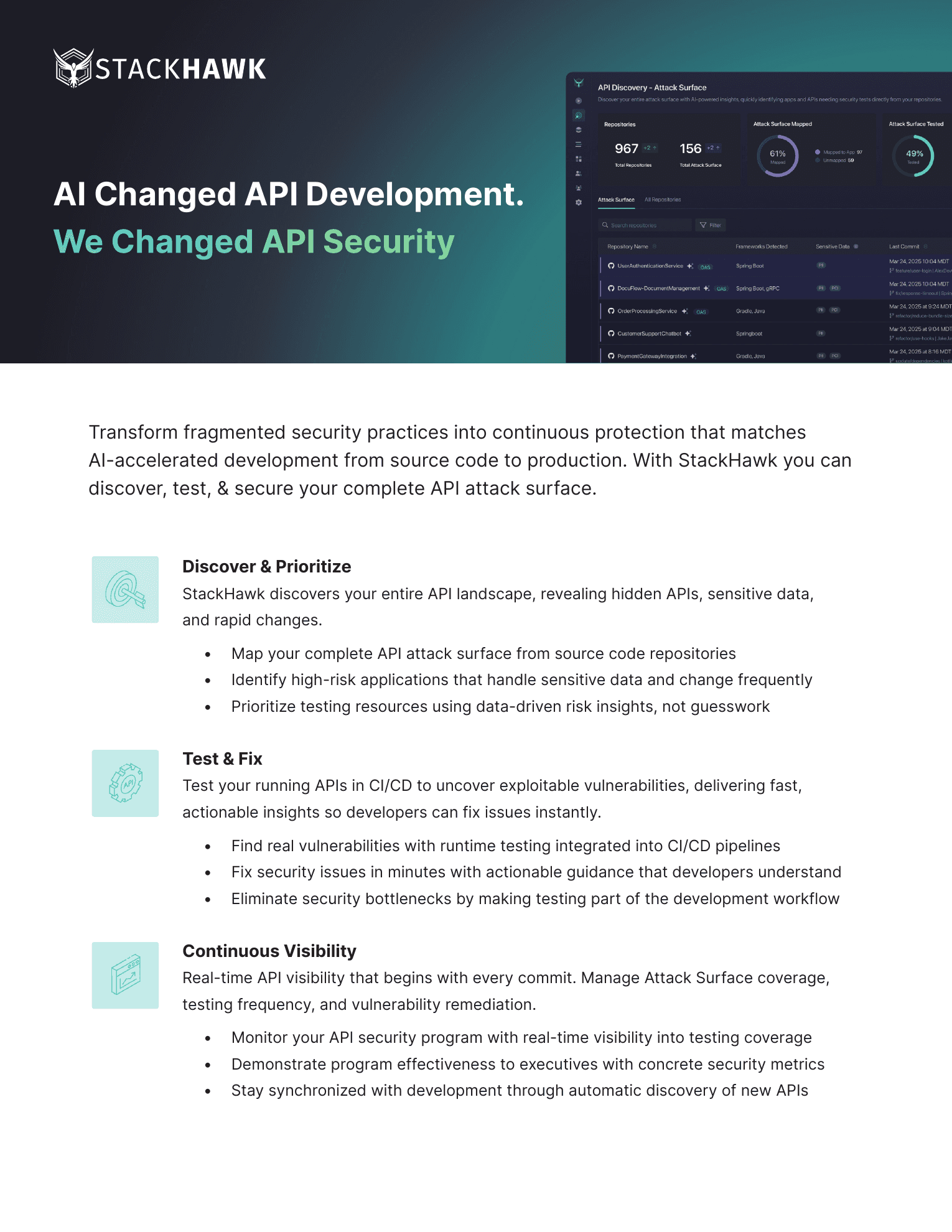
*StackHawk’s July 2025 official product one-pager shows its connected API-security workflow.*
CodeAnt AI vs StackHawk by buyer job
Preventing security issues before a service runs
CodeAnt has the broader native control surface before deployment. Inline pull-request review can report security problems beside the affected change, which reduces the distance between detection and developer review.
Code-security gates can evaluate first-party source through SAST and imported packages through SCA. The same policy point can also catch exposed secrets and unsafe infrastructure definitions.
StackHawk starts from an executable application. Its agent can run before merge when it can boot the service locally, and HawkScan can test an ephemeral environment during CI.
That runtime loop can block a demonstrated regression, but it does not inspect every unexecuted source path or package declaration. Our guide to integrating SAST into CI/CD shows where the separate static gate belongs.
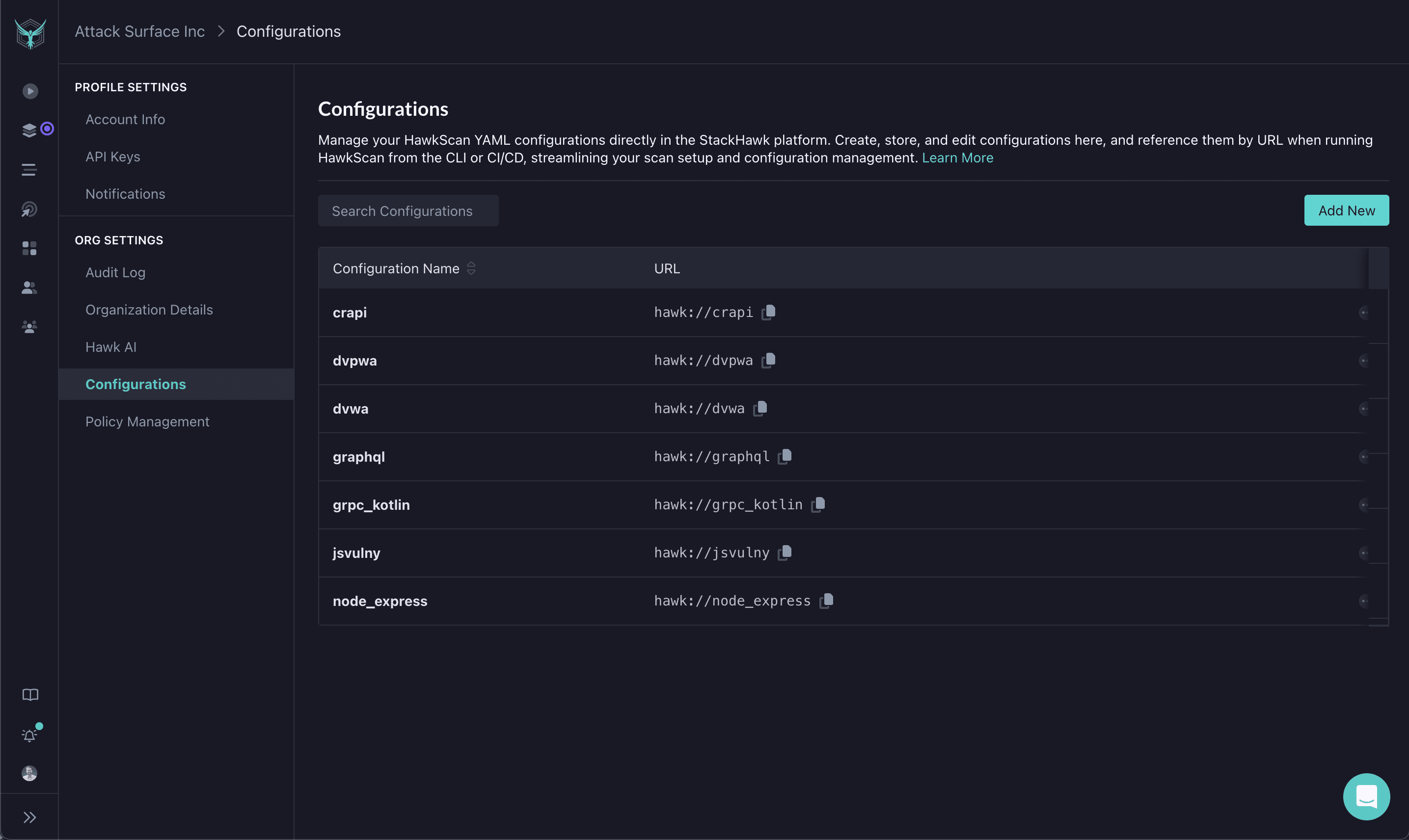
*StackHawk’s official documentation shows hosted HawkScan configurations stored in the platform and referenced by hawk:// URLs from the CLI or CI/CD.*
The practical choice is about control coverage, not whether one workflow happens earlier on a timeline. StackHawk can prove that a reachable runtime behavior is exploitable, while CodeAnt can also stop a risky dependency or credential before the application runs.
Testing APIs and authenticated runtime behavior
StackHawk gives teams configuration paths for REST and GraphQL APIs. It also supports gRPC services.
SOAP definitions and JSON-RPC endpoints use dedicated configuration instead of being forced into a generic discovery model.
Discovery alone may miss operations that are absent from crawlable traffic. StackHawk can therefore consume an OpenAPI document for REST or a schema for GraphQL, while gRPC descriptors and WSDL files serve the same purpose for their protocols.
Authentication configuration covers form logins and token-based access. Cookie sessions can be represented directly, while OAuth patterns and custom scripts handle flows that need more control.
The scanner needs a protected test path plus reliable indicators for logged-in state. Authorization-code flows or SAML may require manual setup, and a scan that loses its session measures only public coverage.
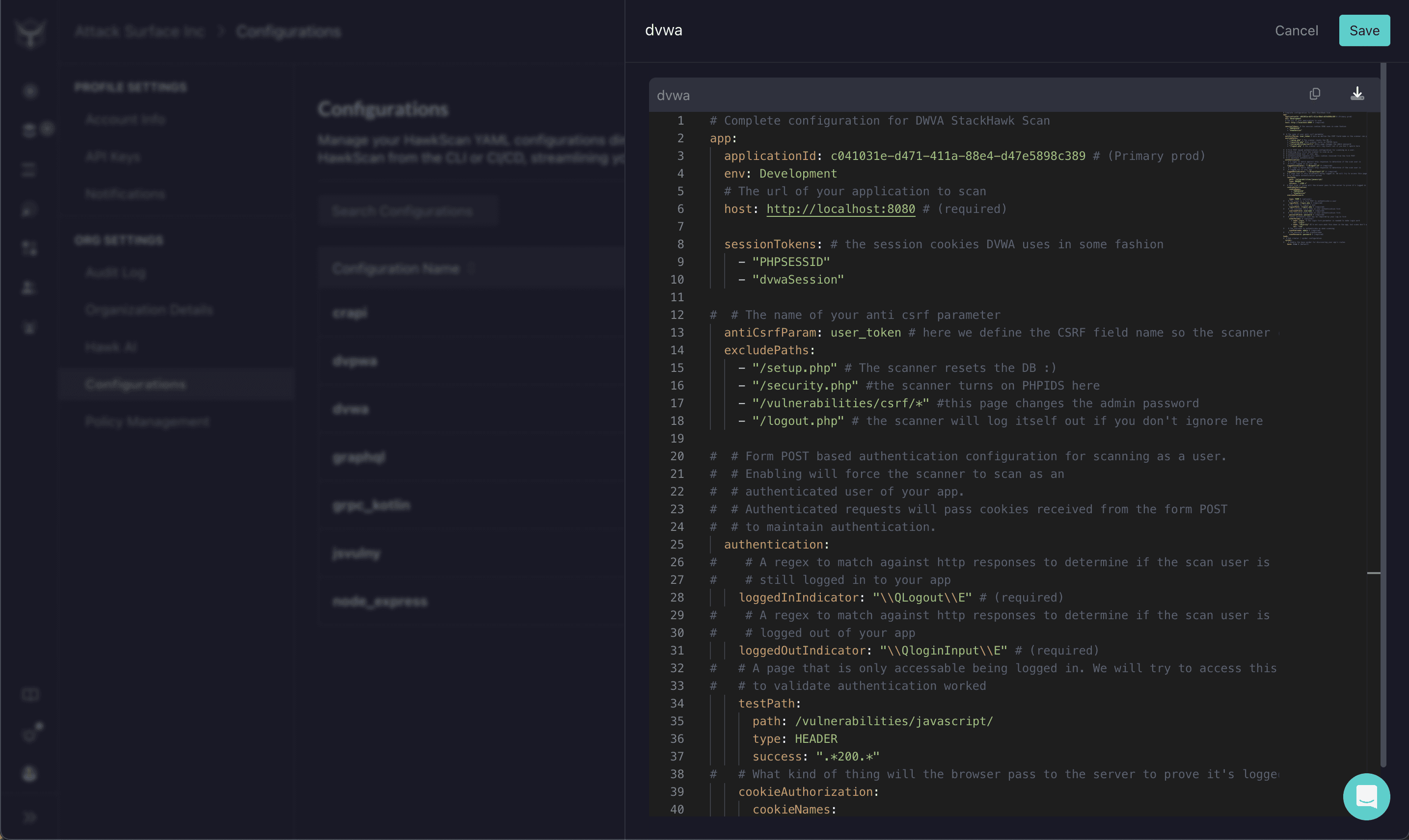
*The official configuration-editor screenshot shows the settings that define scan access and state.*
CodeAnt’s offensive model adds source memory to runtime testing. White-box analysis can expose internal routes and code paths, while gray-box testing can retain that context during an authenticated attack chain.
AI pentesting and traditional DAST explains how scanner configuration differs from source-informed adversarial reasoning. An API pilot should still give both products identical identities and object fixtures, then test the same schema and authorization boundaries.
Our authenticated GraphQL pentest checklist provides a reusable scope model for this exercise. StackHawk supplies a configuration-as-code DAST workflow, while CodeAnt extends runtime testing with a broader source-aware offensive method.
Turning a finding into a verified fix
Both products keep developers close to remediation, but they enter the loop from different evidence. StackHawk’s agent reads a runtime finding and modifies the repository, then runs HawkScan again to verify the new behavior.
Outside that agent loop, teams can triage findings in the StackHawk platform. Subscribed plans may also export scan reports or route work through Jira.
CodeAnt places defensive findings directly in pull requests with severity and impact analysis. A suggested change can move into the IDE, while steps of reproduction preserve the evidence a developer needs to validate the issue.
Offensive findings can move through remediation and re-verification in the pentest workflow. The penetration-test retest process describes why the second pass should preserve the original evidence and connect it to the corrective change.
A useful pilot measures the handoff rather than the number of remediation features. Ask a developer to reproduce the issue and identify its affected commit, then require a reviewable fix with a clean rerun.
Governing coverage across an application portfolio
StackHawk Scale uses repository connections to discover the attack surface and identify sensitive-data context. Coverage reporting lets AppSec compare known applications with the assets that have actually been tested.
Its higher-tier packaging adds organization-level scan policies and role controls. Teams and SSO support move access management from individual scanner configuration into the program layer.
CodeAnt’s Control Center aggregates code health and security across repositories. Its policy scope includes pull-request findings and dependency risk, then extends to secrets and infrastructure definitions without separating them from runtime evidence.
A software bill of materials supplies the component inventory that DAST cannot reconstruct from requests alone. StackHawk remains centered on runtime test coverage, whereas CodeAnt governs a wider code-to-cloud risk model.
CodeAnt AI vs StackHawk pricing and packaging
The public prices use different units, so the entry figures are not a like-for-like cost comparison. StackHawk Wingman costs $10 per user each month and includes unlimited applications, with 50 scans allocated to each user per month.
Wingman also includes a 14-day trial. StackHawk Scale is quote-based and adds unlimited agentic scans alongside discovery and sensitive-data context.
Scale’s program layer includes reporting and team controls. Roles and SSO support enterprise administration, while enterprise support changes the service level around the product.
CodeAnt’s published pricing lists a 14-day trial with 100 pull-request reviews. Premium costs $24 per user each month and includes unlimited pull-request reviews plus SAST on those reviews.
Enterprise is quote-based. It adds SSO and audit logs, with on-premises or VPC deployment available alongside dedicated support.
CodeAnt’s offensive package allows one full AI pentest scan and exposes low- or medium-severity findings without charge. Customers pay to unlock high- and critical-severity findings, but the page does not publish a fixed unlock amount.
Seat multiplication therefore cannot calculate CodeAnt’s full pentesting cost. Compare the expected deliverable with CodeAnt’s public pentest-report example, then ask both vendors to price the same deployment scope and scan cadence.
The quote should reflect application environments and repository count rather than a generic demo. It should also state the required identity controls and hosting model, then price offensive engagements and retests separately where applicable.
CodeAnt AI vs StackHawk operational requirements and limits
StackHawk needs a reachable running application. Its agent workflow also needs the source repository plus a service the agent can boot or access.
HawkScan coverage depends on accurate API definitions and seed paths. Stable test data keeps stateful workflows repeatable, while durable authentication prevents protected routes from disappearing midway through a scan.
Maintaining that harness takes engineering work. In return, the team gets a repeatable runtime control that can sit close to development.
CodeAnt needs repository access for code-aware analysis and integration with pull-request or CI workflows. Offensive testing still requires a reachable runtime target, so broader platform scope does not remove environment preparation.
The wider access model expands procurement review even when it reduces tool fragmentation. Check enterprise deployment requirements for data flow and retention, then verify model-use and regional-processing terms against the required audit evidence.
Neither official source set supports an unconditional finding-count verdict. StackHawk’s structured API configuration may fit a team refining developer DAST, while CodeAnt covers risk classes that a runtime-only target cannot represent.
Which one should you pick?
When CodeAnt AI is the better fit
Choose CodeAnt when one owner needs preventive source analysis and software-supply-chain checks beside runtime testing. The platform fits a program that wants pull-request review to share policy context with SAST and SCA, while secret and IaC findings remain in the same operating model.
Its offensive layer adds DAST plus code-aware pentesting. The code review versus penetration testing comparison explains why preventive review and adversarial validation remain separate controls even when one platform connects their evidence.
When StackHawk is the better fit
Choose StackHawk when the immediate job is developer-run DAST against web applications or APIs. The team should be prepared to maintain schemas and authentication, then supply representative data in an environment that can be scanned repeatedly.
Runtime findings can flow through a coding agent or CI/CD review workflow. StackHawk also fits an AppSec program that already has separate static and software-composition tools and does not want to replace them.
When using both is defensible
Use both when CodeAnt owns preventive code controls while StackHawk remains the specialist runtime gate. Document which software-composition risks belong to SCA, then keep executable behavior under the DAST owner.
The teams must deduplicate overlapping runtime findings and designate one remediation record. If the specialist scan produces no unique evidence during the pilot, another policy surface is difficult to justify.
A concrete pilot checklist
Run both products against the same staged application and commit. The following procedure separates product behavior from differences in test setup:
Freeze the scope. Record the commit and deployed image, then capture the base URL and API schema version. Store tool versions and enabled application features with the test record; NIST’s Secure Software Development Framework provides a neutral evidence structure.
Build the route inventory. Map public and authenticated behavior separately. Cover each API protocol in scope, then record asynchronous entry points and administrative functions outside the primary interface.
Create two test roles. Give the identities distinct tenant or account objects. Use the OWASP API Security Top 10 to define the authorization boundaries those roles should test.
Configure equal runtime access. Give each tool the same schema and credentials. Match the scan window and exclusions, then confirm that the session survives by following the OWASP Web Security Testing Guide.
Add static-only cases. Put one approved dependency issue in an isolated branch. Add a non-production secret and an IaC misconfiguration so the pilot can measure preventive scope without presenting those fixtures as DAST failures.
Measure evidence. Record discovered operations and validated findings, then capture reproduction detail and affected code location. Track duplicate findings and developer triage time separately instead of rewarding raw alert count.
Fix and rerun. Save the remediation diff with the targeted-rescan result. Your choice between continuous and annual pentesting determines how often that evidence must be refreshed.
Test governance. Export a report and inspect API access. Apply a team policy and verify roles, then trace one finding into the ticketing workflow and map the result to the OWASP Application Security Verification Standard.
Price the operating model. Use actual seats and expected scan frequency. Include engineering work for the CI/CD pipeline, test identities, and seeded application state in the annual estimate.
Write the decision. Score runtime coverage and preventive coverage separately. Compare remediation proof with administration effort, then finish with developer effort and annual cost.
The procedure produces comparable evidence only when the application state stays stable. If one product receives a richer schema or a working privileged identity, repeat the affected test before scoring the result.

