

Type “AI pentesting” into a search bar and CodeAnt AI and Synack both come back claiming the category. Neither is lying, and that is exactly what makes the shortlist confusing.
The two platforms mean different things by the same three words. Synack uses AI to expand what its human red team can cover, while CodeAnt AI uses AI to run the pentest itself, starting from a place no Synack researcher ever looks: your source code.
Short answer: Choose CodeAnt AI if you ship software and want the pentest to read your code, run continuously, and start free. Choose Synack if you need vetted human researchers proving exploitability on deployed systems, under FedRAMP Moderate authorization, and a credit-funded engagement model fits how you buy.
What Does “AI Pentesting” Mean in Each Product?
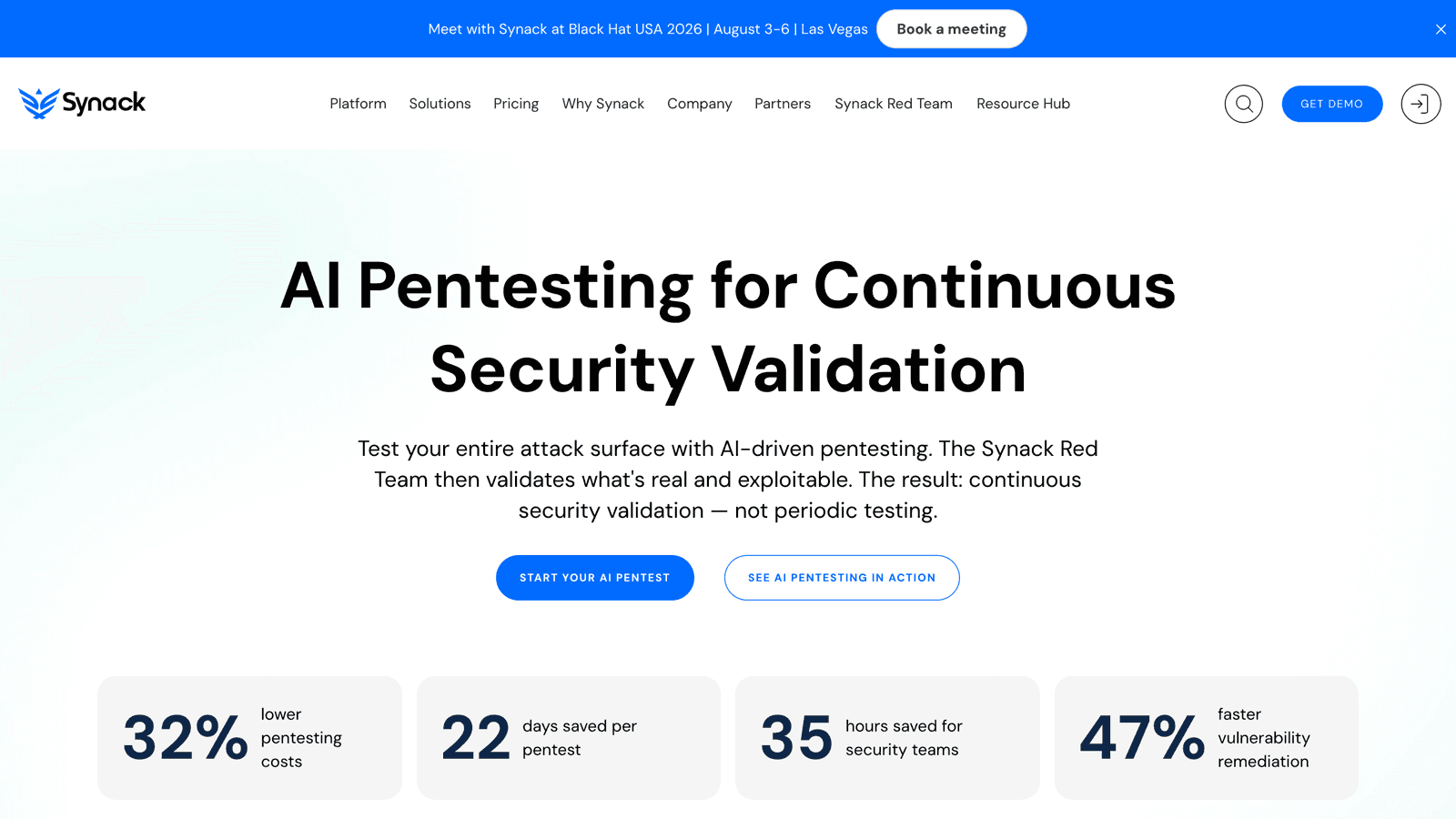
Synack’s homepage states the division of labor in one line: “AI Finds More. Humans Prove What Matters.” Sara, the Synack Autonomous Red Agent, “expands coverage,” the Synack Red Team “validates real risk,” and the platform “delivers continuous validation.”
Read that carefully and the architecture falls out. At Synack, the AI is a scout, and a human researcher stands between every AI finding and your dashboard.
CodeAnt AI inverts the design. Its agentic pentest runs 500+ exploit agents that reason over your code, infrastructure, and runtime, prove exploitability themselves with a working proof of concept, and never wait for a human to sign off.
Neither design is wrong. They answer different questions, and the rest of this comparison walks through where each one wins.
How Synack Runs a Pentest
Every claim in this section comes from Synack’s own product pages and documentation. The engagement follows a fixed commercial and technical path.
You start by buying credits against a statement of work, then spend them on a named testing offering. Synack’s offering table defines exactly what each one buys.
Offering | Window | Who tests | Scope |
|---|---|---|---|
Sara Pentest | 4-5 days | AI agent driven | 1 low-complexity web app or up to 100 host IPs, external only |
Sara Pentest+ | 4-5 days | AI agent driven | 1 large web app or up to 250 host IPs, external only |
SynackST / ST+ | 5-10 days | 1 assigned researcher | Checklist-based, up to 25 unauthenticated URLs or 100 host IPs |
Synack14 / 90 / 365 | 14 to 365 days | Pools of rotating researchers | 1 large web app, 50 unauthenticated URLs, 1 mobile app, or 250 host IPs |
API | Varies | Pool of researchers | 1 headless API, up to 25 endpoints |
Once a test launches, Sara deploys “swarms of agents” through a Discover, Analyze, Validate, Deliver flow. On web targets it hunts SQL injection, XSS, IDOR, SSRF, and command injection, and on hosts it probes SSH, FTP, SMTP, and SMB weaknesses, including known exploits like EternalBlue.
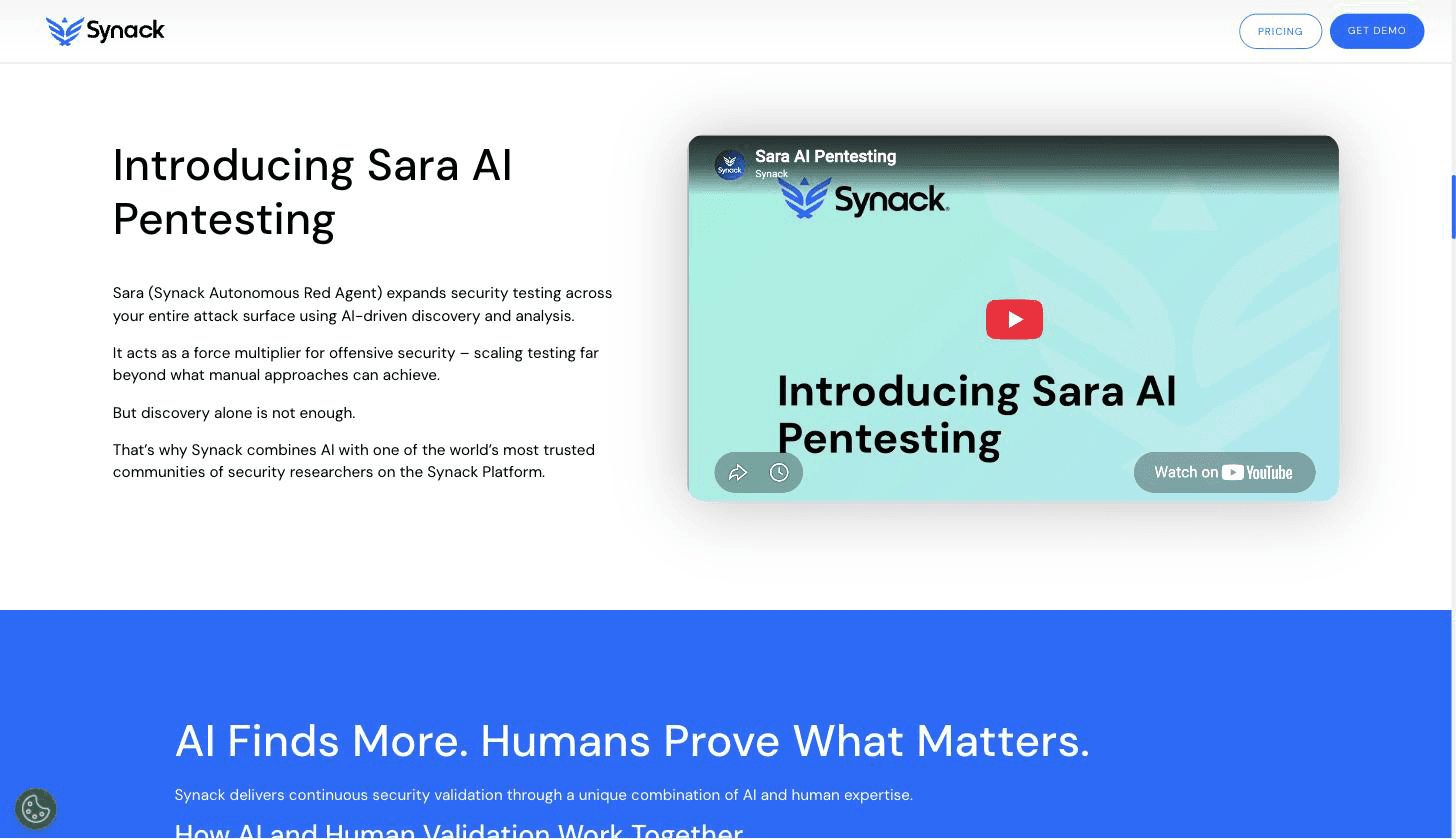
The human layer then takes over. The Synack Red Team is “over 1,500 of the world’s most skilled and trusted security researchers,” vetted through five stages including background and ID verification, and Synack is explicit that “we are not a bug bounty program.”
Control is the quiet star of the whole system. Researchers test exclusively through the LaunchPoint VPN, signed in for all activity, which hands you “full packet capture of all testing,” real-time traffic analytics, and a one-click pause on any assessment.
Findings close out with patch verification, where researchers confirm your fix actually resolved the issue. Domino’s summarizes the buyer experience on Synack’s homepage: “Our policy is if an app is going to impact the business before it goes live, it must be Synacked.”
How CodeAnt AI Runs a Pentest
CodeAnt AI is an exploit-based agentic security platform, and its pentest starts where Synack’s cannot: inside the repository. Connect a URL for black box, or your code for white and grey box testing, and the agents map what you built before attacking it.
Reading source changes what a pentest can find. Authorization flaws like IDOR and broken access control hide in business logic that a black-box scanner guesses at, while a code-aware agent follows the actual permission checks to the exact line that fails.
Findings arrive as proof rather than suspicion. Every high or critical result ships with a working proof-of-concept exploit and a curl reproduction, findings rank by EPSS so you fix what attackers actually use, and an Attack Chains stage strings individual flaws into full compromise paths.
The loop then keeps running. A Reverify button re-tests any finding free and unlimited after your fix, reports land within 48 hours, and issues file straight into Linear and Jira.
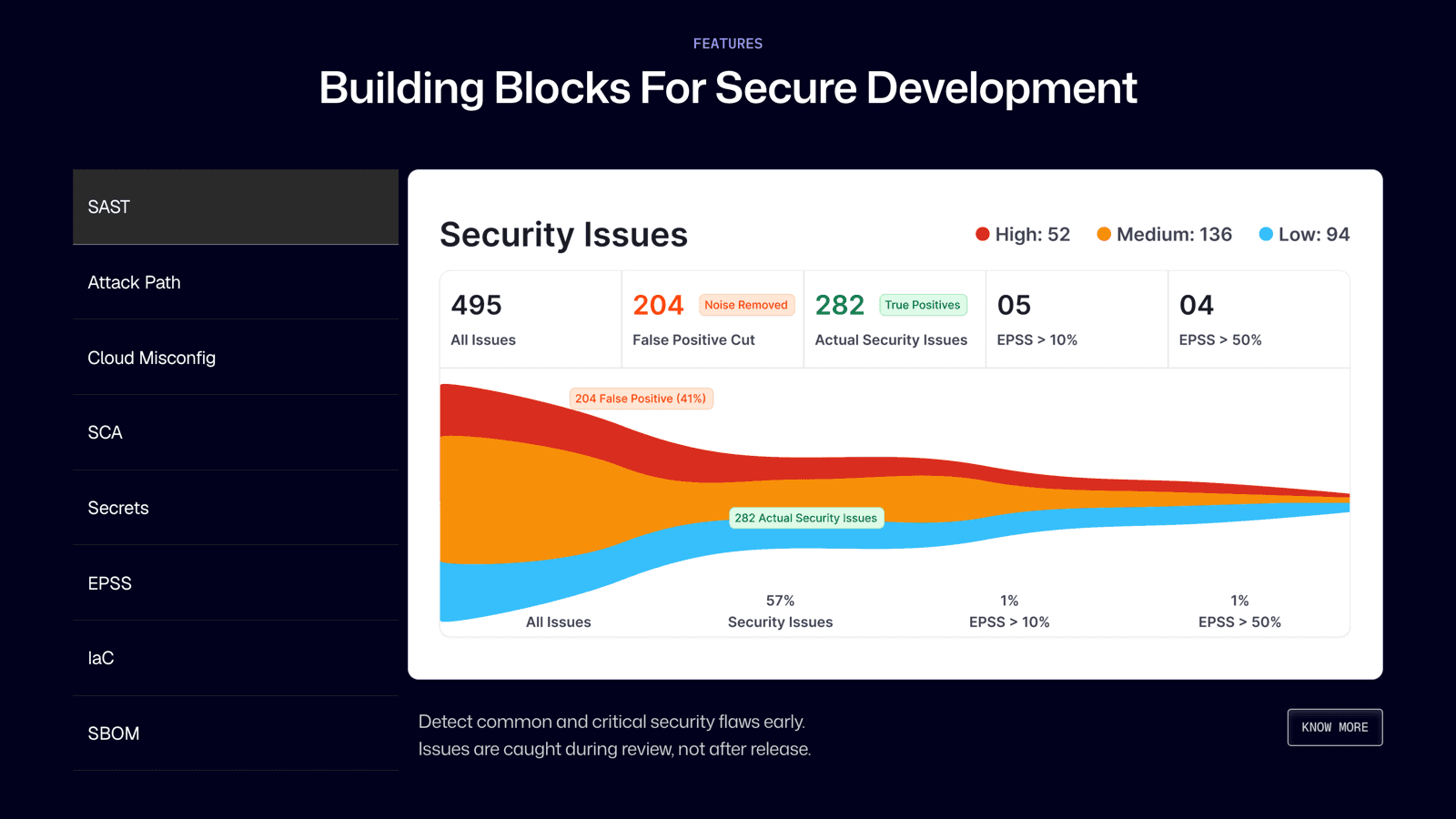
Around the pentest sits the defensive layer Synack does not build. AI code review on every pull request, SAST, SCA, secret scanning, and IaC checks in one unified report, with quality gates and DORA delivery metrics for the engineering org.
The Five Differences That Decide It
Strip away the marketing and five structural differences separate these platforms. The table maps them, and the sections after unpack the two that surprise buyers most.
Dimension | CodeAnt AI | Synack |
|---|---|---|
Who proves a finding | Exploit agents, with a working PoC per high or critical | Human researchers, after Sara’s AI discovery |
What the platform can see | Your source code, infrastructure, and runtime | Deployed external targets, plus internal via human engagements |
Testing cadence | Continuous, re-scans free and unlimited | Per engagement, 4 to 365 days per credit spent |
Coverage beyond the pentest | Code review, SAST, SCA, secrets, IaC, DORA metrics | Mobile, LLM/AI apps, missions, attack surface discovery |
How you buy | Free scan, then per seat, pentest pays only on findings | Prepaid credits through an SOW, platform subscription separate |
Source access is the deepest split. Synack’s entire catalog tests what you have already deployed, and no offering on its table accepts a repository. The vulnerability merged this morning stays invisible to Synack until it ships somewhere a tester can reach, while CodeAnt AI flags it in the pull request.
Cadence is the difference budgets feel. A Synack365 engagement delivers a year of rotating researchers, and each additional engagement draws down more credits. CodeAnt AI treats testing as infrastructure rather than an event, which is why re-scans cost nothing and the pentest bills only when a working exploit ships.
What Only Synack Gives You
Synack fields resources CodeAnt AI genuinely does not, and pretending otherwise would make this a worse comparison.
Human judgment at scale. 1,500+ vetted researchers hunting vulnerabilities, working missions against compliance checklists, and verifying patches.
Surfaces beyond the web stack. The offering table covers mobile apps and LLM/AI applications, and the catalog extends to social engineering and zero-day response engagements.
Federal-grade authorization. FedRAMP Moderate, sponsored by HHS, with 325 NIST 800-53 controls enforced, and dedicated public sector support for defense and intelligence environments.
Forensic-grade oversight. LaunchPoint’s full packet capture of every researcher action is an audit artifact no autonomous tool reproduces.
Noise triage at the platform level. Synack’s homepage claims it filters “99.98% of the noise so you only receive verified, real vulnerabilities.”
Government logos on Synack’s own homepage, including the Department of Transportation, the Federal Reserve System, and the IRS, tell you which buyer this machinery was built for.
What Only CodeAnt AI Gives You
The reverse list is just as real, and it maps to everything left of deployment.
A pentest that reads code. White and grey box modes that follow your actual auth logic, not probes against a black box.
The whole defensive stack. SAST, SCA, secret scanning, IaC, and SBOM in one report, none of which appears anywhere in Synack’s product catalog.
Review where bugs are born. Unlimited AI review on every pull request, with plain-English custom rules and org-wide gates.
Engineering visibility. DORA metrics, test coverage, and complexity analysis beside the security findings.
A free, self-serve start. One URL, no card, full report, and published per-seat pricing after that, with no sales cycle in between.
Sara’s Published Limits
Synack documents Sara’s boundaries in its own FAQ, which deserves credit for honesty. Three of them matter before you shortlist the AI tier.
External only. “Currently Sara can only test external web and host assets. Testing of internal assets is on the roadmap.”
No MFA or OTP. Support is “not available now, but is on the roadmap,” which excludes most production login flows.
CAPTCHA stops it. Synack advises that “testing is best performed on targets without it.”
Sara also runs on infrastructure worth knowing about: Synack states it uses Anthropic Claude for Sara services via GCP Vertex AI, and that the underlying models “do not retain or train on any Synack customer data.” Safety guardrails block destructive commands across nine infrastructure categories and prohibit DoS testing, brute-forcing, and uncontrolled post-exploitation.
CodeAnt AI’s equivalent boundary is the human one. There is no named researcher behind a finding, so an auditor who requires a human signature needs a service engagement, and internal network or Active Directory testing sits outside both platforms’ AI tiers.
What Each One Costs
Synack publishes starting prices on its pricing page, which is rarer than it should be in this market. Read the whole page before budgeting, though.
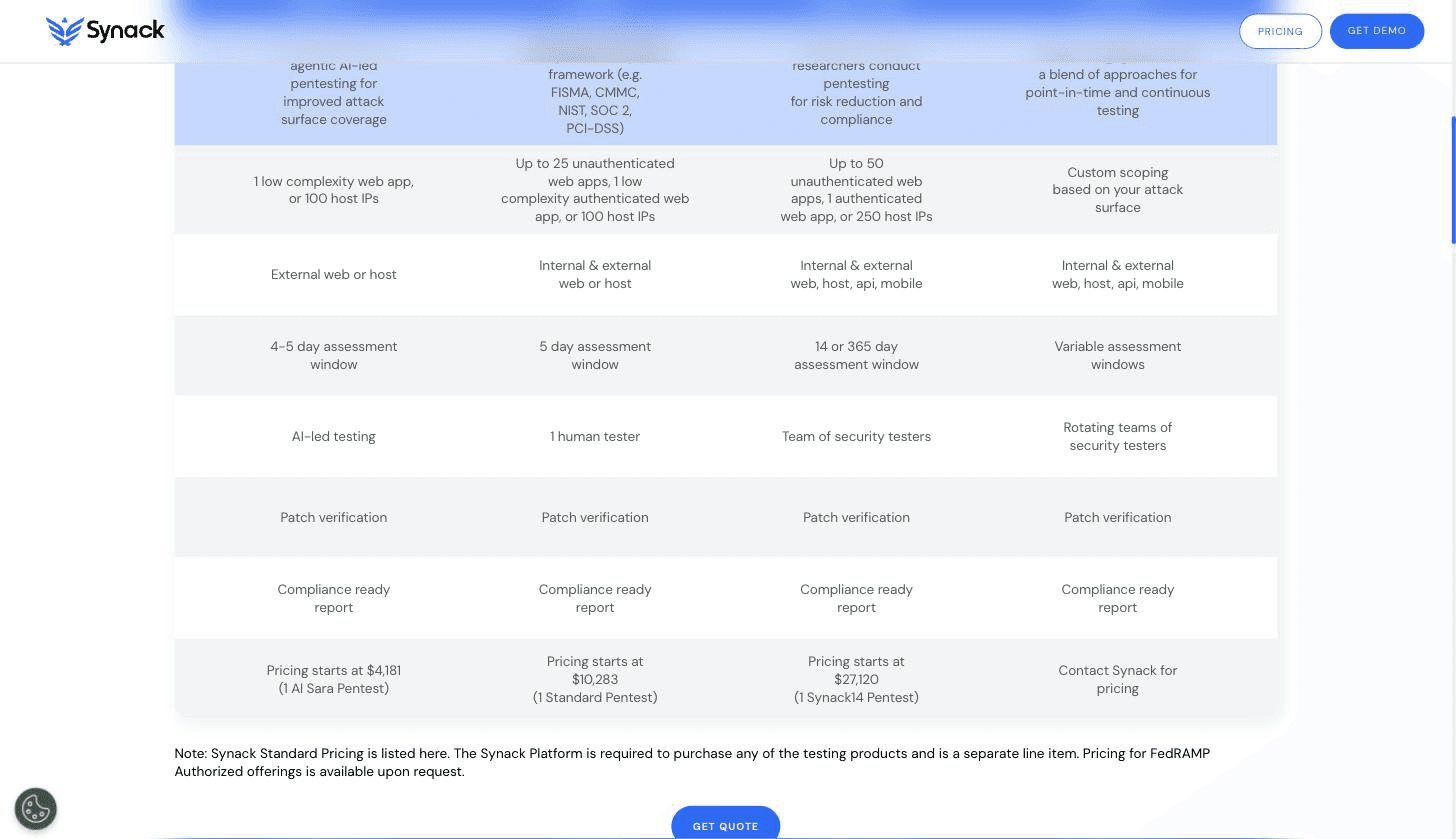
Sara Pentest starts at $4,181, SynackST at $10,283, and Synack14 at $27,120, each buying one test through credits.
Credits expire one year from purchase, per Synack’s own FAQ, whether used or not.
The platform is a separate line item. Synack’s note reads: “The Synack Platform is required to purchase any of the testing products and is a separate line item,” and its price is not published.
The free Basic tier is a shell. It includes the portal, RBAC, and reporting, but every actual test still requires purchased credits, and integrations plus SSO sit in the paid platform tier.
CodeAnt AI’s numbers all sit on the pricing page. The pentest starts with a free one-URL scan and bills only on high or critical findings, AI Code Review runs $24 per user per month, and the security, quality, and metrics modules run $20 per user per month each, with a 14-day unlimited-seat trial.

Our Synack pricing breakdown works through the full cost model line by line.
Which One Should You Pick?
Buy the machine that matches where your risk lives. Code that changes weekly needs testing that lives with the code, while a regulated estate facing auditors and federal frameworks needs humans whose work leaves a paper trail.
Your situation | Pick | Because |
|---|---|---|
You ship web apps and APIs continuously | CodeAnt AI | The pentest reads each change, and re-tests are free |
Your auditor wants a named human behind the report | Synack | Vetted researchers, packet capture, patch verification |
You sell to or work in the U.S. federal government | Synack | FedRAMP Moderate with HHS sponsorship |
You want SAST, secrets, and code review with the pentest | CodeAnt AI | One platform covers the defensive layer Synack omits |
You need mobile or LLM application testing today | Synack | Both sit in its offering table now |
You want to see findings before spending anything | CodeAnt AI | Free scan, no card, report in 48 hours |
Plenty of security programs eventually run both motions, continuous code-aware testing plus periodic human engagements. Start with the one you can verify this afternoon, and the Synack alternatives roundup maps the field if neither fits cleanly.
Try CodeAnt AI
Point the free scan at one URL you own. If the agents find something high or critical, you get a working exploit as proof, and if they find nothing, you owe nothing.

