

The best NetSPI alternative depends on which part of its portfolio you need to replace. NetSPI combines human-led PTaaS with broad application and infrastructure testing, then extends that coverage into specialist assessments and security-program operations.
A team that needs one provider across that portfolio should keep NetSPI on its shortlist. A SaaS team that mainly needs code-aware application testing can use CodeAnt AI’s agentic pentesting platform to connect exploit evidence to source-level remediation, while an infrastructure team should prioritize tests it can rerun after each material environment change.
The practical decision is to separate expert assurance from repeatable exploit validation. Specialist testing forms a third job, and this guide compares six alternatives across those needs while treating the three access models as distinct evidence.
TL;DR: The Best NetSPI Alternatives at a Glance
Alternative | Best fit | Delivery model | Public starting price, as of July 31, 2026 | Main boundary |
|---|---|---|---|---|
CodeAnt AI | Code-aware web and API testing tied to remediation | Autonomous, with source and runtime context | One full scan included; low/medium findings free; high/critical findings unlock on payment | Not a replacement for mainframe, hardware, or physical testing |
Repeatable application PTaaS with a tester collaboration platform | Human-led PTaaS plus autonomous testing | $3,500 promotional autonomous web-app test through Dec. 31, 2026; other tiers quoted | Credit planning and annual packages still require scoping | |
Regulated enterprises that want a managed researcher network | Vetted researcher community plus autonomous testing | Quote-based credit model and platform subscription | Researcher-community model differs from a dedicated in-house team | |
Internal, external, cloud, Kubernetes, and identity attack paths | Autonomous pentesting software | Quote-based packages | Infrastructure-first; not a substitute for specialist manual application review | |
Continuous adversarial validation across enterprise infrastructure | Automated security validation software | Quote-based subscription | Validation platform, not a one-for-one human PTaaS replacement | |
Bishop Fox | High-complexity applications, hardware, red teaming, and bespoke scopes | Expert-led consulting with AI-assisted services | Quote-based | More engagement-led than self-service PTaaS |
The shortlist spans PTaaS operating models and automated pentesting, then includes specialist consulting for unusual scopes. Product facts come from each vendor’s official product and documentation pages, including official pricing or service material where available.
The comparison also considered competitor claims captured in the supporting research. This article links to neutral references and CodeAnt resources where they help readers verify the evaluation criteria.
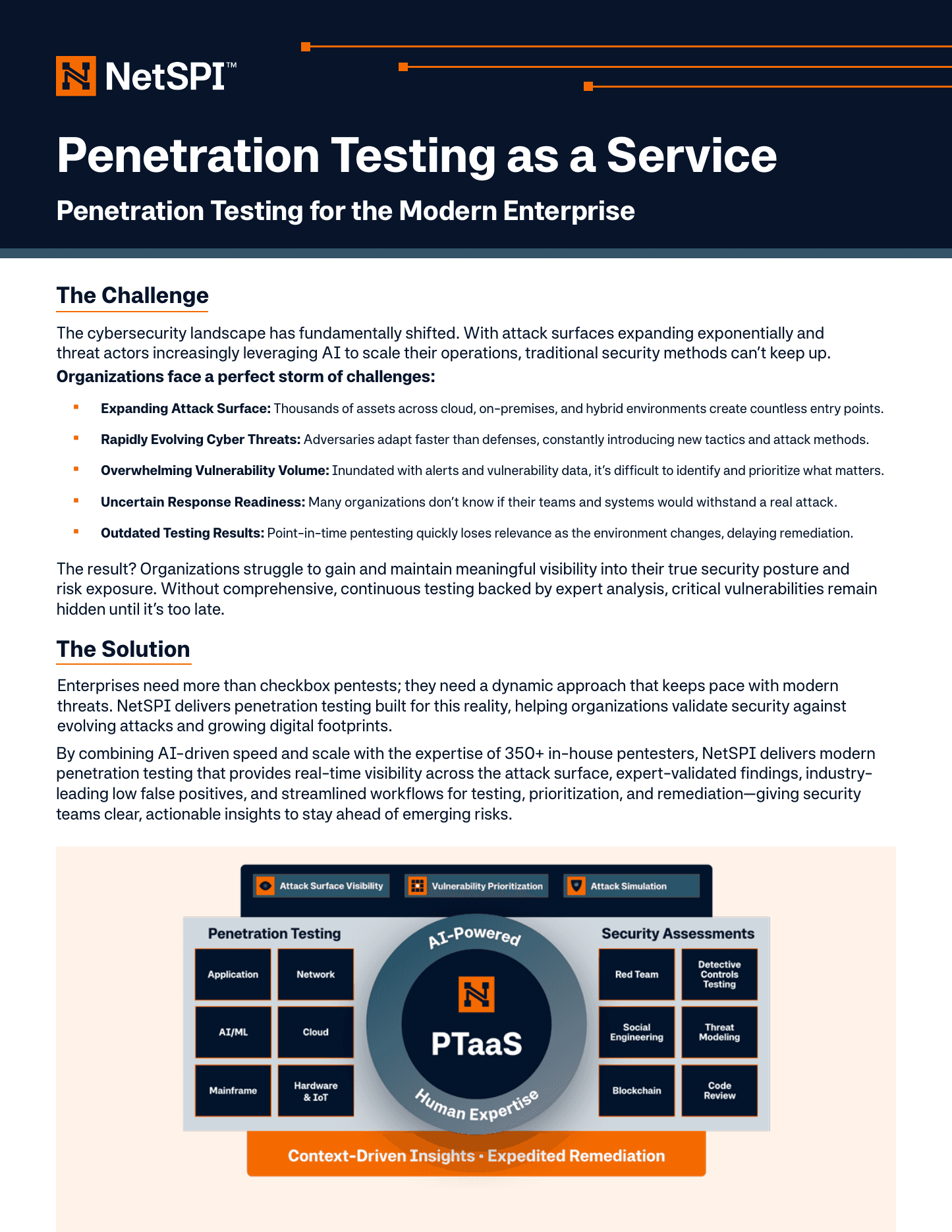
What NetSPI Actually Includes
NetSPI is not just an application pentest marketplace. Its official portfolio covers common application and infrastructure targets alongside mainframes and embedded hardware.
AI systems and human targets are covered through dedicated testing and red-team engagements.
The platform supports the operating work around those tests through findings management and remediation testing. Asset discovery and prioritization feed its reporting and workflow integrations, so a narrow scanner cannot replace the complete service.
NetSPI does not publish a simple list price for PTaaS on its current product pages. Buyers have to scope their assets and test frequency before a proposal can account for expert effort and platform access.
Use a penetration-testing cost model that separates engagement labor from retesting and ongoing coverage. A lower quote may otherwise represent a smaller test rather than a more efficient service.
Coverage overlap: what each alternative can replace
Use a penetration-testing process to map the required evidence before you compare brands. These four categories make gaps between unlike delivery models visible:
Application assurance: web apps, APIs, authenticated workflows, authorization, business logic, mobile, and source-assisted analysis.
Infrastructure validation: internal and external networks, Active Directory or identity, cloud control planes, Kubernetes, and attack-path chaining.
Program operations: scoping, scheduling, live findings, developer tickets, retesting, reporting, and portfolio trends.
Specialist assessment: mainframe, hardware, embedded systems, physical security, social engineering, LLMs, or objective-based red teaming.
The completed matrix should distinguish a vulnerability scan from an exploit-led test. NIST SP 800-115 treats technical security testing as a set of assessment techniques, while the OWASP Web Security Testing Guide provides scenario-level application guidance.
The automated-pentesting checklist converts those differences into procurement questions. The defensive-versus-offensive security guide also explains why detecting a risky code pattern and proving an attack path are separate controls.
6 Best NetSPI Alternatives in 2026
These six alternatives solve different parts of the NetSPI problem. The profiles below separate application testing, infrastructure validation, and specialist consulting so you can compare each option by coverage, operating model, and practical limits.
1. CodeAnt AI: best for code-aware application pentesting
CodeAnt AI is the closest fit when the buyer wants offensive findings connected to the code that created them. Its agents map the public attack surface before analyzing repositories and infrastructure-as-code for application context.
The analysis also covers dependencies and secrets, then validates exploitability against running applications and APIs. The same product family includes SAST and software composition analysis alongside secret scanning and infrastructure-as-code analysis.
Verified strengths
Authenticated and source-aware tests add application context to black-box reconnaissance. Findings carry exploit evidence into reproduction guidance and source-level remediation.
Attack-path analysis connects weaknesses that become more serious when chained. EPSS-based prioritization adds exploitation likelihood to the remediation queue without replacing the pentest’s proof.
The workflow continues into pull requests and CI/CD through code-security gates. Engineering teams can move a confirmed finding directly into a code change.
Where it stops
CodeAnt AI is application- and code-centric. It does not substitute for NetSPI’s mainframe and hardware work or its physical social-engineering and broad internal-network consulting.
For a SaaS application, source context can expose missing authorization checks that an external-only test has to infer. The IDOR vulnerability guide explains the role of object ownership and tenant boundaries, while the OWASP API Security project provides a neutral testing baseline.
When to choose CodeAnt AI
Choose it to prove exploitable web and API risk and fix the responsible code in the delivery workflow. The source-code analysis and penetration-testing guide can define the pilot, while NetSPI or another specialist covers infrastructure and unusual assets.
2. Cobalt: best for repeatable, human-led application PTaaS
Cobalt centralizes tests for applications and APIs as well as mobile and desktop software. Its catalog extends into cloud and network targets, with separate AI/LLM and red-team work.
Teams can scope and launch tests before working with pentesters on findings in real time. More than 50 integrations support issue routing and retesting, while Cobalt’s Core supplies vetted external experts rather than NetSPI’s in-house tester model.
Verified strengths
Cobalt’s tiers progress from Standard through Premium to Enterprise and define test start times and support. Higher levels add controls such as SSO and program reporting.
Its credit model assigns one credit to eight hours of offensive security testing. The package covers the work from scoping through retesting as well as platform access.
Cobalt publicly lists its autonomous web-application offer at a promotional $3,500 per test through December 31, 2026. A Cobalt pentester oversees the test and delivers findings in the same platform.
Retesting is available on demand throughout the contract term, so teams can verify fixes without waiting for the next scheduled assessment.
Where it stops
Cobalt has broad testing services, but a credit-based annual program still needs careful asset sizing. Ask what consumes credits and whether the selected tier includes the required support and integrations.
Buyers must decide whether an autonomous test meets the assurance requirement. The PTaaS provider SLA checklist defines launch timing and critical-finding notifications alongside report and retest deadlines.
When to choose Cobalt
Choose Cobalt when engineering teams need repeatable human-led tests with direct tester collaboration. Live findings and predictable workflow integrations support the program after testing starts.
Compare the proposed scope against your continuous-pentesting requirements, not against the promotional autonomous-test price alone.
3. Synack: best for managed researcher breadth and regulated testing
Synack pairs its PTaaS platform with the Synack Red Team, a community of more than 1,500 vetted researchers. The platform supports human-led and Sara autonomous tests across web or mobile applications as well as hosts and APIs.
Cloud and AI applications can also enter the test scope. Customers launch and monitor tests in the platform, where they can stop activity before moving findings through patch verification and reporting.
Verified strengths
Synack offers human testing programs that run for 14 days or 90 days, with year-long coverage also available depending on the service. Its platform controls tester traffic and testing hours, and customers can stop a test when operational conditions require it.
The pricing model combines a platform subscription with credits tied to test type and duration, but the public page does not list dollar prices. Some engagements can also request specialized researcher cohorts, including groups restricted by location.
Where it stops
The operating model uses a managed researcher community rather than a fixed in-house team. Procurement should examine cohort eligibility and tester continuity alongside triage and retesting controls.
Synack states that purchased credits expire after one year. The pentest authorization versus statement-of-work guide helps teams document traffic restrictions and related test controls explicitly.
When to choose Synack
Choose Synack when broad, managed researcher access and test-governance controls matter more than a dedicated consulting bench. For regulated scopes, translate “compliance-ready” into the exact method and evidence required.
SOC 2 penetration-testing requirements provide one applicable baseline. The PCI Security Standards document library provides another when cardholder data is in scope.
4. NodeZero: best for autonomous infrastructure and identity attack paths
Horizon3.ai’s NodeZero is autonomous pentesting software for internal networks and external assets. Dedicated test types cover Kubernetes and cloud environments as well as Active Directory and related identity scenarios.
Internal tests run from a Docker host or virtual appliance, while external tests run from Horizon3.ai’s cloud. Attack paths show exploit proof and impact before reporting and fix verification.
Verified strengths
Teams can schedule internal and external tests from the portal. Cloud and Kubernetes tests extend coverage into the control planes connecting infrastructure assets.
NodeZero treats identity as a dedicated attack surface, with tests designed around credential exposure, privilege paths, and directory weaknesses.
NodeZero chains weaknesses to show how access progresses through an environment. Its Kubernetes deployment works with on-premises and managed clusters, testing exposed secrets before tracing RBAC weaknesses and escape paths.
Rapid Response tests focus on newly exploited vulnerabilities. This gives the platform a time-sensitive validation role that a fixed annual assessment cannot fill.
Where it stops
NodeZero is strongest in infrastructure and identity validation. It does not replace human analysis of application business logic or specialist engagements for mainframes and physical social engineering.
A bespoke red-team objective also remains a separate service. Teams should compare coverage with the CISA Known Exploited Vulnerabilities catalog without treating a KEV check as a full penetration test.
When to choose NodeZero
Choose NodeZero when the primary question is whether an attacker can move from an initial foothold to privileged infrastructure or cloud workloads. It also fits teams that want to rerun that proof after a Kubernetes or identity change.
The cloud pentest checklist can expose scope gaps before a pilot. The cloud-infrastructure security guide helps inventory the IAM and network layers before adding workloads and data to the authorization.
5. Pentera: best for continuous adversarial exposure validation
Pentera automates adversarial testing across internal networks and internet-facing assets. Its Cloud product covers cloud-native identity and configuration paths in cloud or hybrid environments.
Pentera Core focuses on internal attack paths, while Surface handles the external view. Resolve supports remediation and revalidation, and Pentera positions the combined platform as exposure validation software rather than a human PTaaS service.

Verified strengths
Pentera executes live attack paths under customer-defined guardrails. Audit logs record activity, while throttling and stop controls limit execution.
The platform deduplicates findings and adds asset and identity context. Proven impact drives prioritization before remediation and retesting.
Cloud and internal tests can demonstrate lateral movement or privilege escalation on a path to a critical asset. Pentera describes CTEM as the wider program framework, with its product supporting validation and revalidation inside that program.
Where it stops
Pentera is not a direct replacement for the full set of manual tests or compliance engagements. It is a strong fit for repeatable infrastructure validation, but application business logic and mobile behavior may still need specialists.
Hardware and mainframe work also sit outside its core validation model, as do attack paths aimed at people. Use continuous versus annual pentesting to decide which checks can be automated and which require a human engagement.
When to choose Pentera
Choose Pentera when the team wants frequent, controlled validation of whether infrastructure exposures can become working attack paths, followed by evidence that remediation broke those paths. If the goal is an expert-written application assessment, shortlist a PTaaS or specialist provider instead.
6. Bishop Fox: best for specialist and objective-based assessments
Bishop Fox offers application and mobile testing alongside secure code reviews. Specialist services address AI/LLM systems and hardware, while its offensive portfolio covers cloud or network targets through red-team and social-engineering engagements.
Its application methodology combines automated and manual testing, while cloud engagements can follow a customer-defined objective. The firm also provides ransomware-readiness work and incident tabletops as well as Cosmos for continuous attack-surface discovery and testing.
Verified strengths
Bishop Fox uses specialist teams for the hardware and AI/LLM work described above. Red-team and social-engineering services test controls that cross technical and human systems.
Application assessments examine access controls and session handling before testing input processing and connected components. Cloud engagements cover AWS and Azure along with GCP and Kubernetes, using objective-based attack paths rather than configuration review alone.
Managed programs can combine Bishop Fox service lines when one objective crosses asset categories.
Where it stops
Bishop Fox is a better fit for depth and tailored objectives than for buyers seeking a self-service PTaaS catalog with public unit pricing. Its public pages route buyers to scope an engagement.
Define success in advance using pentest authorization-letter elements. Map adversary objectives to MITRE ATT&CK when that model fits the engagement.
When to choose Bishop Fox
Choose Bishop Fox when the scope is unusual or high-consequence. Hardware and complex cloud paths fit that profile, as do mobile assessments and adversary-led exercises involving people.
For high-frequency web-app releases, compare that depth against a more repeatable automated pentesting for DevSecOps workflow.
How to Choose a NetSPI Alternative
Start with a coverage matrix rather than a demo. Record each asset class and tester access, then define test frequency and exploitation limits.
Add the reporting audience and retest window, including any audit requirement for human work. The external penetration-testing methodology separates reconnaissance and validation from exploitation and reporting.
Use the same bounded pilot for every finalist:
Give each finalist the same two or three representative assets and the same authorization limits.
Require evidence for each confirmed issue: affected asset, attack path, reproduction, impact, and a concrete remediation step.
Measure time to first actionable finding, triage effort, developer handoff, retest completion, and report usability.
Verify the report against the OWASP Application Security Verification Standard or another scope-appropriate standard.
Record what the platform did not test. A clean report without a coverage record proves very little.
Choose CodeAnt AI when code-aware web and API evidence must move directly into remediation. Cobalt and Synack fit human-led PTaaS programs, while NodeZero and Pentera focus on repeatable infrastructure validation.
Bishop Fox serves specialist and objective-led work. Keep NetSPI when one provider must cover uncommon asset classes and run the surrounding program operations.

