Continuous vs Annual Penetration Testing: Which Fits SaaS?
Sonali Sood
Founding GTM, CodeAnt AI
Most teams still run penetration testing once a year. But their applications don’t change once a year. They change every week, new endpoints, updated authentication flows, third-party integrations, infrastructure changes.
That mismatch creates a structural problem. Security is being tested at one cadence, while risk is being introduced at another.
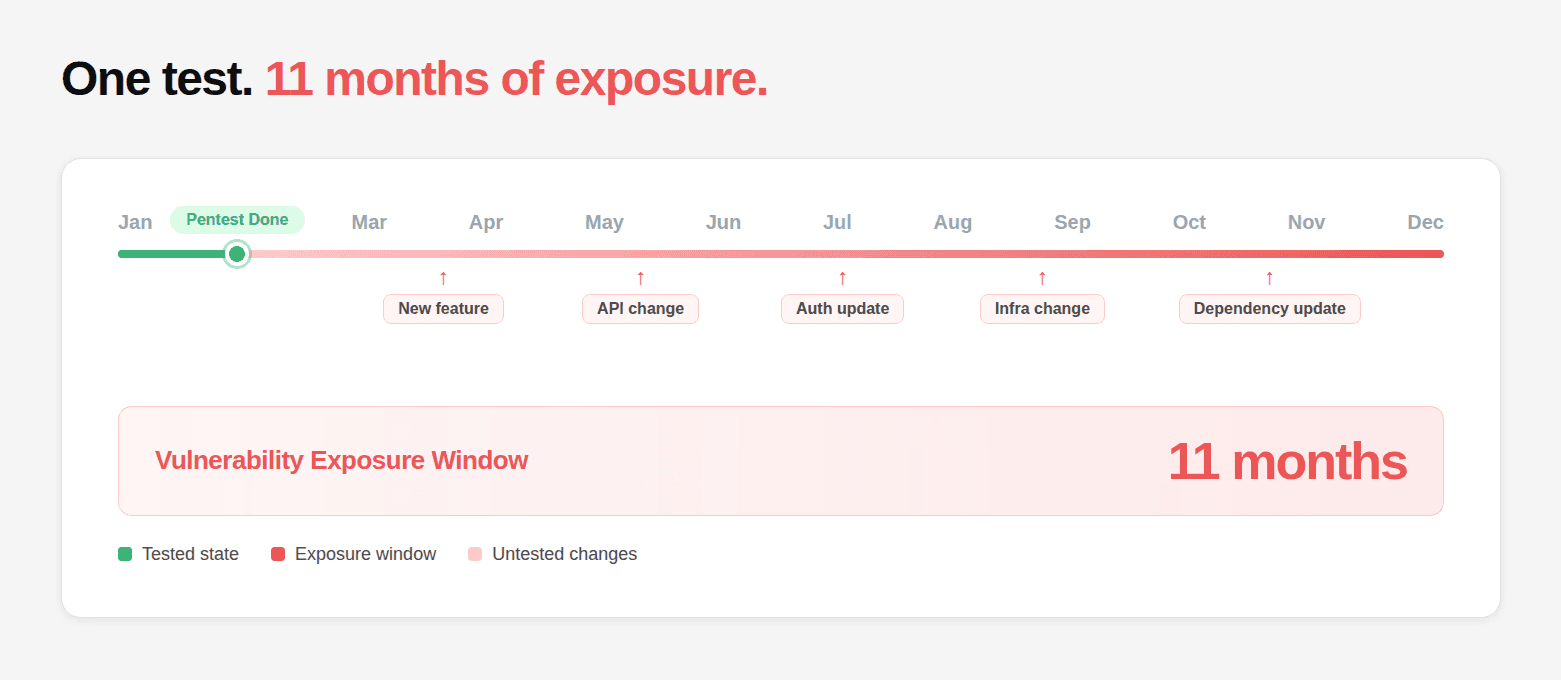
The result is what we can call the deployment velocity gap, the time between when a vulnerability enters the system and when it is actually detected.
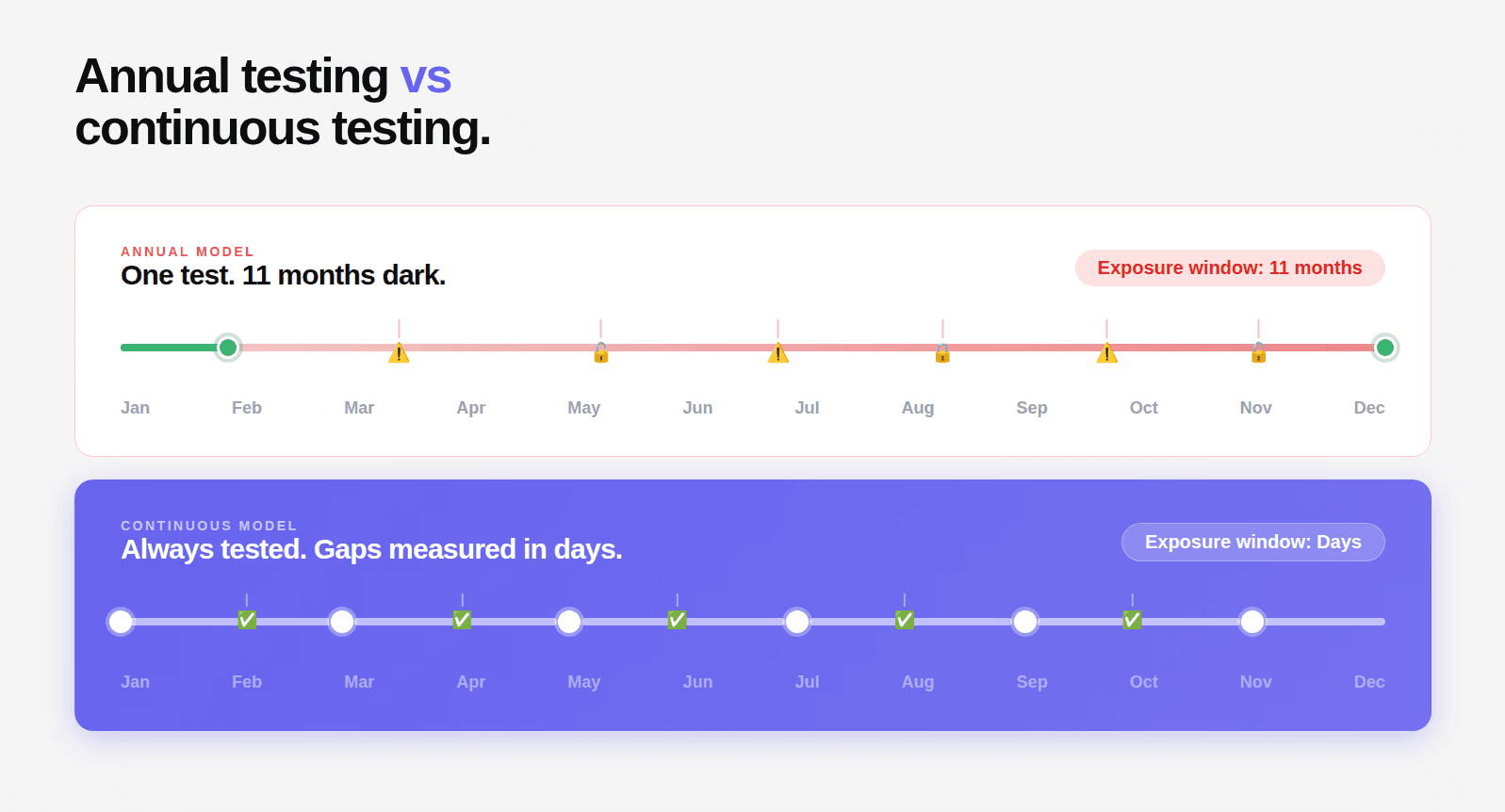
In an annual testing model, that gap can stretch for months. A system may be “secure” at the moment of testing, but every change that follows creates new, untested surface area. By the time the next test arrives, the application has already evolved far beyond what was originally evaluated.
This is not a failure of pentesting itself. It’s a mismatch between how often systems change and how often they are tested.
To understand why this gap exists, and why it continues to grow in modern engineering teams, we need to look at how annual penetration testing actually works in practice, and what it does (and does not) cover.
For a broader introduction to AI-driven security testing, see our AI penetration testing guide, which covers how AI pentesting works, its methodology, and how it differs from vulnerability scanning.
What Is Continuous Penetration Testing?
Continuous penetration testing is the practice of testing an application's security repeatedly as its attack surface changes, rather than relying on a single point-in-time penetration test each year. The goal is to reduce the time between a security-relevant change entering production and that change being evaluated through penetration testing.
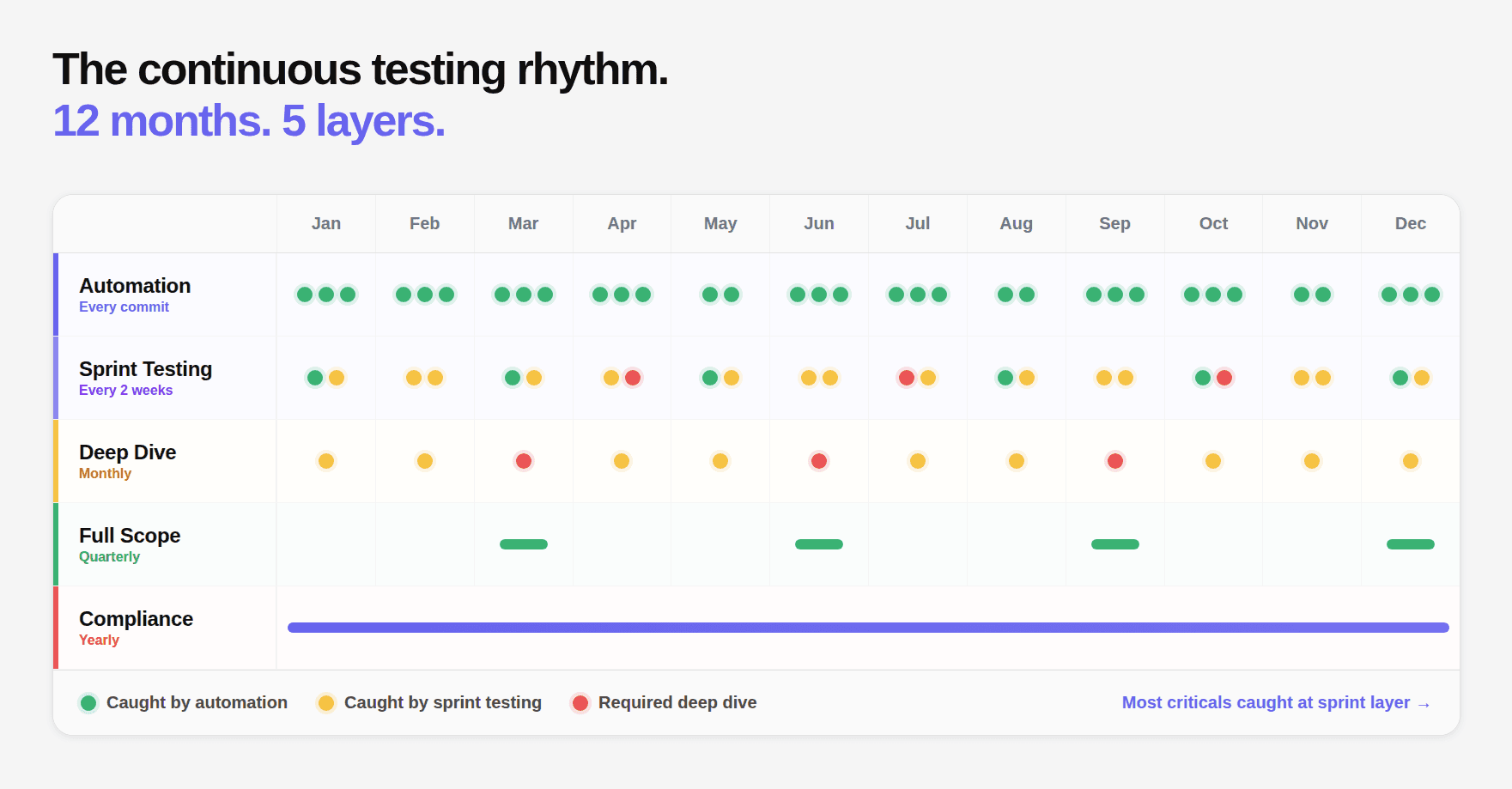
Unlike annual penetration testing, which evaluates the application during a defined engagement window, continuous penetration testing aligns security testing more closely with development and deployment activity. Depending on the organization's risk profile and release cadence, this can mean monthly, sprint-based, or targeted testing after significant changes.
Why Annual Pentesting Made Sense (And Where It Falls Short)
Annual penetration testing made sense when codebases and production environments changed less frequently.
A company might deploy new code on a slower cadence, with the same services and infrastructure remaining relatively stable between assessments. An annual test could therefore provide a useful snapshot of the application's security posture for a meaningful period of time.
Modern SaaS environments are different.
Engineering teams can ship code multiple times per week. New API endpoints get added. Authentication flows get updated. Third-party integrations get introduced. Infrastructure gets reconfigured. Each of these changes can alter the application's attack surface.
The problem is not that annual pentesting is bad security work. The problem is that it evaluates the application during a defined window, while the application continues to evolve after that assessment.
Annual pentesting therefore has two practical constraints:
It tests a moment in time. The engagement captures a snapshot of the application and infrastructure. The system that is tested during the engagement can change substantially after the assessment ends.
It tests a defined scope. A penetration test has a defined scope, testing window, and set of techniques. Rarely used workflows, newly introduced endpoints, configuration changes, and other attack paths may fall outside the assessment depending on the engagement.
As deployment velocity increases, both constraints become more important.
The question is therefore not whether annual penetration testing has value. It does. The question is whether the testing cadence matches the rate at which the application changes.
The Deployment Velocity Gap: How to Measure Your Actual Exposure
The deployment velocity gap is the time between when a security-relevant change is introduced into production and when that change is evaluated through security testing.
For an annual penetration testing program, the interval between formal assessments can be many months. If a new endpoint, authentication flow, integration, or infrastructure change introduces a security weakness shortly after an assessment, that change may remain outside the scope of penetration testing until the next engagement.
This is not abstract. You can calculate your organization's exposure by looking at two numbers:
How frequently do you deploy?
How frequently do you perform penetration testing?
def calculate_deployment_velocity_gap(test_interval_days,weekly_deployments):"""
Calculate your average vulnerability exposure window.
test_interval_days:365 = annual,90 = quarterly,30 = monthly
weekly_deployments:how many times code ships per week"""
# Average gap = half the testing intervalaverage_gap_days = test_interval_days / 2
# Total deployments between tests(all go untested until next engagement)total_deployments = (test_interval_days / 7) * weekly_deploymentsrisk_level = ("CRITICAL"ifaverage_gap_days > 90else"HIGH"ifaverage_gap_days > 45else"MEDIUM"ifaverage_gap_days > 14else"LOW")return{"average_exposure_window_days":average_gap_days,"max_exposure_window_days":test_interval_days,"untested_deployments_per_cycle":total_deployments,"risk_level":risk_level}
def calculate_deployment_velocity_gap(test_interval_days,weekly_deployments):"""
Calculate your average vulnerability exposure window.
test_interval_days:365 = annual,90 = quarterly,30 = monthly
weekly_deployments:how many times code ships per week"""
# Average gap = half the testing intervalaverage_gap_days = test_interval_days / 2
# Total deployments between tests(all go untested until next engagement)total_deployments = (test_interval_days / 7) * weekly_deploymentsrisk_level = ("CRITICAL"ifaverage_gap_days > 90else"HIGH"ifaverage_gap_days > 45else"MEDIUM"ifaverage_gap_days > 14else"LOW")return{"average_exposure_window_days":average_gap_days,"max_exposure_window_days":test_interval_days,"untested_deployments_per_cycle":total_deployments,"risk_level":risk_level}
def calculate_deployment_velocity_gap(test_interval_days,weekly_deployments):"""
Calculate your average vulnerability exposure window.
test_interval_days:365 = annual,90 = quarterly,30 = monthly
weekly_deployments:how many times code ships per week"""
# Average gap = half the testing intervalaverage_gap_days = test_interval_days / 2
# Total deployments between tests(all go untested until next engagement)total_deployments = (test_interval_days / 7) * weekly_deploymentsrisk_level = ("CRITICAL"ifaverage_gap_days > 90else"HIGH"ifaverage_gap_days > 45else"MEDIUM"ifaverage_gap_days > 14else"LOW")return{"average_exposure_window_days":average_gap_days,"max_exposure_window_days":test_interval_days,"untested_deployments_per_cycle":total_deployments,"risk_level":risk_level}
Annual pentesting,shipping 3x per weekannual = calculate_deployment_velocity_gap(365,3)→ average_exposure_window_days:182.5→ untested_deployments:156→ risk_level:CRITICALMonthly pentesting,shipping 3x per weekmonthly = calculate_deployment_velocity_gap(30,3)→ average_exposure_window_days:15→ untested_deployments:12.8→ risk_level:MEDIUM
Annual pentesting,shipping 3x per weekannual = calculate_deployment_velocity_gap(365,3)→ average_exposure_window_days:182.5→ untested_deployments:156→ risk_level:CRITICALMonthly pentesting,shipping 3x per weekmonthly = calculate_deployment_velocity_gap(30,3)→ average_exposure_window_days:15→ untested_deployments:12.8→ risk_level:MEDIUM
Annual pentesting,shipping 3x per weekannual = calculate_deployment_velocity_gap(365,3)→ average_exposure_window_days:182.5→ untested_deployments:156→ risk_level:CRITICALMonthly pentesting,shipping 3x per weekmonthly = calculate_deployment_velocity_gap(30,3)→ average_exposure_window_days:15→ untested_deployments:12.8→ risk_level:MEDIUM
For example, a team deploying several times per week may introduce hundreds of production changes between annual assessments. A monthly testing cadence reduces that interval considerably, while sprint-based or targeted testing can reduce it further for higher-risk changes.
The goal is not to test every deployment indiscriminately. It is to reduce the amount of time that meaningful changes to the attack surface remain untested.
That is the central problem continuous penetration testing is designed to address.
What Continuous Pentesting Actually Means
Continuous pentesting is the practice of running security assessments at a cadence that reflects how frequently your application and attack surface change, rather than relying exclusively on a single annual assessment.
What it does not mean: running a scanner on every commit. Fully automated testing does not automatically become penetration testing. A mature program still requires defined scope, authorization, controlled exploitation, validated findings, appropriate reporting, and human oversight.
What it does mean in practice:
Monthly testing: A recurring assessment evaluates the current production environment at a shorter interval than an annual engagement.
Sprint-cadence testing: Testing can be aligned with development cycles when the application changes frequently.
Targeted testing: Major features, authentication changes, new APIs, integrations, and other high-risk changes can trigger focused security assessments.
Integrated security lifecycle: Security testing can complement controls at the IDE, pull request, CI/CD, production, and remediation stages.
The key operational insight is that continuous pentesting is not defined by one specific frequency. The appropriate cadence depends on deployment velocity, application risk, attack surface, regulatory requirements, and the organization's ability to remediate findings.
How Often Should a SaaS Company Run a Penetration Test?
There is no single testing frequency that fits every SaaS company. A practical starting point is to align penetration testing with deployment velocity, application risk, regulatory requirements, and the organization's ability to remediate findings.
Pre-SOC 2 or early-stage SaaS: Quarterly testing can provide a stronger baseline than an annual assessment while the security program is being established.
Series A and growth-stage SaaS: Monthly or sprint-aligned testing can make sense when the application changes frequently and the attack surface is expanding.
Enterprise SaaS: Testing may need to be aligned with major releases, material architectural changes, high-risk applications, and recurring compliance requirements.
The important question is not simply how often a company can afford to test. It is how long a newly introduced security risk can remain untested.
Continuous Penetration Testing vs Annual Pentesting
Annual penetration testing
Continuous penetration testing
Testing frequency
Typically once per year
Monthly, sprint-based, or aligned to major releases
Average exposure window
Can extend for months between assessments
Reduced by shortening the interval between assessments
Cost model
Usually priced per engagement
Can be subscription, recurring engagement, or usage-based
Compliance coverage
Provides point-in-time assessment evidence
Can provide recurring evidence, but does not automatically replace compliance-specific testing requirements
Untested deployments/year
Potentially many, depending on release cadence
Fewer, depending on the testing cadence and scope
How AI Makes Continuous Penetration Testing More Practical
AI can change the economics and operational model of recurring penetration testing by automating parts of the assessment that traditionally require substantial manual effort.
Depending on the platform, AI can assist with:
Large-scale attack-surface discovery
Application and API mapping
Source-code comprehension
Test-case generation and adaptation
Vulnerability investigation
Exploit validation
Correlation between findings
Attack-path analysis
Evidence collection and reporting
Retesting after remediation
The important distinction is that automation does not automatically make an assessment a penetration test. A mature program still needs defined scope, authorization, controlled exploitation, human oversight, validated findings, and appropriate reporting.
For teams evaluating AI-driven approaches, CodeAnt AI's penetration testing platform combines automated testing with black-box, white-box, and gray-box assessment models.
How CodeAnt AI Makes Continuous Pentesting Operationally Possible
The reason traditional firms cannot support continuous pentesting is structural: their model requires a human consultant to manually work through a target over one to two weeks. You cannot compress that timeline or reduce the cost to a level that supports monthly testing.
CodeAnt AI's architecture was built from scratch for high-frequency, high-depth engagements.
500+ specialized exploit agents run concurrently. Where a consultant works sequentially through a target, our agents execute hundreds of targeted tests in parallel. What takes a human two weeks takes our system hours.
Every engagement builds on the last. The codebase intelligence accumulated from prior engagements, every insecure call pattern, every API structure, every authentication flow, informs the next test. Each engagement is deeper than the one before it. No external firm can do this. They start from scratch every time.
This is the Grey Box + Code Memory advantage. By the time the penetration test runs, our engine has already learned your codebase from the defensive phases, IDE scanning, PR review, CI/CD analysis. We re-attack using everything we learned. An attacker who has never seen your code does not have this. We do.
48-hour report delivery. Traditional firms take 2–4 weeks from engagement start to report delivery. Our full engagement, reconnaissance, source code analysis, JS bundle intelligence, blackbox execution with WAF evasion, attack chain construction, evidence-based reporting, completes in 48 hours.
Unlimited retests at no additional cost. When a finding is remediated, we verify the fix. If it is not fully closed, we keep testing until it is. No new engagement required, no additional billing.
The practical result: monthly pentesting at a price point that is sustainable, with report turnaround that does not block your engineering team. Check out our agentic pentesting here.
Sprint-Cadence Testing: Aligning Security With Development
For engineering teams shipping every 1–2 weeks, sprint-cadence testing can bring security validation closer to the way the application changes.
The goal is not necessarily to perform a full penetration test after every sprint. Instead, security teams can use deployment and architectural changes to determine when a deeper assessment is warranted.
class SprintSecurityTestingProgram:
"""
Operationalizes sprint-cadence security testing.
Each sprint's changed components are tested before the next sprint begins.
"""def__init__(self,repo_url: str,pentest_team_contact: str):
self.repo_url = repo_urlself.pentest_team = pentest_team_contactself.sprint_history = []defanalyze_sprint_changes(self,sprint_start: datetime.date,sprint_end: datetime.date,merged_prs: list) -> dict:
"""
Analyze what changed in a sprint to determine security testing scope.
"""changed_components = {'authentication': [],# Changes to auth logic'authorization': [],# Changes to access control'api_endpoints': [],# New or modified endpoints'data_access': [],# ORM, database query changes'external_integrations': [],# Third-party API changes'infrastructure': [],# IaC, Kubernetes, CI/CD changes'dependencies': [],# package.json, requirements.txt changes'configuration': [],# Config files, environment changes}security_relevant_prs = []forprinmerged_prs:
files_changed = pr.get('files_changed',[])# Classify changes by security relevanceclassifications = []forfileinfiles_changed:
ifany(patterninfile.lower()forpatternin['auth','login','jwt','token','session','oauth']):
changed_components['authentication'].append(file)classifications.append('authentication')elifany(patterninfile.lower()forpatternin['permission','role','acl','policy','rbac','middleware']):
changed_components['authorization'].append(file)classifications.append('authorization')elifany(patterninfile.lower()forpatternin['routes','views','controllers','handlers','api']):
changed_components['api_endpoints'].append(file)classifications.append('api_endpoints')elifany(patterninfile.lower()forpatternin['models','queries','repository','dao','db','orm']):
changed_components['data_access'].append(file)classifications.append('data_access')eliffilein['package.json','package-lock.json','requirements.txt','Pipfile','pom.xml','build.gradle','go.mod']:
changed_components['dependencies'].append(file)classifications.append('dependencies')elifany(patterninfile.lower()forpatternin['kubernetes','k8s','helm','terraform','bicep','.github/workflows','jenkinsfile','dockerfile']):
changed_components['infrastructure'].append(file)classifications.append('infrastructure')ifclassifications:
security_relevant_prs.append({'pr_number': pr.get('number'),'title': pr.get('title'),'author': pr.get('author'),'security_categories': list(set(classifications)),'files_changed': len(files_changed),'security_relevant_files': [fforfinfiles_changedifany(catinf.lower()forcatin['auth','api','model','route','middleware'])]})# Determine test depth required for this sprintrisk_score = (len(changed_components['authentication']) * 10 + # Highest weightlen(changed_components['authorization']) * 8 +
len(changed_components['api_endpoints']) * 5 +
len(changed_components['data_access']) * 6 +
len(changed_components['infrastructure']) * 7 +
len(changed_components['external_integrations']) * 5 +
len(changed_components['dependencies']) * 3)return{'sprint_start': sprint_start.isoformat(),'sprint_end': sprint_end.isoformat(),'total_prs': len(merged_prs),'security_relevant_prs': len(security_relevant_prs),'changed_components': changed_components,'sprint_risk_score': risk_score,'recommended_test_depth': self.classify_test_depth(risk_score),'estimated_test_hours': self.estimate_test_hours(risk_score),'priority_areas': self.identify_priority_areas(changed_components),'security_relevant_pr_details': security_relevant_prs}defclassify_test_depth(self,risk_score: int) -> str:
ifrisk_score > 100:
return'FULL_DEPTH — Authentication changes require complete auth chain review'elifrisk_score > 50:
return'TARGETED_DEEP — Multiple security-relevant changes require deep testing'elifrisk_score > 20:
return'TARGETED_STANDARD — Specific changed components need focused testing'else:
return'LIGHTWEIGHT — Minor changes, automated testing sufficient'defestimate_test_hours(self,risk_score: int) -> str:
ifrisk_score > 100:
return'8–16 hours'elifrisk_score > 50:
return'4–8 hours'elifrisk_score > 20:
return'2–4 hours'else:
return'1–2 hours'defidentify_priority_areas(self,changed_components: dict) -> list:
priorities = []ifchanged_components['authentication']:
priorities.append({'area': 'Authentication','priority': 1,'reason': 'Auth changes have highest security impact','test_focus': 'JWT validation, session management, MFA bypass, brute force'})ifchanged_components['authorization']:
priorities.append({'area': 'Authorization','priority': 2,'reason': 'Access control changes may introduce privilege escalation','test_focus': 'RBAC, IDOR, cross-tenant access, role bypass'})ifchanged_components['data_access']:
priorities.append({'area': 'Data Access Layer','priority': 3,'reason': 'ORM changes may introduce injection or IDOR','test_focus': 'SQL injection, NoSQL injection, ownership filter presence'})returnsorted(priorities,key=lambdax: x['priority'])
class SprintSecurityTestingProgram:
"""
Operationalizes sprint-cadence security testing.
Each sprint's changed components are tested before the next sprint begins.
"""def__init__(self,repo_url: str,pentest_team_contact: str):
self.repo_url = repo_urlself.pentest_team = pentest_team_contactself.sprint_history = []defanalyze_sprint_changes(self,sprint_start: datetime.date,sprint_end: datetime.date,merged_prs: list) -> dict:
"""
Analyze what changed in a sprint to determine security testing scope.
"""changed_components = {'authentication': [],# Changes to auth logic'authorization': [],# Changes to access control'api_endpoints': [],# New or modified endpoints'data_access': [],# ORM, database query changes'external_integrations': [],# Third-party API changes'infrastructure': [],# IaC, Kubernetes, CI/CD changes'dependencies': [],# package.json, requirements.txt changes'configuration': [],# Config files, environment changes}security_relevant_prs = []forprinmerged_prs:
files_changed = pr.get('files_changed',[])# Classify changes by security relevanceclassifications = []forfileinfiles_changed:
ifany(patterninfile.lower()forpatternin['auth','login','jwt','token','session','oauth']):
changed_components['authentication'].append(file)classifications.append('authentication')elifany(patterninfile.lower()forpatternin['permission','role','acl','policy','rbac','middleware']):
changed_components['authorization'].append(file)classifications.append('authorization')elifany(patterninfile.lower()forpatternin['routes','views','controllers','handlers','api']):
changed_components['api_endpoints'].append(file)classifications.append('api_endpoints')elifany(patterninfile.lower()forpatternin['models','queries','repository','dao','db','orm']):
changed_components['data_access'].append(file)classifications.append('data_access')eliffilein['package.json','package-lock.json','requirements.txt','Pipfile','pom.xml','build.gradle','go.mod']:
changed_components['dependencies'].append(file)classifications.append('dependencies')elifany(patterninfile.lower()forpatternin['kubernetes','k8s','helm','terraform','bicep','.github/workflows','jenkinsfile','dockerfile']):
changed_components['infrastructure'].append(file)classifications.append('infrastructure')ifclassifications:
security_relevant_prs.append({'pr_number': pr.get('number'),'title': pr.get('title'),'author': pr.get('author'),'security_categories': list(set(classifications)),'files_changed': len(files_changed),'security_relevant_files': [fforfinfiles_changedifany(catinf.lower()forcatin['auth','api','model','route','middleware'])]})# Determine test depth required for this sprintrisk_score = (len(changed_components['authentication']) * 10 + # Highest weightlen(changed_components['authorization']) * 8 +
len(changed_components['api_endpoints']) * 5 +
len(changed_components['data_access']) * 6 +
len(changed_components['infrastructure']) * 7 +
len(changed_components['external_integrations']) * 5 +
len(changed_components['dependencies']) * 3)return{'sprint_start': sprint_start.isoformat(),'sprint_end': sprint_end.isoformat(),'total_prs': len(merged_prs),'security_relevant_prs': len(security_relevant_prs),'changed_components': changed_components,'sprint_risk_score': risk_score,'recommended_test_depth': self.classify_test_depth(risk_score),'estimated_test_hours': self.estimate_test_hours(risk_score),'priority_areas': self.identify_priority_areas(changed_components),'security_relevant_pr_details': security_relevant_prs}defclassify_test_depth(self,risk_score: int) -> str:
ifrisk_score > 100:
return'FULL_DEPTH — Authentication changes require complete auth chain review'elifrisk_score > 50:
return'TARGETED_DEEP — Multiple security-relevant changes require deep testing'elifrisk_score > 20:
return'TARGETED_STANDARD — Specific changed components need focused testing'else:
return'LIGHTWEIGHT — Minor changes, automated testing sufficient'defestimate_test_hours(self,risk_score: int) -> str:
ifrisk_score > 100:
return'8–16 hours'elifrisk_score > 50:
return'4–8 hours'elifrisk_score > 20:
return'2–4 hours'else:
return'1–2 hours'defidentify_priority_areas(self,changed_components: dict) -> list:
priorities = []ifchanged_components['authentication']:
priorities.append({'area': 'Authentication','priority': 1,'reason': 'Auth changes have highest security impact','test_focus': 'JWT validation, session management, MFA bypass, brute force'})ifchanged_components['authorization']:
priorities.append({'area': 'Authorization','priority': 2,'reason': 'Access control changes may introduce privilege escalation','test_focus': 'RBAC, IDOR, cross-tenant access, role bypass'})ifchanged_components['data_access']:
priorities.append({'area': 'Data Access Layer','priority': 3,'reason': 'ORM changes may introduce injection or IDOR','test_focus': 'SQL injection, NoSQL injection, ownership filter presence'})returnsorted(priorities,key=lambdax: x['priority'])
class SprintSecurityTestingProgram:
"""
Operationalizes sprint-cadence security testing.
Each sprint's changed components are tested before the next sprint begins.
"""def__init__(self,repo_url: str,pentest_team_contact: str):
self.repo_url = repo_urlself.pentest_team = pentest_team_contactself.sprint_history = []defanalyze_sprint_changes(self,sprint_start: datetime.date,sprint_end: datetime.date,merged_prs: list) -> dict:
"""
Analyze what changed in a sprint to determine security testing scope.
"""changed_components = {'authentication': [],# Changes to auth logic'authorization': [],# Changes to access control'api_endpoints': [],# New or modified endpoints'data_access': [],# ORM, database query changes'external_integrations': [],# Third-party API changes'infrastructure': [],# IaC, Kubernetes, CI/CD changes'dependencies': [],# package.json, requirements.txt changes'configuration': [],# Config files, environment changes}security_relevant_prs = []forprinmerged_prs:
files_changed = pr.get('files_changed',[])# Classify changes by security relevanceclassifications = []forfileinfiles_changed:
ifany(patterninfile.lower()forpatternin['auth','login','jwt','token','session','oauth']):
changed_components['authentication'].append(file)classifications.append('authentication')elifany(patterninfile.lower()forpatternin['permission','role','acl','policy','rbac','middleware']):
changed_components['authorization'].append(file)classifications.append('authorization')elifany(patterninfile.lower()forpatternin['routes','views','controllers','handlers','api']):
changed_components['api_endpoints'].append(file)classifications.append('api_endpoints')elifany(patterninfile.lower()forpatternin['models','queries','repository','dao','db','orm']):
changed_components['data_access'].append(file)classifications.append('data_access')eliffilein['package.json','package-lock.json','requirements.txt','Pipfile','pom.xml','build.gradle','go.mod']:
changed_components['dependencies'].append(file)classifications.append('dependencies')elifany(patterninfile.lower()forpatternin['kubernetes','k8s','helm','terraform','bicep','.github/workflows','jenkinsfile','dockerfile']):
changed_components['infrastructure'].append(file)classifications.append('infrastructure')ifclassifications:
security_relevant_prs.append({'pr_number': pr.get('number'),'title': pr.get('title'),'author': pr.get('author'),'security_categories': list(set(classifications)),'files_changed': len(files_changed),'security_relevant_files': [fforfinfiles_changedifany(catinf.lower()forcatin['auth','api','model','route','middleware'])]})# Determine test depth required for this sprintrisk_score = (len(changed_components['authentication']) * 10 + # Highest weightlen(changed_components['authorization']) * 8 +
len(changed_components['api_endpoints']) * 5 +
len(changed_components['data_access']) * 6 +
len(changed_components['infrastructure']) * 7 +
len(changed_components['external_integrations']) * 5 +
len(changed_components['dependencies']) * 3)return{'sprint_start': sprint_start.isoformat(),'sprint_end': sprint_end.isoformat(),'total_prs': len(merged_prs),'security_relevant_prs': len(security_relevant_prs),'changed_components': changed_components,'sprint_risk_score': risk_score,'recommended_test_depth': self.classify_test_depth(risk_score),'estimated_test_hours': self.estimate_test_hours(risk_score),'priority_areas': self.identify_priority_areas(changed_components),'security_relevant_pr_details': security_relevant_prs}defclassify_test_depth(self,risk_score: int) -> str:
ifrisk_score > 100:
return'FULL_DEPTH — Authentication changes require complete auth chain review'elifrisk_score > 50:
return'TARGETED_DEEP — Multiple security-relevant changes require deep testing'elifrisk_score > 20:
return'TARGETED_STANDARD — Specific changed components need focused testing'else:
return'LIGHTWEIGHT — Minor changes, automated testing sufficient'defestimate_test_hours(self,risk_score: int) -> str:
ifrisk_score > 100:
return'8–16 hours'elifrisk_score > 50:
return'4–8 hours'elifrisk_score > 20:
return'2–4 hours'else:
return'1–2 hours'defidentify_priority_areas(self,changed_components: dict) -> list:
priorities = []ifchanged_components['authentication']:
priorities.append({'area': 'Authentication','priority': 1,'reason': 'Auth changes have highest security impact','test_focus': 'JWT validation, session management, MFA bypass, brute force'})ifchanged_components['authorization']:
priorities.append({'area': 'Authorization','priority': 2,'reason': 'Access control changes may introduce privilege escalation','test_focus': 'RBAC, IDOR, cross-tenant access, role bypass'})ifchanged_components['data_access']:
priorities.append({'area': 'Data Access Layer','priority': 3,'reason': 'ORM changes may introduce injection or IDOR','test_focus': 'SQL injection, NoSQL injection, ownership filter presence'})returnsorted(priorities,key=lambdax: x['priority'])
Changes to authentication, authorization, payment flows, externally exposed APIs, infrastructure, or major application functionality can justify targeted testing, while broader recurring assessments can provide deeper coverage across the application.
This approach allows penetration testing to become part of the development and release lifecycle without treating every code change as a full penetration testing engagement.
The Economics: Annual vs Continuous Total Cost of Ownership
The Economics: What Changes When Testing Becomes Continuous?
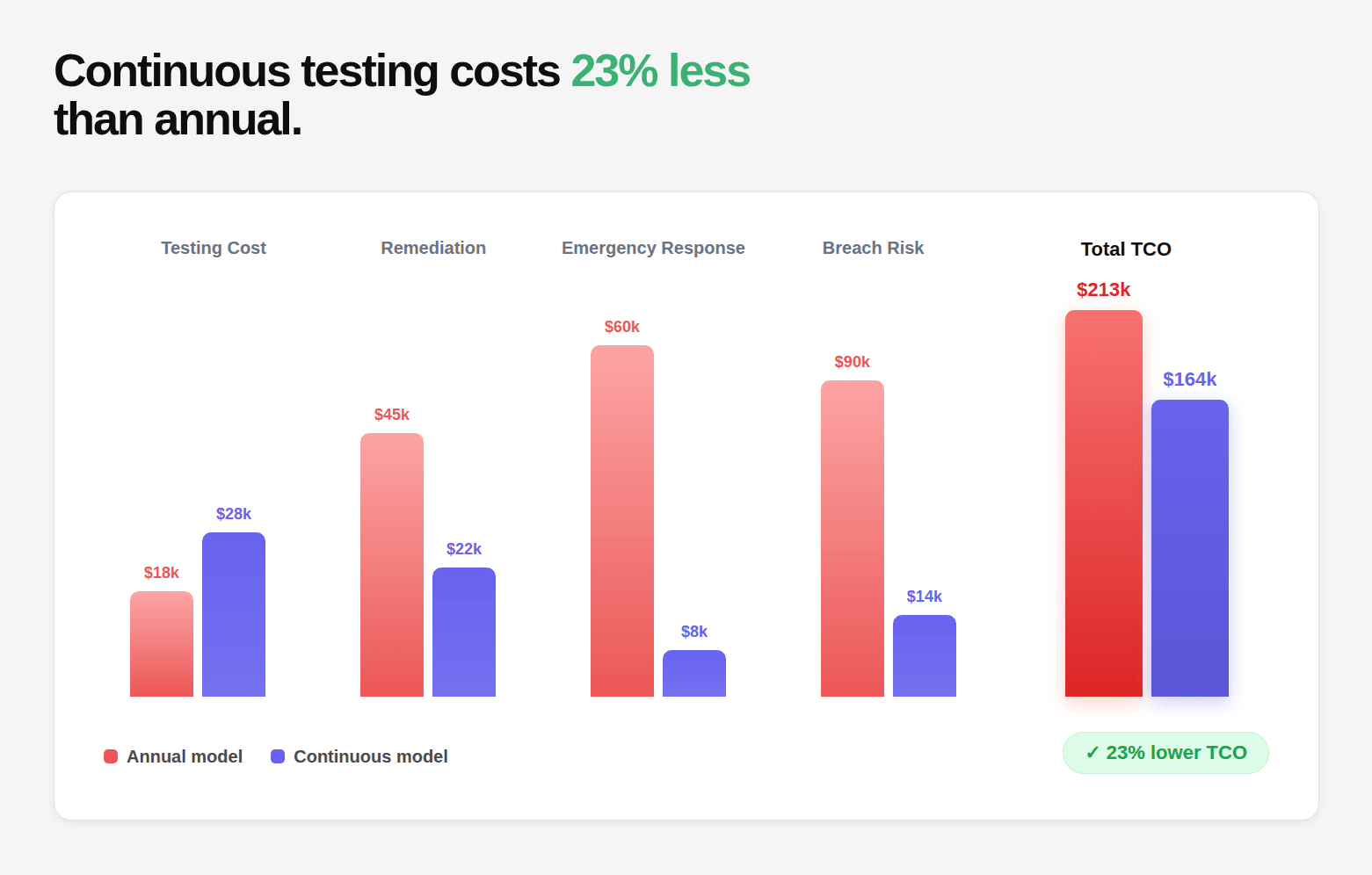
The cost of continuous penetration testing cannot be compared with an annual pentest by looking only at the invoice.
A useful comparison includes:
Cost factor
Annual model
Continuous model
Assessment cost
Larger point-in-time engagements
Smaller recurring or usage-based assessments
Retesting
May be a separate engagement
Often incorporated into the recurring model
Engineering effort
Findings may arrive in batches
Findings can arrive closer to when changes are introduced
Compliance evidence
Periodic assessment evidence
Recurring evidence, depending on the provider and framework
Exposure window
Longer between assessments
Shorter when testing cadence is higher
Operational overhead
Concentrated around assessment periods
Distributed throughout the development cycle
The surface-level cost comparison (annual pentest = one invoice) consistently underestimates the true cost of the annual model and overestimates the cost of continuous testing:
defcalculate_tco_comparison(org_profile: dict) -> dict:
"""
Calculate Total Cost of Ownership for annual vs continuous security testing.
Includes direct costs, breach probability adjustment, and remediation costs.
"""# Organization profile inputsannual_revenue = org_profile['annual_revenue']deployment_frequency_per_year = org_profile['deployments_per_year']engineering_team_size = org_profile['engineering_team_size']avg_engineer_hourly_cost = org_profile['avg_engineer_hourly_cost']breach_probability_annual = org_profile['estimated_breach_probability']# e.g., 0.15 = 15%avg_breach_cost = org_profile['avg_breach_cost']# all-in cost if breach occurs# ═══════════════════════════════════════════════════════# ANNUAL PENETRATION TESTING MODEL# ═══════════════════════════════════════════════════════annual_model = {}# Direct costsannual_model['pentest_cost'] = 25000# Typical annual pentest (1 week, 1-2 testers)annual_model['retest_cost'] = 8000# Retest after remediation# Engineering remediation costs# Average: 8 findings, 3 days engineering per findingavg_findings = 8avg_remediation_days = 3annual_model['engineering_remediation_cost'] = (avg_findings * avg_remediation_days * 8 * # 8 hours/dayavg_engineer_hourly_cost)# Emergency response costs (for critical findings discovered late)# Annual model has longer gap → higher probability of undetected critical issue# that then requires emergency responseprob_emergency_response = 0.35# 35% chance of emergency security incidentavg_emergency_response_cost = 50000# War room, hotfix, communicationannual_model['expected_emergency_response_cost'] = (prob_emergency_response * avg_emergency_response_cost)# Alert fatigue / wasted engineering time on non-exploitable findings# Annual test typically has higher percentage of false positives vs continuousannual_model['false_positive_remediation_waste'] = (avg_findings * 0.3 * # 30% false positive rate for annual2 * 8 * # 2 days to discover and document it's a false positiveavg_engineer_hourly_cost)# Breach risk — adjusted for longer exposure window# Annual model has ~180 day average undetected vulnerability window# Breach probability scales with exposure windowexposure_window_days_annual = 180annual_model['adjusted_breach_probability'] = breach_probability_annual * (exposure_window_days_annual / 365)annual_model['expected_breach_cost'] = (annual_model['adjusted_breach_probability'] * avg_breach_cost)annual_model['total_direct_cost'] = (annual_model['pentest_cost'] +
annual_model['retest_cost'] +
annual_model['engineering_remediation_cost'] +
annual_model['expected_emergency_response_cost'] +
annual_model['false_positive_remediation_waste'])annual_model['total_tco'] = (annual_model['total_direct_cost'] +
annual_model['expected_breach_cost'])# ═══════════════════════════════════════════════════════# CONTINUOUS PENETRATION TESTING MODEL# ═══════════════════════════════════════════════════════continuous_model = {}# Direct costs — subscription modelcontinuous_model['monthly_subscription'] = 4500# Typical continuous programcontinuous_model['annual_subscription_cost'] = continuous_model['monthly_subscription'] * 12# Engineering remediation costs — findings caught earlier are cheaper to fix# Studies show: 6x cheaper to fix in development vs production# Continuous testing catches most issues within 2 weeks of introductioncontinuous_avg_findings = 12# More findings per year (nothing escapes for 11 months)continuous_avg_remediation_days = 1.5# Caught earlier = simpler fix (feature branch)continuous_model['engineering_remediation_cost'] = (continuous_avg_findings * continuous_avg_remediation_days * 8 *
avg_engineer_hourly_cost)# Emergency response costs — much lower (issues caught before breach)prob_emergency_response_continuous = 0.08# 8% vs 35% for annualcontinuous_model['expected_emergency_response_cost'] = (prob_emergency_response_continuous * avg_emergency_response_cost)# Near-zero false positive waste — continuous testing is more targetedcontinuous_model['false_positive_remediation_waste'] = (continuous_avg_findings * 0.05 * # 5% false positive rate1 * 8 *
avg_engineer_hourly_cost)# Breach risk — dramatically reduced exposure windowexposure_window_days_continuous = 14# 2-week sprint cadencecontinuous_model['adjusted_breach_probability'] = breach_probability_annual * (exposure_window_days_continuous / 365)continuous_model['expected_breach_cost'] = (continuous_model['adjusted_breach_probability'] * avg_breach_cost)continuous_model['total_direct_cost'] = (continuous_model['annual_subscription_cost'] +
continuous_model['engineering_remediation_cost'] +
continuous_model['expected_emergency_response_cost'] +
continuous_model['false_positive_remediation_waste'])continuous_model['total_tco'] = (continuous_model['total_direct_cost'] +
continuous_model['expected_breach_cost'])# Comparisontco_savings = annual_model['total_tco'] - continuous_model['total_tco']return{'organization_profile': org_profile,'annual_model': annual_model,'continuous_model': continuous_model,'comparison': {'annual_tco': round(annual_model['total_tco']),'continuous_tco': round(continuous_model['total_tco']),'tco_savings': round(tco_savings),'savings_percentage': round((tco_savings / annual_model['total_tco']) * 100,1),'breakeven_required_breach_probability': (annual_model['total_direct_cost'] - continuous_model['total_direct_cost']) / avg_breach_cost,'recommendation': 'Continuous'iftco_savings > 0else'Annual','primary_savings_driver': ('Breach risk reduction'ifcontinuous_model['expected_breach_cost'] <
annual_model['expected_breach_cost'] * 0.5else'Engineering efficiency')}}# Example calculation:example_org = {'annual_revenue': 10_000_000,'deployments_per_year': 52,# Weekly releases'engineering_team_size': 15,'avg_engineer_hourly_cost': 100,'estimated_breach_probability': 0.12,# 12% annual breach probability'avg_breach_cost': 500_000}result = calculate_tco_comparison(example_org)print(f"Annual model TCO: ${result['comparison']['annual_tco']:,}")print(f"Continuous model TCO: ${result['comparison']['continuous_tco']:,}")print(f"Expected savings: ${result['comparison']['tco_savings']:,}")
defcalculate_tco_comparison(org_profile: dict) -> dict:
"""
Calculate Total Cost of Ownership for annual vs continuous security testing.
Includes direct costs, breach probability adjustment, and remediation costs.
"""# Organization profile inputsannual_revenue = org_profile['annual_revenue']deployment_frequency_per_year = org_profile['deployments_per_year']engineering_team_size = org_profile['engineering_team_size']avg_engineer_hourly_cost = org_profile['avg_engineer_hourly_cost']breach_probability_annual = org_profile['estimated_breach_probability']# e.g., 0.15 = 15%avg_breach_cost = org_profile['avg_breach_cost']# all-in cost if breach occurs# ═══════════════════════════════════════════════════════# ANNUAL PENETRATION TESTING MODEL# ═══════════════════════════════════════════════════════annual_model = {}# Direct costsannual_model['pentest_cost'] = 25000# Typical annual pentest (1 week, 1-2 testers)annual_model['retest_cost'] = 8000# Retest after remediation# Engineering remediation costs# Average: 8 findings, 3 days engineering per findingavg_findings = 8avg_remediation_days = 3annual_model['engineering_remediation_cost'] = (avg_findings * avg_remediation_days * 8 * # 8 hours/dayavg_engineer_hourly_cost)# Emergency response costs (for critical findings discovered late)# Annual model has longer gap → higher probability of undetected critical issue# that then requires emergency responseprob_emergency_response = 0.35# 35% chance of emergency security incidentavg_emergency_response_cost = 50000# War room, hotfix, communicationannual_model['expected_emergency_response_cost'] = (prob_emergency_response * avg_emergency_response_cost)# Alert fatigue / wasted engineering time on non-exploitable findings# Annual test typically has higher percentage of false positives vs continuousannual_model['false_positive_remediation_waste'] = (avg_findings * 0.3 * # 30% false positive rate for annual2 * 8 * # 2 days to discover and document it's a false positiveavg_engineer_hourly_cost)# Breach risk — adjusted for longer exposure window# Annual model has ~180 day average undetected vulnerability window# Breach probability scales with exposure windowexposure_window_days_annual = 180annual_model['adjusted_breach_probability'] = breach_probability_annual * (exposure_window_days_annual / 365)annual_model['expected_breach_cost'] = (annual_model['adjusted_breach_probability'] * avg_breach_cost)annual_model['total_direct_cost'] = (annual_model['pentest_cost'] +
annual_model['retest_cost'] +
annual_model['engineering_remediation_cost'] +
annual_model['expected_emergency_response_cost'] +
annual_model['false_positive_remediation_waste'])annual_model['total_tco'] = (annual_model['total_direct_cost'] +
annual_model['expected_breach_cost'])# ═══════════════════════════════════════════════════════# CONTINUOUS PENETRATION TESTING MODEL# ═══════════════════════════════════════════════════════continuous_model = {}# Direct costs — subscription modelcontinuous_model['monthly_subscription'] = 4500# Typical continuous programcontinuous_model['annual_subscription_cost'] = continuous_model['monthly_subscription'] * 12# Engineering remediation costs — findings caught earlier are cheaper to fix# Studies show: 6x cheaper to fix in development vs production# Continuous testing catches most issues within 2 weeks of introductioncontinuous_avg_findings = 12# More findings per year (nothing escapes for 11 months)continuous_avg_remediation_days = 1.5# Caught earlier = simpler fix (feature branch)continuous_model['engineering_remediation_cost'] = (continuous_avg_findings * continuous_avg_remediation_days * 8 *
avg_engineer_hourly_cost)# Emergency response costs — much lower (issues caught before breach)prob_emergency_response_continuous = 0.08# 8% vs 35% for annualcontinuous_model['expected_emergency_response_cost'] = (prob_emergency_response_continuous * avg_emergency_response_cost)# Near-zero false positive waste — continuous testing is more targetedcontinuous_model['false_positive_remediation_waste'] = (continuous_avg_findings * 0.05 * # 5% false positive rate1 * 8 *
avg_engineer_hourly_cost)# Breach risk — dramatically reduced exposure windowexposure_window_days_continuous = 14# 2-week sprint cadencecontinuous_model['adjusted_breach_probability'] = breach_probability_annual * (exposure_window_days_continuous / 365)continuous_model['expected_breach_cost'] = (continuous_model['adjusted_breach_probability'] * avg_breach_cost)continuous_model['total_direct_cost'] = (continuous_model['annual_subscription_cost'] +
continuous_model['engineering_remediation_cost'] +
continuous_model['expected_emergency_response_cost'] +
continuous_model['false_positive_remediation_waste'])continuous_model['total_tco'] = (continuous_model['total_direct_cost'] +
continuous_model['expected_breach_cost'])# Comparisontco_savings = annual_model['total_tco'] - continuous_model['total_tco']return{'organization_profile': org_profile,'annual_model': annual_model,'continuous_model': continuous_model,'comparison': {'annual_tco': round(annual_model['total_tco']),'continuous_tco': round(continuous_model['total_tco']),'tco_savings': round(tco_savings),'savings_percentage': round((tco_savings / annual_model['total_tco']) * 100,1),'breakeven_required_breach_probability': (annual_model['total_direct_cost'] - continuous_model['total_direct_cost']) / avg_breach_cost,'recommendation': 'Continuous'iftco_savings > 0else'Annual','primary_savings_driver': ('Breach risk reduction'ifcontinuous_model['expected_breach_cost'] <
annual_model['expected_breach_cost'] * 0.5else'Engineering efficiency')}}# Example calculation:example_org = {'annual_revenue': 10_000_000,'deployments_per_year': 52,# Weekly releases'engineering_team_size': 15,'avg_engineer_hourly_cost': 100,'estimated_breach_probability': 0.12,# 12% annual breach probability'avg_breach_cost': 500_000}result = calculate_tco_comparison(example_org)print(f"Annual model TCO: ${result['comparison']['annual_tco']:,}")print(f"Continuous model TCO: ${result['comparison']['continuous_tco']:,}")print(f"Expected savings: ${result['comparison']['tco_savings']:,}")
defcalculate_tco_comparison(org_profile: dict) -> dict:
"""
Calculate Total Cost of Ownership for annual vs continuous security testing.
Includes direct costs, breach probability adjustment, and remediation costs.
"""# Organization profile inputsannual_revenue = org_profile['annual_revenue']deployment_frequency_per_year = org_profile['deployments_per_year']engineering_team_size = org_profile['engineering_team_size']avg_engineer_hourly_cost = org_profile['avg_engineer_hourly_cost']breach_probability_annual = org_profile['estimated_breach_probability']# e.g., 0.15 = 15%avg_breach_cost = org_profile['avg_breach_cost']# all-in cost if breach occurs# ═══════════════════════════════════════════════════════# ANNUAL PENETRATION TESTING MODEL# ═══════════════════════════════════════════════════════annual_model = {}# Direct costsannual_model['pentest_cost'] = 25000# Typical annual pentest (1 week, 1-2 testers)annual_model['retest_cost'] = 8000# Retest after remediation# Engineering remediation costs# Average: 8 findings, 3 days engineering per findingavg_findings = 8avg_remediation_days = 3annual_model['engineering_remediation_cost'] = (avg_findings * avg_remediation_days * 8 * # 8 hours/dayavg_engineer_hourly_cost)# Emergency response costs (for critical findings discovered late)# Annual model has longer gap → higher probability of undetected critical issue# that then requires emergency responseprob_emergency_response = 0.35# 35% chance of emergency security incidentavg_emergency_response_cost = 50000# War room, hotfix, communicationannual_model['expected_emergency_response_cost'] = (prob_emergency_response * avg_emergency_response_cost)# Alert fatigue / wasted engineering time on non-exploitable findings# Annual test typically has higher percentage of false positives vs continuousannual_model['false_positive_remediation_waste'] = (avg_findings * 0.3 * # 30% false positive rate for annual2 * 8 * # 2 days to discover and document it's a false positiveavg_engineer_hourly_cost)# Breach risk — adjusted for longer exposure window# Annual model has ~180 day average undetected vulnerability window# Breach probability scales with exposure windowexposure_window_days_annual = 180annual_model['adjusted_breach_probability'] = breach_probability_annual * (exposure_window_days_annual / 365)annual_model['expected_breach_cost'] = (annual_model['adjusted_breach_probability'] * avg_breach_cost)annual_model['total_direct_cost'] = (annual_model['pentest_cost'] +
annual_model['retest_cost'] +
annual_model['engineering_remediation_cost'] +
annual_model['expected_emergency_response_cost'] +
annual_model['false_positive_remediation_waste'])annual_model['total_tco'] = (annual_model['total_direct_cost'] +
annual_model['expected_breach_cost'])# ═══════════════════════════════════════════════════════# CONTINUOUS PENETRATION TESTING MODEL# ═══════════════════════════════════════════════════════continuous_model = {}# Direct costs — subscription modelcontinuous_model['monthly_subscription'] = 4500# Typical continuous programcontinuous_model['annual_subscription_cost'] = continuous_model['monthly_subscription'] * 12# Engineering remediation costs — findings caught earlier are cheaper to fix# Studies show: 6x cheaper to fix in development vs production# Continuous testing catches most issues within 2 weeks of introductioncontinuous_avg_findings = 12# More findings per year (nothing escapes for 11 months)continuous_avg_remediation_days = 1.5# Caught earlier = simpler fix (feature branch)continuous_model['engineering_remediation_cost'] = (continuous_avg_findings * continuous_avg_remediation_days * 8 *
avg_engineer_hourly_cost)# Emergency response costs — much lower (issues caught before breach)prob_emergency_response_continuous = 0.08# 8% vs 35% for annualcontinuous_model['expected_emergency_response_cost'] = (prob_emergency_response_continuous * avg_emergency_response_cost)# Near-zero false positive waste — continuous testing is more targetedcontinuous_model['false_positive_remediation_waste'] = (continuous_avg_findings * 0.05 * # 5% false positive rate1 * 8 *
avg_engineer_hourly_cost)# Breach risk — dramatically reduced exposure windowexposure_window_days_continuous = 14# 2-week sprint cadencecontinuous_model['adjusted_breach_probability'] = breach_probability_annual * (exposure_window_days_continuous / 365)continuous_model['expected_breach_cost'] = (continuous_model['adjusted_breach_probability'] * avg_breach_cost)continuous_model['total_direct_cost'] = (continuous_model['annual_subscription_cost'] +
continuous_model['engineering_remediation_cost'] +
continuous_model['expected_emergency_response_cost'] +
continuous_model['false_positive_remediation_waste'])continuous_model['total_tco'] = (continuous_model['total_direct_cost'] +
continuous_model['expected_breach_cost'])# Comparisontco_savings = annual_model['total_tco'] - continuous_model['total_tco']return{'organization_profile': org_profile,'annual_model': annual_model,'continuous_model': continuous_model,'comparison': {'annual_tco': round(annual_model['total_tco']),'continuous_tco': round(continuous_model['total_tco']),'tco_savings': round(tco_savings),'savings_percentage': round((tco_savings / annual_model['total_tco']) * 100,1),'breakeven_required_breach_probability': (annual_model['total_direct_cost'] - continuous_model['total_direct_cost']) / avg_breach_cost,'recommendation': 'Continuous'iftco_savings > 0else'Annual','primary_savings_driver': ('Breach risk reduction'ifcontinuous_model['expected_breach_cost'] <
annual_model['expected_breach_cost'] * 0.5else'Engineering efficiency')}}# Example calculation:example_org = {'annual_revenue': 10_000_000,'deployments_per_year': 52,# Weekly releases'engineering_team_size': 15,'avg_engineer_hourly_cost': 100,'estimated_breach_probability': 0.12,# 12% annual breach probability'avg_breach_cost': 500_000}result = calculate_tco_comparison(example_org)print(f"Annual model TCO: ${result['comparison']['annual_tco']:,}")print(f"Continuous model TCO: ${result['comparison']['continuous_tco']:,}")print(f"Expected savings: ${result['comparison']['tco_savings']:,}")
The right comparison is therefore total security-program cost, not simply the price of one penetration test.
The Economics Summary Table
Cost Category
Annual Model
Continuous Model
Delta
Direct testing cost
$25,000–$50,000
$48,000–$72,000/yr (sub)
+$10K–$25K
Retest cost
$8,000–$15,000
Included in subscription
-$12K
Engineering remediation
$19,200 (8 findings × 3 days)
$14,400 (12 findings × 1.5 days)
-$4,800
False positive waste
$9,600 (30% false positive)
$1,600 (5% false positive)
-$8,000
Emergency response
$17,500 (35% probability)
$4,000 (8% probability)
-$13,500
Expected breach cost ($500K × probability)
$24,657 (180-day window)
$1,644 (14-day window)
-$23,013
Total TCO
~$104,000
~$80,000
-$24,000
These are illustrative figures for a company with $10M ARR, weekly releases, 15 engineers at $100/hr, 12% breach probability, $500K average breach cost.
Recurring penetration testing also requires clear expectations around scope, response times, reporting, retesting, and finding remediation. See our guide to PTaaS provider SLAs for the operational questions to ask before choosing a recurring testing provider.
Continuous Pentesting in the CI/CD Lifecycle
Continuous penetration testing works best when it complements, rather than replaces, the security controls already operating in the development lifecycle.
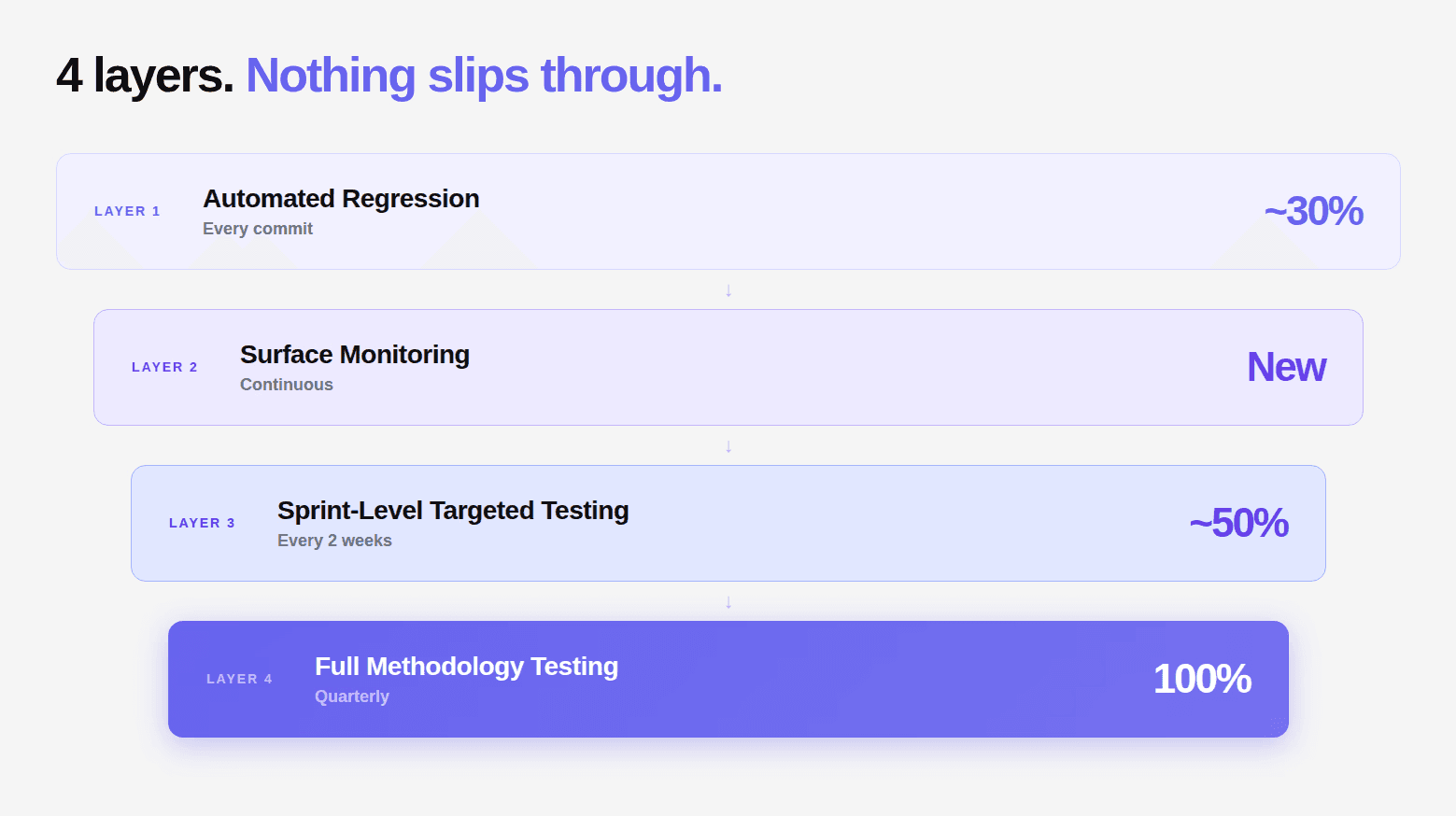
A mature security workflow can layer controls across multiple stages:
IDE: identify security and code-quality issues while developers are writing code
Pull request: review changes before they merge
CI/CD: run automated security checks before deployment
Production: monitor the live attack surface
Penetration testing: actively attempt to exploit weaknesses in the deployed system
Retesting: verify that remediation actually closed the attack path
This layered model matters because penetration testing and automated security scanning solve different problems. Scanners can identify known patterns at high volume, while penetration testing is designed to investigate how vulnerabilities can be exploited in the context of a real application.
The Maturity Model: Which Testing Cadence Fits Your Organization
The Security Testing Maturity Framework
Not every organization needs the same testing cadence. A practical security testing program can mature from periodic assessment toward more frequent, development-aligned validation as deployment velocity, risk, and security resources increase.
The following model is a practical way to think about that progression, rather than a formal industry standard.
Maturity Level
Description
Deployment Velocity
Testing Model
Minimum Frequency
Level 0
No structured security testing
Any
Annual minimum
Annual
Level 1
Compliance-driven testing
Monthly or less
Annual + automated scanning
Annual
Level 2
Risk-aware testing
Bi-weekly
Quarterly + sprint-aware
Quarterly
Level 3
DevSecOps-integrated testing
Weekly
Sprint-cadence + monthly deep
Per-sprint
Level 4
Continuous security program
Daily
Continuous all layers
Ongoing
Level 5
Security-native development
Continuous
Embedded, automated + weekly deep
Real-time
Decision Framework: Annual vs Continuous
Choosing the right testing model depends on several factors:
how fast your system changes
how sensitive your data is
what your compliance requirements demand
how quickly your team can respond to findings
Instead of a single answer, use this decision framework.
1. How Often Do You Deploy?
Your deployment frequency directly determines how quickly risk accumulates.
Deployment Frequency
Recommended Model
Why It Matters
What to Invest In
Less than monthly
Annual or semi-annual
Attack surface changes slowly
Strong pre-deployment security reviews
Monthly to bi-weekly
Quarterly (minimum)
New risk accumulates faster than annual coverage
Quarterly external tests + automated regression
Weekly or more
Continuous or sprint-based
Annual testing covers <10% of deployments
Security program aligned with release cadence
2. What Data Do You Handle?
Data sensitivity changes both risk tolerance and testing frequency requirements.
Data Type
Recommended Approach
Why
PII (>10K users), payment data, health data
Quarterly or continuous (minimum annual for compliance)
Breach impact + regulatory exposure is high
Business confidential, moderate PII
Annual minimum, quarterly if deploying frequently
Risk grows with deployment velocity
Internal tools, low sensitivity
Annual may be sufficient
Lower impact if compromised
👉 In high-risk environments, economics shift, breach cost often justifies continuous testing.
3. What Is Your Regulatory Environment?
Compliance should influence your testing strategy, but compliance and continuous security testing are not interchangeable.
Different frameworks and contractual requirements have different expectations around penetration testing, vulnerability management, risk assessment, and evidence.
An organization should therefore determine its required testing activities from the applicable standard, scope, contractual obligations, and auditor guidance.
Framework or requirement
What to consider
PCI DSS
Determine the penetration testing activities required for the applicable scope and assessment
SOC 2
Use the applicable trust services criteria and auditor expectations to determine evidence requirements
HIPAA
Consider the organization's risk analysis, safeguards, and applicable security testing practices
ISO 27001
Align testing with the organization's risk treatment, controls, and applicable assessment requirements
Continuous penetration testing can complement these requirements by providing more frequent security validation and additional evidence between formal assessments. It should not automatically be presented as a replacement for a specific compliance-mandated penetration test.
The practical goal is to satisfy the required baseline while reducing the amount of time that newly introduced attack surface remains untested.
4. Do You Have a Security Team?
Your ability to act on findings determines how continuous your model can be.
Team Setup
Recommended Model
Why
Dedicated security team (even 1 person)
Continuous testing
Can triage and respond in real time
No dedicated team (shared responsibility)
Sprint-based / monthly cadence
Prevents alert overload
No team + no plans
Quarterly testing
Continuous model will fail operationally
Final Recommendation
If you simplify everything above, the decision comes down to this:
Scenario
Recommended Model
High velocity (weekly+) + sensitive data + budget
Continuous
High velocity (weekly+) + sensitive data + limited budget
Quarterly
Moderate velocity (monthly) + sensitive data
Quarterly
Moderate velocity + low sensitivity
Semi-annual
Low velocity (monthly or less)
Annual
That said, the right testing model is not about preference. It’s about alignment. If your system changes faster than your testing cycle, risk accumulates faster than it is detected.
The Finding SLA Matrix for Continuous Programs
Continuous testing requires clear SLAs, because findings arrive continuously, the team needs defined timelines for each severity:
Severity
CVSS Range
Acknowledgment SLA
Remediation SLA
Retest SLA
Escalation
Critical
9.0–10.0
4 hours
48 hours
Within 24h of fix
C-suite notification
High
7.0–8.9
24 hours
7 days
Within 48h of fix
Security team lead
Medium
4.0–6.9
72 hours
30 days
Within sprint
Engineering manager
Low
0.1–3.9
1 week
90 days
Next quarterly
Backlog
Informational
N/A
2 weeks
Next roadmap
N/A
None
Common Failure Modes in Continuous Testing Programs
Why Continuous Programs Fail After 6 Months
Organizations that start continuous testing programs often abandon them within 6–12 months. The failure patterns are consistent:
Metrics That Define a Successful Continuous Program
The KPI Stack for Continuous Security Testing
A continuous penetration testing program should measure whether security validation is actually keeping pace with application change.
Useful metrics include:
Metric
What It Measures
Why It Matters
Mean Time to Detection
Time between a security-relevant change and its detection
Shows how quickly new risk is identified
Mean Time to Remediation
Time between finding discovery and remediation
Measures how long known risk remains open
Security Validation Coverage
Percentage of relevant releases or changes evaluated
Shows whether testing tracks application change
Retest Completion Rate
Percentage of remediated findings that are retested
Confirms whether fixes were actually validated
Findings Reopened
Findings that reappear after remediation
Identifies incomplete or ineffective fixes
Attack Surface Coverage
Portion of the known attack surface included in testing
Helps identify areas that may remain untested
The objective is not to optimize every metric independently. The goal is to shorten the time between meaningful application changes, security validation, remediation, and verification.
class ContinuousSecurityProgramMetrics:
"""Track and report continuous security testing program effectiveness"""defcalculate_program_kpis(self,program_data: dict) -> dict:
findings_data = program_data['findings']test_events = program_data['test_events']deployments = program_data['deployments']# KPI 1: Mean Time to Detection (MTTD)# How long from vulnerability introduction to detection?mttd_values = []forfindinginfindings_data:
iffinding.get('introduction_date')andfinding.get('detection_date'):
days = (finding['detection_date'] - finding['introduction_date']).daysmttd_values.append(days)mttd = sum(mttd_values) / len(mttd_values)ifmttd_valueselseNone# KPI 2: Mean Time to Remediation (MTTR)# How long from detection to confirmed fix?mttr_values = []forfindinginfindings_data:
iffinding.get('detection_date')andfinding.get('remediation_date'):
days = (finding['remediation_date'] - finding['detection_date']).daysmttr_values.append(days)mttr = sum(mttr_values) / len(mttr_values)ifmttr_valueselseNone# KPI 3: Vulnerability Introduction Rate# New security findings per 100 deploymentstotal_findings = len(findings_data)total_deployments = len(deployments)vuln_rate = (total_findings / total_deployments * 100)iftotal_deploymentselse0# KPI 4: Escape Rate# Percentage of vulnerabilities NOT caught before production# (Found by external researchers or incident response, not internal testing)external_discoveries = sum(1forfinfindings_dataiff.get('discovered_by') == 'external')escape_rate = (external_discoveries / total_findings * 100)iftotal_findingselse0# KPI 5: SLA Compliance Rate# Percentage of findings remediated within defined SLAssla_compliant = sum(1forfinfindings_dataiff.get('remediated_within_sla') == True)sla_rate = (sla_compliant / total_findings * 100)iftotal_findingselse0# KPI 6: CVSS Trend# Is the average CVSS of findings going up or down over time?monthly_avg_cvss = {}forfindinginfindings_data:
month = finding['detection_date'].strftime('%Y-%m')ifmonthnotinmonthly_avg_cvss:
monthly_avg_cvss[month] = []monthly_avg_cvss[month].append(finding['cvss'])cvss_trend = {month: sum(scores) / len(scores)formonth,scoresinmonthly_avg_cvss.items()}# KPI 7: Attack Surface Growth Rate# How fast is the untested attack surface growing?surface_snapshots = program_data.get('surface_snapshots',[])iflen(surface_snapshots) >= 2:
first = surface_snapshots[0]last = surface_snapshots[-1]surface_growth = ((len(last['endpoints']) - len(first['endpoints'])) /
len(first['endpoints']) * 100)else:
surface_growth = Nonereturn{'mean_time_to_detection_days': round(mttd,1)ifmttdelse'N/A','mean_time_to_remediation_days': round(mttr,1)ifmttrelse'N/A','vulnerability_introduction_rate_per_100_deployments': round(vuln_rate,2),'escape_rate_percent': round(escape_rate,1),'sla_compliance_rate_percent': round(sla_rate,1),'cvss_trend_by_month': cvss_trend,'attack_surface_growth_percent': round(surface_growth,1)ifsurface_growthelse'N/A','program_health': self.assess_program_health(mttd,mttr,escape_rate,sla_rate),'benchmarks': {'mttd_industry_annual': 180,# days'mttd_industry_continuous': 14,'mttd_your_program': mttd,'mttr_pci_requirement_critical': 1,# day'sla_compliance_target': 95,# percent}}defassess_program_health(self,mttd,mttr,escape_rate,sla_rate) -> str:
score = 0ifmttdandmttd < 14: score += 2elifmttdandmttd < 30: score += 1ifmttrandmttr < 7: score += 2elifmttrandmttr < 30: score += 1ifescape_rate < 5: score += 2elifescape_rate < 15: score += 1ifsla_rate > 95: score += 2elifsla_rate > 80: score += 1ifscore >= 7: return'EXCELLENT'elifscore >= 5: return'GOOD'elifscore >= 3: return'IMPROVING'else: return'NEEDS_ATTENTION'
class ContinuousSecurityProgramMetrics:
"""Track and report continuous security testing program effectiveness"""defcalculate_program_kpis(self,program_data: dict) -> dict:
findings_data = program_data['findings']test_events = program_data['test_events']deployments = program_data['deployments']# KPI 1: Mean Time to Detection (MTTD)# How long from vulnerability introduction to detection?mttd_values = []forfindinginfindings_data:
iffinding.get('introduction_date')andfinding.get('detection_date'):
days = (finding['detection_date'] - finding['introduction_date']).daysmttd_values.append(days)mttd = sum(mttd_values) / len(mttd_values)ifmttd_valueselseNone# KPI 2: Mean Time to Remediation (MTTR)# How long from detection to confirmed fix?mttr_values = []forfindinginfindings_data:
iffinding.get('detection_date')andfinding.get('remediation_date'):
days = (finding['remediation_date'] - finding['detection_date']).daysmttr_values.append(days)mttr = sum(mttr_values) / len(mttr_values)ifmttr_valueselseNone# KPI 3: Vulnerability Introduction Rate# New security findings per 100 deploymentstotal_findings = len(findings_data)total_deployments = len(deployments)vuln_rate = (total_findings / total_deployments * 100)iftotal_deploymentselse0# KPI 4: Escape Rate# Percentage of vulnerabilities NOT caught before production# (Found by external researchers or incident response, not internal testing)external_discoveries = sum(1forfinfindings_dataiff.get('discovered_by') == 'external')escape_rate = (external_discoveries / total_findings * 100)iftotal_findingselse0# KPI 5: SLA Compliance Rate# Percentage of findings remediated within defined SLAssla_compliant = sum(1forfinfindings_dataiff.get('remediated_within_sla') == True)sla_rate = (sla_compliant / total_findings * 100)iftotal_findingselse0# KPI 6: CVSS Trend# Is the average CVSS of findings going up or down over time?monthly_avg_cvss = {}forfindinginfindings_data:
month = finding['detection_date'].strftime('%Y-%m')ifmonthnotinmonthly_avg_cvss:
monthly_avg_cvss[month] = []monthly_avg_cvss[month].append(finding['cvss'])cvss_trend = {month: sum(scores) / len(scores)formonth,scoresinmonthly_avg_cvss.items()}# KPI 7: Attack Surface Growth Rate# How fast is the untested attack surface growing?surface_snapshots = program_data.get('surface_snapshots',[])iflen(surface_snapshots) >= 2:
first = surface_snapshots[0]last = surface_snapshots[-1]surface_growth = ((len(last['endpoints']) - len(first['endpoints'])) /
len(first['endpoints']) * 100)else:
surface_growth = Nonereturn{'mean_time_to_detection_days': round(mttd,1)ifmttdelse'N/A','mean_time_to_remediation_days': round(mttr,1)ifmttrelse'N/A','vulnerability_introduction_rate_per_100_deployments': round(vuln_rate,2),'escape_rate_percent': round(escape_rate,1),'sla_compliance_rate_percent': round(sla_rate,1),'cvss_trend_by_month': cvss_trend,'attack_surface_growth_percent': round(surface_growth,1)ifsurface_growthelse'N/A','program_health': self.assess_program_health(mttd,mttr,escape_rate,sla_rate),'benchmarks': {'mttd_industry_annual': 180,# days'mttd_industry_continuous': 14,'mttd_your_program': mttd,'mttr_pci_requirement_critical': 1,# day'sla_compliance_target': 95,# percent}}defassess_program_health(self,mttd,mttr,escape_rate,sla_rate) -> str:
score = 0ifmttdandmttd < 14: score += 2elifmttdandmttd < 30: score += 1ifmttrandmttr < 7: score += 2elifmttrandmttr < 30: score += 1ifescape_rate < 5: score += 2elifescape_rate < 15: score += 1ifsla_rate > 95: score += 2elifsla_rate > 80: score += 1ifscore >= 7: return'EXCELLENT'elifscore >= 5: return'GOOD'elifscore >= 3: return'IMPROVING'else: return'NEEDS_ATTENTION'
class ContinuousSecurityProgramMetrics:
"""Track and report continuous security testing program effectiveness"""defcalculate_program_kpis(self,program_data: dict) -> dict:
findings_data = program_data['findings']test_events = program_data['test_events']deployments = program_data['deployments']# KPI 1: Mean Time to Detection (MTTD)# How long from vulnerability introduction to detection?mttd_values = []forfindinginfindings_data:
iffinding.get('introduction_date')andfinding.get('detection_date'):
days = (finding['detection_date'] - finding['introduction_date']).daysmttd_values.append(days)mttd = sum(mttd_values) / len(mttd_values)ifmttd_valueselseNone# KPI 2: Mean Time to Remediation (MTTR)# How long from detection to confirmed fix?mttr_values = []forfindinginfindings_data:
iffinding.get('detection_date')andfinding.get('remediation_date'):
days = (finding['remediation_date'] - finding['detection_date']).daysmttr_values.append(days)mttr = sum(mttr_values) / len(mttr_values)ifmttr_valueselseNone# KPI 3: Vulnerability Introduction Rate# New security findings per 100 deploymentstotal_findings = len(findings_data)total_deployments = len(deployments)vuln_rate = (total_findings / total_deployments * 100)iftotal_deploymentselse0# KPI 4: Escape Rate# Percentage of vulnerabilities NOT caught before production# (Found by external researchers or incident response, not internal testing)external_discoveries = sum(1forfinfindings_dataiff.get('discovered_by') == 'external')escape_rate = (external_discoveries / total_findings * 100)iftotal_findingselse0# KPI 5: SLA Compliance Rate# Percentage of findings remediated within defined SLAssla_compliant = sum(1forfinfindings_dataiff.get('remediated_within_sla') == True)sla_rate = (sla_compliant / total_findings * 100)iftotal_findingselse0# KPI 6: CVSS Trend# Is the average CVSS of findings going up or down over time?monthly_avg_cvss = {}forfindinginfindings_data:
month = finding['detection_date'].strftime('%Y-%m')ifmonthnotinmonthly_avg_cvss:
monthly_avg_cvss[month] = []monthly_avg_cvss[month].append(finding['cvss'])cvss_trend = {month: sum(scores) / len(scores)formonth,scoresinmonthly_avg_cvss.items()}# KPI 7: Attack Surface Growth Rate# How fast is the untested attack surface growing?surface_snapshots = program_data.get('surface_snapshots',[])iflen(surface_snapshots) >= 2:
first = surface_snapshots[0]last = surface_snapshots[-1]surface_growth = ((len(last['endpoints']) - len(first['endpoints'])) /
len(first['endpoints']) * 100)else:
surface_growth = Nonereturn{'mean_time_to_detection_days': round(mttd,1)ifmttdelse'N/A','mean_time_to_remediation_days': round(mttr,1)ifmttrelse'N/A','vulnerability_introduction_rate_per_100_deployments': round(vuln_rate,2),'escape_rate_percent': round(escape_rate,1),'sla_compliance_rate_percent': round(sla_rate,1),'cvss_trend_by_month': cvss_trend,'attack_surface_growth_percent': round(surface_growth,1)ifsurface_growthelse'N/A','program_health': self.assess_program_health(mttd,mttr,escape_rate,sla_rate),'benchmarks': {'mttd_industry_annual': 180,# days'mttd_industry_continuous': 14,'mttd_your_program': mttd,'mttr_pci_requirement_critical': 1,# day'sla_compliance_target': 95,# percent}}defassess_program_health(self,mttd,mttr,escape_rate,sla_rate) -> str:
score = 0ifmttdandmttd < 14: score += 2elifmttdandmttd < 30: score += 1ifmttrandmttr < 7: score += 2elifmttrandmttr < 30: score += 1ifescape_rate < 5: score += 2elifescape_rate < 15: score += 1ifsla_rate > 95: score += 2elifsla_rate > 80: score += 1ifscore >= 7: return'EXCELLENT'elifscore >= 5: return'GOOD'elifscore >= 3: return'IMPROVING'else: return'NEEDS_ATTENTION'
The Security Posture Dashboard
Metric
Annual Model Baseline
Continuous Program Target
Why It Matters
Mean Time to Detection
~180 days
<14 days
Determines breach window
Mean Time to Remediation
~45 days (batch quarterly)
<7 days (continuous pipeline)
Reduces risk-open duration
Vulnerability Escape Rate
~25% (found by others first)
<5%
Measures program effectiveness
SLA Compliance Rate
~60%
>95%
Audit evidence quality
False Positive Rate
~40%
<10%
Engineering team trust
Attack Surface Coverage
~70% (tested version drifts)
>95% (weekly updates)
Completeness of protection
CVSS Trend (target: declining)
Uncorrelated
Measurable decline
Program impact evidence
The Gap Closes When Testing Matches Change
Annual penetration testing provides a valuable point-in-time assessment. But for SaaS companies that deploy continuously, the security state of the application can change substantially between assessments.
Continuous penetration testing addresses that gap by bringing security validation closer to the cadence at which the application changes.
The right model depends on your deployment frequency, attack surface, risk profile, compliance requirements, and ability to act on findings. For some organizations, annual testing may remain appropriate. For others, quarterly, monthly, or release-aligned testing can provide substantially more timely validation.
The important thing is to make the testing cadence a deliberate security decision rather than an artifact of the calendar.
Want to see how continuous penetration testing could fit into your security workflow?