

CodeAnt AI pentesting connects offensive testing to source-to-runtime code security. NetSPI pairs expert-led penetration testing with exposure management and attack simulation, so this comparison starts with the program you need to run rather than a scanner checklist.
CodeAnt fits an application-security program built around repositories and delivery pipelines. NetSPI fits a broader offensive-security program that needs specialist testers for applications as well as infrastructure and unusual environments.
CodeAnt publishes outcome-based terms for AI pentesting, while NetSPI does not publish a standard PTaaS price. To compare them fairly, assign an owner to each testing scope and define the retest handoff before requesting quotes.
TL;DR: CodeAnt AI vs NetSPI at a Glance
Decision point | CodeAnt AI | NetSPI |
|---|---|---|
Core model | Agentic defensive and offensive application security | Human-led, AI-accelerated PTaaS and exposure management |
Best fit | Teams that want code review, SAST, SCA, secrets, IaC, cloud findings, and application pentesting in one workflow | Enterprises that want an expert testing partner across a broad set of technologies and engagement types |
Application testing | Black-box, white-box, and gray-box/code-memory pentesting | Expert-led web, API, mobile, thick-client, and virtual-application pentesting |
Earlier SDLC controls | Native PR, IDE, CLI, and CI/CD security workflows | Not the primary product center; secure code review can be scoped as a service |
Wider offensive scope | Focused on application, code, cloud, and runtime workflows | Broad PTaaS, continuous pentesting, attack-surface management, attack simulation, and specialist assessments |
Public pricing | Published outcome-based AI pentest terms | No standard PTaaS list price found on official public pages reviewed |
Pick it when | Developers must prevent, reproduce, fix, and reverify issues without leaving the delivery workflow | Security needs external expert capacity, specialized scopes, and centralized engagement management |
How We Compared CodeAnt AI and NetSPI
This comparison uses official public product pages and documentation available on July 31, 2026. It is not a detection benchmark because I did not run the same target through both platforms.
I compared how each vendor prevents insecure changes and tests running systems, then followed findings through prioritization and remediation. A fair pilot can use coverage language from the OWASP Web Security Testing Guide and assessment-planning guidance from NIST SP 800-115.
The PTaaS operating model provides the category context for that pilot. It separates the testing service from the platform used to manage findings and from automated scanners that run without a human-led engagement.
What Is CodeAnt AI?
CodeAnt AI starts in the repository and extends into offensive testing. Its defensive layer scans first-party code through static application security testing, then checks packages through software composition analysis.
Secret scanning and infrastructure-as-code analysis cover credentials and deployment definitions. AI code review brings those findings into the developer’s pull-request and CI/CD workflow.
The offensive layer can test a public surface without source access or run with repository and authenticated context. A pilot should verify whether that context connects vulnerable behavior to the code or configuration that produced it; the architecture alone does not prove that a finding will exist.
CodeAnt’s scope is broader than an autonomous web scanner and narrower than a full-service offensive-security consultancy. It follows an application from code review to deployed testing before findings move through remediation and reverification.
What Is NetSPI?
NetSPI describes its offering as human-led and AI-accelerated. As of July 31, 2026, its official material reports more than 350 in-house pentesters working across more than 50 pentest types.
Its application practice covers browser-based systems and APIs, along with mobile and thick-client software. This puts application specialists on targets that require more than browser testing.
Separate practices assess infrastructure and hardware. NetSPI also offers AI/ML testing and adversary-focused work through red-team or social-engineering engagements.
The platform separates PTaaS from its attack-surface and breach-simulation modules. PTaaS manages engagements and remediation, while the simulation layer tests defensive controls against behavior that can be mapped to MITRE ATT&CK.
NetSPI operates at the security-program level rather than inside each pull request. Buyers use that model when they need specialist labor and managed engagements across a wider estate.
*Evidence screenshot: page 12 of NetSPI’s official “Ultimate Guide to Modern Penetration Testing,” retrieved July 31, 2026. The source is recorded in the research package and is not linked in the published article.*
CodeAnt AI vs NetSPI Feature Comparison by Buyer Job
The comparison is easiest to follow by buyer job. Start with prevention in the delivery pipeline, then compare runtime testing, infrastructure coverage, and the workflow each platform uses to close verified findings.
Prevent insecure changes before release
CI/CD review and pull-request quality gates place CodeAnt’s feedback where developers approve changes. The Scan Center checks first-party code and uses the SCA workflow to trace direct and transitive packages in a deployable service.
NetSPI can scope secure code review and application testing as an independent assessment. CodeAnt supplies the automated checkpoint on each change, but it does not eliminate peer review because code review and penetration testing answer different questions.
Test applications and APIs
CodeAnt documents black-box testing as well as tests that use source and authenticated context. During a pilot, check whether that context improves the evidence for a vulnerable code path; the SAST versus DAST decision guide explains why source analysis and runtime tests reveal different defects.
NetSPI combines automated tooling with human testers across web and API targets. Mobile and thick-client testing extends its application scope beyond a conventional browser-based SaaS product.
Virtual application testing covers another delivery model. Buyers can therefore keep those targets within the same application-testing practice.
Its official application material includes both authenticated and anonymous testing. The documented methodology covers authorization and business-logic flaws alongside technical weaknesses such as injection and insecure configuration.
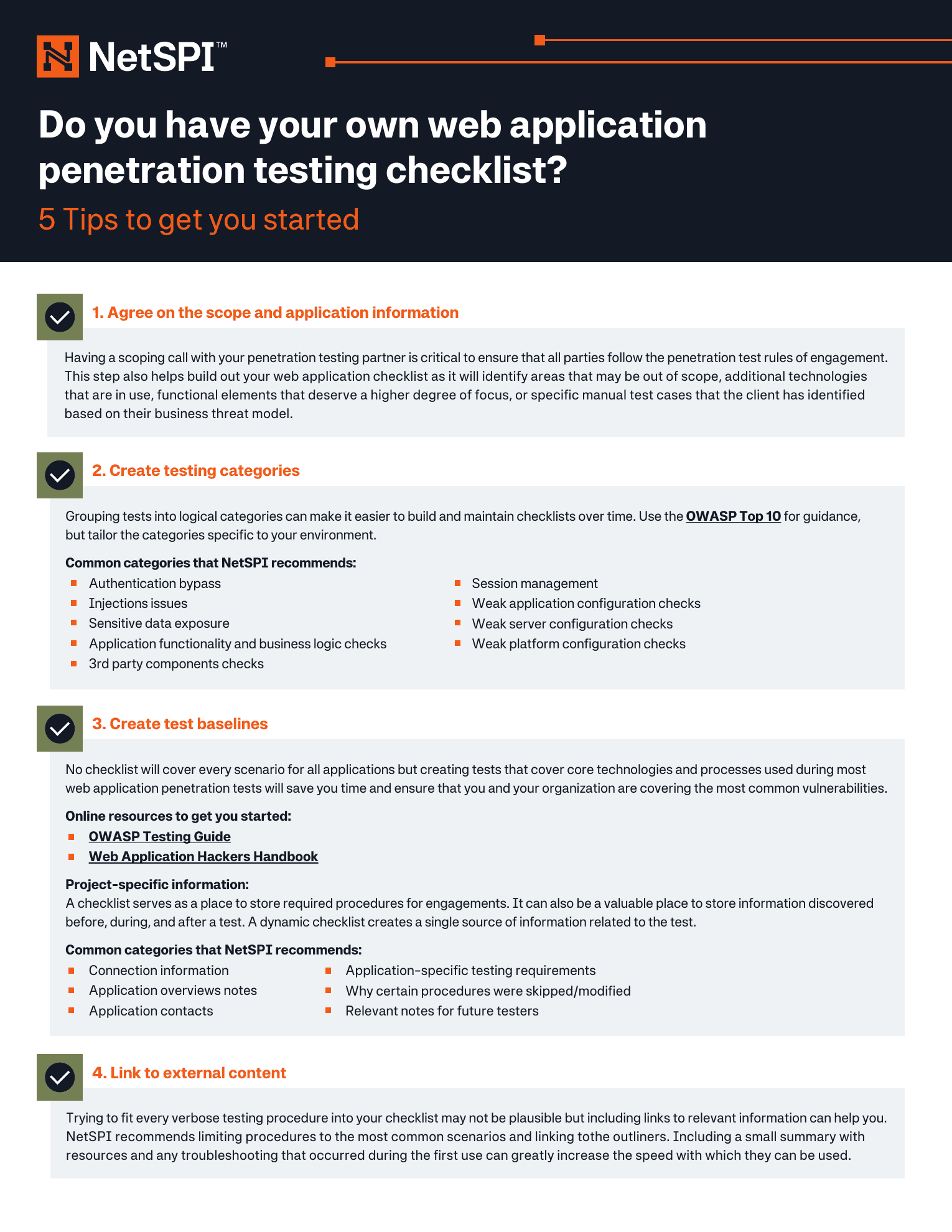
*Evidence screenshot: page 1 of NetSPI’s official web application penetration testing checklist, retrieved July 31, 2026. It shows the vendor’s recommended scoping steps and test categories.*
Both vendors mix automation with human involvement, so “AI versus people” does not describe the purchase. Evaluate who controls the test logic and how findings return to engineering; the defensive-versus-offensive security model provides a way to document that handoff.
Cover cloud, infrastructure, and the wider attack surface
CodeAnt follows an application from its source and packages into cloud configuration and runtime. Its attack-path analysis connects findings across those layers, while the cloud pentest checklist can define the identities and infrastructure included in a pilot.
NetSPI publishes a wider set of specialist scopes for networks and cloud environments. Separate practices cover mainframes and embedded hardware.
Red-team and social-engineering exercises test human and operational controls. These engagements sit outside CodeAnt’s repository-centered scope.
CodeAnt should not be presented as a replacement for that breadth. Its advantage is a testing loop tied closely to software delivery, while NetSPI offers both point-in-time engagements and continuous external or cloud pentesting.
Use the continuous-versus-annual pentesting framework to define the cadence before comparing proposals. The contract should define the event that starts a new test.
A software release and an infrastructure change are separate triggers. Asset discovery may start a new test while completed remediation may start a scoped retest.
Prioritize findings, report them, and verify fixes
CodeAnt centralizes findings in a security dashboard and can enforce security gates. Developer-facing steps of reproduction carry the result into remediation instead of leaving the engineer with a severity label alone.
Its EPSS-based prioritization adds an exploitation probability for published CVEs. FIRST defines EPSS as the probability that a CVE will be exploited in the wild during the next 30 days, which teams can weigh against asset exposure and business impact.
NetSPI’s PTaaS workflow assigns findings and tracks remediation through reporting. Its documented states separate “Ready for Retest” from “Remediation Verified,” and moving a finding to the first state does not launch a retest.
The statement of work must define who starts and completes that retest. CodeAnt’s sample pentest report provides a concrete baseline for comparing each vendor’s evidence and reproduction detail.
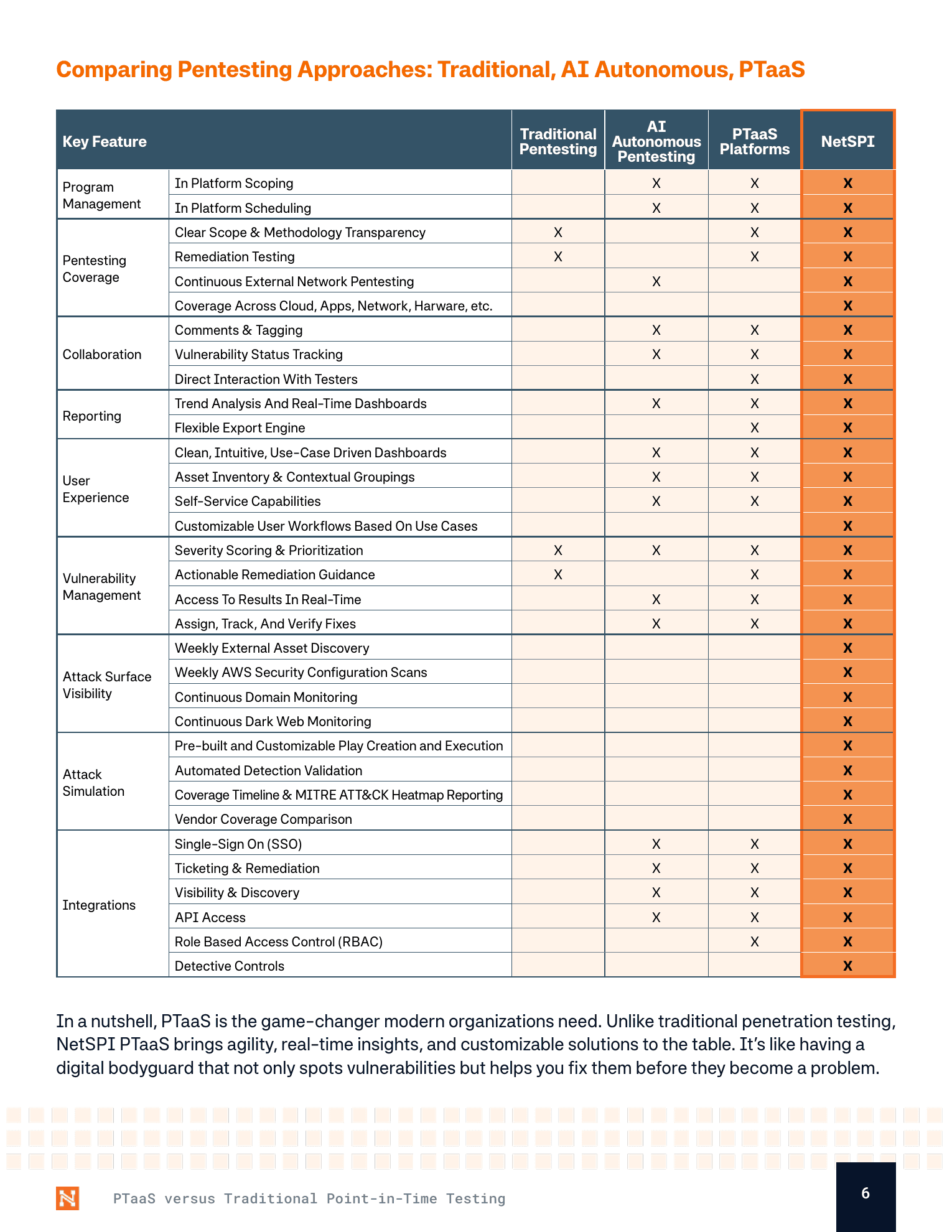
*Evidence screenshot: page 7 of NetSPI’s official “Ultimate Guide to Modern Penetration Testing,” retrieved July 31, 2026. Treat the vendor-authored comparison as evidence of NetSPI’s documented packaging, not as an independent ranking.*
Pricing and Packaging Comparison
CodeAnt publishes outcome-based AI pentest terms. As of July 31, 2026, its current pricing page describes one full scan and makes low- or medium-severity findings available without an unlock fee.
The buyer pays to unlock high- or critical-severity findings, including the associated exploit simulation and remediation guidance. Confirm the scope and severity method in the order form, then document when payment occurs and whether reverification is included.
NetSPI does not show a standard PTaaS dollar list price on the official public pages reviewed. Its cost guidance ties price to the target’s complexity and the work required from its testers, while compliance and remediation requirements can change the engagement.
Request a quote that separates the initial test from retesting and change orders. If the proposal includes other platform modules, price them separately so the PTaaS comparison remains clear.
For CodeAnt, include developer access and rollout work in the 12-month cost, along with any fees to unlock qualifying findings. For NetSPI, include each scoped engagement and the internal effort needed to coordinate it.
Operational Limits and Where Each Platform Pulls Ahead
When CodeAnt AI is the better fit
CodeAnt is the stronger fit when the same engineering organization owns the repository and the deployed SaaS application. Findings can enter pull requests and release gates, then remain connected to the source context used to fix them.
The platform also suits teams that want authenticated testing to reuse repository context instead of operating as a separate engagement. CodeAnt’s simple-git remote-code-execution research and the corresponding CVE-2026-28292 database record show how research and vulnerability context can be paired.
The pilot still has to locate the affected package or code path in your environment. It should then show whether the resulting evidence gives an engineer enough detail to act.
When NetSPI is the better fit
NetSPI is the stronger fit when the security team needs an external testing partner rather than another control inside the development platform. Its specialist scopes cover systems that do not fit a repository-centered AppSec program, including mainframes and hardware.
Its managed-engagement model also suits buyers that require named tester qualifications and manual investigation. Attack-surface discovery and defensive-control simulation can sit alongside those engagements in the wider NetSPI platform.
NetSPI can make more sense when the buyer cannot provide source access or needs organizational independence from the development team. CodeAnt’s repository context contributes less when the application is owned by a third party.
Which One Should You Pick?
Pick CodeAnt AI when engineers need security feedback before release and offensive findings must lead back to source. Pick NetSPI when the program depends on external expertise and specialist testing beyond the application pipeline.
The products can share a program if their boundaries are explicit. CodeAnt can handle the day-to-day application loop, while NetSPI runs independently governed assessments on a defined schedule.
A Concrete Pilot Checklist
The pilot should test both the technical result and the operating model. Run these steps in order so each vendor receives the same target and decision criteria:
Choose a production-representative application: Give it two user roles and a real authorization boundary, then include an API and a known vulnerable test component. The IDOR testing guide provides an application-logic case for the plan.
Write the rules before scanning: Define the authorized target and excluded actions, then record the stop condition and emergency contact. Keep the pentest authorization separate from the statement of work.
Set one scorecard: Measure verified findings and the quality of the evidence used to reproduce them. Score remediation and completed retests separately from raw finding count.
Run each operating model: Put CodeAnt through a pull request and SAST in CI/CD, then deploy a fix and reverify it. In NetSPI, follow a live finding from assignment through the documented retest process.
Trigger a failure path: Use one expected failure, such as an unreachable target or missing credential, and record how the vendor recovers. Then dispute one false positive to test the escalation path.
Inspect the evidence package: Use an automated pentesting checklist to compare what an engineer receives with what an auditor needs.
Price the same 12-month outcome: Include planned releases and retests, then account for new assets and internal operating time. The AI pentesting provider criteria supplies a procurement questionnaire.
Record each result against the same scorecard and attach the evidence used to award it. This keeps the final decision tied to observed workflow quality rather than the length of either feature catalog.

