

A Cobalt renewal is a bet on how much testing you will need twelve months from now. You buy credits in an annual package, each one worth eight hours of offensive security testing, and whatever you do not spend by the end of the contract year is gone.
The rest of the friction is operational: a scoping wizard, a wait for a tester, a 14-day window, a PDF, then a retest that has to be booked before the free retest period lapses.
The ten tools below are ranked by how directly each one attacks that economics problem: what a test costs, how long it takes to produce the first real finding, whether coverage survives between engagements, and what a retest adds to the bill.
TL;DR, the 10 best Cobalt alternatives in 2026:
CodeAnt AI charges a $0 engagement fee and bills only for exploitable High and Critical findings, returns the report in 48 hours, and re-scans free.
Hadrian runs continuous external testing and returns an on-demand agentic pentest in 24 to 48 hours at €3,000 per URL.
XBOW returns an audit-ready autonomous web and API pentest in five days, though its per-test figures have come off the pricing page.
Aikido Security sells a fixed $4,000 pentest and a Rightsized tier you do not pay for when nothing High or Critical lands.
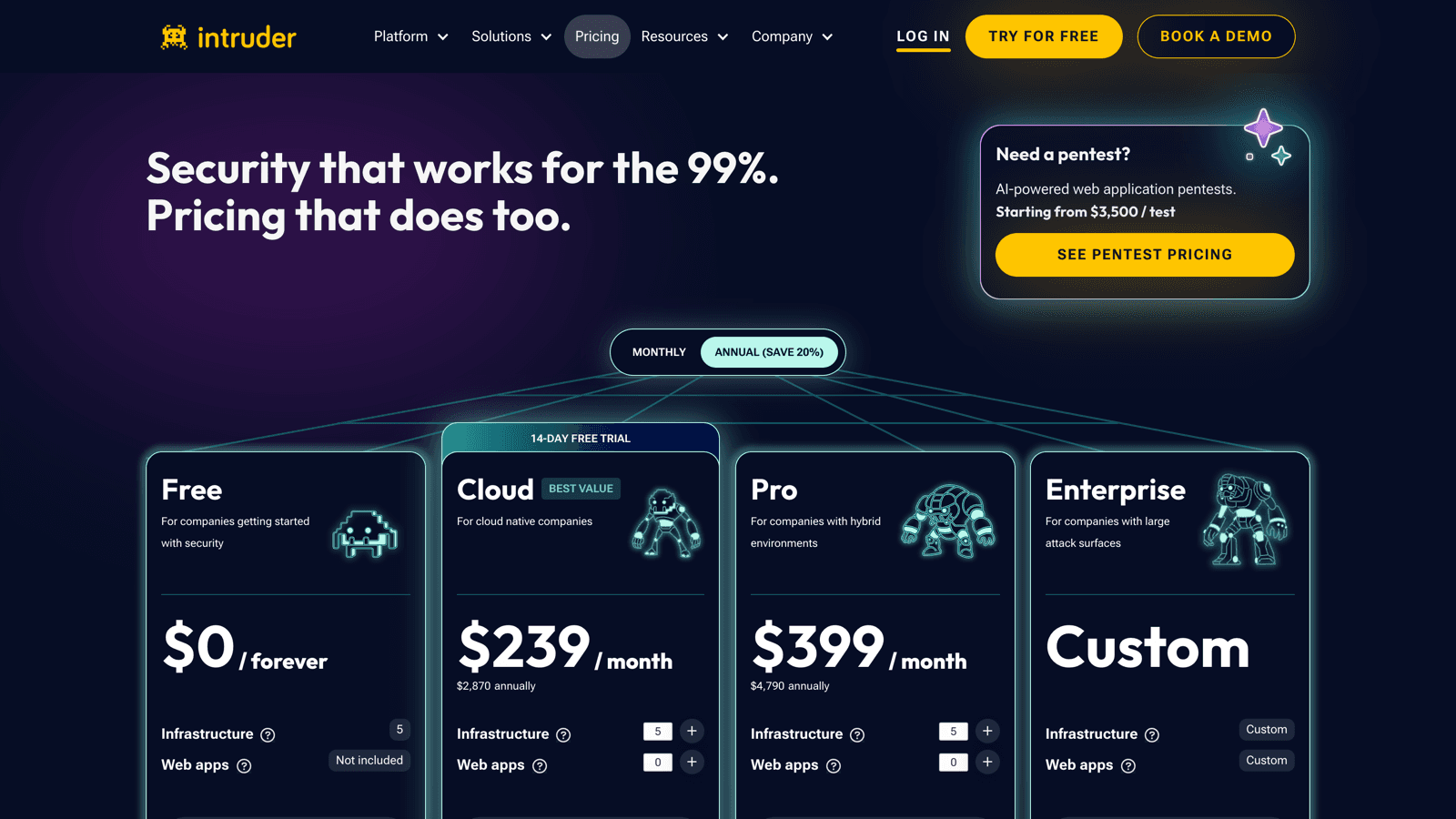
Intruder adds an on-demand AI pentest from $3,500 with same-day turnaround on top of a free-forever scanning tier.
NodeZero removes the meter entirely with unlimited autonomous network, cloud, and Active Directory pentests plus one-click retest.
Pentera validates the whole estate at uncapped frequency, at an enterprise price you negotiate rather than read.
Astra Security is the closest like-for-like PTaaS swap, with per-target prices printed and unlimited scanning between tests.
Synack publishes what a human-validated pentest costs and carries FedRAMP Moderate, though its credits expire the same way Cobalt’s do.
StackHawk keeps runtime testing running between engagements at $10 per user per month.
What Is Cobalt?
Cobalt is an offensive security platform built on Cobalt Core, a community of 450+ vetted freelance testers averaging eleven years of experience, and the delivery layer around them handles scoping, tracking, and reporting.
Its 2026 tagline is “Human-Led, AI-Powered Continuous Offensive Security,” and the pitch is aimed at consultancies rather than scanners.
So Cobalt claims a start “in as little as 24 hours” and reports “2.6X faster” than a legacy engagement, with start SLAs of three, two, or one business day depending on tier.
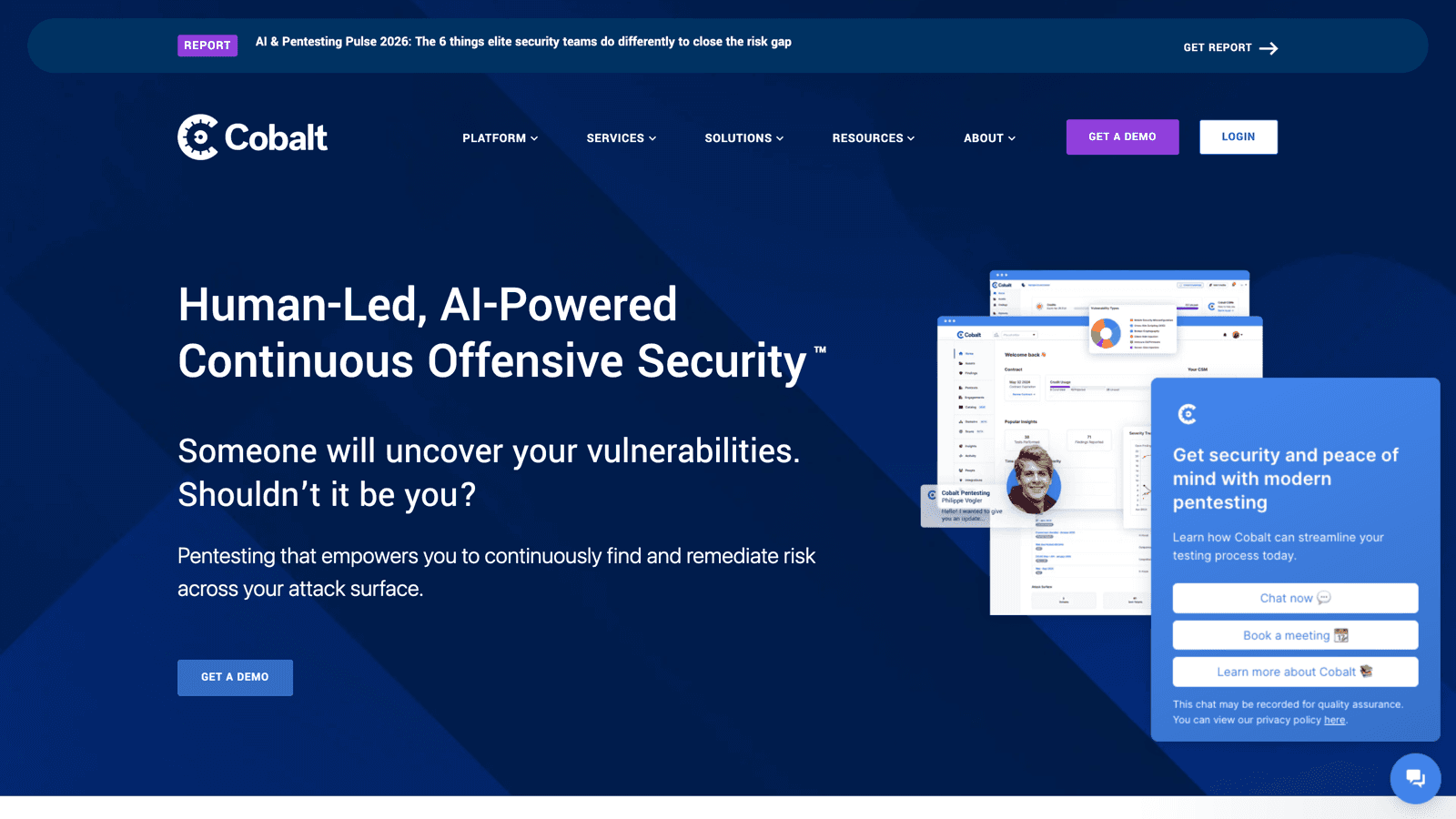
Web, mobile, API, network, cloud, and AI/LLM tests are scoped through a wizard and run for a standard 14-day period, with free retesting of individual findings for six to twelve months afterward.
Once a test starts, autonomous agents handle reconnaissance while human testers work the chained exploits, business-logic flaws, and privilege escalation.
Secure Code Review sits in the catalog as a staffed engagement that runs SAST and SCA tooling and adds expert validation on top. Beyond that catalog, Cobalt also ships DAST and Attack Surface Monitoring, and every customer gets one free DAST target with extras sold as an add-on.
How much does Cobalt cost?
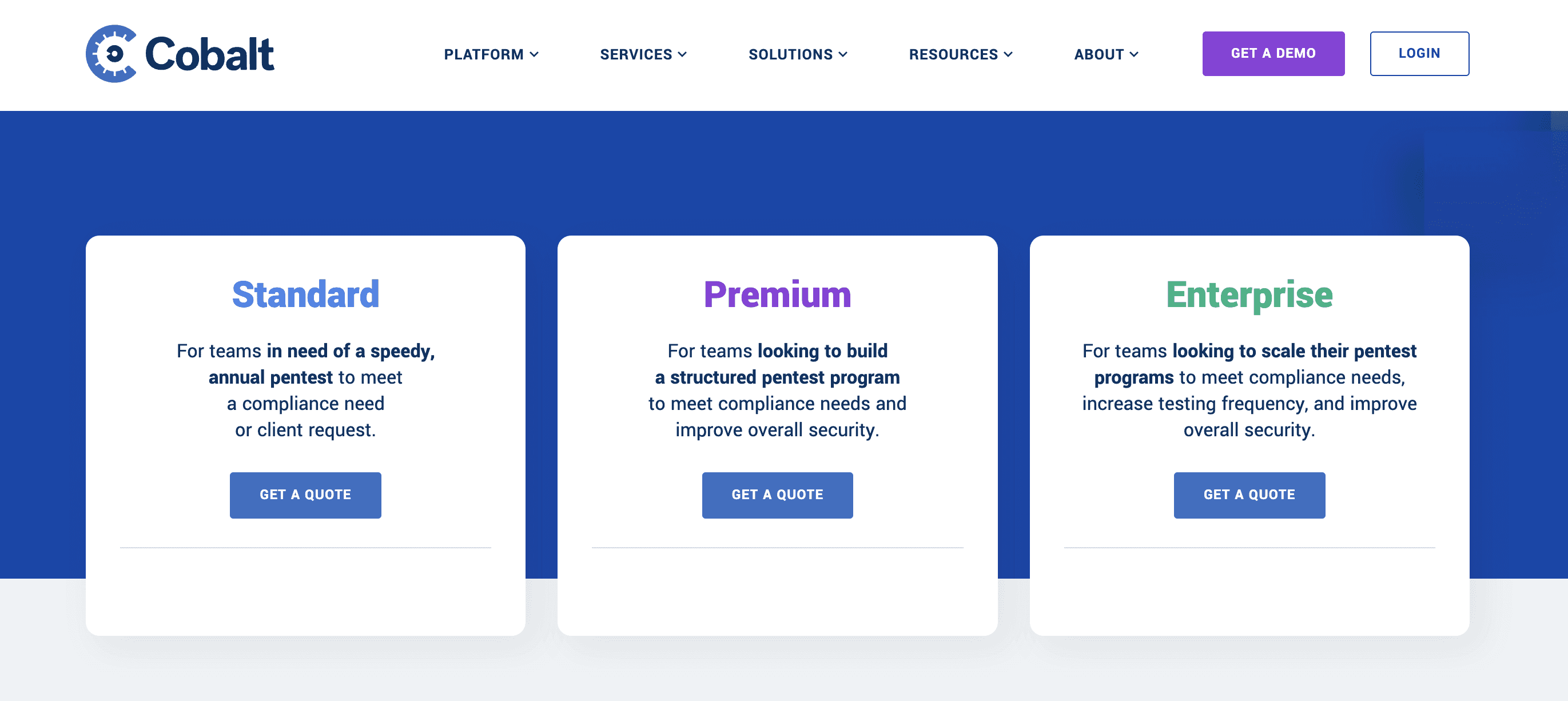
Nobody outside a sales call knows. The pricing page lists Standard, Premium, and Enterprise, and all three end at a “Get a Quote” button.
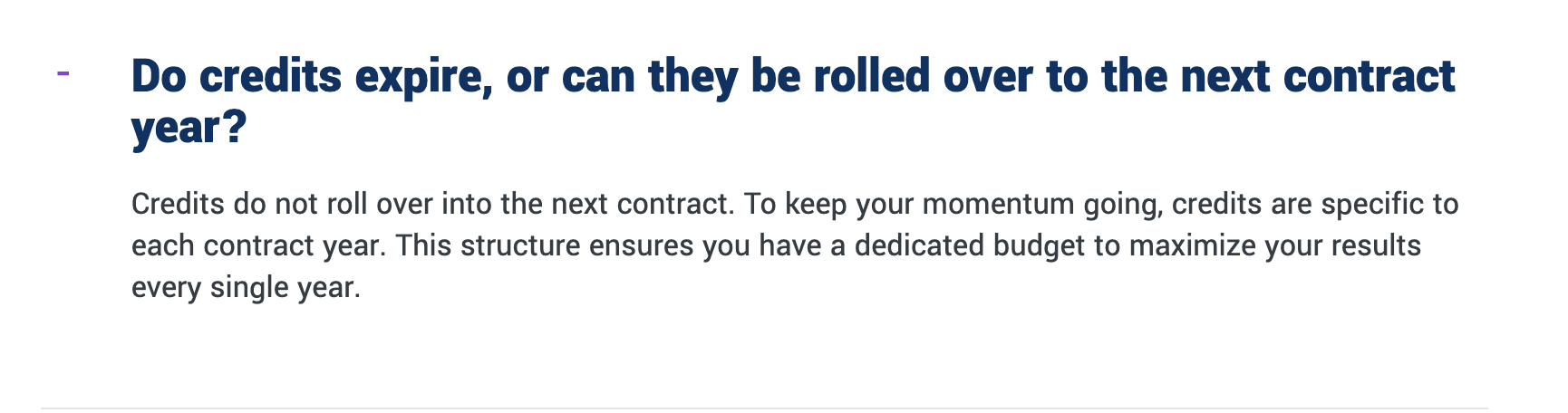
A Cobalt Credit is “the equivalent of 8 hours of offensive security testing,” sold in annual packages, and credits “do not roll over into the next contract” beyond 10% on Enterprise.
And how many credits your web app or your network consumes is never published, so the unit price and the unit count are both unknown until you are on the call. Reviewers also report a five-credit minimum, which prices small or frequent scopes out of the model.
Standard buyers get no native integrations, no customizable reports, and no strategic planning, so findings from a test you paid for cannot be piped into Jira or GitHub at all.
If you want the direct head-to-head first, we wrote CodeAnt AI vs Cobalt. For the general shape of the market, our guide to how much penetration testing costs and the case for continuous versus annual pentesting both cover the math behind the ranking below.
The 10 Best Cobalt Alternatives at a Glance
Four columns decide this purchase: how the testing gets done, how fast a finding reaches you, what happens when you need to prove the fix, and what the entry ticket costs.
# | Tool | Testing model | Time to first finding | Retest handling | Starting price |
|---|---|---|---|---|---|
1 | CodeAnt AI | Agentic pentest plus SAST and AI review | Report in 48 hours | Free unlimited re-scans after fixes | $24 / user / mo, $0 engagement fee |
2 | Hadrian | Agentic, continuous external | 24 to 48 hours (Nova) | Re-validated continuously, entitlements expire at year end | €3,000 / test (one URL) |
3 | XBOW | Autonomous AI pentester | Audit-ready report within 5 days | Continuous coverage on Enterprise, retest not priced separately | Request Pricing only, $4,000 / test on the old page |
4 | Aikido Security | AI pentest plus code-to-cloud AppSec | Agents dispatched on every deploy | Infinite agents rerun at $16 each | $4,000 / assessment, platform from $350 / mo |
5 | Intruder | Continuous scanning plus on-demand AI pentest | Same-day pentest turnaround | Daily rescans included in the subscription | $0 free tier, $3,500 / pentest |
6 | NodeZero (Horizon3.ai) | Autonomous, unlimited runs | On demand, no scoping call | 1-Click Verify, proof retained 12 months | Quote only, 30-day free trial |
7 | Pentera | Agentless automated validation | On demand, frequency uncapped | Rerun any time at no extra charge | Quote only, roughly $100k to $400k / yr |
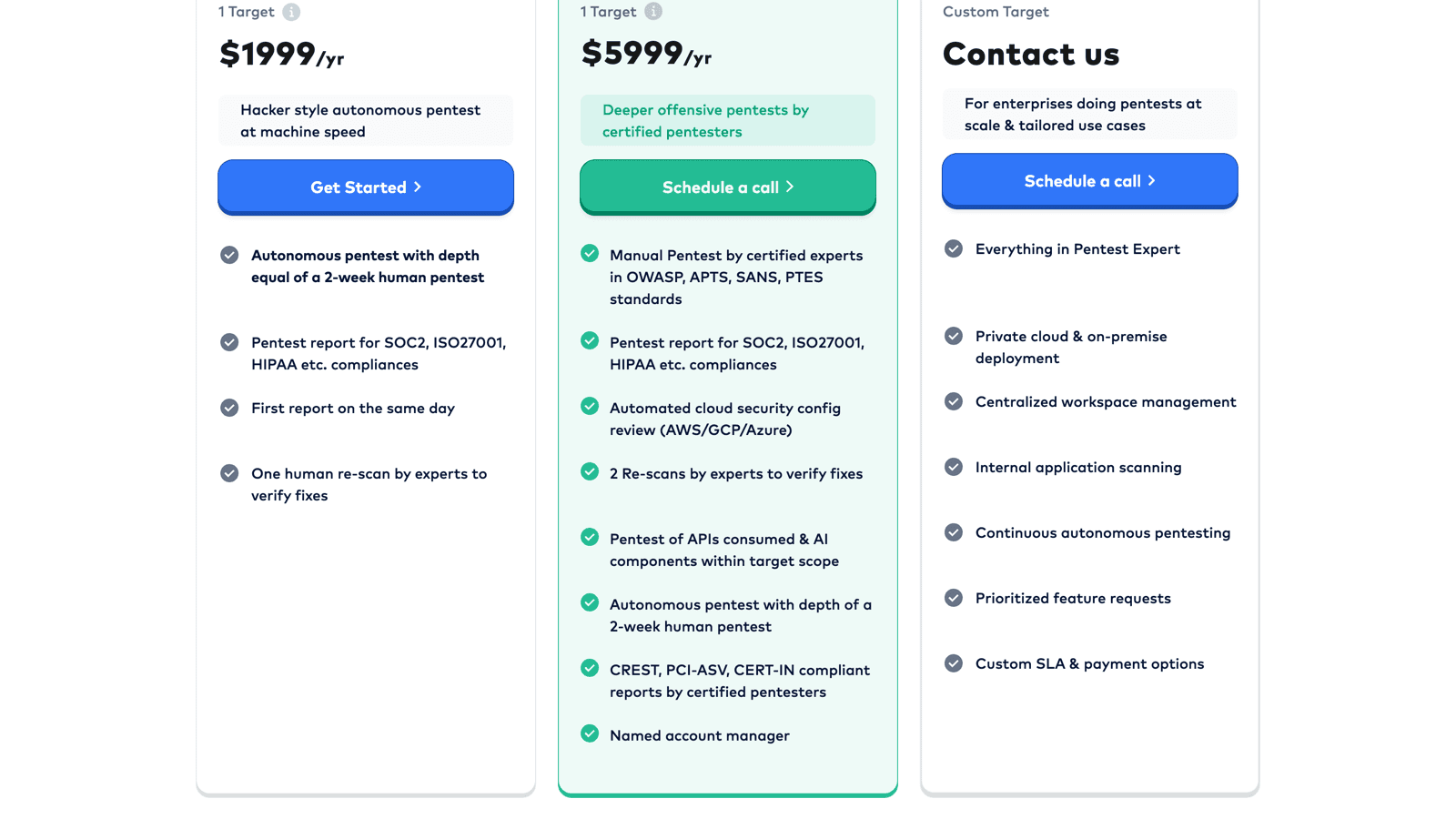
8 | Astra Security | Human-led PTaaS plus automated scanning | 10 to 15 working days (manual) | Unlimited DAST scans across the contract | $1,999 / yr per target |
9 | Synack | Human red team plus AI agent | Not published | Prepaid credits, expire one year from purchase | From $4,181 / pentest, plus platform fee |
10 | StackHawk | Developer DAST in CI | Every CI run | Rescan in the pipeline or the coding agent | $10 / user / mo |
The 10 Best Cobalt Alternatives in 2026
Every tool here is judged on the same four questions above, plus one more that decides renewals. Does the finding land in the pull request that created it, or in a PDF three weeks later?
1. CodeAnt AI
CodeAnt AI inverts the credit model outright. There is no engagement fee, no credit balance to plan around, and you settle only for exploitable High and Critical findings, which means a clean application costs nothing to test.
Beyond that, the report comes back in 48 hours and re-scans after a fix are free and unlimited, so the retest line item that follows every Cobalt engagement disappears from the budget.
Why a Cobalt buyer switches
You pay for outcomes, not hours. A Cobalt credit buys eight hours whether or not those hours produce anything. CodeAnt AI charges a $0 engagement fee and bills exploitable High and Critical findings, which puts the vendor on the hook for results.
Turnaround measured against a 14-day window. Engagements return a SOC 2 or ISO 27001 grade report within 48 hours, against Cobalt’s standard two-week testing period plus scoping and report time on either side.
Retesting stops being a purchase. Free unlimited re-scans replace Cobalt’s six-to-twelve-month retest window, so nothing expires while a fix waits on a sprint.
Findings land in the pull request. SAST, SCA, secret detection, and IaC checks run inline on every PR across 30-plus languages, so the vulnerability class a pentest would have found in November gets caught in July.
Three modes on one platform. Blackbox maps what is publicly reachable, Whitebox works from the code, and Graybox with Code Memory combines both, so the offensive layer already knows how the application was built.
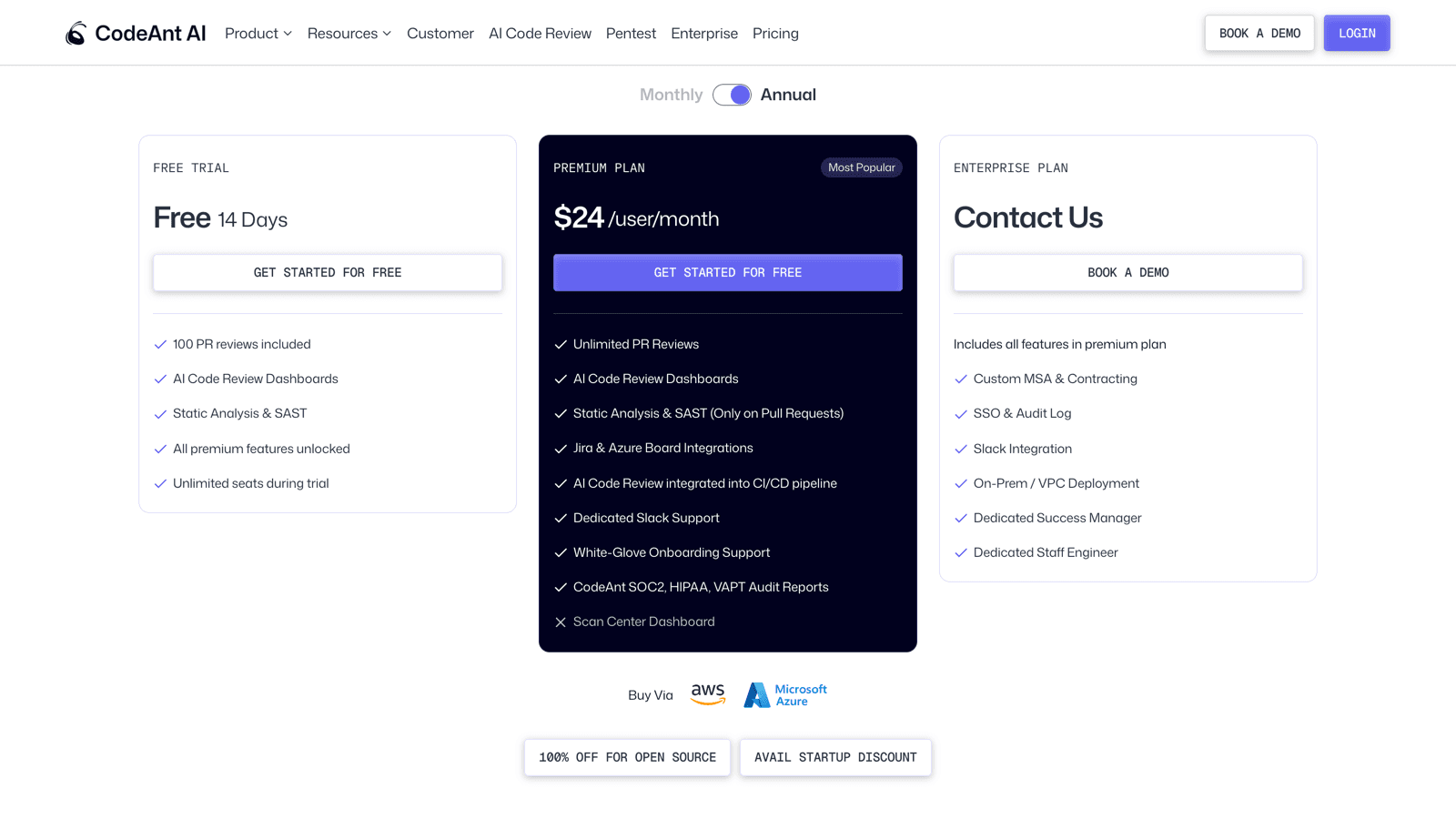
A price you read before the call. AI code review lists at $24 per user per month on annual billing, public repositories are free, and a 14-day trial covers 100 PR reviews with unlimited seats. Full details sit on the AI pentesting page.
What you give up
No named human tester. The offensive layer runs on autonomous agents. A buyer who needs a CREST-accredited human name on the engagement is choosing a different delivery model, and that is a fair reason to keep Cobalt for one scope.
Internal network and Active Directory sit outside scope. Lateral movement across a corporate domain is not what CodeAnt AI tests, so a network-heavy program still needs NodeZero or Pentera alongside it.
Onboarding wants a tuning pass. A mid-market G2 reviewer found suggestions “too cautious or sometimes it needs manual adjustments, also onboarding takes time.”
A shorter review corpus. CodeAnt AI rates 4.8 on G2 and 4.7 on Gartner across fewer reviews than Cobalt’s 178 on G2, so use the trial rather than the star count. A Gartner Peer Insights reviewer in IT services called the feedback “highly accurate” for “issues with edge cases, missed logic,” and an engineering director on G2 credited it with cutting “considerable time to review PR.”
Best for: security leads who want the renewal to scale with findings rather than with hours, and want the same platform catching the bug at the pull request.
2. Hadrian
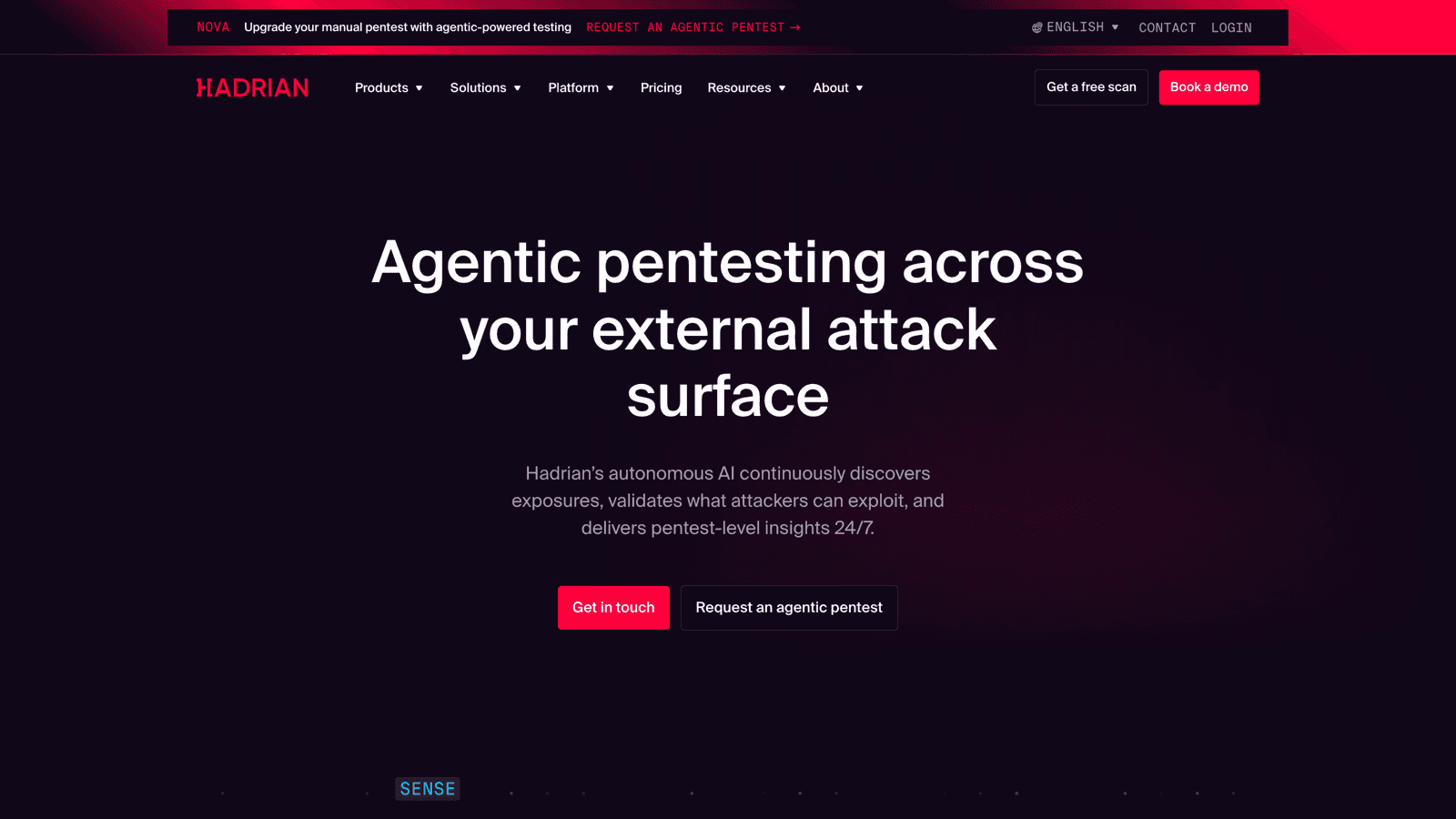
Hadrian attacks the coverage gap rather than the price. You hand it nothing, and it finds your assets the way an attacker would, then keeps validating which of them are genuinely exploitable.
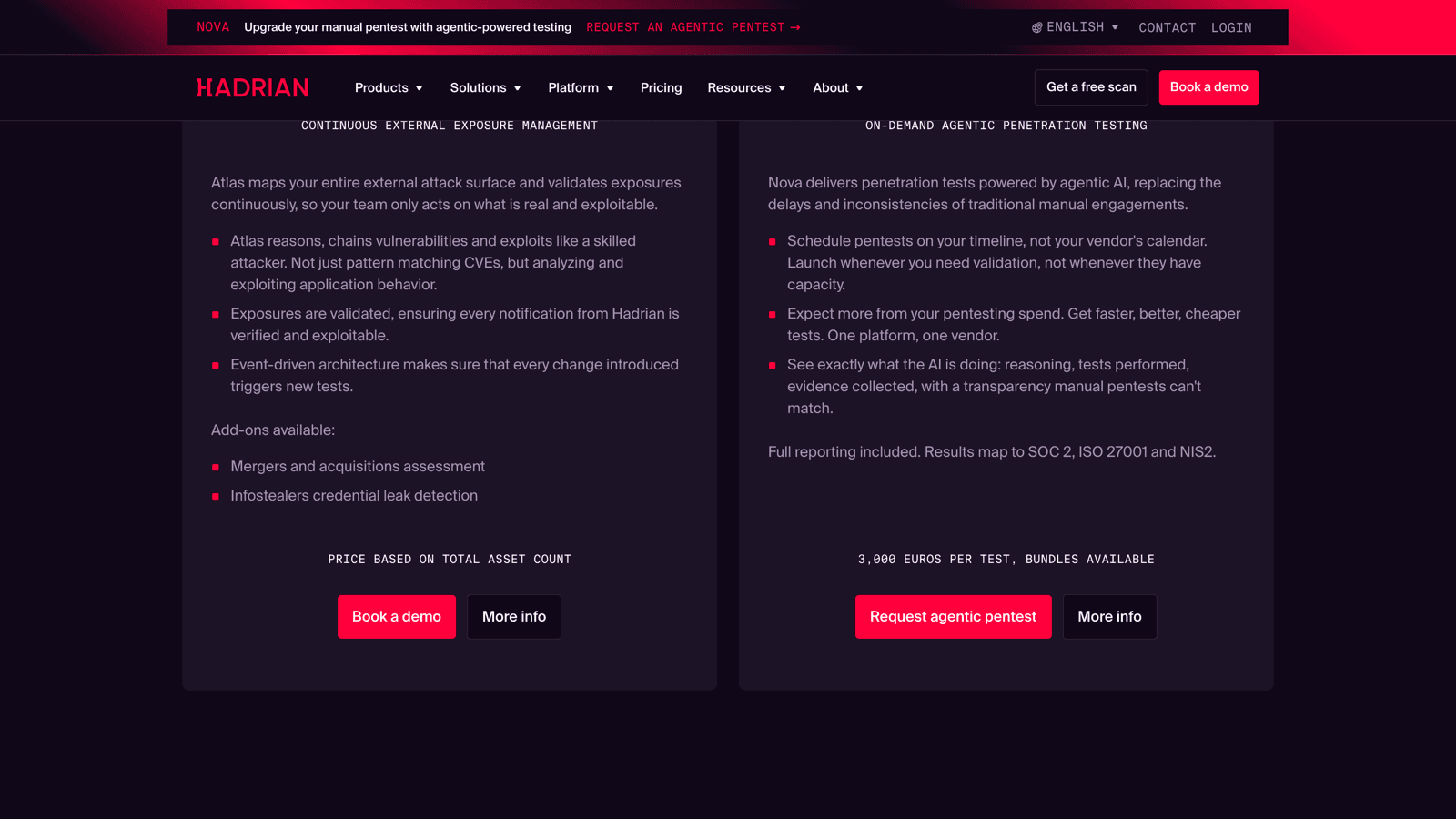
When you do want a discrete engagement, Nova sits on top as an on-demand agentic pentest at €3,000 per URL that returns validated findings in 24 to 48 hours.
What changes when coverage stops being scheduled
Testing fires on change, not on a calendar. The Sense engine runs hourly passive scans and event-driven testing when an asset changes, so a subdomain that appears in week three of a quarter is not waiting for the next window.
Nova turnaround beats a booked engagement. Web apps, APIs, and cloud come back in 24 to 48 hours at a published €3,000 per test against one URL.
Confirmed risk is separated from potential risk. Hadrian’s orchestrator attaches step-by-step reproduction to every confirmed risk and claims 99% of the noise disappears before it reaches you.
Scanning matched to the fingerprint. Contextually-gated checks only run against technologies actually detected, which is why reviewers describe the output as trustworthy rather than voluminous.
Prioritization past CVSS. Asset criticality, CISA KEV data, and dark web monitoring feed the ranking, which is closer to how you would triage a pentest report yourself. Our guide to external penetration testing methodology covers the same ground manually.
Limits to price in
External surface only. No source-code review, no SCM or CI integration, no mobile, and internal network testing is not stated, so Cobalt keeps the broader catalog.
Entitlements expire the same way credits do. Pentest entitlements run out at the end of the contract year and do not roll over, which is the exact mechanic you were trying to escape.
Nova’s own terms disclaim completeness. Hadrian states it “does not warrant that Nova will identify every vulnerability,” worth reading before it replaces an attestation.
Reporting gaps and a thin review base. G2 reviewers flagged “missing reporting or exporting functionalities” and features that “are not always fully completed,” across only four reviews, and one enterprise reviewer said “the pricing is a bit high.”
One mid-market G2 reviewer said Hadrian surfaces “real-time visibility of risks that we would have to wait until a penetration test to discover,” and that it became “a daily part of our workflows.”
Another enterprise reviewer contrasted it with tools whose false positives “costed a lot of time to investigate,” adding that “when Hadrian reports a vulnerability you know it is real.”
Best for: teams whose external estate keeps growing through acquisition and who cannot justify a scoped test every time it does.
3. XBOW
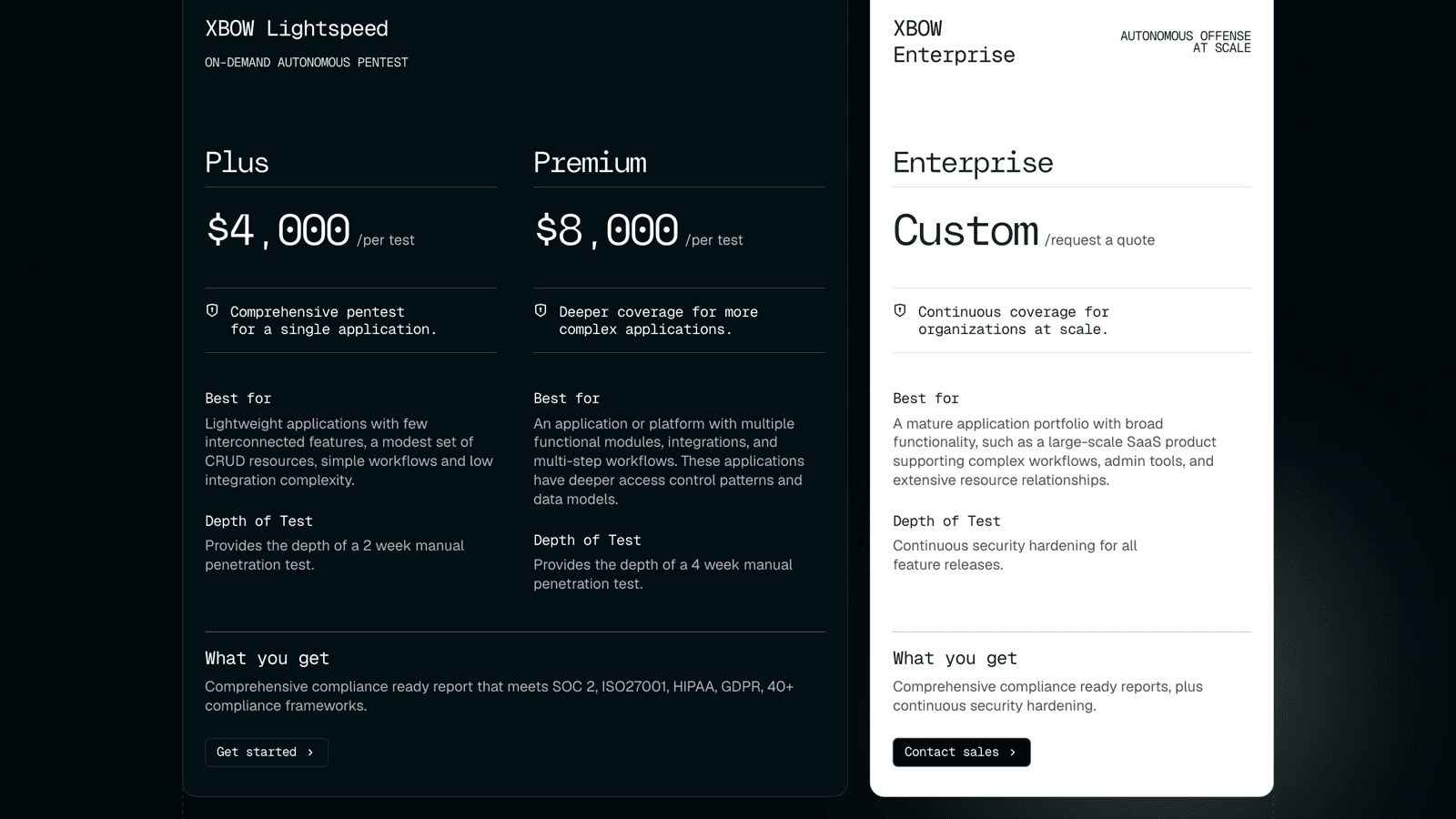
XBOW went further on price transparency than Cobalt ever has, then walked it back. Its pricing page used to put a figure on an autonomous test and say what that figure bought in manual-engagement terms.
That page is gone. Instead the number is scoped to your environment behind a Request Pricing form, which leaves both vendors answering the renewal question the same way.
What the autonomous model still changes
A reference point, even if it is a dated one. The retired pricing page put Lightspeed Plus at $4,000 per test against a two-week manual engagement and Premium at $8,000 against a four-week one. Historic, no longer quotable, and still more orientation than an eight-hour credit at an unstated unit price has ever given a buyer.
Turnaround without a scoping cycle. Audit-ready reports arrive within five days in blackbox, whitebox, or greybox mode, and thousands of short-lived agents run the learn, map, coordinate, attack, and prove loop in parallel.
Validation before the finding reaches you. Every XBOW result clears a separate deterministic validator, then ships with a working exploit and full request and response detail across chains documented up to 48 steps.
Testing triggered by the pipeline. Enterprise adds continuous coverage, and a REST API plus webhooks let you fire a pentest on merge or before a deploy rather than when a window opens.
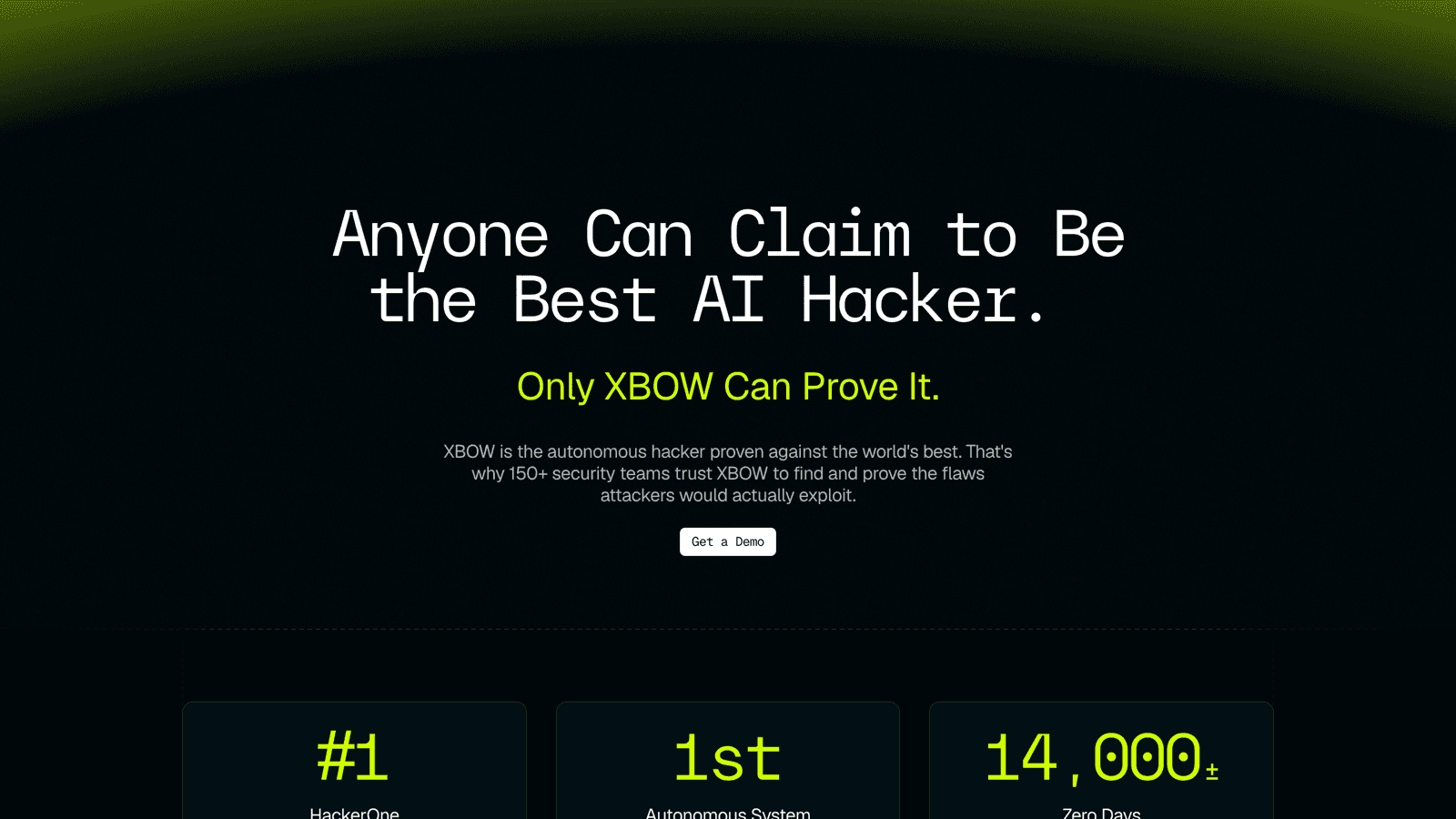
Public evidence you can check. XBOW topped the HackerOne US leaderboard above every human researcher, and one veteran researcher conceded that finding “valid bugs across multiple programs using ’just their software’” is “impressive.” Moderna’s Deputy CISO singled out the bug chaining as “something no other product is doing well in the web space.” Our CodeAnt AI vs XBOW comparison covers the overlap.
Where it runs out of scope
Web apps and their APIs, nothing else. Mobile, cloud, network, and binary testing are roadmap items, so a multi-surface Cobalt program cannot move over wholesale.
Skepticism about depth is on the record. One veteran practitioner described the HackerOne badges as “some of the more basic things you can find with automation,” and HackerOne’s co-founder has said AI still struggles with business-logic flaws.
No live figure to hold anyone to. Pricing is described only as usage-based and scoped to your coverage, every call to action lands on a Request Pricing form, and the CEO acknowledges you must “give it a URL to start with, possibly… some additional information like credentials.”
SaaS only. There is no self-hosted option and no named CI, SCM, or ticketing integrations, and the headline benchmark figures date from mid-2024.
Best for: web and API-centric products that want an audit-ready engagement on demand instead of quarterly, and can live with a quote-only conversation to get one.
4. Aikido Security
Aikido gives procurement a fixed number for a pentest, €3,500 or $4,000 per assessment, and a Rightsized tier carrying a “No High or Critical Finding = Don’t Pay” guarantee.
Around it sits a code-to-cloud platform on published monthly tiers, which turns the security line item into something you can forecast rather than reconcile against a credit balance.
The case for moving the budget
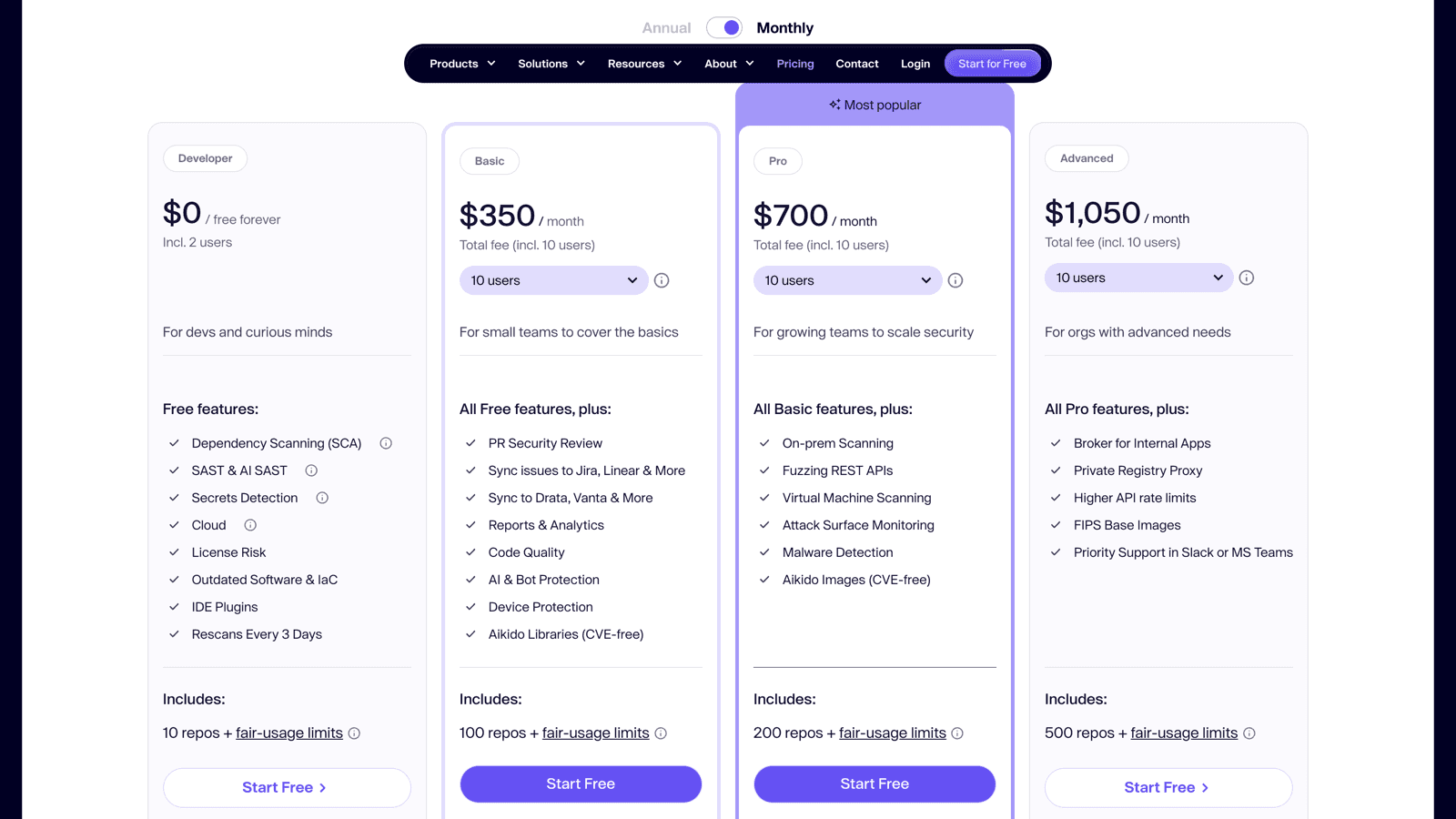
Fixed-fee or contingent, both readable. A Standard Pentest is $4,000 per assessment and the Rightsized Pentest costs nothing when no High or Critical finding lands.
Continuous testing without a balance to burn down. Aikido Infinite dispatches agents on every deploy at $16 each, which is a per-event cost you can model against release frequency.
Platform pricing on the page. Plans run $350, $700, and $1,050 a month with ten users bundled, and a Developer plan covers two users free forever.
Coverage between engagements. CSPM, container, VM, and Kubernetes scanning plus the Zen in-app firewall keep watching ground a scoped test only visits.
Rollout that does not need a project plan. Marc Lehr of GEA said “in just 45 minutes, we onboarded 150+ developers with Aikido,” and Christian Schmidt of Go Autonomous said “the triaging is just… done.” See CodeAnt AI vs Aikido Security for the direct comparison.
The catch
Agents where Cobalt fields people. Aikido’s offensive layer is automated, so deep manual business-logic work stays with Cobalt Core.
Bundled caps push the real price up. Each tier fixes ten users with hard limits on repos, containers, and cloud accounts, and extra users move to custom pricing.
First-party proof carries most of the weight. Aikido leans on its own customer testimonials rather than a large independent corpus, so test pentest depth during a trial before it replaces a booked engagement.
Best for: teams that want one forecastable security bill covering both the scanner and the pentest, with a contingent option when the scope is low risk.
5. Intruder
Intruder is the cheapest way to stop the coverage lapse. The scanning tier starts at $0, runs daily, and rescans whenever your internet-facing estate changes.
When you do need a pentest, it is $3,500 per test for subscribers with same-day turnaround and no quote required.
What a Cobalt buyer gains
A pentest with a price and a same-day clock. A white-box web-app test connects GitHub or GitLab and returns an audit-ready report from $3,500, or $4,000 as a one-off.
Coverage that costs nothing to start. The free plan carries five infrastructure licences and three users, so continuous scanning begins before any renewal conversation.
New disclosures tested in hours. Emerging Threat Scans check your systems as CVEs land, a cadence no scheduled engagement can hold.
Triage handled before it reaches your queue. An AI analyst called GregAI ranks what matters and drafts environment-specific remediation you can hand straight to a developer, with an MCP server for agent workflows.
A review base larger than Cobalt’s. Intruder holds 4.8 on G2 across 207 reviews. One operations director wrote that “rather than overwhelming us with low-value noise, it highlights vulnerabilities that genuinely matter,” and an enterprise reviewer called it “our number one, 100% vulnerability assessment tool, replacing both Nessus open source and Tenable.”
What stays uncovered
Orchestrated scanners rather than testers. Intruder routes OpenVAS, Nuclei, Tenable Nessus, and OWASP ZAP behind one interface, so depth on business logic trails Cobalt Core.
Licences that lock for 30 days. A licence is consumed for 30 days per scanned target and does not release early on deletion or cancellation, which matters if your asset list churns.
Real capability sits above the entry tier. Internal scanning needs Pro, and attack surface view, subdomain discovery, and Rapid Response are Enterprise-only.
Nothing reads your repository. Outside the pentest add-on there is no SAST or SCA, and one enterprise reviewer noted “the Azure integration for Intruder is definitely still a little bit immature.”
Best for: lean security teams that need daily coverage and an occasional cheap, fast pentest instead of a five-credit annual minimum.
6. NodeZero (Horizon3.ai)
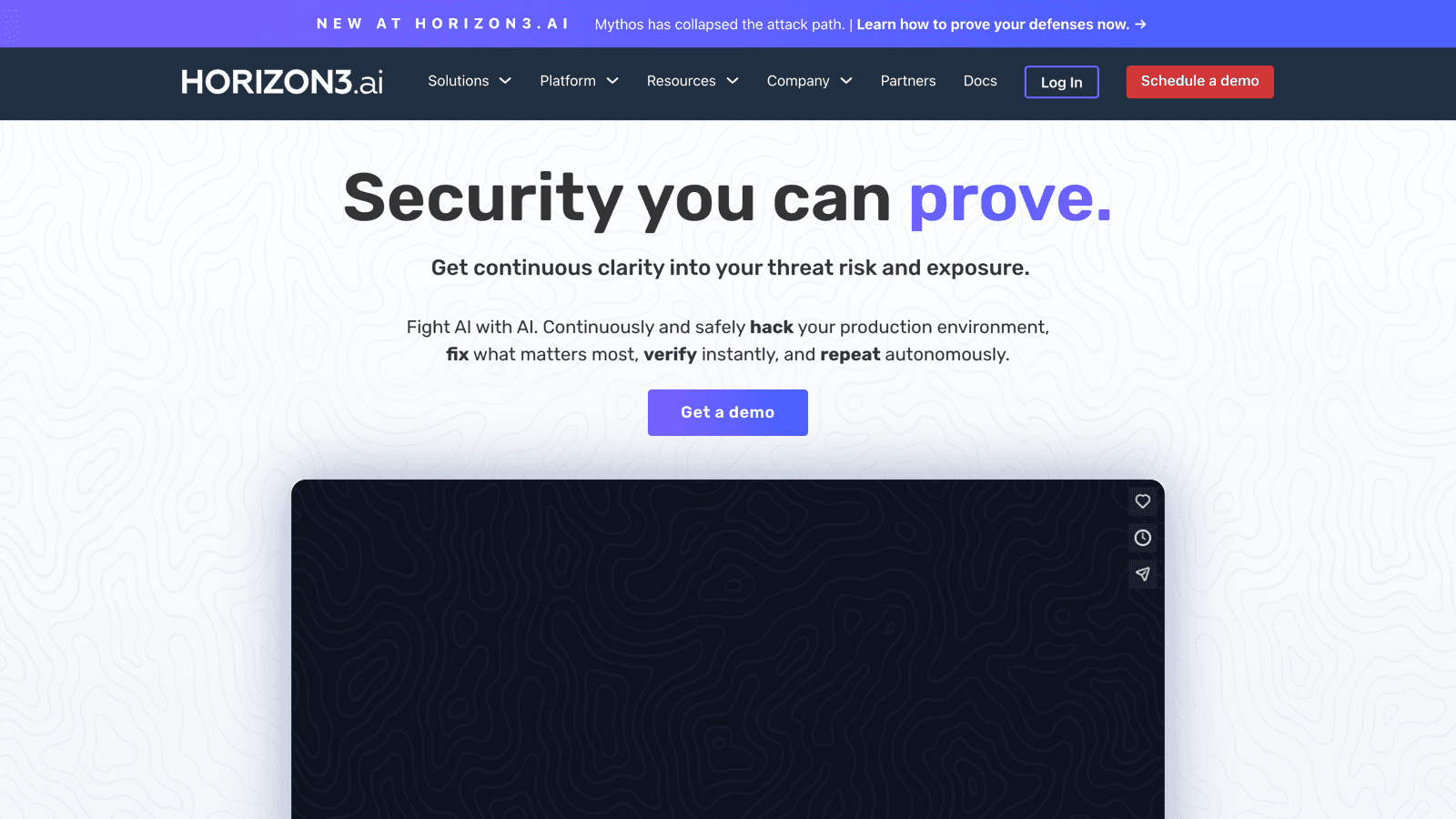
NodeZero deletes the meter. Internal, external, cloud, Kubernetes, Entra ID, segmentation, and insider-threat pentests run without limit, all available at the entry tier.
For a Cobalt buyer whose credits go on network testing, that swap alone changes the renewal arithmetic.
Why the meter disappears
Unlimited runs replace counted credits. Agentless autonomous pentests across the whole multi-domain scope carry no per-test charge, where Cobalt debits a credit balance for each network engagement.
Retest is a button. 1-Click Verify retests a remediation and retains the proof for twelve months, so proving a fix never means booking anything.
Proof of exploit on every finding. Each result ships with proof and impact from exploits run safely in production, which is the standard a pentest report is held to.
Attacks past the CVE list. Credential attacks, misconfigurations, AD password cracking, and Endpoint Security Effectiveness testing that deploys a test RAT and reports whether EDR blocked, alerted, or missed it.
Findings routed where work happens. ServiceNow, Jira, Splunk, and Microsoft Sentinel integrations plus a hosted MCP server, none of it gated behind a premium tier the way Cobalt gates Standard. Read our primer on automated penetration testing for how this class works.
Where Cobalt keeps the edge
No application-layer human depth. Web application pentesting is behind an early-access waitlist, and there is no source-code analysis anywhere in the packaging matrix.
Tiering still bites. You cannot schedule pentests on a recurring cadence below Core, and the reporting analytics stay locked until Elite.
Unlimited is not free. Pricing is quote-only across Flex, Core, Pro, and Elite, and a senior security engineer flagged “high cost for low-yield real attacks” alongside “frequent out-of-scope detections.”
Some ramp-up required. A reviewer noted a “learning curve for advanced features” and that “cost may challenge smaller organizations.” On PeerSpot, an infrastructure manager described the workflow as “set it, scope it, and let it go,” and Horizon3.ai took a Gartner Peer Insights Customers’ Choice in 2025 with a head of digital IT putting deployment at “under ten minutes.”
Best for: security teams spending Cobalt credits on network, cloud, and Active Directory scopes that could run weekly at no marginal cost.
7. Pentera

Pentera makes frequency a non-issue. Testing is agentless, runs remotely or on-prem, and carries no cap on how often you validate the estate.
In return you swap one opaque quote for a larger one, since pentera.io/pricing returns a 404 and the only public figures sit in an analyst whitepaper Pentera hosts.
What uncapped frequency buys
Testing whenever you want it. No agents, no network configuration, and no frequency limit, against a credit meter that counts every engagement.
The whole estate in one contract. Pentera Core, Surface, and Cloud validate internal, external, and cloud environments together instead of scoping each one separately.
Production-safe by policy. A published do-no-harm policy with configurable range, scope, time, and stealth means testing live without booking a window.
Hours recovered from manual work. An education-sector reviewer reported saving “approximately 45% of the hours we used to spend on manual penetration testing,” which is the clearest ROI statement in this list.
Evidence a board will read. A reviewer valued that “attack path visualization gives me the ability to communicate with leadership and the board,” and Pentera Peer answers questions about findings in natural language. Our Pentera versus CodeAnt AI writeup goes deeper.
What it costs you
Six figures, and no way to check. A director wrote on PeerSpot that “the product has become very expensive,” with representative licences put at $100,000 and $400,000 a year in a hosted analyst whitepaper. No free trial or tier exists.
Nothing runs before a merge. Every Pentera product tests a running environment, and it ships no SAST or SCA, only ingesting other tools’ code findings into Resolve.
Compliance scope is narrower than it looks. Its SOC 2 and SOC 3 reports cover Surface and Resolve rather than the full platform, and Pentera states it “does not certify compliance or claim FedRAMP authorization.”
Rough edges remain. A network engineer flagged navigation “which seems slower,” and a reviewer said “cloud testing capabilities need enhancement.”
Best for: large regulated enterprises where the credit ceiling, not the invoice, is the binding constraint, and internal network validation is the priority.
8. Astra Security
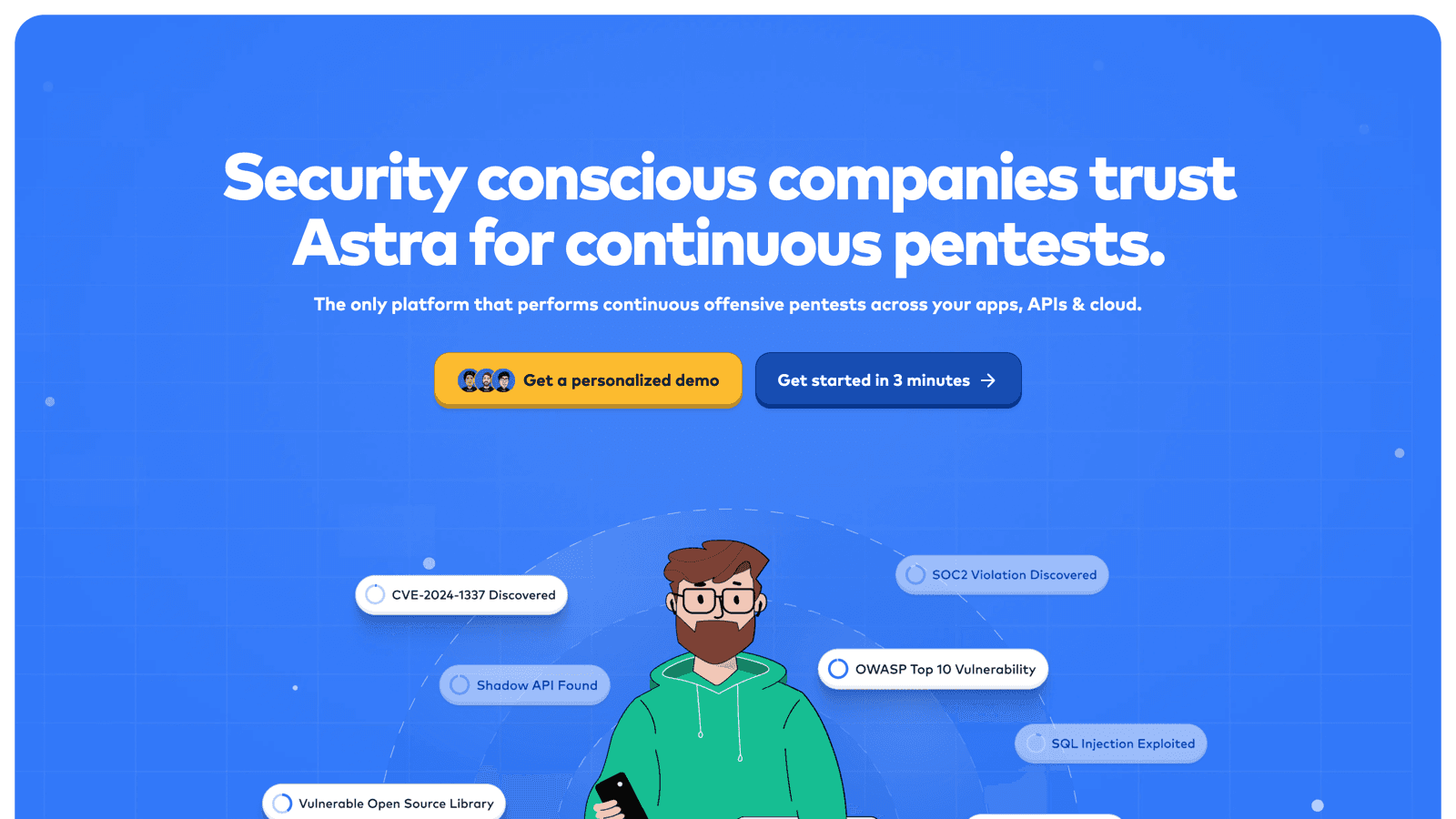
Astra is the closest like-for-like swap, and it answers the pricing complaint head on. Pentest Auto is $1,999 a year per target and Pentest Expert is $5,999 a year, both printed on the page.
Though manual findings take 10 to 15 working days to come back, they arrive with proof-of-concept videos, and automated scanning runs unlimited across the contract so nothing lapses in between.
Why the swap works
Annual cost known before the call. Two published per-target prices replace a five-credit minimum at an undisclosed rate, which makes a renewal comparison a single subtraction.
Certified humans on the manual tier. OSCP, CEH, CRTP, and CREST-certified pentesters threat-model and test by hand, the same delivery model Cobalt leads with.
Scanning that fills the gap between tests. A DAST scanner with 10,000-plus test cases runs unlimited scans, handles TOTP MFA through custom login scripts, and crawls JavaScript-heavy applications.
API coverage is the strong suit. An authorization matrix for user-level privileges plus 15,000-plus authenticated test cases, including discovery of zombie, shadow, and orphan endpoints.
Fixes pushed to the developer. Over MCP, Astra sends a ready-to-paste fix prompt into Cursor, Claude Code, or VS Code. See our Astra comparison and CodeAnt AI vs Astra Security.
Where the swap gets thin
Ten to fifteen working days is not fast. Manual results take longer to arrive than an agentic test, so the turnaround complaint about Cobalt does not fully go away.
A smaller bench. Astra’s tester community is smaller than Cobalt Core and its own CVE-count claims vary across pages, so confirm tester fit for your stack.
The autonomous tier is not shipping yet. The flagship Autonomous Pentest is waitlist-only with credit rates unpublished, and Astra states it assists developers rather than remediating.
No source-code analysis. The MCP integration reads a repository to write a fix, never to find issues, and a financial-services security officer wrote that “the accuracy of the automated scanner can be made more efficient.” An IT-services co-founder was blunter about the value, noting “pen tests can be shockingly expensive and Astra is a very low price.”
Best for: teams that want to keep human-led PTaaS but need the annual number fixed and visible before the renewal meeting.
9. Synack
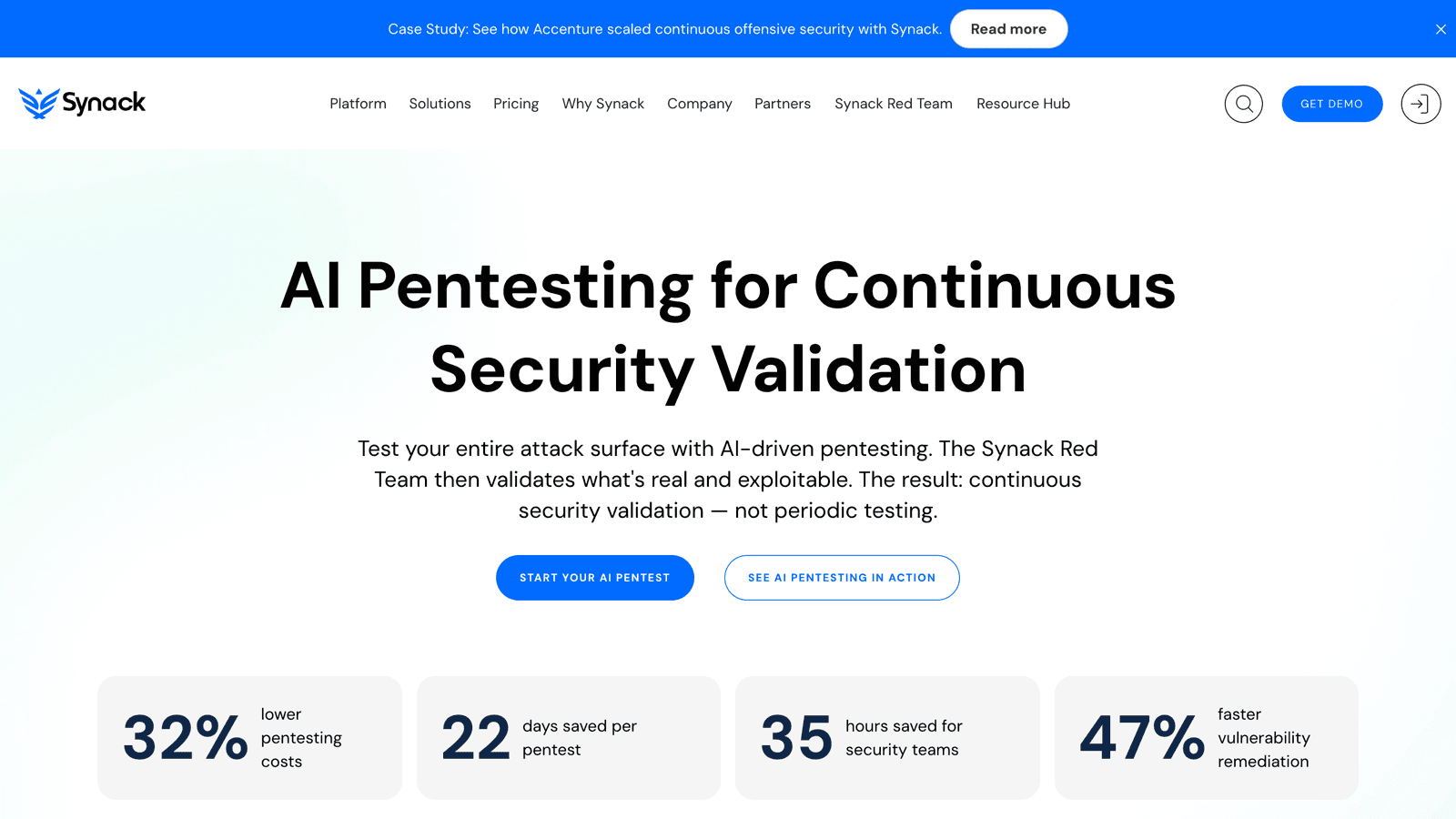
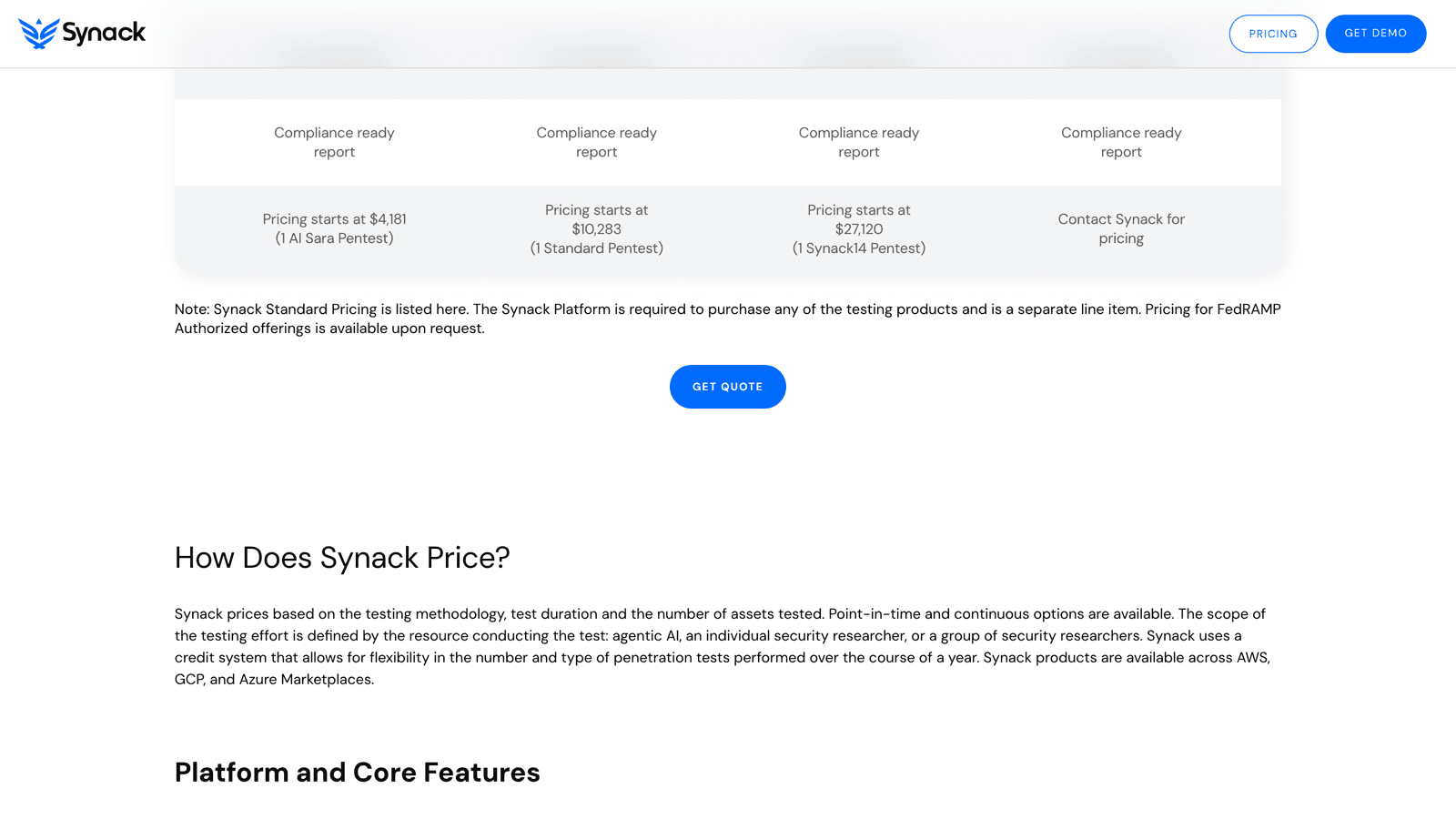
Synack publishes what Cobalt hides. A Sara AI pentest starts at $4,181, a SynackST at $10,283, and a Synack14 at $27,120.
But the commercial model rhymes with the one you are trying to leave, since those are prepaid credits that expire one year from purchase and the platform subscription is a separate line item on top.
Reasons to move
Numbers you can put in a budget. Three published starting prices give you a floor for a human-validated test, which is more than any Cobalt tier offers.
Federal credentials Cobalt does not carry. FedRAMP Moderate with 325 NIST controls, ISO 27001, and DoD impact levels 4, 5, and 6, where Cobalt holds CREST accreditation and no FedRAMP.
A larger, harder-vetted bench. The Synack Red Team runs 1,500+ researchers through a five-step process with under 10% acceptance, and a cyber-defense manager valued “a diverse pool of vetted researchers.”
Noise removed before humans look. Sara Triage ingests Tenable and Qualys output and strips 99.98% of scanner noise, then the red team confirms what is exploitable.
Control over the test itself. All researcher traffic runs through the LaunchPoint VPN with full packet capture, and you can pause an assessment with one click. Our explainer on pentest as a service covers how these platforms are structured.
Reasons the argument collapses
Credits expire, same as Cobalt’s. Tests are bought as prepaid credits with a one-year expiry, usually via PO, so the use-it-or-lose-it problem follows you across.
The published price is not the price. “The Synack Platform is required to purchase any of the testing products and is a separate line item,” so the real entry cost is higher than $4,181.
Sara’s scope is narrower than the marketing. The agent tests external web and host assets only, cannot handle MFA, OTP, or CAPTCHA, and internal testing is on the roadmap.
No code review either. Synack is exclusively black and grey-box offensive testing, and a reviewer flagged “cost pressures” in a market that “has become more commoditized.” A G2 reviewer was warmer, saying it “explains exactly how each flaw was exploited” in enough detail that it felt “like getting secure code training for free.”
Best for: regulated and public-sector buyers where FedRAMP Moderate decides the purchase, and the credit model is acceptable if the price is at least visible.
10. StackHawk
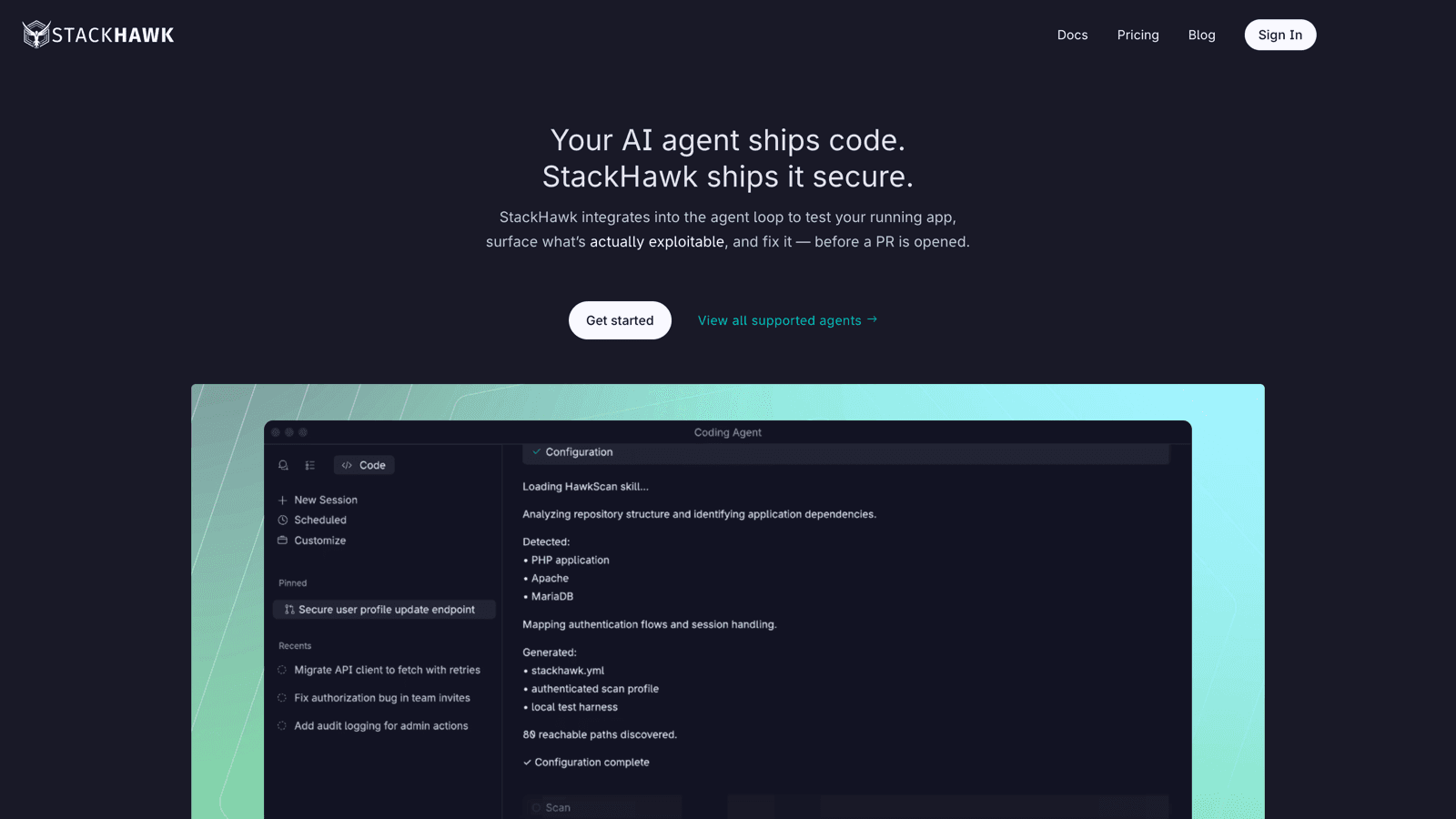
StackHawk is not a pentest replacement and does not claim to be.
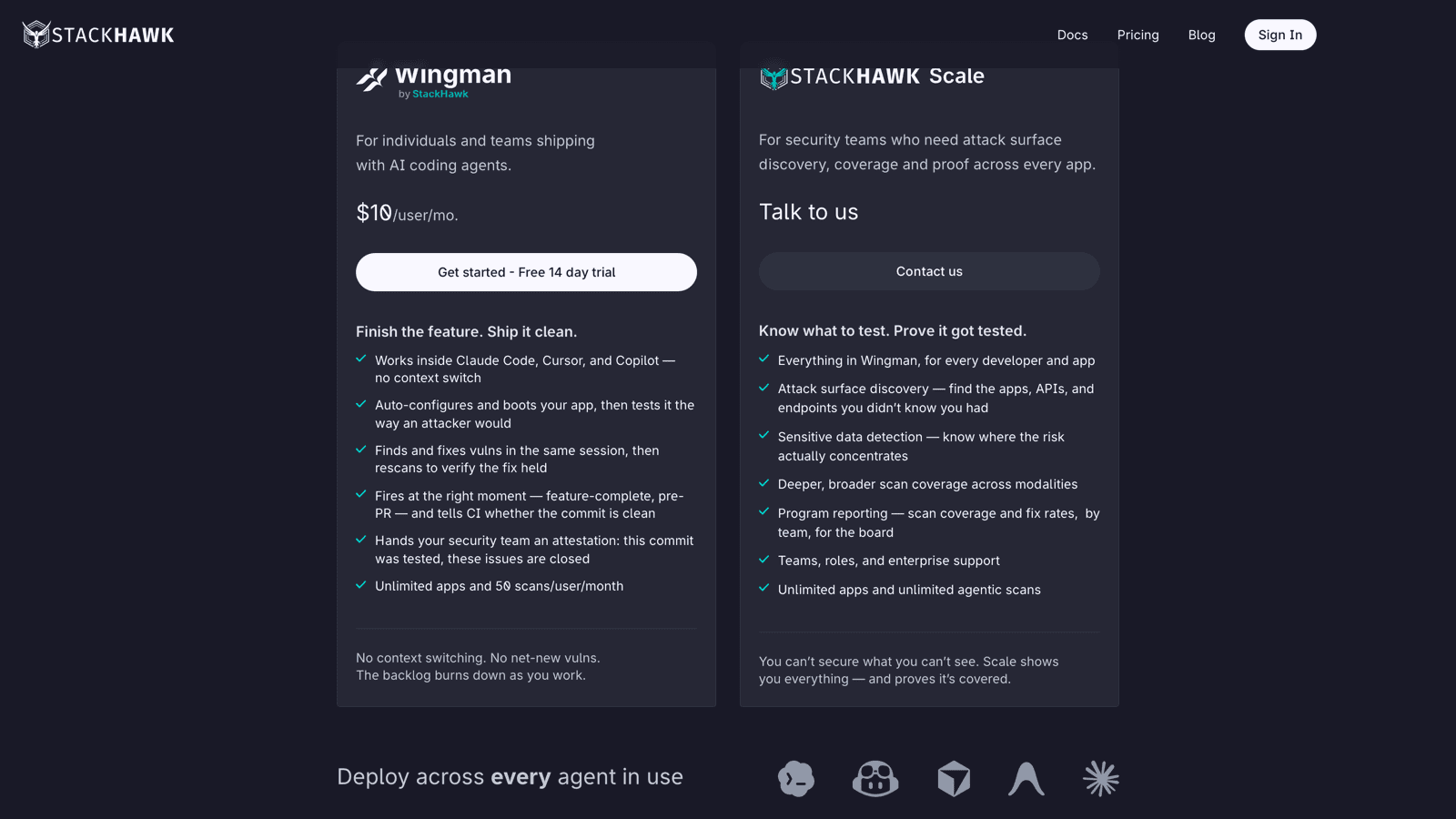
Instead, at $10 per user per month with unlimited apps, runtime testing runs on every CI job, which is a rounding error next to a single Cobalt credit package.
What it covers between engagements
DAST on every pipeline run. The HawkScan CLI runs natively in GitHub Actions, GitLab, Jenkins, and CircleCI, configured by a versioned stackhawk.yml with reproducible results per scan.
API protocols a scoped test often skips. REST, GraphQL, gRPC, JSON-RPC, SOAP, and WebSocket, with deep authenticated-scan support and OpenAPI specs generated from source.
Find, fix, verify inside the coding agent. Wingman installs into Claude Code, Cursor, and Copilot to scan, fix in-codebase, then rescan before the PR opens.
MCP tooling actually tested. StackHawk performs a real MCP handshake and fuzzes each tool call for injection and disclosure issues.
A price that needs no approval. $10 per user per month covers unlimited apps and 50 agentic scans per user, against Cobalt’s one bundled DAST target with extras sold as add-ons. See AI pentesting versus traditional DAST for where the line sits.
What it will never do
No pentest product at any tier. There is no human engagement, no attestation letter, and no red team, so it sits alongside a pentest rather than replacing one.
No SAST. Static analysis is explicitly not StackHawk’s job; it defers that layer to Semgrep, Snyk Code, and CodeQL through integrations.
Authenticated scans take work. An AWS Marketplace reviewer noted “authenticated scans can be frustrating,” and a DevOps engineer said pipeline-dependency setup “needs refinement.”
Cost still compounds per seat. A security-operations manager on PeerSpot wished “the product was a little less expensive,” though StackHawk holds a 4.6 rating across 68 G2 reviews and one reviewer called onboarding “one of the best I’ve seen.”
Best for: teams that keep a human pentest for depth and want the eleven months in between covered for the price of a lunch.
Where This Leaves You
Cobalt does human-led PTaaS well, and if your program is built around vetted testers on named scopes, the renewal is defensible. But credits expire, the unit price is unknown, retests are booked against a clock, and the findings arrive after the code has already shipped.
CodeAnt AI answers each of those directly. A $0 engagement fee with billing tied to exploitable High and Critical findings, a report in 48 hours, free unlimited re-scans, and SAST plus AI review catching the same vulnerability classes at the pull request.
Start with the free open-source plan or the 14-day trial, connect one repository, and run a pentest against the surface you were about to buy credits for.
For more depth, read our guide to the best AI penetration testing tools, the full AI penetration testing guide, and the best continuous pentest tools for CI/CD.

