

Pentera proves whether an attacker gets through the controls you already run. But it never looks at the code that produced the vulnerability it just exploited.
Nor can you model what it costs as your estate grows, because pentera.io/pricing returns a 404 and no trial or self-serve signup exists anywhere on the site.
The only dollar figures on Pentera’s own domain sit in a hosted analyst whitepaper, putting representative licences at $100,000 and $400,000 a year.
For a closer look at what buyers can expect, including available estimates and the factors that affect the total cost, see our guide to Pentera pricing.
TL;DR: CodeAnt AI is the strongest fit if you want exploit-validated pentesting and code-level security in one platform, at a price you can read before a sales call.
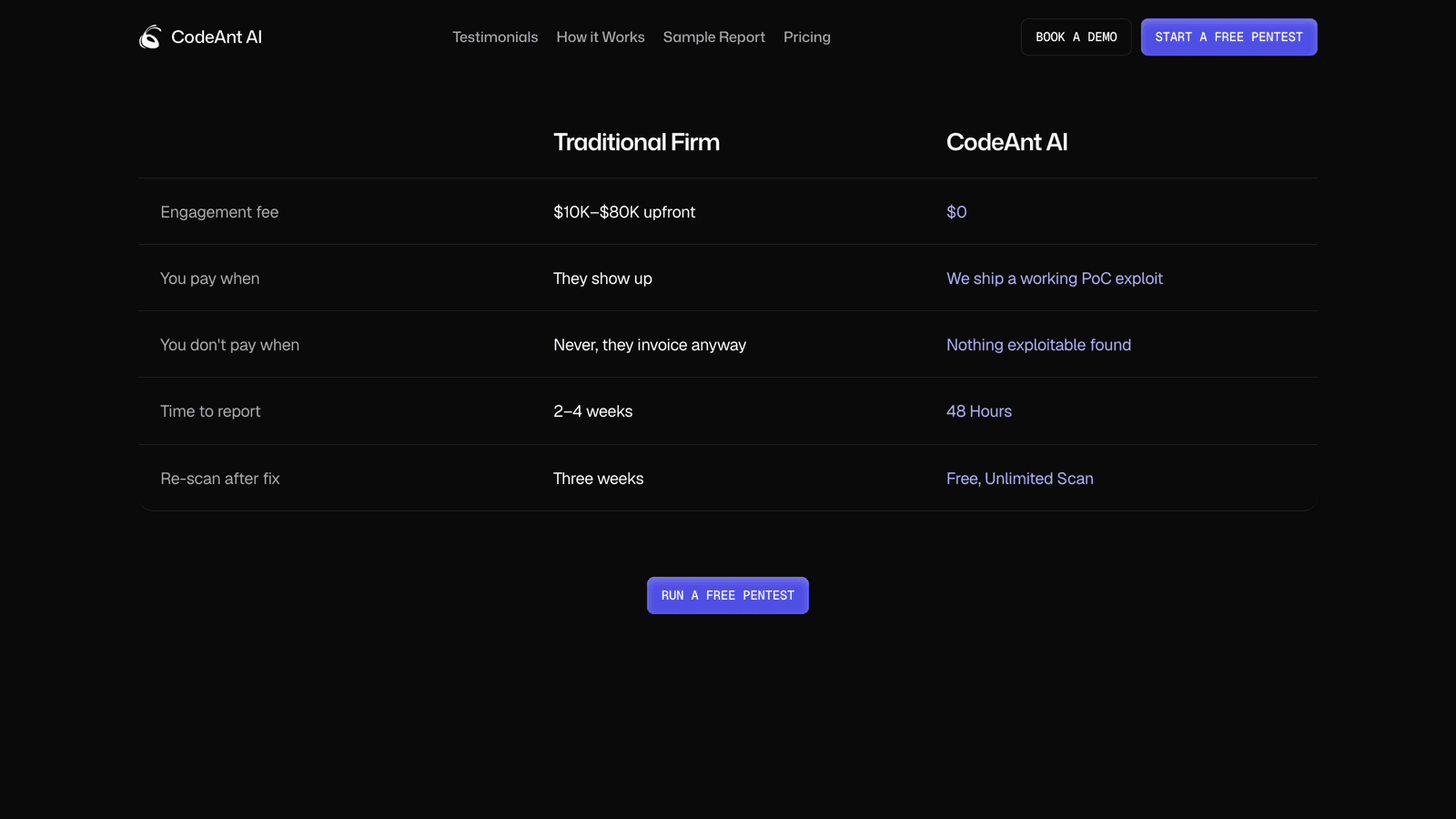
It publishes $24 per user per month, bills pentesting only when a working exploit lands, and reviews every pull request before it attacks your deployed surface.
The rest of the list sorts by which Pentera gap you are closing.
Application and API depth. XBOW and StackHawk go deep on the layer Pentera treats as one asset class among many.
Human testers and audit paperwork. Cobalt and Astra Security attach a named signature to the engagement.
External and cloud exposure. Hadrian and Intruder cover the outside estate at published prices.
A like-for-like swap. Horizon3.ai NodeZero is the closest match if internal network validation is all you want.
Why You Might Need a Pentera Alternative
Four gaps send Pentera customers looking, and you can verify every one of them on Pentera’s own site.
No published pricing, so no way to model growth.
pentera.io/pricingreturns HTTP 404, and the string never appears across the platform, product, or FAQ pages.No way to evaluate it without a sales call. There is no free trial, no freemium tier, and no self-serve signup, so the first real number you see arrives from a rep, after a demo.
No source-code analysis. Pentera ships no SAST, SCA, or repository-analysis product. Its Integrations page instead lists Checkmarx, Contrast, Veracode, Semgrep, SonarQube, JFrog, Black Duck, Snyk, FOSSA, Coverity, and Mend.io under “Code Security,” alongside Jenkins, Bitbucket, GitLab, and GitHub, and all of them feed findings into Pentera Resolve.
Nothing runs before a merge. Because every Pentera product tests a running environment, a flaw you merge today stays unexamined until it reaches somewhere Pentera can attack it. Which is also the moment it becomes expensive.
On that first gap, the only dollar figures anywhere on Pentera’s domain sit inside a TAG Infosphere ROI whitepaper it hosts, which puts representative licences at $100,000 and $400,000 a year and then tells readers they “should not use these numbers as the basis for actual license fees.”
So the renewal math is left where you cannot run it. And Pentera keeps validating the estate while the estate keeps regenerating the same weaknesses, because nothing upstream ever changed.
What Pentera Already Does Well

Pentera owns internal network validation, and none of the eight tools below matches it there.
Capability | What Pentera delivers |
|---|---|
Internal network attack emulation | Pentera Core runs credential-based access validation, privilege escalation, and attack-path root cause analysis against production |
Active Directory testing | AD Password Assessment cracks password hashes offline to find accounts that pass policy yet stay exploitable |
External surface validation | Pentera Surface maps the external kill chain to MITRE ATT&CK, including phishing emulation |
Remediation orchestration | Pentera Resolve ingests findings from roughly 62 named third-party tools |
Compliance evidence | Validated findings mapped to PCI DSS v4.0, SOC 2, ISO 27001, NIST, DORA, NIS2, and HIPAA |
Pentera’s SOC 2 and SOC 3 reports cover Surface and Resolve, a scope narrower than the full platform, and its compliance page states outright that Pentera “does not certify compliance or claim FedRAMP authorization.”
If deeper internal coverage is the thing you still need, stay with Pentera. Read on if what you are missing sits at the application layer, in the repository, or on the invoice.
The 8 Best Pentera Alternatives at a Glance
The three columns below are the axes a Pentera renewal turns on: where the tool runs, what it points at, and what the meter counts.
# | Tool | Deployment model | Layer it tests | Licence basis |
|---|---|---|---|---|
1 | CodeAnt AI | SaaS, with on-prem and VPC on Enterprise | Source code, then the deployed application | Per user, pentest billed on proven exploits |
2 | XBOW | SaaS only, no self-hosted option | Web applications and their APIs | Per test |
3 | StackHawk | SaaS platform, scanner binary runs in your CI | Running applications and APIs, pre-merge | Per user |
4 | Cobalt | SaaS platform plus human testers | Apps, APIs, network, cloud, and code by engagement | Annual credits, one credit buys eight hours |
5 | Astra Security | SaaS, agentless cloud scanner | Apps, APIs, cloud | Per target, per year |
6 | Hadrian | SaaS, nothing deployed inside the network | External attack surface | Per test for Nova, total asset count for Atlas |
7 | Intruder | SaaS, internal scanning on Pro | External and cloud exposure | Per scanned target, licence held 30 days |
8 | Horizon3.ai NodeZero | Agentless, runs remotely or on-prem | Internal, external, cloud, Kubernetes, AD | Subscription tier, test frequency uncapped |
The 8 Best Pentera Alternatives
The order runs from the tools that reach furthest into the application and the repository down to the one that repeats what Pentera already does for you. Every price, limitation, and feature below comes from the vendor’s own site or documentation, checked in July 2026.
1. CodeAnt AI
CodeAnt AI is the only platform here that reads the code, then attacks what the code became: it reviews each pull request, runs SAST against the repository, and sends 500+ AI exploit agents at the deployed application.
That ordering matters for a Pentera buyer. Because the offensive layer already knows how the application was built, it starts from architecture rather than from a port scan.
Pentera’s four products all validate infrastructure that exists. By contrast, CodeAnt AI covers the stage before deployment and the stage after it, which is the loop described in the defensive and offensive platform breakdown.
Key features:
AI code review on every pull request. Reviews arrive as inline PR comments with full codebase context, so findings land where the fix happens instead of in a separate dashboard.
SAST, SCA, secrets, and IaC scanning in one pass. Covers the code-security categories Pentera integrates with rather than performs.
Three pentesting modes. Blackbox maps everything publicly reachable, Whitebox works from the code, and Graybox & Code Memory combines both.
48-hour audit-grade reporting. Engagements return a SOC 2 or ISO 27001 PDF within 48 hours, with free unlimited re-scans after fixes.
Published CVE research. Three CVEs disclosed by the CodeAnt team, listed on the pentesting page.
Limitations:
Internal network and Active Directory attack emulation sit outside its scope, so keep Pentera or add NodeZero if lateral movement across a corporate domain is your priority.
The pentesting product targets applications and the surface around them, stopping short of the whole enterprise estate.
Choose it when: the exposures Pentera keeps proving trace back to code you own, and you want them caught in the pull request as well as on the live target.
Pricing (per the CodeAnt AI pricing page, July 2026):
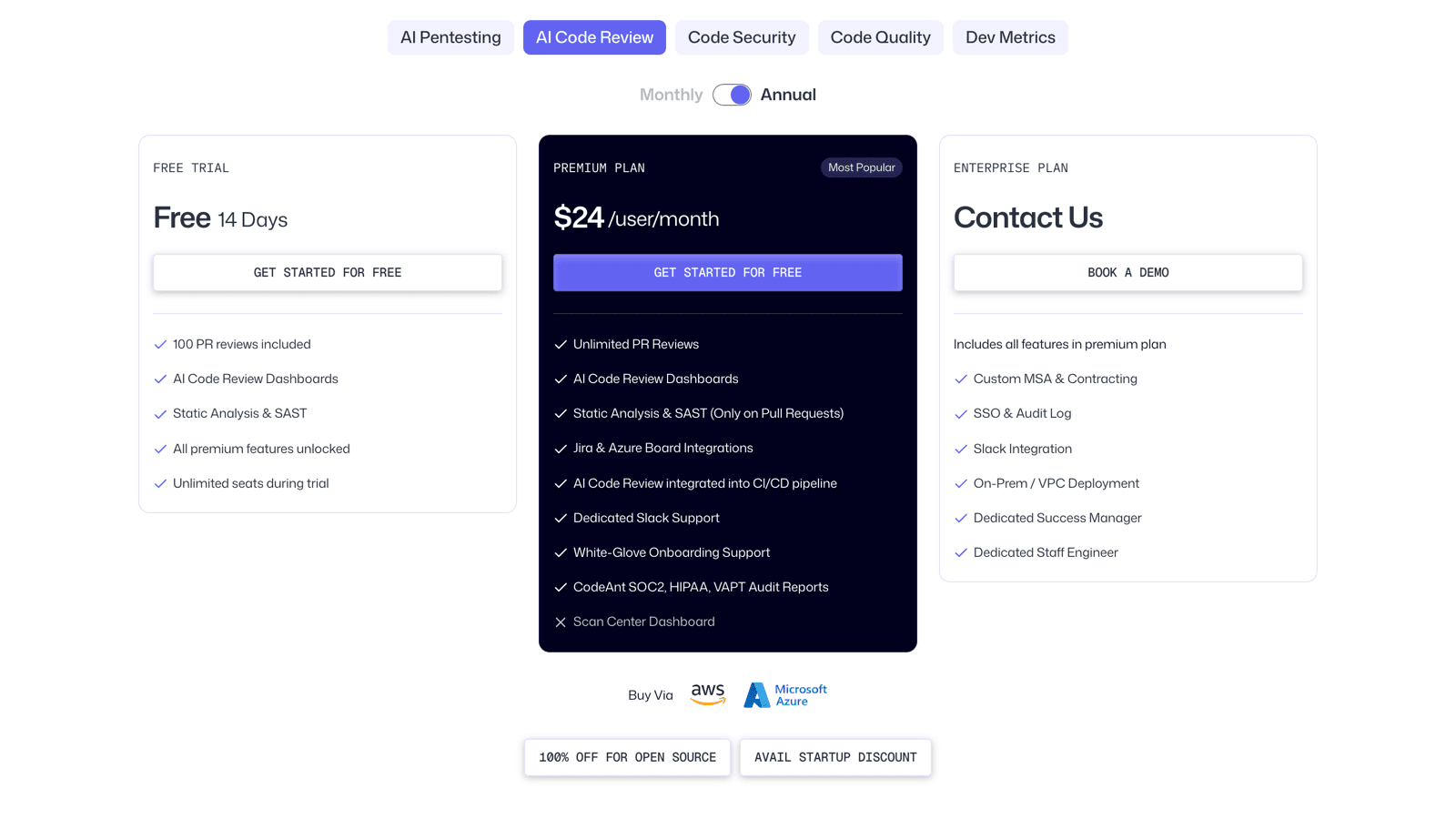
Plan | Price | Includes |
|---|---|---|
Free trial | 14 days | 100 PR reviews, unlimited seats |
Premium | $24 per user/month | Unlimited PR reviews, SAST, CI/CD review |
Enterprise | Contact | On-prem and VPC deployment, SSO, custom MSA |
Seats are the meter, not assets. And pentesting runs on a risk-reversal model where you pay only when a working exploit lands.
2. XBOW
XBOW applies Pentera’s discipline of proving exploitability to the layer Pentera treats as one asset class among many. It runs a five-stage autonomous attack loop and returns a proof of concept and a full trace for every finding.
But web applications and their APIs are the only supported targets, which is the trade for the depth.
Its whitebox mode is the part a Pentera buyer notices, because pointing it at the repository starts the attack with knowledge of the implementation rather than with reconnaissance. For where the two approaches split, see the CodeAnt AI and XBOW comparison.
Key features:
Autonomous attack loop. Learn, map, coordinate, attack, and prove, with thousands of short-lived agents working in parallel.
Exploit chaining with proof. Documented chains up to 48 steps, delivered with request and response detail.
Separated discovery and validation. Deterministic validators confirm exploitability before a finding surfaces.
Lightspeed on-demand pentests. Audit-ready reports within five days in blackbox, whitebox, or greybox mode.
Model routing. Routes each task to the best available model without migration work.
Limitations:
Web apps and APIs only. Mobile, cloud, network, and binary testing sit on the roadmap, so this replaces none of Pentera Core.
SaaS only, with no self-hosted option and no named CI, SCM, or ticketing integrations.
Headline benchmark figures date from mid-2024 and have not been refreshed, and every pricing call to action routes to a contact form.
Choose it when: your product is web and API-centric, and you want application-layer exploit proof on demand without a scoping cycle.
Pricing: Nothing you can read. The pricing page now says the number is “scoped to your environment” and bills on usage rather than a fixed annual engagement, and Request Pricing is the only button on it.
An earlier version of that page did carry figures, and they are worth knowing as history rather than as a budget line.
Lightspeed Plus was listed at $4,000 per test, which XBOW positioned against a two-week manual engagement.
Lightspeed Premium was listed at $8,000 per test, positioned against a four-week one, with Enterprise on request.
Neither figure survives on the live page. Quote them to a vendor today and you will be corrected.
So XBOW lands in the same place Pentera does on the question that opened this article. You cannot model the third-year bill without a sales call, and the difference is only that XBOW used to let you.
3. StackHawk
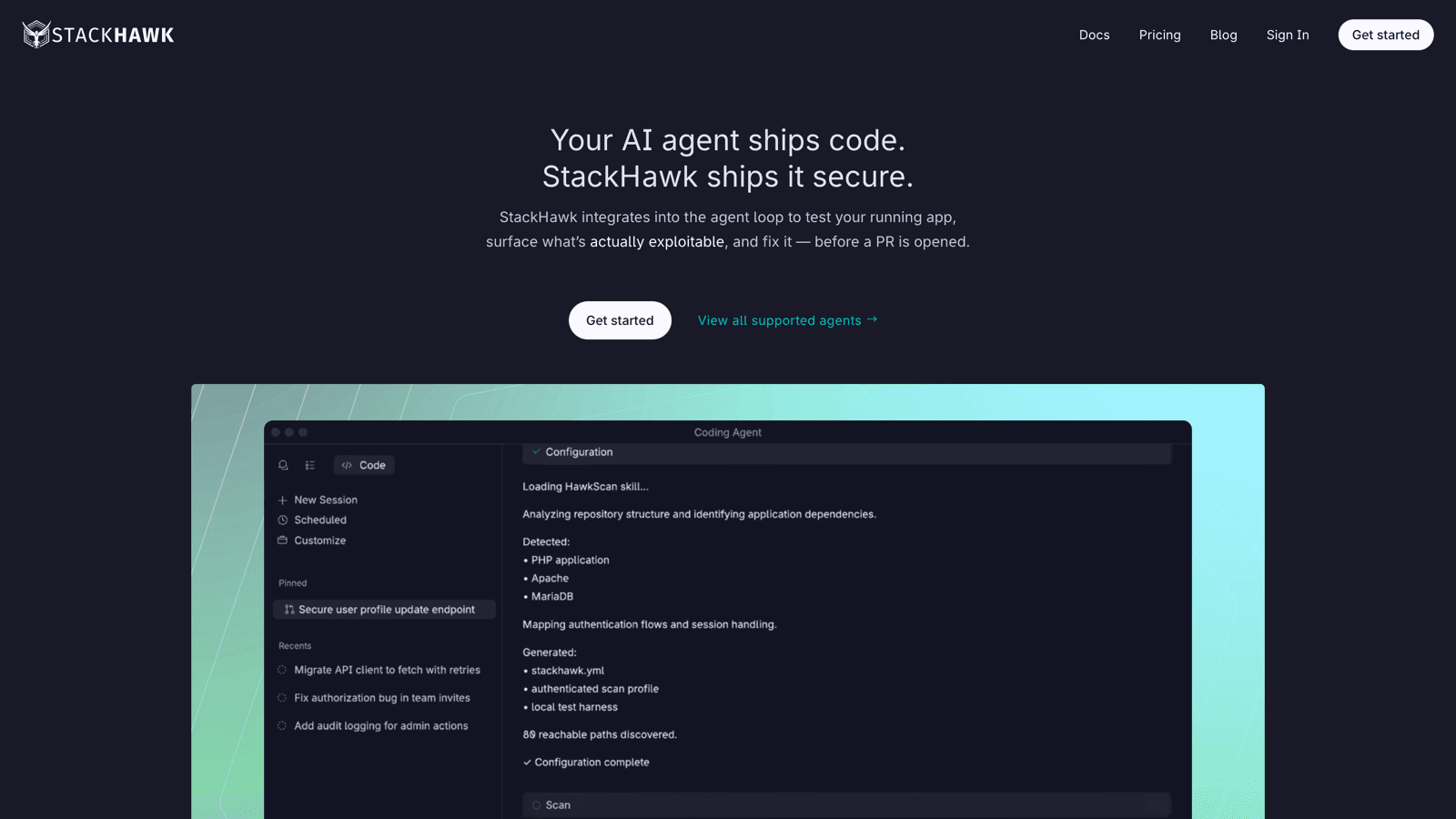
StackHawk is the only tool in this list besides CodeAnt AI that touches your repository, running DAST against a live build from inside CI, with current positioning aimed squarely at code written by AI agents.
Because the detection method stays dynamic throughout, this closes the timing gap rather than the code-analysis gap. A vulnerability gets attacked before the merge instead of after the deploy.
If your reason for leaving Pentera is that validation arrives too late in the lifecycle, start here or with the roundup of continuous pentest tools that run in CI/CD.
Key features:
HawkScan CLI. A native binary running in GitHub Actions, GitLab, Jenkins, and CircleCI, configured by a versioned
stackhawk.yml.Broad API protocol coverage. REST, GraphQL, gRPC, JSON-RPC, SOAP, and WebSocket, with deep authenticated-scan support.
MCP server testing. Performs a real MCP handshake and fuzzes each tool call for injection and disclosure issues.
Wingman agent skills. Installs into Claude Code, Cursor, and Copilot to scan, fix in-codebase, then rescan to verify.
API Discovery. Maps endpoints from connected repositories and generates OpenAPI specs from source.
Limitations:
No SAST. StackHawk positions against static analysis and hands it to Semgrep, Snyk Code, and CodeQL integrations, so the repository gets read for endpoints rather than examined for flaws.
No penetration testing product or tier exists.
No self-hosted platform, and the Hosted Scanner is being deprecated in favor of Cloud Deployment.
Choose it when: your stack is API-heavy and you want runtime testing driven by a coding agent inside the pull request loop.
Pricing (per the StackHawk pricing page, July 2026):

Plan | Price | Includes |
|---|---|---|
Wingman | $10 per user/month | Unlimited apps, 50 agentic scans per user |
StackHawk Scale | Talk to us | Unlimited scans, attack surface discovery, SSO |
4. Cobalt
Cobalt sells human-delivered pentesting on a platform, billed in credits where one credit buys eight hours of testing. And it is the only vendor here that puts a person on your source code.
Though that analysis arrives as a scoped engagement an auditor will accept, it never runs at the pull request, so treat it as evidence rather than as coverage.
The credit meter is the thing to model carefully if you are already unhappy with an opaque licence. The CodeAnt AI and Cobalt comparison lays the two billing models side by side.
Key features:
Cobalt Core. 450+ vetted freelance testers averaging 11 years of experience, with start SLAs of 3, 2, or 1 business days by tier.
Secure Code Review. Human-led source-code analysis using automated SAST and SCA, followed by expert validation for business logic flaws.
Published methodologies. Per-asset test plans for web, API, mobile, network, cloud, desktop, and AI/LLM targets.
DAST scanner. Roughly two-hour scans with authenticated coverage via a Sequence Recorder.
Pentest Management Platform. Runs your own in-house or third-party testers on Cobalt’s platform.
Limitations:
Credits expire with the contract year, capped at 10% rollover on Enterprise, and reviewers flag a five-credit minimum that makes small scopes uneconomic.
The Standard tier excludes Jira and GitHub integrations entirely, per Cobalt’s own pricing table.
Cobalt’s docs describe Attack Surface Management as launched “with basic functionality,” with subdomain-takeover detection listed as future work.
Choose it when: an auditor or an enterprise customer wants a named human’s signature on the report, including on the code review.
Pricing: quote only across Standard, Premium, and Enterprise. Cobalt publishes the credit unit and comparative savings claims rather than a per-credit rate.
5. Astra Security
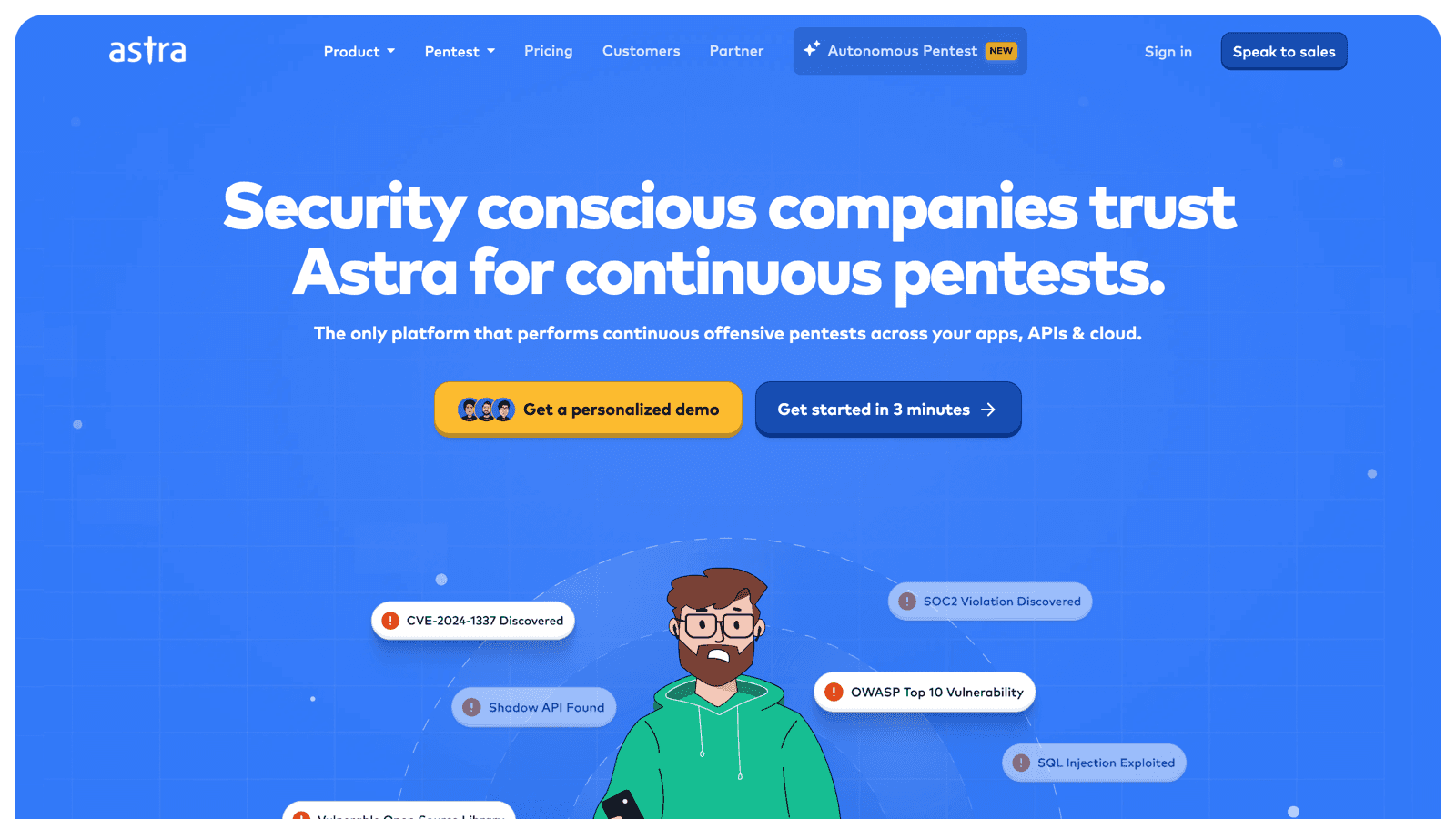
Astra runs automated scans first, then puts certified pentesters on the same dashboard, returning findings with proof-of-concept videos in 10 to 15 working days.
API coverage is its strongest technical area, including discovery of zombie, shadow, and orphan endpoints. Which is useful if your application estate grew faster than your inventory of it.
The licence is a flat annual fee per target, which is the most predictable model in this list. For the coverage trade behind that simplicity, see the CodeAnt AI and Astra Security comparison.
Key features:
Hybrid PTaaS. Automated scanning followed by OSCP, CEH, CRTP, and CREST-certified manual testing.
API security depth. An authorization matrix for user-level privileges plus 15,000+ authenticated test cases.
Authenticated DAST. Handles TOTP MFA via custom login scripts and crawls JavaScript-heavy applications.
Cloud scanner. 400+ agentless detectors across AWS, Azure, and GCP, with a first report in under 10 minutes.
MCP auto-fix. Pushes a ready-to-paste fix prompt into Cursor, Claude Code, or VS Code.
Limitations:
No SAST or code-review product. The MCP integration reads a repository to write a fix for a runtime finding, never to find issues in code.
The flagship Autonomous Pentest is waitlist-only, with credit rates not yet published.
Astra does not remediate, stating it assists developers rather than fixing vulnerabilities.
Choose it when: you need a CREST or PCI-ASV-backed report to clear an enterprise security review, at a price you can put in a budget line.
Pricing (per the Astra pricing page, July 2026):
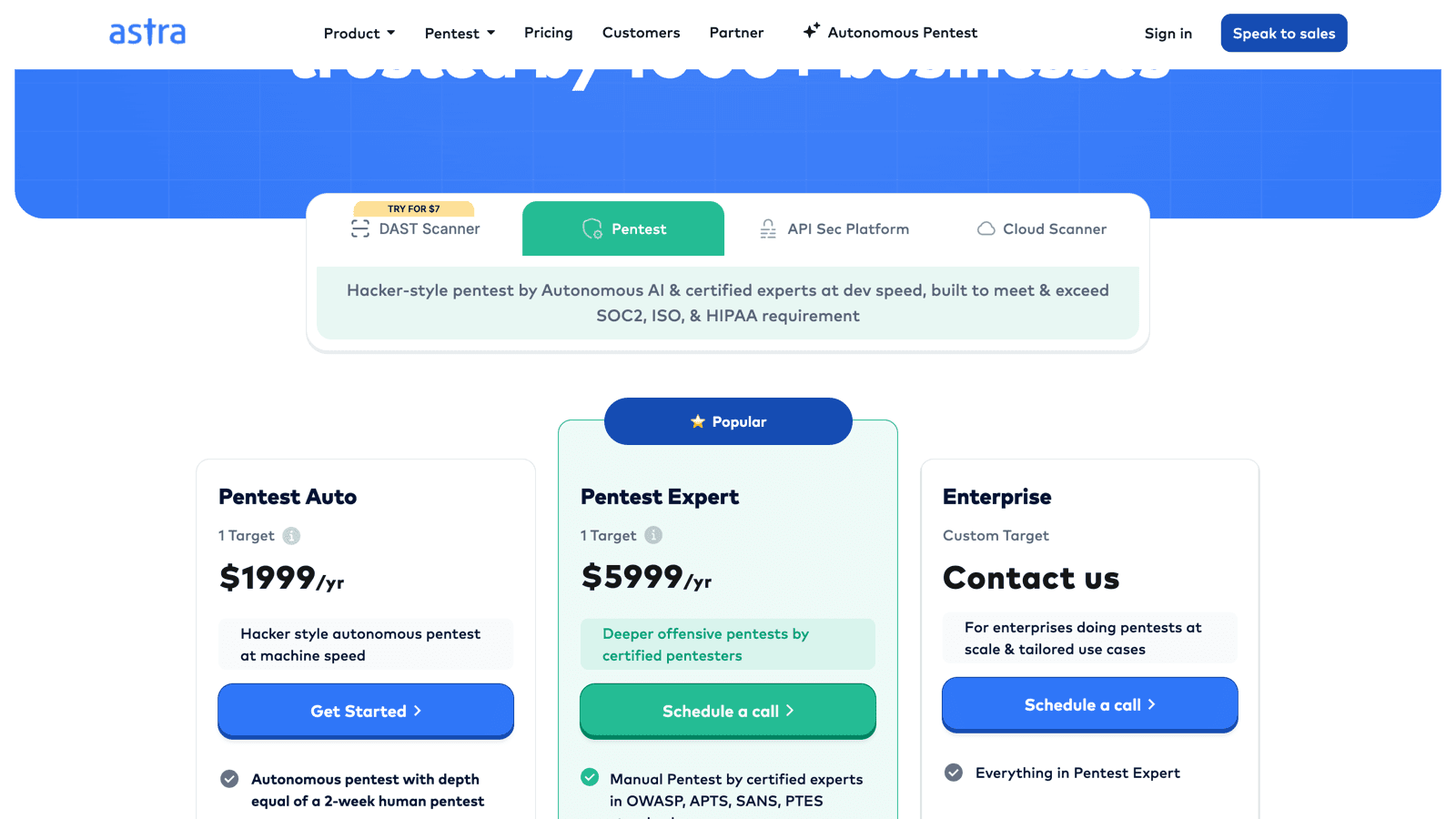
Pentest plans bill annually and cover one target each, while unlimited DAST scanning sits outside that as a separate $199 a month subscription.
6. Hadrian
Hadrian discovers external assets without a supplied scope, then validates which exposures an attacker could actually reach.
And event-driven testing fires the moment an asset changes rather than waiting for a scheduled window, which helps when your estate keeps growing through acquisition.
Nothing gets deployed inside your network, so security review is short. For the methodology behind this kind of coverage, see the external penetration testing methodology guide.
Key features:
Sense engine. Hourly passive scans with ML trained by ethical hackers to confirm asset ownership.
Verified Risks. Splits potential from confirmed, attaching step-by-step reproduction to every confirmed risk.
Contextually-gated scanning. Runs only checks matching the fingerprinted technology, avoiding WordPress checks against SAP.
Nova. On-demand agentic pentests against web apps, APIs, and cloud, returning results in 24 to 48 hours.
Business-context prioritization. Ranks beyond CVSS using asset criticality, CISA KEV data, and dark web monitoring.
Limitations:
External surface only. No source-code review, no SCM or CI integration, and internal network testing is not stated.
Nova’s terms disclaim completeness, stating Hadrian “does not warrant that Nova will identify every vulnerability.”
Pentest entitlements expire at the end of the contract year and do not roll over, and Atlas is priced on total asset count.
Choose it when: you manage a large or acquisitive external estate and want continuous exposure validation with nothing installed.
Pricing: Nova costs €3,000 per test, where one test covers one URL. Atlas is priced on total asset count with no published figure.
7. Intruder
Intruder orchestrates several scanning engines behind one interface for teams with no security specialist on staff, and published pricing plus a genuine free tier make it the easiest entry point here.
But it is also the clearest illustration of what a per-target meter does to a bill, since a licence is consumed for 30 days and does not release early.
If you are rebuilding a business case after a Pentera quote, the breakdown of what penetration testing actually costs is a useful anchor.
Key features:
Multi-engine scanning. OpenVAS, Nuclei, Tenable Nessus, and OWASP ZAP routed by plan, with 18,800+ external checks on Pro.
GregAI. Prioritizes findings, writes environment-specific remediation, and ships an MCP server.
AI issue validation. An agent that mimics pentester behavior to confirm exploitability, metered in credits.
CloudBot. Syncs AWS, GCP, Azure, and Cloudflare, auto-triggering scans when new services appear.
Secrets detection. 850+ token formats, including extraction from JavaScript bundles in single-page apps.
Limitations:
No SAST, SCA, or code-review product exists anywhere on the platform.
A licence is consumed for 30 days per scanned target and does not release early on deletion or cancellation.
Internal scanning requires Pro, and attack surface view, subdomain discovery, and Rapid Response are Enterprise-only.
Choose it when: you run a small security or IT team and need continuous external and cloud coverage plus an auditor-acceptable report.
Pricing (per the Intruder pricing page, July 2026, annual billing):
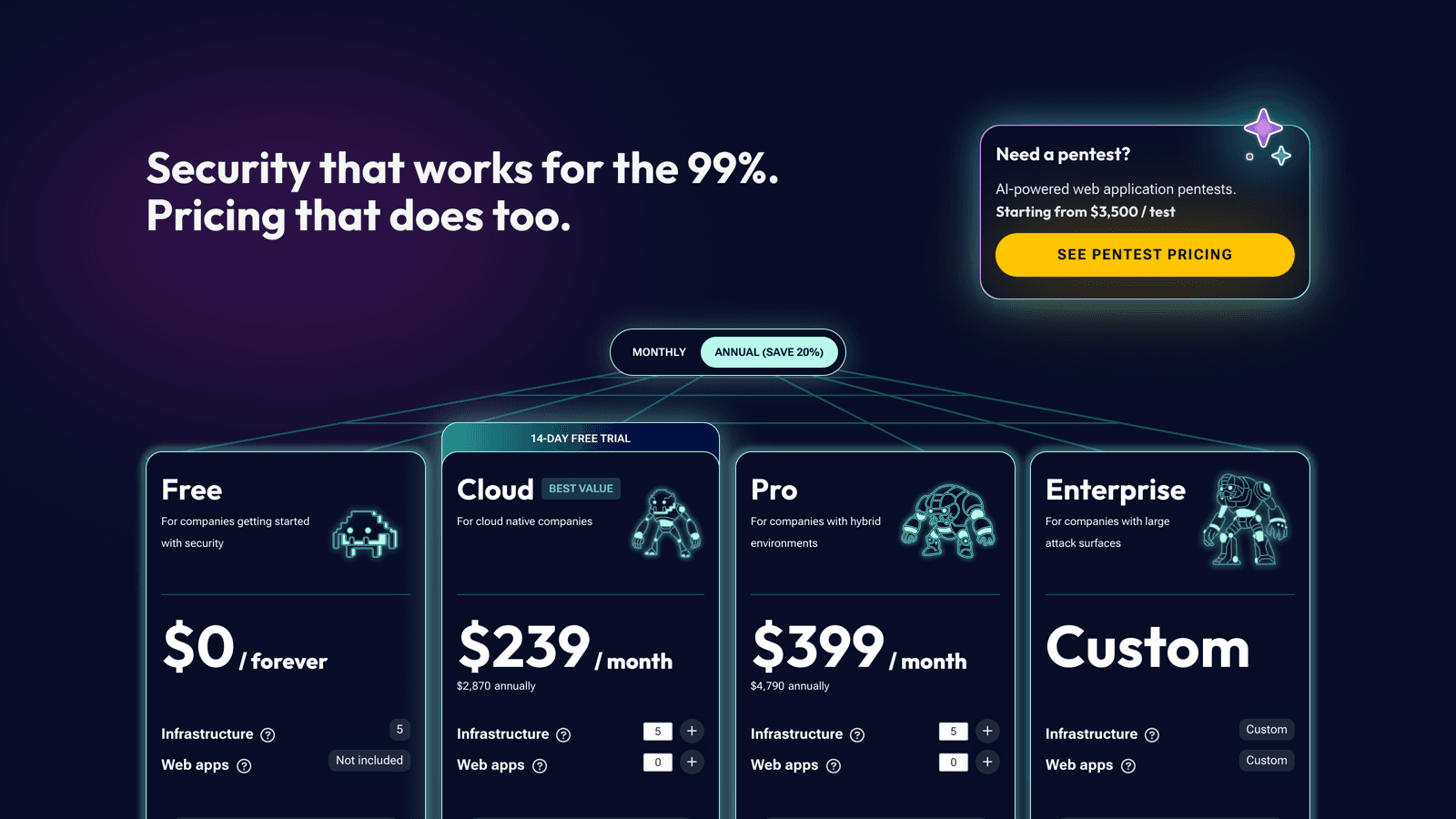
Plan | Annual price | Notes |
|---|---|---|
Free | $0 | 5 infrastructure licences, 3 users |
Cloud | $239 per month | $2,870 billed annually |
Pro | $399 per month | $4,790 billed annually, internal scanning |
Enterprise | Custom | Annual billing only |
AI pentests cost $3,500 per test for subscribers and $4,000 as a one-off.
8. Horizon3.ai NodeZero
NodeZero is the closest thing to Pentera in this list, so it solves the licence and the deployment question without solving the code question.
Both run agentless autonomous exploitation against production, chain attack paths, and revalidate fixes. Where they separate is deployment, since NodeZero runs remotely or on-prem with no agents and no network configuration, and it does not cap test frequency.
Horizon3 also pushes harder on federal and MSSP channels, holding FedRAMP High authorization where Pentera holds none. Read the automated penetration testing primer if you are comparing this class of tool for the first time.
Key features:
Multi-domain exploitation. Internal, external, AWS, Azure Entra ID, Kubernetes, segmentation, and insider-threat testing, available at the entry tier.
1-Click Verify. Retests a remediation and retains proof for 12 months, currently internal environments only.
Rapid Response. Production-safe exploits for newly disclosed CVEs, often within hours of disclosure.
Endpoint Security Effectiveness. Deploys a test RAT and reports whether EDR blocked, alerted, or missed it.
NodeZero MCP Server. Drives pentests from LLM and agentic workflows over OAuth 2.1.
Limitations:
Zero code-security surface. The packaging matrix has no code rows, and GitHub appears only as a destination for remediation tickets.
Web application pentesting remains behind an early-access waitlist, so the application-layer gap you have today stays open.
Recurring scheduled pentests require the Core tier or above, and reporting analytics are Elite-only. And pricing is quote-gated, same as Pentera.
Choose it when: internal network and Active Directory exploitation is the whole job, you want uncapped test frequency, or you carry a FedRAMP High requirement.
Pricing: quote only. Four cumulative tiers (Flex, Core, Pro, Elite) with no published figures, though a self-serve 30-day free trial exists.
What Each One Costs, and What the Meter Counts
Two things decide a renewal: the entry price, and the unit the vendor multiplies. And a per-asset or per-target meter is what turns a reasonable first-year number into an unreasonable third-year one.
Tool | Entry price | What the meter counts | Evaluate without sales |
|---|---|---|---|
CodeAnt AI | $24 per user/month | Seats, plus proven high and critical exploits | 14-day trial, 100 PR reviews |
XBOW | Quote on request, formerly $4,000 per test | Tests, with an $8,000 tier on the retired page | No. Every pricing CTA is a contact form |
StackHawk | $10 per user/month | Seats, 50 agentic scans each, unlimited apps | Free trial |
Cobalt | No published figure | Annual credits, eight hours each, five-credit minimum | No free tier or self-serve trial |
Astra Security | $1,999 per year | Targets, $5,999 for the certified manual tier | No free tier, a paid $7 scanner week instead |
Hadrian | €3,000 per Nova test | URLs for Nova, total asset count for Atlas, unpublished | Not published |
Intruder | $239 per month, billed annually | Scanned targets, each licence held 30 days | Free tier, 5 infrastructure licences and 3 users |
Horizon3.ai NodeZero | No published figure | Subscription tier, test frequency uncapped | Self-serve 30-day free trial |
Pentera | No published figure, pentera.io/pricing returns 404 | Not published | No trial and no self-serve signup |
CodeAnt AI and StackHawk are the only vendors here that bill per seat, so the number moves when the team moves, not when the estate does.
The $100,000 and $400,000 whitepaper figures are the only public anchor for Pentera, and Pentera itself tells you not to treat them as fees.
Common Features Versus Differentiators
Every tool here proves exploitability rather than reporting theoretical severity.
Table stakes across all eight:
Capability | Availability |
|---|---|
Exploit-validated findings | All eight |
Proof of concept or reproduction steps | All eight |
Compliance-mapped reporting | All eight |
Remediation guidance | All eight |
Continuous or on-demand scheduling | All eight |
The differences that decide the purchase are scope, and whether anything reads your code.
Tool | Internal network | External surface | Web and API | Source-code analysis | Runs pre-merge |
|---|---|---|---|---|---|
CodeAnt AI | No | Yes | Yes | Yes | Yes |
XBOW | No | No | Yes | Whitebox input only | No |
StackHawk | No | No | Yes | Reads repos only | Yes |
Cobalt | Yes | Yes | Yes | Engagement only | No |
Astra Security | Enterprise | Yes | Yes | No | No |
Hadrian | No | Yes | Yes | No | No |
Intruder | Pro tier | Yes | Yes | No | No |
Horizon3.ai NodeZero | Yes | Yes | Waitlist | No | No |
Pentera | Yes | Yes | Yes | No | No |
Two columns separate the field, and they are the two Pentera leaves empty. CodeAnt AI is the only platform here that analyzes source code to find vulnerabilities and then attacks the deployed application.
By contrast, Cobalt reviews code as a billed human engagement, XBOW accepts code as input to an attack rather than analyzing it for defects, and StackHawk reads repositories only to map endpoints.
How to Choose
Find the row that describes your situation. The recommendation is the tool that closes that specific gap, not the tool with the widest feature list.
Your situation | Start with | Why |
|---|---|---|
The exposures Pentera proves keep tracing back to your own code | CodeAnt AI | Review, SAST, and pentesting on one platform, so the flaw is caught in the pull request and proven again on the live target |
You need application and API exploit depth on a running target | CodeAnt AI Graybox, then XBOW | CodeAnt attacks with knowledge of the implementation. XBOW is the narrow specialist if web and API is your entire scope |
Validation has to happen before the merge, not after the deploy | CodeAnt AI, or StackHawk | CodeAnt reviews every pull request. StackHawk runs DAST from inside CI if you already have static analysis elsewhere |
An auditor wants a named human on the report | Cobalt | Vetted testers with published methodologies, and the only human-led secure code review here |
You need CREST or PCI ASV evidence at a fixed annual cost | Astra Security | Certified manual testing at $5,999 a year per target, with the price published |
Your external estate grows faster than your inventory of it | Hadrian | Scope-free discovery and event-driven retesting, with nothing installed inside the network |
Lean team, no security specialist, and a budget that must be readable | Intruder | A free tier, published plans, and multi-engine scanning behind one interface |
Internal network and Active Directory validation is the whole job | Horizon3.ai NodeZero | Agentless, remote or on-prem, uncapped test frequency, and FedRAMP High |
You want deeper internal coverage than anything above delivers | Stay with Pentera | Nothing in this list beats Pentera Core and AD Password Assessment on their own ground |
Most teams leaving Pentera do not need a second network validator. They need the layer underneath, which is why the AI penetration testing guide is a better next read than another vendor demo.
Where This Leaves You
Pentera answers one question well: would an attacker get through the controls you already run?
Eight alternatives answer adjacent questions. Only one also answers whether the code you shipped this morning wrote the next finding.
The defensive and offensive comparison covers the architecture, and the Pentera head-to-head drills into the direct matchup.

