

Traditional penetration testing has a structural problem: it is a project, and your software is a stream. You commission a test, wait two to four weeks, get a PDF, and by the time you finish reading it your team has shipped a dozen releases the report never saw. Penetration Testing as a Service (PTaaS) exists to close that gap, by delivering testing through a platform, continuously, instead of as a one-off engagement.
But "as a service" is doing a lot of work in that name, and not every PTaaS offering means the same thing. Some are a thin dashboard bolted onto the same slow manual process. Others are automated scanners rebranded with a subscription. The good ones combine real exploit validation with platform-delivered speed and continuous coverage.
This guide explains what PTaaS actually is as a delivery model, the capabilities that separate a real platform from a repackaged scanner, and the honest pros and cons, so you can tell whether PTaaS fits your program or whether a traditional engagement still serves you better.
What Is Penetration Testing as a Service (PTaaS)?
Penetration Testing as a Service is a delivery model, not a new testing discipline. It packages the penetration testing lifecycle, scoping, testing, real-time findings, remediation tracking, reporting, and retesting, through a cloud platform, rather than as a one-off consulting engagement that ends with a static PDF.
The category is recognized enough that Gartner covers it in a dedicated Innovation Insight on Penetration Testing as a Service, defining it as continuous, scalable security testing delivered through a combination of automation and human expertise, available on-demand or by subscription. Gartner's own projections put numbers on why teams are moving: by 2029, PTaaS adopters are expected to run penetration testing up to five times more frequently than teams using traditional approaches, and by 2028 to achieve remediation cycles about twice as fast.
The key word is model. PTaaS does not automatically mean better testing, it means testing delivered differently: continuously, through a platform, with findings you see as they land rather than in a report weeks later. Whether that testing is deep depends entirely on what sits behind the platform, which is the whole point of the pros and cons below.
Within that model, PTaaS is sold three ways, and the difference matters for how you buy.
On-demand lets you launch a scoped test whenever you need one, with no annual contract, which suits teams that test per major release.
Subscription bundles a set cadence of testing into a recurring fee, which suits teams that want predictable, ongoing coverage.
Continuous runs testing automatically against every change, which suits fast-shipping teams where the attack surface moves weekly.
Most modern platforms offer more than one, and the right choice tracks how often your code actually changes.
PTaaS vs Traditional Pentesting vs Vulnerability Scanning
The single most common PTaaS question is how it differs from the two things it gets confused with. Here is the clean separation.
Dimension | Vulnerability scanning | Traditional pentest | PTaaS |
|---|---|---|---|
Primary method | Automated detection | Human-led project | Testing delivered through a platform |
Findings | Possible vulnerabilities | Validated findings in a final report | Validated findings in real time |
Cadence | Continuous or scheduled | One-off, annual or quarterly | On-demand plus continuous |
Delivery | Scanner dashboard | 30-to-80-page PDF | Live platform, remediation tracking |
Exploit validation | None | Yes, manual | Yes, if the platform is real |
Retesting | Re-scan | New engagement, billed | Included in the workflow |
Best for | Known-CVE hygiene | Deep annual assessment | Continuous coverage at release speed |
The distinction that matters: a scanner tells you what might be wrong, a pentest proves what an attacker can do, and PTaaS delivers that proof continuously through a platform instead of once a year in a document. We break the scanning-versus-testing line down further in What Is VAPT? Vulnerability Assessment vs Penetration Testing, and the cadence half in Continuous vs Annual Penetration Testing.
PTaaS is also not a bug bounty. A bug bounty relies on a broad crowd of external researchers hunting your scope for a per-valid-finding payout, with less structured engagement. PTaaS is scoped, methodical testing delivered as a managed service.
The Core Capabilities of a PTaaS Platform
Gartner lists the delivery-model benefits that define the category: faster scheduling and execution, real-time communication with testers, live visibility of results, workflow automation through DevOps and ticketing integrations, and access to a pool of testers with subject-matter expertise. In practice, a credible platform runs a recognized testing methodology (the OWASP Web Security Testing Guide, PTES, or NIST SP 800-115) behind the dashboard, and delivers on six capabilities.
On-demand scoping and scheduling. You define the target and kick off testing through the platform in hours, not the three-to-six-week lead time a traditional firm needs. New asset, new test, no procurement cycle.
Real-time findings. Vulnerabilities appear in a dashboard as testers or agents confirm them, so remediation starts on day one instead of after a report lands weeks later. This is the single biggest time-to-remediation improvement PTaaS offers.
Continuous and on-demand testing. The subscription model supports both a point-in-time assessment and ongoing testing that runs as your environment changes, so coverage tracks your release cadence rather than a calendar.
SDLC and workflow integration. Findings flow into Jira, GitHub, or your ticketing system automatically, with API and CI/CD hooks, so security testing becomes part of the pipeline instead of an out-of-band event.
Remediation tracking and retesting. The platform tracks each finding from open to fixed to re-validated, and retesting is part of the workflow rather than a separate billed engagement, which removes the retest-fee friction of traditional testing.
Exploit validation. The capability that separates a real PTaaS platform from a rebranded scanner: it proves a vulnerability is exploitable with a working proof-of-concept, not a theoretical flag from a version banner. If the platform cannot hand you a working exploit, you are paying subscription prices for scanner output.
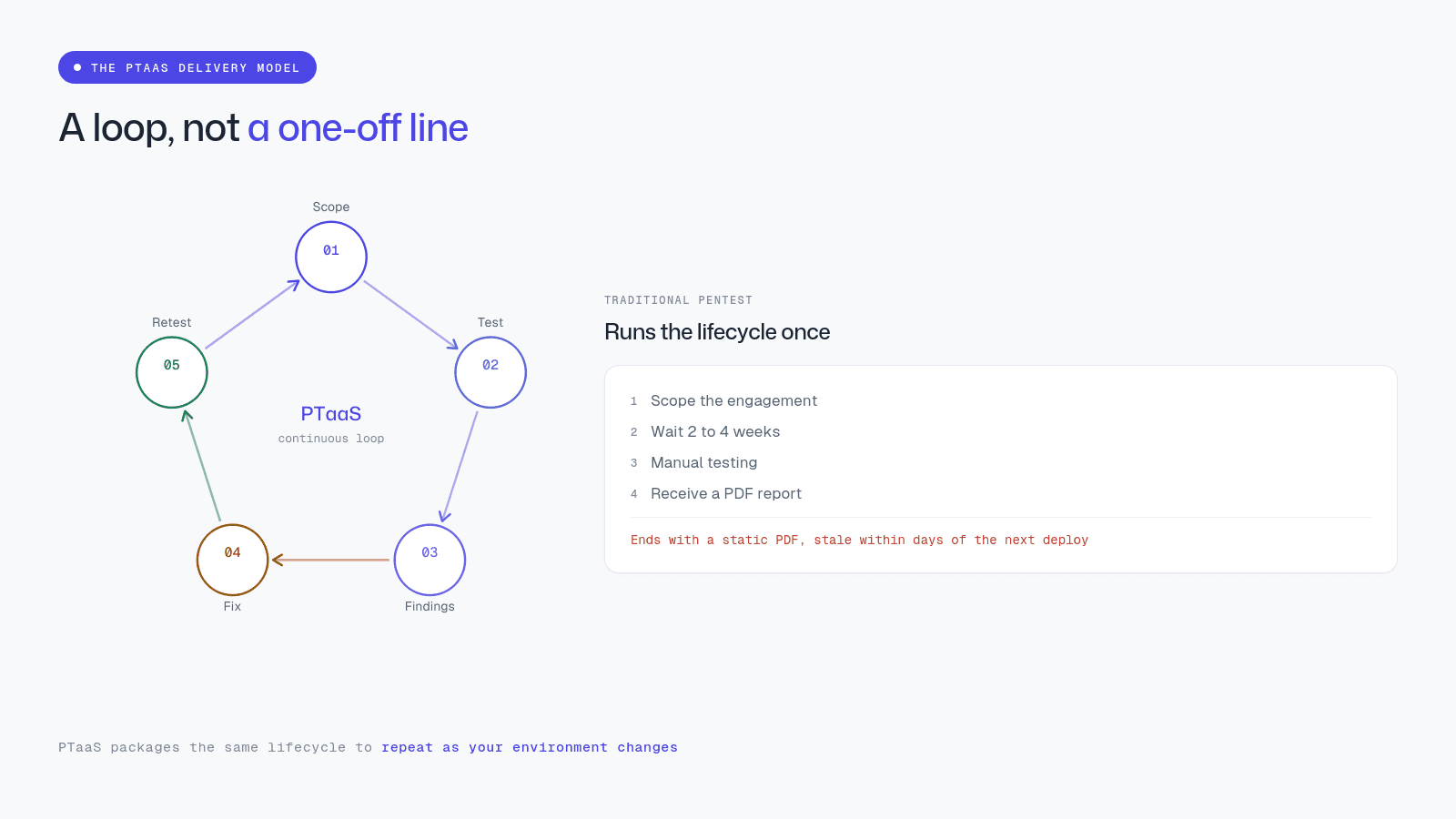
Put together, a PTaaS engagement runs as a loop rather than a line. You scope an asset in the platform, testing begins (automated coverage plus human or agent validation), findings appear in the dashboard in real time with evidence and severity, they route into your issue tracker, your team fixes and requests a retest, the platform re-validates that the exploit path is closed, and the cycle repeats as the environment changes. A traditional engagement runs that same lifecycle exactly once and hands you a PDF at the end.
How a PTaaS Engagement Works
The capabilities above come together as a five-phase engagement, and the phases show where a real platform proves its depth.
Phase 1: Scoping and access. You define the testing scope (domains, API endpoints, mobile apps), provision test accounts at varying privilege levels in your identity provider, tag them clearly, set rate limits, and configure logging so tester or agent activity can be correlated. Good scoping here is what prevents the "test the application" ambiguity that derails weaker engagements.
Phase 2: Reconnaissance. Passive recon (subdomain enumeration via certificate transparency logs, JavaScript bundle analysis) and active recon (port scanning, API schema discovery) map the attack surface. This phase routinely surfaces the most critical exposures on its own: an exposed admin panel, a forgotten staging environment, or an API endpoint missing authentication entirely.
Phase 3: Authenticated testing. This is where depth separates a platform from a scanner. Testers or agents construct attack chains and validate business-logic flaws: Broken Object Level Authorization testing by changing user IDs in API requests, IDOR exploitation by manipulating object references, privilege escalation, and GraphQL-specific attacks. Evidence includes the full HTTP request and response logs and a working proof-of-concept for each confirmed finding, not a theoretical flag.
Phase 4: Reporting and workflow integration. Findings auto-create Jira or GitHub tickets with severity labels, CVSS scores, curl PoC exploits, and remediation steps, delivered in real time rather than in a report weeks later. The faster your team can triage and fix, the shorter the exposure window stays.
Phase 5: Continuous retesting. After you deploy a fix, the platform re-runs the original exploit to validate remediation. If the fix is incomplete, the finding reopens with additional context. This is what compresses the traditional "test, then report, then wait, then fix" cycle into a continuous feedback loop.
The Pros of PTaaS
The advantages are real when the platform is real.
Continuous coverage. Traditional testing gives you a snapshot that is stale within days of your next deploy. PTaaS provides ongoing visibility as your environment changes, closing the exposure window between engagements, which is the core failure of the annual model.
Faster time to remediation. Real-time findings mean fixing starts immediately, not after a report cycle. Gartner's own projection is roughly twice-as-fast remediation for PTaaS adopters.
Lower and more predictable cost structure. A subscription or outcome-based model, with retesting included, is usually cheaper than repeated fixed-fee engagements plus per-retest charges, and easier to budget. The cost comparison breaks down the true totals.
Developer-friendly workflow. Findings land in the tools engineers already use, with tracking and retest built in, instead of a PDF someone has to transcribe into Jira by hand.
Compliance evidence that stays current. Because testing is continuous, the evidence for SOC 2, ISO 27001, or PCI DSS reflects your system now, not a snapshot from ten months ago. The PCI DSS and SOC 2 requirement guides cover what each auditor expects.
Scales with a growing attack surface. New services, APIs, and subdomains get pulled into testing without a new procurement cycle each time.
The Cons and Trade-offs of PTaaS
The honest limitations, because "as a service" is not automatically better.
Quality varies wildly by platform. The single biggest risk. Some "PTaaS" is a dashboard on the same slow manual process, and some is an automated scanner with a subscription and no real exploit validation. The label tells you the delivery model, not the depth.
Depth can be shallower than an elite manual engagement. For novel business-logic flaws, bespoke red-team scenarios, and creative attack research that needs deep human context, a top-tier consultancy or elite individual can still go deeper than a platform tuned for speed and breadth. Gartner is explicit that automation complements rather than replaces skilled testers.
Code access and trust. The deepest platforms are code-aware, which means granting repository access. That is a governance decision, and it needs a clear data-handling and deletion policy, though a platform that already reviews your code defensively raises no new exposure.
Some auditors still want human certification. Most SOC 2, ISO 27001, and PCI DSS auditors accept PTaaS reports with exploit evidence, but some HIPAA and financial-services auditors still expect a named human sign-off, so verify your specific auditor's stance.
Continuous testing needs a program to act on it. PTaaS surfaces findings faster than a team without triage and remediation capacity can close them. The value only lands if you can act on the stream.
How to Evaluate a PTaaS Provider
Because quality varies so much, the evaluation is the whole game. Weight these when comparing platforms.
Does it prove exploitability? Ask for a sample finding with a working proof-of-concept, a curl command or script, not a theoretical severity flag. This is the line between a real platform and a rebranded scanner.
Automation plus human or agent depth. A credible platform combines automated coverage with validation that can reason about attack chains and business logic, not signature matching alone.
Real SDLC integration. Native Jira, GitHub, and CI/CD hooks, not a CSV export. If findings do not reach developers in their workflow, the "continuous" promise breaks.
Retesting included. Confirm that re-validating a fix is part of the subscription, not a separate charge, since that is a core PTaaS advantage.
Code-aware option for code-heavy products. For an API-first, multi-tenant product, a platform that uses source access to build deeper chains and give file-and-line remediation will out-find an external-only one.
If you are turning this into a formal comparison, the RFP template and the hiring guide turn these into scored questions, and the best AI pentesting platforms comparison lays the field out side by side.
Where Code-Aware PTaaS Changes the Model
Most PTaaS platforms test from the outside, delivered through a platform but still blind to your source. A code-aware platform changes what "as a service" can mean, because the same code intelligence that reviews your pull requests also drives the offensive testing.
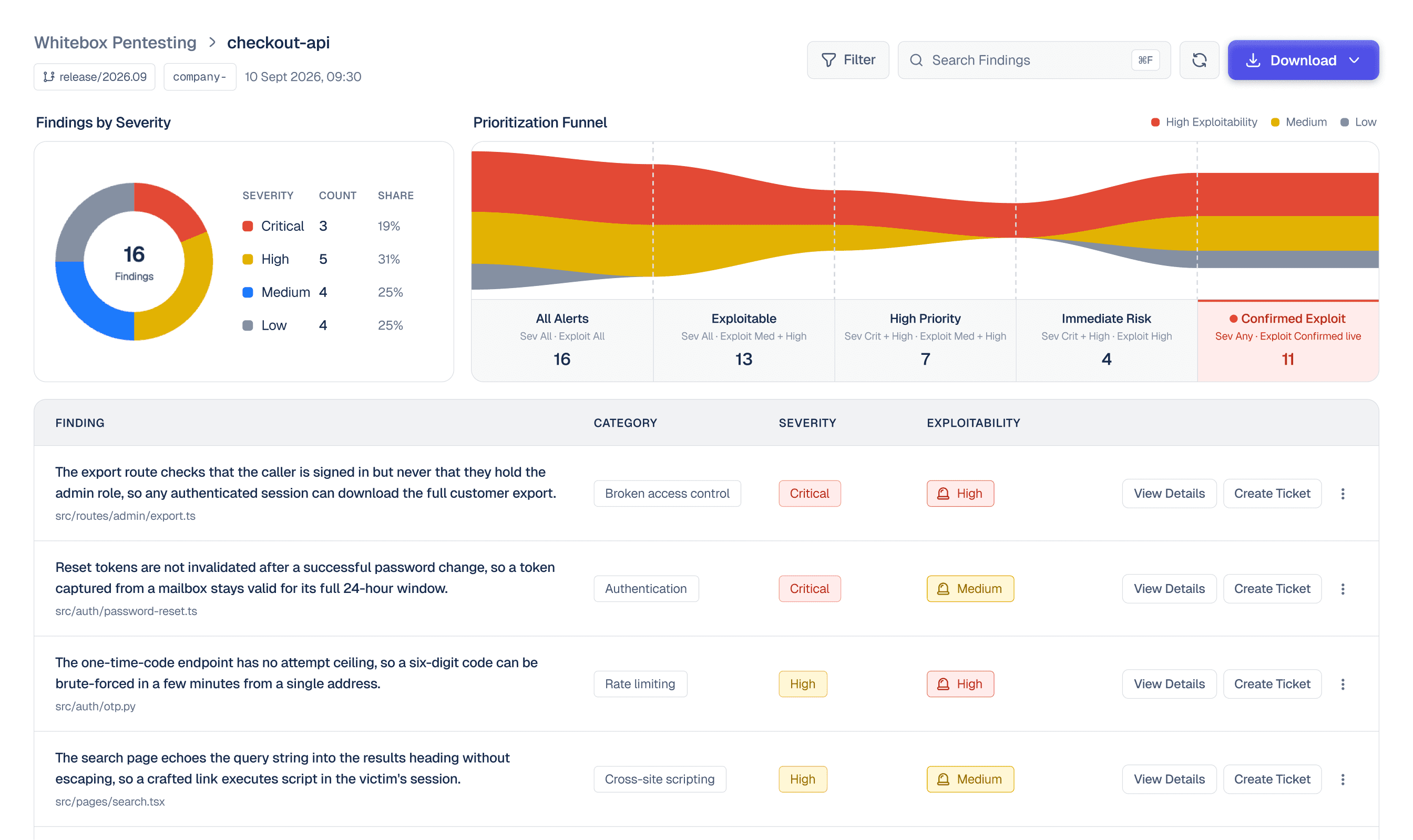
That shifts three things. Testing is more targeted, because the platform knows which endpoints handle sensitive data and where authorization lives, so it goes straight for the Broken Object Level Authorization and tenant-isolation flaws that cause real breaches instead of fuzzing blindly. Remediation is faster, because findings arrive with the exact file, line, and a working proof-of-concept rather than an endpoint and a guess. And the defensive and offensive sides share intelligence, so a pattern caught in code review informs the offensive test and vice versa. We cover the mechanics in the automated pentesting guide.
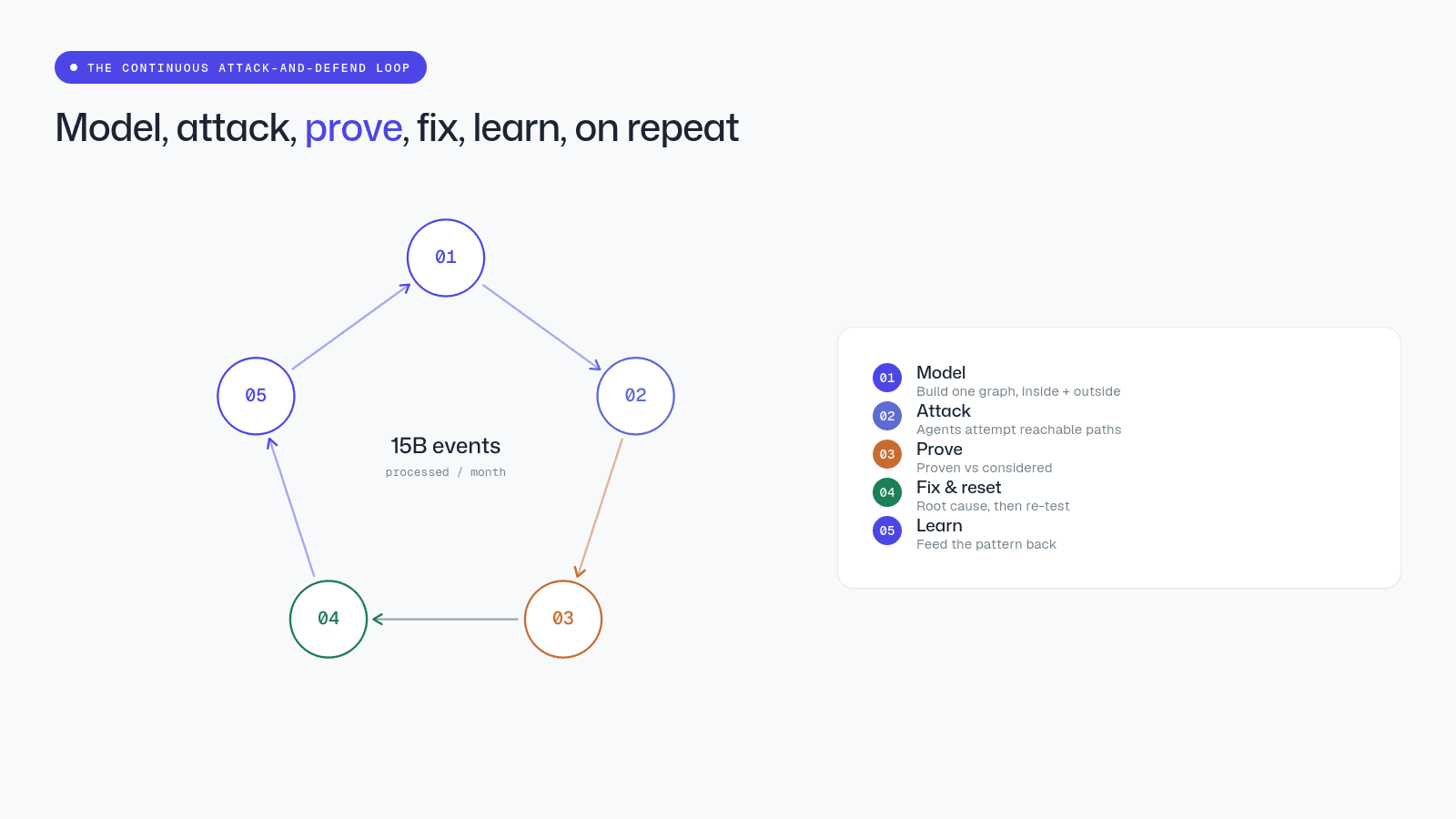
That is the model CodeAnt AI runs: PTaaS delivery, but code-aware, so every finding lands with a file, a line, and a PoC, retests are unlimited and automatic, and pricing is outcome-based, you pay only when a high or critical is confirmed exploitable rather than for scanner noise or idle seats.
PTaaS Is Only as Good as What Sits Behind the Platform
Penetration Testing as a Service fixes the core flaw of the traditional model, that a one-off test cannot keep pace with software that ships continuously, by delivering testing through a platform with real-time findings, built-in retesting, and coverage that tracks your release cadence.
But the label describes the delivery, not the depth, so the evaluation comes down to one question: does the platform prove exploitability, or just flag theoretical risk through a nicer dashboard?
The strongest version of the model is code-aware. CodeAnt AI delivers PTaaS with the source context an external-only platform never has: the same code intelligence that reviews your pull requests drives the offensive testing, so every finding arrives with the exact file, line, and a working PoC, retesting is unlimited and automatic, and you pay only when a high or critical is confirmed exploitable. It is continuous coverage that proves what an attacker can actually do, not a subscription to a scanner.
Where to start this week
Take one candidate PTaaS platform and ask for a single sample finding, then check it for a working proof-of-concept, file-and-line remediation, and a chained attack path, the three things a rebranded scanner cannot fake. Then run a free code-aware scan on your highest-risk application to see what real-time, exploit-validated output looks like next to a traditional PDF. The two together tell you whether "as a service" means depth or just delivery.
Run a free code-aware pentest →
Related reading
Continuous vs Annual Penetration Testing: the cadence problem PTaaS is built to solve
Automated Penetration Testing: how the exploit-validation engine behind a real platform runs
How Much Does an AI Pentest Cost vs a Manual One?: the subscription-versus-engagement cost math
Best AI Penetration Testing Platforms: the platform field compared, with pricing
How to Hire a Penetration Tester: choosing between an individual, a firm, and a platform

