

Your CFO just asked you to justify the $40k line item for this year's penetration test. Meanwhile your team ships code every week, and that annual report, when it finally arrives in six weeks, will be outdated before your security team finishes reading it.
A manual penetration test runs $10k to $50k per engagement, with hidden costs that can double that number: retesting fees, scheduling delays that block releases, and 40-plus hours of developer time parsing a generic PDF. AI-driven platforms flip the model, from a few hundred dollars per user per month up to outcome-based pricing that closes the exposure window a manual test leaves wide open.
But price alone does not tell the story. Not every "AI pentest" validates exploitability, and the real cost question is not AI versus manual, it is episodic versus continuous security in an era where vulnerabilities do not wait for your annual test cycle.
This guide breaks down the true total cost of ownership, the hidden expenses vendors do not advertise, and a framework to build a 2026 pentest budget that matches your release velocity.
The Real Tension: Point-in-Time vs Continuous Validation
Before comparing line items, the core issue: traditional pentesting is episodic by design, while modern software delivery is continuous by necessity. A $30k manual test gives you a snapshot of vulnerabilities on test day, but if you ship weekly, that snapshot is stale within seven days and fully outdated by day 90. So the honest cost comparison is not "AI vs manual," it is point-in-time validation versus continuous validation. We make the full cadence case in Continuous vs Annual Penetration Testing.
The split lands in a few clear categories.
Manual pentesting. Human experts spend one to three weeks, deliver a 50-page PDF, charge $5k to $15k for a retest after you fix issues, and leave you exposed for the 11 months until the next engagement.
Scanner-grade "AI." Automated DAST and SAST tools flag potential vulnerabilities continuously but run 20% to 40% false positives and rarely validate whether an issue is exploitable, forcing developers to triage theoretical risk. This is the vulnerability-scanning-versus-testing gap.
Agentic AI pentesting. Autonomous platforms run exploit agents that chain vulnerabilities, validate exploitability with a working PoC, and retest automatically after each deploy, collapsing the exposure window and cutting remediation time sharply. This is the model the automated pentesting guide covers.
Automation excels at continuous validation of known patterns (OWASP Top 10, API risks, auth-bypass chains), exploit chaining, and rapid retesting. Humans still win on novel business logic (a multi-step financial workflow with a subtle race condition), social engineering, and creative attack research that needs your specific business context. Most mature programs converge on the hybrid: continuous AI testing plus an annual manual red-team exercise for deep business-logic review.
What Counts as "AI Pentesting" in 2026
"Manual pentest" and "AI pentest" have become marketing catch-alls. There are four real categories, and the price and value differ sharply across them.
Classic consultant pentests assign one to three consultants for one to two weeks in black, gray, or white box mode, delivering a 30-to-80-page PDF with CVSS scores. The limit is episodic testing and a 365-day exposure window.
Crowdsourced platforms (Cobalt, Synack, Bugcrowd) have vetted researchers compete to find vulnerabilities, with real-time findings and validated PoCs. Quality varies by researcher, and testing is still episodic unless you pay a premium for a continuous program.
Automated scanners (Snyk, Invicti, Acunetix) use pattern matching, not autonomous reasoning. They crawl and flag on signatures, with no exploit validation and 20% to 40% false positives.
Autonomous agentic pentesting deploys AI agents that plan, execute, and chain exploits, then validate exploitability by building a working PoC. The deliverable is audit-grade: only confirmed exploitable findings, a curl or Python PoC for each, attack-chain documentation, compliance-mapped results, and continuous retesting with no separate retest fee.
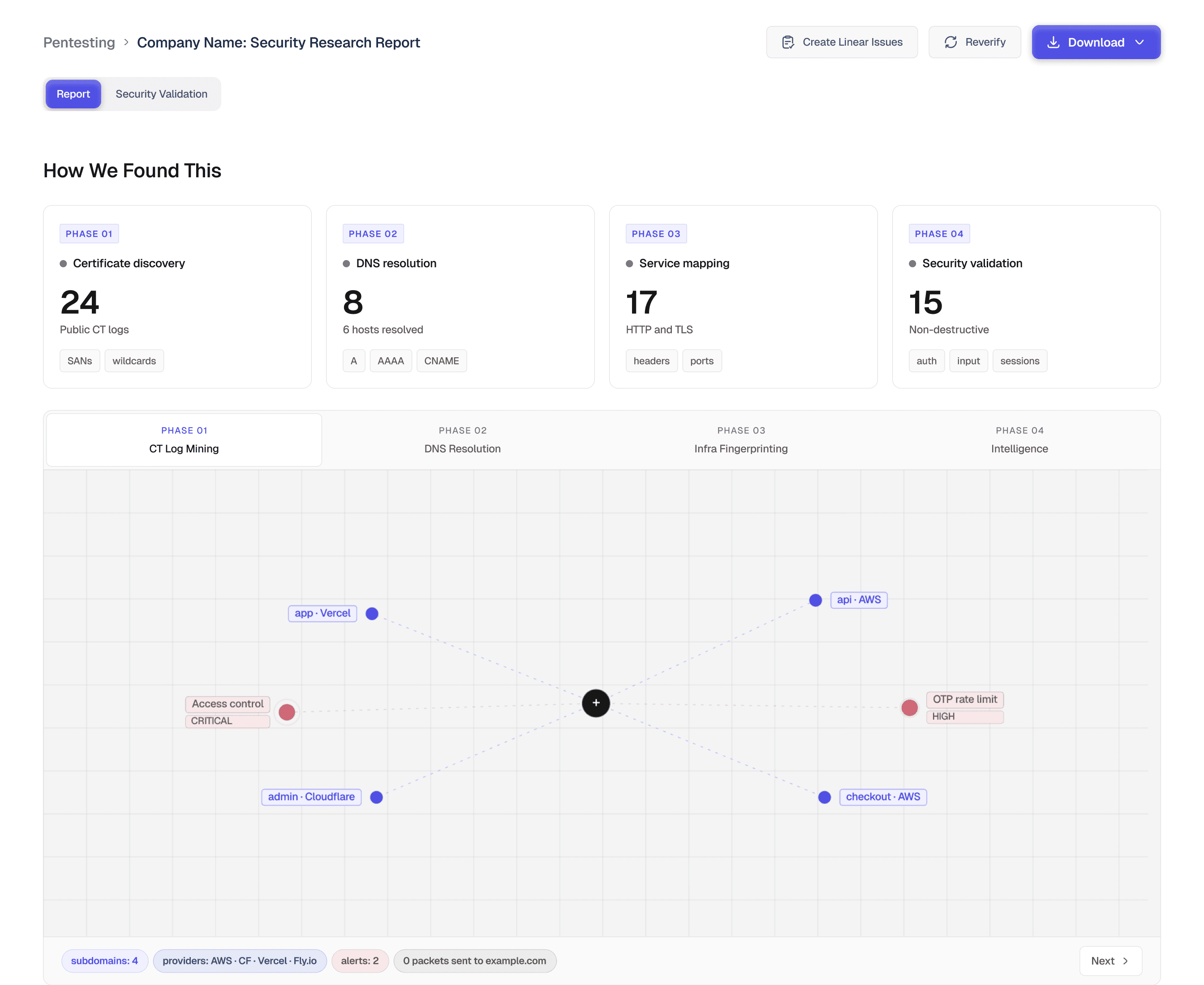
A platform like CodeAnt AI that leverages internal code context tests deeper than an external-only tool, using the same intelligence that reviews your pull requests to guide the offensive attack chains.
Manual Penetration Testing: Baseline Market Pricing
Manual pricing is driven by scope complexity and human expertise. These are typical 2026 market ranges.
Test type | Typical range | What drives it |
|---|---|---|
Network penetration test | $10k to $25k | Internal costs 20 to 30% more than external; wireless adds $3k to $8k |
Web application test | $15k to $35k | Multi-role SaaS at the top; each extra user role adds $2k to $5k |
API penetration test | $12k to $30k | GraphQL adds 30 to 40% effort; microservices add $5k to $10k |
Mobile application test | $20k to $40k per platform | iOS and Android are separate; cert pinning and offline storage add $5k to $8k |
These reflect comprehensive testing following the OWASP Web Security Testing Guide methodology. A cheaper "pentest" that skips phases or leans on an automated scanner is not comparable, and the RFP guide covers how to tell the difference before you sign.
The Hidden Costs of a Manual Pentest
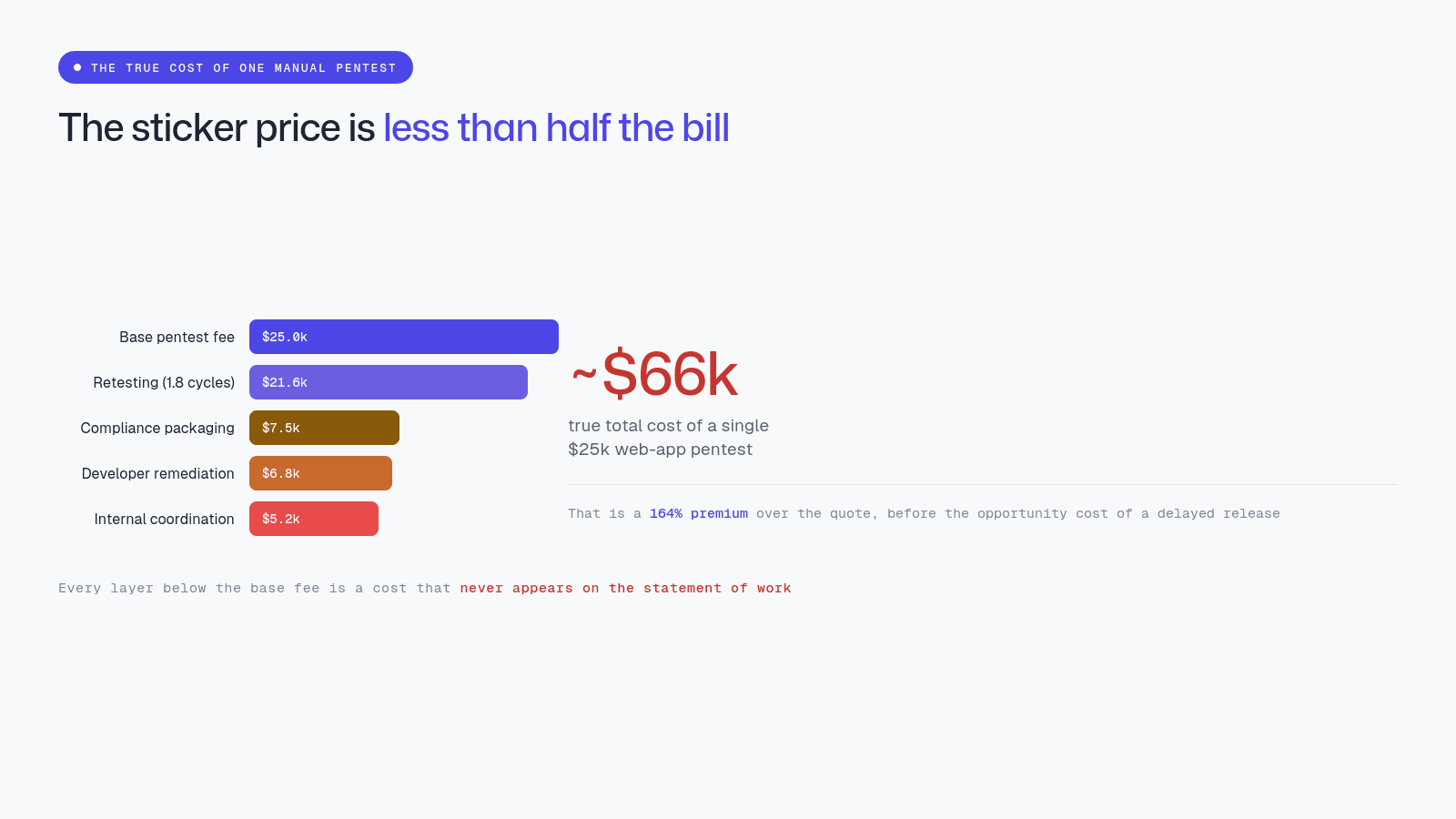
The vendor invoice is less than half of what you actually pay. Four multipliers never appear on the statement of work.
The scheduling tax. Firms need three to six weeks of lead time. For a team shipping weekly, that forces a choice: delay the launch or ship without validation. Even before remediation begins, the coordination overhead runs 28 to 45 hours of internal labor (scoping, environment provisioning, engineering standby, debrief meetings).
Retesting fees. PCI DSS and good practice both require confirming a fix, and firms charge for it. On a $25k web-app test, a retest cycle runs 40 to 60% of the original scope, and the average engagement needs about 1.8 cycles, so the real total lands at $43k to $52k, 72% to 108% over the initial quote.
The PDF-triage problem. A 50-to-80-page PDF is structured for auditors, not developers. The difference in remediation time is stark.
Delivery format | Time to triage | Time to locate code | Time to fix | Total |
|---|---|---|---|---|
PDF report | 8 to 12 hrs | 12 to 18 hrs | 20 to 25 hrs | 40 to 55 hrs |
Code-level feedback | 1 to 2 hrs | 0 hrs | 3 to 5 hrs | 4 to 7 hrs |
At a $150 fully loaded developer rate, that is an 8-to-10x cost multiplier across the 8 to 12 finding categories in a typical engagement.
Compliance packaging. Mapping findings to SOC 2, ISO 27001, PCI DSS, or HIPAA controls, building the evidence package, and handling auditor correspondence adds 36 to 65 hours per audit cycle, roughly $4.3k to $11.7k, unless the report arrives audit-ready.
Total cost of ownership. Add it up on a $25k web-app test: base $25k, retesting $21.6k, developer remediation ~$6.8k, coordination ~$5.3k, compliance packaging ~$7.5k, for roughly $66k, a 164% premium over the sticker price, before the opportunity cost of a delayed release.
AI Penetration Testing: What It Actually Costs
AI-driven pentesting is priced in three ways, and the right one depends on your team shape.
Per-seat subscription. Most code-aware platforms charge per developer per month for the platform, which rolls up into a predictable blended annual cost as the team scales. Unlimited scans are included, with no surprise per-scan bill. The catch with any seat model is paying for seats even when part of the team is not shipping.
Per-asset. External-only platforms charge $1k to $5k per application or API per year. Fine for a small, stable surface, but asset sprawl kills it, every new subdomain or microservice adds to the bill.
Usage-based (per scan). Pay-per-scan is flexible but unpredictable. At $500 to $1,000 a scan, weekly testing runs $25k to $50k a year, more than a subscription.
The market spread is wide and mostly quote-gated, which is why published numbers matter. For real, published anchors: Cobalt starts at $3,500 per autonomous test, Astra runs $1,999 to $5,999 per target per year, and enterprise infrastructure platforms like Pentera and NodeZero land in the tens of thousands per year. The best AI pentesting platforms comparison lays the full field out side by side.
Where costs creep in on any AI platform: asset sprawl on per-asset contracts, authenticated-testing setup fees ($2k to $5k initial, $1k to $3k a year to maintain), CI/CD blocking as an "enterprise add-on" ($3k to $8k a year), and audit-ready compliance documentation as a 20 to 40% upcharge. The one line that reliably favors continuous platforms is the frequency multiplier: a manual retest is $5k to $15k per cycle, while an included-rescan model runs 50-plus validation cycles a year at zero marginal cost.
The one number that matters: can it prove the exploit?
Not all "AI pentesting" delivers the same depth, and the price should track the depth.
Capability | Scanners | AI-assisted manual | Autonomous agents |
|---|---|---|---|
Exploit validation | No | Yes, human validates | Yes, agent builds a PoC |
Attack chaining | No | Manual | Automated |
Testing cadence | Continuous (PR) | Episodic (quarterly) | Continuous (daily/weekly) |
Developer time per cycle | 40-plus hrs | 20 to 30 hrs | 5 to 10 hrs |
False positive rate | 20 to 40% | 5 to 10% | Under 5% for criticals |
The critical differentiator is whether the platform proves a vulnerability with a working curl command or just flags theoretical risk. If it cannot deliver a working exploit, you are paying for noise.
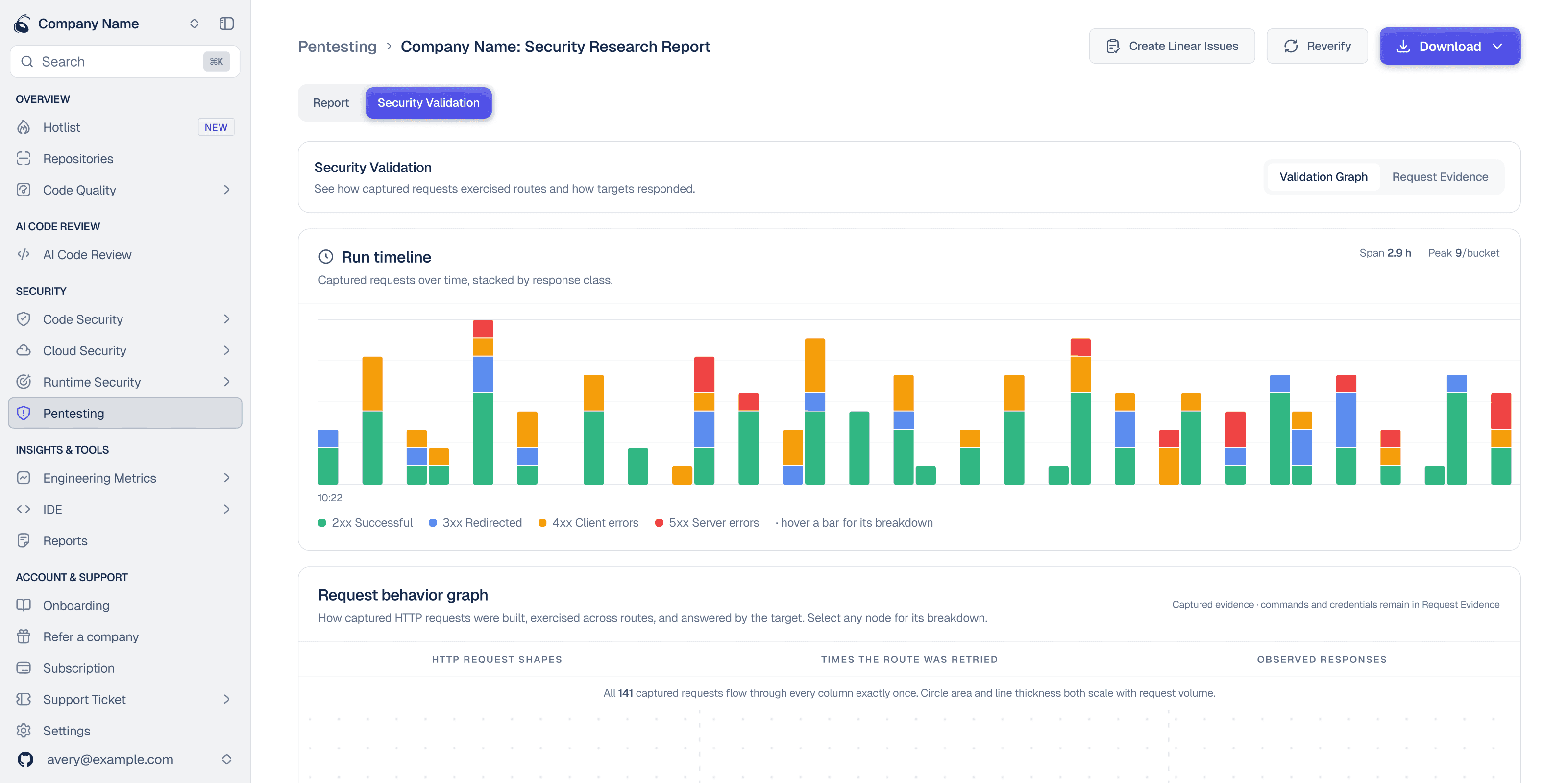
This is where CodeAnt's model is different: its pentesting is priced on the outcome, you pay only when a high or critical is confirmed exploitable with a PoC, and nothing when only low and medium issues are found, so the meter tracks real risk rather than time spent or seats provisioned.
The Continuous Cost Advantage: the Exposure Window
The real cost of testing is not the invoice, it is the exposure window between tests. Traditional pentesting runs annually or quarterly, and for the 10 to 11 months between tests, every new feature, dependency update, and infrastructure change ships untested.
The math is unforgiving. Day 0, a clean report. Day 90, a new auth flow ships with an IDOR flaw. Day 180, a dependency update introduces prototype pollution. Day 270, an API refactor exposes Broken Object Level Authorization on admin endpoints. Day 365, the next test finds all three, but they have been live and exploitable for 9, 6, and 3 months. If just one is exploited, you are looking at the $4.44 million global average breach cost from IBM's 2025 report, which is roughly 148 years of a $30k annual pentest.
Continuous testing collapses the window from months to hours: a new endpoint merges at 10am, agents enumerate and attempt Broken Object Level Authorization by 11am, a confirmed exploit with a curl PoC arrives by 2pm, and the fix is deployed and re-validated the next morning. Time-to-detection goes from 90 to 270 days to about an hour. That is the difference the internal and external penetration testing guides both come back to: coverage between the tests, not just on test day.
A worked example makes the gap concrete. A 50-developer SaaS finds a critical auth bypass in its annual pentest. The fix costs two weeks of engineering (three developers, roughly $18k), a one-week launch delay (~$25k opportunity cost), and a $10k retest, about $53k. Caught in PR review by continuous testing instead, it is four hours of one developer's time (~$600), no launch delay, and no retest fee. Same bug, an 80-plus-fold difference in cost, driven almost entirely by when it was caught.
Real-World Cost Scenarios
Each scenario puts the fully loaded manual cost next to the continuous alternative. The continuous figures below use CodeAnt AI's blended annual pricing (the platform subscription plus outcome-based pentesting), the numbers our GTM team sees in real deals, rather than a per-scan list price.
Scenario 1: a 10 to 25 developer team, monthly releases.
The continuous model runs about 85% cheaper here, and it tests every release rather than twice a year.
Line item | Manual-only | Continuous (CodeAnt AI) |
|---|---|---|
Testing | 2 web-app tests ($40k) plus 1 mobile test ($25k) | Subscription, roughly $12k a year |
Retesting | 2 cycles (~$18k) | Unlimited, included |
Developer remediation | ~$8k | ~$2k (code-level fixes) |
Compliance packaging | ~$6k | Included |
Annual total | ~$92k | ~$14k |
Scenario 2: a 50 developer SaaS, weekly releases.
Weekly manual testing is not affordable at any price, which is the structural point: continuous testing is only possible because the per-cycle cost is near zero.
Line item | Manual-only | Continuous (CodeAnt AI) |
|---|---|---|
Testing | 5 services quarterly plus 1 annual API assessment (~$160k) | Subscription, roughly $24k a year |
Retesting | 4 to 6 cycles (~$40k) | Unlimited, included |
Developer remediation | ~$15k | ~$4k (code-level fixes) |
Compliance packaging | ~$8k | Included |
Annual total | ~$180k to $220k | ~$28k with a bi-annual manual engagement layered on |
Scenario 3: a 200-plus developer enterprise.
At this scale the manual approach is paying full price for snapshots of an estate that changes daily, and the savings from going continuous are the largest of any tier.
Line item | Manual-only | Continuous (CodeAnt AI) |
|---|---|---|
Testing | 15-plus apps plus quarterly infrastructure tests (~$300k) | Subscription, roughly $72k a year |
Retesting | 8-plus cycles (~$80k) | Unlimited, included |
Developer remediation | ~$40k | ~$10k (code-level fixes) |
Compliance packaging | ~$20k across audits | Included |
Annual red team | Bundled into the above | ~$30k (kept for depth) |
Annual total | ~$400k or more | ~$102k including the red team |
A Decision Framework: Manual vs AI vs Hybrid
Five factors decide which model fits.
Release cadence. Weekly or faster points to AI-only or hybrid. Monthly to quarterly suits hybrid. Quarterly or slower can still work manual-only.
Attack-surface complexity. Microservices, APIs, and cloud-native favor AI. A monolith with deep business logic favors hybrid. A simple sub-10-endpoint app is fine with manual-only.
Compliance. Most SOC 2, ISO 27001, and PCI DSS auditors accept AI-driven reports with exploit evidence. Some HIPAA and financial-services auditors still want human certification, so verify first.
Appetite for continuous validation. A DevSecOps culture points to AI or hybrid, and an annual-checkbox culture to manual-only.
Incident history and data sensitivity. A prior breach or highly sensitive data pushes toward aggressive hybrid.
The short version: a startup with a simple stack and quarterly releases can stay manual-only, a fast-shipping SaaS should go AI-primary, and a regulated enterprise should run hybrid so continuous AI provides coverage while a periodic manual engagement satisfies the human-certification requirement.
Build Your Own Number: the TCO Formula
The true cost is a formula, not a quote:
Run it both ways with your own inputs. A representative manual year: $30k base, $10k retesting, $6k developer time (40 hours at $150), and a $50k opportunity cost from a two-week launch delay, for roughly $96k.
The continuous equivalent zeroes out retesting and the delay, drops developer time to a handful of hours, and leaves the platform cost plus any confirmed-exploit fees, a materially smaller number.
Fill in the four variables from your own last engagement (get three vendor quotes for the base fee, ask each about retest pricing, track the real hours your last pentest consumed, and use your finance team's loaded rate), and the right model usually becomes obvious.
Stop Paying Full Price for a Snapshot That Expires in a Week
The honest cost question was never AI versus manual. It is whether you keep paying full price for a point-in-time snapshot that is stale within days of your next deploy, or move to continuous validation that costs less and covers the whole year. A manual test's sticker price hides a total that runs well over double, and the biggest cost of all is the exposure window it leaves open between engagements.
That is the gap CodeAnt AI is built to close, and its pricing reflects the model. The platform runs on a simple per-seat cost, and the pentesting is outcome-based: you pay only when a high or critical is confirmed exploitable with a working PoC, and nothing when only low and medium issues surface.
Retests are unlimited and included, the report arrives audit-ready with control mapping rather than as a PDF your developers have to decode, and because the same code intelligence that reviews your pull requests drives the offensive testing, findings land with the exact file and line. You pay for real risk found, not for time spent or a snapshot that is already out of date.
Where to start this week
Run the TCO formula on your last pentest with your own numbers, base fee, retest fees, the real developer hours it consumed, and the loaded rate, and put the true total next to your sticker price. Then run a free scan against your highest-risk application to see what continuous, exploit-validated output looks like next to a 50-page PDF. The comparison usually settles the budget question on its own.
Run a free code-aware pentest →
Related reading
Continuous vs Annual Penetration Testing: the cadence case behind the cost math
Automated Penetration Testing: how the continuous engine actually runs
Best AI Penetration Testing Platforms: the full field of tools compared, with pricing
How to Write a Penetration Testing RFP: how to scope and price an engagement before you sign
What Is VAPT? Vulnerability Assessment vs Penetration Testing: why a cheap scan is not a pentest

