

An automated scanner can tell you a login form exists, that a parameter looks injectable, and that a library has a known CVE. What it cannot tell you is whether a standard user can chain three low-severity findings into admin access, whether your discount logic can be abused to make an order free, or whether tenant A can read tenant B's data by changing one number in an API request. Those take a human.
Manual penetration testing is human-led adversarial testing, a skilled tester actively attempting to exploit your systems the way a real attacker would, using creativity, business context, and hands-on technique rather than pattern-matching alone. It is the discipline behind the reports auditors trust and the findings that actually reflect what an attacker can do.
This guide is a deep dive: what manual penetration testing is, how it differs from automated testing, the methodology and phases a tester follows, the specific techniques and tools they use, the vulnerability classes only a human reliably finds, where manual testing falls short, and how the modern hybrid model combines human depth with continuous coverage. It is written for engineers and security leaders who need to understand the discipline, not just buy it.
What Manual Penetration Testing Actually Is
Manual penetration testing is the practice of a human security professional simulating a real-world attack against an application, network, or system, by hand. The tester reasons about the target, forms hypotheses about how it might break, crafts custom payloads and attack chains, and validates exploitability with a working proof-of-concept. The defining trait is judgment: a manual tester understands business logic, adapts to defenses in real time, and pursues the multi-step chains that a signature-matching tool cannot reason about.
It is often confused with two adjacent things it is not. It is not vulnerability scanning, which automatically detects known weaknesses and reports possible issues without proving them, a distinction we cover in What Is VAPT? Vulnerability Assessment vs Penetration Testing. And it is not the same as automated penetration testing, which runs exploit logic at machine speed but within the boundaries of what it was programmed to try. Manual testing is the part where a person does the thinking.
The value shows up in the findings. A scanner reports "potential SQL injection in the search parameter." A manual tester confirms the injection, extracts the database schema, escalates to the admin table, and demonstrates full data exfiltration with a working command, then explains the exact business impact. One is a lead. The other is proof.
Manual vs Automated Penetration Testing
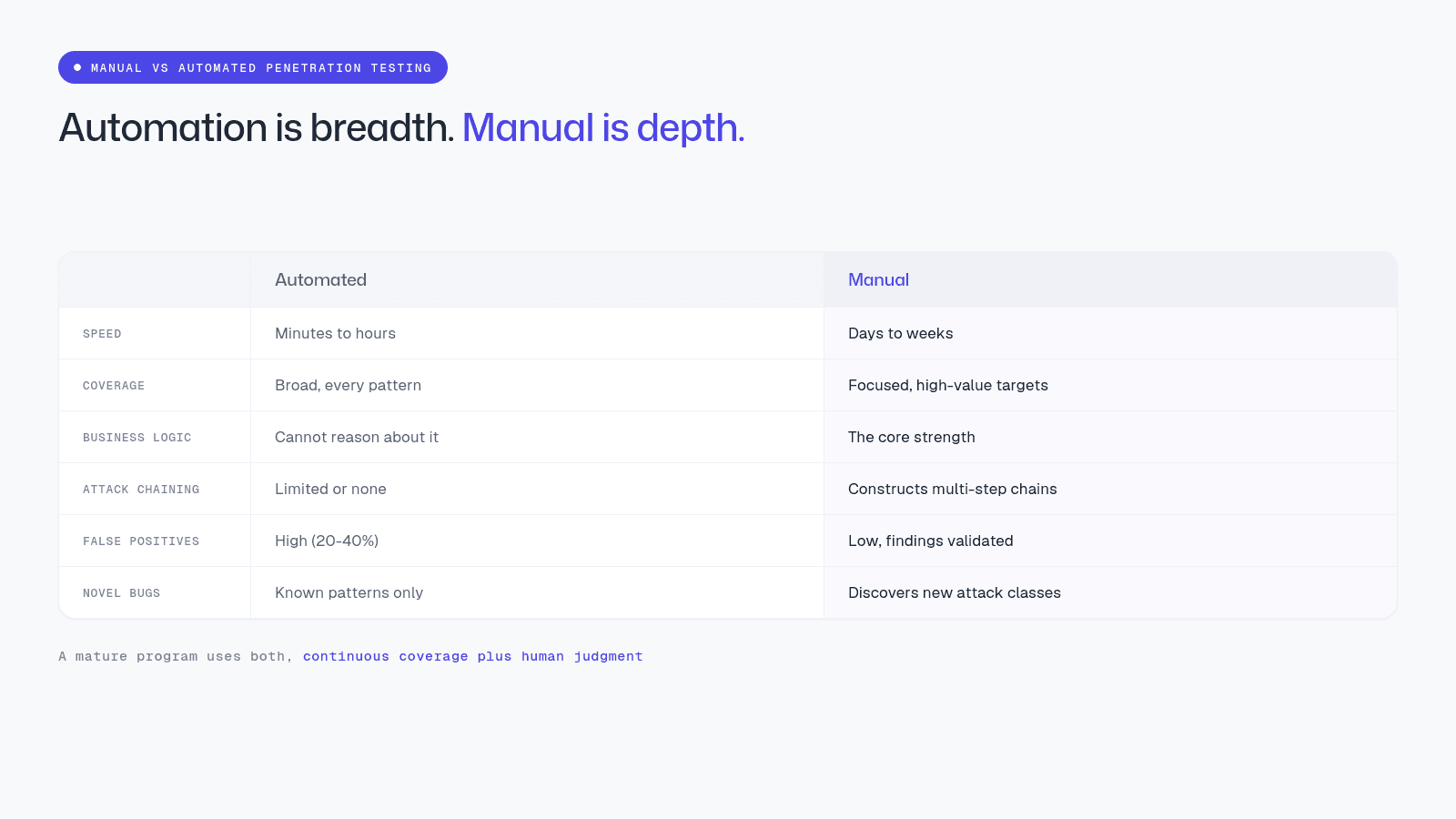
The honest framing is not manual versus automated, it is understanding what each does well, because a mature program uses both. Automation gives you breadth and speed. Manual testing gives you depth and judgment.
Dimension | Automated testing | Manual testing |
|---|---|---|
Speed | Minutes to hours | Days to weeks |
Coverage | Broad, every known pattern | Focused, the high-value targets |
Business logic | Cannot reason about it | The core strength |
Attack chaining | Limited or none | Constructs multi-step chains |
False positives | High (20 to 40%) | Low, findings are validated |
Novel vulnerabilities | Only known patterns | Discovers new attack classes |
Cost per run | Low, repeatable | High, expert labor |
Best for | Continuous coverage, known CVEs | Deep assessment, logic, chains |
Where automation wins: continuous coverage of known patterns (OWASP Top 10, dependency CVEs, misconfigurations), speed, repeatability, and cost at scale. Where manual wins: business-logic flaws, multi-step attack chains, novel vulnerabilities, and the exploitability judgment that turns a theoretical finding into a proven one. We break the trade-off down further in the automated penetration testing guide and the manual-vs-automated cost comparison.
Why Human Judgment Still Matters
The reason manual testing endures in an age of automation is that the highest-impact vulnerabilities are contextual, and context is exactly what a tool lacks. Three capabilities separate a human tester from any scanner.
Understanding business intent. A scanner does not know that your platform is not supposed to let a user apply two discount codes, or that a support agent should not be able to switch into a customer's tenant, or that a refund should never exceed the original charge. A human understands the intended behavior and tests whether the implementation enforces it. These business-logic flaws are invisible to pattern matching because there is no signature for "this workflow can be abused."
Constructing attack chains. Real breaches are rarely one vulnerability. They are a chain: an exposed endpoint reveals a user ID format, an IDOR lets you enumerate accounts, a weak password policy lets you take one over, and a privilege-escalation flaw turns that account into admin. Each link might be low or medium severity alone. A human sees how they combine into a critical exploit, which is the single hardest thing for automation to replicate.
Adapting in real time. When a WAF blocks a payload, a human tries a different encoding, a different vector, a different assumption. When an application behaves unexpectedly, a human forms a new hypothesis and follows it. This adaptive, hypothesis-driven exploration is how novel vulnerabilities get found, the ones with no CVE and no signature because no one has seen them before.
The Manual Penetration Testing Methodology
Professional manual testing follows a structured methodology, not ad-hoc poking. The recognized standards, the OWASP Web Security Testing Guide (WSTG), the Penetration Testing Execution Standard (PTES), NIST SP 800-115, and OSSTMM, all describe the same underlying phases, and testers map their techniques to adversary frameworks like the Lockheed Martin Cyber Kill Chain and MITRE ATT&CK so the engagement mirrors how a real intrusion unfolds.
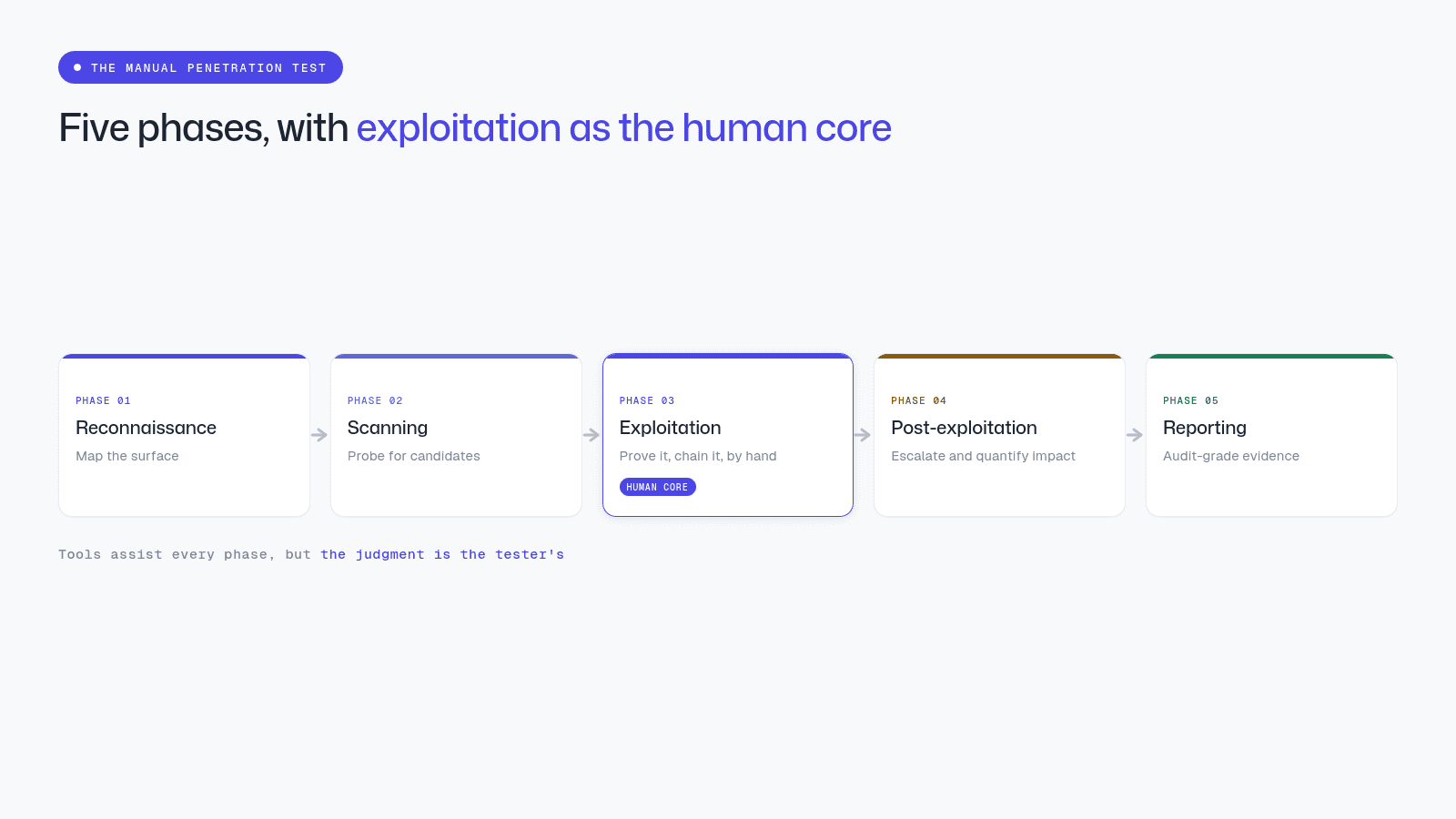
A manual engagement moves through five phases, and we cover the process in depth in Penetration Testing Process, Types, and Key Tools.
Phase 1: Reconnaissance and information gathering
The tester maps the target before touching it. Passive reconnaissance gathers information without interacting directly: certificate transparency logs to enumerate subdomains, DNS records, public code repositories, Google dorking for exposed files and endpoints, Shodan for internet-exposed services, employee information for social-engineering context, and technology fingerprinting. Active reconnaissance interacts with the target: port scanning, service enumeration, and directory brute-forcing to find hidden paths.
The goal is a complete picture of the attack surface, including the assets the target forgot they had, which is where a large share of real breaches begin.
Phase 2: Scanning and enumeration
The tester actively probes discovered assets to identify potential weaknesses: port and service scanning, web-application spidering, API endpoint discovery through JavaScript analysis, and authentication-boundary mapping. This is where automated tools assist a manual tester, running the broad scan so the human can focus on validating and exploiting what it surfaces. The distinction from pure automated testing is that a human triages the scanner output, discarding false positives and prioritizing the findings worth exploiting.
Phase 3: Exploitation
This is the heart of manual testing and where human skill is irreplaceable. The tester constructs custom payloads, chains vulnerabilities, and validates exploitability with a working proof-of-concept. A confirmed finding is not "this might be injectable," it is a command that proves it:
Exploitation is where the tester's creativity matters most: bypassing filters with novel encodings, chaining a server-side request forgery into cloud-metadata access, or abusing a business workflow the developers never imagined an attacker would touch.
Phase 4: Post-exploitation
A single foothold is rarely the end. Post-exploitation demonstrates the real impact by escalating privileges, pivoting through the network, establishing persistence, and quantifying what an attacker could actually reach. On an internal network that means techniques like LSASS credential dumping, pass-the-hash, Kerberoasting, AS-REP roasting, and Golden Ticket attacks to move from a compromised workstation toward domain admin, the assumed-breach work we cover in internal penetration testing. The output is an attack narrative: how initial access became a full compromise, and which crown jewels were reachable.
Phase 5: Reporting
The deliverable is what makes the engagement worth its cost. A strong manual report gives, per finding, a working proof-of-concept, a CVSS score with its vector, reproduction steps a developer can follow, the business impact in plain terms, and remediation guidance specific to the stack. It separates confirmed exploits from theoretical observations, and it maps findings to the compliance controls (SOC 2, ISO 27001, PCI DSS, HIPAA) an auditor will check.
Manual Testing Techniques by Vulnerability Class
A comprehensive manual test exercises specific techniques against each vulnerability class. These are the techniques a skilled tester applies by hand.
Injection. SQL, NoSQL, command, and LDAP injection, tested by crafting payloads that break out of the intended query context, then confirming with data extraction rather than a version-banner guess. A human validates whether a WAF actually blocks exploitation or just the obvious probe.
Broken authentication and session management. JWT algorithm confusion (
alg: none), token-lifecycle abuse, session fixation, weak password reset flows, and multi-factor bypass, tested by manipulating tokens and flows the way an attacker would.Authorization flaws. Broken Object Level Authorization and IDOR by manipulating object references, Broken Function Level Authorization by accessing admin endpoints as a standard user, and mass assignment by injecting unauthorized fields. These are the highest-value manual findings because they need an understanding of the app's access model.
Server-side request forgery and injection sinks. SSRF to reach internal services and cloud metadata, XML external entity (XXE) attacks, and insecure deserialization, tested by tracing where user input reaches a dangerous sink.
Business logic abuse. The technique with no signature: replaying a workflow, stacking discounts, manipulating a multi-step process out of order, or abusing a race condition in a payment flow. This is pure human reasoning about intended versus actual behavior.
Client-side and API-specific. Cross-site scripting variants, CSRF, GraphQL over-fetching and batching attacks, and API-specific abuse. Modern applications are API-first, so the API layer is where much of the manual effort now goes.
The Manual Penetration Tester's Toolkit
Manual does not mean no tools. It means a human drives the tools rather than a tool driving itself. The standard toolkit spans every phase of the engagement.
Phase | Common tools | What the tester does with them |
|---|---|---|
Reconnaissance | Shodan, Amass, certificate-transparency search, Google dorking, theHarvester | Map the external surface and gather OSINT without touching the target |
Scanning | Nmap, Nikto, web spiders | Enumerate ports, services, and web paths, then triage what is worth exploiting |
Web and API | Burp Suite, OWASP ZAP, sqlmap | Intercept, modify, and replay every request by hand; confirm injection |
Network capture | Wireshark, tcpdump, Responder | Inspect traffic, capture credentials, run LLMNR/NBT-NS poisoning |
Password attacks | Hydra, John the Ripper, hashcat | Brute-force, spray, and crack captured hashes offline |
Exploitation | Metasploit Framework, custom Python/Bash | Run known exploits and write bespoke ones for anything not pre-packaged |
Post-exploitation | Mimikatz, BloodHound, Cobalt Strike, cloud IAM tooling | Dump credentials, map AD attack paths, pivot, and escalate to domain admin |
The tools accelerate the work, but the judgment about what to try, how to chain findings, and when a result is actually exploitable is the human's. A tester who only runs the tools is running a scan, not a pentest. The interesting exploits, the ones that make a report worth its cost, rarely come pre-packaged in any tool.
Types of Manual Penetration Tests
Manual testing applies across every layer of a modern stack, and the technique set shifts with the target.
Web application testing exercises the OWASP Top 10 plus business logic, authentication, and authorization, the most common manual engagement for a SaaS product. See web application penetration testing for the perimeter view.
API penetration testing targets REST, GraphQL, and gRPC for Broken Object Level Authorization, broken authentication, and mass assignment, increasingly the highest-value surface.
Network penetration testing covers external perimeter and internal lateral movement, with the internal side simulating an assumed breach.
Cloud penetration testing targets IAM misconfigurations, storage exposure, and privilege escalation across AWS, Azure, and GCP, covered in the cloud pentesting guide.
Mobile application testing examines client-side storage, certificate pinning, and API communication for iOS and Android.
Wireless penetration testing targets Wi-Fi encryption, rogue access points, and network segmentation between the guest and corporate networks.
Social engineering and physical test the human and physical layers (phishing, pretexting, tailgating, badge cloning), usually as a distinct red-team scope rather than part of a standard application pentest.
The right testing depth for each depends on the knowledge you give the tester, the black box, gray box, or white box models we cover in Black Box vs White Box vs Gray Box Penetration Testing.
What Only Manual Testing Reliably Finds
To make the case concrete, these are the vulnerability classes where manual testing consistently outperforms automation, and why.
Business-logic flaws. No signature exists for "this workflow can be abused," so a tool cannot find what it cannot pattern-match. A human who understands the business rule tests whether the code enforces it.
Chained exploits. Automation flags issues in isolation. A human sees that a Low plus a Medium plus another Low combine into a Critical, which is how most real breaches actually happen.
Novel vulnerabilities. Zero-days and new attack classes have no CVE and no rule. They are found through creative, hypothesis-driven experimentation, a fundamentally human process.
Context-dependent severity. A tool rates a finding by generic CVSS. A human judges whether that finding, in your specific architecture, actually reaches sensitive data, which is the difference between a theoretical Critical and a real one.
Where Manual Testing Falls Short
An honest guide names the limitations, because they are exactly why the model is evolving.
It is a point-in-time snapshot. A manual test validates the system on test day. If you ship weekly, the report is stale within days and fully outdated within months, leaving the exposure window the continuous vs annual comparison describes.
It is expensive and slow. Expert labor runs $10k to $50k per engagement with a two-to-four-week turnaround, and a retest often costs extra, which discourages validating that a fix actually worked.
It does not scale to continuous delivery. A human cannot test every one of 50-plus annual releases. The cadence of manual testing and the cadence of modern deployment are fundamentally mismatched.
Coverage depends on the individual. Two testers of different skill produce different results on the same target, so quality varies with who you hired, which is why vetting the tester matters, covered in how to hire a penetration tester.
The Hybrid Model: Human Depth Plus Continuous Coverage
The resolution is not to abandon manual testing, it is to stop asking it to do the job automation does better. The modern program pairs the two: continuous automated, exploit-validating testing for coverage between engagements, and periodic manual testing for the deep business-logic work, novel-vulnerability research, and human judgment that automation cannot replace.
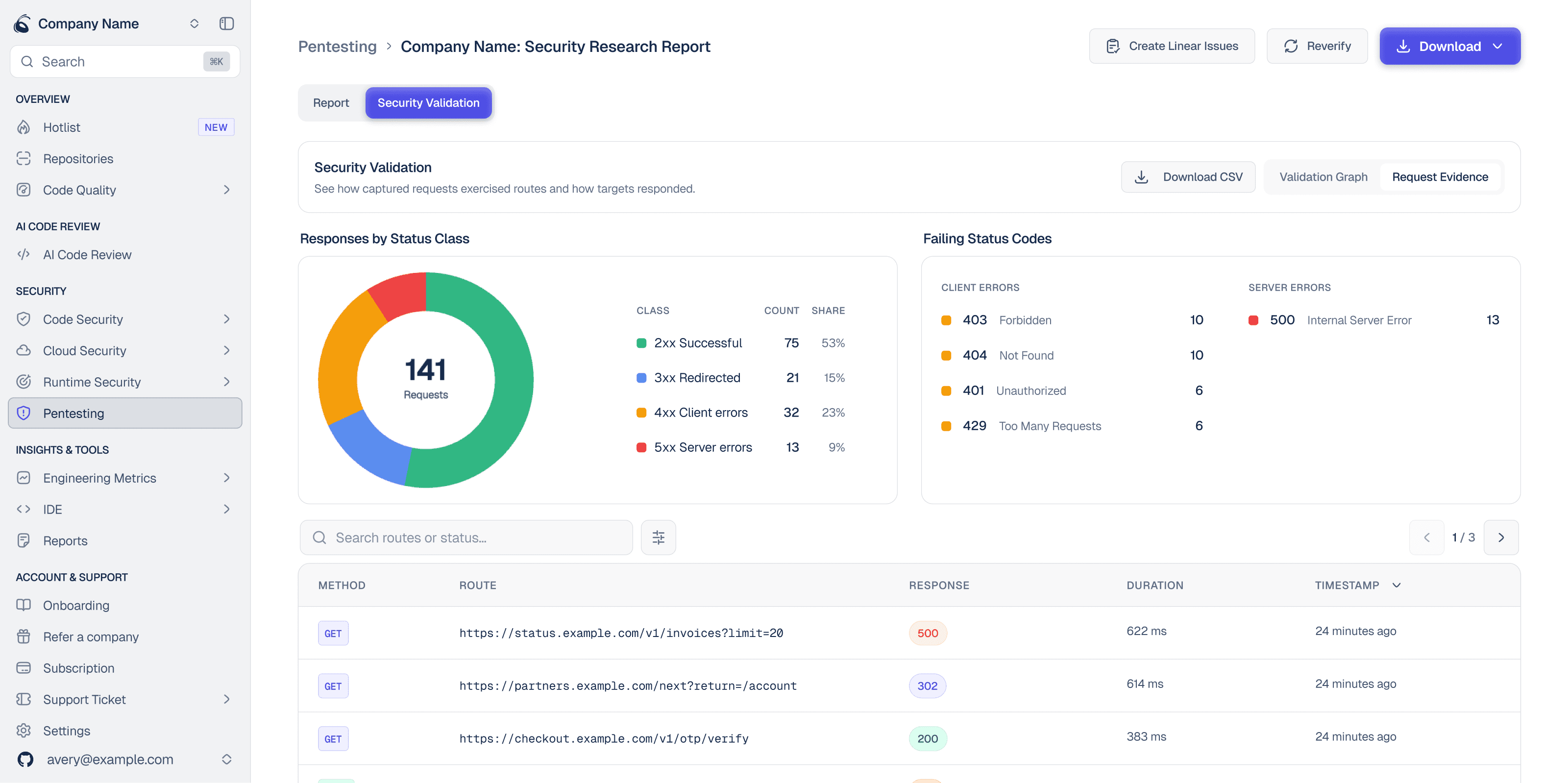
Code-aware testing narrows the gap further. When a platform reads your codebase the way CodeAnt AI does, it brings some of the context that used to require a human, it knows which endpoints handle sensitive data, where authorization lives, and how data flows, so it can construct and validate attack chains that an external-only scanner cannot. It does not replace the human tester for genuinely novel research, but it covers the large middle ground of known-pattern chains continuously, which frees the manual engagement to focus on the hard problems only a person can solve.
What code-aware testing delivers
The advantage is concrete, and it shows up in three ways a black-box test cannot match.
Tracing data flows through source. A code-aware tester reads the actual path from user input to a dangerous sink:
External testing might miss this SQL injection because the endpoint requires authentication and the error messages are generic. Code-aware testing spots the unsafe query construction immediately.
Identifying authentication middleware exclusions. The tester reads the exclusion list directly rather than guessing at it:
An external tester might eventually discover /api/admin/legacy through fuzzing. A code-aware tester finds it in minutes.
Prioritizing based on code reality. Instead of testing everything with equal weight, a code-aware tester focuses on what the code shows is actually risky:
Endpoints querying sensitive tables (
users,payments,medical_records)Functions constructing dynamic SQL, shell commands, or file paths from user input
Authorization checks that rely on client-supplied parameters
API routes that bypass the standard authentication middleware
The CodeAnt advantage
CodeAnt AI operates on both sides at once. The same code intelligence that reviews your pull requests for insecure patterns, flagging unsafe query construction, authentication bypasses, and authorization gaps, directly informs the offensive testing.
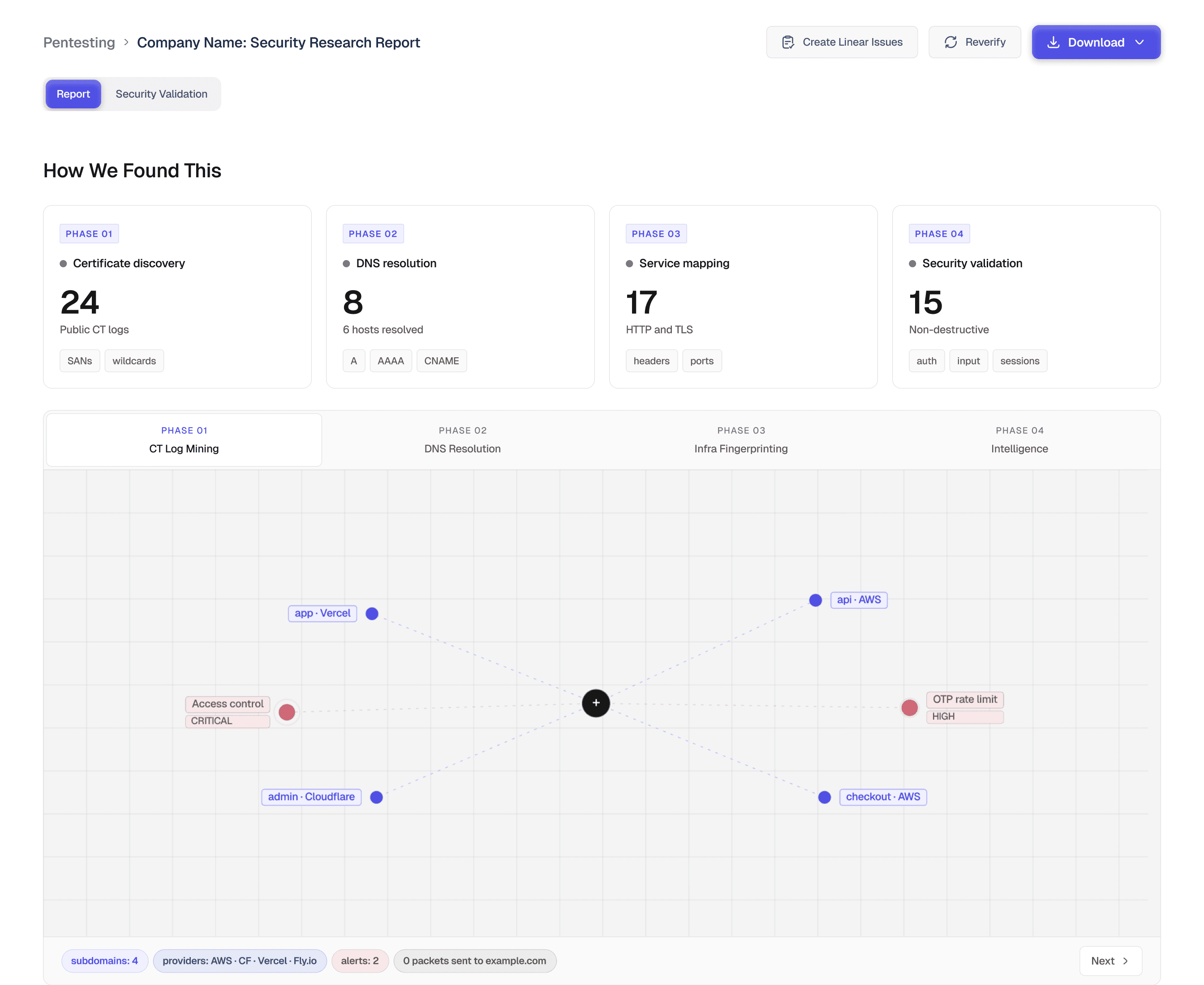
When CodeAnt begins a gray-box engagement, it already knows which endpoints exclude authentication middleware, where data flows through unsafe transformations, which service-to-service calls lack authorization validation, and which business-logic patterns are inconsistent.
That is precision over guesswork. Instead of 200 theoretical findings that need triage, you get confirmed exploits with working PoC code, CVSS scoring, and direct mapping to the source that needs fixing. The outcome-based model, you pay only when a high or critical is confirmed exploitable, means every finding is validated, exploitable, and actionable.
How to Decide What Your Program Needs
Match the approach to how you ship and what governs you.
Slow-changing, low-complexity, annual compliance: a periodic manual engagement may be sufficient on its own.
Fast-shipping SaaS, weekly or daily deploys: continuous automated validation for coverage, plus a periodic manual engagement for depth.
Regulated enterprise, multiple apps: continuous testing for the ongoing evidence auditors want, plus an annual manual red team for the human sign-off some frameworks require.
Novel product, high-stakes launch: a deep manual white-box assessment before launch, then continuous coverage afterward.
The decision is rarely manual or automated. It is how much of each, and in what cadence, for your specific risk and release velocity.
Manual Testing Finds What Machines Cannot, but It Cannot Be Everywhere at Once
Manual penetration testing is the discipline of a skilled human proving what an attacker can actually do, the business-logic abuse, the chained exploits, the novel vulnerabilities that no scanner has a signature for. It produces the findings auditors trust and the proof that reflects real risk, and for the hardest problems it remains irreplaceable.
Its limitation is not depth, it is reach: a person cannot test every release of a system that ships every day. That is the gap CodeAnt AI is built to close. It brings code-aware, exploit-validating testing to every deploy, constructing and proving the attack chains a scanner misses, so the continuous middle ground is covered and your manual engagements can focus on the genuinely novel work only a human can do.
Every finding lands with a file, a line, and a working PoC, retests are unlimited, and you pay only when a high or critical is confirmed exploitable. Human depth where it matters, continuous coverage everywhere else.
Where to start this week
Look at your last manual pentest and count the releases you have shipped since. Each one is untested until the next engagement, which is the gap manual testing alone cannot close. Run a free code-aware scan on your highest-risk service to see continuous, exploit-validated coverage next to your point-in-time report, then reserve your manual budget for the deep business-logic and novel-vulnerability work where a human genuinely outperforms.
Run a free code-aware pentest →
Related reading
Penetration Testing Process, Types, and Key Tools: the full five-phase process this guide follows
Automated Penetration Testing: the continuous counterpart to manual testing
Black Box vs White Box vs Gray Box Penetration Testing: the knowledge models a manual test can use
How Much Does an AI Pentest Cost vs a Manual One?: the cost math behind manual versus continuous
How to Hire a Penetration Tester: vetting the human whose skill a manual test depends on

