

Cloud pentesting isn't traditional network pentesting with a cloud logo. When you're testing AWS IAM privilege escalation paths, Azure managed identity exploitation, or GCP service account key leakage, you're dealing with attack vectors that didn't exist five years ago.
Configuration scanners like Prowler catch obvious stuff, public S3 buckets, overly permissive security groups, but they can't chain an SSRF vulnerability through your application layer to the EC2 metadata service, steal IAM credentials, and demonstrate lateral movement to your production database.
For a deeper technical walkthrough of the AWS attack surface specifically, methodology, tools, and compliance requirements, see our guide to AWS penetration testing.
This guide walks through cloud pentesting methodology that proves exploitability: reconnaissance and asset discovery, vulnerability identification and exploitation, post-compromise lateral movement, and evidence collection that maps to SOC 2 and ISO 27001 controls. You'll get platform-specific attack techniques for AWS, Azure, and GCP, with actual commands and exploit chains.
We'll cover the honest trade-offs between automated tools, manual pentesting firms, and hybrid approaches, including where grey box testing with code-level context finds attack paths that external-only scanning misses. For the enterprise-level overview of why this matters and what to test, see AI Penetration Testing For Cloud Security; for the attack-path mechanics specifically, see Cloud Attack Path Testing.
Cloud makes the underlying asymmetry worse, not better. An attacker needs one misconfigured role or one exposed metadata service. You have to secure every account, every region, every service your team spun up this quarter, all at once, indefinitely.
Security bought as five separate tools, one each for attack surface, code, cloud, binaries, and pentesting, means five different vendors each seeing their own slice of that estate and none of them seeing the chain that connects them.
What "seeing the whole estate" actually requires is correlating two different views. The external view is what an attacker sees without credentials: domains and subdomains, IP addresses and open ports, exposed employee credentials turning up in dark web dumps or stealer logs, third-party and vendor risk.
The internal view is what only someone with access to your systems sees: code and PR history, dependencies and binaries, cloud and IaC configuration, runtime identity and access. Most cloud pentesting engagements only ever get one of those two views.
A metadata-service SSRF chain is a textbook case of a finding that needs both: the external view finds the exposed application, the internal view is what tells you the IAM role behind it can actually reach something.
Why Cloud Pentesting Demands a Different Playbook
Cloud environments fundamentally invert the assumptions that shaped traditional penetration testing. You're no longer testing a network perimeter, you're testing logical isolation boundaries, IAM permission chains, and API control planes where identity is the perimeter.
Identity Became the Attack Surface
In traditional pentesting, you mapped network topology and worked inward through firewall rules. Cloud flips this:
IAM-first security: Every API call authenticates against identity policies. A misconfigured
s3:GetObjectpermission on a role is as exploitable as an open port, but harder to discover from the outside.Ephemeral infrastructure: The EC2 host you scanned yesterday doesn't exist today, but the IAM role attached to it persists, and might be over-permissioned.
API control planes: Cloud providers expose management APIs that become the primary attack vector. You're testing REST endpoints, not TCP handshakes.
Federated identity: SSO integrations and OAuth flows create trust boundaries across organizational boundaries.
Real example: Traditional pentesting finds an exposed web app. Cloud pentesting chains that compromise through SSRF to the metadata service, steals IAM credentials, escalates privileges via iam:PassRole, assumes a cross-account role, and exfiltrates data from a different AWS account entirely.
Serverless and Managed Services Shift Testing Focus
Cloud providers abstract infrastructure, changing what you're actually testing:
Serverless functions (Lambda, Azure Functions, Cloud Run): No OS to patch, but event injection, environment variable leakage, and IAM over-permissions create new attack vectors.
Managed databases and storage: You can't SSH into RDS or DynamoDB. Testing focuses on access policies, encryption, and whether public exposure is intentional.
Container orchestration: EKS, AKS, GKE abstract Kubernetes management, but RBAC misconfigurations and service account token abuse remain your responsibility.
This means pentesting must validate logical isolation, whether your Lambda function can access another team's S3 bucket, whether a compromised container can escape to the node, whether cross-account roles are scoped correctly.
Cloud Logging Changes the Evidence Game
Traditional pentesting emphasized stealth. Cloud environments log everything by default: CloudTrail, Azure Activity Log, and GCP Cloud Audit Logs record every API call. You can't avoid creating evidence.
The pentesting shift: instead of avoiding detection, you're validating whether the organization notices malicious activity. Does their SIEM alert on privilege escalation? Do they detect cross-account role assumptions? Can they trace an exploit chain from initial compromise to data exfiltration?
Configuration Review vs Exploitation: What Actually Proves Risk
Configuration scanning tells you what's misconfigured. Exploitation proves what an attacker can actually do with it.
CSPM and configuration scanning tools (Prowler, Scout Suite, Checkov) excel at breadth. They enumerate your cloud resources and flag deviations: an S3 bucket with public read access, an IAM role with
*permissions, a security group allowing0.0.0.0/0on port 22. These tools are essential for continuous monitoring.Penetration testing validates exploitability. A public S3 bucket might contain only marketing assets (low risk), or it might contain hundreds of thousands of sensitive customer records (critical breach). Configuration scanning can't distinguish those two cases. It just reports that a public bucket exists.
Multi-Step Attack Chains Configuration Tools Miss
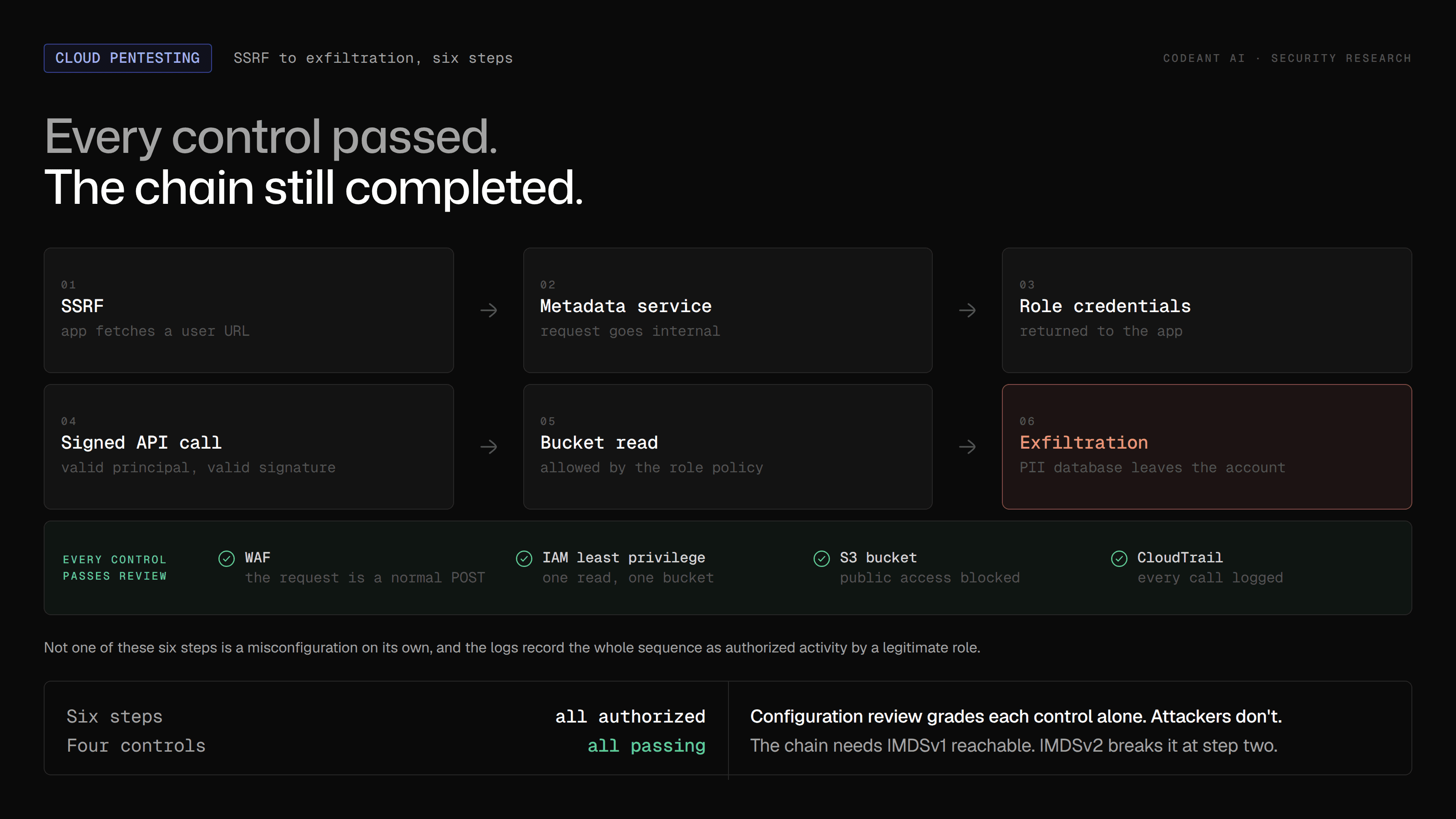
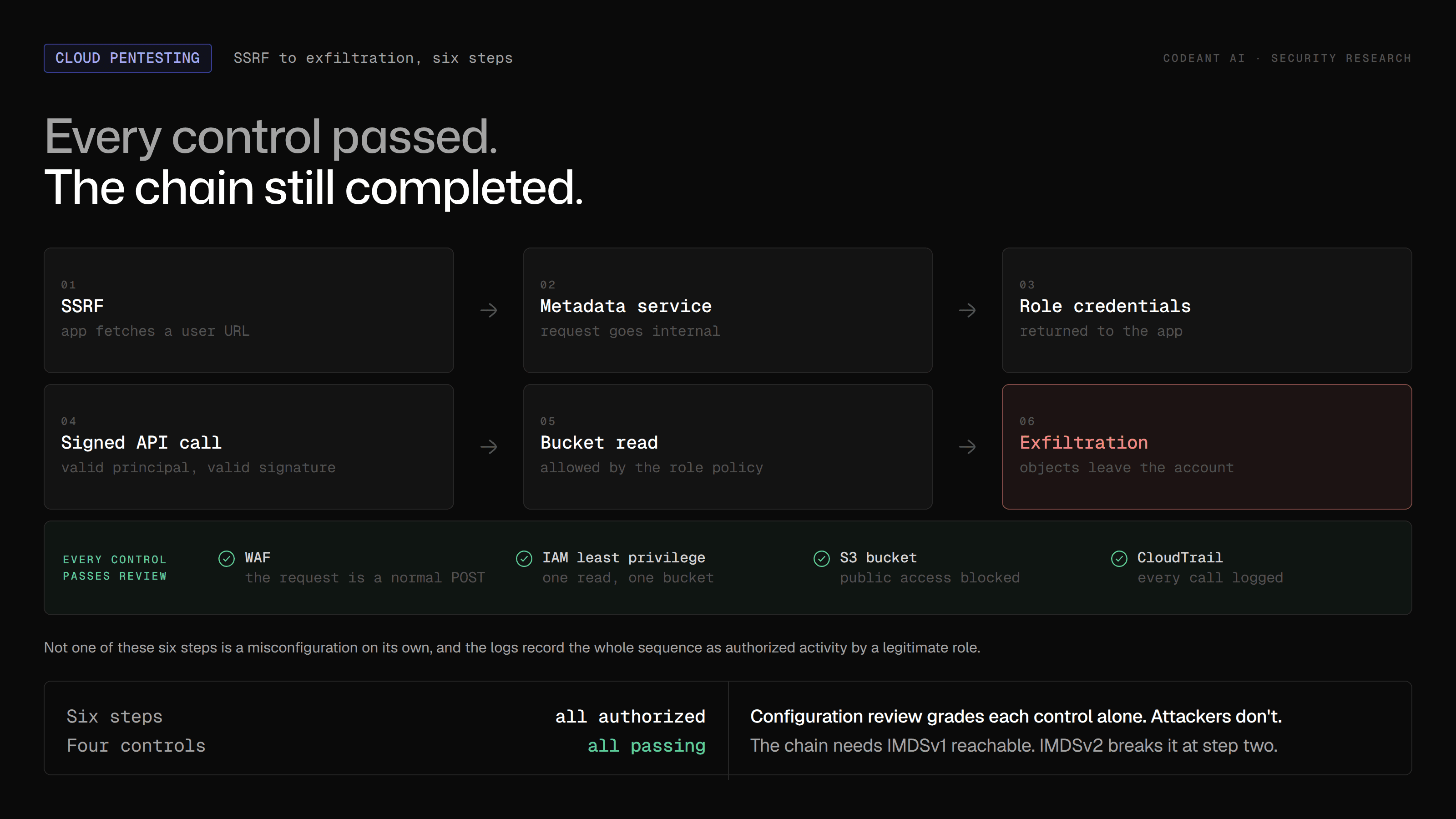
The real danger lies in attack chains that configuration tools miss because they evaluate controls in isolation:
Each individual step might pass configuration review:
Web application has WAF enabled
IAM role follows least-privilege (scoped to specific S3 buckets)
S3 bucket is private (not publicly accessible)
CloudTrail logging enabled
But the chain is exploitable. The SSRF vulnerability (application-layer issue) becomes the entry point. The IMDSv1 metadata service provides credentials. The IAM role's AssumeRole trust policy enables privilege escalation.
This is the same failure mode CodeAnt's own IDOR research keeps surfacing at the application layer: individual checks that each look fine reviewed in isolation, and an exploitable path that only shows up once someone actually walks the chain end to end. CodeAnt's Liquid Network hack writeup is a non-cloud example of exactly this pattern.
The Hybrid Reality
Smart organizations use both approaches strategically:
Approach | Strengths | Best Use Case |
|---|---|---|
Configuration Scanning | Fast, comprehensive coverage; catches known misconfigurations; runs continuously | Continuous monitoring, compliance baselines, catching obvious mistakes |
Penetration Testing | Proves real-world exploitability; chains vulnerabilities; demonstrates business impact | Validating defense-in-depth, compliance audits, understanding actual risk |
Code-Aware Grey Box Testing | Combines scanning breadth with exploitation depth; understands application logic and data flows | DevOps environments with frequent deployments; continuous validation beyond config checks |
Configuration scanning answers: What security controls are misconfigured?
Penetration testing answers: What can an attacker actually accomplish?
Code-aware grey box testing answers: Which misconfigurations are exploitable given our application's actual logic and data flows?
Cloud-Specific Attack Vectors Traditional Pentests Miss
Metadata Services and Identity Token Theft
Cloud metadata services (AWS IMDSv1 at 169.254.169.254, Azure IMDS, GCP metadata server) expose temporary credentials to compute instances. SSRF vulnerabilities in web applications become critical because they provide a direct path to IAM credentials.
Exploitation example:
Defense:
Enforce IMDSv2 (session-oriented) on all EC2 instances
Network egress filtering to block
169.254.169.254from application layersRuntime monitoring for unusual metadata service access
Least privilege IAM roles attached to compute instances
IAM Privilege Escalation Patterns
Cloud IAM systems enable complex permission chains that create privilege escalation paths invisible to traditional pentests.
High-yield escalation paths:
Technique | Platform | Required Permission | Impact |
|---|---|---|---|
PassRole + CreateFunction | AWS |
| Execute code with any IAM role |
UpdateAssumeRolePolicy | AWS |
| Assume privileged roles |
Add-AzRoleAssignment | Azure |
| Grant self any Azure role |
SetIamPolicy | GCP |
| Modify project-level permissions |
Defense:
Permission boundary policies limiting maximum permissions
Service Control Policies (SCPs) denying dangerous actions org-wide
CloudTrail/Azure Activity Log monitoring for escalation indicators
Regular IAM access analysis using AWS IAM Access Analyzer
Separation of duties ensuring no single role has both policy creation and role assumption
Serverless Event Injection and Function Exploitation
Serverless functions process events from multiple sources: API gateways, message queues, storage triggers. Attackers can inject malicious payloads into event sources or exploit insecure deserialisation and command injection vulnerabilities.
Defense:
Input validation and sanitization for all event data
Avoid
shell=Truein subprocess callsFunction-level IAM roles with minimal permissions
Runtime security monitoring (AWS GuardDuty for Lambda)
Code review for injection vulnerabilities in event handlers
Secrets in CI/CD Pipelines and Build Artifacts
CI/CD systems handle cloud credentials, API keys, and deployment tokens. Hardcoded secrets in code, exposed environment variables in build logs, or overly permissive service account keys create persistent access.
Common exposures:
Hardcoded AWS keys in application code or IaC templates
Environment variables logged in CI/CD output
Long-lived service account keys checked into repositories
Overprivileged deployment credentials with full admin access
Defense:
Pre-commit secret scanning using git-secrets or TruffleHog
Secrets management services (AWS Secrets Manager, Azure Key Vault)
OIDC federation for CI/CD authentication (eliminating static credentials)
Build log sanitization
Regular credential rotation
Platform-Specific Attack Vectors
AWS: IAM, S3, Lambda, IMDS
IAM Privilege Escalation via PassRole:
S3 Exposure Beyond Public ACLs:
Test for bucket policies with Principal: "*" and insufficient condition keys, cross-account access without external ID, and versioning without lifecycle policies.
Lambda Event Injection:
Functions often have broad IAM permissions and process untrusted input. Test environment variable exposure:
IMDS v1 vs v2:
IMDSv1 allows simple HTTP GET requests; IMDSv2 requires a session token via PUT. Many SSRF vulnerabilities can't make PUT requests, so IMDSv2 blocks the attack, but test whether your SSRF allows full HTTP control.
Azure: Entra ID, Storage, Managed Identities
Entra ID as Primary Attack Surface:
Application registrations with overly permissive API permissions (Directory.ReadWrite.All, RoleManagement.ReadWrite.Directory) can modify directory objects or assign roles.
Managed Identity Exploitation:
Azure VMs and App Services expose managed identity tokens via IMDS:
Storage Account Key Exposure:
Storage account keys provide full access to all data. Look for keys in application configuration, connection strings with embedded keys, and rotation failures leaving multiple valid credentials active.
Cross-Tenant Guest Risk:
External users invited as guests inherit permissions in the host tenant. Test for guests with admin roles, resource access via groups, and conditional access bypass.
GCP: Cloud IAM, Storage, Service Accounts
Service Account Key Hygiene:
Unlike AWS IAM roles that leverage temporary credentials, GCP service account keys are long-lived JSON files. User-managed keys don't rotate automatically.
IAM Role Privilege Escalation:
GCP permissions are cumulative and inherited across organization, folder, project, and resource levels.
Test for iam.serviceAccountKeyAdmin, iam.serviceAccountTokenCreator, and resourcemanager.projects.setIamPolicy permissions.
Cloud Storage Bucket Exposure:
Common misconfigurations include roles/storage.objectViewer granted to allAuthenticatedUsers and signed URLs with excessive expiration.
Choosing Your Testing Approach
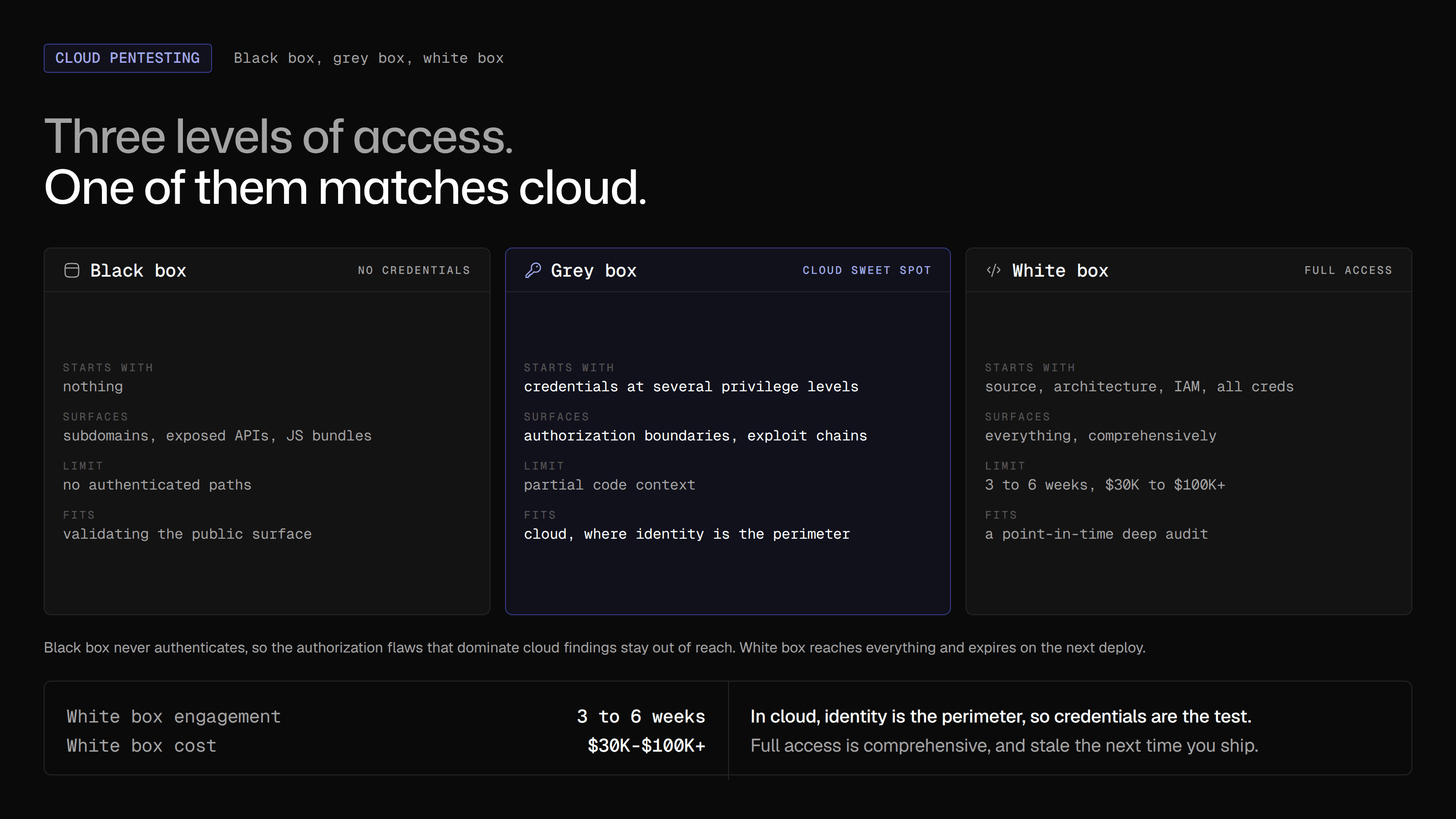
Black Box vs Grey Box vs White Box
Black box testing simulates an external adversary with zero prior knowledge, enumerating subdomains, probing exposed APIs, analyzing JavaScript bundles. It validates public attack surface but misses authenticated attack paths, authorization flaws, and privilege escalation chains.
Grey box testing provides authenticated access (valid credentials at multiple privilege levels) with partial code context. This is the sweet spot for cloud pentesting because:
Identity is the perimeter, so testing with valid credentials lets you probe authorization boundaries
Exploit chains require context: understanding authentication middleware and authorization logic reveals multi-step attack paths
Practical efficiency: it avoids the overhead of full white box access while catching the authorization flaws that matter most
White box testing provides complete access: source code, architecture diagrams, IAM policies, credentials for all environments. It delivers comprehensive coverage but requires significant time investment (3-6 weeks), high cost ($30K-$100K+), and creates a point-in-time snapshot outdated the moment your next deployment ships.
CodeAnt's guide to the three pentest types covers this same trade-off in more general terms, outside the cloud context specifically.
Continuous vs Point-in-Time Testing
Annual pentests made sense when teams deployed quarterly. They don't work when you're shipping dozens of times a day.
Why annual pentests fail:
A team deploying 200 times per month and pentesting once a year is testing a tiny fraction of its production changes against anything offensive
Stale findings, because infrastructure evolves significantly during report delivery
No validation of fixes without expensive retest engagements
Compliance theater over real security
The hybrid operating model:
Continuous automated discovery: runs on every deployment, covering reconnaissance, configuration scanning, and safe exploit validation
Quarterly human-led deep dives: expert pentesters find novel attack chains, business logic flaws, sophisticated privilege escalation paths
Frequent re-scans: fix an issue and trigger a retest the same day rather than waiting for the next scheduled engagement
This catches common issues immediately while reserving expensive manual expertise for sophisticated scenarios. CodeAnt's continuous versus annual pentesting guide goes deeper into exactly this trade-off, including how to measure the gap your own release cadence creates.
Where CodeAnt AI Fits: Code-Aware Offensive Testing
Most platforms force you to choose between defensive tooling that catches vulnerabilities in pull requests or offensive platforms that probe your infrastructure from outside. CodeAnt AI connects both through the same code intelligence layer.
1. Recon that reads the code, not just the traffic
The platform doesn't blindly fuzz endpoints. It analyzes JavaScript bundles to extract API routes, parses authentication middleware to identify bypass opportunities, and maps data flows through source code to spot BOLA and IDOR vulnerabilities before launching exploits, the same class covered in depth in CodeAnt's IDOR guide.
2. Simulate the attack, then chain it
Grey box testing with real session context authenticates as different user roles, then systematically tests privilege boundaries, horizontal access controls, and cross-tenant isolation, the attack vectors that external-only scanners miss. More than 500 autonomous exploit agents don't just find individual issues. They chain vulnerabilities (SSRF to metadata service to IAM credential theft to lateral movement) to demonstrate real business impact.
That's what a black-box confirmation looks like against a live target: not a pattern match, an actual request that produced an actual error or actual data.
3. Cover the configuration side too
On the configuration side specifically, CodeAnt's Cloud Security Posture Management feature connects to AWS, GCP, and Azure through a read-only role (no write, create, or delete permissions, the same least-privilege principle this article recommends for every IAM role you grant). A full account scan typically finishes in minutes and evaluates the configuration against CIS, SOC 2, ISO 27001, HIPAA, PCI DSS, NIST 800-53, and several other frameworks in the same pass.
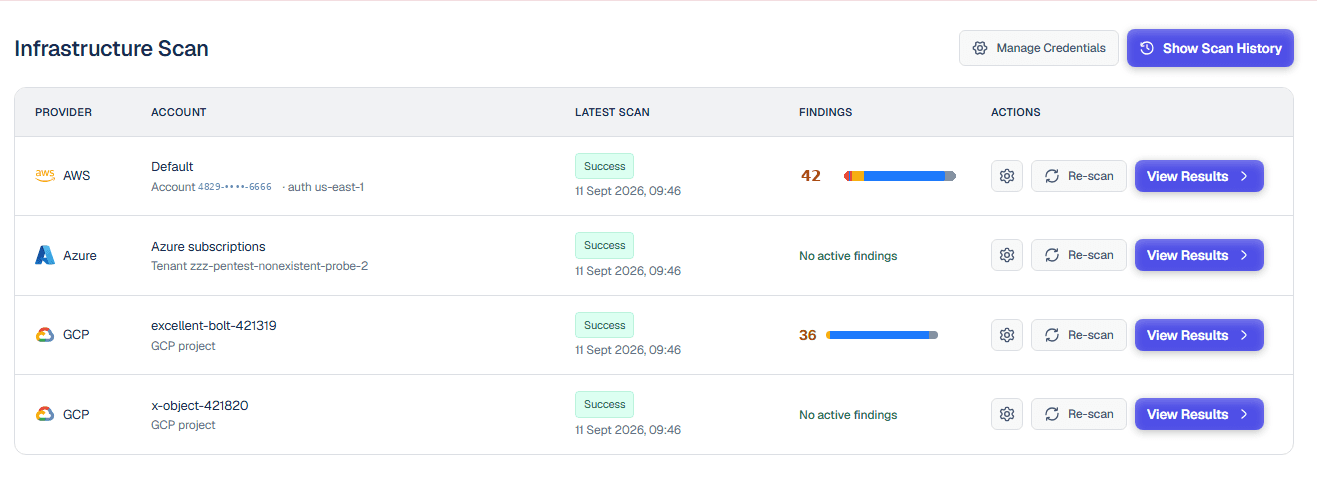
That CSPM layer is the configuration-scanning half of this article. The offensive pentest is what chains a finding it surfaces, like an over-broad IAM role or a public bucket, into a proven exploit path rather than leaving it as an isolated flag.
4. Let what one account proves protect the next one
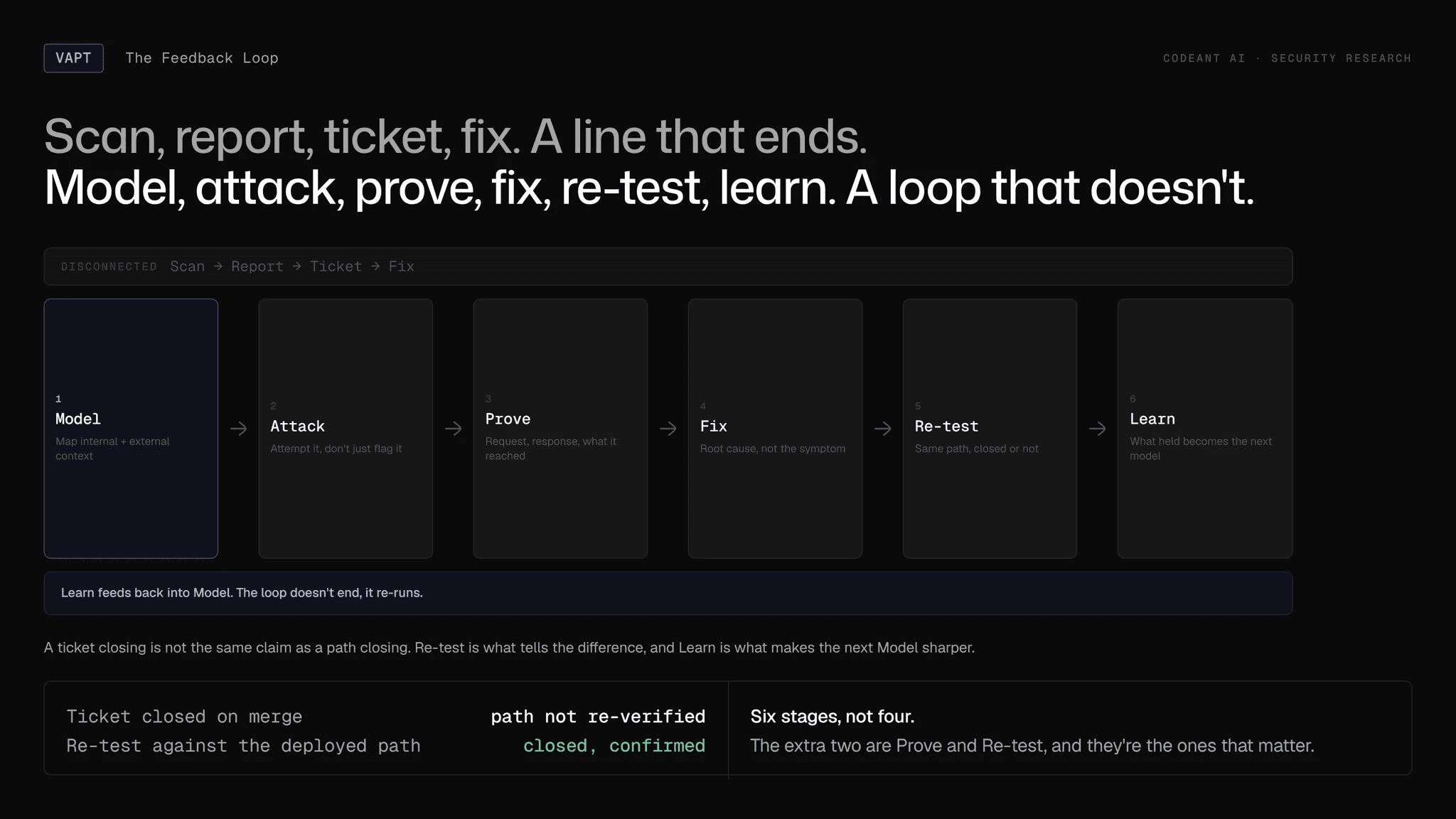
When offensive testing discovers a working exploit, the defensive engine can be updated to catch that pattern in future code changes, closing the loop between the offensive and defensive sides of the platform. That loop also runs across customers, not just across scans on the same account: internal context, your code, your cloud config, your identity setup, never leaves your account, but a verified, externally-reachable exploit pattern gets abstracted and reused to re-score every other customer with matching exposure. A misconfiguration class discovered against one AWS account can flag the same class on someone else's before it's ever exploited there.
Mechanically that's a five-stage loop, model the surface, attack it, prove what's reachable, fix and reset, learn from what held, running continuously across roughly 15 billion security events a month across CodeAnt's customer base. In cloud specifically, that means an IAM escalation chain or an SSRF-to-metadata-service path proven once doesn't stay a one-off finding; it becomes a pattern the model checks for by default on every account it touches next.
What this delivers:
Continuous offensive testing aligned with deployment velocity
Compliance-grade evidence (CIS, SOC 2, ISO 27001, HIPAA, PCI DSS, NIST 800-53) with CVSS scoring and reproducible PoC exploits
Code-level remediation guidance: exact source locations and suggested fixes
Performance-based model: no working exploit, no payment
Where you still need humans: Novel zero-days requiring deep research, niche domain expertise (Kubernetes runtime escapes, advanced cryptographic implementations), and sophisticated social engineering still benefit from specialized manual pentesting.
Practical Implementation: 30/60/90-Day Program
Days 1-30: Establish Baseline
Week 1:
Enumerate cloud footprint using Scout Suite or Prowler, or connect a read-only CSPM scan as described above
Map IAM boundaries and identify crown jewels
Document public attack surface
Weeks 2-4:
Deploy continuous configuration scanning
Fix top 10 critical findings (public S3 buckets, IMDSv1 instances)
Establish baseline metrics (MTTR, critical findings resolved)
Target: Eliminate publicly accessible storage with sensitive data, migrate to IMDSv2.
Days 31-60: Introduce Grey Box Testing
Weeks 5-6:
Select 2-3 critical applications handling sensitive data
Provide authenticated access and code context
Define success criteria (exploit chains demonstrating business impact)
Weeks 7-8:
Run grey box pentesting
Validate findings with working PoCs (curl commands proving exploitability)
Map findings to compliance controls
Prioritize by attack chain depth
Milestone: Deliver an audit-grade report with CVSS scoring and control mappings.
Days 61-90: Establish Retest Cadence
Weeks 9-10:
Feed findings into issue tracker (Jira, Linear, GitHub)
Implement a frequent re-scan policy for fast fix validation
Add security gates to CI/CD
Integrate IaC scanning (Terraform, CloudFormation)
Weeks 11-12:
Continuous automated testing on every deployment
Quarterly grey box pentesting for critical applications
Annual manual expert assessment for sophisticated scenarios
Track security posture over time
Success metric: By day 90, documented testing cadence, CI/CD security gates, and a measurable reduction in exploitable vulnerabilities reaching production.
Ship Secure Cloud Infrastructure From Today
Cloud pentesting is fundamentally about identity, control planes, and proving exploit chains, not just collecting misconfiguration findings. Real security value comes from demonstrating how an SSRF chains to metadata service access, escalates IAM privileges, and reaches production data.
Your next steps:
Map your attack surface using platform-native tools
Choose grey box testing for code-level exploit chain analysis
Operationalize retesting by integrating findings into CI/CD
Reference the MITRE ATT&CK Cloud Matrix and provider security documentation
Traditional pentesting firms deliver point-in-time reports. Your cloud infrastructure changes with every deployment, and by the time that report lands, it's already describing a system that no longer exists.
Where to start this week
Pick your single most privileged IAM role, the one attached to whatever touches production data, and trace exactly what it can do: not what you intended it to do, what its actual policy allows. Most teams find at least one permission on that role they can't explain, and that's usually the fastest real finding available without running a single exploit.
CodeAnt AI Pentesting closes the gap between that manual check and a continuous programme. 500+ exploit agents run black box, grey box, and white box testing with the same code intelligence that powers CodeAnt's defensive scanning, chaining IAM misconfigurations, exposed metadata services, and application flaws into real, reproduced attack paths instead of a list of theoretical findings. Every report is audit-grade: CVSS-scored, mapped to CIS, SOC 2, ISO 27001, HIPAA, PCI DSS, and NIST 800-53, and backed by a working proof of concept for every high and critical finding. Fix something and retest it the same day, not on next year's engagement.
You don't pay for a report. You pay for a confirmed exploit, and nothing else. If nothing exploitable turns up, the scan costs you nothing. Start a free scan →
Related reading
AI Penetration Testing For Cloud Security: the enterprise-level overview this guide's methodology sits underneath.
Cloud Attack Path Testing: more on validating exploit chains specifically.
Continuous Penetration Testing vs Annual Pentesting: the release-cadence argument in full.
3 Types of Penetration Testing: how black, grey, and white box differ outside the cloud-specific context.
The IDOR guide: the application-layer authorization bugs that most often show up as the first link in a cloud attack chain.

