

Your perimeter defenses will fail. A phishing email lands, a credential leaks in a breach, a contractor's laptop gets compromised. The question is not whether an attacker gets inside. It is what they can reach once they are.
Internal penetration testing answers that question. It runs on an assumed-breach model: the tester starts from a foothold already inside your network, a standard user account or a compromised workstation, and finds out whether your segmentation, your Active Directory hardening, and your monitoring can actually stop an adversary who is already past the front door.
For engineering teams at companies with 100 or more developers, especially those handling regulated data or carrying SOC 2, PCI DSS, or HIPAA obligations, this is not academic. It is the difference between catching an attack at the first foothold and reading about your breach in the news six months later. This guide covers what internal pentesting validates, when your organization actually needs it, and why doing it once a year is no longer enough.
Stop Outsourcing the Question of Whether You Are Secure
Here is the mindset shift that matters before any methodology. No company should rely only on external tools, security researchers, and annual auditors to tell it whether security issues live in its systems. Those are point-in-time opinions about a system that changes every day. The teams that catch attacks early do something different: they run tooling that integrates into the entire SDLC and surfaces critical security issues before they become incidents.
Internal penetration testing gets far more powerful the moment you pair it with attack surface management that runs every single day, not once a quarter. Daily attack surface management gives you the delta: every open port and IP address, every networking call, every new CVE that lands on your network layer, and every misconfigured asset in your cloud infrastructure. It also tells you, in near real time, which threat actors are probing your systems today, which IP addresses they are using, and what queries they are running, so you can block them before they chain into something worse.

Now combine those three, the network surface, the cloud surface, and the live threat signal, with the one thing an external firm never sees: your source code and data. That means your SAST, DAST, and SCA findings, your leaked secrets, your malware and dependency risk, all in the same model. When a platform holds all of that at once, it can build real attack chains and prove real exploitation instead of handing you a list of isolated findings. The only requirement is cadence. A large company should run this daily. A smaller one can run it weekly or monthly. Either way, the model is always current, and that is the whole point.
That is a problem no manual engagement can solve at the speed your code changes. It is exactly the gap a code-aware, continuous platform is built to close, and it is why the rest of this guide treats internal testing as a running system, not a yearly event.
Why Internal Networks Are the Real Attack Surface
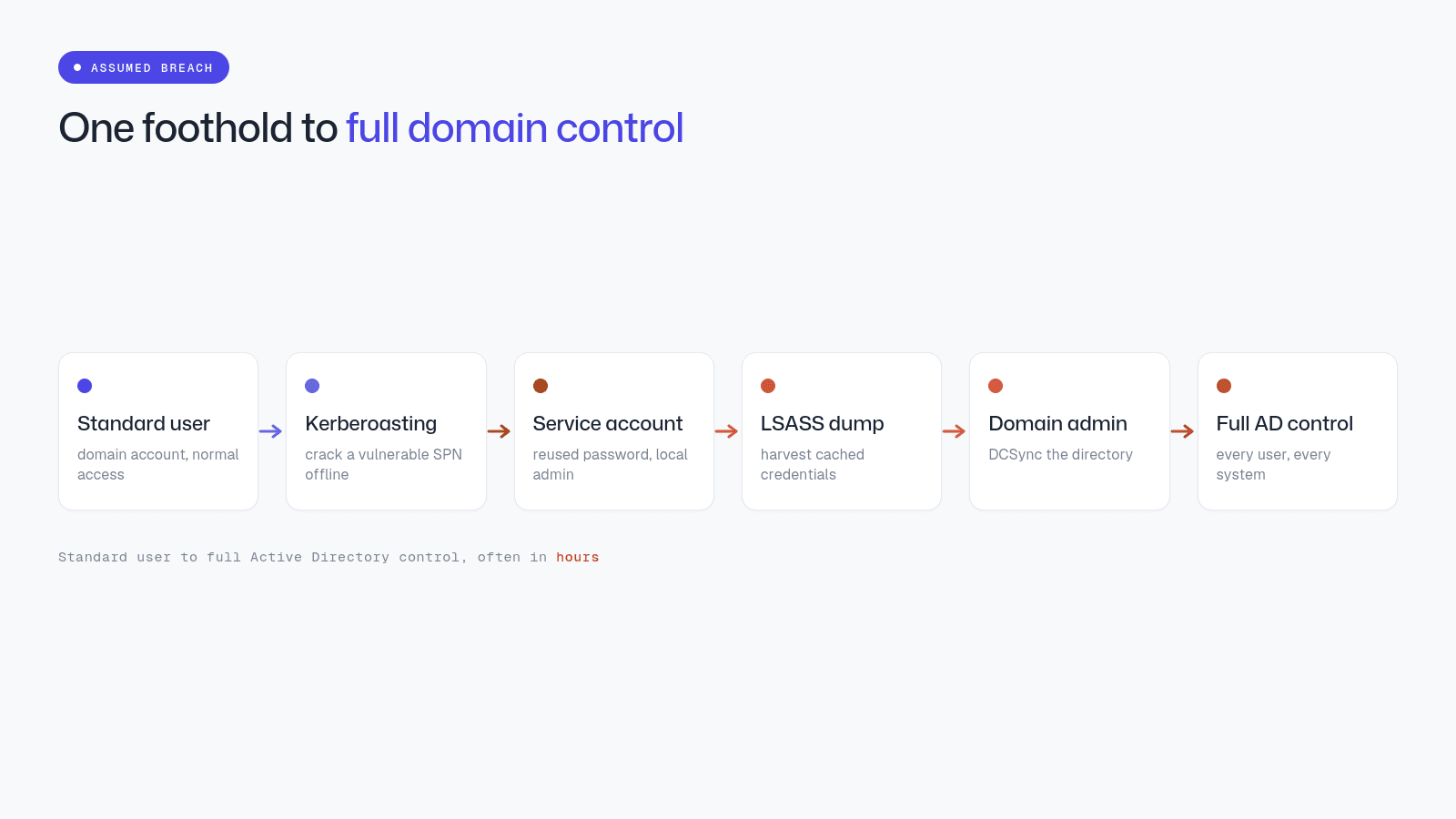
External penetration testing probes your perimeter. Vulnerability scanners enumerate known CVEs. Both matter, but neither answers the question that decides how bad a breach gets: if an attacker is already inside, how far can they go?
Internal pentesting fills three gaps that external-only security misses.
Lateral movement validation. Can an attacker pivot from a compromised workstation to your database servers? External tests stop at the perimeter. Internal tests map the actual paths through your network.
Privilege escalation assessment. Does a standard user account have a route to domain admin? Internal testing exploits the Active Directory misconfigurations, weak service accounts, and excessive permissions that external scanners never see.
Impact radius measurement. Which crown jewels are reachable after the initial compromise? Internal pentesting traces data flows, finds segmentation failures, and puts a number on the business risk.
The asymmetry is structural. Your perimeter gets hardened through constant exposure. Your internal network was designed for productivity and trust: broad Active Directory trusts, over-privileged service accounts, segmentation that exists on a diagram but breaks in practice.
An external test might find SQL injection on your login page. An internal test discovers that once inside, an adversary can enumerate every domain user, crack a service account password through Kerberoasting, move laterally with pass-the-hash, and reach every data store, often within hours.
What Internal Pentesting Actually Tests
Internal penetration testing is adversarial exploitation from an assumed-breach position inside your network. It simulates what happens after an attacker gains initial access through phishing, stolen credentials, or a compromised third party.
Starting positions
An internal pentest begins from a realistic foothold, not from nothing.
Domain user account. Standard employee credentials with typical access.
Compromised workstation. Physical or remote control of a corporate device.
VPN user. Remote-access credentials simulating a compromised remote worker.
Cloud SSO user. An authenticated session in Azure AD or Okta with standard permissions.
Network-only access. Raw connectivity, testing lateral movement from a compromised IoT device.
What gets validated
Testing focuses on lateral movement, privilege escalation, and data exfiltration. The common techniques fall into a few families.
Active Directory exploitation. Kerberoasting, AS-REP roasting, DCSync, Golden Ticket attacks.
Credential harvesting. LSASS dumping, NTDS.dit extraction, password spraying.
Network attacks. SMB relay, LLMNR and NBT-NS poisoning, ARP spoofing.
Application vulnerabilities. Internal web apps carrying SQL injection, SSRF, or insecure deserialization.
Misconfigurations. Over-privileged service accounts, weak ACLs, unpatched systems.
The goal is not to find vulnerabilities. It is to prove exploitability and map the attack path from initial foothold to critical impact.
Deliverables that drive action
An internal pentest is only as good as what it hands your engineers. Three outputs separate a useful report from a PDF that sits in a folder.
Validated attack paths. Not "this system is vulnerable," but the exact sequence showing how an adversary progresses:
Proof of impact with working exploits. Quality reports include the curl commands, scripts, or screenshots that demonstrate real exploitation, not theoretical risk. This is where code-aware gray-box testing pulls ahead: when the platform has already analyzed your codebase during code review, it knows where authentication logic lives, how data flows, and which API endpoints handle sensitive operations. That makes exploitation more targeted and points remediation straight at the vulnerable code. We break the three testing depths down in Black Box vs White Box vs Gray Box Penetration Testing.
Prioritized remediation roadmap. The best reports sequence fixes by risk reduction: exploitability (does a Metasploit module exist, or does this need a custom exploit), blast radius, business impact, and remediation effort. Disabling LLMNR is a very different lift from redesigning network segmentation, and the roadmap should say so.
Internal vs External Penetration Testing vs Vulnerability Scanning
Three activities get conflated constantly, and the confusion changes how teams architect systems and prioritize fixes. We cover the assessment-versus-testing distinction in depth in What Is VAPT? Vulnerability Assessment vs Penetration Testing. Here is the clean separation.
Dimension | Vulnerability scanning | External penetration testing | Internal penetration testing |
|---|---|---|---|
Threat model | Known CVEs | Internet-based attacker at the perimeter | Insider threat or post-breach adversary |
Starting position | Automated tool, no context | Outside the network, zero access | Inside the network, standard credentials |
Primary goal | Detect known vulnerabilities | Breach perimeter defenses | Validate lateral movement and privilege escalation |
Typical techniques | Port scanning, signature matching | OWASP Top 10 exploitation, injection | Kerberoasting, pass-the-hash, AD enumeration |
Exploitation depth | Detection only | Validates a perimeter breach | Chains exploits to show business impact |
Typical cadence | Continuous or weekly | Quarterly or annually | Annually or after major changes |
The developer-facing difference is the part worth internalizing. Vulnerability scanning tells you what is broken at the component level: fix the CVE, move on. External pentesting reveals how attackers chain your application flaws together, so that one IDOR bug becomes the first step in a critical chain. Internal pentesting exposes the architectural assumptions that stop holding the moment someone is inside.
Your app trusts Active Directory authentication? Internal testing shows how an adversary compromises AD and impersonates any user. Your microservices trust each other because they are "internal only"? Internal testing demonstrates the lateral movement that assumption invites.
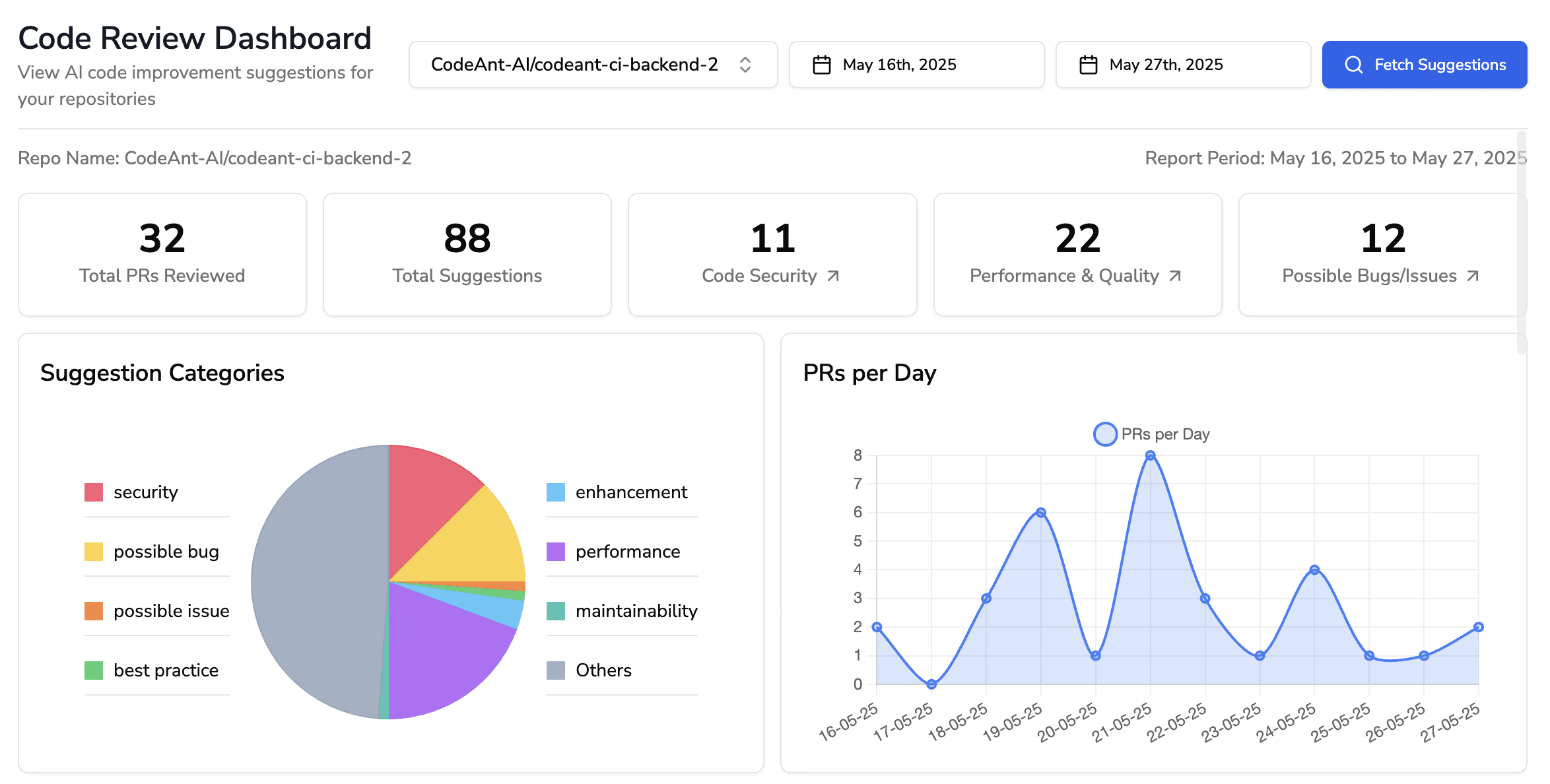
Code-aware internal testing changes the equation again. When the platform has already read your codebase, the way CodeAnt's defensive code review does continuously, internal testing gets dramatically more targeted.
Testers know where sensitive data flows, understand the authentication logic from the code itself, and can aim at the specific endpoints handling high-value operations, validating whether the code-level issues found in review are actually exploitable in production.
Where this connects: internal and external testing model different attackers, and mature programs run both. If you have not locked down the perimeter yet, start with the external penetration testing guide, then come back here for the assumed-breach layer.
When You Actually Need Internal Penetration Testing
Two kinds of triggers should put internal testing on your roadmap: compliance obligations and business events that reshape your attack surface.
Compliance triggers
Several frameworks require internal testing explicitly, not as a nice-to-have.
PCI DSS Requirement 11.4. Internal and external penetration testing at least annually and after significant infrastructure changes, including testing the segmentation controls between the cardholder data environment and other networks. See the PCI DSS penetration testing requirements for the full breakdown.
SOC 2 Type II (CC7.1). Periodic security testing including penetration testing. Auditors expect internal testing that validates controls beyond the external perimeter. The SOC 2 penetration testing requirements guide covers what evidence they want.
ISO 27001:2022 Control 8.8. Regular penetration testing validating the effectiveness of access controls, network security, and secure configuration.
HIPAA Security Rule 164.308(a)(8). Regular security testing validating that PHI access controls, encryption, and segmentation prevent unauthorized access.
Business triggers
Specific events change your internal attack surface in ways that invalidate last year's clean report.
Post-merger or acquisition. Combining networks means inheriting the other side's vulnerabilities, misconfigurations, and excessive privileges. Test before full integration, not after.
Major cloud migration. Moving workloads to AWS, Azure, or GCP redraws your network boundaries and segmentation model, and introduces IAM attack paths that on-prem testing never covers (see the cloud pentesting guide for AWS, Azure, and GCP). Test after migration, before you call it production-ready.
Zero Trust implementation. Validate that it actually works by testing lateral movement despite the micro-segmentation and identity-based controls you just deployed.
Remote work expansion. Test whether a compromised laptop can pivot into the corporate network, and what your VPN segmentation actually enforces.
Post-incident validation. After a breach, prove the remediation closed the attack paths, not just patched the one vulnerability that got exploited.
Network segmentation project. Validate that segmentation genuinely prevents lateral movement before declaring victory.
The readiness decision tree
Internal testing only pays off if you can act on what it finds. Walk this in order.
Have you completed external penetration testing in the past 12 months? No means secure the perimeter first. Yes with findings remediated means continue.
Do you fall under PCI DSS, SOC 2, ISO 27001, or HIPAA? Yes makes internal testing mandatory, schedule it annually at minimum. No means continue.
Have you had an M&A, cloud migration, Zero Trust rollout, remote-work expansion, security incident, new SSO, or segmentation project in the past six months? Yes means your attack surface changed fundamentally, test within 90 days. No means continue.
Do you have MFA on all accounts, patch management, endpoint protection, and centralized logging? No means fix the fundamentals first, testing will only surface what you already know is broken. Yes means continue.
Can you act on findings, with the budget, engineering capacity, and executive support to remediate critical issues within 30 to 60 days? No means wait until you can. Yes means you are ready.
When Internal Pentesting Is Premature
Before spending $15k to $50k on an engagement, build the foundational controls that make findings actionable. Test too early and the report just restates problems you have not resourced.
Multi-factor authentication everywhere. Stolen credentials remain the single most common way attackers break in, the initial vector in 22% of breaches, and they show up in 88% of basic web application attacks, according to the Verizon 2025 Data Breach Investigations Report. MFA blocks the pass-the-hash, Kerberoasting, and stolen-credential attacks that form the backbone of lateral movement.
Patch management. Without a process to patch critical CVEs inside 30 days, findings pile up faster than you can close them.
Endpoint detection and response. Without EDR, you cannot observe how an attacker moved or whether your detection would have caught it.
Least-privilege access controls. If every developer has local admin and service accounts run as SYSTEM, testing will just trace a straight line from user compromise to domain admin.
Centralized logging and SIEM. Without logs, you cannot answer "would we have detected this?", which is half the value of the exercise.
Incident response runbooks. If your answer to "we found domain admin compromise" is "add it to the backlog," you are not ready.
How to Prepare: A Practical Setup Checklist
Good preparation is what separates a smooth engagement from a disruptive one. Work backward from the testing window.
Two to four weeks before testing
Define objectives and scope. Decide what you are validating: AD security, segmentation, Zero Trust, or a specific compliance requirement. Identify the crown jewels (customer databases, CI/CD pipelines, admin consoles, source repositories), set testing windows, mark off-limits systems, and agree on escalation and break-glass procedures.
Prepare infrastructure. Document network topology and segmentation boundaries, complete an asset inventory, decide staging versus production, create test accounts with realistic (non-admin) privileges, verify recent backups and test the restore, and implement a change freeze for the window.
Enable monitoring. Confirm your SIEM is ingesting logs from domain controllers, critical servers, and network devices. Baseline normal authentication and traffic patterns, brief the SOC on the window and expected techniques, and configure monitoring to catch the pentest activity, because that is a live test of your detection.
Code-aware preparation (optional, high value). If you are using a code-aware platform, provide read-only repository access, share your API specifications (OpenAPI, Swagger, GraphQL schemas), and supply an SBOM showing dependencies and versions. The platform uses that codebase intelligence to identify high-risk endpoints before testing begins, which makes the engagement more targeted and more efficient.
Choosing the Right Approach
Three models dominate the market, and they are not interchangeable. Match the approach to your maturity and cadence.
Traditional pentesting firms
Expert manual testers bring creative attack scenarios, comprehensive red-team operations, and compliance credibility. The trade-offs are real: point-in-time only, expensive ($15k to $50k or more), slow (two to four weeks), no code context, and limited retesting. Best for complex environments, red-team operations, and mature programs with high-stakes compliance needs.
Automated scanning tools
Continuous, cost-effective ($5k to $20k a year), and broad in coverage. But false-positive rates run 30% to 50%, there is no exploitation validation, chained attacks get missed, and business context is absent. Best as continuous monitoring and a supplement to manual testing, not a replacement for it.
Code-aware platforms
This is the model the intent of this guide keeps pointing back to: continuous code security (defensive) combined with AI-driven penetration testing (offensive) that is informed by codebase intelligence. Testing starts already knowing where sensitive data flows, where authentication is weak, and which endpoints matter.
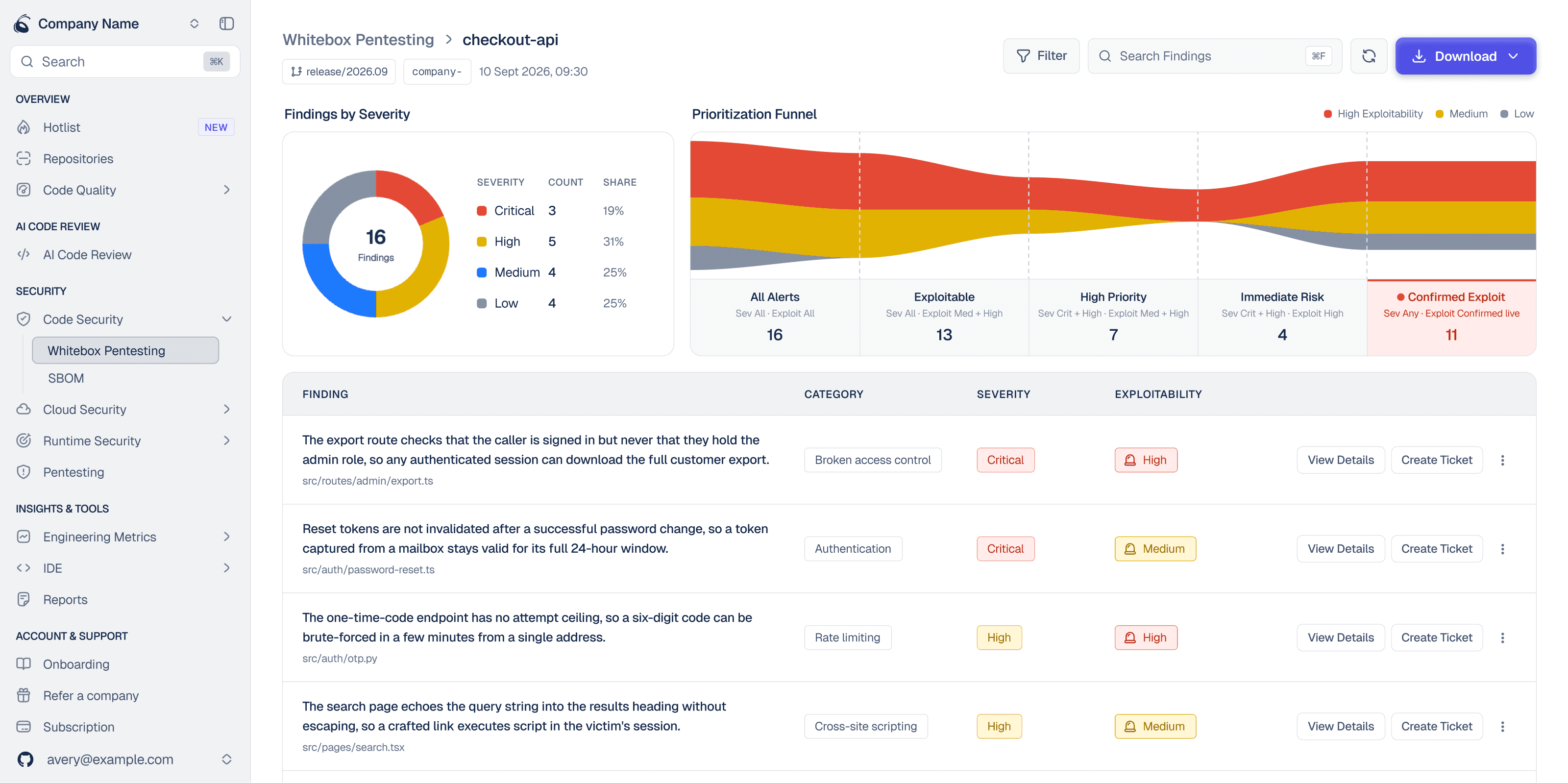
Code-informed scope. Testing focuses on the attack surfaces the code analysis actually reveals.
Faster turnaround. 24 to 48 hours instead of weeks.
Confirmed exploits. 500+ autonomous agents validate exploitability with a working PoC.
Unlimited retesting. Fix, re-scan, validate, with no additional charge.
Developer-friendly output. Findings carry exact file and line numbers plus remediation code.
SDLC integration. Automated ticketing, CI/CD hooks, and continuous validation.
Criteria | Traditional firms | Automated tools | |
|---|---|---|---|
Testing depth | Elite manual expertise | Known CVEs only | AI exploitation + code intelligence |
Turnaround | 2 to 4 weeks | Minutes to hours | 24 to 48 hours |
Cost | $15k to $50k+ | $5k to $20k a year | Performance-based |
Retesting | Separate charge | Automatic but shallow | Unlimited, code-aware |
Code context | None | None | Full codebase intelligence |
SDLC integration | Manual coordination | API-driven | Native CI/CD, automated ticketing |
What Effective Reports Deliver
A report earns its cost when it hands engineers something they can act on the same day. Look for five things.
Attack-path narratives. A clear progression from initial foothold to compromise, framed by business impact.
Precise scope. Exact hostnames and IPs, service versions, access paths, and data exposure.
Working proof-of-concept. The actual commands, not a description of them.
Reproduction steps. Curl commands, scripts, or manual steps a developer can rerun to validate a fix.
Compliance mapping. Findings mapped to SOC 2, ISO 27001, PCI DSS, and HIPAA controls.
A real proof-of-concept reads like this, an LLMNR-poisoning chain that ends in write access to backup shares:
For code-aware platforms, the report goes one level deeper, giving the exact file path, line number, and suggested fix, so the finding points at the code rather than the symptom.
Post-Test: From Findings to Fixes
Finding the problem is the start, not the finish. Route each finding to an owner, prioritize by real risk, and validate the fix.
Ownership mapping
Infrastructure teams. Network segmentation, AD hardening, endpoint protection gaps.
Application teams. Auth and authz flaws, input validation, secret management, API security.
IT and identity teams. User provisioning, MFA enforcement, password policies, service accounts.
Security engineering. Detection gaps, control validation, vulnerability management.
Prioritization framework
Do not just follow CVSS. Sequence by exploitability plus business impact, the same logic we break down in CVSS, EPSS, and CISA KEV: How to Actually Prioritize Vulnerabilities.
Critical (7 to 14 days). Single-step privilege escalation to domain admin, direct access to crown jewels, full network compromise from a standard user.
High (30 days). Multi-step chains to sensitive data, lateral movement that bypasses segmentation, auth bypass in a regulated application.
Medium (60 days). Defense-in-depth failures, segmentation gaps that need further exploitation, information disclosure that aids reconnaissance.
Low (90 days). Theoretical issues needing significant resources, isolated dev environments, informational findings.
Validation through retesting
The most common failure is a fix deployed without validation. Set a cadence: retest critical findings and architectural changes within a week, retest high and medium findings quarterly to confirm they have not regressed, and run a comprehensive retest annually for compliance and maturity.
Unlimited retesting removes the cost excuse entirely, deploy a fix, request the retest, get validation back in 24 to 48 hours. This is the same continuous-validation loop we cover in Continuous vs Annual Penetration Testing.
Stop Guessing How Far a Breach Would Go. Prove It.
External tools, researchers, and annual auditors can tell you your perimeter looked clean on the day they checked. None of them can tell you what an attacker reaches once they are inside, on the version of your system you shipped this morning. Internal penetration testing answers that, and answered continuously, it stops being a yearly compliance chore and becomes an early-warning system.
That is precisely the gap CodeAnt AI is built to close. CodeAnt runs daily attack surface management across your network, cloud, and live threat signal, then fuses it with the one thing no external firm sees: your source code, your SAST, DAST, and SCA findings, your secrets, and your dependency risk, in a single model.
Because the same code intelligence that reviews your pull requests also drives the offensive testing, it already knows where your authentication logic lives and where your sensitive data flows before the first probe. It chains isolated findings into real attack paths, confirms them with a working PoC, and hands your engineers the exact file, line, and fix, not a CVSS number and a shrug.
The commercial model matches the technical one. You get an audit-grade report in 24 to 48 hours, not weeks. Low and medium findings are free. You pay only when a high or critical is confirmed exploitable, and retests after every fix are unlimited and included, so there is no per-retest fee and no waiting to prove a finding is closed.
Where to start this week
Run the readiness decision tree above, then scope your crown jewels: the five internal systems whose compromise would hurt most, your customer database, your CI/CD pipeline, your admin console, your source repos, and your identity provider. Point a code-aware gray-box test at them, since gray box mirrors a realistic insider threat better than any other mode. You will see confirmed, exploitable paths mapped to code, and nothing to pay unless there is a real high or critical behind them. That is the fastest way to learn how far a breach would actually go, before an attacker teaches you the expensive way.
Run a free code-aware pentest →
Related reading
External Penetration Testing: What It Covers and What It Misses: the perimeter half of the picture, and the six gaps external testing leaves open
Black Box vs White Box vs Gray Box Penetration Testing: which testing depth your systems actually need
Continuous vs Annual Penetration Testing: why cadence, not depth, is the real differentiator
PCI DSS Penetration Testing Requirements: what Requirement 11.4 actually asks for, including segmentation testing
SOC 2 Penetration Testing Requirements: the evidence auditors expect for CC7.1
Guide to Cloud Pentesting: AWS, Azure, and GCP: IAM privilege escalation and attack paths unique to the cloud

