

Your security team just handed you a 73-page external penetration testing report with 50+ findings. "SQL injection on /api/search." But which query? Which file? What's the fix for your ORM? The report doesn't say.
By the time you ship a patch and wait six months for a re-test, your team has merged 200 more pull requests. Any one of them could have introduced the next vulnerability, and nobody is looking.
External penetration testing is still essential. It validates your perimeter, it satisfies PCI-DSS and SOC 2 auditors, and it tells you what an internet-based attacker sees before they attack. But six structural gaps stop the traditional model from delivering the depth, speed, and remediation clarity that a team shipping weekly releases actually needs. And the pressure is not theoretical: exploited vulnerabilities jumped to 20% of breaches as an initial access vector, up 34% year over year, in the Verizon 2025 Data Breach Investigations Report.
This guide covers what a rigorous external pentest delivers, the six gaps it leaves open, and how code-aware offensive testing closes them, all the way from a raw finding to a validated PR fix.
Here's the short version of what you'll get:
What external penetration testing actually tests: methodology, tools, and the findings that recur
The six gaps traditional testing leaves open, each with a real-world failure
How code-aware testing unifies external reconnaissance with internal code intelligence
A decision framework: when traditional testing is enough, when continuous fits, and when you need code context
An engineering-first workflow that takes a finding to a merged, re-tested fix
What External Penetration Testing Covers
External penetration testing simulates how an internet-based attacker probes your public-facing systems to find exploitable weaknesses before a real adversary does. It answers one question: what can a motivated attacker accomplish starting from nothing but your domain name, with no credentials and no insider access?
That threat model matters because it is the realistic one for most breaches. Ransomware crews, opportunistic criminals, and nation-state actors almost always start from the internet, enumerate the target with OSINT, and work inward. Your external attack surface is the front door, the side entrance, and every window visible from the street.
Before methodology, it helps to fix the three testing depths, because the rest of this guide turns on the difference between them.
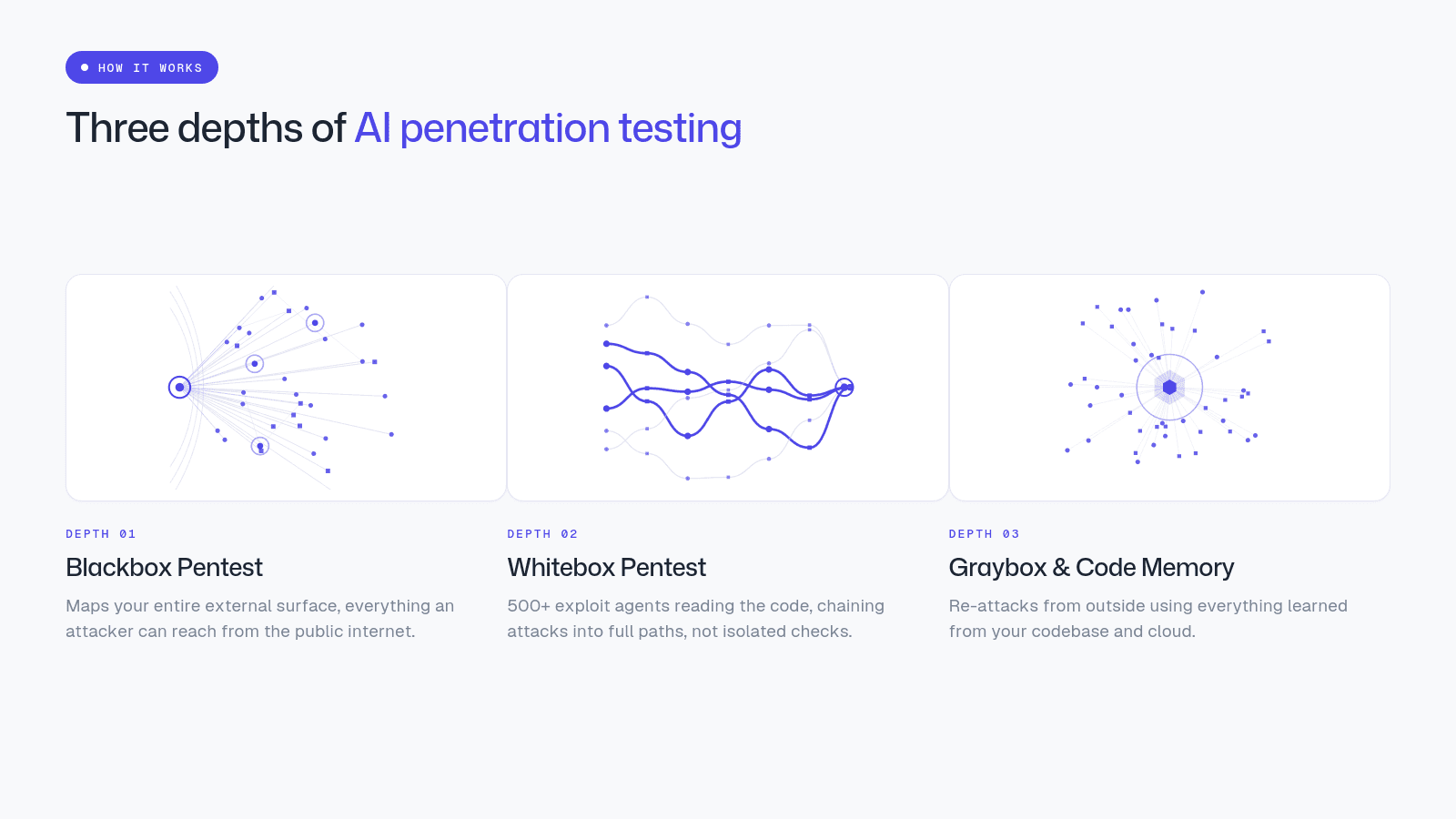
Black box is how an attacker sees you from the outside with zero inside knowledge. Testers get your public URLs and enumerate from scratch. If your network is not penetrable, no attacker in the world can see your code. This validates the perimeter but cannot test authenticated flows, trace data propagation, or check privilege boundaries between roles.
White box is the opposite. A tester reads your entire codebase, every API call, every database call, and builds a threat model from your SaaS logic, third-party dependencies, infrastructure, secrets, and SBOM. Pair that with your cloud, every misconfiguration in your WAF, network, and storage layers, and you can ask the questions the outside can never answer. Is there an unauthenticated API call hitting the database directly, with no rate limiting? From outside you would never know. From the code you can see it on the first read.
Gray box clubs the two together. You know, from the code, that a public API quietly triggers a downstream internal API that makes a database call. So you step outside the network, act like an adversary, and use that inside knowledge to reach the thing that was never meant to be reachable. This is how the best security programs defend against both external and internal threat actors at once.
Where this connects: the depth you choose decides what a test can find. We break the three down in detail in Black Box vs White Box vs Gray Box Penetration Testing, and CodeAnt runs all three from one AI pentesting engine.
The Five-Phase Attack Lifecycle
A rigorous external engagement runs through five phases. The full methodology guide has the exact commands. Here is the shape.
Phase 1: Reconnaissance. Testers map your exposure through Certificate Transparency log mining, DNS enumeration, cloud asset discovery, and technology fingerprinting. This surfaces every entry point, including the forgotten admin.staging.yourapp.com and the misconfigured S3 bucket nobody remembers creating.
Phase 2: Service discovery. Port scanning with nmap, HTTP fingerprinting with httpx, API discovery through JavaScript bundle analysis, and authentication boundary probing find where validation might fail.
Phase 3: Manual validation. This is where professional testing separates from automated scanning. Testers build custom payloads, chain low-severity findings into critical ones, probe business logic a scanner cannot understand, and eliminate false positives. A tester finds storage.yourapp.com in Certificate Transparency logs. A scanner reports "publicly accessible S3 bucket." The tester lists the objects, reads the files, and documents the real impact: 476,000 customer records exposed.
Chaining alone can eat seven to eight hours, because it is where isolated issues, threats, and root causes get stitched into a single path to a real data leak. Then a human researcher takes the machine's output and re-validates every finding by hand, confirms where the actual issue sits, and pushes the report further by chaining vulnerabilities the automated pass stopped short of. That human-plus-agent hand-off is what turns a list of findings into a proven attack path, and it is the part a signature-matching scanner can never reproduce.
Phase 4: Exploitation. For confirmed issues, testers prove exploitability with working proof-of-concept code.
Phase 5: Evidence collection. The output is audit-grade: curl PoC exploits, CVSS scores, control mapping to SOC 2, ISO 27001, PCI-DSS, and HIPAA, plus remediation guidance.
Common Findings and Why They Matter
Four finding classes come up in almost every external engagement. Each one exposes the same limitation: the report tells you the endpoint, not the line.
Misconfigured cloud storage and IAM. The finding reads "publicly readable S3 bucket exposes 47GB of customer data." The root cause is a bucket policy granting
s3:GetObjecttoPrincipal: "*", or a legacy ACL overriding the policy. The gap: the report won't tell you which Terraform module created it or how to stop it recurring.Missing authentication on API endpoints. "Unauthenticated access to
/api/v2/admin/usersreturns the full user database with PII." Root cause: an Express middleware chain that excludes/api/v2/admin/*from auth checks. Without code context, a developer hunts for which controller handles that route across a dozen microservices.OWASP Top 10 vulnerabilities. "SQL injection in search parameter:
GET /search?q=test' OR '1'='1." Root cause: user input concatenated straight into a query. The report shows the endpoint, not the vulnerable line insearch_controller.py:127.IDOR and BOLA patterns. "User 1042 can read invoices for user 1043 by changing
GET /api/invoices/1043." Root cause: the check validates that a JWT exists but never confirmsinvoice.user_id == current_user.id. Finding every endpoint with that pattern needs code-level analysis, which is exactly what we cover in the IDOR technical guide.
The Six Gaps Traditional External Testing Leaves Open
The gaps below are not six unrelated problems. They are symptoms of one thing: traditional external testing operates outside your codebase, while your vulnerabilities live inside it.
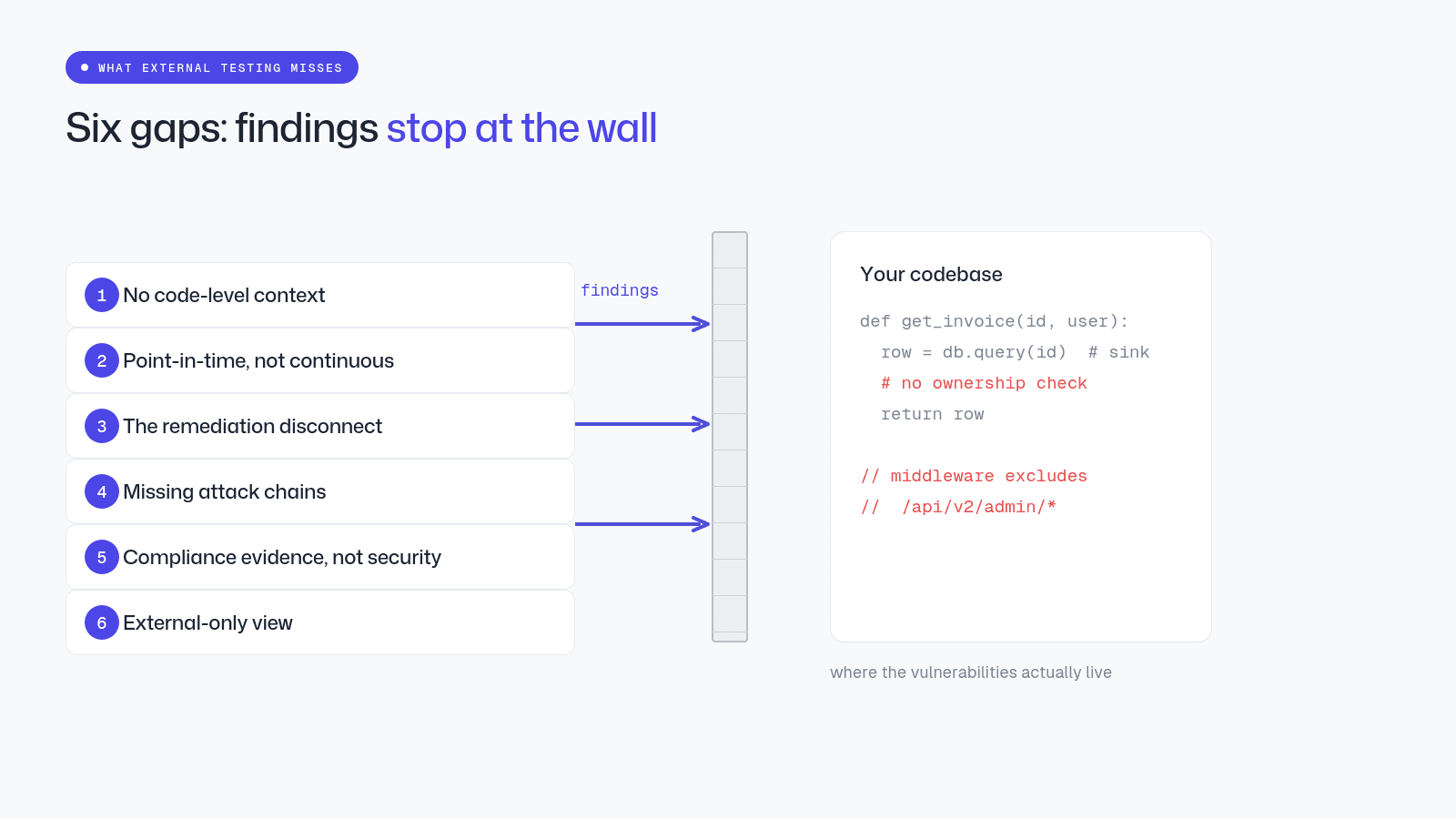
Gap 1: No code-level context
External testers can confirm /api/users returns user data. They can test for BOLA, attempt injection, and probe auth. What they cannot do without code access is trace whether user input reaches a dangerous sink, or whether an authorization check is bypassed internally.
A real failure mode. A healthcare SaaS provider's annual external pentest found no critical issues. Three months later a researcher disclosed an exploit chain exposing 476,000 patient records. The chain needed both the external API endpoint and the internal authorization logic that skipped role checks when certain query parameters combined. An external-only test could not construct it, because it required reading the code.
Code-aware testing traces data flows from source to sink, analyzes middleware ordering and exclusion rules, maps service-to-service trust boundaries, and scans Git history for leaked credentials.
Gap 2: Point-in-time testing versus continuous drift
You pass your annual external pentest in January. Over the next 51 weeks you ship 26 releases with new endpoints, services, and auth flows that were never tested.
Attack surface drift in practice. In March you deploy /api/appointments. In June you add GraphQL with introspection enabled. In September you migrate one bucket to public read. By December your attack surface is a different shape entirely, but the clean January report still satisfies the auditor.
Continuous validation closes this with passive DNS and Certificate Transparency monitoring that catches new subdomains within hours, automated enumeration across cloud providers, JavaScript bundle analysis that finds endpoints as they deploy, and unlimited re-scans after every fix. We break the tradeoff down fully in Continuous vs Annual Penetration Testing.
Gap 3: The remediation disconnect
Security receives: "Authentication bypass on /api/users. CVSS 8.1. Recommendation: implement proper authorization checks."
Engineering asks: which middleware is misconfigured? Is this a role check, an ownership check, or session handling? Which controller does /api/users map to? What's the data flow? The external tester cannot answer any of these, because they proved the exploit from outside and never saw your code.
The result is an expensive guessing loop:
Engineer guesses the root cause is a missing role check
Adds
@RequiresRole("ADMIN")Re-test shows the real issue was resource ownership, not role
Second attempt patches the service method and introduces a regression
Rollback, ticket back to the backlog
A senior engineer finally traces the flow and finds the missing
WHERE user_id = :current_userclause
Total time from finding to real fix: 16 to 20 weeks.
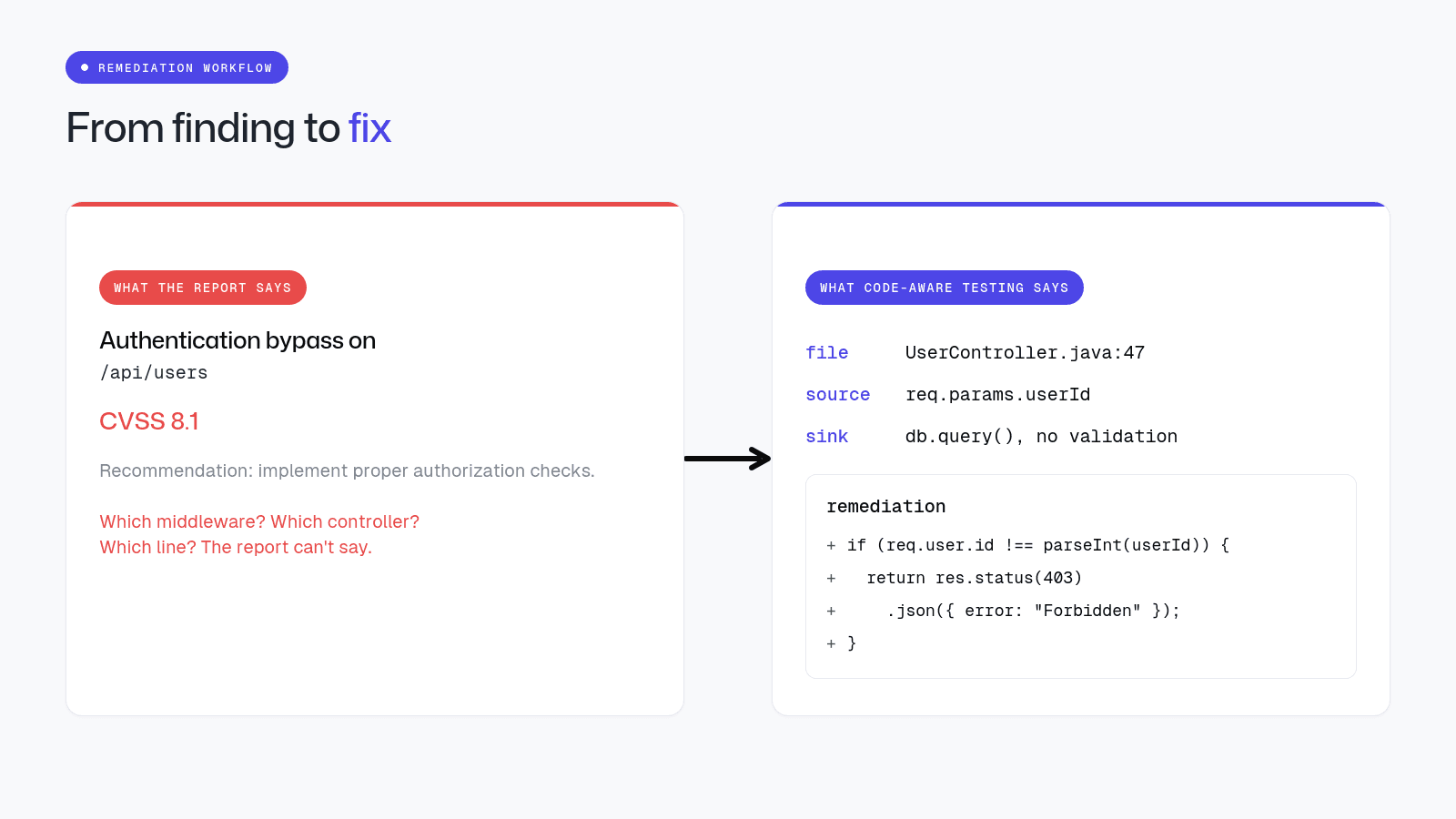
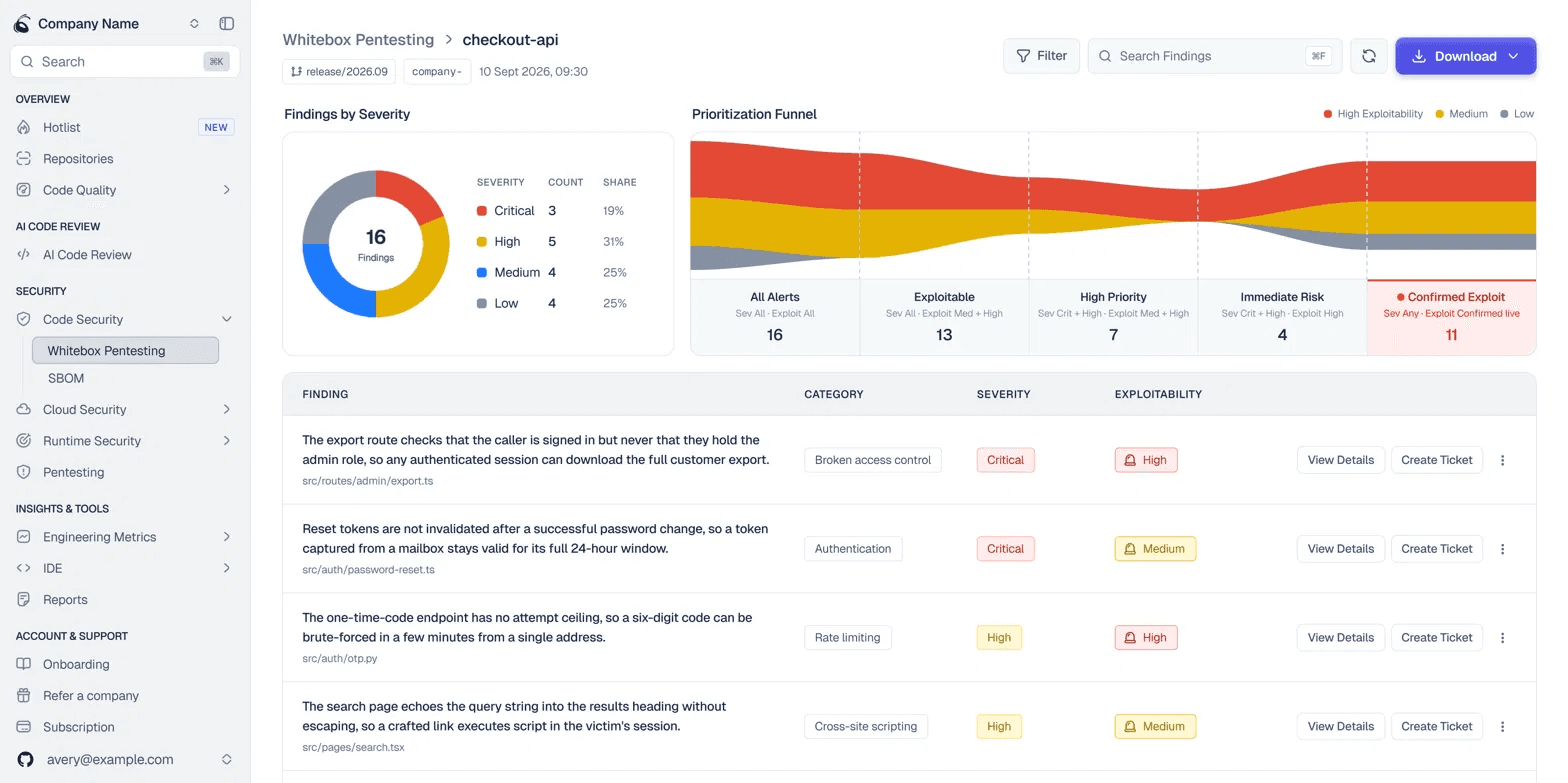
Code-aware testing collapses that loop by giving the file and line, the data-flow trace, a remediation diff, and an on-demand re-test within 24 to 48 hours.
Gap 4: Missing attack chains
Your scanner reports three findings: GraphQL introspection enabled (Low), BOLA on user enumeration (Medium), weak password policy (Medium). Nothing critical. Triage marks them "fix when convenient."
Three months later an attacker chains all three. Introspection reveals the internal API structure, BOLA enumerates valid user IDs, credential stuffing with common passwords lands, privilege escalation follows, and 742M records walk out the door.
Why it happens. Scanners match signatures one at a time and cannot reason across findings to build a multi-stage chain. Human testers can, but a two-to-four-week engagement does not allow exhaustive chain exploration. In one disclosed case, a researcher spent 40 hours chaining four "Low" and "Medium" findings into a full patient-record breach. The annual test that missed it had allocated 80 hours total across the entire application.
Autonomous exploit agents construct and validate chains the way a persistent adversary does, deliver a working PoC for the full chain, and map it to business and compliance impact. That is the difference an attack-path approach makes over isolated checks.
Gap 5: Compliance evidence versus real security
You complete annual external testing in Q1 for PCI-DSS 11.3. The report goes in the compliance folder. Then the SOC 2 audit lands in Q4 and the auditor asks: how do you validate security between annual tests? What shows you were secure after each release? How do you prove a fix landed and never regressed?
The annual report answers none of it. Traditional testing treats security as a point-in-time snapshot, while SOC 2, ISO 27001, and HIPAA increasingly want a continuous evidence trail.
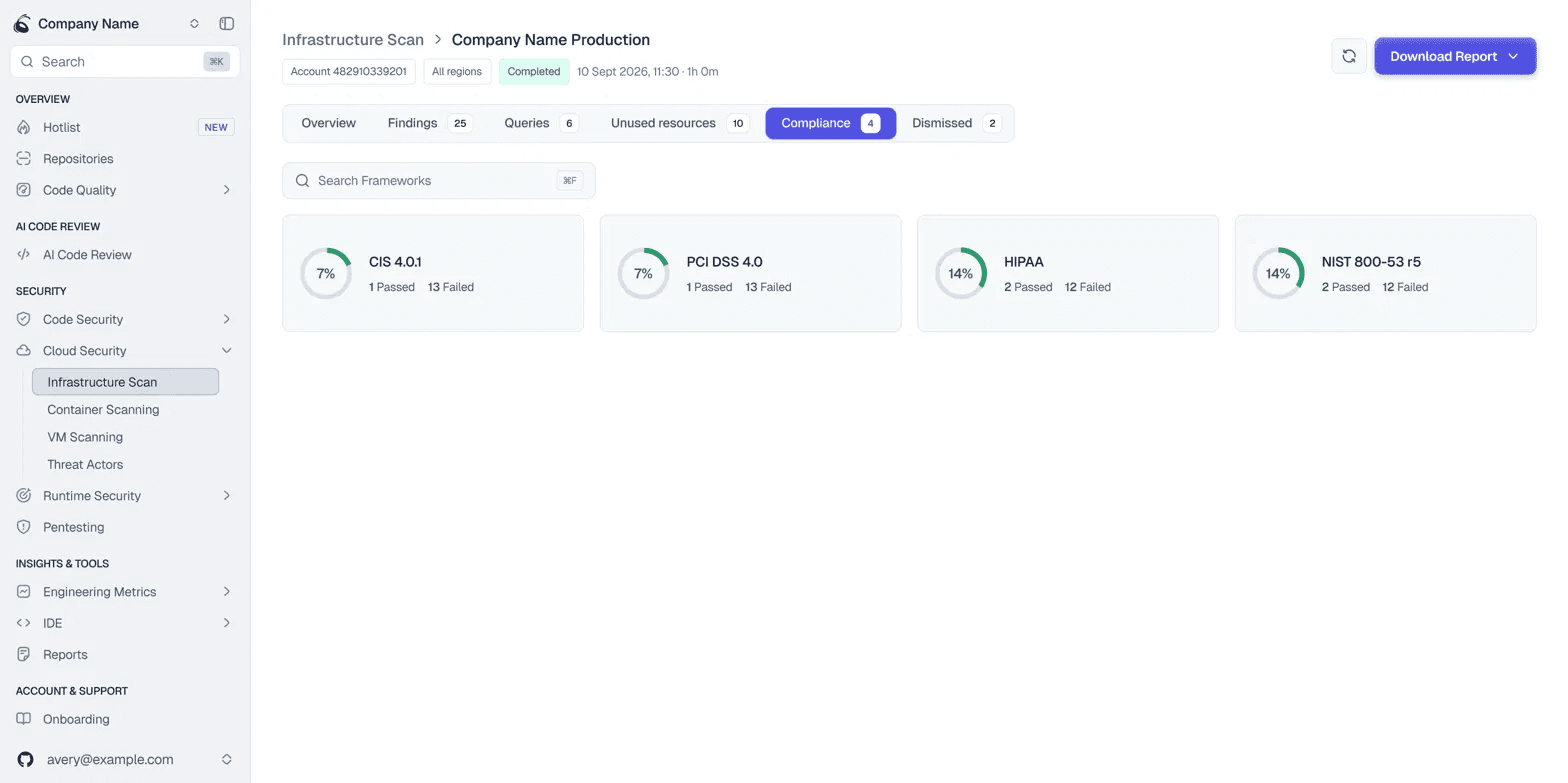
Continuous validation produces exactly that: audit-grade reports with CVSS scores, control mapping, curl PoC exploits, and unlimited re-scan records, plus automatic artifacts like "Finding #47 (CVSS 8.6) maps to SOC 2 CC6.1. Remediated 2026-03-15. Re-scan 2026-03-16 confirms fix. No regression across the next 12 releases."
Gap 6: External-only testing misses insider knowledge
Your external pentest runs in pure black-box mode. Real sophisticated attackers do not. They scrape GitHub for leaked credentials, read JavaScript bundles to find internal endpoints, map your engineering team on LinkedIn, and operate with persistent reconnaissance and partial inside knowledge.
A real failure mode. A SaaS company's external pentest found no auth bypass. Three months later an attacker exploited one that required internal endpoint structure pulled from JavaScript bundles, a legacy auth middleware disabled for specific routes found in Git history, and the exact query-parameter combination reverse-engineered from source. The attacker had the inside knowledge the external-only test never had.
Code-aware gray-box testing simulates that adversary. It reads the repository, traces data flows, scans Git history, and analyzes client-side code, testing the way a real attacker operates after the reconnaissance phase, not before it.
The Evolution: Code-Aware Offensive Testing
Code-aware offensive testing operates on both sides of the perimeter at once. The same engine that understands your authentication middleware, traces data flows through your API layers, and reviews your pull requests also runs adversarial reconnaissance against your external attack surface. When it finds an auth bypass on /api/users, it already knows which middleware handles that route, because it has been reviewing that code for months.
The reason it knows is that it is wired into your whole SDLC, not bolted on once a year. It watches from the moment a developer writes the code, through the pull request, through CI/CD, and rebuilds its threat model on every commit. So the model that the offensive side tests against is never stale: it reflects the code you shipped this morning, not the snapshot an annual engagement captured last quarter. That is the difference between a test that knows your system and one that is meeting it for the first time.
The unified workflow runs in six steps:
Defensive intelligence feeds offensive recon. The engine reviewing your PRs already knows your API structure and authorization middleware. When it discovers
/api/v2/users, it traces the endpoint back through the code to the controller, the middleware, and the sink.External recon finds exposed surfaces. Continuous subdomain enumeration, JavaScript bundle analysis, GraphQL introspection, and cloud service enumeration detect new exposure as you ship.
Exploit agents validate real risk with chains. 500+ autonomous agents build multi-stage chains, each step confirmed with a working PoC.
Findings map to code with remediation context. Every finding lands with a file, a line, a source, a sink, a PoC, and a fix.
Unlimited re-scans validate fixes in 24 to 48 hours. After you merge the fix, the engine re-runs the exploit chain to confirm closure. No six-month wait, no per-retest fee.

The evidence trail closes the compliance loop. Every step generates audit-grade evidence: the initial PoC, the remediation commit hash, the re-test result, the control mapping.
Performance-based accountability. Traditional firms charge $10K to $80K per engagement whether they find anything or not. Code-aware testing charges for outcomes: no working exploit, no payment. You pay only for confirmed, exploitable issues with a curl PoC, low and medium findings stay free, and unlimited re-scans kill the per-retest fee.
Choosing the Right Approach
No single model wins every time. Match the approach to how often you ship and how sensitive your data is.
Approach | Best fit | Strengths | Limitations |
|---|---|---|---|
Traditional pentesting firm | Stable surface, quarterly-or-less releases, annual compliance, bespoke red-team scenarios | Decades of manual expertise, creative exploitation automation can't match | 2 to 4 week turnaround, separate re-test fees, findings arrive as reports not tickets |
Continuous external monitoring | SaaS needing 24/7 surface monitoring, breadth over exploitation depth | Detects new exposure as it appears | Flags potential issues but lacks exploitation depth and code-level remediation |
Code-aware offensive testing | Weekly/bi-weekly deploys, API-driven architectures, continuous-evidence compliance | Code-mapped findings, attack chains, unlimited fast re-scans, outcome pricing | Needs read-only repo access, overkill for a static site with no sensitive data |
A quick decision framework. Ask yourself six questions. How often do we deploy? Do we handle regulated data (PHI, PII, financial)? Can security translate reports into developer tickets today? Do we re-test fixes multiple times a quarter? Does our architecture enable attack chains? Are we under continuous audit pressure?
If you answered "yes" to three or more of the deploy, regulated-data, re-test, chain, or audit questions, or "no" to the tickets question, code-aware offensive testing is likely the right fit.
From Findings to PR Fixes: Engineering-First Remediation
A finding is worth nothing until it is a merged, re-tested fix. Here is the workflow that gets it there.
Triage with technical context
Prioritize on exploitability and blast radius, not raw CVSS. A working PoC makes it P0. Pre-auth jumps the queue. PHI, PII, or financial data in the blast radius means fix now. A good ticket carries the exploit, the root cause, and the acceptance criteria in one place:
Reproduce and localize
Trace the request through the stack until you reach the exact line:
Patch with defense in depth
Fix at the layer that survives a re-test, which usually means enforcing the invariant at the query, not in a decorator.
Parameterize input rather than escaping it:
Validate with tests and re-scans
Lock the fix in place with a negative test, then request the re-scan:
A modern code-aware platform returns the re-scan within 24 to 48 hours, unlimited, so you confirm closure without waiting months or paying extra.
Close out with compliance evidence
Stop Shipping Findings Your Next Audit Won't Catch
External penetration testing still earns its place for compliance and perimeter validation. But the six gaps, no code context, point-in-time testing, the remediation disconnect, missing attack chains, compliance theater, and the external-only view, mean a traditional external test alone cannot keep pace with weekly releases.
The fix is not to replace external testing. It is to give it code memory, so a perimeter finding arrives with the line that caused it and the diff that closes it. That is exactly what CodeAnt AI is built to do.
CodeAnt runs black box, white box, and gray box testing from one engine, the same code intelligence that reviews your pull requests is the one probing your external surface, so it already knows your middleware, your data flows, and your dangerous sinks before the first packet goes out.
Every finding lands with a file, a line, a source-to-sink trace, and a remediation diff, not a CVSS number and a shrug. The offensive track chains low and medium findings into the full attack path a real adversary would build, then confirms it with a working PoC. And the whole loop is code-aware, so a perimeter exposure connects straight back to the exact line in your repo.
The commercial model matches the technical one. You get a full audit-grade report in 48 hours, not two to four weeks. Low and medium findings are free. You pay only when a high or critical is confirmed exploitable with a working PoC, and re-scans after every fix are unlimited and included, so there is no per-retest fee and no six-month wait to prove a finding is closed.
Where to start this week
Pick your ten most sensitive internet-facing endpoints, the ones touching PHI, PII, or payment data, and point CodeAnt at them with a free black-box scan from a single URL. You will see confirmed, exploitable findings mapped to code, and nothing to pay unless there is a real high or critical with a PoC behind it. It is the fastest way to see the gap between what your last report said and what your code actually exposes, and to close it before your next audit does it for you.
Related reading
External Penetration Testing Methodology Guide: the exact OSINT, recon, and exploitation commands, phase by phase
Black Box vs White Box vs Gray Box Penetration Testing: which depth your application actually needs
Continuous vs Annual Penetration Testing: attack surface drift, cadence, and ROI
IDOR Vulnerabilities: Complete Technical Guide: every variant, real exploits, and prevention
AI Penetration Testing: Methodology, Tools & Best Practices: how autonomous testing runs recon through reporting

