

Enterprise security does not fail because one tool missed one bug. It fails because the pieces were bought separately and the breach ran between them. A code scanner sees your repositories. A cloud tool sees your infrastructure. An attack-surface product sees your external exposure. A pentest firm sees a scoped slice, once a year. Each vendor sees its own slice, and the attack path, the one that starts at an exposed subdomain and ends at your customer database, crosses all of them and is owned by none.
An enterprise penetration testing platform exists to close that gap. It is not a bigger scanner or a faster pentest firm. It is a system that models your entire attack surface, internal and external, as one connected graph, continuously attacks it the way a real adversary would, and proves which paths can actually reach critical data. The features that matter are the ones that let it do that at enterprise scale.
This guide breaks down those features: what an enterprise pentest platform must do, why attack-path validation is the capability that separates a platform from a tool, and how to evaluate one against your real requirements.
Why the Category Exists: Security Is Bought in Pieces, Breaches Happen in Chains
The enterprise security stack is fragmented by design. A typical enterprise runs separate vendors for code security, cloud posture, attack-surface management, SIEM, infrastructure scanning, and penetration testing. Each is competent at its slice. None sees the whole.
The problem is that breaches do not respect those boundaries. A real intrusion is a chain: an exposed staging subdomain reveals an API, the API has no authentication on reads, the response leaks a workforce directory, a reused credential from that directory unlocks an identity system with write access, and now the attacker owns production. Six tools might each flag one link as low or medium severity. Not one of them sees the chain, because the chain is precisely the thing that lives between their scopes.
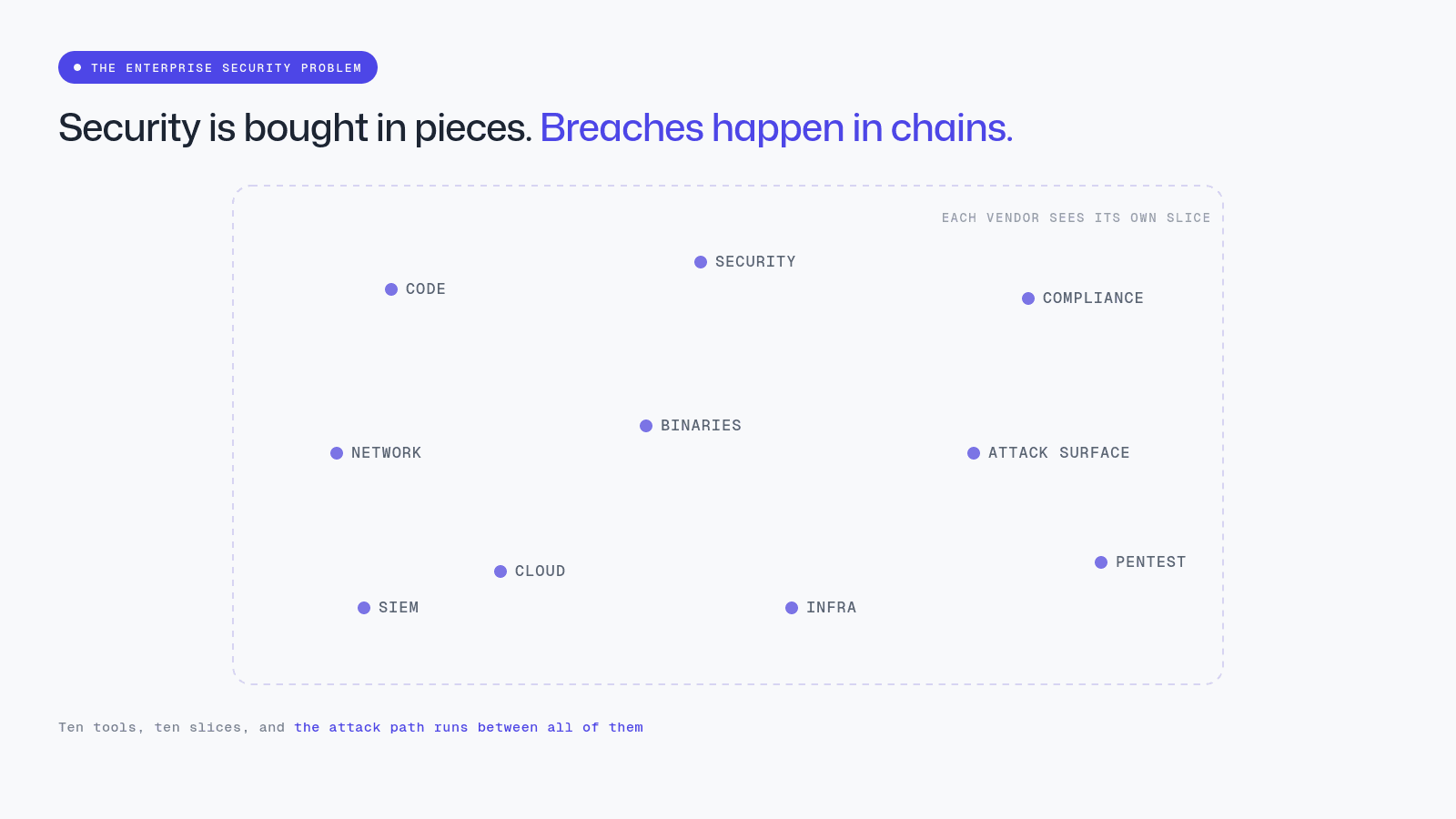
This is the vulnerability-scanning-versus-testing gap at the platform level. A scanner tells you what might be wrong in its lane. A platform proves what an attacker can do across all of them. And the pressure to close that gap is rising: exploitation of vulnerabilities reached 20% of breaches as an initial access vector in the Verizon 2025 Data Breach Investigations Report, a 34% year-over-year jump, while Gartner's continuous threat exposure management framework projects that organizations running a continuous exposure-management program are three times less likely to suffer a breach. The category exists because point tools cannot deliver that, and the shift to continuous validation is the market pricing it in.
Feature 1: A Unified Graph of Internal and External Context
The foundational feature of an enterprise pentest platform is that it models the company from the inside and the outside at once, as one graph, rather than as separate inventories. Most tools see one side. The paths that matter run between them.
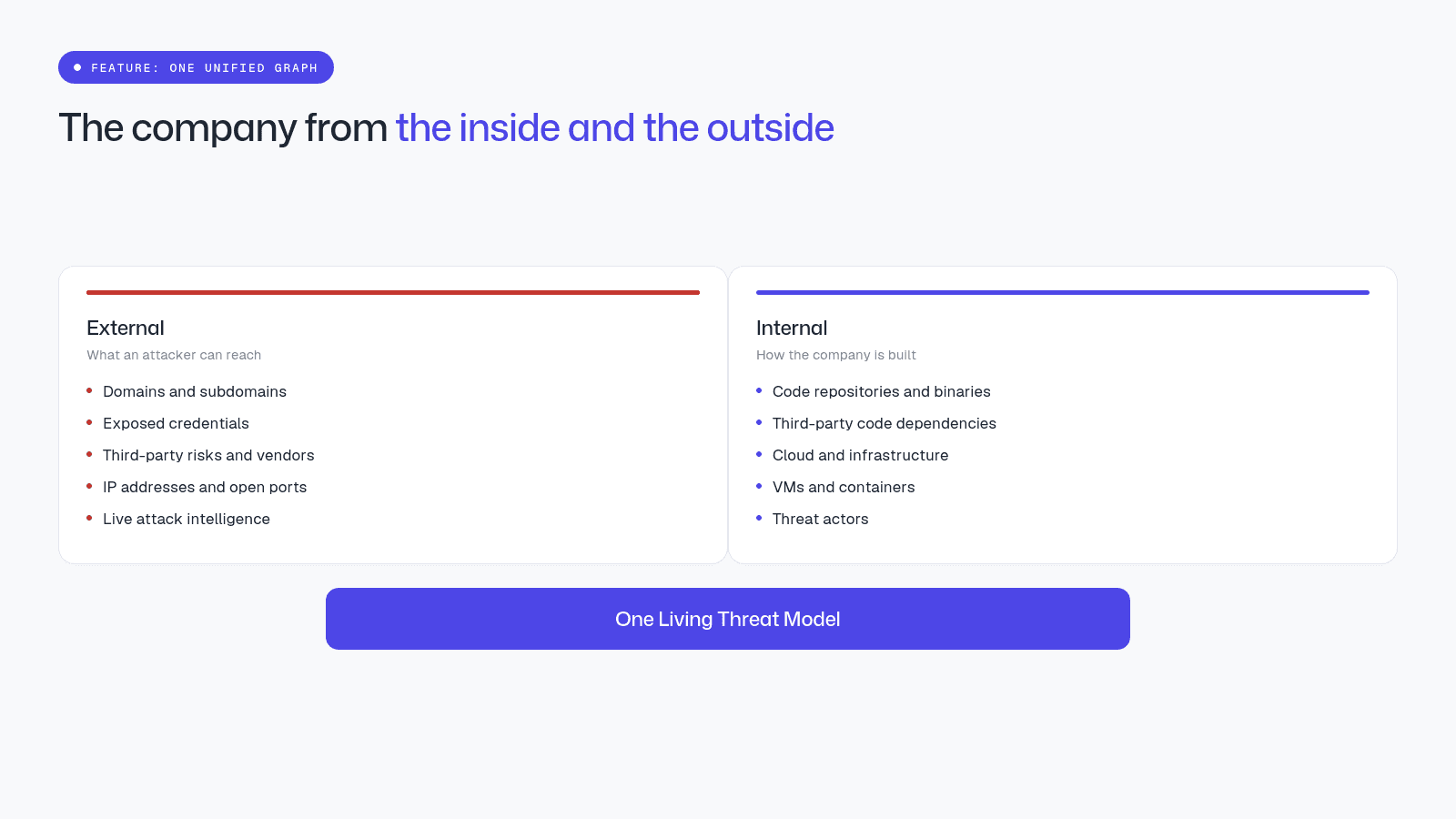
The external view is what an attacker can reach: domains and subdomains, exposed credentials, third-party risks and vendors, IP addresses and open ports, and live attack intelligence about who is probing you right now.
The internal view is how the company is actually built: code repositories and binaries, third-party code dependencies, cloud and infrastructure, VMs and containers, and runtime identity and access.
A platform that holds both can connect them. CodeAnt AI feeds both sides into what it calls a living threat model, so a weakness in one layer becomes a route through the next:
A vulnerable third-party NPM package is pulled into a backend service
The service is built from a primary repository
It ships as a Docker container
The container runs on an EKS cluster behind a load balancer
The load balancer exposes a subdomain
Each node is a separate tool's job. The platform's job is the edges between them, because that chain of edges is the attack path. This is the same internal-plus-external principle behind the internal and external penetration testing guides, unified into one continuously-maintained model.
Feature 2: Attack-Path Validation From Exposed Surface to Critical Data
If the unified graph is the foundation, attack-path validation is the feature that makes a platform a platform rather than a correlation dashboard. The question an enterprise platform must answer is not "how many vulnerabilities do we have?" but "which of them can actually be reached, and what do they reach?"
That reframes severity entirely. A vulnerable dependency scanned in isolation is one line in an SCA report. Placed in the graph, connecting your repositories, containers, cloud resources, and exposed subdomains, it becomes a dependency pulled into a service, shipped in a container, running behind a public endpoint that reaches a database of customer PII. Severity lives in reachability, and a finding without a reachable path is a guess.
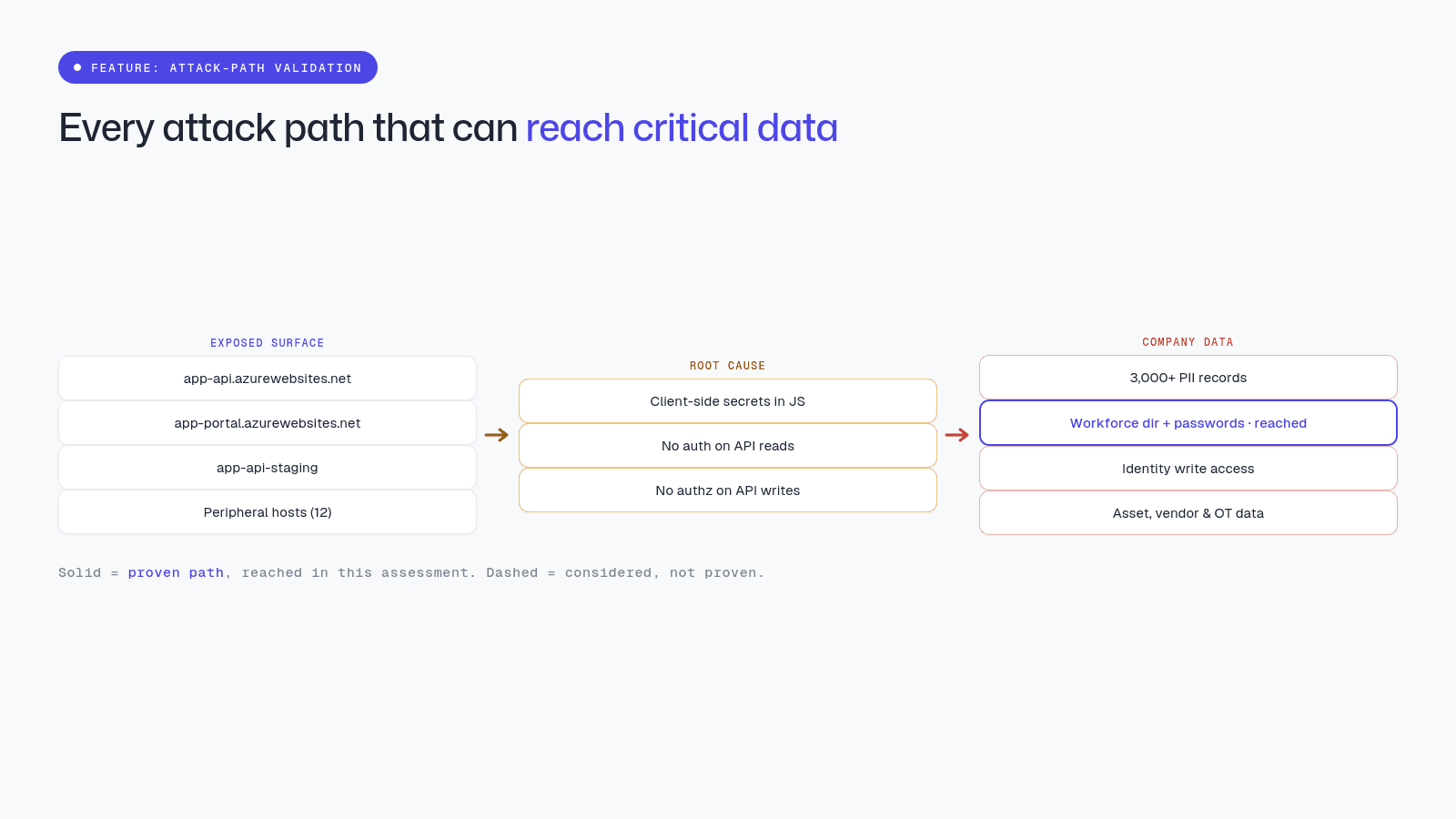
A platform proves the path end to end. In a real CodeAnt assessment, the model traced from the exposed surface (five azurewebsites.net hosts plus twelve peripheral hosts), across the company boundary, to the root causes (client-side secrets in JS bundles, no authentication on API reads, no authorization on API writes), and through to the company data those root causes reach: 3,000-plus PII customer records, a workforce directory plus passwords, identity-system write access, and asset, vendor, and OT data.
The workforce directory was marked "reached in this assessment", a proven path, not a theoretical one. This is attack path analysis operating across the full internal and external surface at once.
The critical distinction an enterprise platform must draw is proven versus considered. A proven path is one the platform validated end to end, an attacker could walk it. A considered path is one it modeled but did not confirm.
Keeping the two separate is what keeps the output honest: proven paths drive immediate remediation, considered paths tell the team where the model will test next, rather than inflating the report with theoretical criticals. A platform that cannot tell you which is which is not proving exploitability, it is guessing with a nicer interface.
Feature 3: Continuous Rebuilding at the Speed of Change
An enterprise ships continuously, so the model has to. A platform that maps the attack surface once and reports quarterly is describing a system that stopped existing a few hundred deploys ago.
The defining enterprise feature is that the graph rebuilds with every change, on every commit, dependency bump, infrastructure change, and new exposure, so the answer to "can this be reached?" is always current.
This is what separates a platform from a point-in-time engagement, and it is the whole argument of continuous vs annual penetration testing. When a new endpoint merges at 10am, the model incorporates it, attempts the reachable paths, and flags a confirmed exploit before the day is out, instead of leaving it untested until next year's audit.
CodeAnt AI processes roughly 15 billion security events a month across its customer base to keep that model live, which is the scale continuous rebuilding requires.
Continuous operation also changes what compliance evidence looks like. Instead of a stale annual PDF, the platform produces a current, always-on evidence trail that maps to the controls auditors check, which is what modern SOC 2 and PCI DSS programs increasingly expect.
Feature 4: Code-Aware Testing, Not Just External Scanning
Most platforms test from the outside, delivered through a nice interface but blind to your source. The enterprise-grade feature is code awareness: the same intelligence that reviews your pull requests for insecure patterns also drives the offensive testing, so the attack is informed by how the software is actually built.
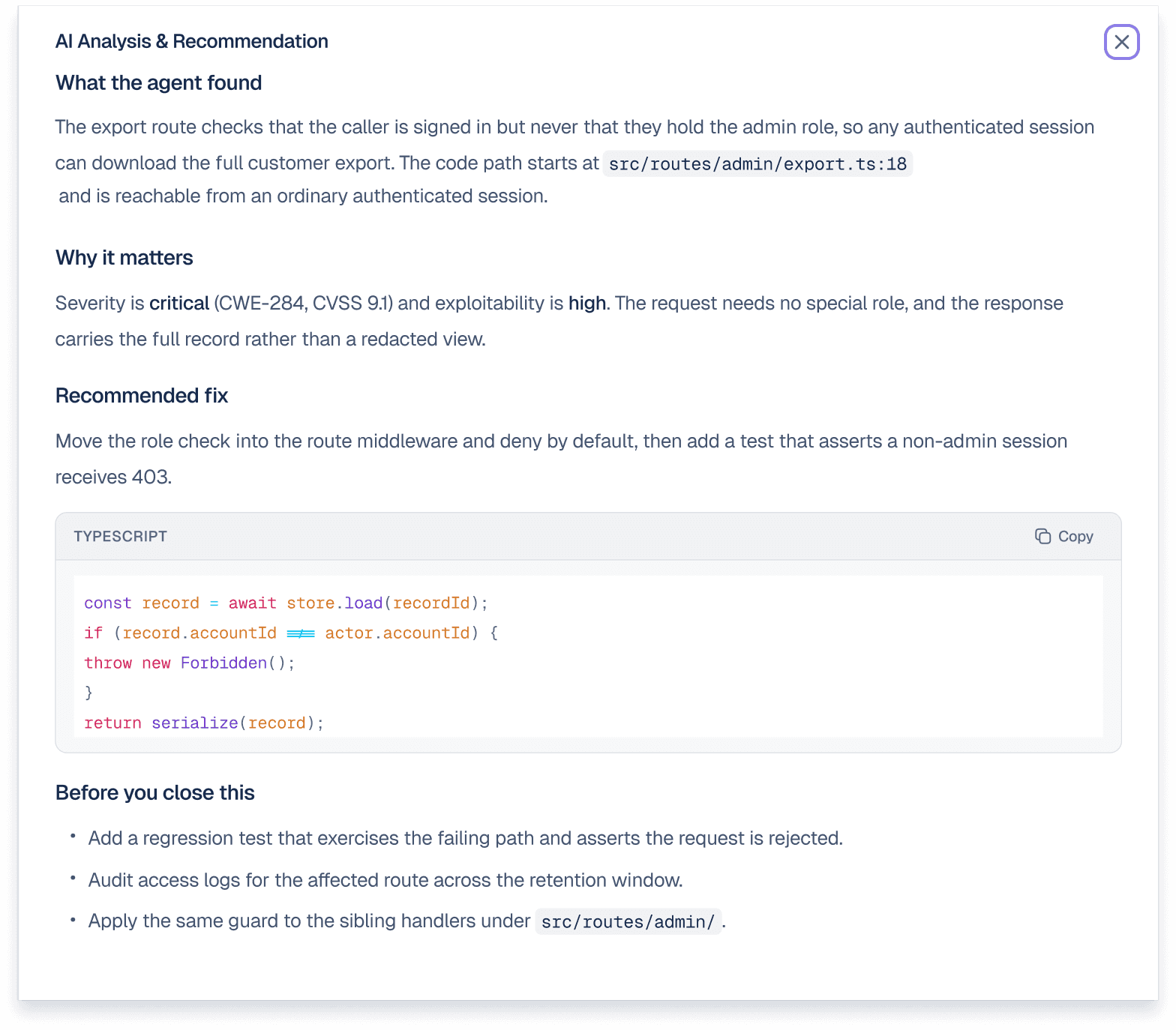
Code awareness changes three things.
It makes testing more targeted, because the platform knows which endpoints handle sensitive data and where authorization lives, so it goes straight for the Broken Object Level Authorization and tenant-isolation flaws that cause real breaches.
It makes exploitation deeper, tracing a data flow from user input to a dangerous sink that an external test would never see because the endpoint requires authentication and returns generic errors.
It makes remediation faster and precise, because a finding arrives with the exact file, line, and a working proof-of-concept rather than an endpoint and a guess.
This defensive-plus-offensive integration is the difference between a scanner that flags a pattern and a platform that proves the pattern is exploitable in the running system. It is the model the automated penetration testing guide describes, applied at enterprise scale across the whole graph.
Feature 5: Real Exploits With Working Proof, Not Theoretical Findings
An enterprise platform has to cut through noise, and the only reliable filter is exploit validation. Every finding that reaches the team should carry a working proof-of-concept, a curl command or script that demonstrates the exploit, not a theoretical flag from a version banner. If the platform cannot hand you a working exploit, you are triaging noise at enterprise volume, which is its own cost.
This is why the strongest platforms tie the model to the outcome. CodeAnt AI runs an outcome-based model: you pay only when a high or critical is confirmed exploitable with a proof-of-concept, and nothing when only low and medium issues are found, so the meter tracks real risk rather than raw finding count.
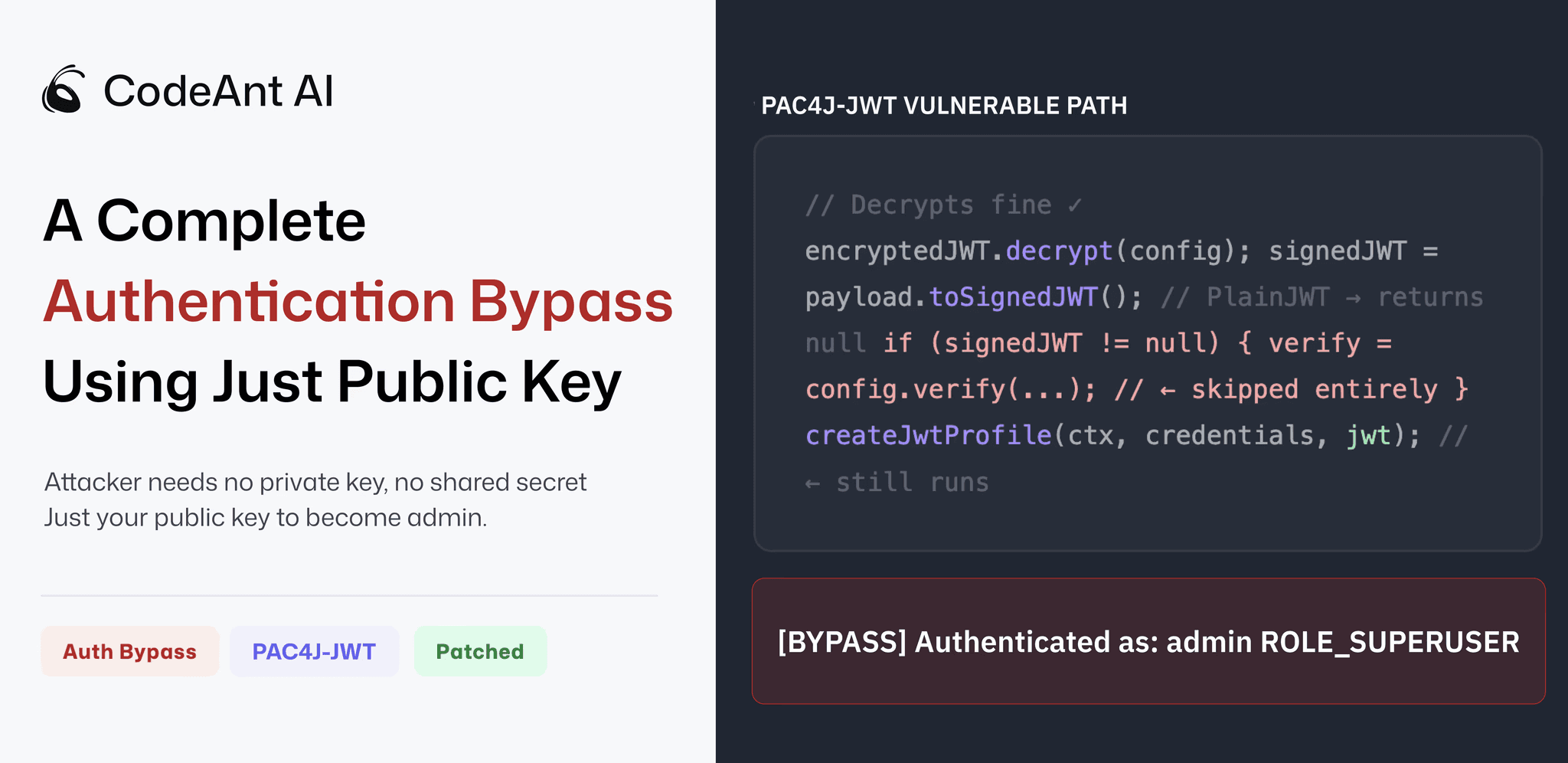
The proof that this produces real results rather than marketing sits in the numbers the platform's agents have generated running against live customer surfaces: 150-plus CVEs discovered in real environments rather than a separate research lab, a CVSS 10.0 maximum-severity flaw in the widely used pac4j library that had sat undetected for six years (CVE-2026-29000), and 2 billion-plus monthly downloads protected as the blast radius of that single upstream finding.
The reporting standard follows from this. Each finding gives a working PoC, a CVSS score with its vector, the exact affected code, remediation guidance, and mapping to the compliance control it satisfies. That is the deliverable an enterprise security team and an auditor both need, and it is covered in the what effective reports deliver requirements.
Feature 6: The Attack-Validate-Learn Loop
An enterprise platform is not a scanner that runs on a schedule, it is a closed loop that gets smarter with every engagement. The loop has five stages, and running it continuously is what compounds the platform's value over time.
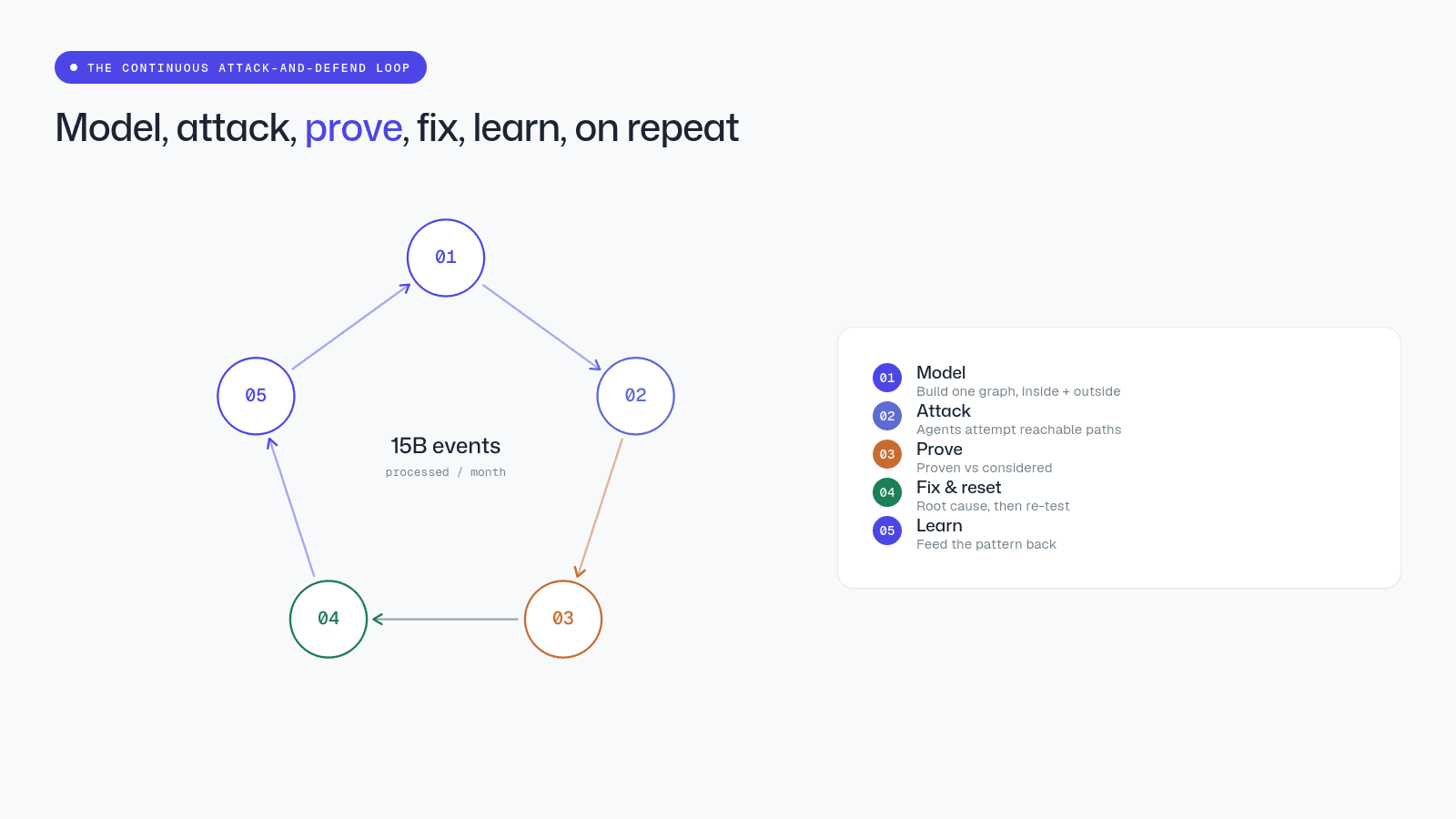
Model. Build the unified graph from internal and external signals, and rebuild it on every change.
Attack. Autonomous agents attempt the reachable attack paths, recording successful attempts, failed attempts, and the controls they encountered.
Prove. A path validated end to end is marked proven and produces a verified attack-path record: the conditions under which it becomes exploitable, the sequence by which it reaches a critical asset, and the proven remediation that permanently closes it.
Fix and reset. The finding is fixed at the root cause, the same path is re-tested to confirm it is closed, and recurrence is prevented.
Learn. The verified pattern is abstracted and fed back into the model, so a later change that reopens the path is caught immediately.
Because the loop records the full testing trail, every call, command, timestamp, and response, an engineer can reproduce any path before fixing it, and an auditor gets evidence of exactly what was tested and when. This is the same continuous attack-and-defend model the penetration testing process guide describes, operationalized as a platform.
Feature 7: Privacy-Safe Intelligence and the Network Effect
At enterprise scale, two requirements sit in tension: a platform should get smarter from everything it sees, and your internal data must never leak to another customer. The enterprise-grade resolution is a privacy-safe abstraction, and it is a genuine differentiating feature.
The model here is precise. A customer's private internal context, code, cloud and IaC, identity and access, runtime, CI/CD, never leaves that customer. What gets shared is only the verified, externally reachable exploit pattern, abstracted so that it removes the customer's data, preserves the graph pattern, and keeps the attack conditions. That abstracted pattern feeds a proprietary attack-path corpus of verified paths, failed attempts, blocking controls, and proven fixes, which is then applied to every other customer.
The effect compounds. When CodeAnt discovers and verifies an externally-reachable exploit pattern in one customer, similar customers are automatically re-scored against it, a verified external pattern that matches their exposure re-scores them without any of the first customer's private data changing hands.
Every new customer adds external exploit intelligence, so the model gets harder for attackers to outrun the longer it runs. Private internal learning stays private, shared exploit intelligence generalizes only the verified internet-reachable patterns, and the network effect compounds. For an enterprise buyer, this is the feature that turns a platform from a static product into one whose defensive value increases over time.
Feature 8: Coverage Across the Full Breach Path, Continuously
The last feature is really the sum of the others: an enterprise platform must cover the entire breach path, not a slice of it, and cover it continuously rather than once. This is the clearest way to separate a platform from the point tools and services around it.
The market splits into recognizable groups, and mapping them shows where the coverage gaps are:
Approach | External surface | Apps and APIs | Code guides attacks | Shipped binaries | Cloud and identity | What it proves |
|---|---|---|---|---|---|---|
AI pentesting (app-focused) | Partial | Continuous | On-demand | No | No | App exploits |
AI pentesting plus AppSec | Continuous | Continuous | Continuous | No | Posture only | App exploits |
Enterprise testing (network) | Continuous | Continuous | No | No | Continuous | Network and identity paths |
Services and PTaaS | One-time, manual across the board | Scoped attack paths | ||||
Continuous | Continuous | Continuous | Continuous | Continuous | Code-to-data path, verified |
The pattern is that most vendors are continuous in some columns and absent in others, and the absent columns are where breaches chain.

A true enterprise platform is continuous across the external surface, the apps and APIs, the code that guides the attacks, the shipped binaries, and the cloud and identity layer, and what it proves is not "app exploits" or "network paths" in isolation but the verified code-to-data path end to end. That completeness is the feature enterprises are actually buying, whether they name it that way or not.
How to Evaluate an Enterprise Pentest Platform
Turn the features into evaluation questions, and the field narrows quickly.
Does it unify internal and external context? Ask to see one graph that connects your code, cloud, and external exposure, not two separate inventories bolted together.
Does it prove attack paths, or just list findings? Require a sample that shows a proven path from exposed surface to critical data, with the proven-versus-considered distinction made explicit.
Is it continuous, and at what cadence? Confirm the model rebuilds on every change, and ask how it handles a new endpoint merged today.
Is it code-aware? For a code-heavy enterprise, a platform that reads source will out-find an external-only one, and its findings arrive with file-and-line precision.
Does every finding carry a working exploit? Ask for a curl PoC in the sample report. No PoC means no proof of exploitability.
How does it handle data privacy and multi-tenant intelligence? Confirm that internal context never leaves your tenant and only abstracted, verified patterns are shared.
Does it cover the full breach path? Check each column of the coverage table above against the platform, and note where it goes dark.
If you are turning this into a formal process, the RFP template and the scope of work guide turn these into scored, sendable requirements, and the hiring guide covers the individual-versus-platform decision.
Stop Buying Slices. Buy the Whole Breach Path.
An enterprise pentest platform earns the name when it does what no point tool can: model your internal and external surface as one graph, prove which attack paths reach critical data, and keep that answer current as you ship. The features that matter, the unified graph, attack-path validation, continuous rebuilding, code awareness, real exploit proof, the attack-validate-learn loop, privacy-safe intelligence, and full-breach-path coverage, all serve that single job. Everything else is a slice.
That is the platform CodeAnt AI is built to be. It sees the company from the inside and the outside, correlates both into one living threat model, continuously attacks it, and proves the code-to-data paths that actually reach your crown jewels, separating what is proven from what is merely considered. Every finding lands with a working PoC and the exact file and line, retests are unlimited, and you pay only when a high or critical is confirmed exploitable. Internal learnings stay private, verified exploit intelligence compounds across customers, and the model gets harder to outrun the longer it runs.
Where to start this week
Take your current security stack and draw the one attack path you most fear, exposed surface to critical data, then check how many separate tools you would have to correlate by hand to see it end to end. That number is the gap an enterprise platform closes. Then run a free code-aware assessment against your highest-risk surface to see a proven, code-to-data attack path next to what your point tools report in isolation.
Run a free code-aware assessment →
Related reading
PTaaS Market 2026: From Annual Audits to Continuous Validation: the market shift the platform category rides
Penetration Testing as a Service (PTaaS): Capabilities, Pros, and Cons: the delivery model behind the platform
Automated Penetration Testing: how the exploit-validation engine runs
How to Write a Penetration Testing RFP: turning platform requirements into a scored evaluation
Continuous vs Annual Penetration Testing: the cadence case at the heart of the platform model

