

Most security teams treat on-premise and cloud penetration testing as a binary choice. Legacy firms for the internal network, cloud platforms for API scanning. That framing quietly misses the actual problem.
Hybrid is the default now. 73% of organizations run hybrid cloud estates, per the Flexera 2026 State of the Cloud Report, and 89% run multi-cloud. The most dangerous attack chains do not respect deployment boundaries. An attacker who compromises a cloud identity does not stop at the cloud perimeter. They pivot to on-premise systems through federated identity, a VPN misconfiguration, or a CI/CD pipeline that bridges both.
So the real question is not which deployment model to test. It is whether your testing can validate attack chains that span both environments and the seams between them. This guide covers the architectural differences, the honest trade-offs, and a decision framework for hybrid penetration testing in 2026.
Why the On-Premise vs Cloud Debate Misses the Point
"Should we do on-premise or cloud penetration testing?" assumes a binary that does not exist for most organizations. If you run hybrid infrastructure, the question is whether your testing can follow an attack chain across environments.
Modern applications do not respect infrastructure boundaries. Your auth service runs in AWS, your customer database on-premise, your API gateway in Azure, your CI/CD in GitHub. Attackers follow the path of least resistance across whatever boundaries you drew.
Here is what breaks when you test each environment in isolation.
Legacy pentesting firms excel at on-premise networks and Active Directory but struggle with cloud-native architecture, testing Kubernetes RBAC with methodologies designed for Windows Server 2008.
Cloud-only scanners enumerate AWS resources and flag misconfigurations but cannot test the VPN tunnel connecting your on-premise ERP to your cloud data warehouse.
The gap between the two tools is exactly where real breaches happen: compromised cloud credentials pivoting into internal networks, or lateral movement from an on-premise jump box into cloud storage.
A real breach that crossed the seam. In late 2023, the Scattered Spider group ran an attack that ReliaQuest observed pivoting from a customer's identity-as-a-service provider to their on-premise assets in under an hour. The chain: social-engineer an IT admin's Okta SSO, complete the MFA prompt on an attacker-registered device, authenticate to Citrix VDI, then move laterally into the on-premise environment across Azure, SharePoint, and vCenter, dumping Active Directory along the way. No single-environment test validates that chain. A cloud scan sees the identity provider. An on-premise engagement sees the AD weakness. Neither one connects them.
Deployment model vs testing capability
The industry conflates two different things, and untangling them removes most of the confusion.
Where the platform runs (on-premise appliance vs SaaS) is about data handling, compliance, and operational overhead.
What the platform can test (on-premise infrastructure, cloud resources, hybrid connections) is about coverage.
These are independent. A cloud-based platform can test on-premise infrastructure with the right network access. An on-premise appliance can test AWS with IAM permissions.
Consideration | On-premise | Cloud / SaaS |
|---|---|---|
Data residency | All scan data stays in your datacenter | Scan data transits to vendor infrastructure |
Compliance | Easier for HIPAA, FedRAMP, classified | Requires vendor SOC 2, ISO 27001 |
Operational overhead | You manage updates, scaling, availability | Vendor handles infrastructure |
Network access | Direct access to internal and air-gapped systems | Requires VPN or bastion for internal testing |
Cost structure | CapEx: upfront license, hardware, maintenance | OpEx: subscription or usage-based |
From point-in-time to continuous
Traditional testing runs on a quarterly cadence: schedule, wait four to eight weeks for the report, remediate, repeat. That model breaks when infrastructure changes continuously. Cloud environments deploy multiple times a day. A pentest from January describes infrastructure that no longer exists in February, and 200 deployments since then have introduced new exposure.
Point-in-time testing decays at deployment velocity. You need continuous validation that runs at CI/CD speed, catching misconfigurations before production and re-testing after every change. The key insight: continuous testing is not about where the platform runs, it is whether it can operate at the speed your infrastructure evolves. We break the cadence question down in Continuous vs Annual Penetration Testing.
On-Premise Testing: When It Is Still the Right Call
On-premise penetration testing deploys scanning infrastructure inside your perimeter, giving full control over data flow and methodology. It genuinely excels in four cases.
Air-gapped and classified networks. Government contractors, defense systems, and critical infrastructure on isolated networks have no alternative. If systems are physically disconnected from the internet, cloud-based platforms are architecturally impossible.
Strict data residency. Healthcare under HIPAA, financial institutions at PCI DSS Level 1, and European entities under GDPR often face constraints that prohibit sending vulnerability data outside the environment, even encrypted.
Deep legacy protocol testing. Mainframes, industrial control systems (ICS/SCADA), and proprietary protocols need specialized tools and manual expertise that cloud-native platforms do not support.
Custom internal applications. HR systems, internal wikis, and custom ERP that live entirely inside the corporate network need testing from inside the perimeter.
The operational cost reality
That control carries overhead that is increasingly hard to justify. Traditional engagements run $15,000 to $50,000 with a four-to-eight-week turnaround, which becomes a bottleneck for teams with multiple business units or frequent releases.
Quarterly snapshots go stale within days if you deploy daily. Every engagement needs scoping calls, access provisioning, firewall rules, and maintenance windows. And global operations mean flying consultants around or juggling separate vendor relationships, neither of which scales.
Where on-premise tools go blind
On-premise tools struggle at architectural boundaries. They cannot test serverless functions, Kubernetes policies, cloud IAM, or API Gateway authorization, so they see your VPN endpoint but cannot follow the path into a Lambda function.
They cannot test SaaS integration points like OAuth flows into Salesforce or Auth0. They operate against running systems, so they cannot validate a Terraform or CloudFormation config before it ships. And they test one side of a boundary while cloud tools test the other, so neither validates the connection between them.
Cloud Penetration Testing: Speed, Scale, and Trade-offs
Cloud platforms are purpose-built for modern architecture but operate in a different security model.
They excel at continuous validation and asset discovery, finding new EC2 instances, Lambda functions, and S3 buckets as they deploy without manual scoping. They test REST, GraphQL, and gRPC APIs with real authentication flows and trace requests across service boundaries.
They scan infrastructure-as-code before deployment, catching misconfigurations in Terraform, CloudFormation, and Kubernetes manifests during CI/CD. And they map IAM relationships to surface over-permissive roles, cross-account trust, and privilege escalation paths. Our cloud penetration testing guide for AWS, Azure, and GCP walks through the platform-specific techniques.
The shared responsibility reality
Cloud providers secure the infrastructure, the datacenters, hypervisors, and network fabric. Customers own everything built on top. That split is where most failures live: in its Innovation Insight for Cloud Security Posture Management, Gartner projected that at least 99% of cloud security failures would be the customer's fault, driven by misconfiguration rather than provider flaws.
The shared responsibility model also shapes what you can test. Providers impose strict rules: no port scanning outside your own infrastructure, no DNS zone walking, no DDoS testing. MFA and SSO integration create testing friction, since a platform has to handle conditional access without triggering lockouts. API rate limits cap thoroughness. And WAFs (AWS WAF, Cloudflare, Imperva) block common attack patterns, so a scanner firing thousands of requests cannot always tell whether a vulnerability is exploitable or just blocked.
The false positive problem
The bigger practical issue is not what cloud platforms test, it is how they report. Automated scanners generate thousands of alerts, most without exploitability context.
Finding type | Typical volume | Actually exploitable | Business impact |
|---|---|---|---|
Misconfigured S3 buckets | 100 to 500 per scan | 15 to 20% truly public | High if exploitable |
Over-permissive IAM | 500 to 2,000 per account | 5 to 10% enable escalation | Critical if chained |
Container vulnerabilities | 1,000 to 5,000 per cluster | 2 to 5% remotely exploitable | Varies widely |
API security issues | 200 to 800 per app | 10 to 15% lead to data exposure | High for IDOR/BOLA |
When a team gets 3,000 findings and has to manually triage which 50 matter, testing becomes a bottleneck instead of an accelerator.
Hybrid Testing: Validating Cross-Environment Attack Chains
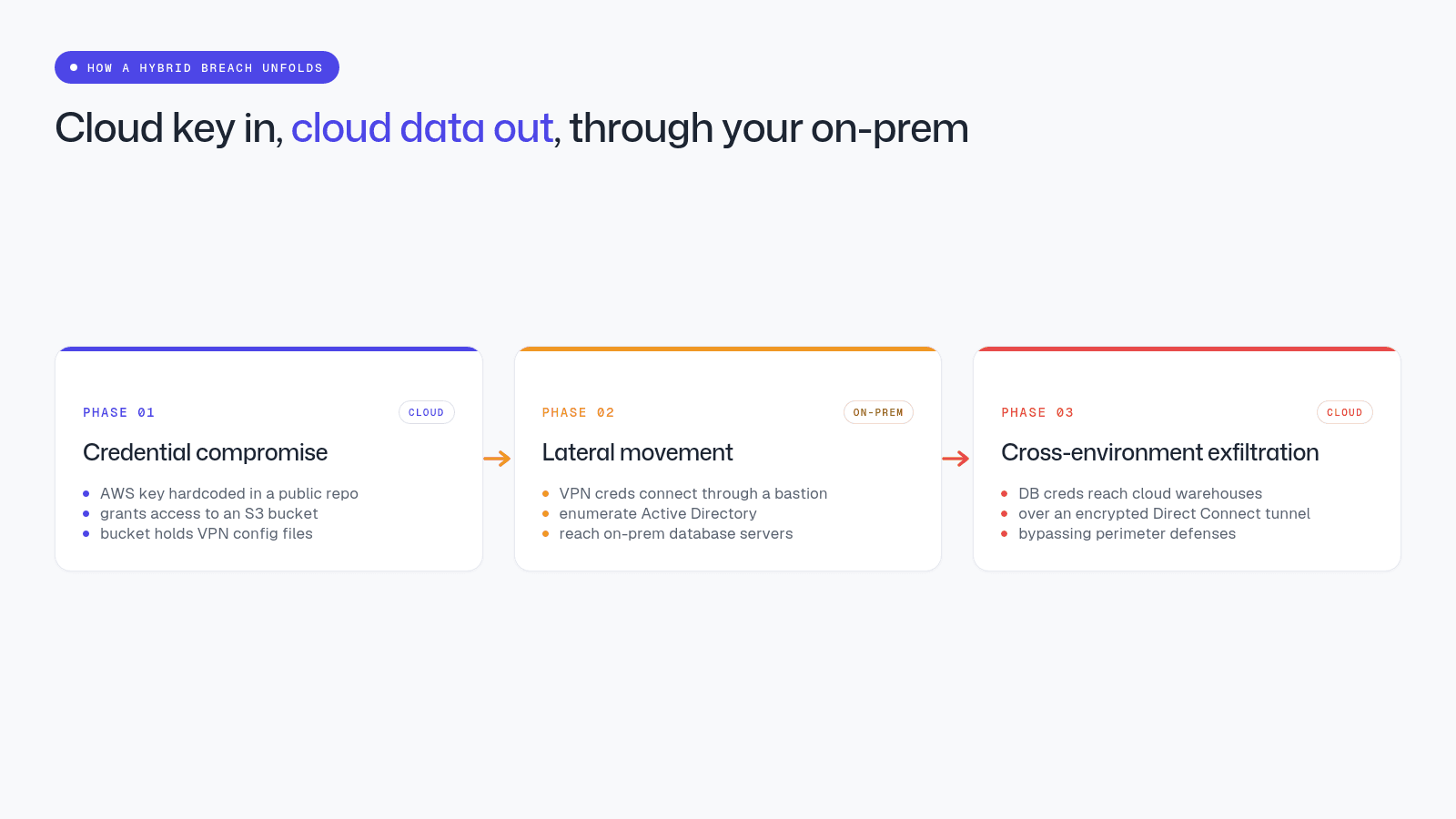
The most dangerous vulnerabilities live at the intersections, where an attacker pivots between cloud and on-premise. A real hybrid breach unfolds in three phases.
Phase 1, cloud credential compromise. The attacker finds AWS credentials hardcoded in a public GitHub repo, granting access to an S3 bucket that holds VPN configuration files.
Phase 2, lateral movement to on-premise. Using the VPN credentials from S3, they connect to the internal network through a bastion host, enumerate Active Directory, identify privileged service accounts, and move to on-premise database servers.
Phase 3, exfiltration across environments. Compromised on-premise database credentials reach cloud data warehouses over Direct Connect, exfiltrating data through an encrypted tunnel that bypasses perimeter defenses.
Traditional approaches miss this entirely. A cloud scan flags the exposed S3 bucket but never tests whether the VPN credentials work. An on-premise engagement finds the weak AD but never discovers the cloud entry point.
The correlation gap
Testing environments with different tools creates a correlation problem that is structural, not incidental.
Exposed CI/CD runners in cloud may reach on-premise artifact repositories, but cloud scanners do not test internal connectivity.
Misconfigured identity federation between Azure AD and on-premise Active Directory creates escalation paths neither tool maps fully.
Shared secrets in build logs bridge environments, but point-in-time scans miss the window when those secrets are valid.
Shadow SaaS integrated via OAuth may hold excessive permissions to both cloud storage and on-premise file shares.
Each tool ships a separate report with its own severity ratings. No single view shows how findings chain. A "Medium" cloud finding (exposed S3 bucket) plus a "Low" on-premise finding (weak VPN) becomes "Critical" when tested as one chain.
CI/CD pipelines: the ultimate bridge
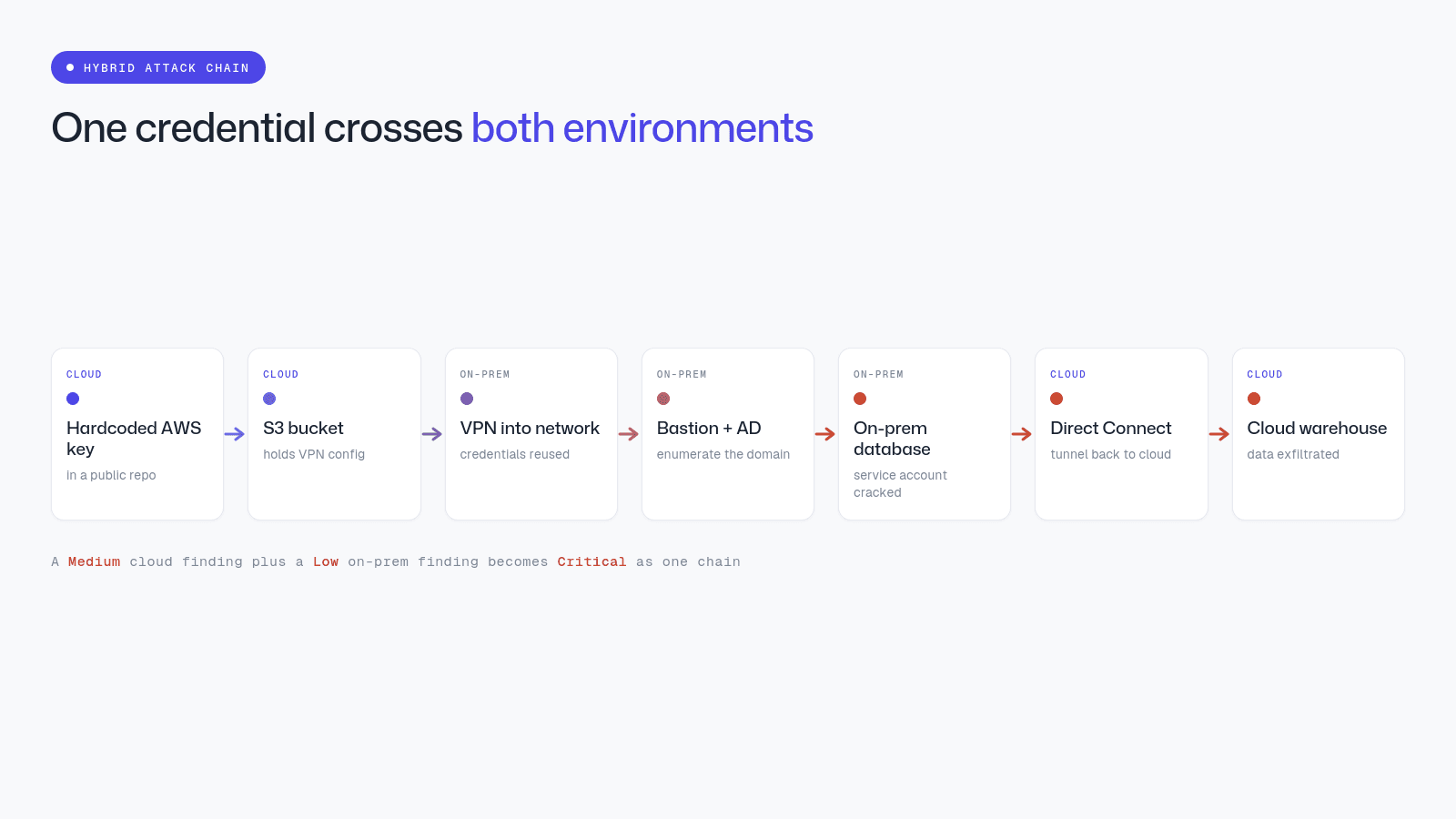
Your CI/CD infrastructure is the hybrid attack surface attackers love. Build runners routinely hold cloud IAM roles that deploy across multiple accounts, on-premise credentials for internal repositories and databases, secrets used in both environments, and network access to public cloud and internal corporate networks at once.
A compromised runner becomes a pivot point. Yet traditional testing treats CI/CD as either cloud (if AWS-hosted) or on-premise (if self-hosted), missing that the pipeline itself is the bridge.
Code-Aware Gray Box Testing: The Missing Layer
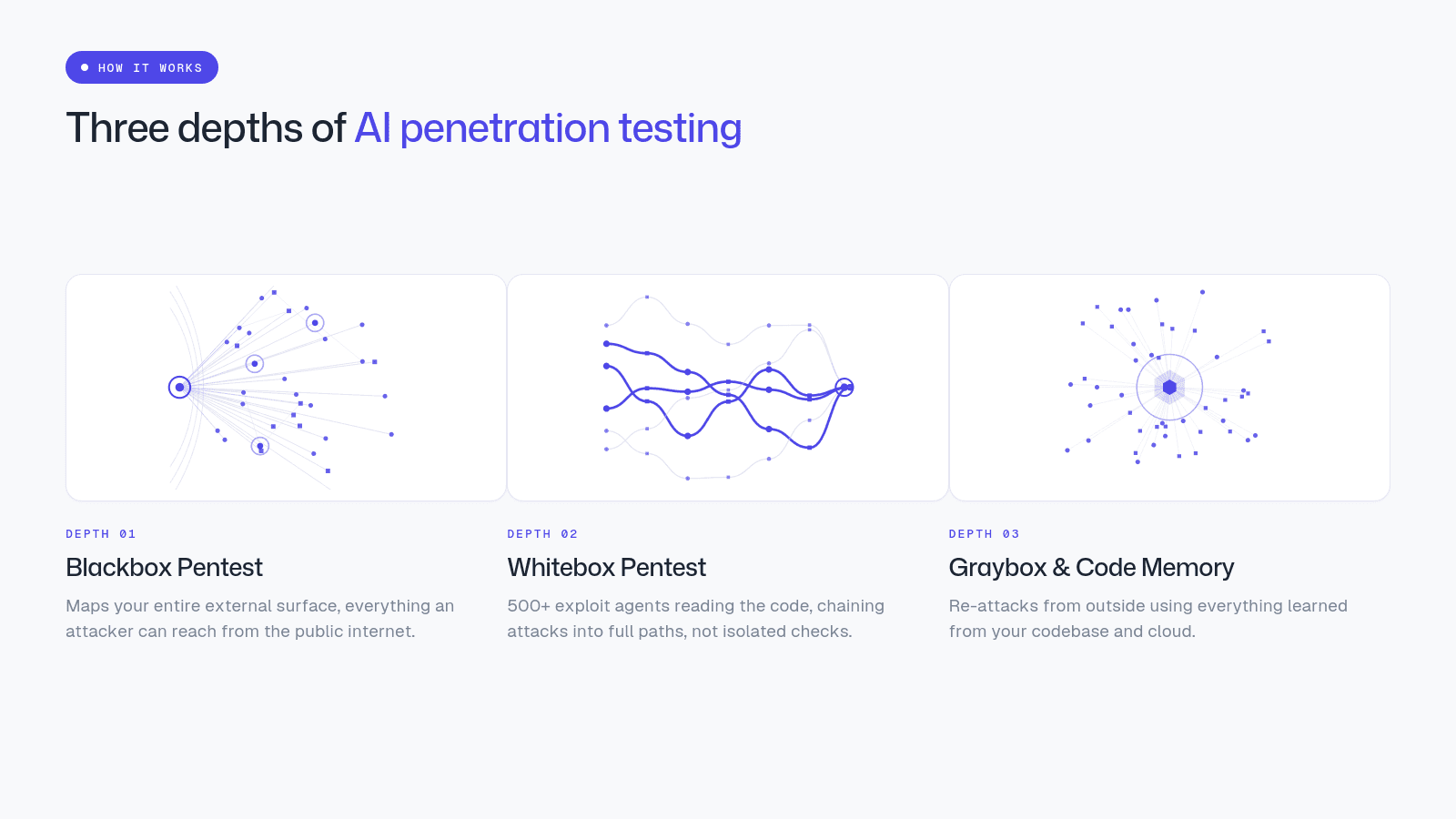
Most testing operates in extremes: pure black box (external attacker, zero knowledge) or pure white box (full source access, often manual review). Both miss where real attackers operate. Gray box combines outside-in attack behavior with inside code intelligence, and we cover all three depths in Black Box vs White Box vs Gray Box Penetration Testing.
Why black box and white box leave gaps. Black box simulates an external attacker with no internal knowledge. It cannot distinguish a real vulnerability from a false positive without understanding code logic, so it flags a potential IDOR on /api/users/{userId}, sees that userId=124 returns different data, but cannot tell whether an authorization check actually blocks exploitation. White box (SAST) analyzes source for patterns but lacks the attacker's perspective, flagging eval(userInput) without knowing whether userInput is reachable from an unauthenticated endpoint.
Gray box combines both: testing from outside like an attacker, with inside code knowledge to guide exploitation depth and eliminate false positives.
Tracing user input to a dangerous sink.
Gray box knows this is direct SQL injection by tracing request.args.get('query') to unsanitized concatenation to db.execute(). It does not waste time testing parameters that are properly sanitized.
Understanding authorization checks.
Gray box sees the authenticate middleware exists but no ownership check, then crafts the targeted exploit: authenticate as User A, request User B's document, confirm unauthorized access. This is the IDOR pattern, and code context is what separates a real finding from noise.
Decision Framework: Choosing Your Approach
Match the approach to your architecture, your compliance load, and your release velocity.
Pure on-premise (a small minority of organizations): air-gapped networks, classified systems, strict data sovereignty. Traditional firms with on-site teams remain the standard. Trade-off: four-to-eight-week turnaround, $15k to $50k per engagement, point-in-time snapshots.
Hybrid architecture (the majority of enterprises): on-premise plus AWS/Azure/GCP, VPN-connected, SaaS integrations. You need unified testing across both environments and the connections between them, validating lateral movement from a cloud credential compromise into internal networks.
Cloud-native: Kubernetes, serverless, microservices, API-first, infrastructure-as-code. You need continuous validation integrated with CI/CD, testing API security, IAM policies, container security, and IaC before deploy.
On compliance, the deployment model matters less than the evidence. SOC 2 Type II cares about evidence quality (working PoC exploits, CVSS scoring, audit logs). ISO 27001 requires regular testing of both external and internal surfaces with attack-chain validation.
PCI DSS requires quarterly external scans plus annual pentests and segmentation testing across the cardholder data boundary, which often spans both environments. HIPAA's data residency may mandate on-premise deployment, and gray-box testing that validates application-layer security without exfiltrating PHI fits that constraint well.
Capability | Traditional firms | Cloud scanners | Unified gray-box platforms |
|---|---|---|---|
Deployment flexibility | On-site only | Cloud/SaaS | Cloud or on-premise |
Testing depth | Manual, deep | Automated infra | Code-aware, exploit validation |
Speed | 4 to 8 weeks | Hours to days | 24 to 48 hours |
Hybrid support | Separate engagements | Limited | Unified across environments |
Code intelligence | No | No | Yes (gray box) |
CI/CD integration | No | Yes | Native (IDE/CLI/CI/CD) |
Retesting | New engagement | Subscription | Unlimited, no extra cost |
Attack-chain validation | Manual | Limited | AI-driven chain construction |
How CodeAnt AI Tests Across the Seam

Most tooling stops at one environment or one layer. CodeAnt AI runs as a unified platform handling both defensive security (code review) and offensive security (penetration testing) from the same code intelligence, which is what lets it follow a chain the whole way across.
The defensive layer integrates from the IDE through CI/CD and reviews every pull request for insecure patterns and misconfigurations before merge. The offensive layer runs autonomous testing against your public exposure, enumerating subdomains, analyzing JavaScript bundles, tracing data flows, and attacking authenticated flows.
The differentiator is that the same code intelligence reviewing your pull requests makes the offensive testing deeper than any external-only platform. It tests from outside with inside knowledge of your codebase, the gray-box approach that pure black box or white box testing miss.
Testing capability | Traditional pentest | Cloud-only tools | CodeAnt AI |
|---|---|---|---|
On-premise applications | Yes (manual, slow) | Limited | Yes (automated) |
Cloud-native services | Limited | Infrastructure focus | Code plus infra |
Hybrid attack chains | Separate engagements | Visibility gaps | Unified view |
Code-level analysis | Black box only | Config scanning | Gray-box depth |
Continuous validation | Point-in-time | Scheduled scans | CI/CD integrated |
On pricing, the model matches the technical claim. Low and medium findings are free. You pay only when a high or critical is confirmed exploitable with a working PoC, which strips out the false-positive noise, and unlimited re-scans after every fix confirm the vulnerability stays closed with no per-retest fee.
Stop Testing Two Halves of One Attack Surface
The on-premise vs cloud debate is a false binary. Your architecture is hybrid, your attack surface spans both, and the most dangerous vulnerabilities live at the seams where a cloud credential becomes on-premise domain admin. The right approach validates security across the entire infrastructure, understands how code creates exploitable paths, and runs at the speed your team ships.
That is what CodeAnt AI is built for. The same code intelligence that reviews your pull requests drives adversarial testing against your production infrastructure, so it can follow a chain from a hardcoded cloud key to an on-premise database without handing you two disconnected reports. It confirms findings with a working PoC, maps them to the exact file and line, and re-scans unlimited times after every fix.
Where to start this week
Pick the one connection that bridges your two environments most directly, usually the CI/CD runner or the VPN tunnel between cloud and on-premise, and trace what a single compromised credential on either side could reach on the other. Then run a code-aware scan that tests that path end to end rather than each half separately. Low and medium findings come back free, and you only pay if there is a confirmed, exploitable high or critical behind them.
Run a free cross-environment pentest →
Related reading
Guide to Cloud Pentesting: AWS, Azure, and GCP: the platform-specific techniques for the cloud half of your estate
Internal Penetration Testing: What It Validates After Your Perimeter Fails: the assumed-breach layer for the on-premise half
External Penetration Testing: What It Covers and What It Misses: the perimeter view and the six gaps it leaves open
Black Box vs White Box vs Gray Box Penetration Testing: which testing depth each part of your architecture needs
Continuous vs Annual Penetration Testing: why cadence beats depth when infrastructure changes daily

