

If you’re searching for BreachLock alternatives, you may run into a category problem: BreachLock is difficult to replace with one product because it combines four jobs: Attack Surface Management, autonomous Adversarial Exposure Validation, human-led Penetration Testing as a Service, and red-team services.
That breadth is useful when one security team owns the entire offensive-security program. But that same breadth can also become the reason to look elsewhere.
An application team may want source-aware testing rather than another enterprise ASM. A network team may need unlimited internal attack-path validation. A compliance team may care most about a named human pentester and a predictable report.
TL;DR
CodeAnt AI is the best BreachLock alternative for code-aware application penetration testing and developer remediation.
Pentera and NodeZero are stronger alternatives for continuous penetration testing across infrastructure and identity.
NetSPI is the closest broad enterprise competitor across PTaaS, ASM, and security validation.
Cobalt and Synack fit teams prioritizing human-led penetration testing providers.
XBOW is a focused alternative for autonomous web and API exploitation.
This guide compares ten credible BreachLock competitors and penetration testing companies by testing model, target coverage, human involvement, pricing visibility, and operational fit. It does not treat every vulnerability scanner listed on a software marketplace as an equivalent replacement.
Best BreachLock Alternatives at a Glance
BreachLock alternative | Best for | Testing model | Public pricing signal | Main trade-off |
|---|---|---|---|---|
CodeAnt AI | Code-aware application pentesting | Autonomous AI plus source analysis | Free URL scan; outcome-based paid findings | Not a broad internal-network or red-team platform |
Pentera | Enterprise-wide continuous validation | Automated security validation | Quote-only; enterprise pricing | Larger deployment and budget |
Horizon3.ai NodeZero | Internal network, AD, cloud, and identity attack paths | Autonomous pentesting | Quote-only | Limited code and application-development context |
NetSPI | Broad enterprise PTaaS | Human experts plus platform and automation | Quote-only | Sales-led enterprise purchase |
Cobalt | Collaborative human application pentesting | Vetted human pentesters plus automation | $3,500 autonomous test; human plans quote-only | Credit-based human scope |
Synack | Vetted researcher coverage and federal buyers | AI discovery plus human validation | Starts at $4,181 plus required platform fee | Credits expire and total platform cost is not public |
XBOW | Autonomous web and API exploitation | Multi-agent autonomous pentesting | Quote-only; historical on-demand start was $4,000 | Web and API focus |
Compliance-friendly application pentesting | Scanner plus human expert tiers | $1,999 Auto; $5,999 Expert per target/year | Less broad infrastructure validation | |
Pentest-Tools.com | Self-serve offensive tooling | Deterministic scanners, automation, and optional humans | Free edition; web pentest from $3,400 | More operator-driven than a unified AEV program |
Continuous exposure scanning and fast AI web pentests | Scanning plus AI white-box pentesting | $3,500 subscriber; $4,000 one-off per test | Narrower offensive-security breadth |
Why Look for a BreachLock Alternative?
The BreachLock platform is strongest when a buyer wants discovery, exploit validation, human testing, remediation, and reporting under one vendor.
There are three common buying problems can still make an alternative a better fit.
BreachLock does not publish current list pricing. Its autonomous AEV subscription is based on contracted IPs and URLs, PTaaS is scoped as an engagement, and red teaming requires a custom proposal. That makes an accurate budget dependent on a sales process. Our BreachLock pricing guide separates current quote-only products from older public package figures.
Breadth can create overlap. A company that already owns an attack surface management platform may not want to buy ASM again just to access autonomous testing. A development team with one customer-facing SaaS application may prefer a product built around repositories, pull requests, and developer remediation.
Testing models are not interchangeable. BreachLock AEV is autonomous. BreachLock PTaaS is human-led. A red-team exercise tests detection and response across people and process. Buyers should not compare a basic scanner with a manual pentest simply because both return a vulnerability report. The differences are clearer in our SaaS pentesting-model comparison.
Use the missing capability as the search criterion:
Choose application and code context when developers own remediation.
Choose internal attack-path coverage when identity, endpoints, and lateral movement drive risk.
Choose human PTaaS when an auditor, customer, or complex business workflow requires expert judgment.
Choose self-serve scanning when coverage and budget matter more than deep exploitation.
Choose a broad platform only when consolidation is a real operational goal.
1. CodeAnt AI: Best for Code-Aware Application Pentesting
Description
CodeAnt AI is the strongest BreachLock alternative for software teams that want the pentest connected to how an application is built.
That creates a different feedback loop from BreachLock. BreachLock starts with the enterprise attack surface and moves from discovery to AEV or a human engagement. CodeAnt starts with the application and repository, then connects exploit evidence to the code a developer can change.
Key features
Black-box, gray-box, and white-box testing for web applications and APIs
Autonomous application mapping, attack generation, and a validated working proof of concept
Source-aware findings and developer-ready remediation
AI code review, SAST, SCA, secret scanning, and IaC security
Pull-request quality gates, reports within 48 hours, and unlimited free rescans
Pros
Strong application and source-code context
Findings fit directly into engineering and pull-request workflows
A live target can be evaluated before a large contract
Outcome-based purchasing aligns spend with demonstrated risk
Cons
It is not a direct replacement for BreachLock RTaaS or broad external ASM
It is not designed for autonomous lateral movement across a large internal Windows estate
Teams seeking a traditional named human pentester may prefer a PTaaS provider
Pricing
CodeAnt AI pricing is easy to test before procurement. A team can enter one public URL for free. Low- and medium-severity findings are visible at no charge; high- and critical-severity issues require payment to unlock. CodeAnt advertises no engagement fee, payment only for a working proof of concept, a report within 48 hours, and unlimited free rescans.
Verdict
Choose CodeAnt AI when web applications and APIs are the primary targets, source context will improve remediation, and paying for demonstrated outcomes fits better than licensing asset capacity. The CodeAnt AI vs BreachLock comparison explains the boundary in detail, while our AI pentesting methodology guide shows what a complete application test should cover.
2. Pentera: Best for Enterprise-Wide Automated Security Validation
Description
Pentera is a strong BreachLock AEV alternative for enterprises that want continuous, automated validation across internal networks, external assets, cloud environments, credentials, and security controls.
Pentera and BreachLock overlap in continuous exploit-driven validation, but their centers of gravity differ. Pentera is primarily a technology platform for automated security validation. BreachLock combines its AEV engine with in-house PTaaS and red-team services in the same commercial platform.
Key features
Agentless automated security validation
Safe attacker emulation, exploit chaining, and reachable attack-path proof
Internal, external, cloud, ransomware-resilience, and credential-risk modules
Repeatable testing and remediation validation across enterprise environments
Pros
Broad infrastructure and security-control coverage
Strong internal attack-path and credential validation
Repeatable testing across complex environments
Well suited to mature security operations teams
Cons
Quote-only, enterprise-oriented purchase
Deployment, licensing, and operation can require a larger budget and team
Human pentesting is not included in every platform test
It does not provide a developer-first source-code security workflow
Pricing
Pentera does not publish simple self-serve prices. Enterprise pricing varies with assets and licensed modules. A previously public UK government rate card placed named packages from £63,750 to £175,000 per year, but that is historical procurement context rather than a universal quote. See our detailed Pentera pricing guide for the pricing model, cost drivers, and buyer benchmarks.
Verdict
Choose Pentera when infrastructure and control validation are the main goals, internal attack paths matter more than source code, and the organization can operate an enterprise platform. Read our Pentera vs CodeAnt AI comparison for the application-versus-infrastructure split, then review Pentera features and the best Pentera alternatives.
3. Horizon3.ai NodeZero: Best for Internal Attack Paths
Description
Horizon3.ai NodeZero is built around autonomous pentesting of networks, Active Directory, cloud environments, Kubernetes, endpoints, and identity systems.
This makes NodeZero a practical BreachLock AEV competitor for internal validation. Both products aim to replace theoretical vulnerability lists with proof of what an attacker can reach. BreachLock has the broader service layer through PTaaS, ASM, and RTaaS; NodeZero has a particularly clear identity as a self-operated autonomous pentesting platform.
Key features
Autonomous testing across networks, Active Directory, cloud, Kubernetes, endpoints, and identity
Environment enumeration and exploitation of reachable weaknesses
Credential and misconfiguration chaining with visual attack paths
Repeatable testing and one-click verification after remediation
Pros
Excellent fit for internal attack paths and identity risk
Proof-based findings reduce theoretical vulnerability noise
Security teams can run repeated tests without scheduling a consultant
Clear autonomous platform model
Cons
No source-code or pull-request security workflow
Human PTaaS is a separate procurement decision
It lacks BreachLock’s combined ASM, PTaaS, and red-team service breadth
Pricing is not public
Pricing
NodeZero uses quote-based pricing. Buyer-reported marketplace data has put a median contract near $18,600, but environment size, modules, and negotiated terms can move the number substantially. Treat that as a planning signal, not a vendor quote. Our NodeZero pricing guide explains the contract model and cost benchmarks.
Verdict
Choose NodeZero when Active Directory and credential attack paths are central, security teams want repeatable internal tests, and one-click verification matters. Our CodeAnt AI vs NodeZero guide shows where application and infrastructure layers meet. For more detail, see NodeZero features and NodeZero alternatives.
4. NetSPI: Best Broad Enterprise Replacement
Description
NetSPI is the closest one-vendor alternative to the broader BreachLock platform.
This is a credible replacement when an enterprise values service depth and tester expertise more than autonomous speed. It is also appropriate when one provider must handle many target types across a global program.
Key features
Human-led PTaaS, attack surface management, breach and attack simulation, and continuous pentesting
More than 50 pentest types with live reporting and remediation workflows
Web, mobile, API, network, cloud, thick client, IoT, social engineering, and red-team assessments
External asset discovery plus continuous cloud testing
Pros
Broad human service depth and specialist coverage
One platform can consolidate ASM, PTaaS, and validation
Strong collaboration, trend reporting, and remediation management
Appropriate for complex global enterprise programs
Cons
Consultative, sales-led procurement
No public rate card
Autonomous speed is less central than expert-led service delivery
A narrow application-testing team may pay for breadth it does not use
Pricing
NetSPI pricing is quote-only. Scope, test type, frequency, asset count, and expert time all affect the proposal. NetSPI does not publish an individual rate card, so the vendor’s contact and quote page is the direct pricing path.
Verdict
Choose NetSPI when human expertise is non-negotiable, the program spans many technologies, and ASM, PTaaS, and validation need one system of record. Choose a narrower alternative when the team only needs one web application pentest or immediate autonomous testing. Its breadth creates value only when the organization will use it.
5. Cobalt: Best for Collaborative Human PTaaS
Description
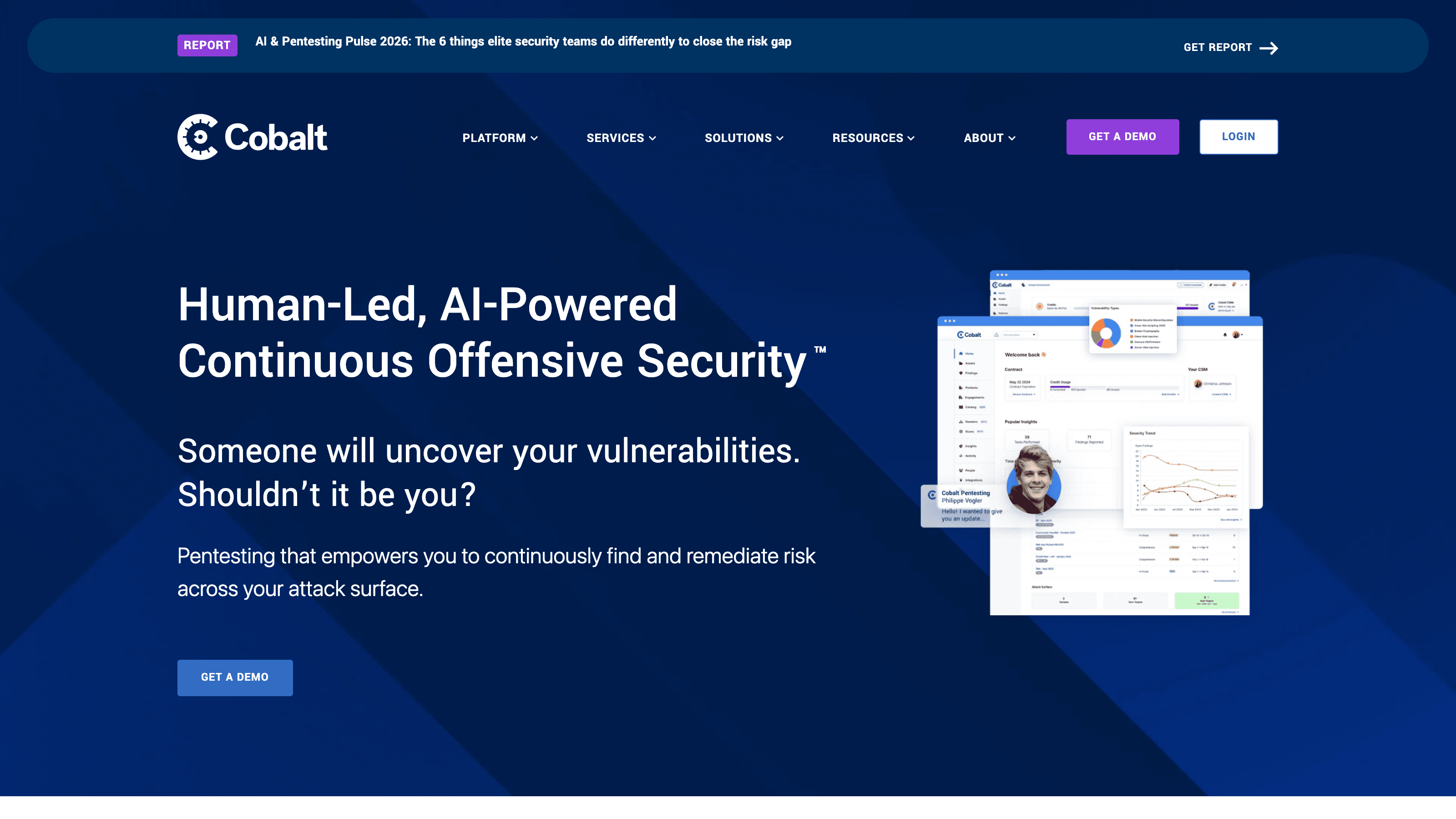
Cobalt is a focused BreachLock PTaaS alternative for teams that want to launch and manage human pentests through a modern platform.
Key features
Cobalt Core for scoping, scheduling, communication, findings, remediation, retesting, and reports
Vetted pentester community covering web, API, mobile, cloud, and network targets
Findings delivered during the engagement
Credit-based human pentest capacity and an autonomous pentest option
Pros
Collaborative human-led testing workflow
Developers get findings before the final report
Credit pools can distribute tests across teams and target types
Strong fit for application and cloud pentesting
Cons
Human delivery relies on a vetted community rather than only in-house testers
Credit mapping, expiry, retesting, and unused capacity require scrutiny
Broader ASM and autonomous infrastructure validation are less central than with BreachLock
Most human plans remain quote-only
Pricing
Cobalt’s official pricing page advertises a $3,500 autonomous pentest, while human pentest credit packages and enterprise plans require a quote. Buyers should clarify how credits map to target complexity, duration, retesting, and unused capacity. Our Cobalt pricing guide breaks down those commercial details.
Verdict
Choose Cobalt when a collaborative human pentest is the primary purchase, application and cloud tests dominate the calendar, and developers need direct access to testers. BreachLock has a stronger native ASM-plus-AEV story. The CodeAnt AI vs Cobalt comparison examines autonomous testing versus human PTaaS; also compare Cobalt features and Cobalt alternatives.
6. Synack: Best for Vetted Researcher Coverage
Description
Synack combines Sara, its autonomous red agent, with a vetted global researcher network. The AI expands discovery; human researchers validate issues and submit proof through a controlled testing platform.
That division of labor makes Synack a good alternative when the buyer wants human judgment at scale rather than a purely autonomous report. Synack covers web, host, API, cloud, mobile, and AI or LLM targets. It routes testing through a monitored LaunchPoint VPN and has FedRAMP Moderate authorization, which makes it particularly relevant to U.S. federal and regulated buyers.
Key features
Sara autonomous discovery plus human researcher validation
Web, host, API, cloud, mobile, and AI or LLM target coverage
Vetted global researcher network
Controlled testing through a monitored LaunchPoint VPN
FedRAMP Moderate authorization
Pros
Human judgment scales across a global researcher community
Strong fit for federal and regulated procurement
Broad target coverage and proof-based findings
Public starting prices offer an initial budget anchor
Cons
The required platform is a separate, unpriced line item
Testing credits expire one year after purchase
Sara centers on external web and host assets
No source-code review or unified AppSec stack
Pricing
Synack’s pricing page lists Sara Pentest from $4,181, SynackST from $10,283, and Synack14 from $27,120. Those figures do not equal total cost: testing credits expire after one year, and the required Synack Platform is a separate line item with no public price. See our Synack pricing guide before normalizing a quote.
Verdict
Choose Synack when vetted human researchers are part of the control requirement, federal authorization affects procurement, or flexible researcher coverage matters more than one consultancy. Our CodeAnt AI vs Synack comparison covers the architecture and cost model. Continue with Synack features and Synack alternatives.
7. XBOW: Best for Autonomous Web and API Exploitation
Description
XBOW is an autonomous AI pentesting platform for web applications and APIs.
This overlaps with BreachLock AEV on autonomous web testing, but XBOW is narrower. BreachLock also covers network environments, ASM, human PTaaS, and red-team services. XBOW is a cleaner shortlist choice when the target is a web application and autonomous depth is the entire buying question.
Key features
Autonomous application mapping and multi-agent attack execution
Exploit chaining and independent validation before reporting
Credentials, API specifications, and architecture context
Working exploits and developer-ready remediation
Pros
Deep focus on autonomous web and API exploitation
Repeatable tests without a traditional engagement queue
Proof-based results rather than raw scanner alerts
Useful contextual inputs for authenticated and API testing
Cons
Narrower than BreachLock across networks, ASM, mobile, and red teaming
No built-in human PTaaS program
Requires stable authentication and target context for the best coverage
Current pricing is quote-only
Pricing
XBOW currently scopes pricing to the customer environment. A November 2025 company announcement said Pentest On-Demand started at $4,000, but current product pages have moved to quote-based pricing. Treat $4,000 as historical context, not a guaranteed 2026 price. Our XBOW pricing guide tracks the latest public signals and quote factors.
Verdict
Choose XBOW when the target is a public web application or API, continuous autonomous exploitation is the priority, and working proof matters more than human attribution. Look elsewhere for internal network testing, broad asset discovery, or mobile testing. Our CodeAnt AI vs XBOW comparison explains the architectural differences; the XBOW features and XBOW alternatives pages complete the evaluation.
8. Astra Security: Best for Predictable Application Pentest Packages
Description
Astra Security combines an application vulnerability scanner with expert-led penetration testing. It is a practical BreachLock alternative for startups and mid-market teams that need a compliance-friendly web, API, mobile, cloud, or network assessment without buying a broad offensive-security platform.
The trade-off is scope. Astra can deliver a human-reviewed application pentest and compliance evidence, but it is not positioned as a direct equivalent to BreachLock’s combined ASM, agentic network AEV, and RTaaS program.
Key features
Automated application vulnerability scanning
Expert-led web, API, mobile, cloud, and network pentesting
Compliance-ready reports and remediation guidance
Annual per-target plans with retesting
Pros
Clear packaged pricing simplifies early budgeting
Hybrid scanning and human testing fits common compliance needs
Accessible to startups and mid-market teams
Broad application target support
Cons
Not a direct equivalent to BreachLock’s ASM, network AEV, and RTaaS combination
Annual per-target pricing can add up across a large estate
Less depth for enterprise-wide attack-path validation
Enterprise scope is still custom-priced
Pricing
Astra Security’s pricing page lists annual per-target plans. Auto costs $1,999 and centers on automated testing; Expert costs $5,999 and adds manual testing by security professionals. Enterprise scope is custom. Our Astra Security pricing guide explains inclusions, scope limits, and total-cost considerations.
Verdict
Choose Astra when a small number of applications need annual coverage, published pricing matters, and SOC 2, ISO 27001, HIPAA, or customer evidence drives the test. Choose BreachLock, NetSPI, Pentera, or NodeZero when continuous enterprise attack paths are the requirement. Our CodeAnt AI vs Astra Security comparison examines the workflow; also compare Astra Security features and Astra Security alternatives.
9. Pentest-Tools.com: Best Self-Serve Offensive Toolkit
Description
Pentest-Tools.com gives security practitioners a browser-based toolkit for reconnaissance, asset mapping, web and network vulnerability scanning, internal testing, reporting, monitoring, and multi-step automation through Pentest Robots.
Key features
Browser-based reconnaissance, asset mapping, and vulnerability scanning
Web, network, cloud, API, and internal testing
Pentest Robots for multi-step automation
VPN agent, integrations, API access, monitoring, and reporting on paid plans
Optional human web application pentests
Pros
Free edition supports a practical product evaluation
Security teams retain direct control over tools and scans
Published human pentest prices improve budget predictability
Useful combination of reconnaissance, monitoring, and testing utilities
Cons
Requires more operator judgment than BreachLock’s managed model
Buyers assemble the workflow rather than buying one unified AEV program
Scanner automation is not equivalent to full autonomous exploit validation
Large programs may need a separate service and governance layer
Pricing
The Pentest-Tools.com pricing page includes a free edition and paid platform plans. The company’s human web pentests list a black-box test at $3,400, with an expected three-working-day assessment and report on the fourth day. A gray-box test starts at $3,400 plus $900 per user role and takes four or more working days.
Verdict
Choose Pentest-Tools.com when an internal security team wants direct control, monitoring and reconnaissance matter more than managed AEV, and published prices or a free evaluation are valuable. It is a capable toolkit, but the buyer—not the vendor—does more of the work to combine scanning, validation, and human testing into a complete operating model.
10. Intruder: Best for Continuous Scanning Plus Fast AI Pentests
Description
Intruder combines continuous vulnerability management with AI-powered white-box web application pentesting.
Key features
Continuous scanning for external and internal infrastructure, cloud, web applications, APIs, and containers
AI-powered white-box web application pentesting
GitHub and GitLab source context
Audit-ready reports produced in hours
Methodology developed by CREST-certified experts
Pros
Fixed per-test pricing
Fast start without a traditional scoping queue
Combines continuous vulnerability management with application pentesting
Refund promise if an auditor rejects the report
Cons
Narrower than BreachLock across human PTaaS, lateral network validation, ASM, and red teaming
Source context centers on GitHub or GitLab workflows
AI web testing is not a replacement for every complex human engagement
Per-test fees may become costly at high cadence
Pricing
Intruder’s pricing page lists AI pentests at $3,500 per test for platform subscribers and $4,000 for a one-off test. That direct rate makes it easier to budget than a broad annual AEV contract, although teams should still model test frequency and the underlying platform subscription.
Verdict
Choose Intruder when fast audit evidence is the immediate goal, continuous scanning already covers most infrastructure needs, GitHub or GitLab context is sufficient, and fixed per-test pricing is preferable. It is a targeted replacement for web-testing and vulnerability-management needs, not a one-for-one offensive-security platform.
How to Choose the Right BreachLock Competitor
Start with the asset, not the vendor shortlist.
If the risk lives in a SaaS application and remediation belongs to developers, test CodeAnt AI, XBOW, Intruder, or Astra. Ask whether the system reads source code, handles authenticated roles, validates business logic, proves exploitation, and connects the finding to a code change.
If the risk lives in Active Directory, cloud identity, endpoints, and internal network paths, test Pentera or NodeZero. Ask how the platform deploys, what privileges it needs, how it controls destructive actions, and whether it can safely repeat tests after every material change. Our cloud attack-path testing guide provides a useful technical baseline.
If the requirement is a human-signed assessment, compare NetSPI, Cobalt, Synack, Astra, and Pentest-Tools.com. Ask who performs the work, whether testers are employees or community members, how findings are quality-checked, what retesting is included, and whether the report satisfies the specific auditor or customer.
Then normalize price. A low per-test price may exclude the platform fee, additional user roles, internal assets, retesting, or specialist work. An “unlimited” subscription still has a contracted asset boundary. Compare the annual cost for the same targets, test frequency, human hours, reports, integrations, and revalidation rights.
Finally, run a proof of value against a representative target. Seed a known but safe issue, measure time to verified evidence, count false positives, inspect remediation quality, and let the engineers who must fix the result evaluate it. A polished executive dashboard cannot compensate for shallow testing or unusable developer guidance. Use our AI pentest evaluation checklist to make the trial repeatable.
Which BreachLock Alternative Should You Choose?
Choose the smallest platform that fully covers the risk you need to manage.
CodeAnt AI is the best application-focused alternative when source context, developer workflow, and outcome-based pentesting matter. Pentera and NodeZero are the strongest infrastructure-first options for repeated autonomous validation. NetSPI is the closest broad enterprise substitute. Cobalt and Synack are strong when human expertise and collaboration define the purchase. XBOW is compelling for autonomous web and API exploitation. Astra, Pentest-Tools.com, and Intruder offer clearer entry prices for narrower testing programs.
BreachLock remains a sensible choice when one vendor genuinely needs to provide ASM, autonomous AEV, human PTaaS, and red teaming. But do not pay for platform breadth by default. Map the required targets, testing depth, human involvement, report standard, and annual cadence first.
For a direct product decision, read CodeAnt AI vs BreachLock. For commercial planning, use the BreachLock pricing breakdown. For a module-by-module view, see the complete BreachLock features guide. To widen the shortlist beyond these ten, compare the best AI penetration-testing platforms and continuous pentesting tools.
Frequently Asked Questions
What is the best BreachLock alternative?
There is no universal replacement because BreachLock covers several categories. CodeAnt AI is best for code-aware application pentesting, Pentera and NodeZero for continuous infrastructure validation, and NetSPI for broad human-led enterprise PTaaS.
Which BreachLock competitor has transparent pricing?
Intruder publishes $3,500 subscriber and $4,000 one-off AI pentests. Pentest-Tools.com publishes black-box web pentesting at $3,400 and gray-box testing from $3,400 plus $900 per user role. Astra publishes $1,999 Auto and $5,999 Expert annual per-target tiers.
Is there a free alternative to BreachLock?
CodeAnt AI offers a free one-URL scan with low- and medium-severity findings visible, while Pentest-Tools.com offers a free edition for basic mapping and scanning. These help evaluate fit but do not replace a complete enterprise offensive-security program.
Which alternative is best for autonomous penetration testing?
CodeAnt AI and XBOW are application-first. Pentera and NodeZero are infrastructure-first. The right autonomous pentesting platform depends on whether the primary target is source-backed web software or internal networks, identity, cloud, and security controls.
Which alternative is best for PTaaS?
NetSPI provides the closest broad enterprise PTaaS replacement. Cobalt offers a collaborative application-focused model, Synack adds vetted global researchers and federal credentials, and Astra or Pentest-Tools.com provide more accessible packaged web pentests.

