

CodeAnt AI and BreachLock are AI penetration testing platforms that promise something more useful than another vulnerability list: validated evidence that a weakness can actually be exploited. The similarity ends there.
CodeAnt AI starts with the software development lifecycle. Its agents combine black box, white box, and gray box penetration testing with standing knowledge from source-code analysis, AI code review, secret scanning, and the repository history. BreachLock starts with the enterprise attack surface. Its platform combines attack surface management, autonomous adversarial exposure validation, and certified human-led penetration testing as a service.
TL;DR
Choose CodeAnt AI for code-aware web application penetration testing, developer remediation, and continuous testing inside the software-development lifecycle.
Choose BreachLock for autonomous penetration testing across web and network environments, attack surface management, and certified human PTaaS.
The core difference is context: CodeAnt works from source code outward, while BreachLock works from the enterprise attack surface inward.
Here is the practical CodeAnt AI vs BreachLock comparison as of July 2026.
Area | CodeAnt AI | BreachLock |
|---|---|---|
Best for | SaaS and engineering teams that want code-aware AI pentesting inside the development workflow | Security teams building a broader offensive-security and exposure-validation program |
Core model | Unified defensive and offensive application security | ASM, autonomous AEV, and human-led PTaaS in one platform |
Autonomous coverage | Web apps and APIs across black, white, and gray box testing | Web and network environments, with multi-step attack paths and lateral movement |
Source-code context | Full repository context, Git history, SAST, secrets, and PR memory | White box PTaaS is available, but source-code analysis is not the organizing layer of the platform |
Human testing | AI-led exploit validation with remediation evidence | 100% in-house certified pentesters for PTaaS |
Network and AD depth | Not the primary use case | A core strength of AEV and PTaaS |
Reporting | Audit-grade SOC 2 and ISO 27001 report within 48 hours | Technical, executive, and compliance-ready reports in multiple formats |
Retesting | Free unlimited re-scans | Unlimited AEV testing on contracted assets; PTaaS includes one comprehensive manual re-test |
Pricing model | $0 engagement fee; payment when a working high or critical PoC is delivered | Quote-based by scope for PTaaS; AEV priced by contracted IPs or URLs |
Free entry | Free black-box scan for one URL | No self-serve free tier published |
What Is CodeAnt AI?
CodeAnt AI is an agentic code-security and penetration-testing platform built around a shared view of the codebase. The same system that reviews pull requests and runs static application security testing can carry that context into an offensive test.
That matters because a conventional external pentest only sees what the application returns over the network. It can try payloads and observe responses, but it cannot see a missing ownership check inside a controller, a secret removed from the current branch but preserved in Git history, or an authentication middleware exclusion applied to the wrong route.
CodeAnt addresses those gaps with three testing depths:
Black box testing maps publicly reachable applications, endpoints, subdomains, JavaScript bundles, and exposed infrastructure without credentials or code.
Gray box testing uses authenticated roles and code memory to test IDOR, BOLA, privilege escalation, JWT handling, tenant boundaries, and business-logic abuse.
White box testing reads the repository and configuration, traces untrusted input to dangerous sinks, checks Git history, and connects a confirmed exploit to its root cause.
The result is most useful when a developer can act on it. CodeAnt provides working proof-of-concept evidence, file and line context where code is available, remediation guidance, and a report that can be pushed into the team’s workflow. Its AI penetration testing page says an audit-grade SOC 2 or ISO 27001 report is delivered within 48 hours. Teams can also connect software composition analysis, infrastructure-as-code scanning, and an SBOM to the same application-security program.
CodeAnt is not trying to be the broadest internal-network validation platform. It is strongest on SaaS products, web applications, and APIs where the source repository and release workflow are available. If your immediate project is an Active Directory compromise simulation across thousands of endpoints, BreachLock, Pentera, or NodeZero is a more natural shortlist.
What Is BreachLock?
BreachLock is an offensive-security platform with three connected products:
Attack Surface Management (ASM) continuously inventories public-facing domains, subdomains, IPs, services, shadow IT, third-party infrastructure, and dark-web exposures.
Adversarial Exposure Validation (AEV) uses agentic AI to execute multi-step attacks across web and network environments and prove which paths are reachable and exploitable.
Penetration Testing as a Service (PTaaS) brings certified in-house testers into the same platform for high-stakes, complex, or compliance-driven engagements.
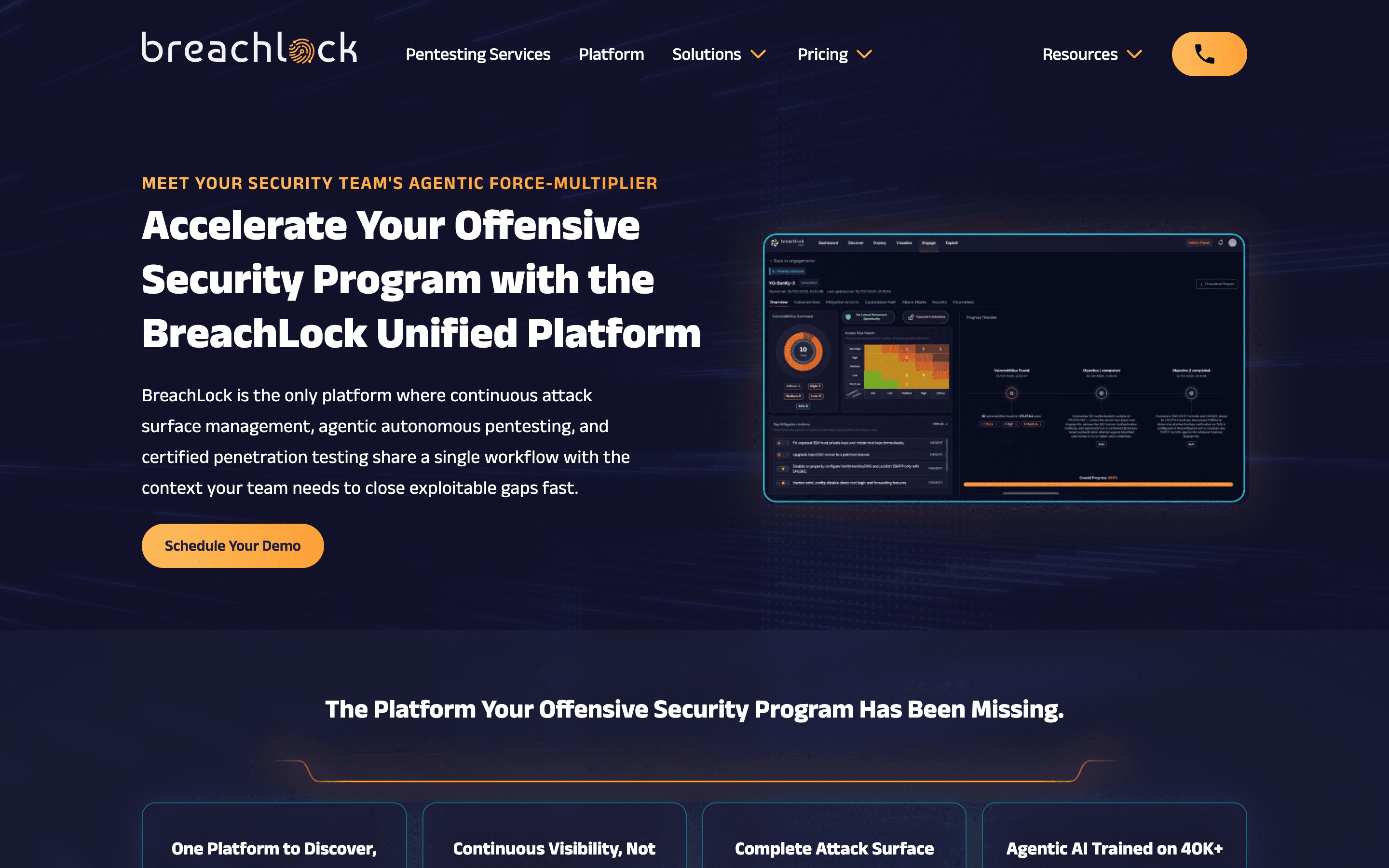
This architecture gives BreachLock a wider operational canvas. ASM finds an unknown asset. AEV tries to exploit it and can pivot or move laterally. PTaaS adds a human tester when business logic, regulatory expectations, or the risk of a live action warrants expert judgment.
BreachLock says its agentic system is trained on intelligence from more than 40,000 real-world penetration-testing engagements. AEV shows the attack path in real time, requires authorization before lateral movement or exploitation, and includes a kill switch. Deployment is agentless through a Linux machine, OVA, or Docker, and the subscription permits unlimited testing on contracted assets.
The human-led side is equally central. BreachLock PTaaS covers web applications, APIs, networks, cloud, mobile apps, IoT, DevOps, and thick clients through black, gray, and white box methods. Its in-house team lists OSCP, OSCE, CREST, CISSP, CEH, GSNA, eJPT, and mobile application security certifications.
In other words, BreachLock is not simply an AI pentesting tool. It is a managed offensive-security program with automation layered through discovery, validation, reporting, and remediation.
CodeAnt AI vs BreachLock: AI Pentesting Architecture
The most important difference is where each platform builds context.
CodeAnt builds context from the codebase outward. BreachLock builds context from the attack surface inward. Our guide to defensive and offensive security explains why mature programs need both views.
Question | CodeAnt AI | BreachLock |
|---|---|---|
What does the platform know before an attack? | Repository structure, source, dependencies, secrets, PR history, code-review findings, and authenticated app roles | External assets, network topology, exposed services, threat intelligence, prior ASM findings, and prior BreachLock tests |
What starts the workflow? | A repository connection, application URL, or pentest request | ASM discovery, an AEV deployment, or a scoped PTaaS engagement |
What does it optimize for? | Finding exploitable application flaws and returning them to developers quickly | Discovering and validating exploitable risk across a broad enterprise surface |
Where does human judgment enter? | Remediation and security-team review around AI-generated evidence | Directly in the PTaaS engagement through assigned certified pentesters |
Neither approach is universally deeper. Depth depends on the target.
For a multi-tenant SaaS API, knowledge of authorization middleware, object ownership, GraphQL resolvers, and old secrets can expose a chain that an external-only system would miss. For an internal environment, the decisive path may run through an exposed service, a credential, Active Directory, a misconfigured segment, and lateral movement. Source code is not the central artifact there.
That is why the right comparison is not “AI versus human.” It is code-centric application security versus attack-surface-centric offensive security.
Which Platform Finds More Application and Business-Logic Risk?
CodeAnt AI has the clearer advantage when source context is available and the target is a modern application.
White box analysis can identify where authentication should have been enforced, trace a user-controlled value across several functions, or discover a credential that was deleted from the current code but remains in repository history. Gray box agents can then test whether those mistakes cross a real user or tenant boundary.
This is particularly useful for:
IDOR and BOLA in REST or GraphQL APIs
JWT verification and privilege-escalation mistakes
tenant-isolation failures
race conditions and workflow bypasses
injection paths spread across several services
leaked secrets and insecure configuration
vulnerable open-source packages that are actually reachable through the application, rather than every dependency listed by an SCA tool
BreachLock also supports white box PTaaS and says AEV tests business logic across both web and network environments. Its certified testers can go deeper manually when a flow depends on domain knowledge or human creativity. The difference is that code analysis, pull-request review, and developer fixes are not BreachLock’s continuous foundation.
If you want a one-time expert to study a complex application, BreachLock PTaaS is credible. If you want the pentest to inherit what the security engine has learned from every merge, CodeAnt’s architecture is better aligned.
Our guide to black box, white box, and gray box penetration testing explains why no single mode gives a complete application-security answer.
Which Platform Is Better for Networks and Enterprise Attack Paths?
BreachLock wins this category.
AEV covers both network and web environments, performs reconnaissance, validates exploitability, pivots between systems, and models lateral movement. This makes it closer to autonomous network penetration testing software than an application-only scanner. ASM continuously finds new public assets and exposed services, so the testing scope can evolve as the environment changes.
The practical advantage is continuity across different offensive-security jobs. A security team can discover an untracked subdomain, validate a path into the environment, view the chain in the platform, and bring in a certified tester without moving the evidence into a second product.
CodeAnt’s public positioning is far more application-centric. It can map a public application and its reachable services, but it is not sold as an Active Directory, segmentation, internal-network, endpoint, or broad cloud attack-path validation platform.
Choose BreachLock when the scope includes:
internal and external networks
enterprise IP ranges
lateral movement and segmentation
cloud infrastructure beyond application code
mobile, IoT, thick-client, or social-engineering projects
red-team or adversarial exposure validation programs
Choose CodeAnt when the scope is primarily the application and the people fixing findings are software engineers.
How Do the Human Testing Models Compare?
BreachLock makes certified human testing a product, not an escalation path.
Every PTaaS engagement includes an in-house testing team, real-time findings in the platform, direct communication with the assigned tester, remediation support, and a comprehensive manual re-test. Critical issues are surfaced while the test is still underway instead of waiting for the final PDF.
This model fits buyers that need:
a named human-led engagement for customer or auditor assurance
specialized manual work on unusual protocols or business processes
certifications such as CREST or OSCP in the delivery story
support for report walkthroughs and remediation questions
a conventional scope, schedule, and statement of work
CodeAnt’s differentiator is machine-speed, code-aware validation. Its public pricing compares a $0 engagement fee with traditional firms charging upfront and ties payment to a working proof-of-concept exploit. The trade-off is that it does not present a large certified human pentester bench as the core deliverable.
For many SaaS teams, that is a feature. They want a verified exploit and a fix within the release cycle, not a consultant calendar. For regulated enterprises and sensitive red-team exercises, the human accountability may be worth the additional scoping and spend.
If you are comparing human-led providers, our CodeAnt AI vs Cobalt PTaaS comparison and CodeAnt AI vs Synack guide cover two different human-testing models in more detail.
How Do Reporting, Compliance, and Retesting Compare?
Both platforms provide evidence that can be used beyond the security team, but BreachLock offers the wider reporting menu.
CodeAnt’s report is designed for three readers: an executive who wants a grade and business impact, an auditor who wants mapped findings, and an engineer who needs proof, root cause, and a remediation path. Its landing page currently promises SOC 2 and ISO 27001 mapping within 48 hours. The AI pentesting compliance guide explains what audit-grade evidence should contain.
BreachLock lets teams generate technical reports, executive summaries, and compliance-ready versions in multiple file formats. Its PTaaS material explicitly maps work to SOC 2, PCI DSS, ISO 27001, HIPAA, GDPR, and other frameworks.
Retest language needs careful reading:
CodeAnt advertises free, unlimited re-scans after a fix.
BreachLock AEV includes unlimited autonomous testing on the IPs or URLs covered by the subscription.
BreachLock PTaaS includes one free comprehensive manual re-test and unlimited online remediation support.
BreachLock’s broader platform page describes unlimited retesting, but that should not be read as unlimited manual tester time under every PTaaS scope.
The operational question is whether the retest happens inside the developer’s release loop. CodeAnt is built for that loop. BreachLock provides more options, but the autonomous and human retest entitlements are different.
Use our pentest retest guide and PTaaS SLA checklist to evaluate any vendor’s evidence, timing, support, and closure rules before signing.
CodeAnt AI vs BreachLock Pricing
The two vendors expose price in very different ways. CodeAnt publishes the mechanics of its application pentest:
$0 engagement fee
a free black-box scan for one URL
low and medium findings remain free
payment is triggered when CodeAnt delivers a working high or critical proof-of-concept
free unlimited re-scans
a report within 48 hours
That does not mean every possible scope has one public flat price. White box and full application assessments require more access and work. It does mean a buyer can start without paying for tester availability before the system has proved value.
BreachLock’s current official pages are quote-based. The PTaaS price depends on environment size, complexity, scope, and testing frequency. AEV is subscription-based and priced by the number of IPs or URLs under contract, with unlimited runs on those assets.
G2 still lists older starting prices of $2,500 for one-time security validation and $5,000 for annual security validation. G2 labels those figures as last updated on October 10, 2024, so they are useful as historical floors, not a reliable 2026 quote for AEV or a complex PTaaS engagement.
Cost question | CodeAnt AI | BreachLock |
|---|---|---|
Can I start without a sales call? | Yes, with a free one-URL black-box scan | No self-serve offer is published |
What drives price? | Confirmed severity and testing depth | PTaaS scope, complexity, frequency; AEV contracted IPs or URLs |
Is testing unlimited? | Unlimited free re-scans | Unlimited AEV testing on contracted assets |
Is human tester time included? | Not the central pricing unit | Yes for scoped PTaaS engagements |
Is a current list price public? | The outcome mechanics are public; complete scopes vary | No, contact sales |
For the complete vendor-specific model, read our BreachLock pricing guide. For broader market benchmarks, see how much penetration testing costs and why PTaaS changes the annual engagement model.
What Do BreachLock Customers Say?
BreachLock has a 4.6 out of 5 rating from 38 G2 reviews at the time of writing. Reviewers repeatedly praise the support team, report quality, remediation detail, and the ability to manage findings and re-tests through one portal.
The criticisms are useful too. Recent reviewers mention that pricing can feel expensive, the interface can be slow or awkward, and false positives can still appear. One reviewer also wanted more customization in reports, while another said it could take a day or two to get an answer about the administration portal.
Those comments fit the product model. BreachLock is closer to a managed program than a lightweight scanner. Buyers get people, broad coverage, and a central platform, but they should test the day-to-day interface and support workflow during procurement.
CodeAnt has a different adoption test. Ask developers whether the findings arrive in the tools they already use, whether the proof is reproducible, and whether the suggested fix survives code review. A sophisticated pentest that sits unread in a security portal has limited value.
Who Should Choose CodeAnt AI?
Choose CodeAnt AI if most of these statements are true:
Your primary assets are SaaS applications, web apps, and APIs.
You can connect the source repository and want white box depth.
IDOR, BOLA, authentication, tenant isolation, and business logic are high-risk categories.
Developers need file-level root cause and remediation context.
You want the pentest connected to SAST, secrets scanning, AI code review, and pull-request quality gates.
A 48-hour evidence cycle is more valuable than booking a multi-week engagement.
You prefer a free entry point and payment tied to a verified high-impact exploit.
The strongest CodeAnt deployment is not “run a scanner before the audit.” It is a continuous loop: review code before merge, validate the running application offensively, fix the root cause in the IDE, and re-test without waiting for the next quarter. Our guide to continuous code-security scanning shows how that loop fits CI/CD.
Who Should Choose BreachLock?
Choose BreachLock if most of these statements are true:
Your attack surface spans web, network, cloud, mobile, IoT, and other enterprise assets.
Continuous asset discovery and shadow-IT visibility matter.
You need autonomous network and web attack-path validation.
Lateral movement, segmentation, and internal exposure are in scope.
Your auditor, customer, or policy expects certified human pentesters.
You want ASM, AEV, PTaaS, remediation, and reporting in one offensive-security platform.
You are comfortable with a scoped sales process and contract-based pricing.
BreachLock is especially compelling for a mature security organization that wants to combine continuous validation with human depth instead of choosing one or the other. See the full BreachLock features breakdown for the module-by-module view, or compare the best BreachLock alternatives if that breadth creates overlap.
Final Verdict: CodeAnt AI or BreachLock?
CodeAnt AI and BreachLock solve adjacent problems, not identical ones.
CodeAnt is the sharper product for application teams. Its differentiator is not simply autonomous testing. It is that the offensive test can use the same code intelligence already watching the repository, then return a validated exploit to the people shipping the fix.
BreachLock is the broader offensive-security platform. ASM discovers the estate, AEV validates web and network attack paths continuously, and PTaaS adds certified people when automation is not enough.
For a SaaS company choosing a penetration-testing platform to sit beside engineering, I would start with CodeAnt AI. Run the free pentest against one application, inspect whether the proof reaches business-logic and authorization risk, and measure how quickly the team closes it.
For a global enterprise choosing a single operating system for attack-surface discovery, autonomous validation, and human testing, BreachLock deserves the demo.
If neither profile is exact, compare the wider field in our guides to the best AI penetration testing platforms, automated pentesting tools for DevSecOps, and continuous pentesting requirements.

