

Manual penetration testing is still the gold standard for depth. A skilled human finds the business-logic flaws, the chained exploits, and the novel vulnerabilities that no scanner has a signature for. None of that is in question. What is in question is whether a test that happens once, or a few times a year, can secure software that changes every day.
It cannot, and the gap is widening. Your team ships continuously. Your codebase in December is not the codebase your annual pentest validated in March. Every merged pull request, dependency bump, and infrastructure change is attack surface that the last engagement never saw and the next one will not see for months. The problem is not that manual testing is weak. It is that a point-in-time test and a continuous delivery pipeline are fundamentally mismatched in cadence.
This guide makes the case plainly: why manual penetration testing alone leaves you exposed in 2026, where the specific gaps are, and why the answer is not to abandon manual testing but to pair it with continuous validation. It is written for teams who value the depth of a human tester and need to understand why that depth, on its own, is no longer sufficient.
The Core Problem: A Snapshot Cannot Secure a Stream
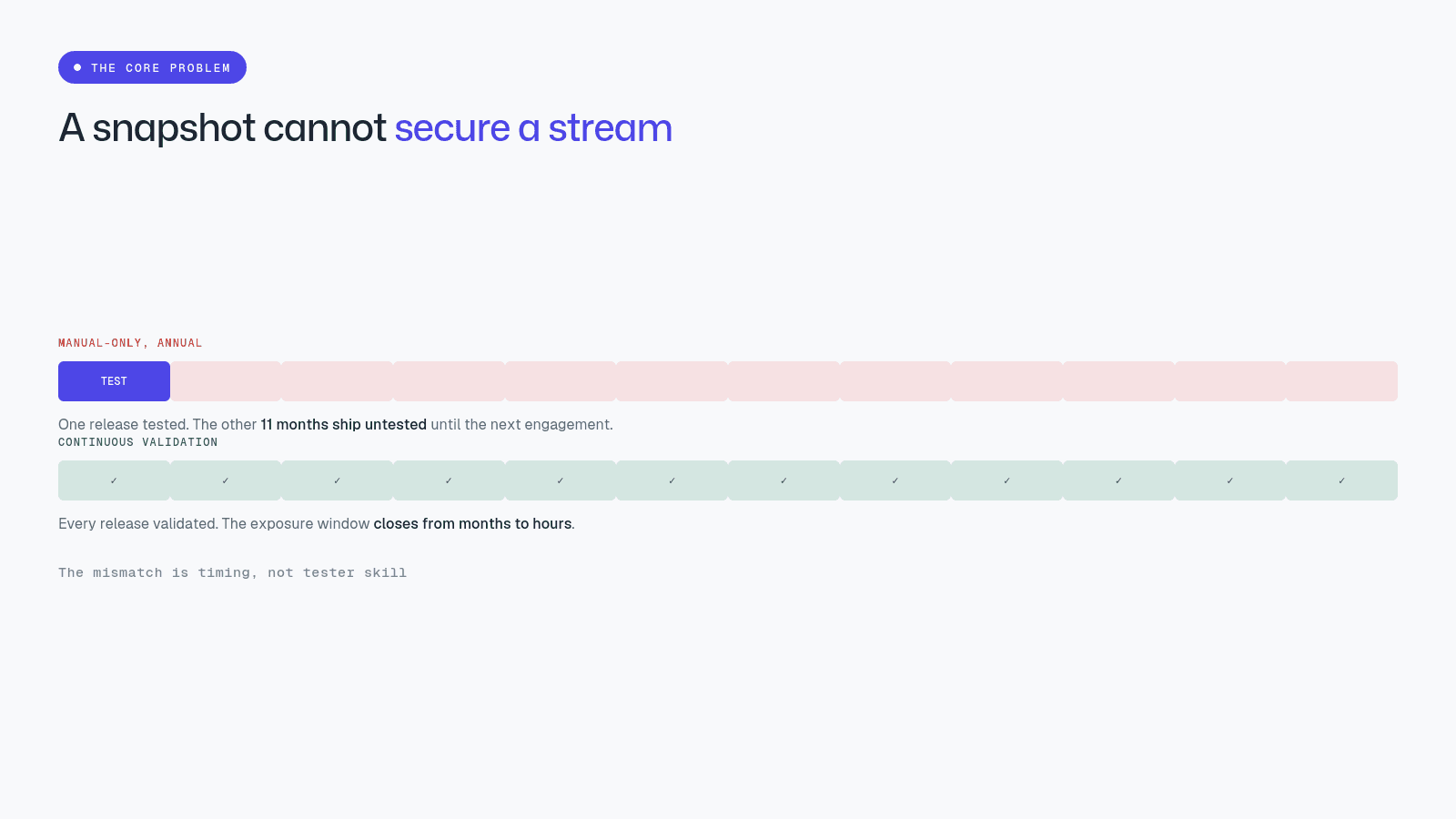
The fundamental limitation of manual penetration testing is structural, not a matter of tester skill. Manual testing is episodic by design: you scope an engagement, a human tests for one to three weeks, and you receive a report describing the state of your systems on the days they were tested. That report is accurate the moment it is written and decays from there.
Modern software delivery is the opposite. It is a continuous stream: CI/CD pipelines, daily deploys, auto-generated GraphQL endpoints, infrastructure that mutates with every Terraform apply. A team shipping weekly ships more than fifty releases a year. A manual pentest validates one of them. The other fifty-plus ship untested for exploitable vulnerabilities until the next engagement, which is the continuous-versus-annual cadence problem at its sharpest.
The mismatch is the whole issue. You are using a point-in-time tool to secure a continuously-changing target. No amount of tester skill closes a gap that is created by timing rather than depth.
Gap 1: The Exposure Window Between Engagements
The most damaging limitation is the exposure window, the months between tests where new vulnerabilities live undiscovered. Walk the timeline of a team on an annual cadence:
Day 0: the pentest runs and returns a clean report.
Day 90: a new OAuth integration ships, and a refactor accidentally removes a scope check.
Day 180: a dependency update introduces a deserialization flaw.
Day 270: an API refactor exposes a Broken Object Level Authorization issue on an admin endpoint.
Day 365: the next pentest runs and finds all three, which have been live and exploitable for nine, six, and three months.
That is not a hypothetical edge case, it is the normal operating condition of any team that deploys between engagements. And the cost of the window is not theoretical: the average data breach reached $4.44 million globally in 2025 per IBM, while exploitation of vulnerabilities rose to 20% of breaches as an initial access vector in the Verizon 2025 Data Breach Investigations Report, up 34% year over year, and attackers now weaponize new vulnerabilities within days of disclosure. When the window between "vulnerability introduced" and "vulnerability found" is measured in months, an annual snapshot is a point-in-time answer to a question that changes daily.
Gap 2: Manual Testing Does Not Scale to Continuous Delivery
Even a team that wanted to test every release manually could not afford to. Manual testing is expensive expert labor, $10k to $50k per engagement with a two-to-four-week turnaround, and a retest often costs extra. The cost comparison breaks the true totals down, but the structural point is simpler: you cannot run a two-week, five-figure engagement fifty times a year.
The scaling limit is not just budget, it is human throughput. A skilled tester works through scope linearly, and there are a finite number of them. Consider the arithmetic: an application with 1,000 endpoints across a dozen microservices, deploying three to five times a day, generates more change in a single week than a two-week manual engagement can thoroughly cover once.
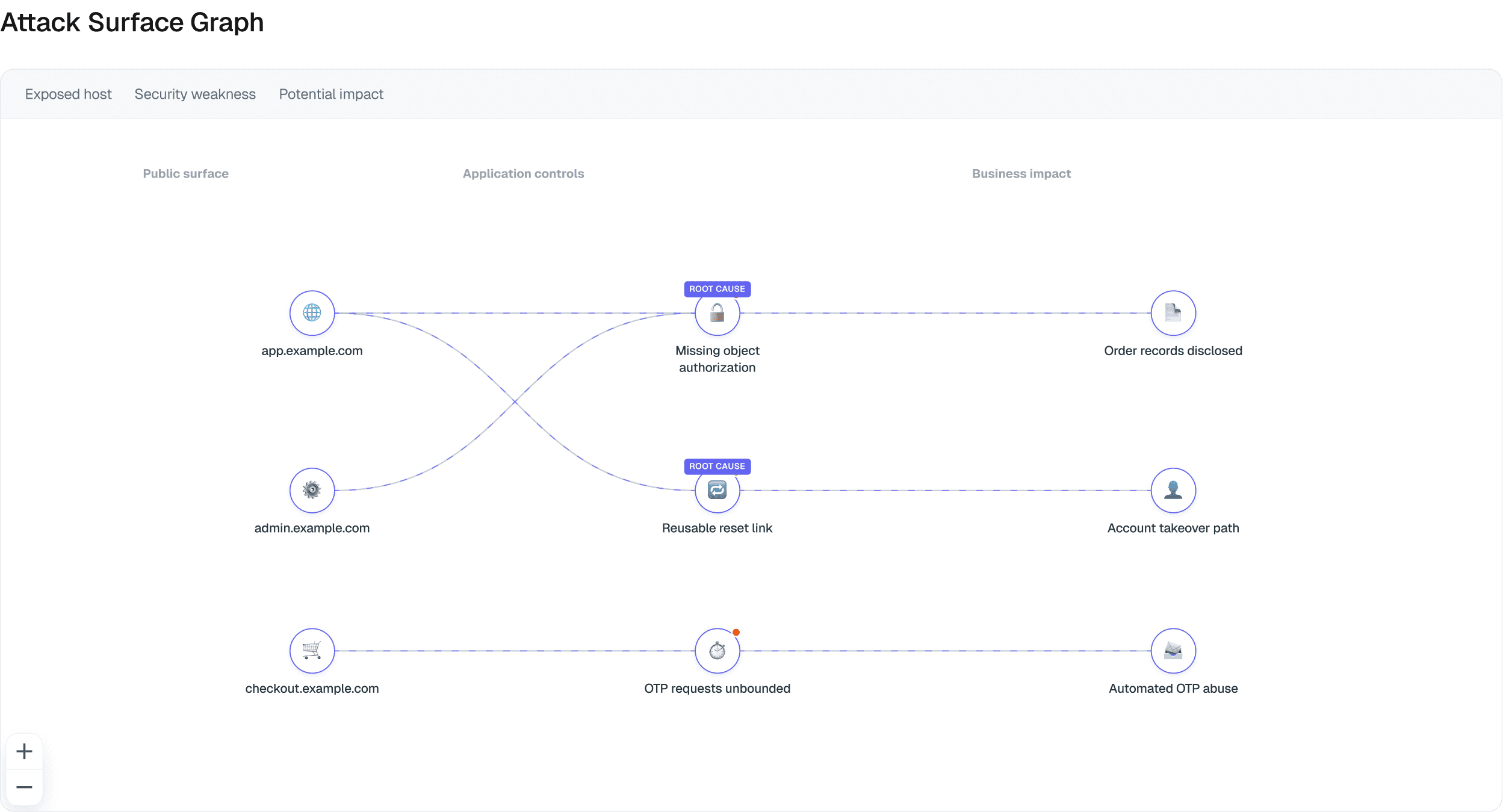
As your attack surface grows, more APIs, more microservices, more cloud accounts, more subdomains, the manual model does not stretch to cover it. The surface expands continuously and the testing capacity does not, so coverage per release falls even as the number of releases rises.
The retest bottleneck compounds this. A finding is discovered, remediation ships, and then it takes weeks and another fee to schedule the retest that confirms the fix. For a team shipping weekly, a fix that waits weeks for validation is a fix you cannot trust in the meantime.
Gap 3: Coverage and Consistency Depend on the Individual
Manual testing quality varies with who you hire. Two testers of different skill produce different results on the same target, and even a strong tester makes judgment calls about where to spend limited hours. That variability is manageable for an annual engagement, but it becomes a real gap when it is your only line of defense, because the depth of your security in any given quarter depends on the depth of one person's engagement two quarters ago.
There is also a coverage ceiling within a single engagement. A time-boxed test cannot exhaustively cover a large modern application. The tester prioritizes the high-value targets and the areas the scope directed them to, which is the right call, but it means the parts of the surface that were not prioritized go untested, and stay untested until the next engagement revisits them, if it does. Vetting the tester matters, which is why the hiring guide exists, but no amount of vetting removes the structural limit of one human and a fixed window.
Gap 4: Point-in-Time Testing Weakens Compliance Evidence
Compliance frameworks increasingly want evidence that testing tracked your changes, not a single annual artifact. PCI DSS 4.0 requires testing after significant change, not only annually. SOC 2 and ISO 27001 auditors increasingly ask how you validate security between engagements. A manual-only program answers that question with "we test once a year," and the obvious follow-up, "you deployed forty-seven times since then, how do you know those changes did not introduce an exploitable vulnerability?", does not have a good answer.
The PCI DSS and SOC 2 requirement guides cover what each framework now expects, and the direction is consistent: continuous evidence that reflects the system as it is now, not as it was on test day ten months ago.
What Manual Testing Is Still Best At
The argument is not that manual testing is obsolete. It is that manual testing is being asked to do a job it was never designed for, continuous coverage, while the job it is uniquely good at goes underused. Human testers remain irreplaceable for a specific and valuable set of problems, and the manual penetration testing guide covers them in depth:
Business-logic flaws that need an understanding of intent, like a discount that can be stacked to make an order free, which no signature can catch.
Novel vulnerability research, the zero-days and new attack classes found through creative, hypothesis-driven experimentation.
Complex multi-step chains that require human intuition to assemble from individually low-severity findings.
Social engineering and physical testing, the human and physical attack layers no automated system replicates.
These are where a human genuinely outperforms, and they are exactly the work that gets crowded out when a manual engagement is stretched to also serve as your continuous-coverage layer. The goal is not less manual testing. It is manual testing focused on what only it can do.
The Answer: A Hybrid Model, Not a Replacement
The resolution is to stop asking manual testing to do the job automation does better, and stop asking automation to do the job humans do better. A hybrid model pairs the two by cadence and by strength.
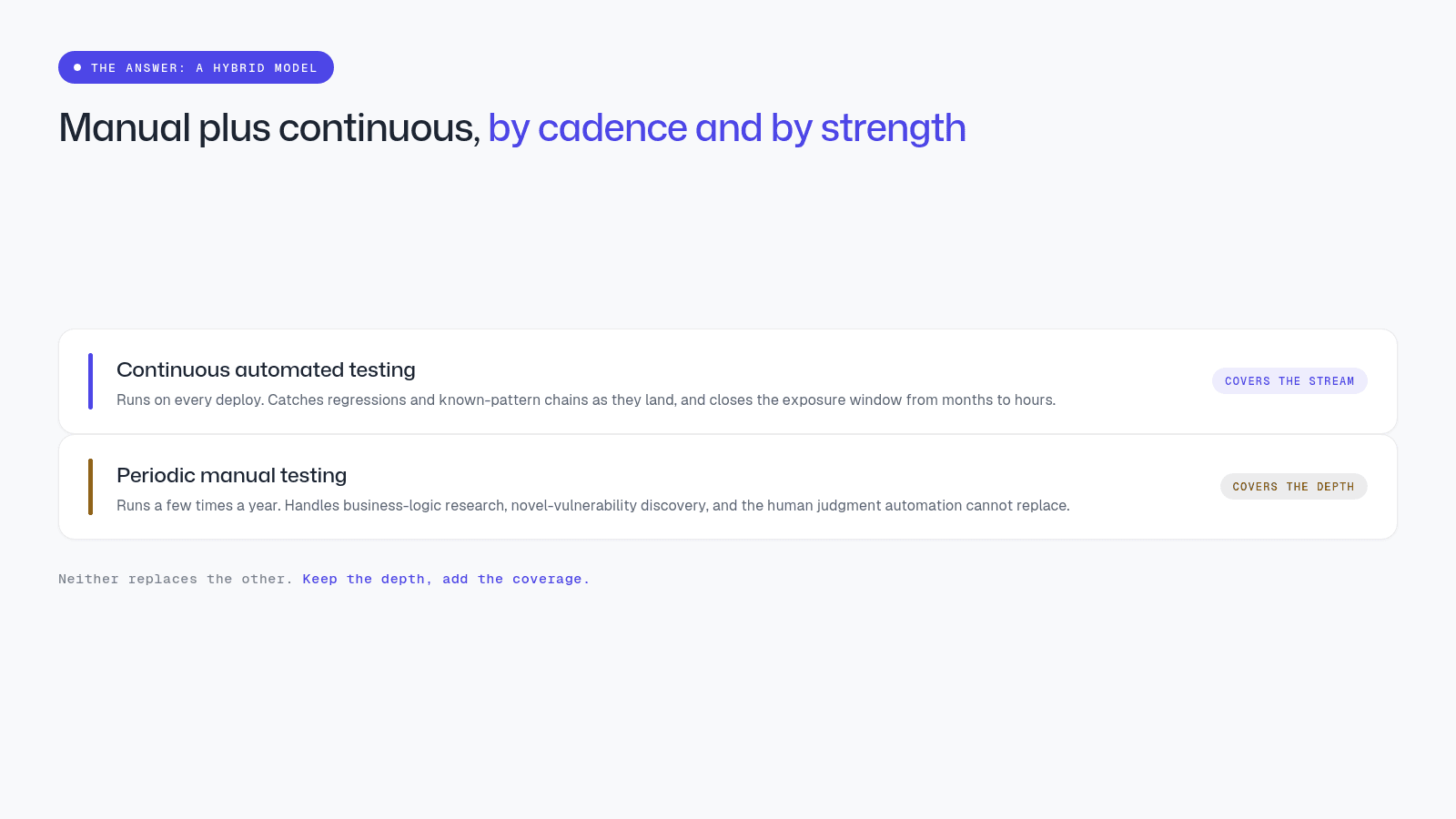
Continuous automated, exploit-validating testing covers the stream: it runs on every deploy, catches regressions and known-pattern chains as they land, and closes the exposure window from months to hours.
Periodic manual testing covers the depth: it handles the business-logic research, the novel-vulnerability work, and the human judgment automation cannot replace. Neither replaces the other, and the automated penetration testing guide covers how the continuous half runs.
The two split cleanly by what each is built to do:
Dimension | Continuous automated | Periodic manual |
|---|---|---|
Cadence | Every deploy | A few times a year |
Coverage | Every release, known patterns | Deep, focused, time-boxed |
Exposure window | Hours | Months |
Business logic | Limited | The core strength |
Novel vulnerabilities | Known patterns only | Discovers new classes |
Regression checks | Automatic on every change | Only at the next engagement |
Cost per cycle | Low, included | High, per-engagement |
Best at | The stream of change | The hardest human problems |
The continuous layer also absorbs the work that SAST and DAST tools do partially, injection patterns, dependency CVEs, misconfigurations, but goes further by validating exploitability rather than flagging a possible issue, which is the scanning-versus-testing distinction that decides what you can rely on.
Code-aware testing narrows the gap between the two even further. When a platform reads your codebase, it brings some of the context that used to require a human, it knows which endpoints handle sensitive data, where authorization lives, and how data flows, so it can construct and validate the Broken Object Level Authorization and tenant-isolation chains that a generic scanner cannot. It does not replace the human for genuinely novel research, but it covers the large middle ground of known-pattern chains continuously, which is exactly the coverage manual testing alone cannot provide.

That is the model CodeAnt AI runs: code-aware, exploit-validating testing on every deploy, so the continuous middle ground is covered and your manual engagements stay focused on the hard problems only a person can solve. Every finding lands with a working PoC and the exact file and line, retests are unlimited and automatic, and you pay only when a high or critical is confirmed exploitable. Human depth where it matters, continuous coverage everywhere else.
What Slips Through the Window: The Vulnerability Classes Manual-Only Misses Between Tests
The exposure window is not an abstract risk, it has a specific shape. Certain vulnerability classes are introduced precisely by the day-to-day changes a manual-only program never sees, and they are exactly the ones that turn into breaches.
Authorization regressions. A refactor to an authentication middleware, a new role, or a changed route guard can silently remove an ownership check, reopening a Broken Object Level Authorization or IDOR path that a previous test confirmed closed. These are introduced by ordinary code changes and are invisible until something tests the authenticated flow again.
New and undocumented endpoints. Every sprint adds API endpoints, and API-first development means one missing authorization check on a new route can leak a database, or a new server-side request forgery (SSRF) sink can reach internal services and cloud metadata. A test from six months ago never saw the route, so it never tested it.
Dependency-introduced flaws. A routine dependency bump can pull in a vulnerable transitive package or a deserialization sink. The manual test that ran before the bump could not have found it, and the next one is months away.
Infrastructure and cloud drift. An IaC change that opens a security group, over-permissions an IAM role, or exposes a storage bucket creates reachable attack surface between tests. This is the attack surface management gap that point-in-time application testing does not cover at all.
Secrets and configuration leaks. A secret committed to a repository, a debug endpoint left enabled, or a verbose error added during troubleshooting can expose sensitive data the day it ships, and sit exposed until the next engagement.
The common thread is that all of these are created by the continuous stream of change, and none of them can be caught by a test that ran before the change was made. This is not a failure of the tester. It is a failure of timing, and timing is exactly what a continuous layer fixes.
How to Move From Manual-Only to Hybrid
The transition does not require abandoning your existing manual program. It layers continuous coverage underneath it.
Keep your annual or periodic manual engagement for the deep work, the business logic, the novel research, the compliance sign-off some auditors still expect.
Add continuous automated testing on every deploy, scoped first to your highest-risk service, the one that ships most often and touches customer data.
Require a working proof-of-concept for anything the continuous layer flags critical, so you are validating real exploitability, not triaging scanner noise.
Wire the retest loop so a fix is re-validated automatically on the next deploy rather than waiting for a scheduled engagement.
Refocus the manual budget on what the continuous layer cannot do, once regressions and known-pattern chains are covered continuously, the human engagement can go deeper on the hard problems.
The result is coverage that matches your release velocity, with human depth reserved for where it genuinely outperforms.
Keep the Depth. Add the Coverage.
Manual penetration testing is not the problem, and it is not going away. The problem is asking a point-in-time engagement to secure a continuously-changing system, a job it was never built for. The depth of a human tester is exactly what you want for business logic, novel research, and creative attack chains, and it is wasted when that same engagement is stretched to also serve as your only coverage between deploys.
The fix is not to choose between manual and continuous, it is to run both. CodeAnt AI provides the continuous, code-aware, exploit-validating layer that covers every deploy and closes the exposure window, so your manual engagements can focus on the hard problems only a person can solve. Every finding arrives with a working PoC and the exact file and line, retests are unlimited, and you pay only when a high or critical is confirmed exploitable. Keep the depth manual testing gives you. Add the coverage it cannot.
Where to start this week
Count the releases you have shipped since your last manual pentest, and how long the average one has gone untested. That number is your exposure window, and it is the gap manual testing alone cannot close. Then run a free code-aware scan on your highest-risk service to see continuous, exploit-validated coverage next to your point-in-time report, and reserve your manual budget for the deep work where a human outperforms.
Run a free code-aware pentest →
Related reading
What Is Manual Penetration Testing?: the depth-focused guide to what manual testing does best
Automated Penetration Testing: the continuous layer that covers the stream
Continuous vs Annual Penetration Testing: the cadence case at the heart of this argument
How Much Does an AI Pentest Cost vs a Manual One?: the cost math behind manual versus continuous
PTaaS Market 2026: From Annual Audits to Continuous Validation: the market shift toward continuous coverage

