

Your SaaS company just passed SOC 2 Type II, but the penetration test that got you there probably missed half your API attack surface. Traditional pentest contracts were written for on-premise infrastructure with defined network perimeters, not for API-first architectures that deploy code daily across multi-tenant environments. (Those two worlds need different tests: see external penetration testing for the perimeter and internal penetration testing for the assumed-breach layer.)
The result is a familiar one. You pay $15k to $50k for annual point-in-time validation that leaves a 364-day gap, misses business logic flaws in your authentication flows, and lands as a PDF your engineers manually transcribe into Jira.
The problem is not the pentesters. It is the contract. Most SaaS companies inherit generic templates that never specify API authentication depth, multi-tenant isolation methodology, or the gray-box requirements that actually trace data flows through your code. Without those clauses you get surface-level findings that auditors accept but attackers exploit.
This guide gives you the exact contract language to require: from OWASP API Security Top 10 coverage and cross-tenant test cases to remediation-workflow integration and compliance mapping for SOC 2, ISO 27001, and PCI DSS.
Why Traditional Pentest Contracts Fail Modern SaaS
Generic contracts create three failures that hit SaaS platforms specifically.
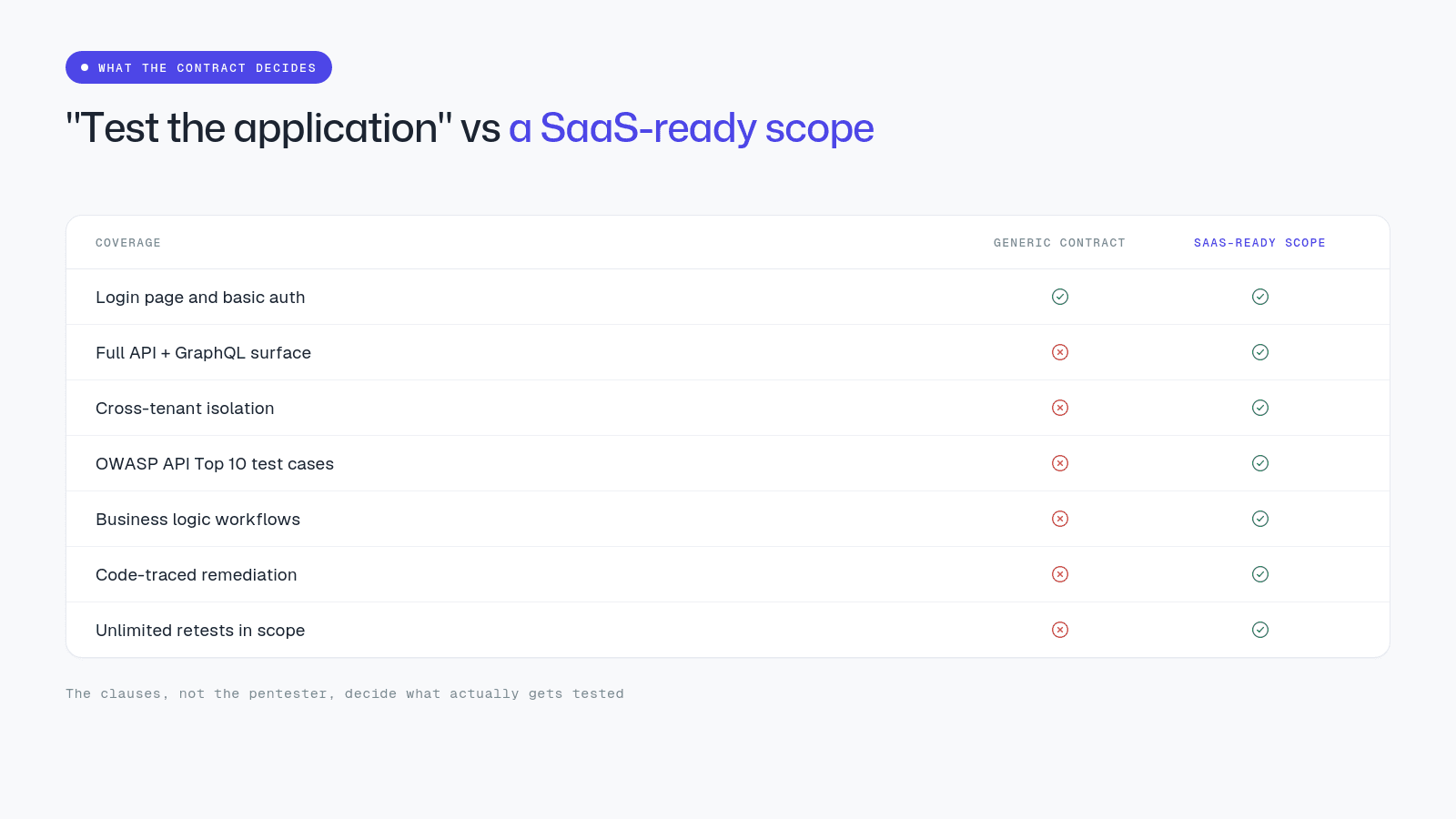
Scope ambiguity becomes cost overruns. "Test the application" sounds clear until the vendor discovers your GraphQL API, WebSocket connections, and third-party OAuth integrations were never listed. Now you are negotiating change orders mid-engagement while real vulnerabilities sit untested. Many SaaS teams deploy multiple times a day while a traditional pentest validates once a year, so hundreds of deployments stack up between security checks. The exposure is not hypothetical: 95% of organizations reported an API security problem in production and 23% suffered a breach, per Salt Security's 2024 State of API Security report.
Missing SaaS-specific technical requirements. Your contract says "test authentication" but does not specify JWT validation across every endpoint, OAuth refresh logic, or cross-tenant privilege escalation. You get a report confirming your login page works. You do not get validation that Tenant A cannot reach Tenant B's data.
No operational integration plan. The contract delivers a PDF without saying how findings map to your Jira workflow, whether remediation includes code examples for your stack, or how re-testing works after a fix ships. Your developers lose days triaging findings that should have arrived pre-categorized by business impact.
Scope and Asset Discovery: Eliminate Surprises Before Testing Starts
The single biggest reason a pentest blows past budget is an incomplete asset inventory. Your contract must mandate a discovery phase before final pricing.
Use this pre-contract checklist to make sure the discovery phase covers everything:
API layer: REST endpoints, GraphQL APIs, internal microservice APIs, webhook receivers, WebSocket and SSE connections.
Authentication: OAuth 2.0, SAML, JWT, API keys. Which mechanisms need testing?
User interfaces: customer portal, admin console, mobile apps.
Background services: workers, scheduled jobs, message queues.
Multi-tenant architecture: database-per-tenant vs schema-per-tenant vs row-level security.
Third-party integrations: OAuth apps, outbound webhooks, SaaS-to-SaaS connections.
Why code-aware discovery matters. Code-aware platforms parse your codebase to extract API endpoints, authentication requirements, and data flows automatically, producing a complete asset inventory in hours instead of days. That is what enables a fixed-price contract, because both parties see the full attack surface upfront rather than discovering it mid-engagement.
API Security Requirements: OWASP API Top 10 as Contract Obligations
Your contract must explicitly require coverage of each OWASP API Security Top 10 class with defined test cases, not a vague "test the API."
API1, Broken Object Level Authorization, is the same root cause as IDOR and remains the number-one API risk by a wide margin, so it deserves the most explicit test cases in your contract.
Token lifecycle testing requirements. A single "test authentication" line leaves most of the token surface untested. Require each phase:
Test phase | Required validation | Common vulnerabilities |
|---|---|---|
Token generation | JWT signature validation, algorithm confusion |
|
Token storage | HttpOnly/Secure flags, SameSite attribute | XSS-based token theft, CSRF |
Token refresh | Refresh token rotation, revocation on logout | Infinite lifetime, reuse after logout |
Token validation | Signature verification, expiration checked | Expired tokens accepted, forged tokens |
Business logic workflow testing. Automated scanners miss business logic flaws, so require manual testing of the critical workflows: subscription upgrade and downgrade, payment and refund flows, role assignment and privilege escalation paths, data export and deletion, and OAuth scope modification for third-party integrations.
Multi-Tenant Isolation: Define Cross-Tenant Test Cases
Multi-tenant isolation failure is the highest-impact vulnerability class in SaaS, because one bypass exposes every tenant at once. Your contract must specify explicit cross-tenant test cases, not leave it to the tester's discretion.
Then define what evidence a tenant-isolation finding must carry, so you do not get "tenant isolation may be weak" with no proof: the complete HTTP request showing the attack, the full response demonstrating unauthorized access, a curl command for independent validation, a step-by-step attack-chain narrative, the business impact (tenants affected, data types exposed), and code-level remediation guidance.
Gray-Box Testing: The Pragmatic Sweet Spot
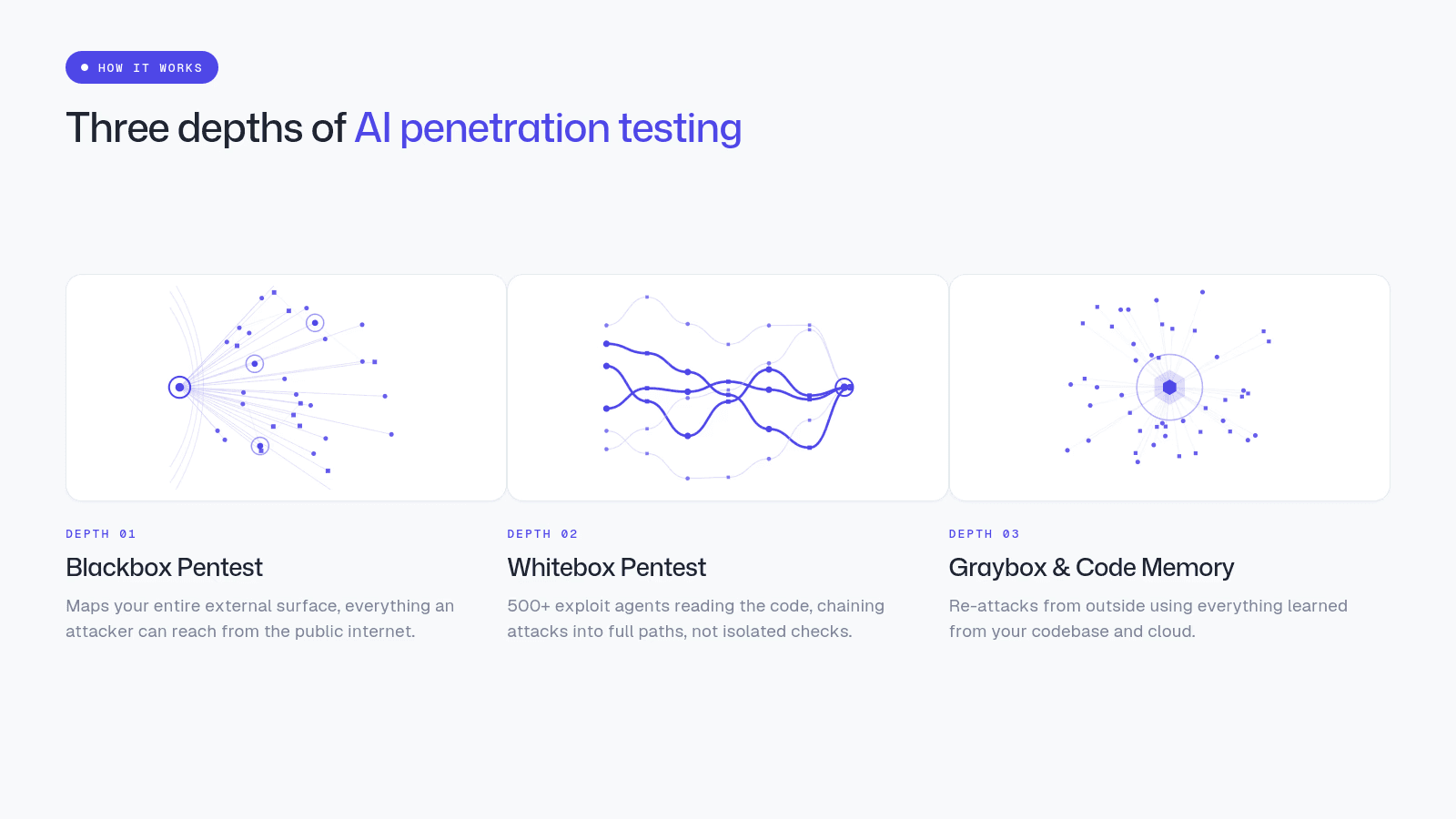
Gray-box testing combines the external attacker's perspective with internal architectural knowledge, which produces deeper findings and fewer false positives than black box alone. We break the three depths down in Black Box vs White Box vs Gray Box Penetration Testing. For a SaaS platform, gray box is usually the right floor to specify.
Testing mode | Coverage depth | False positives | Best for |
|---|---|---|---|
Black box | Surface-level | Highest | External exposure assessment |
Gray box | Deep, traces data flows | Lower | SaaS platforms, API-first |
White box | Comprehensive, time-intensive | Lowest | Pre-IPO audits, critical infra |
Contract language for the gray-box inputs:
The code-aware advantage. A code-aware platform that already has code access for defensive review (PR review, SAST) can extend to gray-box pentesting with no additional IP exposure. It uses the same code intelligence that catches vulnerabilities during development to build deeper exploit chains, tracing data flows and producing findings with exact file-and-line remediation. That is the model CodeAnt AI runs, and it is why the gray-box findings are deeper than an external-only test can reach.
Deliverables and Workflow Integration
Traditional reports arrive as PDFs that need manual transcription. Modern contracts must require machine-readable output.
Then require the integration itself: native issue-tracker tickets created automatically, code-level traceability linking findings to files and lines, remediation tracking that shows fix status and re-test results, and a compliance view that reflects closed findings.
Remediation and Retesting: Close the Loop
The retest clause is where most contracts quietly fail you.
Why unlimited retests matter. Traditional firms charge 20% to 30% of the original engagement for re-testing, which creates a perverse incentive where the vendor profits from an incomplete fix. A code-aware model that re-validates automatically on every commit removes that friction, so you iterate until the vulnerability is confirmed closed rather than paying per round. This is the continuous-validation loop we cover in Continuous vs Annual Penetration Testing.
Compliance Mapping That Satisfies Auditors
Specify deliverables in the exact format auditors expect, or you will be assembling supplemental evidence after the fact.
Framework | Required evidence | Pentest deliverable |
|---|---|---|
SOC 2 CC6.1 | Authentication bypass testing, privilege escalation attempts | Methodology section with findings mapped to the control |
SOC 2 CC7.1 | Proof monitoring detected pentest activity | Log excerpts showing detection or the gaps |
ISO 27001 A.12.6.1 | Vulnerability identification, risk assessment, remediation tracking | Findings registry with CVSS scores and closure evidence |
PCI DSS 11.3 | Annual testing of the CDE and connected systems, PTES methodology | Full report with network and application layer scope |
The SOC 2 penetration testing requirements and PCI DSS penetration testing requirements guides cover exactly what each auditor wants to see.
Require a methodology statement auditors recognize, mapped to the Penetration Testing Execution Standard (PTES):
And define "significant change" up front, because PCI DSS 11.3 requires re-testing after one, and vague language causes scope disputes.
Vendor Evaluation Framework
Evaluate pentest partners on the capabilities that matter for SaaS, not on brand or headcount.
Core competencies to validate: API security expertise (specifically OWASP API1 Broken Object Level Authorization, API2 broken authentication, and API5 broken function-level authorization), a documented multi-tenant isolation methodology with real case studies, gray-box capability that leverages architecture and code access, and demonstrated depth in OAuth 2.0/OIDC, JWT manipulation, and MFA bypass.
Evidence quality: working PoC exploits for every critical and high finding, code-level traceability to the exact file, line, and commit, reproduction steps any engineer can follow, and framework-specific remediation (Django, Flask, Express, Spring Boot).
Deal-breakers to walk away from: scanner-only testing with no manual validation, no PoCs or vague repro steps, a paid re-engagement model charging 20% to 30% per retest, no multi-tenant methodology, and vague scoping language like "test the application."
Criteria | Weight | Question to ask |
|---|---|---|
API security expertise | 20% | "Walk me through how you test for Broken Object Level Authorization in a microservices architecture with 50+ endpoints." |
Multi-tenant methodology | 15% | "Describe a tenant isolation vulnerability you found and how it could have been exploited." |
Gray-box capability | 15% | "How do you use code access to build deeper attack chains?" |
Working PoC exploits | 15% | "Show me sample findings with curl PoCs." |
Unlimited re-scans | 10% | "What is your re-testing policy, included or an additional charge?" |
Bridging the 364-Day Gap
An annual pentest validates exploitability at a point in time, but it cannot protect the 364 days between engagements. The answer is not monthly pentests, which are cost-prohibitive. It is automated, continuous validation between the periodic manual engagements. It is layering periodic offensive validation with continuous defensive controls.
Periodic offensive validation, run annually or semi-annually, is where you validate complex attack chains, test business logic that needs human creativity, and produce the audit-grade evidence SOC 2, ISO 27001, and PCI DSS require.
Continuous defensive controls, running daily, are what actually close the gap: pull-request security review catching vulnerabilities before production, automated secrets detection, dependency monitoring with exploitability context, continuous asset discovery, and configuration-drift detection. If your estate spans cloud and on-premise, hybrid attack chains are the ones a single-environment contract misses entirely.
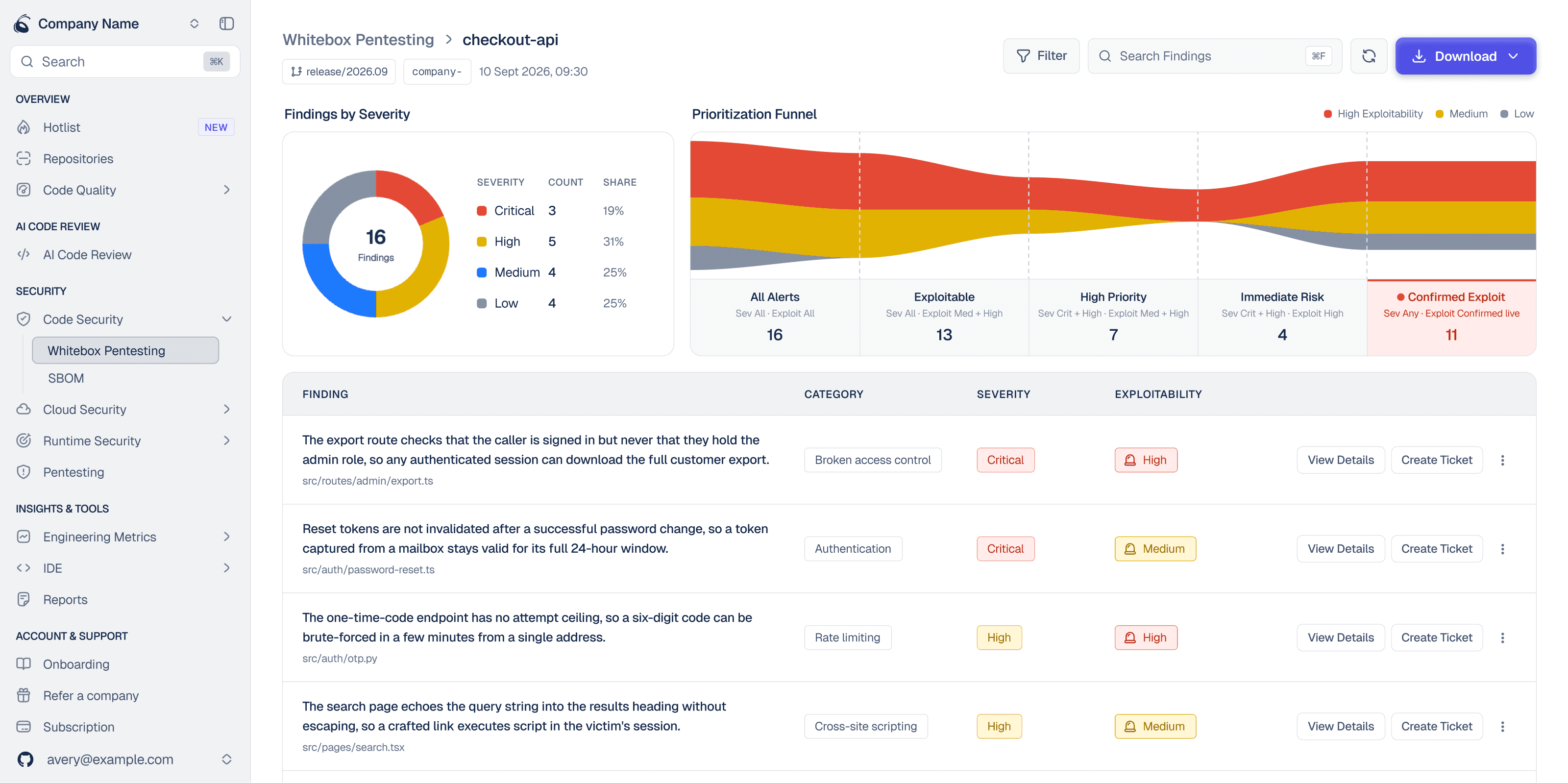
The unified model is what makes this affordable. CodeAnt AI uses the same code intelligence for both the defensive side (PR review, SAST) and the offensive side (AI-driven pentesting). When a pentest identifies a vulnerability, the platform traces it to the exact file and line, ships a working PoC, and re-validates automatically after the fix deploys, so the gap between "finding delivered" and "vulnerability actually closed" disappears.
Your SaaS Pentest Contract Checklist
Before signing, verify the contract covers all four areas.
Scope and methodology: a full asset inventory (APIs, endpoints, auth flows, integrations), gray-box or white-box methodology with code-access provisions, multi-tenant isolation testing with cross-tenant validation, OWASP API Top 10 coverage (especially API1, API2, API5), business logic testing for critical workflows, and both authenticated and unauthenticated surfaces.
Deliverables and quality: audit-grade reports with CVSS scoring and code-level remediation, compliance mapping (SOC 2 CC6.1/CC7.1, ISO 27001 A.12.6.1, PCI DSS 11.3), working PoC exploits for every critical and high finding, and machine-readable output that integrates with Jira or GitHub.
Remediation and retesting: unlimited re-scans within a 90-day window (not a paid re-engagement), defined SLAs for re-validation, integration with your existing workflows, and post-engagement guidance on continuous posture.
Legal and operational: rules of engagement (testing windows, production vs staging), NDA and IP protection for code access, a "significant change" definition that triggers re-testing, and liability and indemnification provisions.
A Three-Week Roadmap to a SaaS-Ready Contract
You do not need to rewrite everything at once. Three focused weeks turn a generic template into a contract that actually scopes your platform.
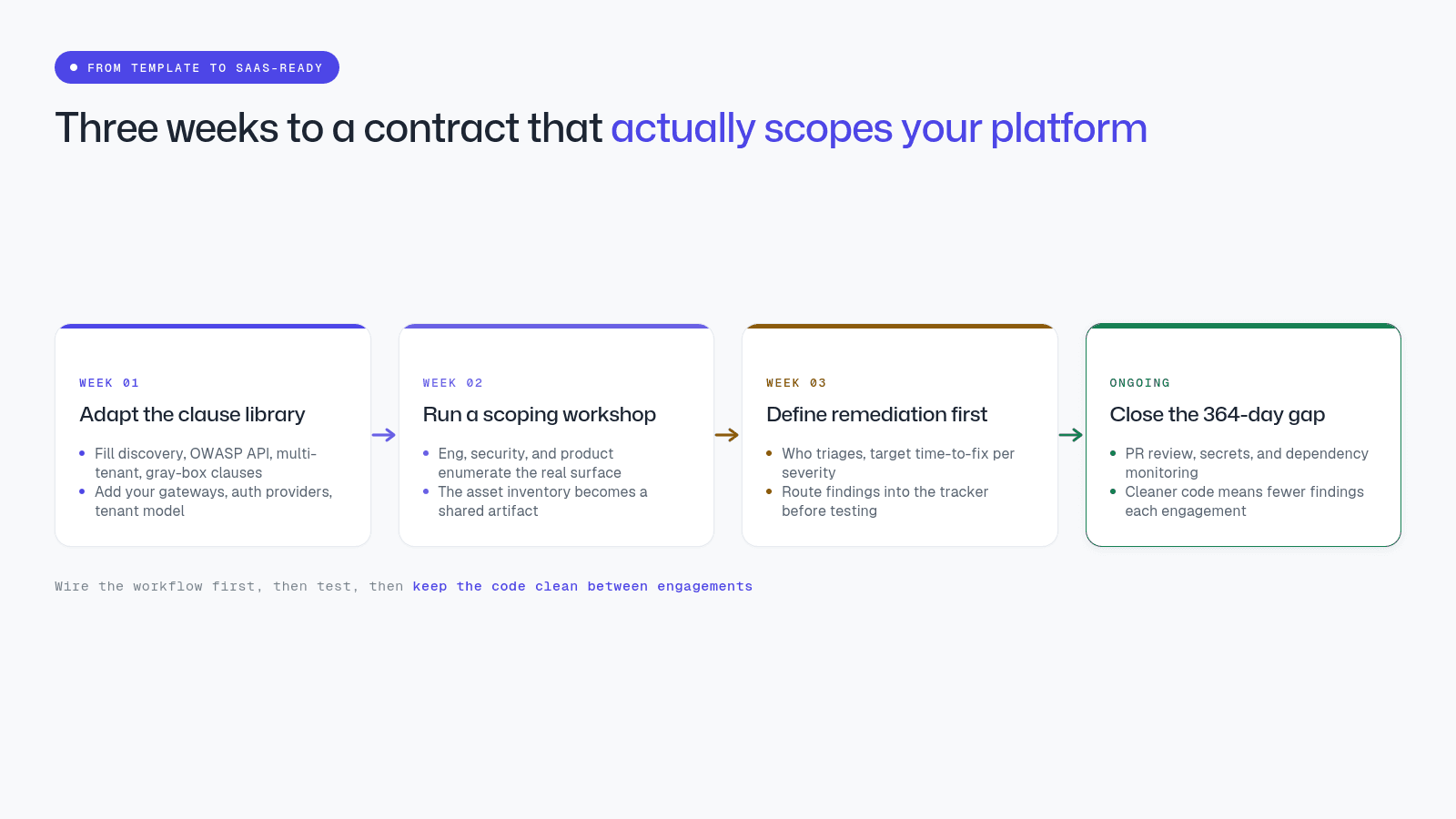
Week 1, adapt the clause library. Take the discovery-phase, OWASP API Top 10, multi-tenant, and gray-box clauses above and fill in your specifics: your API gateway endpoints, your auth providers (Okta, Auth0, Cognito), your multi-tenant model (database-per-tenant, schema-per-tenant, or row-level security), and your third-party integrations. The clauses are the skeleton, and your architecture is what makes them enforceable.
Week 2, run a scoping workshop. Get engineering, security, and product in one room to enumerate the real attack surface, document every authentication flow, and identify the highest-risk business logic (payment, data export, role assignment). This is where the "test the application" ambiguity dies, because the asset inventory becomes a shared artifact rather than something the vendor discovers mid-engagement.
Week 3, define the remediation process before testing starts. Decide who triages findings, what the target time-to-fix is for each severity, and how findings route into your issue tracker. A finding with nowhere to go is a finding that ages into next year's audit. Wire the workflow first, then test.
Ongoing, close the gap. The contract handles the periodic engagement, but the 364 days between them need continuous defensive controls: PR-level security review, secrets detection, and dependency monitoring that catch vulnerabilities before they ever reach a pentest. That is the layer that shrinks each engagement's findings, because the code arrives cleaner.
Stop Signing Contracts That Test Your Login Page and Miss Your API
The best pentest contract in the world still leaves a 364-day gap, and a generic one leaves most of your API surface untested on top of that. For a SaaS platform, the contract is the product: the clauses decide whether you get cross-tenant validation and code-traced findings, or a PDF that confirms your login page works.
CodeAnt AI closes both problems at once. The same code intelligence that reviews your pull requests drives the offensive testing, so gray-box findings arrive traced to the exact file and line with a working PoC, mapped to SOC 2, ISO 27001, and PCI DSS controls, and re-validated automatically on every commit. Low and medium findings are free, you pay only when a high or critical is confirmed exploitable, and retests are unlimited, so there is no per-round fee and no incentive to leave a fix half-done.
Where to start this week
Pull your last pentest contract and check it against one clause: does it name your GraphQL API, your multi-tenant isolation test cases, and gray-box code access, or does it say "test the application"? If it is the latter, rewrite the scope section using the discovery-phase and OWASP API Top 10 language above before your next engagement, then require a working PoC for every high and critical finding. That single change moves you from findings auditors accept to findings attackers cannot.
Run a free code-aware pentest →
Related reading
What Is VAPT? Vulnerability Assessment vs Penetration Testing: the scanning-vs-testing distinction that shapes what you should require
GraphQL Penetration Testing Checklist: the resolver-level authorization tests to name in your contract
SOC 2 Penetration Testing Requirements: the evidence auditors expect for CC6.1 and CC7.1
PCI DSS Penetration Testing Requirements: what Requirement 11.3 actually asks for, including significant-change re-testing
Continuous vs Annual Penetration Testing: how to close the 364-day gap without monthly engagements
External Penetration Testing: What It Covers and What It Misses: the perimeter half, and the six gaps external testing leaves open
Automated Penetration Testing: why continuous validation replaced the quarterly report

