

For two decades, the security calendar had one immovable event: the annual penetration test. You scoped it in Q1, ran it in Q2, remediated in Q3, and filed the report for the auditor in Q4. It worked when software shipped a few times a year. It stopped working when software started shipping a few times a day.
The market is now repricing that gap. The Penetration Testing as a Service (PTaaS) market is projected to reach $0.72 billion in 2026 and $1.98 billion by 2031, a 22.6% compound annual growth rate, and the platform segment alone accounts for roughly three-quarters of it. That growth is not a rebranding of the old model. It is engineering teams moving budget from a once-a-year audit to continuous validation that runs at the speed they deploy.
This guide covers what is actually driving the shift, the Gartner framework (continuous threat exposure management) that gives it a name, where adoption really stands versus the hype, and what the move from annual audits to continuous validation means for how your team buys and runs security testing.
Why the Annual Audit Model Broke
The annual pentest did not fail because the testing got worse. It failed because the thing it tests changed shape underneath it. A team shipping weekly ships 50-plus releases a year, and an annual test validates exactly one of them, leaving 51 releases (roughly 98% of what you deployed) untested for exploitable flaws until the next cycle.
The exposure window is the whole problem. A vulnerability introduced in a March deploy sits live and exploitable until the following year's test finds it, and the cost of that gap is not theoretical: the average data breach reached $4.44 million globally in 2025 per IBM, and attackers now weaponize a large share of new vulnerabilities within days of disclosure. When the window between "vulnerability introduced" and "vulnerability found" is measured in months, an annual snapshot is a point-in-time answer to a question that changes every day.
Three forces turned that structural weakness into a budget decision.
Deployment velocity. CI/CD, microservices, and daily releases made point-in-time testing obsolete on arrival. The report describes a system that no longer exists.
Attack-surface sprawl. APIs, cloud IAM, third-party integrations, and multi-tenant SaaS expanded what needs testing far beyond the network perimeter an annual test was built for.
Compliance evolution. SOC 2, ISO 27001, and PCI DSS increasingly expect evidence of testing after significant change and a continuous trail, not a single yearly artifact. The PCI DSS and SOC 2 requirement guides cover exactly what each framework now asks for.
The Market Data: Where the Money Is Moving
The numbers make the shift concrete. Beyond the headline $0.72B-to-$1.98B trajectory, the composition of the growth tells the story.

Metric | 2026 figure | What it signals |
|---|---|---|
PTaaS market size | $0.72 billion, growing to $1.98B by 2031 | The category is real, not a niche |
CAGR (2026 to 2031) | 22.6% | Faster than the broader security market |
Platform segment share | ~75% | Buyers want platform-delivered, not project-delivered |
Fastest-growing surface | Cloud security pentesting, ~26% CAGR | Testing is following workloads to the cloud |
Largest vertical | BFSI, ~32% of revenue | Regulated, high-stakes teams lead adoption |
The platform-share number is the one to sit with. Three-quarters of the market is moving toward testing delivered through a platform rather than as a one-off consulting project, which is the mechanical definition of the shift from annual audits to continuous validation. We cover what that delivery model actually is in Penetration Testing as a Service (PTaaS): Capabilities, Pros, and Cons.
The field reflects the same split. Established PTaaS players like Veracode, Synack, NetSPI, and Cobalt anchor the platform-delivered, crowd-and-consultant end of the market, while a newer code-aware cohort pushes the validation deeper by testing with source context rather than from the outside. The competitive line is no longer manual versus automated, it is external-only platforms versus ones that understand the code they are attacking, which is where the fastest capability gains are happening.
CTEM: The Framework That Names the Shift
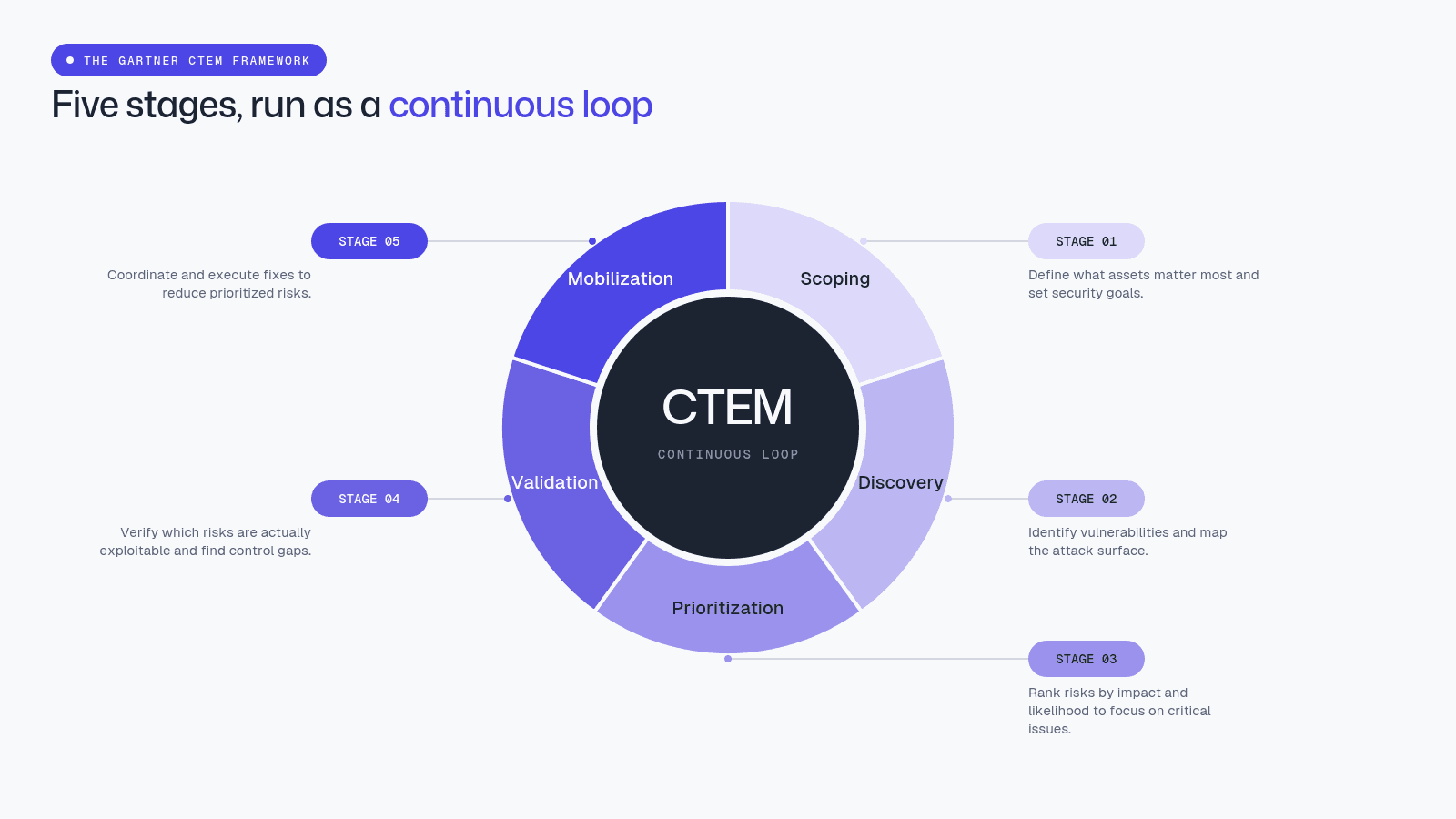
The move from annual audits to continuous validation is not a vendor slogan. Gartner formalized it in 2022 as Continuous Threat Exposure Management (CTEM), a five-stage program that treats exposure reduction as an always-on process rather than a periodic event. The stages are scoping, discovery, prioritization, validation, and mobilization, and they mirror how a real attacker probes an environment continuously rather than once a year.
The distinction CTEM draws is between an exposure and a vulnerability. A CVE on an unpatched server is an exposure, but so is a misconfigured cloud bucket, an over-privileged identity, a forgotten subdomain, and a shadow API that never went through review. CTEM brings all of them into one prioritized view and answers the only question a security leader cares about: of everything that could be attacked right now, what would actually hurt us, and what do we fix first?
The five stages run as a loop rather than a checklist:
Scoping defines what matters, the business-critical assets and the attack surface around them.
Discovery finds the exposures across code, cloud, identity, and the external surface.
Prioritization ranks them by real risk, not raw CVSS.
Validation proves which ones an attacker can actually reach and exploit.
Mobilization routes the proven ones to the teams that fix them, then the loop repeats.
Because it runs continuously, the model mirrors how attackers actually operate, probing every day, not once a quarter, rather than how audits are scheduled.
Gartner's headline projection is the one every analyst cites: organizations that prioritize their security investments through a continuous exposure-management program are three times less likely to suffer a breach, a prediction Gartner set for 2026, the year that has now arrived.
Validation is the stage teams skip, and it matters most
Within the five stages, validation is where most programs fall short, and it is the stage penetration testing directly serves. Validation asks a simple question: of all the exposures we found, which ones can an attacker actually reach and exploit? Testing exploitability rather than counting findings is what separates real risk from theoretical noise, and it is why a scanner-only program leaves a CTEM effort incomplete. Research on CTEM programs found that validating exploitability cut false urgency by roughly 84%, letting teams focus remediation on the small fraction of exposures that actually reach critical assets instead of drowning in a backlog of theoretical criticals. A finding without a proven, reachable path is a guess, which is the same argument the VAPT distinction makes at the tool level.
This is exactly where continuous, exploit-validating penetration testing fits into the market shift: it is the validation engine of a CTEM program, the thing that proves which of your thousands of exposures are the handful that reach critical assets.
Validation is the stage teams skip, and it matters most
Within the five stages, validation is where most programs fall short, and it is the stage penetration testing directly serves. Validation asks a simple question: of all the exposures we found, which ones can an attacker actually reach and exploit? Testing exploitability rather than counting findings is what separates real risk from theoretical noise, and it is why a scanner-only program leaves a CTEM effort incomplete.
Research on CTEM programs found that validating exploitability cut false urgency by roughly 84%, letting teams focus remediation on the small fraction of exposures that actually reach critical assets instead of drowning in a backlog of theoretical criticals. A finding without a proven, reachable path is a guess, which is the same argument the VAPT distinction makes at the tool level.
This is exactly where continuous, exploit-validating penetration testing fits into the market shift: it is the validation engine of a CTEM program, the thing that proves which of your thousands of exposures are the handful that reach critical assets.
Adoption Reality: The Gap Between Belief and Practice
The market growth is real, but so is the gap between what security leaders say and what they have actually built. Roughly 87% of security leaders recognize the importance of a continuous exposure-management approach, yet only about 16% have operationally implemented one, and surveys put a majority of organizations somewhere in the "considering or piloting" stage rather than fully live.
That gap is the actual state of the market in 2026, and it explains the growth curve. The belief has already shifted, the budget is following, and the tooling is maturing, but most teams are early in the transition rather than done with it.
The distance between the 87% who believe and the 16% who have built is not skepticism, it is the ordinary lag between a consensus forming and the engineering work of wiring continuous testing into pipelines, triage, and remediation.
For a buyer, that is useful context: adopting continuous validation now is not a bleeding-edge bet, it is catching up to where the consensus already points, ahead of the majority who are still planning.
The other honest read is that continuous validation only pays off if you can act on it. A program that surfaces exposures faster than a team can triage and remediate them just moves the bottleneck. The teams getting value are the ones pairing continuous testing with the engineering capacity and workflow integration to actually close what it finds, which is why the delivery model matters as much as the testing depth.
What the Shift Means for How You Buy
The move from annual audits to continuous validation changes the buying decision in four concrete ways.
From project to subscription. You stop buying a fixed-scope engagement and start buying ongoing coverage, which changes budgeting from a lumpy annual line item to a predictable recurring one. The cost comparison breaks down how the totals land against manual.
From PDF to platform. The deliverable shifts from a static report to a live dashboard with findings you see as they land and route into your issue tracker, which is what makes remediation start on day one instead of after a report cycle.
From detection to validation. The value moves from "here is a list of possible issues" to "here is what an attacker can actually exploit, with a working proof-of-concept," the validation stage of CTEM made operational.
From episodic to continuous evidence. Compliance evidence stays current because testing tracks your release cadence, rather than going stale the day after an annual test.
The evaluation question that decides it all is unchanged from the PTaaS buyer's guide: does the platform prove exploitability, or just flag theoretical risk through a nicer dashboard? A market shifting toward continuous validation is only as good as whether the validation is real. The best AI pentesting platforms comparison and the hiring guide both come back to that same test.
Where Code-Aware Validation Fits the Market
Most of the PTaaS market tests from the outside, delivered through a platform but blind to your source. The next stage of the shift is code-aware validation, where the same intelligence that reviews your pull requests also drives the offensive testing, so the validation stage of a CTEM program runs with full context rather than external guesswork.
That changes the two things that matter most for the annual-to-continuous transition. It makes validation more accurate, because a code-aware platform knows which exposures are actually reachable through your authorization logic and data flows, so it proves the Broken Object Level Authorization and tenant-isolation paths that reach real data instead of flagging noise. And it makes remediation faster, because findings arrive with the exact file, line, and a working proof-of-concept, which is what lets a team actually close the exposures continuous testing surfaces. We cover the mechanics in the automated pentesting guide.
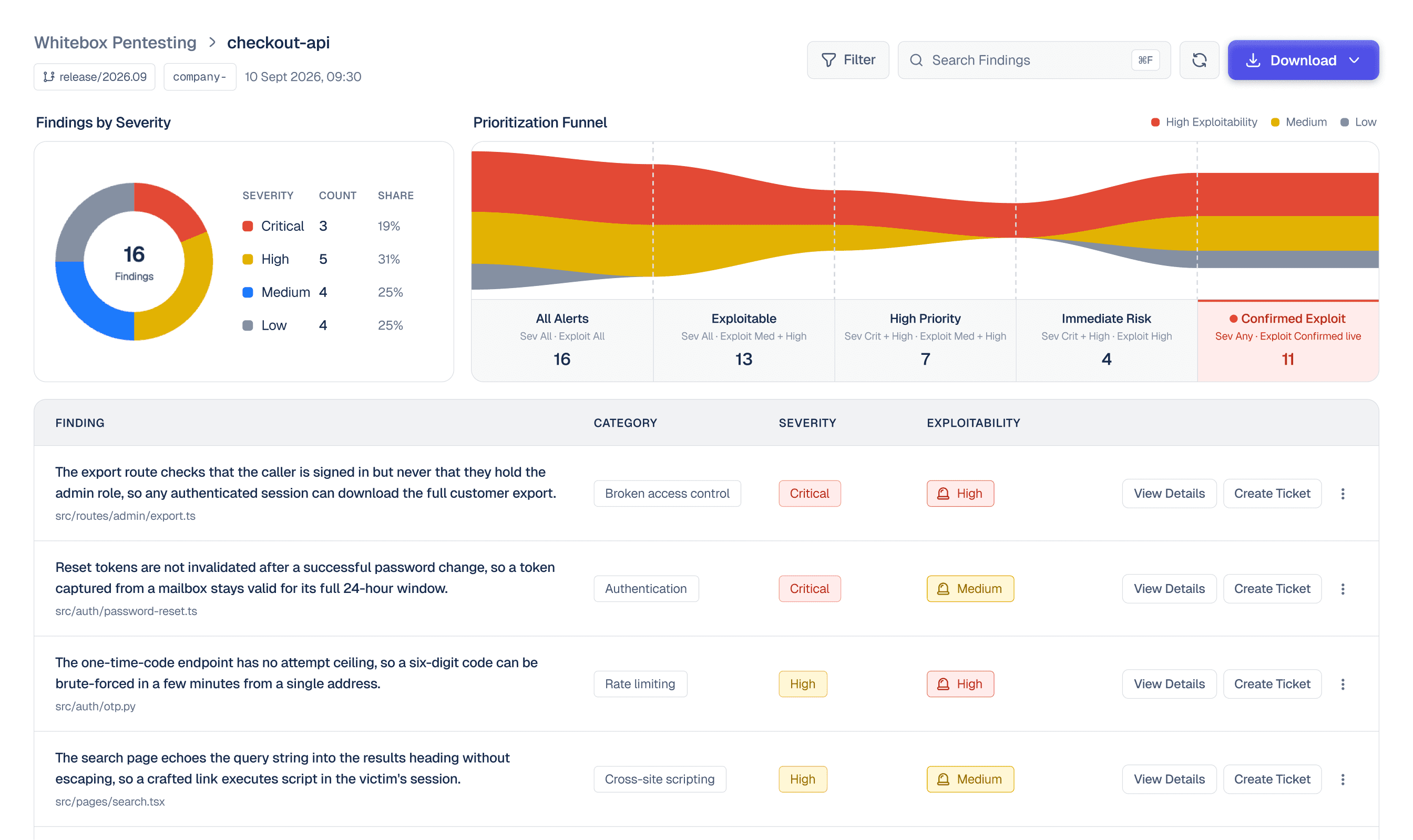
That is the model CodeAnt AI runs: continuous, code-aware validation that proves which exposures reach critical assets, with every finding mapped to a file and line and a PoC, unlimited automatic retests, and outcome-based pricing, you pay only when a high or critical is confirmed exploitable. It is the validation engine the shift to continuous testing is built around, delivered with the source context an external-only platform never has.
The Annual Audit Is Not Dead, but It Is No Longer Enough
The PTaaS market crossing $0.72 billion in 2026 is not a story about a new tool category. It is the market pricing in a structural truth: software that ships continuously cannot be secured by a test that runs once a year. Gartner gave the shift a name with CTEM, the analyst numbers give it a size, and the adoption gap shows most teams are still catching up to a consensus that has already formed.
The move that actually matters is toward validation, proving which exposures an attacker can reach, continuously, rather than filing a snapshot for the auditor. That is what CodeAnt AI is built to deliver: continuous, code-aware validation where every finding lands with a file, a line, and a working PoC, retests are unlimited and automatic, and you pay only when a high or critical is confirmed exploitable. It is the validation engine of the shift the whole market is making, with the source context that makes the validation real.
Where to start this week
Map your own exposure window: count how many releases you have shipped since your last penetration test, and how long the average one has gone untested. If the answer is more than a handful, you are carrying the exact gap the market is repricing. Then run a free code-aware validation scan on your highest-risk service to see what continuous, exploit-proven output looks like next to an annual PDF. That comparison is the clearest read on whether the shift is worth making for your team.
Run a free code-aware pentest →
Related reading
Penetration Testing as a Service (PTaaS): Capabilities, Pros, and Cons: what the delivery model behind the market actually is
Continuous vs Annual Penetration Testing: the cadence case at the heart of the shift
Automated Penetration Testing: how the exploit-validation engine runs
How Much Does an AI Pentest Cost vs a Manual One?: the budget math behind moving from project to subscription
Best AI Penetration Testing Platforms: the platform field compared

