

An insurtech platform usually meets its first serious security requirement the same way, a large carrier or broker asks for a SOC 2 Type 2 report before signing. If the platform is also licensed in New York, a second regime lands on top of it.
The two are not the same shape. This guide covers how they differ, which criteria a penetration test actually maps to, what an insurtech platform needs tested, and how a single testing program can satisfy both without running two parallel exercises.
What CodeAnt AI solves here: CodeAnt AI runs continuous, code-aware penetration testing across code, cloud, APIs, and external surface, chaining findings into proven paths to customer data. Evidence accumulates across the whole Type 2 window, and pricing is outcome-based, so you pay for confirmed critical exposure rather than researcher hours.
Why Insurtech Penetration Testing Must Cover NYDFS And SOC 2 Type 2
An insurtech company is a software business and a regulated insurance entity simultaneously, which is why the obligations stack rather than merge.
The software side answers to customers. Enterprise carriers, brokers, and MGAs run vendor security reviews before contracting, and a SOC 2 Type 2 report is the artifact that clears them.
The insurance side answers to regulators. If the entity is licensed in New York, NYDFS 23 NYCRR 500 applies directly, and in adopting states the NAIC Insurance Data Security Model Law drives a risk-based program.
Those two masters want different evidence. One wants a mandated annual test on a certification cycle, the other wants proof that controls worked continuously across a reporting period.
What SOC 2 Type 2 Requires From Insurtech Penetration Testing Evidence
The distinction between the report types is the single most important thing to understand before scoping a test.
A Type 1 report assesses whether controls are suitably designed at a point in time. The auditor examines design, so a penetration test supports the picture without being central to it.
A Type 2 report assesses operating effectiveness over a period, commonly six or twelve months. The auditor is asking whether the controls worked throughout that window, which changes what counts as good evidence.
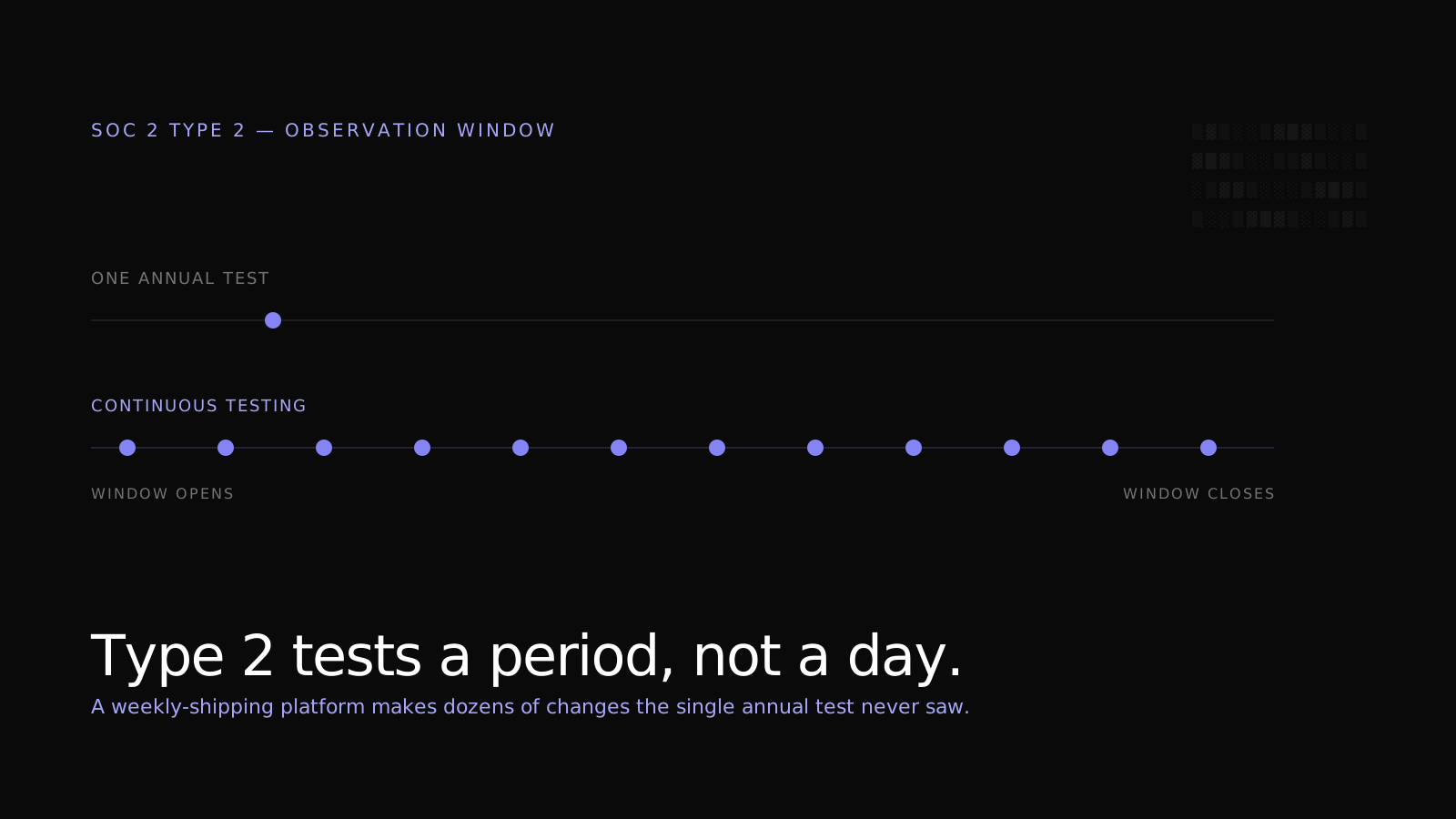
The arithmetic is unforgiving for a fast-shipping platform. A single annual test produces one evidence point in a twelve month window, while an insurtech shipping weekly makes dozens of material changes the test could not have seen.
Which SOC 2 Criteria Insurtech Penetration Testing Supports
SOC 2 is governed by TSP Section 100, the 2017 Trust Services Criteria with Revised Points of Focus, issued by the AICPA's Assurance Services Executive Committee. The 2022 update revised points of focus without altering the criteria themselves.
The criteria never name penetration testing. They also do not prescribe controls at all, since a service organization identifies its own controls that meet the criteria, which is why the same test can be evidence for several of them.
Criterion | What it covers | How a pentest evidences it |
|---|---|---|
CC4.1 | Evaluations of whether controls are functioning | Independent testing that proves controls hold or fail |
CC6 series | Logical access controls | Authorization testing across roles and tenants |
CC7.1 | Detecting configuration changes that introduce vulnerabilities | Findings tied to a specific change or deployment |
CC7.2 | Monitoring for anomalies and malicious activity | Whether the test's own activity was detected |
CC8.1 | Change management | Testing triggered by changes, with retest evidence |
CC9.2 | Vulnerabilities from vendor and partner relationships | Testing third-party integrations in scope |
The practical takeaway is that scope determines coverage. A test confined to the marketing site evidences almost none of these, while one covering the platform, its APIs, and its integrations touches most of the list.
CC7.2 deserves a note that most teams miss. Whether your monitoring caught the test is itself evidence, so a pentest that goes entirely unnoticed by your own alerting is a finding worth reporting.
Why NYDFS Annual Testing And SOC 2 Type 2 Evidence Windows Collide
The two regimes run on different clocks, and nobody synchronizes them for you.
NYDFS requires penetration testing at least annually under Section 500.5, with the compliance certification due each April 15 covering the prior calendar year. That is a calendar-year rhythm.
A SOC 2 Type 2 observation window is set by the company and its auditor, often running mid-year to mid-year to fit a customer's procurement deadline. The two periods rarely align.
Running one annual test to serve both means it sits well inside one window and awkwardly across the other. Testing that runs continuously sidesteps the scheduling problem entirely, because every window contains evidence regardless of where its boundaries fall. Our comparison of annual vs continuous testing under NYDFS covers the trade-off in detail.
What Insurtech Penetration Testing Should Cover
Insurtech platforms share an architecture, and that architecture has predictable failure modes. Scope the test around them rather than around a generic web application checklist.
Multi-tenant isolation
This is the highest-impact failure mode in insurtech and the one worth testing first. A platform serving multiple carriers, agencies, or MGAs holds their data in shared infrastructure, and the boundary between them is enforced in code. Our multi-tenant SaaS penetration testing guide covers the full test method.
The failure is almost always the same shape. An endpoint accepts a tenant identifier from the request, authenticates the caller, and never confirms that the caller owns the tenant it was handed.
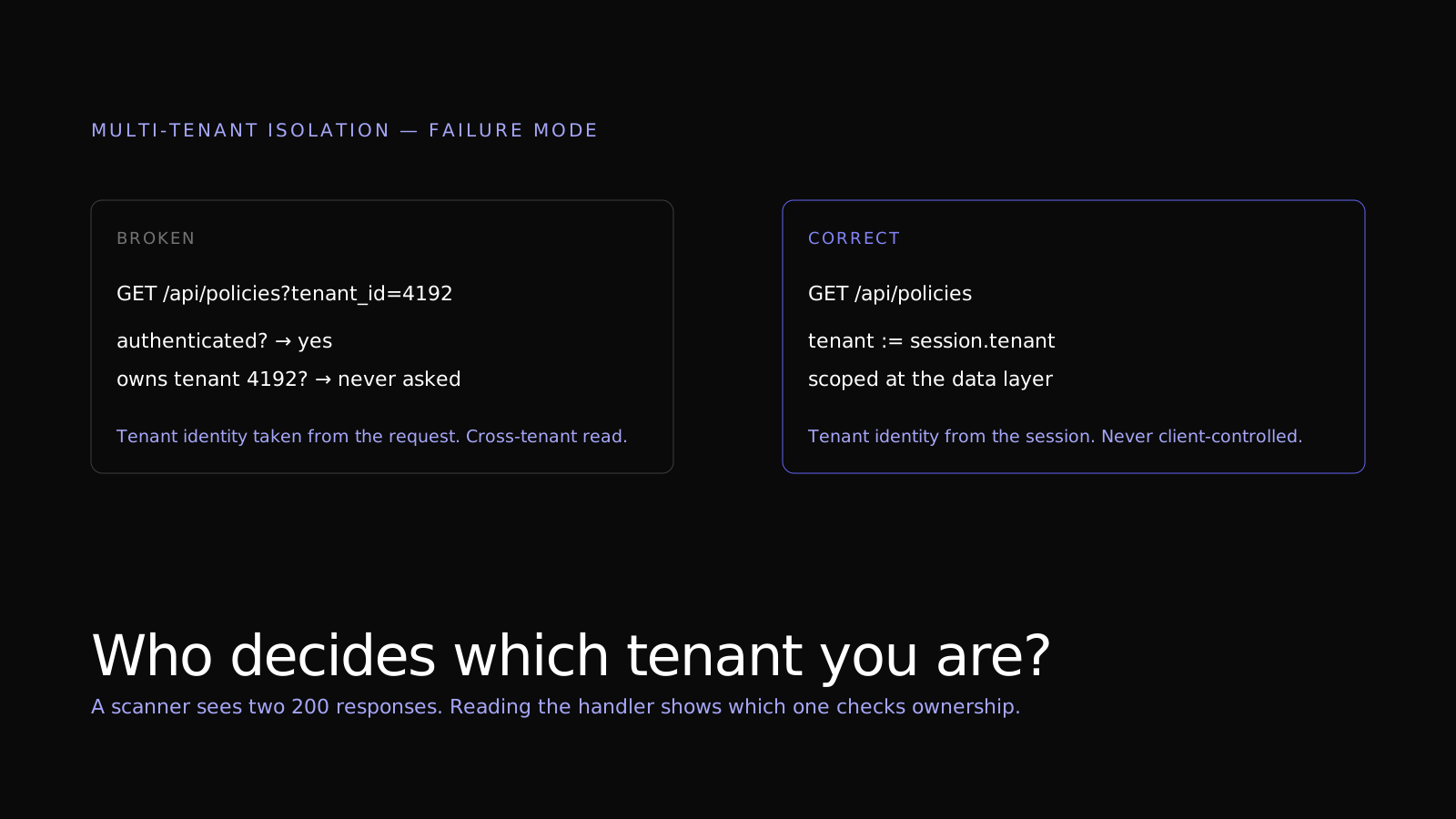
An external scanner cannot distinguish the two. Both return a 200 response, and only reading the handler reveals which one derives tenant identity from the session and which one takes it from the caller.
Rating and quoting engine logic
Rating engines encode business rules, and business logic flaws do not look like vulnerabilities to a scanner. Manipulated inputs that produce an artificially low premium, or a quote flow that discloses underwriting criteria, are logic problems rather than injection problems.
Testing here means abusing the workflow rather than fuzzing parameters. Reordering steps, replaying a prior state, and submitting values the interface would never allow are the techniques that surface it.
Policy and claims APIs
These carry the sensitive payload, and they fail through broken object level authorization. Enumerating policy or claim identifiers to retrieve records belonging to other policyholders is the single most common serious API finding.
The OWASP API Security Top 10 puts broken object level authorization at number one for good reason. Our API penetration testing guide covers the full test sequence.
Carrier and third-party integrations
Insurtech runs on integrations, with carrier systems, payment processors, data enrichment providers, and document services. Each is a trust relationship and each maps to CC9.2.
The questions are consistent. Where are those credentials stored, what happens to the data in transit, and can a compromised integration reach further into your platform than it should.
Cloud storage and document handling
Policy documents, claims attachments, and medical records in health lines end up in object storage. Misconfigured buckets and over-permissioned roles expose them without touching the application at all, which the cloud penetration testing guide covers in depth.
Embedded Insurance APIs: Pet, Travel and Checkout Distribution
Embedded insurance is coverage sold inside another company's checkout. Common examples are travel insurance offered in an airline or travel booking flow, and pet insurance sold through a pet retailer or vet platform.
The carrier or MGA never owns that checkout. Every quote, bind, and payment arrives through a partner's integration, which makes the API the actual storefront.
Where the attack surface sits
Partner API keys and how they're scoped. Each distribution partner authenticates with its own key or OAuth client. The risk is in what that credential can reach: other product lines, other partners' policies, or admin functions nobody meant to expose.
Quote-and-bind endpoints called from a third-party frontend. The partner's frontend calls these endpoints directly, so the carrier cannot trust any value the browser sends. Premium, coverage level, and eligibility have to be recalculated server-side on every request.
Webhook and callback endpoints that confirm policies and payments. These receive signals such as "payment captured" or "policy issued" from partners and payment processors. An unsigned or unverified callback lets an attacker confirm a policy that was never paid for.
Personal data passed from partner to carrier. Names, dates of birth, trip itineraries, and pet and owner details move between companies on every quote. For insurers, this is nonpublic personal information under GLBA, enforced by state insurance regulators. Our GLBA penetration testing guide covers what that means for testing.
What to test
Our API penetration testing guide covers the full test sequence. For embedded distribution, these checks carry the most weight.
Whether one partner can read another partner's policies by changing an identifier (BOLA/IDOR).
Whether a partner key can bind policies for products or partners outside its scope.
Whether editing the price or premium field in the quote request changes what gets bound.
Whether a captured webhook callback can be replayed to issue or confirm a policy twice.
Whether quote endpoints enforce rate limits, since scraping quotes to map pricing is a common abuse.
Whether a leaked partner key can be revoked quickly without breaking other partners' integrations.
Partner isolation is tenant isolation under a different name, because each partner behaves like a tenant. The multi-tenant SaaS penetration testing guide explains how to prove those boundaries hold.
Who owns the risk
Embedded distribution often spans three separate companies. The carrier underwrites the policy, an MGA may run the platform, and the distribution partner owns the checkout.
Each company can authorize testing only on the systems it owns. Testing a partner's frontend or callback handlers without written permission is unauthorized access, even when the carrier's own data flows through them.
That makes the contract the control. The distribution or program agreement should state:
who authorizes the pentest
which systems and environments are in scope
when testing can run
who receives the findings and who fixes them
Put those terms into a penetration testing scope of work. Collect sign-off from every system owner with a pentest authorization letter.
This also ties back to the SOC 2 table above. Testing partner integrations with documented authorization is the evidence CC9.2 asks for on vendor and partner risk.
How Continuous Insurtech Penetration Testing Actually Runs
Phase 1
Passive Recon
Maps your full attack surface, subdomains, open ports, exposed configs, and known CVEs, without touching your systems.


Passive Recon
App Intelligence
500+ Agents
Attack Chains
Evidence
For an insurtech platform, testing starts with the external surface and leaked credentials, then follows reachable flaws into a chained path to policyholder or tenant data, with researchers revalidating each step. Our walkthrough of how AI penetration testing traces a data leak end to end shows a full chain.
That chain often runs from an exposed staging host holding production-like policy data, through a leaked credential, into an API that trusts a client-supplied tenant ID. CC7.1 asks whether you detect the vulnerabilities your changes introduce, and a proven chain answers it directly.
What White Box And Gray Box Testing Add For Insurtech
White box testing reads the handlers, data access code, and cloud configuration behind the platform, and gray box testing uses that inside view to attack public routes the way an informed outsider would. For multi-tenant platforms, reading the handlers finds every endpoint that accepts a tenant identifier without checking ownership.
Our breakdown of black box, white box, and gray box testing covers where each mode fits.
Why Hours-Based Pentest Pricing Fails SOC 2 Type 2 Evidence
There is a structural problem beneath most compliance testing. The traditional engagement bills researcher hours, is paid upfront, and costs the same whether or not it finds anything critical.
That model optimizes for a clean report delivered on schedule. It has no particular reason to push a chain from stage three to stage four, which is the only stage that proves an exposure is real.
The mismatch with Type 2 is structural too. An engagement priced as a discrete project naturally happens once, while the report you are buying evidence for spans six to twelve months.
Outcome-based pricing inverts the incentive. Payment depends on finding a confirmed, critical, exploitable issue, so a shallow test earns nothing, and the economics of paying only when a test finds something real push the work all the way to a proven data leak.
How CodeAnt AI Supports Insurtech Penetration Testing For NYDFS And SOC 2
CodeAnt runs one testing program that serves both regimes. Continuous, code-aware testing re-examines the platform, its APIs, its integrations, and its cloud configuration as they change, so evidence accumulates across any observation window rather than landing on one date.
All three vantage points run as a single system. External reconnaissance and reachability from outside, a code and cloud threat model from inside, and gray box attacks that use the internal picture to drive an external intrusion.
For multi-tenant isolation specifically, reading the code identifies the exact endpoints that trust a client-supplied tenant identifier, then proves the cross-tenant read rather than reporting it as a possibility.
Findings arrive with a working proof of exploit, the code path behind it, a risk priority, and a retest. Each maps to the criterion it evidences, which is what turns a security report into an audit artifact. Our remediation and retest guide covers what each retest should prove.
The commercial model matches. You pay for confirmed critical exposure rather than hours, and the same program produces the NYDFS annual evidence and the Type 2 window evidence together.
For the wider regulatory picture, our compliance penetration testing guide covers SOC 2, PCI DSS, and HIPAA, and the pentesting page covers the offensive side. For a vendor comparison, see insurance pentesting tools compared.
Conclusion: Build Continuous Insurtech Penetration Testing Evidence
Insurtech penetration testing is not just about finding vulnerabilities before an audit. It is about proving that the platform protects policyholder data, tenant boundaries, claims workflows, broker access, rating logic, integrations, and cloud storage across the full period regulators and customers care about.
The challenge is that NYDFS and SOC 2 Type 2 ask for different evidence shapes. NYDFS creates an annual penetration testing and certification rhythm. SOC 2 Type 2 asks whether controls operated effectively across a 6 to 12 month observation window. A single annual engagement may satisfy the first better than the second. Continuous, code-aware penetration testing creates a stronger record because evidence accumulates as the platform changes.
For insurtech teams, scope is everything. Testing should prioritize multi-tenant isolation, policy and claims APIs, broker portals, rating and quoting logic, carrier integrations, payment integrations, and cloud storage. Those are the places where policyholder data actually leaks and where generic web app testing is least likely to be enough.
Treat insurtech penetration testing as a continuous evidence program, not a one-time compliance project. Start with the systems that expose policyholder or tenant data, validate real exploit paths, retest every fix, and map each finding to the SOC 2 criteria and NYDFS evidence your auditors will actually ask for.
That is the model CodeAnt runs, priced on what it proves rather than the hours it takes.
Launch a free black box scan for one URL to see your exposed surface the way an adversary maps it, then book a walkthrough to see continuous, code-aware testing chained through to a proven data leak and mapped to your SOC 2 criteria. For the regulatory groundwork, start with our NYDFS penetration testing requirements guide.

