

Every insurer licensed in New York knows the annual penetration test is mandatory. Fewer notice that the same regulation quietly asks for more than once a year, and that gap is where the continuous-versus-annual decision actually lives.
This guide compares the two testing models for a NYDFS-regulated insurer, grounded in what 23 NYCRR 500 says, with cost and evidence weighed side by side. It closes on which model fits which insurer. For the wider insurer picture, see our insurance penetration testing guide.
What CodeAnt AI solves here: CodeAnt AI runs continuous, code-aware penetration testing that satisfies the NYDFS annual requirement, covers the after-change testing obligation as code ships, and keeps a live evidence trail for the April certification. Pricing is outcome-based, charging only for confirmed critical exposure.
Short answer: annual testing meets the letter of Section 500.5(a)(1) and little else. Continuous testing meets the annual requirement, covers the after-material-change obligation in 500.5(a)(2), and keeps evidence current year-round, which is why insurers that ship frequently are moving to it.
I reviewed the current text of 23 NYCRR 500 and vendor documentation on July 27, 2026. This is a compliance and capability comparison, not legal advice.
Continuous Vs Annual Penetration Testing At A Glance
The two models differ on more than frequency. They differ on what they can prove and when.
Dimension | Annual pentest | Continuous testing |
|---|---|---|
NYDFS 500.5(a)(1) annual test | Satisfied | Satisfied |
500.5(a)(2) after material change | Not covered between tests | Covered as changes ship |
Evidence currency | Accurate on test day, ages after | Current year-round |
Coverage of new APIs and portals | Next annual cycle | On the next scan |
Certification readiness | Reconstructed before April 15 | Accumulated continuously |
Billing model | Fixed fee per engagement | Subscription or outcome-based |
Best fit | Static systems, infrequent change | Frequent releases, insurtech |
For the general version of this comparison outside NYDFS, see our annual vs continuous pentesting comparison.
What NYDFS 23 NYCRR 500.5 Requires For Penetration Testing
The obligation is not a single annual event, and reading it that way is the common mistake. Section 500.5 has two testing limbs, and only one of them is annual.
The first requires penetration testing from both inside and outside the system boundary at least annually. The second requires automated vulnerability scans plus manual review at a risk-based frequency, and promptly after any material system change.
The full breakdown sits in our NYDFS penetration testing requirements guide.
That second limb is the one an annual test cannot satisfy on its own. It is the reason this comparison matters for compliance, not only for security.
What Annual Penetration Testing Gives NYDFS-Regulated Insurers
The annual model is a scheduled, point-in-time engagement. A tester scopes the environment, runs the assessment over a fixed window, and delivers a report, once a year.
Its strengths are real. A focused annual engagement can go deep on the scoped systems, it produces a clean artifact for the file, and it satisfies the explicit 500.5(a)(1) requirement without ambiguity.
Its weakness is time. The report is accurate on the day it is written and starts aging with the next deployment, so a vulnerability introduced in March sits unvalidated until the following year's test.
For an insurer shipping continuously, that is most of the year uncovered.
What Continuous Penetration Testing Gives NYDFS-Regulated Insurers
The continuous model re-examines the surface as it changes rather than on a calendar. Each new endpoint, integration, and configuration is tested as it ships, and findings, fixes, and retests accumulate into a live record.
Its strengths map directly onto the parts of 500.5 an annual test misses. It covers the after-material-change obligation automatically, it keeps evidence current for the certification, and it shortens the window between a vulnerability being introduced and being caught. The FTC's rule goes further and accepts continuous monitoring outright, as our GLBA Safeguards Rule testing breakdown explains.
The trade-off is that continuous testing depends on automation to sustain the cadence, which is where depth quality matters. Automation that only runs shallow scans does not satisfy the spirit of a penetration test, which is why the testing process and the depth behind it decide whether the model actually works.
Why The NYDFS Material Change Clause Favors Continuous Testing
Here is the specific language that settles it for most insurers. Section 500.5(a)(2) does not just ask for periodic scanning, it requires testing promptly after any material system change, and the risk assessment must be updated whenever a change in business or technology materially alters cyber risk.
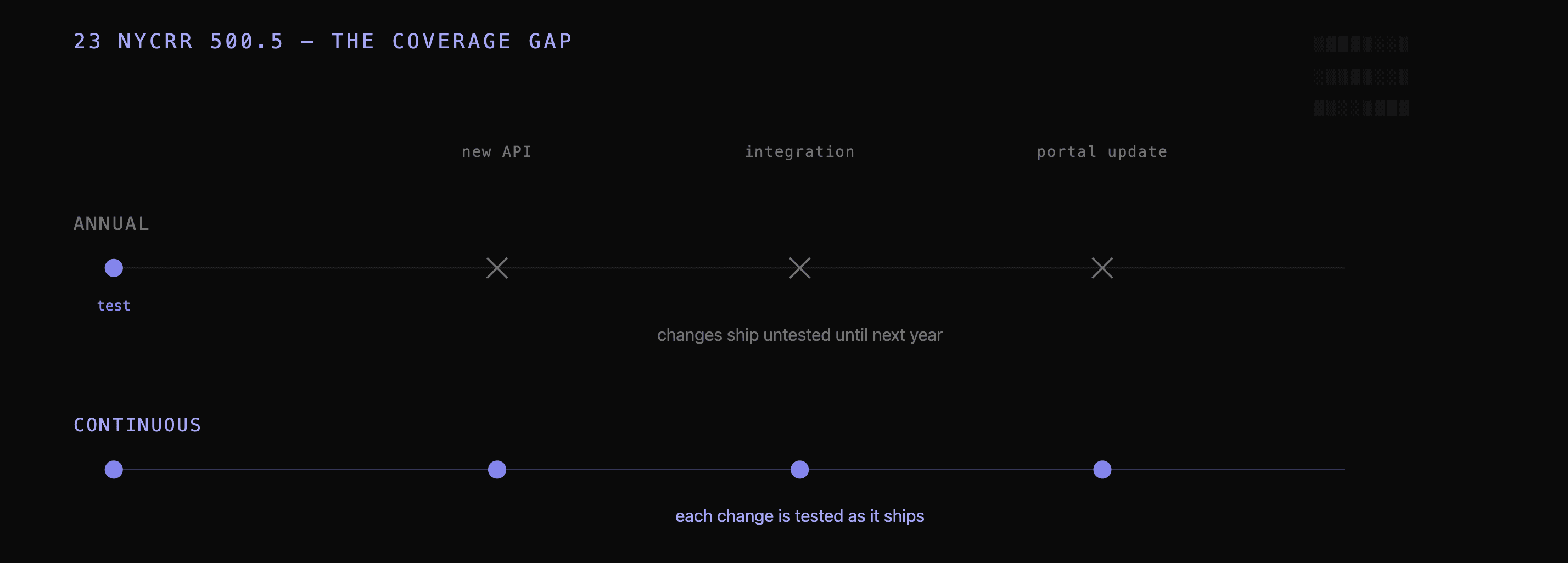
A material change is not rare for an insurer. A new claims API, a policy-administration migration, a broker-portal redesign, or a cloud re-architecture each qualifies, and each triggers an obligation the moment it ships. Our API penetration testing guide covers how to test a new claims or policy API as it ships.
An annual test scheduled months earlier cannot have covered it.
That is the crux. If your systems rarely change, an annual test plus scanning can be defensible.
If you ship frequently, the after-change clause makes a continuous cadence the cleaner path to demonstrable compliance.
Continuous Vs Annual Penetration Testing Cost And Evidence
The budgeting question is not simply a fixed fee versus a subscription. It is what each model costs to keep you compliant across a full year, and what evidence each leaves behind.
Factor | Annual pentest | Continuous testing |
|---|---|---|
Headline cost | One engagement fee | Subscription, or outcome-based per finding |
Retesting | Often billed separately | Typically included |
After-change testing | Extra engagements as needed | Included in cadence |
Evidence for examiner | One dated report | Continuous findings and retest log |
Hidden cost | Months of unvalidated change | Requires depth to be meaningful |
The evidence column is where regulated insurers should focus. When a DFS examiner asks what changed since the last test and how it was validated, an annual snapshot has no answer for the intervening months, while a continuous log answers directly.
Our penetration testing cost guide breaks down the pricing models, and the PTaaS explainer covers the subscription structure.
How Continuous Penetration Testing Actually Runs For Insurers
Continuous does not mean shallow. A serious continuous program runs the same disciplined process as a strong annual engagement, just triggered by change instead of a calendar.
It starts with reconnaissance that maps the external surface, exposed portals, and leaked credentials, moves through service discovery and reachability to find what an attacker can touch, then chains findings into a proven path to policyholder data.
Researchers revalidate every finding, and the output is evidence, a working proof of exploit with the code path behind it and a retest. Our walkthrough of how AI penetration testing traces a data leak shows a full chain.
The depth comes from reading the code. Because it inspects the application and cloud from the inside as well as the outside, code-aware testing finds the authorization gaps and misconfigurations that cause insurer breaches, across black, white, and gray box modes.
That depth is what keeps a continuous cadence from degrading into a scan.
Should NYDFS-Regulated Insurers Choose Annual Or Continuous Testing?
The decision follows from how often your systems change and what you must prove. This maps the common situations.
Your situation | Model | Reason |
|---|---|---|
Legacy systems, infrequent releases | Annual plus scanning | Change is slow enough for a yearly snapshot |
Insurtech shipping weekly | Continuous | The after-change clause fires constantly |
Preparing SOC 2 Type 2 alongside NYDFS | Continuous | Evidence must span the observation window |
Small book, limited surface | Annual, with scans after changes | Cost-proportionate if change is rare |
Frequent portal and API updates | Continuous | New endpoints need testing as they ship |
Examiner focus on after-change testing | Continuous | Produces the intervening-months evidence |
For most insurers with a modern stack, the honest answer is a continuous program that also produces the annual artifact, because it satisfies both limbs of 500.5 at once. For a static environment, a well-scoped annual engagement plus disciplined scanning still holds.
Teams running SOC 2 in parallel should read our insurtech NYDFS and SOC 2 guide.
How To Move From Annual Pentesting To Continuous Penetration Testing
Switching models should not create a compliance gap of its own. A clean transition keeps evidence unbroken.
Baseline first: Run a full assessment to establish the starting state, then let continuous testing maintain it.
Map findings to controls from day one: Ensure the continuous log produces 500.5 and certification evidence, not just tickets.
Keep the annual artifact: A continuous program should still generate a dated annual report for the file.
Confirm the evidence format: Check what your examiner expects before you rely on the continuous log at examination.
The provider evaluation framework and pentest retest guide give you a checklist for the transition.
Conclusion: Use Continuous Testing When NYDFS Evidence Must Stay Current
For a NYDFS-regulated insurer, the continuous-versus-annual question is settled less by preference than by Section 500.5 itself. The annual test satisfies one limb of the rule, and the after-material-change clause in the second limb is what an annual cadence cannot reach.
If your systems barely change, annual testing with disciplined scanning is defensible. If you ship frequently, continuous testing is the cleaner route to demonstrable compliance, because it covers both limbs and keeps the evidence current instead of reconstructed.
Treat continuous penetration testing as the evidence layer for fast-changing NYDFS-regulated systems. Start with a baseline assessment, keep the annual report for the file, then test every material portal, API, cloud, and integration change as it ships so your evidence stays current instead of reconstructed before certification.
That is the model CodeAnt runs, continuous and code-aware, priced on what it proves rather than the hours it takes.
Launch a free black box scan for one URL to see what continuous testing surfaces, then book a walkthrough to see testing mapped to both limbs of your NYDFS obligation. To compare continuous testing vendors, see the best pentest tools for insurers.

