

The best Hadrian alternative depends on the product being replaced. Atlas maps and validates an external attack surface; Nova runs an on-demand agentic pentest for €3,000 per test.
EASM is the closest fit when unknown external assets drive the purchase. Autonomous testing fits teams that need exploit evidence, while PTaaS provides human judgment and attestations.
For application teams, CodeAnt’s agentic pentesting product connects multiple test depths with code-to-runtime attack-path analysis. Shortlist it when the protected surface is your software estate.
Keep an EASM-first product in the evaluation when the scope includes internet-wide discovery across subsidiaries and unknown infrastructure.
TL;DR
Alternative | Best fit | Main boundary | Public pricing visible as of July 31, 2026 |
|---|---|---|---|
CodeAnt AI | Code-informed application, API, cloud, and dependency validation | Not positioned here as a universal replacement for broad internet asset discovery | Current platform plans published; pentest pricing is outcome-based |
External exploit validation with internal and cloud expansion | Broader platform evaluation and sales process | Quote required | |
watchTowr | Continuous external discovery, validation, and emerging-threat response | Focused on the external attack surface | Quote required |
Horizon3.ai NodeZero | Autonomous internal, external, cloud, and Kubernetes attack paths | Internal testing needs a host inside the environment | Quote required |
Detectify | EASM plus web-application and API DAST | Deeper products are priced per domain or target | €0–€15,000 annual platform fee, plus product usage |
Vulnerability and exposure management for a lean team | Lower tiers restrict asset discovery and monitored ports | Free plan; paid plan amount depends on targets | |
Human-led PTaaS, collaboration, and attestations | Engagement capacity rather than continuous autonomous external validation | Quote-based tiers; $3,500 promotional autonomous test |
This list is ordered by buyer job rather than a mixed-scope score. It compares discovery and exploit proof before examining deployment and remediation.
Retesting and pricing complete the evaluation.
Use the broader AI penetration-testing platform comparison when autonomous testing, rather than EASM, is the primary category.
What Hadrian actually includes in 2026
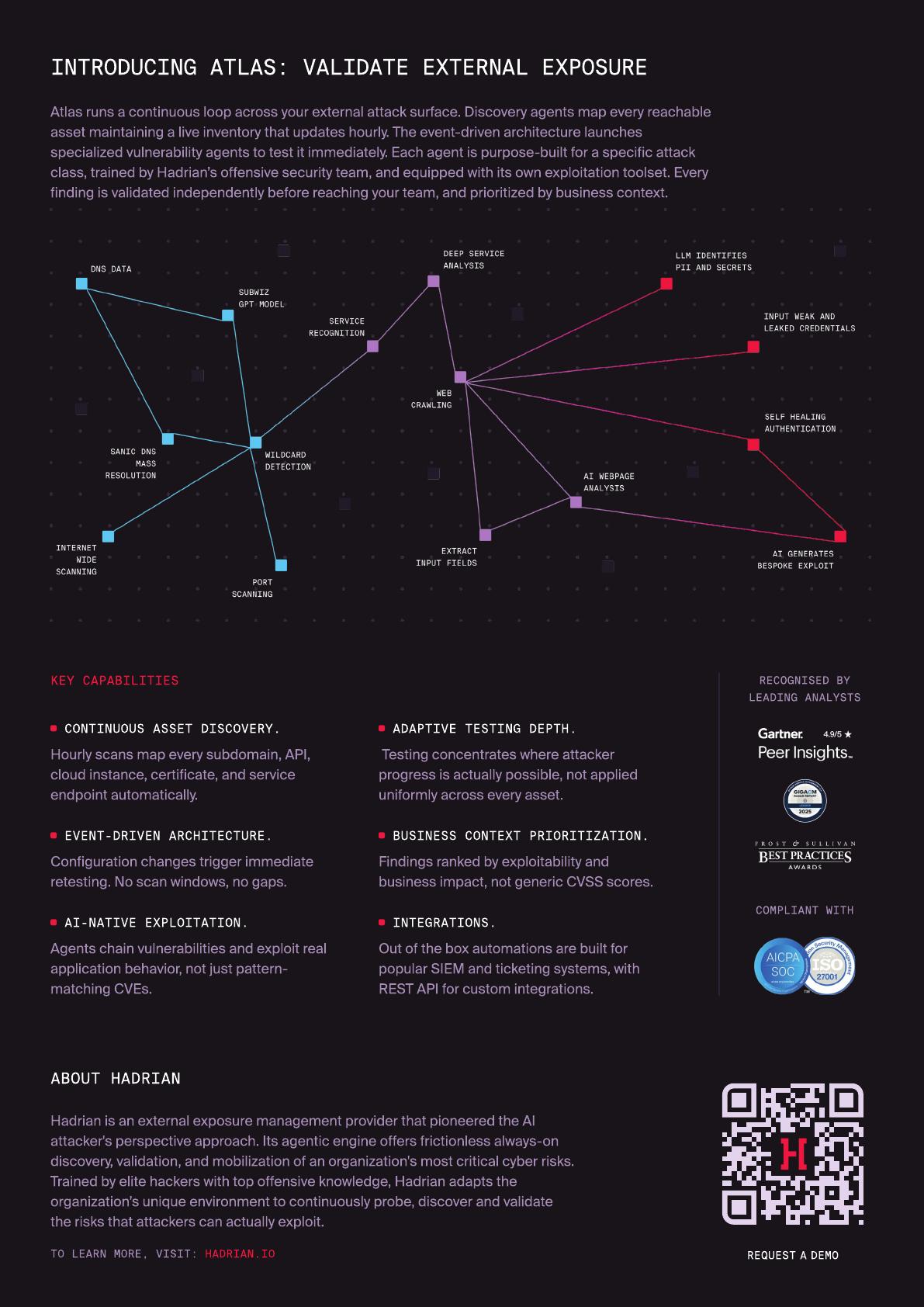
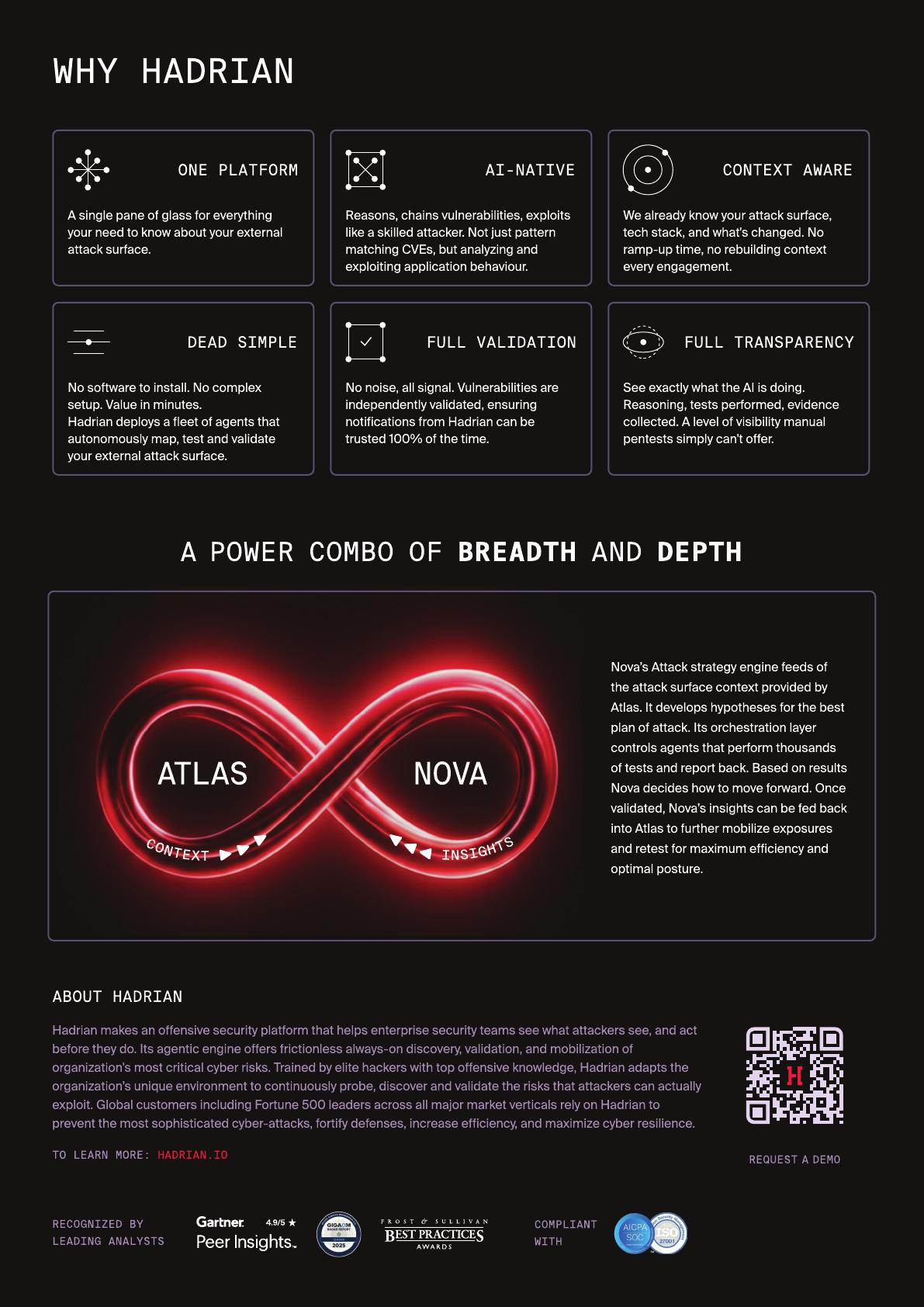
Atlas is a cloud-delivered external exposure-management product, not a standard vulnerability scanner. Its official description starts with mapping internet-facing assets and reasoning across application behavior.
Atlas then validates exploitable exposure. It reruns relevant tests when the attack surface changes.
Atlas pricing is based on total asset count. M&A assessment and infostealer credential-leak detection are add-ons.
Nova is a separate on-demand agentic pentest listed at €3,000 per test, with bundles available. Its reports map findings to SOC 2 and ISO 27001 requirements as well as NIS2.
Hadrian’s terms define one Nova target as an external web application identified by a single target URL. That scope is narrower than continuous external coverage across a changing estate.
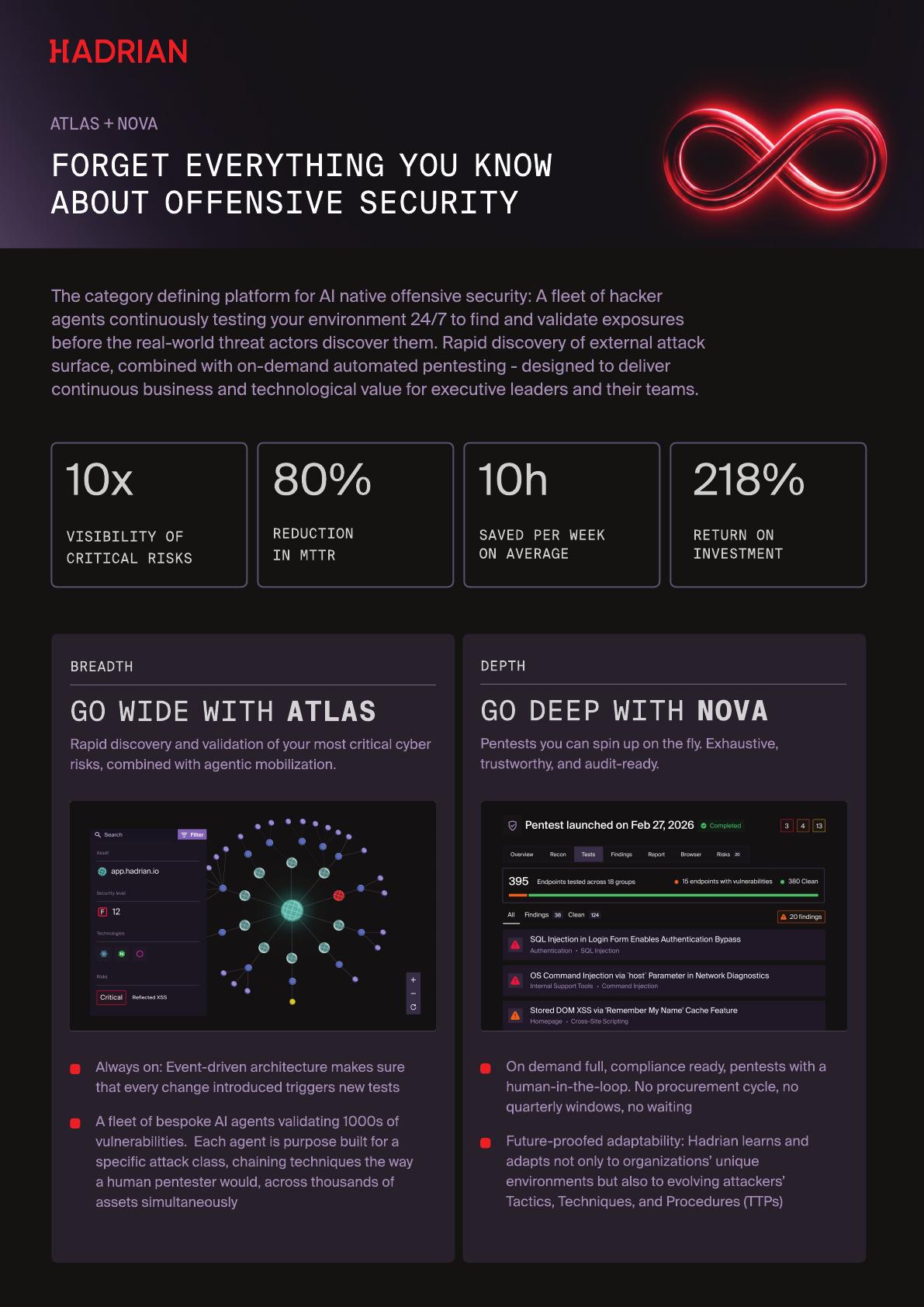
This packaging creates two distinct replacement decisions. A buyer may replace Atlas’s continuous outside-in discovery or Nova’s repeatable application pentests.
Replacing both does not require one product. Different tools can cover each job.
Start by deciding whether you are replacing a continuous or annual pentesting cadence. Then examine how AI penetration testing works, because one product may apply AI only to prioritization or payload generation.
Another may use it to orchestrate workflows or chain attacks autonomously. Some systems keep a human in the execution loop.
Hadrian’s documented onboarding is agentless. A customer supplies initial domains before Hadrian expands and monitors the external map.
Testing runs from Hadrian’s infrastructure.
During a pilot, inspect asset attribution before active testing begins. Use an external penetration-testing methodology to document authorization for newly discovered assets.
Coverage overlap: what a Hadrian alternative can replace
Separate “exposure management” into four layers. The split follows the practical boundary between defensive and offensive security: inventory and severity do not establish what an authorized attacker can achieve.
Discovery: Find externally visible assets, including domains, infrastructure, cloud resources, certificates, and shadow IT.
Assessment: Fingerprint services and identify vulnerabilities, configuration weaknesses, exposed files, and unsafe application behavior.
Validation: Execute controlled actions that prove exploitability or connect weaknesses into an attack path.
Remediation: Route evidence to an owner, verify the fix, and preserve the report for its intended audience.
The OWASP Web Security Testing Guide structures application test areas, while the OWASP Application Security Verification Standard defines verifiable requirements. Neither turns a scanner into a pentest, but both expose coverage gaps.
DAST and autonomous pentesting overlap without being equivalent. A DAST scanner can crawl and fuzz a running application.
An offensive validation product can make sequential decisions and use credentials after an initial foothold. It may then pivot to demonstrate downstream impact.
The distinction in AI pentesting versus traditional DAST is whether the output proves a path or reports an isolated finding.
Prioritization can draw on signals that answer different questions. CVSS describes severity, while FIRST’s EPSS model estimates exploitation probability.
The CISA Known Exploited Vulnerabilities Catalog identifies CVEs with evidence of exploitation in the wild.
CodeAnt’s EPSS-based prioritization surfaces that signal inside an engineering workflow. Ask each vendor whether its rank also includes asset importance and validation evidence.
7 best Hadrian alternatives at a glance
Product | External discovery | Active validation | Internal/cloud expansion | Human testing option | Best reason to shortlist |
|---|---|---|---|---|---|
CodeAnt AI | Application attack surface | Agentic black-, gray-, and white-box testing | Code, dependency, IaC, and cloud context | Not the central operating model | Connect findings from source to runtime and remediation |
Pentera | Internet-facing assets and services | External attack paths in production guardrails | Separate internal and cloud modules | Not the central operating model | Validate initial access and expand across environments |
watchTowr | Continuous external discovery | Automated red-team testing and emerging-threat checks | External focus | Offensive research supports the platform | React quickly to new external exposures |
NodeZero | Passive external discovery | Autonomous external and internal attack paths | Internal, AWS, Azure, Kubernetes | Not the central operating model | Show path, proof, impact, and fix verification |
Detectify | Domains, subdomains, IPs, ports, technologies | Payload-based web and API testing | Internal scanning agents | Research community contributes tests | Combine EASM and DAST for web-heavy estates |
Intruder | External and cloud asset discovery by plan | Vulnerability scanning and AI web-app pentests | Cloud, container, and internal scanning by plan | Expert services available | Run broad exposure workflows with a small team |
Cobalt | ASM available in higher packages | DAST plus scheduled pentests | Web, mobile, API, network, cloud, AI/LLM scopes | Core operating model | Put human pentesters and developers in one workflow |
7 best Hadrian alternatives in 2026
1. CodeAnt AI — code-informed application and cloud validation
CodeAnt combines agentic penetration testing with a unified code-security layer. It connects runtime evidence to repositories and dependencies, then adds context from secrets and infrastructure as code.
Endpoint and cloud-configuration findings extend that context into the deployed environment.
Its public pentesting workflow supports multiple testing depths and returns an audit-grade PDF report. The documented workflow has a 48-hour report window and routes findings to development tools.
Fix reverification closes the workflow after remediation.
Verified strengths
SAST adds source-level evidence, while software composition analysis identifies dependency risk. IaC scanning checks infrastructure definitions before deployment, and secret scanning detects exposed credentials in code.
Cloud-configuration analysis can connect a code change to a reachable runtime path. Security gates then bring the remediation decision into the pull request and CI/CD workflow.
Buyers can choose black-box depth for a test without credentials. Gray-box access adds limited knowledge, while white-box access exposes source and architecture.
This guide to pentest access models explains how each additional level of access changes the test.
Teams testing every release should compare continuous pentest tools for CI/CD. Trigger and retest mechanics determine whether developers receive current evidence.
Where it stops
Choose another platform when the primary job is internet-wide discovery across acquired companies and brands. The same applies when third-party infrastructure is a major part of the scope.
CodeAnt focuses on the software context behind an application and its cloud path rather than universal asset discovery.
Source-code analysis in penetration testing exposes causes and paths that black-box reconnaissance cannot inspect.
When to choose CodeAnt AI
Choose it when engineering owns remediation and needs evidence from source to runtime exploit. It also connects code review and penetration testing instead of producing separate reports.
2. Pentera — external validation with internal and cloud expansion
Pentera Surface tests internet-facing assets and interfaces from an outside-in position. Official materials say it uses vulnerabilities and misconfigurations to build external attack paths.
Exposed services and leaked credentials can also contribute to a path that proves initial access and impact.
The wider platform extends the test through separate products. Core covers internal networks, while Cloud covers cloud and identity paths.
Resolve handles remediation orchestration.
Verified strengths
External attack-path validation reaches beyond an inventory-focused EASM view. Customer-controlled guardrails provide scoped testing and throttling before production tests begin.
Impact limits and an emergency stop constrain execution. Audit logs record the activity.
Credential and identity testing checks whether leaked credentials create reachable external paths. Pentera’s external module can hand the test to its internal and cloud products when a pilot must cross the perimeter.
A cloud pentest checklist can keep that expansion within its authorized scope.
Where it stops
Pentera says Surface is not a CSPM or CNAPP; it validates internet reachability rather than cloud posture. Pair it with AppSec tooling for repository causes or pull-request gates.
Dependency ownership also sits outside this external validation workflow.
Pricing requires a sales conversation.
When to choose Pentera
Choose Pentera for active external proof that can expand into internal or cloud attack paths. Use a written penetration-testing process to assess guardrails and stop conditions.
The same process should define cleanup behavior and evidence handling.
3. watchTowr — continuous external exposure and rapid reaction
watchTowr divides its external-security workflow among three components. Adversary Sight maps external assets and changes before the Automated Red Teaming engine tests weaknesses.
Rapid Reaction turns emerging-threat research into customer exposure checks.
Verified strengths
The platform is built around changing external assets rather than a manually maintained target list. Its intelligence layer combines vulnerability research with observed attacker behavior.
Campaign context and exploitation signals add evidence about active threats.
Findings are available in the dashboard and through APIs. Exports align the results with CVSS and MITRE ATT&CK.
The emphasis on emerging vulnerabilities suits teams that already use the MITRE ATT&CK knowledge base to connect technical findings to adversary behavior.
Where it stops
watchTowr’s public abuse page describes routine EASM scanning as non-intrusive and says it does not send exploit payloads. The customer platform separately provides automated red-team validation.
During a pilot, record which engine produced each finding and which authorization governed the active step. Pricing is quote-based.
When to choose watchTowr
Choose watchTowr when external change and newly weaponized vulnerabilities drive the program. Add response steps to an automated pentesting checklist instead of measuring dashboard speed alone.
4. Horizon3.ai NodeZero — autonomous internal and external attack paths
NodeZero runs autonomous pentests across external and internal environments. Separate test surfaces cover cloud environments and Kubernetes.
External tests run from Horizon3.ai’s cloud, while internal tests use a Docker host or virtual appliance inside the environment. The platform chains weaknesses to show proof and impact.
It also supplies fix actions and reruns tests to verify remediation.
Verified strengths
Passive external discovery precedes an explicit authorization step, which helps prevent accidental testing of third-party assets. External and internal tests can then show whether a perimeter foothold leads to material internal impact.
Internal operations cover credential attacks and misconfigurations. Tests can also expose data or follow paths that do not depend on a CVE.
Cloud and identity testing support hybrid evaluations. A focused guide to AI pentesting across major cloud providers helps define authorization and identity questions for that scope.
Where it stops
NodeZero is closer to an autonomous pentesting platform than a pure EASM inventory. Teams focused on discovery should test its coverage of asset ownership and brand exposure separately.
Certificate monitoring and third-party mapping require the same explicit evaluation.
Internal coverage requires a test host, unlike Hadrian’s external agentless service.
When to choose NodeZero
Choose NodeZero to test whether an external weakness creates downstream impact. Define proof in a penetration-test retest procedure so “fixed” means the path no longer executes.
5. Detectify — EASM plus web and API DAST
Detectify defines its platform as external attack-surface management plus dynamic application security testing. Surface Monitoring tracks internet-facing assets, while Application Scanning crawls and fuzzes web applications.
API Scanning tests REST and GraphQL endpoints. Separate agents cover internal applications.
Verified strengths
The discovery layer and application scanner are designed to work together for web-heavy estates. Payload-based tests come from Detectify’s research team and a vetted ethical-hacker community.
Authenticated testing covers signed-in application surfaces, while API scan profiles configure endpoint testing. PCI ASV scanning supports the corresponding compliance workflow, and CI/CD integrations connect scans to delivery pipelines.
Teams comparing scan types can use this SAST and DAST tool guide to identify the source and runtime layers that remain outside Detectify.
Where it stops
Detectify’s strongest overlap covers web applications and APIs. Domain exposure provides the discovery layer around those targets.
Buyers seeking autonomous lateral movement through internal networks or multi-step infrastructure attack paths should validate that expectation separately.
Product usage is additional to the annual platform fee.
Pricing and when to choose Detectify
As of July 31, 2026, Detectify lists Starter at €0 and Standard at €2,500 per year. Professional costs €5,000 per year, while Enterprise costs €15,000.
The three scanning modules add per-domain or per-target costs. Choose Detectify when web and API coverage is central and a SAST-versus-DAST boundary is acceptable.
6. Intruder — exposure management for lean security teams
Intruder combines attack-surface monitoring with vulnerability management in a plan-based platform. Higher plans extend that foundation into cloud posture checks and web or API DAST.
Container and internal scanning add coverage behind the perimeter.
Its attack-surface product discovers subdomains and exposed services. Cloud connectors can start scans when infrastructure changes.
Verified strengths
Cloud connectors reduce the lag between provisioning an asset and adding it to a scan. Intruder can run Emerging Threat Scans or scheduled scans.
Change monitoring provides another trigger when infrastructure moves.
The current free plan includes weekly external checks for five infrastructure targets. A 14-day trial exposes Cloud-plan functionality for five targets.
Pro and Enterprise add internal scanning and broader port coverage. They also introduce access controls and deeper attack-surface features.
Where it stops
Lower plans restrict port monitoring and omit the Enterprise plan’s automated shadow-IT discovery. Vulnerability scanning and an AI web-application pentest are distinct workflows; a scanner finding does not prove an attack path.
Use the types of penetration testing to define that boundary in the evaluation.
When to choose Intruder
Choose Intruder when a small security or IT team needs broad exposure monitoring with cloud synchronization. Its remediation guidance can support teams that do not operate a dedicated validation program.
Use automated pentesting mistakes to keep scanner findings separate from DAST results and pentest reports.
7. Cobalt — human-led PTaaS with a modern delivery platform
Cobalt’s core model is penetration testing as a service. Human pentesters execute scoped tests while findings and collaboration live in a SaaS platform.
The same platform handles retesting and integrations before producing reports. Engagements can cover applications and infrastructure as well as cloud environments or AI and LLM systems.
Higher packages add attack-surface monitoring and DAST.
Verified strengths
Human testers can investigate business-logic flaws and ambiguous application behavior that need judgment. Developers can discuss a finding in the platform or Slack, then send work to Jira or GitHub.
Paid tiers include free retesting for six or twelve months, depending on package. Compare those start and retest commitments with a written PTaaS service-level agreement.
The credit model lets a program allocate purchased testing capacity across engagements. The PTaaS delivery model explains why that differs from an autonomous continuous platform.
Where it stops
Cobalt scales through engagement credits and tester capacity, not autonomous validation of an unknown external estate. Buyers replacing Atlas should verify discovery breadth and event-driven retesting independently.
Pricing and when to choose Cobalt
The three main tiers are quote-based. Cobalt also lists a $3,500 promotional Autonomous Pentest for web applications, with completion required by December 31, 2026.
Choose Cobalt when the required output is a human-led test delivered with a named testing team and an attestation-ready report.
Use the pentesting vendor evaluation guide to compare tester qualifications and start times. It also defines questions for retesting commitments and evidence quality.
How to choose a Hadrian alternative
Run a bounded pilot against the same authorized assets and score the evidence, not the demo vocabulary.
Define the protected surface
Record domains and IP ranges separately from applications and APIs. Cloud accounts and repositories also need distinct ownership because a vendor may discover them through different mechanisms.
Apply the same ownership test to subsidiaries and third-party services.
Measure discovery
Seed each EASM candidate with the same identifiers. Review attribution errors and the approval flow before authorizing active testing against anything the tool discovers.
Set the proof threshold
Decide whether a version match or payload response is sufficient evidence for each finding. Higher-risk conclusions may require an authenticated action or a complete attack path.
A working proof of concept sets an even higher proof threshold.
Inspect safety controls
Document scope exclusions and rate limits before the test starts. The candidate should also expose stop controls and audit logs.
Cleanup behavior needs a named authorization owner.
A pentest authorization guide helps separate legal permission from a statement of work.
Test remediation routing
Send one finding to the engineering workflow and preserve its evidence. After the fix, rerun the relevant check and confirm that the retest closes the demonstrated path.
Compare cost units
Normalize asset counts and target counts against the expected testing cadence. Then add the annual platform fee and any add-ons.
Pentest credits and per-test charges complete the cost model.
A penetration-testing cost model prevents a low platform fee from hiding target or engagement charges.
Check reporting
Give the same output to an engineer and a security leader. The owner of audit evidence should review it separately.
Each recipient should be able to act without translating the report by hand.
Use CodeAnt’s public pentest sample report as an evidence checklist. The candidate’s output should document scope and reproduction steps before explaining impact.
Remediation detail and a clear retest result are more useful than a severity label by itself.
For AI-led products, use this AI pentesting provider checklist to identify what the agent can execute and which actions require approval. It should also document evidence capture and false-positive handling.
Human oversight needs a defined point in the workflow.
For continuous programs, add the governance and retesting requirements in this continuous pentesting guide.
A team can assign external change to watchTowr and internal attack paths to NodeZero. Cobalt can deliver the human-led assessment, while CodeAnt connects application code to runtime validation.
Document the trigger and owner for each tool. Add its expected output and the condition that ends the workflow so findings do not remain open between systems.

