

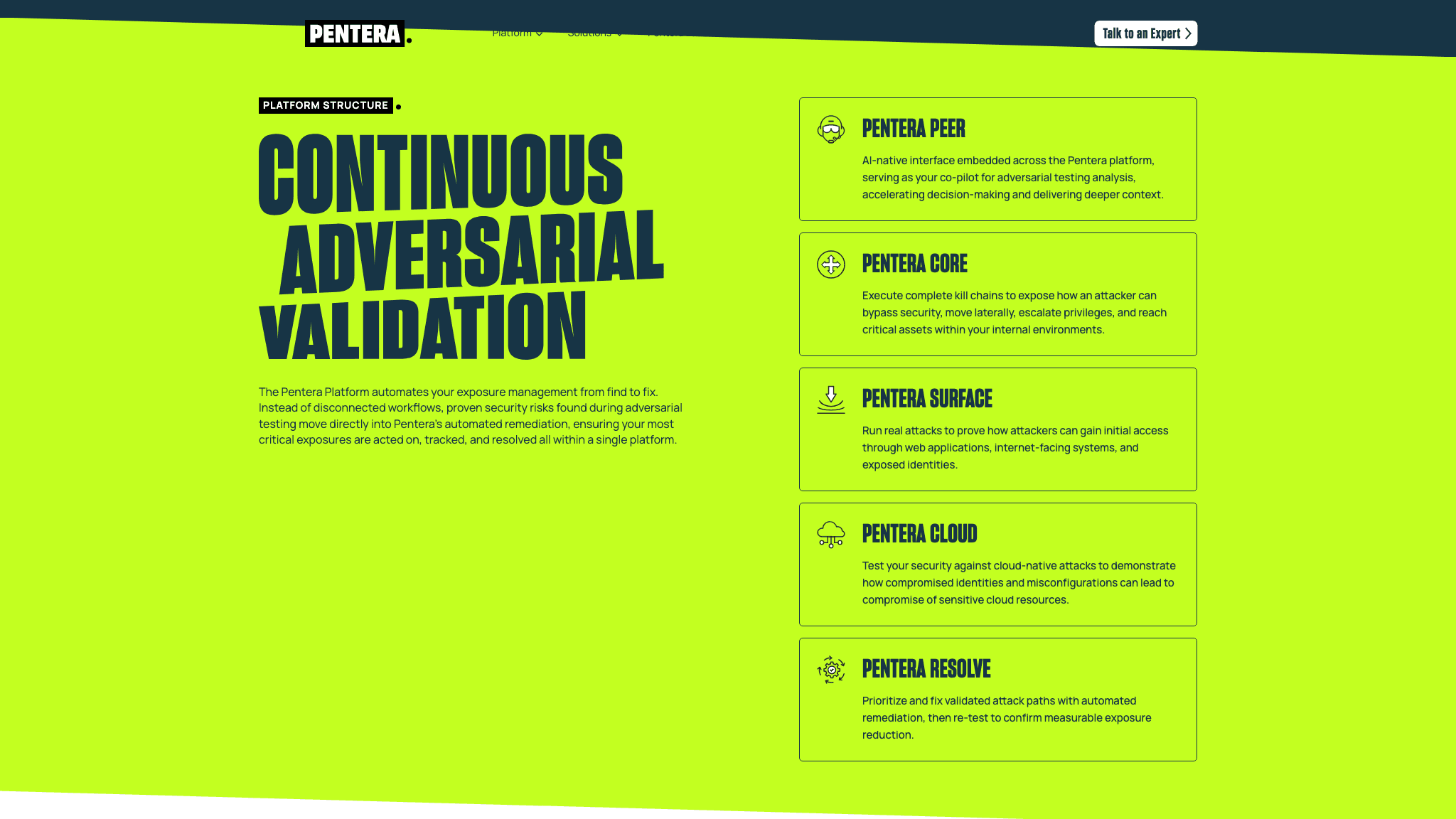
Pentera automates security validation across internal networks, internet-facing assets, and cloud environments. Its product line divides by job: Core tests internal movement, Surface tests external entry points, Cloud tests cloud and hybrid paths, and Resolve manages remediation and retesting.
Pentera is closer to an attack-path validation platform than a conventional vulnerability scanner. It attempts controlled techniques, records the steps that succeed or fail, and can repeat the same test after a team changes a credential, configuration, or security control.
In brief: Pentera Core covers internal networks and Active Directory; Surface covers internet-facing exposure; Cloud covers AWS, Azure, and hybrid attack paths; and Resolve covers remediation operations. Pentera Peer provides a natural-language interface for findings and test planning. The MCP server lets other AI security workflows call Pentera validation.
The platform is strongest when a team needs evidence that several weaknesses can be chained into a working attack path. Buyers should also account for private pricing, an enterprise-infrastructure focus, limited source-code coverage, and the work still required to implement remediation.
Pentera Features at a Glance
The table below separates the products by test surface and output.
Pentera product | What it tests | Evidence it produces |
|---|---|---|
Pentera Core | Internal networks, endpoints, Active Directory, credentials, controls, ransomware resilience | Validated lateral movement, privilege escalation, root cause, and control response |
Pentera Surface | Domains, IPs, exposed services, web applications, identities, leaked credentials, public repositories | Externally exploitable paths from discovery to initial access and impact |
Pentera Cloud | AWS, Microsoft Azure, workloads, identities, containers, misconfigurations, hybrid paths | Executed privilege escalation and movement between cloud and on-premises assets |
Pentera Resolve | Findings, ownership, workflow, SLA, retesting, audit evidence | Prioritized remediation tasks and proof that a fix removed the path |
Pentera Peer | Test history, findings, remediation questions, proposed test steps | Natural-language analysis with human approval or adjustment of actions |
What Features Does Pentera Actually Include?
Pentera attempts controlled techniques against the assets included in a test. Each module applies that approach to a different part of the environment.
Pentera Core: Internal Network and Active Directory Testing
Pentera Core is the platform’s internal attack-path engine. It maps reachable assets, tests credential access, attempts privilege escalation, follows lateral-movement opportunities, and records the chain that reaches a target. Active Directory password strength, credential-based access, CISA Known Exploited Vulnerabilities, OWASP Top 10 checks, and security-control validation are all part of the current feature set.
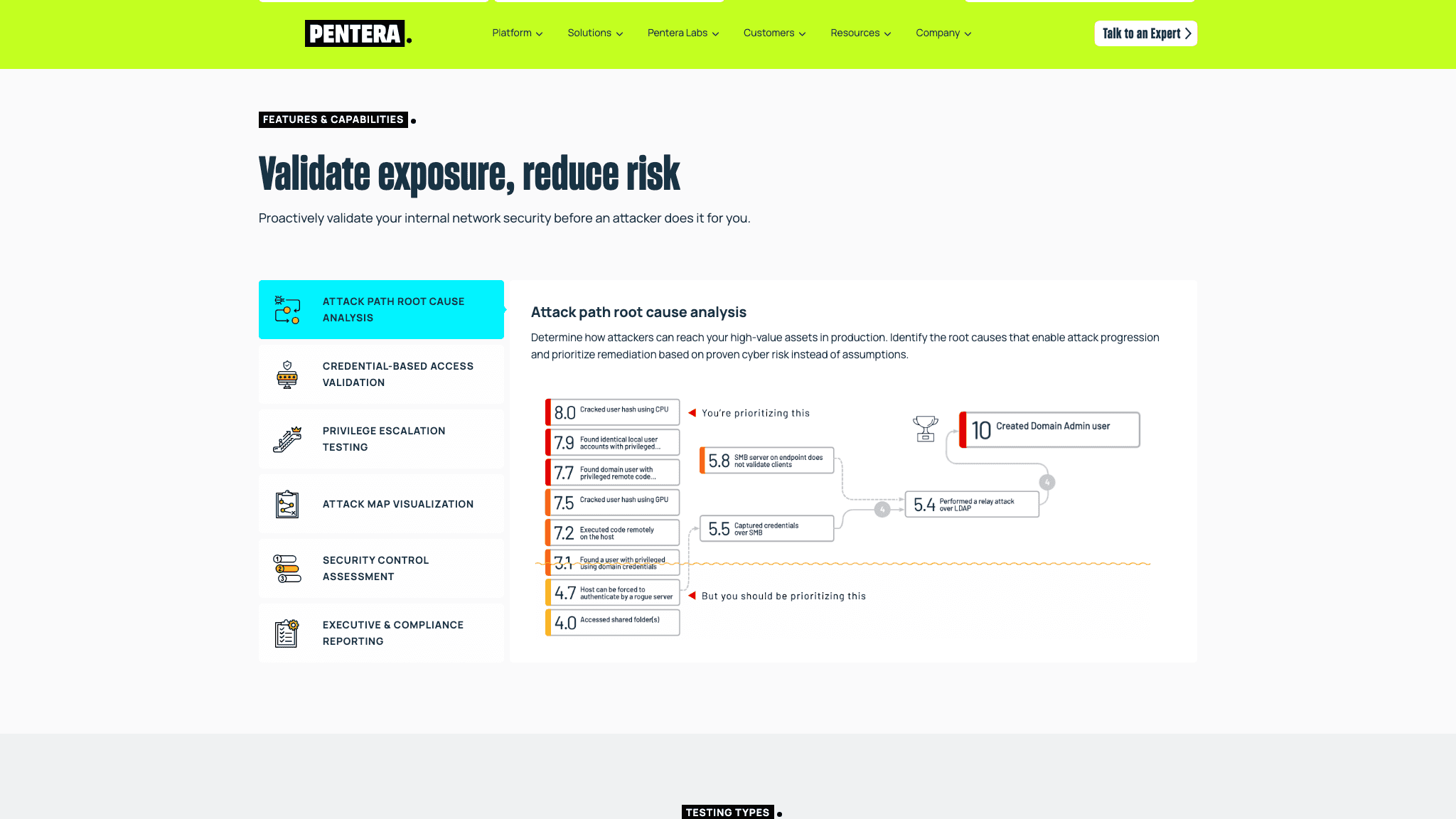
Core reports the sequence it used to reach a target. A result might show that a credential and trust relationship allowed movement from one host to a privileged account on another. Security teams can then fix the condition that enables several downstream findings.
Attack Map, Root Cause, and MITRE ATT&CK Context
Pentera’s Attack Map lays out successful techniques in sequence and maps them to attacker behavior. It also records where a control detected or blocked a step, helping teams identify the credential, route, or configuration whose removal would break the path.
A caveat: an attack graph is only as complete as the assets, identities, routes, and permissions available to the test. A clean result for a tightly scoped segment does not prove that an untested subsidiary, cloud account, or identity path is clean.
Black-Box, Grey-Box, and Targeted Test Modes
Core supports several testing perspectives. Black-box testing begins without supplied credentials, while what-if or grey-box testing starts with selected access to model a breached account. The distinction between black-box, white-box, and grey-box testing changes what the platform can attempt and what a clean result means. Targeted modes focus on ransomware behavior, Active Directory passwords, OWASP categories, or the CISA KEV catalog.
Test mode | Question it helps answer |
|---|---|
Black box | What can an attacker do from the access currently exposed? |
Grey box / what-if | What happens if this user, machine, or segment is already compromised? |
Ransomware validation | Can ransomware-like techniques move, encrypt, or bypass controls under safe limits? |
AD password assessment | Which password and identity weaknesses are practically usable? |
OWASP / CISA KEV | Are selected high-interest web or known-exploited weaknesses reachable? |
Ransomware and Security-Control Validation
Pentera emulates selected ransomware techniques under configured impact limits and cleanup rules. The test records whether endpoint, network, and identity controls detected or prevented each step.
A narrow test question produces the clearest result: can a standard workstation reach the backup administration plane, for example? Running the same test after a policy change shows whether the change closed that route.
Pentera Surface: External Attack Surface Validation
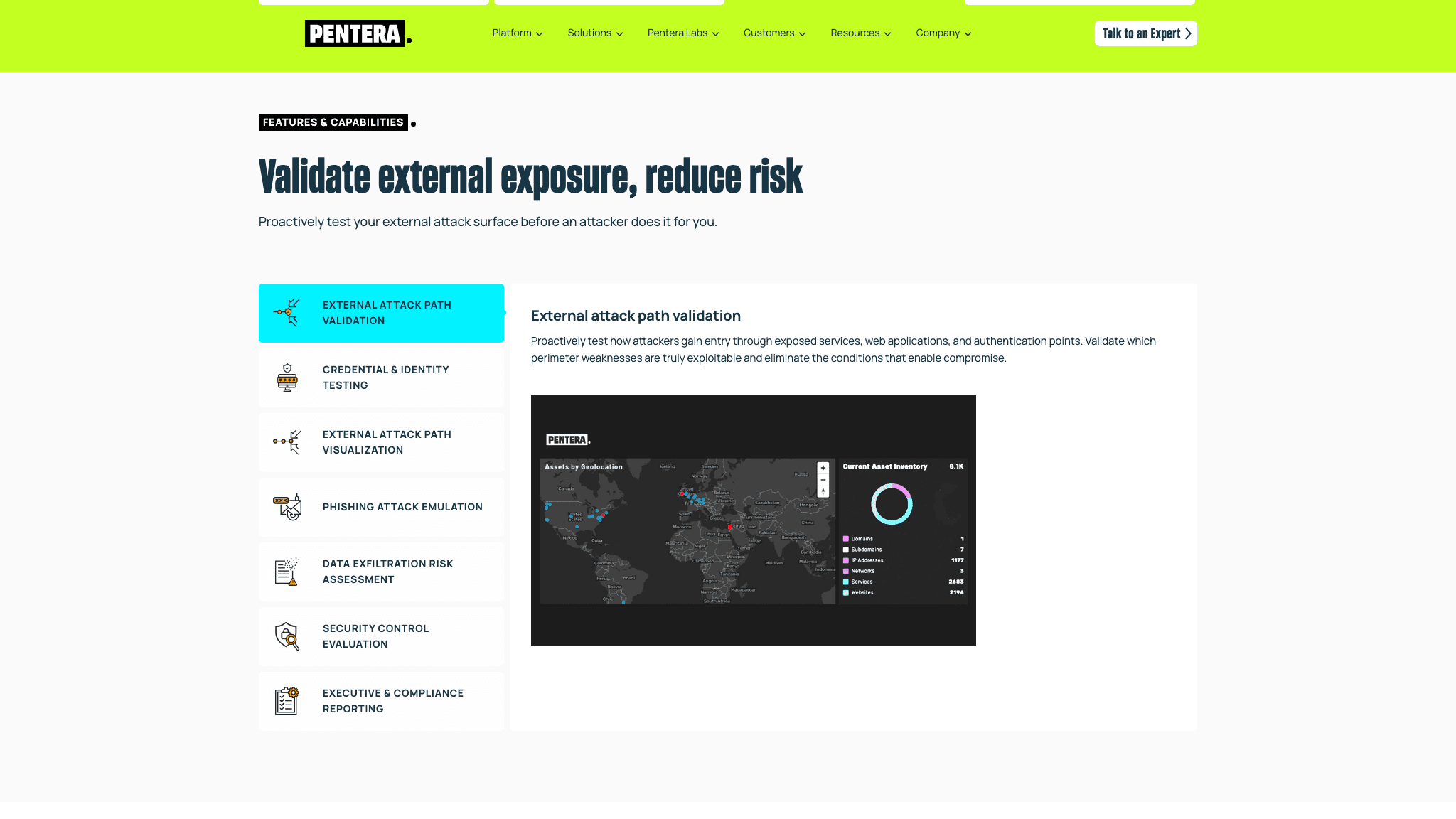
Pentera Surface discovers organization-linked domains, IP addresses, services, applications, and interfaces, then tests how an outside attacker could progress from exposure to access. Current capabilities include external attack-path validation, credential and identity testing, phishing emulation, data-exfiltration risk assessment, and evaluation of perimeter controls such as WAFs, firewalls, and identity providers.
Attack-surface inventory shows what is exposed. Surface goes further by testing whether exposed services, identities, or applications can be combined into a working entry path—the same gap between discovery and exploitation covered in an external penetration testing methodology.
Leaked Credentials, Phishing, and Public Git Exposure
Surface can collect and validate leaked credentials, emulate phishing paths, and look for publicly exposed repositories associated with the organization. Pentera says its repository capability discovers exposed secrets, tokens, configuration, and credentials, then tests whether those artifacts can be used in a chained attack.
Public-repository testing has a narrow scope. It checks whether exposed secrets or configuration can be used in an attack. Full SAST and pull-request review cover private repositories, code paths, dependencies, infrastructure-as-code, and changes before merge. The two workflows meet at the boundary between code review and penetration testing, but they do not provide the same evidence.
Pentera Cloud: AWS, Azure, and Hybrid Attack Paths
Pentera Cloud tests cloud identities, privilege escalation, misconfiguration chains, workload compromise, container and Kubernetes paths, data access, and movement between cloud and on-premises environments. Pentera’s current public page names AWS and Microsoft Azure; buyers with Google Cloud requirements should confirm current coverage in writing rather than assume parity.
CSPM and CNAPP products monitor cloud configuration and policy. Pentera Cloud tests whether multiple conditions can be chained into access or impact. Coverage should be checked against the AWS, Azure, and GCP attack paths the organization needs to validate.
Pentera Resolve: Remediation Operations and Revalidation
Pentera Resolve is the remediation-operations layer. It deduplicates and enriches findings, prioritizes them by validated risk, routes work to owners, tracks SLAs, and triggers revalidation. Pentera describes more than 100 integrations, which matters because the fix usually happens in a ticketing, cloud, endpoint, identity, or engineering system outside Pentera.
Resolve prioritizes findings, assigns work, tracks SLAs, and schedules retests. The actual fix still happens in the identity, cloud, endpoint, ticketing, or engineering system that owns the affected asset.
Pentera Peer and the Pentera MCP Server
Pentera Peer, introduced with Pentera 8, is an adversarial AI interface for asking questions about findings and test history, planning remediation, and proposing test steps that operators can approve or adjust. Pentera said general availability would begin in the second quarter of 2026.
Pentera announced an MCP server in June 2026. It allows an AI SecOps workflow to trigger tests and correlate Pentera results with other signals. Organizations enabling it should define approval rules, asset scope, and audit requirements before an agent can initiate offensive actions.
Safety Controls, Cleanup, and Repeatable Revalidation
Pentera says Core can run in production with throttling, impact limits, emergency stop, optional read-only behavior, and audit logging. Tests record successful and failed techniques, and the platform is designed to clean up artifacts after execution.
Production testing still needs a rollout plan. Start with a narrow scope, identify fragile systems, define stop conditions, check backups, and assign an incident owner. Once a path has been fixed, a documented pentest retest provides stronger closure evidence than waiting for the next scheduled assessment.
Reporting, Compliance Evidence, and Integrations
Pentera provides technical attack details, executive views, compliance-oriented reporting, and integration into the systems that teams already use. The strongest report is the one that links four facts: what was attempted, what succeeded, which control responded, and whether the retest failed after remediation.
Feature | What it proves | What it does not prove alone |
|---|---|---|
Attack-path execution | A bounded path was exploitable in the tested scope | Every untested path is safe |
Control validation | A selected control detected or blocked a technique | The control covers every asset and variant |
Revalidation | The specific tested path no longer succeeds | The underlying system can never regress |
Compliance report | Testing and remediation evidence exists | Automatic compliance with every requirement |
Where Pentera’s Feature Set Is Strong
Validated attack paths reduce triage work. Pentera connects discovery, credentials, execution, control response, remediation, and retesting. Teams can prioritize the conditions used in a working path instead of treating every scanner finding as an independent ticket.
The coverage crosses product boundaries. A single test can connect an exposed identity, a cloud permission, and an internal asset. That is closer to how a real intrusion develops than three separate posture reports.
Known paths can be retested on demand. Human pentesters still add creativity and context, while automation makes it practical to rerun a known route after a fix or control change. That cadence is one reason teams compare continuous and annual pentesting as different operating models.
Pentera Labs feeds techniques into the product. The company says its offensive research is translated into new tests. Buyers should ask how quickly that research reaches each licensed module and how updates are documented.
Where Are Pentera’s Feature Limits?
The main limits are scope, packaging, and ownership of the fix.
Private pricing complicates feature comparison. Pentera does not publish current packages or list prices. Module names do not reveal which tests, assets, bulk units, integrations, or services are included in a quote. The public Pentera endpoint pricing curve helps explain the volume model, but the current order form still determines coverage.
The center of gravity is enterprise infrastructure. Internal networks, Active Directory, internet-facing assets, cloud identities, and controls are its strongest terrain. Small engineering teams looking primarily for code review may be buying far more platform than they need.
Repository testing has a narrower meaning. Pentera validates secrets and credentials exposed through public repositories. That is valuable, but it is not a substitute for SAST, SCA, infrastructure-as-code scanning across private code, or pull-request feedback.
Cloud coverage needs contract-level verification. AWS and Azure are named publicly. Confirm services, regions, Kubernetes environments, and Google Cloud requirements against the current order form and test plan.
Resolve organizes work; it does not remove ownership. Someone still has to implement the fix and accept residual risk.
Scope creates blind spots. Automation can test frequently, but it cannot validate assets, paths, and identities it cannot see or is not allowed to touch.
How Do Pentera’s Features Compare With CodeAnt AI?
Pentera and CodeAnt AI test different layers. Pentera executes paths across deployed infrastructure, identities, external assets, and cloud environments. CodeAnt reviews source code, pull requests, dependencies, infrastructure-as-code, secrets, and application behavior.
Decision area | Pentera | CodeAnt AI |
|---|---|---|
Primary surface | Networks, endpoints, AD, external assets, cloud and security controls | Repositories, pull requests, dependencies, IaC, secrets, and applications |
Core evidence | Executed infrastructure and identity attack paths | Code-aware findings, fixes, attack paths, and application-security validation |
Developer workflow | Usually downstream through remediation and ticketing integrations | Native focus on PR review and fixing issues where code changes |
Public Git exposure | Tests exposed secrets and credentials as attack inputs | Scans code, secrets, dependencies, and configuration in development workflows |
Best fit | Security teams validating enterprise attackability | Engineering and AppSec teams reducing code and application risk |
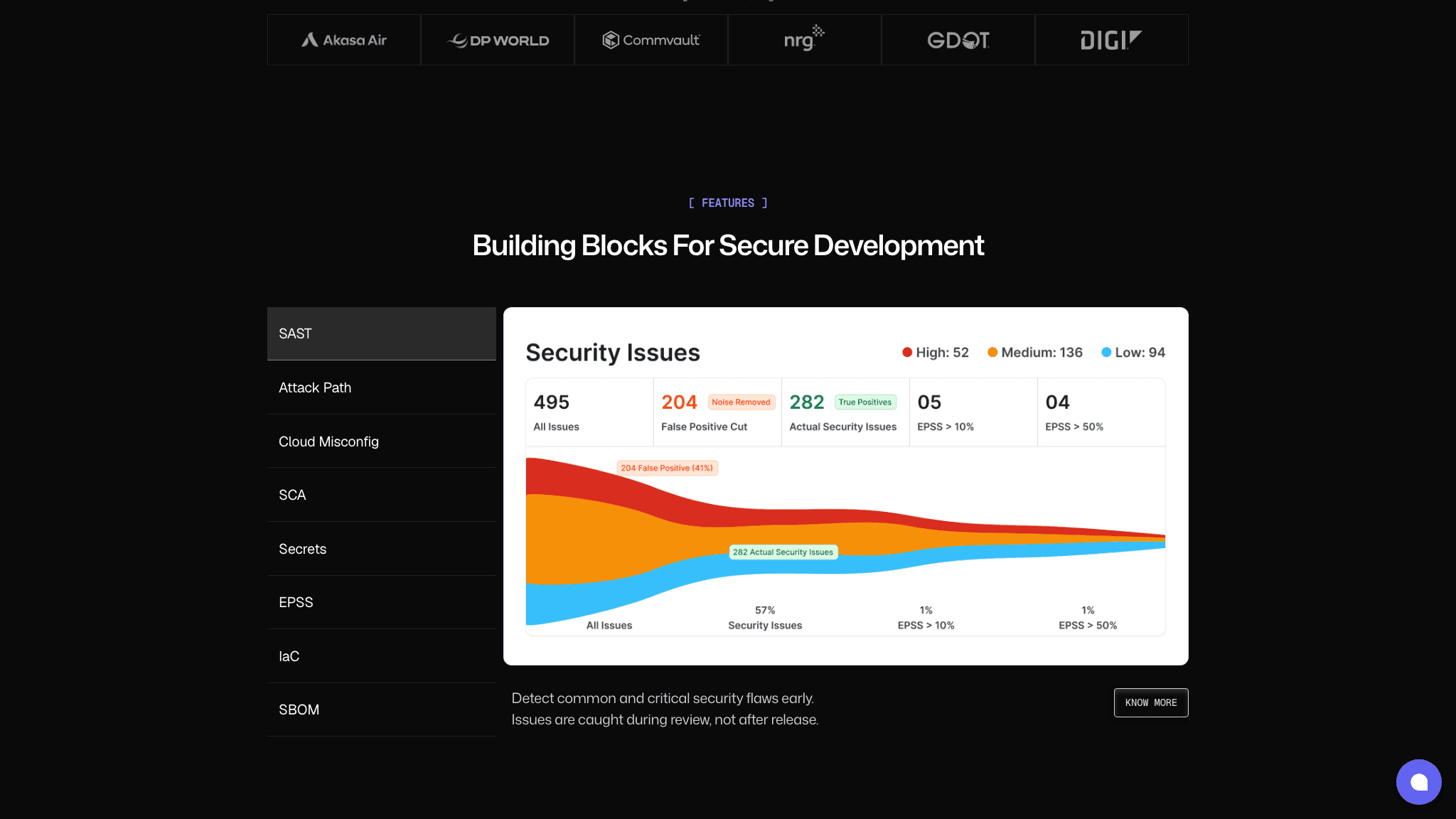
A large organization may use both. Pentera tests paths in the deployed estate; CodeAnt gives developers feedback on code and application risk earlier in the delivery process. The distinction shows up clearly when Pentera and CodeAnt are compared for the same compliance program, while the wider set of Pentera alternatives spans several different testing layers.
The practical difference is timing and surface area: Pentera validates deployed infrastructure; CodeAnt works in developer and application-security workflows.
How to Evaluate Pentera’s Features
The modules make the most sense as one operating cycle: identify exposure, execute a path, assign the root cause, and retest the fix. Core, Surface, Cloud, and Resolve each cover part of that cycle. Peer and MCP add ways to query the evidence and call validation from other workflows.
A useful proof of value should follow one path through the actual environment, show how controls responded, assign the fix to the team that owns it, and rerun the test. Those checks also belong in a wider pentesting-provider evaluation. The proposal should list the included modules, assets, integrations, safety controls, and services.
If the path begins in source code or a pull request, evaluate the code-security workflow separately. If the target is a deployed application or API, compare the evidence and retesting terms offered by the pentesting service. Those scopes sit alongside Pentera rather than inside its infrastructure modules.

