

Your security team runs weekly vulnerability scans. Your compliance framework requires annual penetration tests. The vulnerability assessment produces 200+ findings, the pentest report arrives months later with 12 critical issues, and nobody can easily explain how the two reports relate.
That is the VAPT problem.
Vulnerability assessment tells you what could be wrong. Penetration testing tells you what an attacker can actually do with it. When those two activities run as separate workflows, there is a gap between detection and proof. A vulnerability can sit in a backlog because nobody knows whether it is exploitable, while a different issue that looks less severe on paper may provide a direct path to sensitive data.
The gap becomes larger as software changes faster. A quarterly scan and an annual pentest are point-in-time measurements of systems that may be deploying every day.
The important question is therefore not simply:
"How many vulnerabilities do we have?"
It is:
"Which vulnerabilities are reachable, which can be chained, what can an attacker reach through them, and has the fix actually closed the path in production?"
That is where vulnerability assessment and penetration testing need to operate as one continuous feedback loop.
What this changes operationally: CodeAnt AI runs attack surface management continuously, correlating the National Vulnerability Database, the CISA Known Exploited Vulnerabilities catalog, and EPSS scoring. The point is not simply to collect more vulnerability data. It is to keep the security model aligned with what is actually exposed and what is actually running.
An attacker only needs one viable path into a system. A defender has to close every viable path, across every endpoint, dependency, cloud resource, identity boundary, and deployment.
VAPT works when those two sides of the problem are connected.
VAPT: The Two-Layer Model
VAPT combines two complementary approaches that answer different questions about your security posture.
Vulnerability assessment is the breadth layer. It identifies potential weaknesses across a large environment:
SAST analyzes source code for insecure patterns such as SQL injection, XSS, and hardcoded secrets
SCA inventories dependencies and flags known CVEs in the software supply chain
DAST probes running applications from the outside and tests runtime behavior
Secrets and IaC scanning identifies exposed credentials and infrastructure misconfigurations
The strength of vulnerability assessment is coverage. You can scan thousands of endpoints and millions of lines of code far faster than a human team can review them.
The limitation is that a vulnerability finding is not necessarily an exploit.
A "critical" SQL injection may sit behind authentication, network restrictions, input validation, or a WAF that prevents exploitation. A medium-severity IDOR may be exposed through a public API and allow an attacker to enumerate millions of records. The scanner sees the vulnerability. The attacker sees the path.
Pentesting is the exploitation layer. It tests whether vulnerabilities can actually be used, chained, and converted into meaningful impact.
Pentesting operates in three common modes:
Black box: External-only testing with no code access, simulating an outside attacker
White box: Full code access, enabling deep analysis of application logic and data flows
Gray box: External testing combined with selective code intelligence, allowing the tester to understand how the application is actually built
Pentesting's strength is depth. It can demonstrate that an authentication bypass leads to an IDOR, that the IDOR exposes customer records, or that an apparently isolated SSRF can reach a sensitive internal service.
The problem is cadence. Traditional pentesting is usually periodic. Applications are not.
The integration gap appears when vulnerability assessment and pentesting produce separate findings, on separate schedules, with no shared context.
A vulnerability assessment might flag 200 medium and high issues. A pentest six months later might validate 12 of them and discover five new attack chains. Without correlation, the security team still has to work backwards to determine which findings mattered and which controls actually reduced risk.
For organizations deploying 10, 50, or hundreds of releases per month, that delay is not a reporting problem. It is a security problem.
Vulnerability Assessment vs Pentesting: Practical Differences
Dimension | Vulnerability Assessment | Pentesting |
|---|---|---|
Scope | Broad: entire attack surface | Deep: critical paths and exploit chains |
Goal | Identify potential vulnerabilities | Validate exploitability and business impact |
Frequency | Continuous (automated) | Periodic (manual + automated) |
Output | Vulnerability lists (200+ findings) | Prioritized exploits with PoC (10 to 20 critical findings) |
False Positives | Higher | Lower when findings require exploitation proof |
Evidence | CVSS scores, CWE identifiers | PoC exploits, attack paths, demonstrated impact |
Cost | $10K to $50K per year subscription | $30K to $100K+ per engagement |
When to use vulnerability assessment: Routine security hygiene, shift-left testing in CI/CD, broad coverage at scale, compliance baseline scanning. Vulnerability assessment should be the first line of defense because it provides the coverage required to identify problems across the environment.
When to use pentesting: Exploit validation, critical release assurance, compliance requirements, attack chain discovery, and business-impact validation. Pentesting answers the question that vulnerability assessment cannot: can someone actually use this?
The problem: Most teams need both. Running them separately creates the blind spot.
Vulnerability assessment without pentesting leaves developers deciding which findings represent real risk. Pentesting without continuous vulnerability assessment leaves security teams validating point-in-time snapshots while the application continues to change. The solution is not choosing between the two. It is connecting them.
The VAPT Integration Gap
When vulnerability assessment and pentesting operate as disconnected activities, three problems appear repeatedly.
1. The 6 to 12 Month Validation Window
Consider a team that performs an annual pentest:
January: Annual pentest validates the current security posture
February through December: 120+ releases deploy with limited offensive validation
January the following year: The next pentest discovers vulnerabilities introduced months earlier
During that period, the organization may have introduced new microservices, changed authentication middleware, modified authorization logic, added cloud infrastructure, and upgraded dozens of dependencies. SAST and SCA continue to run, but they cannot answer the full attack-path question:
Can an attacker chain what changed into access to production data?
This is the same fundamental problem that appears in vulnerability patching. Once a vulnerability is publicly disclosed and a fix exists, the relevant security interval is no longer theoretical. The vulnerability has entered a patch window. The window opens when the fix becomes publicly analysable and closes when the fix is actually deployed across the estate.
A vulnerability assessment can tell you that the affected component exists. Pentesting can tell you whether that exposed component produces a viable attack path. Neither answer is enough if they are separated by months.
2. Severity Mismatches Between Vulnerability Assessment and Pentesting
The same vulnerability can have very different practical severity depending on what an attacker can actually reach.
Finding | Vulnerability Assessment Rating | Pentesting Rating | Why They Differ |
|---|---|---|---|
SQL injection in admin endpoint | High (CVSS 7.5) | Critical (CVSS 9.8) | Pentesting proved it extracts customer PII; vulnerability assessment saw the code pattern |
SSRF in image upload | Critical (CVSS 9.1) | Medium (CVSS 5.3) | Pentesting found network segmentation blocks access; vulnerability assessment assumes worst case |
GraphQL BOLA | Medium (CVSS 6.5) | Critical (CVSS 9.4) | Pentesting chained it with a routing gap to reach a broader export than the isolated finding suggested |
Without correlation, the security team can end up fixing the wrong problems first. The "critical" SSRF may be effectively contained. The "medium" BOLA may provide a direct route to a large dataset.
This is why CVSS alone is not enough. Severity needs to be interpreted in the context of reachability, authentication, data sensitivity, blast radius, exploit complexity, and compensating controls.
3. Developer Productivity Tax
Engineering teams spend significant time triaging findings that later turn out to be unexploitable.
The problem gets worse when validation happens months after detection. By the time a pentester tests the finding, the original code may have changed, the developer may have moved teams, and the surrounding architecture may no longer resemble the environment in which the vulnerability was reported.
The result is duplicated work:
Scanner identifies a potential vulnerability
Developer investigates it
Security reviews it
Pentester later validates it
Engineering fixes it
Security schedules a re-test
Nobody is completely sure whether the original attack path still exists
A connected VAPT workflow reduces that repetition by carrying context from discovery into exploitation and from exploitation into remediation.
Exploitability vs. Theoretical Risk
Vulnerability assessment tools identify patterns. Exploitability requires context. There are six factors that determine whether a finding represents a practical attack path.
1. Reachability
Can an attacker access the vulnerable code path? A critical SQL injection behind SSO and an IP allowlist may be less urgent than a medium IDOR on a public API.
2. Authentication Requirements
What access level does exploitation require? A useful priority order is unauthenticated, then low-privilege user, then elevated role, then administrator. The important question is not simply whether authentication exists. It is whether the required privilege can realistically be obtained or bypassed.
3. Data Sensitivity
What does the vulnerable path reach? A path exposing a configuration file is different from a path exposing customer database backups, payment information, credentials, or production secrets.
4. Blast Radius
How much can an attacker access? An IDOR that exposes one record may be significantly less severe than the same flaw allowing an attacker to enumerate an entire customer table.
5. Exploit Complexity
How difficult is exploitation? A stored XSS that executes automatically can have a very different practical risk from a reflected XSS requiring user interaction and an additional CSP bypass.
6. Compensating Controls
What controls prevent the vulnerability from becoming an actual breach? An SSRF may be flagged as critical, but restrictive network controls, cloud metadata protections, and segmentation can materially reduce what the attacker can reach.
This is why vulnerability assessment and penetration testing answer different parts of the same question. The assessment identifies the candidate path. The pentest attempts to walk it.
A mature VAPT process records what was actually demonstrated, where the attack stopped, which control blocked it, and what remediation closes the path. Without that evidence, teams either fix everything or triage almost entirely by severity score. Both approaches are inefficient.
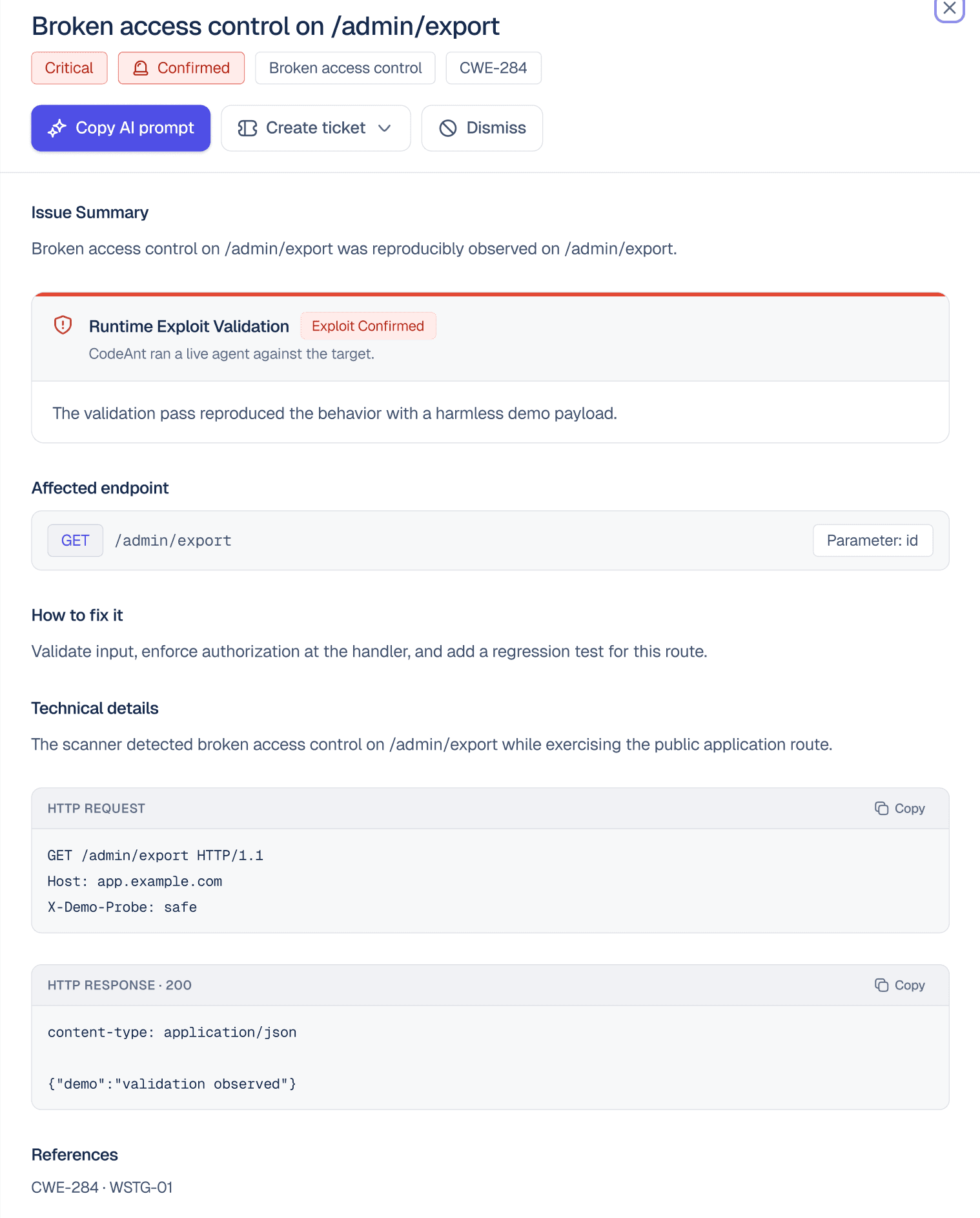
CodeAnt's approach validates exploitability automatically. When a pull request introduces a new API endpoint, the platform tests whether vulnerabilities are actually exploitable given the application's authentication middleware, routing configuration, and data access patterns.
Code-Aware Gray Box Testing
The strongest VAPT model combines external attack-surface visibility with internal code intelligence.
Gray box testing sits between black box and white box testing. CodeAnt's guide to the three pentest types covers the distinction in depth.
The practical difference is straightforward:
Black box asks what an outside attacker can discover and exploit.
White box asks what someone with complete knowledge of the code can exploit.
Gray box asks what an attacker can do from the outside when the tester also understands how the application is built.
That additional context changes what can be proven.
Endpoint Discovery
Instead of crawling /api/* paths and hoping to discover hidden functionality, code-aware testing can inspect routing definitions directly.
This exposes authenticated endpoints, path parameters, alternate routes, and authorization boundaries that may be difficult to infer from external behavior alone.
Authentication Analysis
The relevant question is not simply "does this endpoint require a token?" The question is: where is the token checked, what does it prove, and is the authorization decision actually enforced on every path?
Code-aware analysis can trace middleware application order and identify unprotected debug endpoints, inconsistent authorization checks, or routes that apply authentication but fail to validate the user's relationship to the requested object.
GraphQL Resolver Tracing
GraphQL makes this particularly important because the API surface does not necessarily reveal the underlying data model.
Resolver implementations can be traced to understand how an object is retrieved, which ownership checks are applied, and which database records become reachable. CodeAnt's GraphQL penetration testing checklist covers the specific patterns involved.
Data Flow to Dangerous Sinks
Taint analysis can trace user-controlled input from an entry point through application logic to dangerous sinks such as database queries, OS commands, file operations, template rendering, and network requests.
A black box test might identify the endpoint. Code-aware testing can establish why the endpoint is exploitable and where the resulting access leads.
That distinction matters because a real breach is rarely just "one vulnerability." It is a path.
The Living Threat Model: Connecting the Inside and the Outside
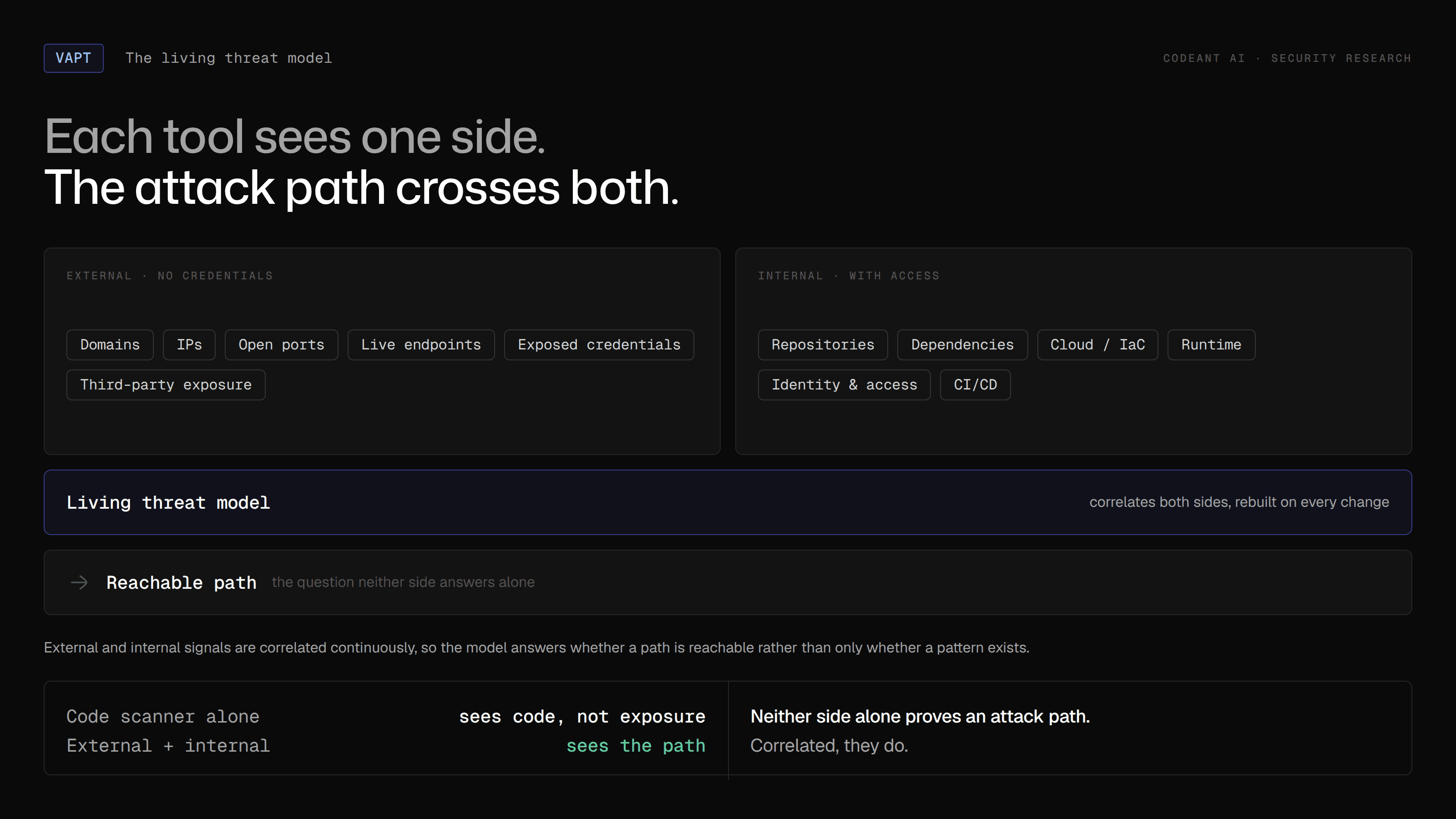
The biggest limitation of disconnected VAPT tooling is that each tool sees only part of the environment. A source-code scanner sees code. An external scanner sees domains and ports. A cloud security tool sees infrastructure. A pentest sees attack behavior. The attack path crosses all of them.
A useful VAPT system therefore needs a connected model of the company. The external side includes domains and subdomains, public IP addresses, open ports and services, live endpoints and APIs, exposed credentials, third-party exposure, and threat intelligence. The internal side includes source repositories, binaries, dependencies, cloud and IaC configuration, VMs and containers, runtime infrastructure, identity and access controls, and CI/CD.
The value comes from correlating the two. The question changes from:
"Does this code contain an IDOR?"
to:
"Is the vulnerable route publicly reachable, can an attacker obtain the required access, does the authorization check fail, and what data does the resulting path reach?"
This also changes how VAPT findings should be represented. A useful finding should tell you what condition makes the path exploitable, what sequence an attacker follows, what critical asset the path reaches, what change fixes the root cause, and whether the same path is still exploitable after the fix. That is more useful than a vulnerability record that ends with a CVSS number.
Real Attack Chains: Why Vulnerability Assessment-Only Programs Miss Critical Risk
Vulnerability scanners find isolated issues. Attackers chain them. Three production findings illustrate the difference.
What CodeAnt Has Found Running Production Engagements
Across engagements, several findings have followed the same pattern: an issue that looked straightforward in isolation became materially more serious once the actual data path was tested.
A US healthcare provider had an unauthenticated API exposing roughly 3.2 million PHI records. The scale of the exposure became apparent once the API was systematically walked rather than sampled.
A major airline had passenger PII, roughly 6 million records, reachable through a BOLA attack chain. What could have appeared to be a medium-severity authorization issue at a single endpoint allowed a tester to move from one passenger record to another.
A UK law firm had client files accessible without an authentication check, exposing 500,000-plus client records.
The common factor was not a particularly exotic vulnerability. It was reachability. The finding mattered because the attacker could follow the path to something valuable.
A Fully Disclosed Example of the Same Pattern
CodeAnt's research team's Dolibarr ERP/CRM findings show the same problem in a publicly reproducible application.
CVE-2026-71505, CVSS 8.1, is a broken object-level authorization vulnerability where one route correctly checked ownership while a sibling write route did not.
A key with only the create-companies permission could receive 403 Forbidden when attempting to read a company it was not allowed to access, then set that company's portal password through the other route and receive 200 OK.
A related finding, CVE-2026-71507, used the same authorization asymmetry on another write path to redirect outbound supplier payments.
Neither required a novel exploit technique. The important part was testing the entire path.
The vulnerability assessment view sees the authorization pattern. The penetration testing view asks what happens when an attacker actually exercises the write operation. That is the difference between a vulnerability inventory and an attack-path model.
VAPT and the Patch Window
The same distinction applies after a vulnerability is discovered. Finding a vulnerability is not the same as closing it.
An n-day vulnerability is publicly disclosed and has a patch available. Once the fix or relevant code change becomes public, attackers can often analyse the change, recover the root cause, build a proof of concept, and scan for vulnerable deployments.
The practical patch window therefore starts before your scanner necessarily reports the issue.
A typical sequence looks like this:
Stage | Typical elapsed time |
|---|---|
Fix merged or advisory published | Day 0 |
Patch analysed and root cause recovered | Hours to days |
Working proof of concept | Days |
Mass scanning for vulnerable instances | Days |
Typical enterprise deployment | Weeks to months |
The problem is the mismatch. Attacker capability is measured in days. Enterprise deployment is often measured in weeks.
This is one reason VAPT cannot be treated as an annual compliance activity. Continuous assessment identifies changes and newly disclosed weaknesses, while continuous or release-level offensive validation establishes whether those weaknesses create an actual attack path.
The starting point matters too. If a scanner only becomes aware of a vulnerability after an enriched CVE record is published, the organization may already have spent part of the exploitation window exposed. CodeAnt's vulnerability intelligence is intended to keep that starting point closer to the vendor advisory or public commit rather than waiting for a later enrichment event.
Why a Merged Fix is Not a Shipped Fix
There is another distinction that VAPT programs often miss: a fixed repository is not necessarily a fixed production system.
A security patch can be merged into a branch, pass CI, and remain absent from the production artifact. That creates an especially dangerous state for open-source software. The fix itself may now be public. The deployed software may still be vulnerable. The attacker gets the information before the defender gets the protection.
The Liquid Network incident illustrates why this matters. A security fix for a consensus-level range-proof caching issue in the Elements codebase was reportedly merged to public branches around September 1 to 3, 2026, but was not included in a tagged release. Production systems therefore remained exposed while the corrective change was already visible in the public repository.
The broader lesson does not depend on the specific incident: merged is not deployed.
A security dashboard that marks a vulnerability resolved when the pull request merges is measuring the repository state. Security requires measuring the deployed artifact.
The same principle applies to VAPT. If a pentest proves an exploit path, a developer merges the fix, and the ticket closes, the attack path has not been proven closed yet. The path needs to be re-tested against the deployed version. That is where the VAPT loop becomes important.
The VAPT Feedback Loop: Model, Attack, Prove, Fix, Re-Test, Learn
A disconnected workflow looks like this:
Scan → Report → Ticket → Fix
A stronger VAPT workflow looks like this:
Model → Attack → Prove → Fix → Re-test → Learn
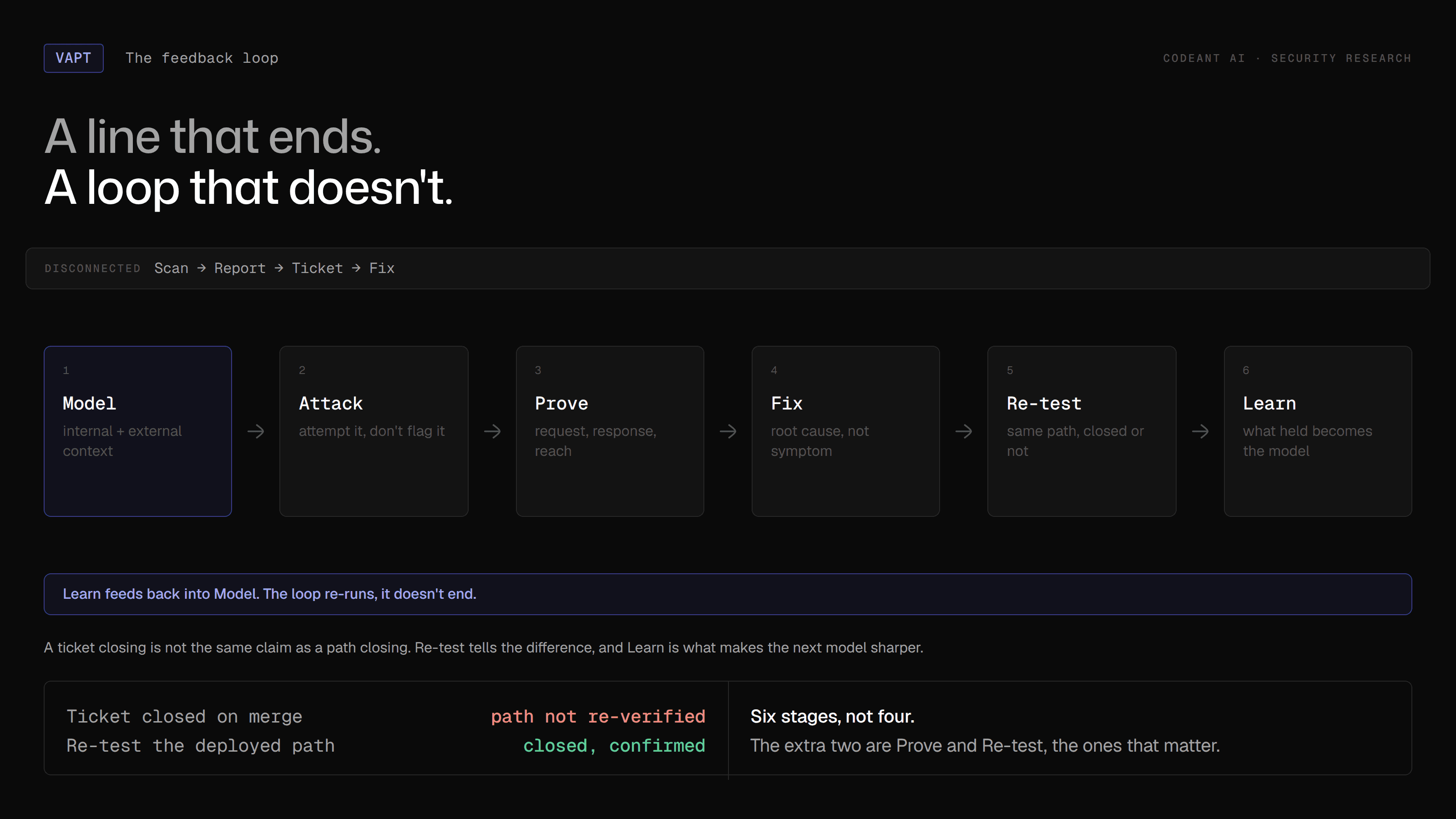
1. Model
Build a current representation of the environment. This includes internal application context and external attack-surface context.
2. Attack
Attempt the relevant adversarial technique. Do not stop at identifying a suspicious code pattern.
3. Prove
Capture the exact request, response, reproduction sequence, and resulting access. Most importantly, establish whether the path reached something that matters. A path that was considered but never confirmed stays in a different category from one that was actually demonstrated; conflating the two is how a report ends up overstating what was proven.
4. Fix
Address the root cause rather than merely suppressing the symptom. The remediation should identify the code, configuration, authorization rule, dependency, or infrastructure control that needs to change.
5. Re-Test
Run the same attack path again. A vulnerability is not closed because the code changed. It is closed when the previously demonstrated path no longer works.
6. Learn
Record what happened. A successful exploit, a failed exploit, and a control that blocked an attack are all useful security information.
This is where continuous VAPT becomes different from repeatedly running the same scanner. The system gets better at identifying which paths matter.
Verified Exploit Intelligence Without Pooling Customer Data
A connected VAPT model can also improve from attacks observed elsewhere, but there is an important boundary.
Customer-specific internal context should remain customer-specific. That includes source code, repositories, cloud configuration, IaC, identity and access, runtime infrastructure, and CI/CD context. None of it is generalized or shared across accounts; it stays where it was found.
What does travel is narrower: once an exploit pattern against an internet-reachable component has been verified, only its abstracted shape, the conditions that make it exploitable and the graph pattern it follows, gets carried forward, with any customer-identifying detail stripped out first.
That creates a useful distinction:
Private internal learning. A finding about a customer's internal architecture improves that customer's threat model and does not become another customer's data.
Shared exploit intelligence. A verified exploit pattern against an internet-reachable component can be abstracted into its attack conditions and graph pattern.
Re-scoring on match. If the same external exposure exists elsewhere, that customer can be re-evaluated against the newly verified attack pattern.
The result is a compounding security model. A new verified attack does not have to remain trapped in a report that gets read once. It can become a test for other environments with the same exposure, contributing to a network effect where every new customer adds verified external exploit intelligence while private internal learning stays isolated to that customer alone. That matters to VAPT because new attack techniques do not wait for your next scheduled pentest.
Vendor Comparison: CodeAnt AI vs Snyk vs Veracode
Snyk: Developer-First Vulnerability Assessment
Strengths: Excellent SAST + SCA, seamless CI/CD integration, developer-friendly remediation with fix PRs, broad language support.
Gap: Primarily a vulnerability assessment workflow. It identifies vulnerabilities but does not provide the same continuous offensive validation of exploitability and attack paths. That creates the core triage question: which of the findings actually matter?
CodeAnt's head-to-head on the SAST layer goes into this difference in more detail.
Best for: Shift-left security, open-source dependency management, and vulnerability assessment when you already have a separate pentesting strategy.
Veracode: Enterprise Application Security
Strengths: Comprehensive SAST + DAST + SCA, binary analysis without source access, compliance-ready reporting, centralized governance.
Gap: Pentesting is a separate activity rather than a continuously correlated exploitation layer. That can create the same integration problem described throughout this article: vulnerability assessment findings and pentesting findings exist in different workflows and have to be reconciled later.
CodeAnt's comparison on the SAST layer covers the architectural difference in more depth.
Best for: Regulated enterprises managing large application portfolios that primarily need centralized vulnerability assessment and governance.
CodeAnt AI: Unified Defensive + Offensive Platform
The distinction is not simply that CodeAnt has both vulnerability assessment and pentesting. The important distinction is that they use shared context.
The same codebase intelligence that identifies a potential vulnerability can provide context for offensive testing. That means a tester can start from the outside while understanding routing configuration, authentication middleware, authorization logic, data models, dependencies, cloud configuration, and runtime context.
This is the practical version of a Living Threat Model. External context tells the system what an attacker can see: domains, subdomains, IPs, open ports, live services, exposed credentials, threat intelligence. Internal context tells it how the company is actually built: code, binaries, dependencies, cloud, infrastructure, runtime, identity. The model connects the two.
Capabilities:
Defensive Vulnerability Assessment: SAST + SCA + secrets detection in CI/CD
Offensive Pentesting: 500+ autonomous exploit agents testing black, white, and gray box
Attack chain construction: Chains vulnerabilities such as authentication bypass, IDOR, and data access
Continuous validation: Retests after fixes and validates changes continuously
Audit-grade reporting: CVSS scoring, control mapping, reproducible PoC exploits, and evidence of demonstrated impact
The gray box advantage becomes particularly clear with authorization vulnerabilities. When CodeAnt discovers an IDOR in a GraphQL resolver, the goal is not simply to report that the resolver lacks an ownership check.
The goal is to determine which records are reachable, which data fields can be accessed, what the attack sequence looks like, and whether the path reaches a meaningful asset. That is the same standard applied in the IDOR guide: a confirmed vulnerability should establish what was actually accessible rather than simply reporting that a route appeared insufficiently protected.
Best for: Organizations deploying weekly or daily, complex architectures involving microservices, GraphQL, serverless, and event-driven systems, and teams that need continuous validation rather than periodic snapshots.
Capability | Snyk | Veracode | |
|---|---|---|---|
SAST/SCA | Strong | Strong | Strong |
Offensive Pentesting | None | Separate service | Autonomous, continuous |
Exploit validation | No | Manual, periodic | Automated, continuous |
Code-aware testing | No | Limited | Gray box with codebase intelligence |
Testing frequency | Continuous vulnerability assessment | Continuous vulnerability assessment, periodic pentesting | Continuous vulnerability assessment + pentesting |
Retest automation | Automatic | Manual scheduling | Automatic |
Pricing model | Per developer | Per application | Per codebase, plus exploit-based pentesting |
Commercial accountability: CodeAnt's model pays out on confirmed exploits. The emphasis is on high or critical findings with working proof of concept rather than a time-boxed engagement that may or may not produce an exploitable result.
Snyk and Veracode are the most direct comparisons for the vulnerability-assessment side of this discussion, but the wider market is fragmented.
Pure AI pentesting platforms such as XBOW and Tenzai focus primarily on offensive validation. AppSec platforms such as Aikido combine security scanning with offensive capabilities. Enterprise testing platforms and services such as Horizon3, Pentera, Bishop Fox, and Synack provide deeper offensive testing across selected parts of the environment.
The architectural question remains the same: do those capabilities operate as separate reports, or as one model of the environment?
A unified model can connect a code-level finding to an externally reachable service, to an identity boundary, to cloud infrastructure, and finally to the data the attacker could reach. That is the path a real attacker cares about.
VAPT for Compliance: What Auditors Actually Want
Compliance frameworks require evidence that vulnerabilities are identified and that security controls are tested.
SOC 2: Vulnerability management, monitoring, remediation evidence, and penetration testing are commonly used to demonstrate relevant controls.
ISO 27001: Organizations need a risk-based approach to technical vulnerability management and monitoring.
PCI-DSS v4.0: Requires defined vulnerability scanning and penetration testing activities, including appropriate testing of external and internal environments and segmentation where applicable.
The exact frequency and evidence requirements depend on the organization's scope and applicable control set, but the operational problem is consistent.
An annual report proves what was tested during the engagement. It does not prove that the same attack path remained closed after the next 50 releases.
Continuous VAPT creates a stronger evidence trail: continuous or frequent vulnerability assessment, demonstrated exploitability where relevant, retest evidence after remediation, timestamps showing when vulnerabilities were closed, attack-path evidence showing business impact, control mapping, and evidence that the deployed environment, not just the repository, was tested.
Audit-grade VAPT reports require:
Executive summary with business impact
CVSS scoring and vectors where applicable
Control violation mapping
Reproducible PoC exploits for confirmed vulnerabilities
Remediation guidance
Retest evidence confirming closure
The important word is confirming. A ticket marked resolved is not equivalent to an attack path being closed.
Decision Framework: Choosing Your VAPT Approach
Choose Vulnerability Assessment-Only Tools If:
You deploy quarterly or less
You have a relatively simple architecture
You have under 50 developers and limited security staffing
You have a separate pentesting strategy
Your primary requirement is broad vulnerability coverage
Choose Separate Vulnerability Assessment + Pentesting Vendors If:
You deploy monthly
You have a moderate microservice architecture
You have 50 to 200 developers
You have a dedicated security team that can correlate findings
You need periodic deep offensive testing alongside continuous scanning
Choose a Unified Platform If:
You deploy weekly or daily
You operate complex architectures with 20+ microservices, GraphQL, serverless, or event-driven systems
You have a large engineering organization
You operate under multiple compliance frameworks
Your security team spends significant time correlating vulnerability assessment and pentesting results
You need frequent exploit validation and re-testing
You need to know whether a vulnerability actually creates a path to critical data
The inflection point is simple. If your deployment frequency is much higher than your pentesting frequency, you have a validation gap. If external-only testing cannot understand your application's authorization and data flows, you have a context gap. If your vulnerability assessment produces more findings than your engineering team can meaningfully validate, you have a prioritization gap.
VAPT should close all three.
Standing Up Continuous VAPT: 60-Day Roadmap
Week 1 to 2: Baseline Assessment
Run initial vulnerability assessment scans across production and development
Inventory public-facing assets including APIs, subdomains, and cloud endpoints
Identify 5 to 10 crown-jewel systems for initial offensive validation
Document current vulnerability count and severity distribution
Map critical data and production systems
Establish the current gap between detected vulnerabilities and confirmed exploits
Week 3 to 4: CI Integration
Deploy the VAPT platform as a required CI check on relevant pull requests
Configure gating for critical and high findings
Establish a suppression workflow for false positives
Connect code findings with application and infrastructure context
Track fixes through deployment rather than stopping at merge
Week 5 to 6: First Pentesting Run
Scope 3 to 5 high-value applications
Configure gray box testing with repository access
Run autonomous pentesting using exploit agents
Prioritize confirmed attack paths
Remediate confirmed critical and high exploits within defined SLAs
Re-test the same paths after fixes
Measure the time from detection to verified closure
Week 7 to 8: Continuous Validation
Configure automated retesting after deployments
Set up compliance reporting and control mapping
Track vulnerability density
Track MTTR
Track the percentage of findings proven exploitable
Track attack paths reaching crown-jewel assets
Track the percentage of fixes verified in the deployed environment
Review which failed attacks and blocking controls should influence future testing
The final metric should not simply be "number of vulnerabilities fixed." It should be:
How many exploitable paths remain open, and how quickly do we close them?
How Do We Prioritize 200+ Vulnerability Findings?
Do not rely on severity alone. Correlate the vulnerability with reachability, authentication requirements, data sensitivity, blast radius, exploit complexity, compensating controls, and evidence of actual exploitation. Then test the highest-value paths.
The goal is not to prove that fewer vulnerabilities exist. The goal is to identify which vulnerabilities create real attack paths and close those first.
Make Vulnerability Assessment and Pentesting a Unified Feedback Loop
Vulnerability assessment provides the breadth required to understand a large environment. Pentesting provides the depth required to establish what an attacker can actually do. The missing piece is the context between them. A useful VAPT platform should understand the environment from both directions.
From the outside: what is exposed, which domains and services are reachable, which endpoints can an attacker access, which credentials or attack techniques apply.
From the inside: what code is actually running, which dependencies and binaries are present, how does authentication work, where are authorization decisions made, which cloud resources and identities are connected, where does the data flow.
Then it should connect those answers into an attack path. The resulting workflow is:
Model → Attack → Prove → Fix → Re-test → Learn
That loop also changes how security teams think about vulnerability windows.
A vulnerability does not become safe because it was detected. A vulnerability does not become safe because a ticket was created. A vulnerability does not become safe because a pull request merged. It becomes safe when the exploitable path is closed in the environment that matters.
And when a verified external exploit pattern appears elsewhere, the same logic can be applied to other environments with matching exposure: proven, customer-agnostic attack patterns improve risk evaluation for everyone with matching exposure, without ever pooling any customer's internal data to do it.
That is the direction VAPT needs to move. Not more vulnerability reports. Not another annual pentest report. A continuously updated model of what an attacker can reach, evidence of what they can actually prove, and verification that the path stays closed after the fix.
What Should Be Your Next Steps?
If you need best-in-class vulnerability assessment with separate pentesting engagements, Snyk and Veracode remain strong choices for shift-left scanning and enterprise vulnerability management.
If you need unified VAPT that connects defensive assessment with offensive validation, CodeAnt AI combines vulnerability assessment and pentesting using shared code intelligence, external attack-surface context, and continuous exploit validation.
See how unified VAPT works in practice. Book a 1:1 with CodeAnt's security team to walk through defensive and offensive capabilities on your own codebase, or start a free pentest directly.
Related Reading
Continuous Penetration Testing vs Annual Pentesting: a deeper look at the validation-window problem.
AI Penetration Testing Methodology: how the gray box engagement runs phase by phase.
The IDOR guide: the authorization flaws behind many of the attack-chain examples above.
The Dolibarr research pillar: a concrete example of how an isolated authorization flaw becomes an exploitable attack path.

