

TL;DR
The attack surface management market has split into two jobs. Most tools are excellent at discovery, finding the assets you forgot you own. Very few do validation, proving which of those exposures actually reach critical data.
The best choice depends on your gap. For seedless discovery and shadow IT, CyCognito leads. For internet-scale discovery data, Censys. For Microsoft or Palo Alto estates, the matching platform EASM is the easiest economics.
For teams that want impact, not just inventory, CodeAnt AI sits in the validation tier. It maps the external surface and then proves which exposures chain through code, cloud, and identity to real data.
Gartner folded external attack surface management into its broader continuous threat exposure management (CTEM) framework, where discovery is one stage and validation is the stage that decides what matters.
The honest pattern across every tool below: strong on discovery, thin on validation. That gap is the real buying decision.
Your attack surface grows with every deploy. Every new subdomain, container, API, cloud resource, and AI-generated service is another place an attacker can start, and it appears faster than any team can track by hand.
Attack surface management (ASM) software exists to find those exposures before an attacker does. The market is crowded and, on a feature page, most of the tools look the same.
Gartner has been pushing teams past plain discovery for years. It introduced continuous threat exposure management in 2022, predicted that organizations running a CTEM program would be three times less likely to suffer a breach by 2026, and in November 2025 launched its first Magic Quadrant for Exposure Assessment Platforms. In that framework, external attack surface management is one stage, and validation is a separate stage.
That split is the whole story of this guide. Most ASM tools answer "what is exposed." Far fewer answer the question that decides your week, which is "what does this exposure actually reach."
Who This Guide Is For
This guide is for security leaders, exposure-management owners, and CISOs evaluating attack surface management software in 2026.
If you are asking "which tool finds the most assets" and "which tool tells me which of those assets can actually get me breached," this guide separates the two, because most tools are much better at the first than the second.
If you want the quick version: CyCognito and Censys lead on discovery breadth, the platform EASM tools win on integration economics inside their own ecosystems, and CodeAnt AI is the option for teams that want proven paths from an exposure to critical data rather than another inventory.
What Is Attack Surface Management Software?
Attack surface management software continuously discovers, inventories, and monitors the assets an attacker could reach, then flags the ones that are exposed or vulnerable. It works from the outside in, mapping your organization the way an adversary would before they act.
A mature tool tracks domains and subdomains, IP ranges, open ports and services, certificates, cloud resources, exposed APIs, third-party assets, and leaked credentials. It alerts you when something new appears or when a known weakness lands on an exposed asset.
The category comes with an alphabet of acronyms. They are easy to separate once you see what each one scopes.
Term | What it means | Scope |
|---|---|---|
ASM | Attack surface management | All reachable assets, internal and external |
EASM | External attack surface management | Only what is visible from the internet |
CAASM | Cyber asset attack surface management | Internal asset inventory, usually via API integrations |
CTEM | Continuous threat exposure management | The Gartner program that orchestrates discovery, prioritization, and validation |
ASM is the broad category. EASM is the internet-facing slice most vendors sell. CTEM is the program Gartner recommends wrapping around all of it, and validation is the step inside CTEM that most tools leave to someone else.
The Three Tiers of Attack Surface Tools
Teams often compare tools that are not solving the same problem. Before the list, it helps to see the three tiers.
Tier 1: Discovery and EASM
These tools find assets. They scan the internet, map your external footprint, and surface shadow IT and forgotten hosts. Censys, Palo Alto Cortex Xpanse, Microsoft Defender EASM, and CrowdStrike Falcon Surface live here. Discovery is their strength, and validation is usually out of scope.
Tier 2: Asset Inventory and CAASM
These tools unify internal and external asset data, often by pulling from the APIs of tools you already run. The output is a clean, deduplicated inventory. It answers "what do we have," not "what can an attacker do with it."
Tier 3: Exposure Validation
These tools take the exposures the first two tiers find and prove which ones are reachable and which connect to critical data. This is where attack simulation, breach and attack simulation, and attack-path validation sit. CodeAnt AI and, in part, CyCognito operate here.
The tier matters because a Tier 1 tool will hand you a thousand exposed assets and no way to rank them by real impact. That ranking is a Tier 3 job.
How We Evaluated These Tools
Every tool below discovers assets. The useful comparison is what each one does after discovery, so we judged them on six things.
Discovery breadth. How well it finds unknown and forgotten assets, including shadow IT.
Validation. Whether it proves an exposure is reachable and exploitable, or only flags that it exists.
Prioritization. Whether it ranks exposures by real impact rather than raw severity.
Remediation. Whether it helps fix and verify, not just report.
Integration. How cleanly it fits an existing stack and workflow.
Fit. The kind of team, ecosystem, and budget it suits best.
Where a tool's validation claim is vendor-documented rather than independently tested, we have said so.
The 11 Best Attack Surface Management Tools in 2026 at a Glance
Tool | Category | Discovery | Validation | Best for |
|---|---|---|---|---|
CodeAnt AI | Exposure validation | Strong (external surface) | Proven code-to-data paths | Impact, not just inventory |
CyCognito | EASM | Best-in-class, seedless | Attack simulation | Shadow IT and unknown assets |
Palo Alto Cortex Xpanse | EASM platform | Massive scale | Limited | Large Palo Alto estates |
Microsoft Defender EASM | EASM platform | RiskIQ-based | Risk scoring | Microsoft and Azure teams |
Censys ASM | Internet intelligence | Best-in-class data | None, data layer | Discovery accuracy |
CrowdStrike Falcon Surface | EASM platform | Continuous | Risk scoring | Existing CrowdStrike customers |
Tenable One ASM | ASM plus VM | Strong | Vulnerability correlation | Existing Tenable customers |
Qualys EASM | ASM plus VM | Strong | Vulnerability correlation | Existing Qualys customers |
Mandiant ASM | EASM plus threat intel | Strong | Threat-context ranking | Adversary-aware prioritization |
IONIX | EASM | Strong, dependency-aware | Exploit testing | Mapping connected third-party risk |
Intruder | Lightweight ASM | Moderate | Scan-based | Lean teams wanting simple coverage |
1. CodeAnt AI: Best for Impact, Not Just Inventory
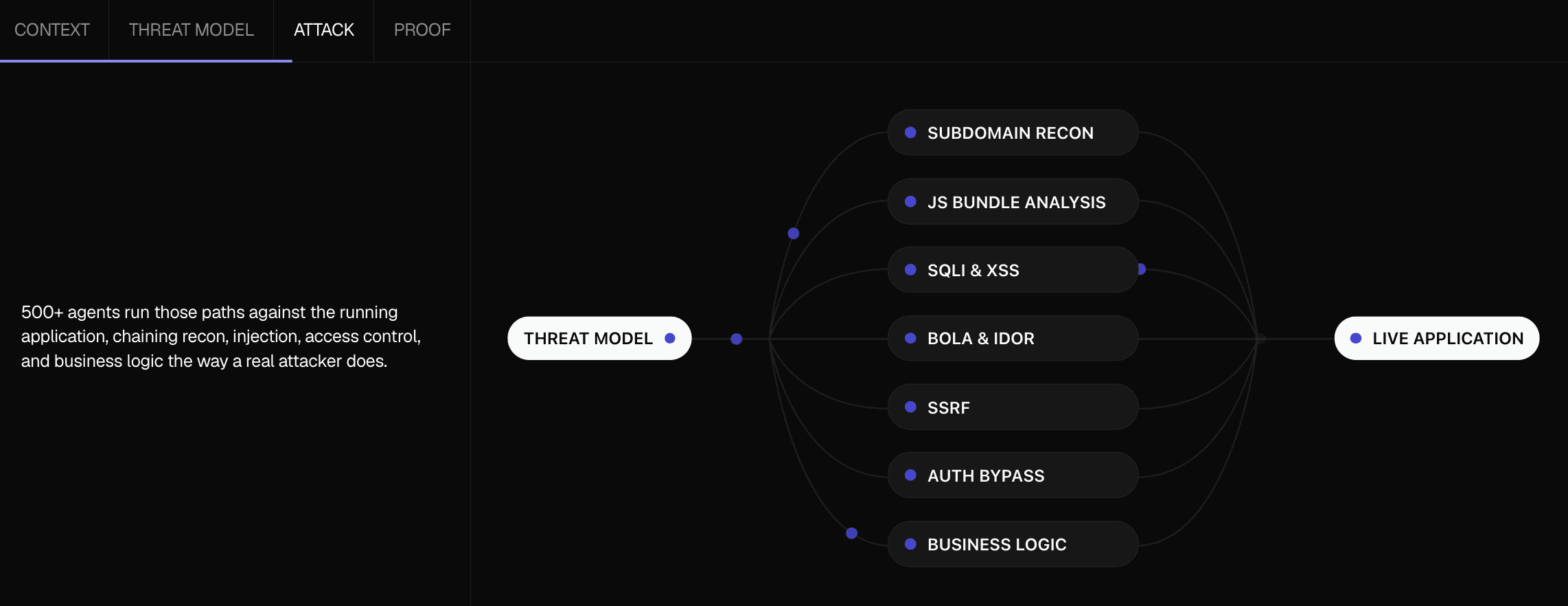
CodeAnt AI is built around a single idea: find the path to a breach, not just the list of problems. Most tools on this list grew from the outside in, starting as internet scanners and later trying to reason about impact. CodeAnt grew the other way, from the code, secrets, cloud, and identity outward, then added external discovery on top. That origin is why its native question is "what can this reach," which is exactly the question an attack surface inventory leaves unanswered, and it is the reason CodeAnt sits in the validation tier of this list rather than the discovery one.
Best for: teams tired of a long, flat asset list that want to know which exposures actually lead to a breach.
How it works: CodeAnt External maps the internet-facing surface (domains, hosts, ports, services, exposed applications, leaked credentials). CodeAnt Internal then connects each exposure to the code, secrets, cloud configuration, and identities behind it, and agents test which of those connections reach critical data. Every exposure is scored by the route it opens, not by the fact that it exists.
Strengths:
One model of external exposure and internal context, so a weakness in one layer is traced as a route through the next.
Validation that marks a path proven only when agents demonstrate it end to end, with the full testing trail behind every finding.
Prioritization by reachability to critical data rather than by severity score.
Limitation: CodeAnt is not a pure internet-scale discovery scanner in the mold of Censys. Its strength is connecting external exposure to internal impact, so a team that only wants a raw external asset feed may not need its depth. The distinction is covered in attack surface management vs. attack path analysis and attack path validation.
Pricing: custom, based on scope. Validation is delivered as an assessment through the AI pentesting product.
See which exposures reach your critical data. Book an assessment with CodeAnt AI.
2. CyCognito: Best for Seedless Discovery and Shadow IT

CyCognito is one of the companies that defined the external attack surface category, founded by operators who came out of national-intelligence units and built the product around seeing an organization the way an attacker would. For years it was the reference name whenever a security team said "we do not even know what we have exposed." Its reputation rests on finding the unknown rather than monitoring the known. Among dedicated EASM platforms, it is usually the first one shortlisted when the fear is shadow IT and forgotten infrastructure.
Best for: organizations whose main problem is unknown assets and shadow IT across a sprawling perimeter.
How it works: CyCognito maps the external attack surface without seed lists or IP ranges, then uses attacker-style reconnaissance and active testing to rank exposures by how reachable and attractive they are.
Strengths:
Zero-input discovery that surfaces assets teams did not know they owned.
Exploitability-aware prioritization rather than raw severity.
Active security testing on discovered assets, the furthest toward validation of the pure EASM tools.
Limitation: a dedicated external platform, so it does not map internal code-to-data context the way an attack-path tool does.
Pricing: custom, annual subscription. Contact sales for a quote.
3. Palo Alto Cortex Xpanse: Best for Large Palo Alto Estates

Cortex Xpanse is the external attack surface arm of Palo Alto Networks, one of the largest security vendors in the world, and it entered the portfolio through the acquisition of Expanse in 2020. It carries the roadmap, support, and gravity of a platform company, which is both its strength and its ceiling. Enterprises rarely evaluate Xpanse in isolation. They adopt it because they already run Cortex and want external exposure living inside the same console, and that platform pull shapes who it genuinely fits.
Best for: large enterprises already standardized on Palo Alto Networks.
How it works: continuous internet-scale discovery with machine-assisted attribution, paired with an Active Response Module that automates remediation of exposures.
Strengths:
Asset discovery at enterprise scale.
Automated response, not just alerting.
Tight correlation with Cortex XDR for connected threat response.
Limitation: its clearest value is inside the Palo Alto ecosystem. Outside that stack the EASM capability is capable but less differentiated than CyCognito's breadth or Censys's data depth.
Pricing: custom, module-based within Cortex, annual. Contact sales for a quote.
4. Microsoft Defender EASM: Best for Microsoft and Azure Teams

Defender EASM exists because Microsoft acquired RiskIQ in 2021, one of the original external attack surface companies, and folded its discovery engine into the Defender family. For the vast number of organizations already standardized on Azure, Sentinel, and Defender, it is less a new purchase than a capability already sitting in the tenant. Its real advantage is reach and integration economics rather than best-in-class discovery depth. It tends to be the option Microsoft shops assess first, simply because it is the one they already own.
Best for: Microsoft and Azure-centric security teams wanting integrated EASM.
How it works: built on the RiskIQ technology Microsoft acquired, it maps internet-facing infrastructure, classifies assets, and surfaces built-in reports (Attack Surface Summary, Security Posture, GDPR, OWASP Top 10) inside Azure.
Strengths:
Native integration with Microsoft Defender XDR and Sentinel.
RiskIQ discovery heritage, one of the pioneers of EASM.
Transparent, predictable per-asset pricing.
Limitation: value concentrates for teams already standardized on Microsoft security, and it scores risk rather than proving reachable paths.
Pricing: roughly $0.011 per asset per day after a 30-day free trial.
5. Censys ASM: Best for Discovery Accuracy

Censys grew out of academic research at the University of Michigan, where its founders built internet-wide scanning techniques that much of the industry now relies on. It is often described less as a security product and more as a living map of the internet that security teams query. A number of other platforms quietly sit on top of data of this kind beneath their own dashboards. That research heritage is why teams who care most about raw discovery accuracy keep returning to it as the source of truth.
Best for: teams that want the most accurate internet-scale discovery data.
How it works: continuous internet-wide scanning builds research-grade data on hosts, services, and certificates, which Censys maps to your organization's external footprint.
Strengths:
Best-in-class discovery data accuracy, from its academic scanning roots.
Deep certificate and service visibility.
Flexible data and analysis for research-grade investigation.
Limitation: a data and discovery platform rather than a validation tool, so what an exposure reaches is left to you or another layer.
Pricing: custom. Contact sales for a quote.
6. CrowdStrike Falcon Surface: Best for CrowdStrike Customers

Falcon Surface is CrowdStrike's external attack surface module, and like most things in the CrowdStrike world it is designed to pull another security function into the Falcon platform rather than stand on its own. CrowdStrike earned its reputation in endpoint detection and threat intelligence, and Falcon Surface extends that same lens outward to internet-facing assets. For the large base of organizations that already treat Falcon as their security backbone, the appeal is consolidation rather than novelty. It is rarely the tool a team adopts in isolation from the rest of the platform.
Best for: existing CrowdStrike customers consolidating within one platform.
How it works: continuous external discovery and real-time monitoring feed risk scoring into the Falcon console, enriched with CrowdStrike threat intelligence.
Strengths:
Consolidates external exposure into a console teams already use every day.
Continuous monitoring with CrowdStrike threat context.
Fast to adopt for existing Falcon customers.
Limitation: the economics favor existing Falcon customers, and it scores risk rather than proving an end-to-end path.
Pricing: custom, as part of the Falcon platform. Contact sales for a quote.
7. Tenable One ASM: Best for Tenable Customers

Tenable is one of the longest-standing names in vulnerability management, the company behind Nessus, and its ASM capability is part of a deliberate shift from vulnerability management toward broader exposure management under the Tenable One banner. For an installed base that has run Tenable for years, external discovery is a natural extension of a familiar workflow. The story it tells is less about novel discovery and more about keeping every exposure in one platform. That continuity is the main reason existing customers choose it over a standalone EASM tool.
Best for: teams already invested in Tenable for vulnerability management.
How it works: external discovery feeds the Tenable One exposure platform, landing external findings alongside internal vulnerability data under one scoring model.
Strengths:
Workflow continuity with Tenable vulnerability management.
Part of a broader exposure-management platform.
Familiar scoring and reporting for existing customers.
Limitation: validation stays at the level of vulnerability correlation rather than proven attack paths.
Pricing: custom, as part of Tenable One. Contact sales for a quote.
8. Qualys EASM: Best for Qualys Customers

Qualys is another vulnerability-management veteran, known for delivering its scanning entirely from the cloud and for its VMDR product, and its EASM capability follows the same logic as Tenable's. The company's enduring strength has been breadth of scanning from a single cloud platform. Adding external discovery lets it offer a one-console story to the enterprises that already depend on it. As with Tenable, its pull is integration and familiarity rather than leadership in discovery itself.
Best for: teams already running Qualys for vulnerability management.
How it works: agentless external discovery surfaces unknown internet-facing assets and feeds them into Qualys VMDR, so exposures flow through existing workflows.
Strengths:
Single console shared with Qualys VMDR.
Agentless discovery of unknown assets.
Continuity with established Qualys processes.
Limitation: like Tenable, validation is correlation with vulnerability data rather than path proof.
Pricing: custom, as part of the Qualys platform. Contact sales for a quote.
9. Mandiant ASM: Best for Adversary-Aware Prioritization

Mandiant is one of the most respected incident-response and threat-intelligence firms in the industry, the team called in after many of the decade's largest breaches, and it is now part of Google Cloud. Its attack surface product is distinctive because it is backed by that frontline intelligence rather than by discovery technology alone. Where most tools rank exposures by generic severity, Mandiant can weight them by what its responders are watching attackers actually do. That intelligence pedigree, more than its scanning, is what sets it apart.
Best for: teams that want threat-intelligence-aware prioritization.
How it works: continuous discovery is paired with Mandiant frontline threat intelligence, now part of Google Cloud, ranking exposures by adversary activity and running active checks on discovered assets.
Strengths:
Prioritization informed by Mandiant threat intelligence.
Active checks on discovered exposures.
Adversary context that most pure-discovery tools lack.
Limitation: the threat context sharpens ranking, but it still stops short of proving an end-to-end path through your environment.
Pricing: custom, via Google Cloud. Contact sales for a quote.
10. IONIX: Best for Mapping Connected Third-Party Risk

IONIX, formerly Cyberpion, built its approach around a specific observation: your real attack surface includes everything your assets connect to, not only the assets you own. That means third-party scripts, cloud dependencies, and the long chain of services a single application quietly relies on. It is a narrower and more opinionated take on ASM than the broad-discovery platforms around it. The teams drawn to it usually run dependency-heavy or deeply interconnected environments where that connective risk is the thing that actually keeps them up at night.
Best for: teams whose risk lives in dependencies and connected third-party assets.
How it works: IONIX maps not only your assets but the third-party and dependency relationships that extend the surface, then runs targeted exploit testing on discovered exposures.
Strengths:
Maps the connective tissue and third-party dependencies, not just owned assets.
Active exploit testing on discovered exposures.
Focused prioritization of the connections that extend your risk.
Limitation: an external platform, so it does not reach into internal code and identity context.
Pricing: custom. Contact sales for a quote.
11. Intruder: Best for Lean Teams

Intruder is a UK-based company that deliberately built for the opposite end of the market from the enterprise platforms above. Its entire design philosophy is to make continuous external security approachable for teams that do not have a dedicated security operations function. It leans on a clean interface and sensible defaults instead of deep configurability. For a lean startup or a small security team, that accessibility is often worth more than the extra depth of a heavier platform they would struggle to operate.
Best for: lean teams that want continuous external coverage they can run without a dedicated operator.
How it works: continuous scanning and monitoring watch your external targets, with emerging-threat scans that re-check assets when new vulnerabilities are published.
Strengths:
Fast setup and a simple interface.
Continuous and emerging-threat scanning.
The most accessible entry cost in this list.
Limitation: scanning depth rather than deep ASM discovery or validation, and no internal context.
Pricing: published subscription tiers, with a lower entry cost than the enterprise platforms. Check the vendor for current rates.
Open-Source Attack Surface Management
If budget is the constraint and you have the in-house skill to operate it, open-source tooling covers the discovery basics. OWASP Amass is the most established, mapping external assets and infrastructure through passive and active reconnaissance.
The trade-off is real. Open-source tools give you discovery and nothing downstream. There is no prioritization engine, no validation, and no managed support, so the operating cost moves from a license to your team's time.
How to Choose: The Decision Framework
The real decision is usually made at the intersection of three constraints: what your team cannot currently see, which ecosystem you already run, and whether you need proof or just an inventory.
If your situation is… | Start with | Why |
|---|---|---|
You cannot list your internet-facing assets with confidence | CyCognito or Censys | Seedless discovery and research-grade data find the unknowns |
You are a Microsoft, Palo Alto, CrowdStrike, Tenable, or Qualys shop | The matching platform EASM | Integration economics inside your existing stack |
You want the most accurate internet discovery data | Censys | Best-in-class scan data and certificate visibility |
Your risk lives in third-party and dependency connections | IONIX | Maps the connective tissue, not just your own assets |
You have an inventory but cannot tell which exposures matter | Validates which exposures reach critical data | |
You need proof an exposure reaches sensitive data, not a severity score | Proven, end-to-end attack paths with a testing trail | |
You are a lean team wanting simple coverage | Intruder | Straightforward monitoring without platform weight |
Most teams already own some discovery. The gap that usually remains is the connection from an exposure to the identity, permission, and data behind it.
Attack Surface Management vs Vulnerability Management vs CTEM
Three terms get used as if they were the same program. They are not, and the difference decides what each tool is for.
Discipline | Core question | What it produces |
|---|---|---|
Vulnerability management | What is wrong with the assets we know about? | A ranked list of CVEs on known assets |
Attack surface management | What is exposed, including assets we forgot? | A discovered, monitored inventory of exposures |
Attack path analysis and validation | Which exposures actually reach critical data? | Proven routes, prioritized by impact |
CTEM (the Gartner program) | How do we run all of the above continuously? | A repeating cycle of scope, discover, prioritize, validate, mobilize |
Vulnerability management works on assets you already know. ASM finds the ones you do not. Validation proves which of them matter. CTEM is the program that keeps the loop running, and it is why prioritization beyond CVSS alone has become the standard expectation.
The full breakdown of where inventory stops and impact begins is in attack surface management vs. attack path analysis.
The Bottom Line
The ASM market is full of capable discovery tools, and the right platform EASM is often the one that fits the stack you already run. That solves the first half of the problem, which is knowing what is exposed.
The second half is knowing what those exposures reach. A growing inventory of unranked assets is not the same as a short list of routes to your data, and Gartner's move to fold ASM into a validation-centric CTEM program is a signal that discovery alone is no longer enough. A tool that maps the surface and validates the paths behind it turns that inventory into decisions. That is the layer CodeAnt AI adds on top of discovery.
For deeper reading:
See your external attack surface and the proven paths behind it. Book an assessment with CodeAnt AI.

