

Your security team runs annual penetration tests. Your developers ship code every week. Between those two realities lies a dangerous gap, one where a vulnerability introduced in sprint 3 gets exploited in sprint 8 and discovered in next year's pentest report.
So, are offensive security and penetration testing the same thing? No. Penetration testing is a focused, time-boxed component inside the broader discipline of offensive security, which also includes red teaming, attack surface management, and continuous validation. Understanding that relationship is what decides whether your security program can actually keep pace with how fast you ship.
This guide gives you the practical version: where pentesting fits inside offensive security, why annual engagements cannot match CI/CD deployment speed, and how to run continuous offensive testing that plugs into your pipelines, including the code-aware techniques that find what external-only scanning misses.
The Core Distinction: A Component vs a Discipline
Penetration testing is a time-boxed, goal-oriented engagement where security professionals try to exploit vulnerabilities in defined targets. It usually runs three to five days, with a clear scope and a deliverable report. It is one technique.
Offensive security is the whole discipline, every proactive method for testing your defenses:
Vulnerability assessment: automated discovery of known weaknesses (OWASP Top 10, dependency checks, misconfigurations). Identification, no exploitation. We cover this distinction in What Is VAPT? Vulnerability Assessment vs Penetration Testing.
Penetration testing: active exploitation of discovered vulnerabilities with a working proof-of-concept that demonstrates real business risk.
Red teaming: extended adversary simulation (weeks to months) focused on stealth, persistence, and objective completion while testing your detection.
Attack surface management: continuous discovery and monitoring of external-facing assets, subdomains, APIs, cloud storage, third-party integrations.
Continuous validation: ongoing offensive testing integrated into CI/CD, triggered by deployments, API changes, or authentication modifications.
The distinction matters because most organizations deploy 50 or more times a year but pentest once, leaving roughly 49 deployment windows untested. Penetration testing answers "can this specific target be exploited today?" Offensive security asks "is our whole attack surface defensible, continuously?"
The Offensive Security Spectrum
Where your organization sits on this spectrum tells you what to invest in next.

Approach | Scope | Duration | Primary objective | What it misses |
|---|---|---|---|---|
Vulnerability scanning | Automated surface scan | Continuous | Identify known vulnerabilities | Logic flaws, authorization bypasses, complex chains |
Penetration testing | Time-boxed, targeted | 3 to 5 days | Prove exploitability | Detection gaps, long-term persistence |
Red teaming | Adversarial simulation | 2 to 6 weeks | Test detection and response | Breadth (it is objective-focused) |
Continuous offensive | Ongoing, integrated | Always-on | Catch issues at development speed | Very little, when properly implemented |
Two factors decide where you belong.
Deployment frequency: monthly or quarterly, and annual pentesting may cover compliance. Weekly, and you have 50-plus untested release windows a year. Daily, and traditional pentesting simply cannot keep pace.
Application surface area: a simple monolith is well served by scanning plus an annual test, but an API-heavy microservices platform needs gray-box testing with code awareness, and a multi-tenant SaaS needs continuous testing that understands authorization at the code level, because a single tenant-isolation failure exposes everyone.
For a look into the best penetration tools for SaaS companies, see our blog.
Black Box, Gray Box, White Box: Choosing Your Knowledge Model
Within pentesting itself, the amount of knowledge you give the tester changes what gets found. We go deep on all three in Black Box vs White Box vs Gray Box Penetration Testing. Here is the short version and why gray box usually wins.
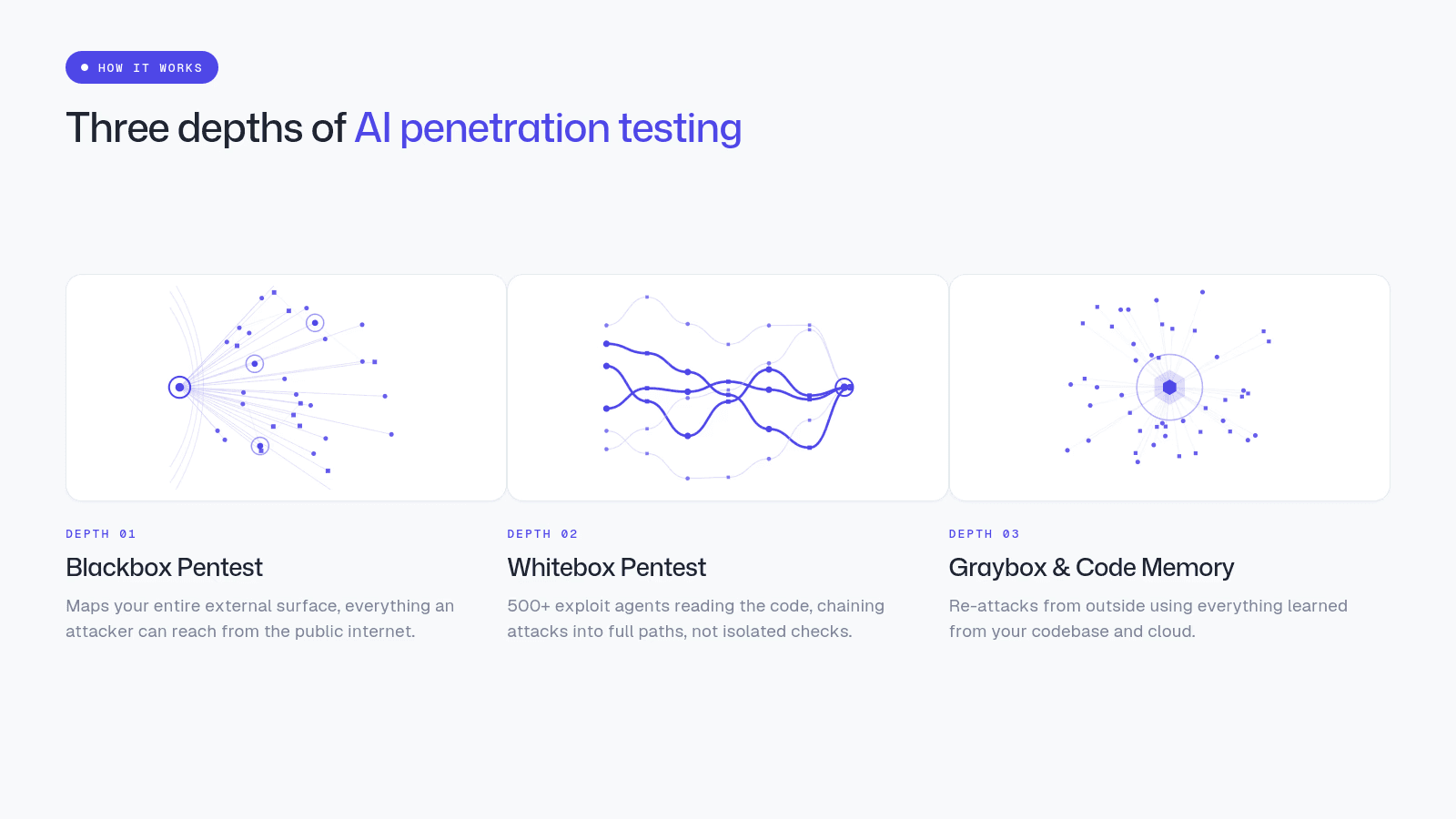
Black box simulates an external attacker with zero internal knowledge. It finds infrastructure misconfigurations, authentication bypasses, and client-side issues well, but struggles with business logic flaws, server-side authorization bypasses, and tenant isolation. Use it when compliance requires external-only validation or for pre-acquisition due diligence.
White box provides full source, architecture, and engineer access. It uniquely finds logic vulnerabilities that need code-level understanding, cryptographic implementation flaws, and side-channel leakage. The catch is the coordination tax: repository access, architecture walkthroughs, and engineer availability, which makes it impractical for continuous testing. Use it for pre-launch reviews and security-critical code.
Gray box sits in the middle: partial knowledge, authenticated credentials, and sometimes architecture context, without full source. It mirrors the most realistic threat model, an attacker with compromised credentials, and it is where the ROI lives. It tests RBAC enforcement, tenant isolation, and privilege escalation, catching the Broken Object Level Authorization and IDOR bugs that lead to mass data exposure, with far less coordination than white box.
How code-aware testing changes the gray-box equation
Traditional gray box stops at the API boundary. A code-aware platform combines external testing with codebase intelligence, and that changes three things. It finds targets faster, analyzing the codebase to spot the high-risk endpoints (JWT handling, complex authorization, database queries from user input) instead of blindly fuzzing. It exploits deeper, constructing chains an external-only tool cannot see:
And it remediates precisely, with the exact file, line, and function, a fix based on how correct endpoints handle authorization, and a retest that confirms the fix. That last column is the difference between a report and a resolution.
Vulnerability type | Black box | Gray box | White box | Code-aware gray box |
|---|---|---|---|---|
Exposed admin panel | Yes | Yes | Yes | Yes |
SQL injection | Basic | Deeper | All instances | Plus code location |
Broken Object Level Authorization / IDOR | Limited | Yes | Yes | Plus exploit chain |
Tenant isolation bypass | No | Yes | Yes | Plus root cause |
Multi-step logic flaw | No | Maybe | Yes | Plus attack chain |
Remediation guidance | Generic | Generic | Detailed, manual | File/line/function plus fix |
Why Annual Pentests Fail at Software Speed
If your team deploys once a week, you ship 52 releases a year and your annual pentest validates exactly one, leaving 51 releases (98% of deployments) untested for exploitable vulnerabilities. The failure mode is concrete:
Week 1: the team ships a new OAuth integration.
Week 8: an engineer refactors token validation and accidentally removes scope verification.
Week 18: an attacker uses that gap to access 476K customer records through a Broken Object Level Authorization vulnerability.
Week 24: the annual pentest runs and finds the authorization bypass.
That is 23 weeks between introduction and discovery. We break the cadence problem down fully in Continuous vs Annual Penetration Testing.
The retest bottleneck makes it worse. Traditional firms charge $5k to $15k for retesting, so the loop stalls: 15 findings delivered, 12 fixed next sprint, two to four weeks to schedule a retest around consultant availability, and then three fixes turn out incomplete. The bottleneck is operational, not technical, because traditional firms optimize for breadth (many clients once) rather than depth (one client's fixes, thoroughly).
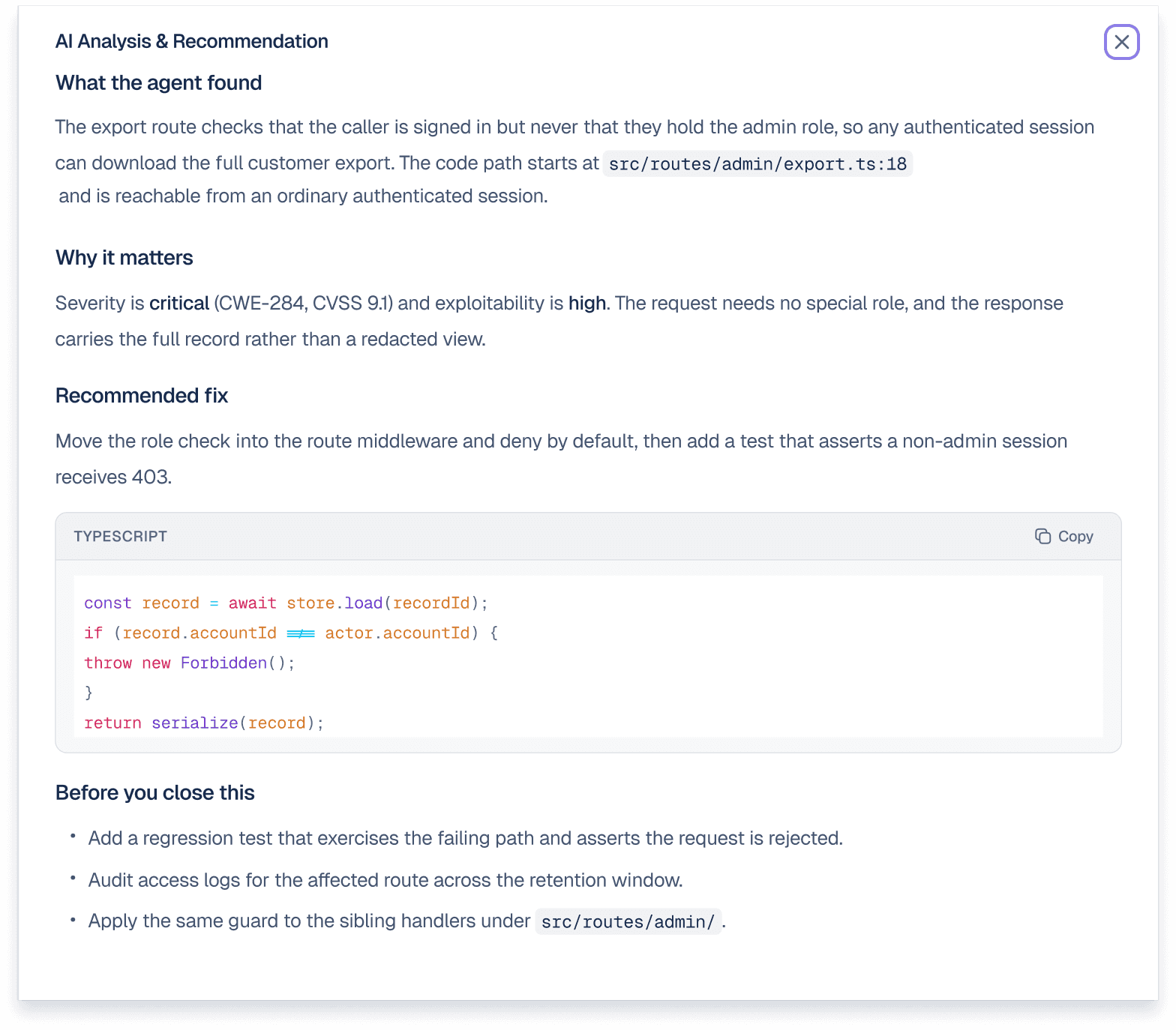
And generic findings slow the fix. A finding that says "SQL injection in the user search endpoint, implement parameterized queries" starts two or three clarification rounds. A code-aware finding ends them:
The difference is a fix on the first attempt versus a back-and-forth thread.
Where Offensive Testing Fits in CI/CD
Continuous offensive security is not one tool. It is testing at four stages of the pipeline, each with a different depth-versus-speed tradeoff.
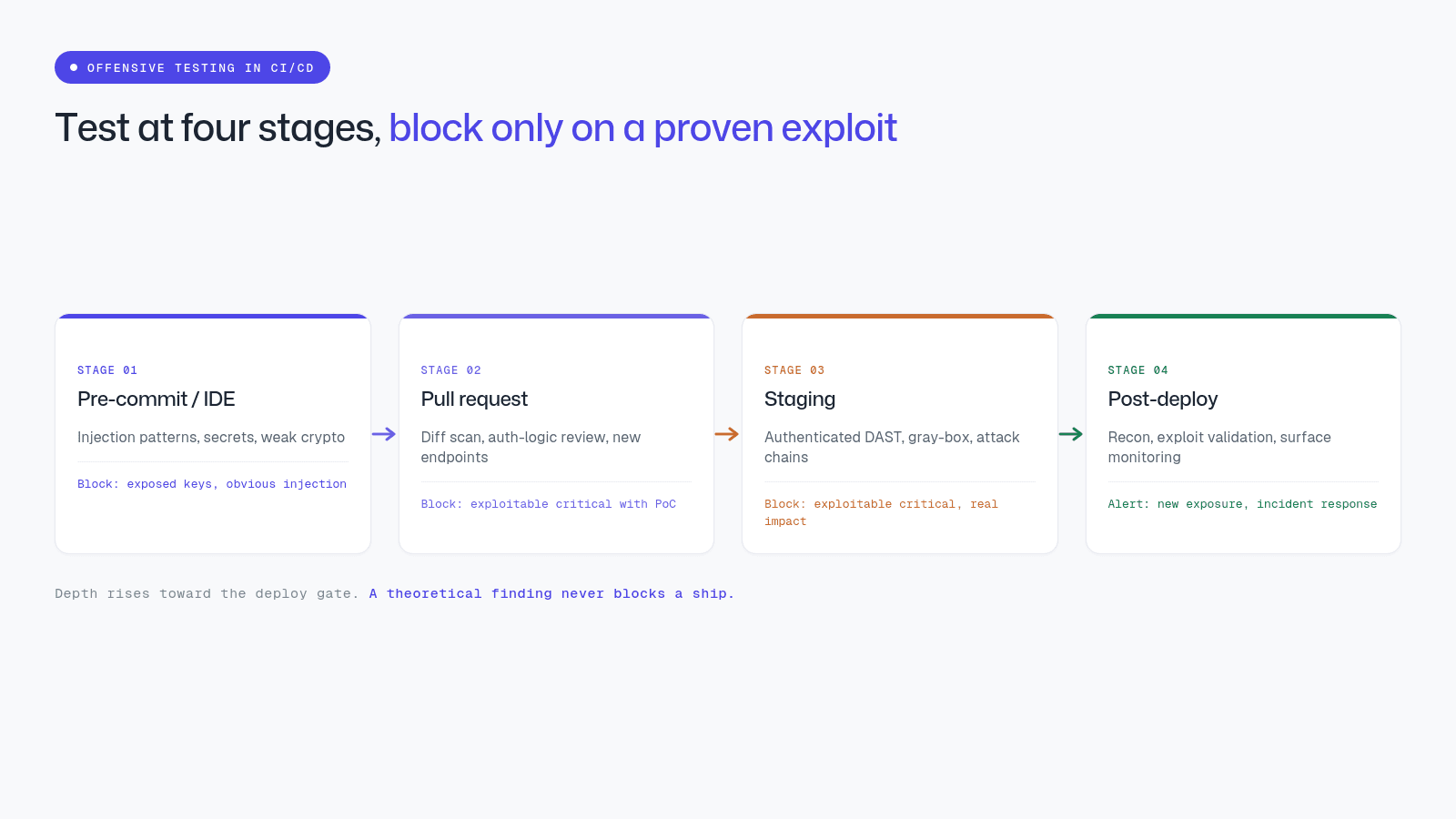
Stage 1, pre-commit and IDE. SAST-style checks for injection patterns, hardcoded secrets, and weak crypto, plus dependency scanning. Block on the unambiguous criticals (exposed API keys, obvious injection), and warn on everything else so you do not slow the developer.
Stage 2, pull request. Differential scanning focused on the changed files, authorization-logic review, and new-endpoint analysis. Block only on an exploitable critical with a working PoC, never on a theoretical finding with no exploit path.
Stage 3, staging. Authenticated DAST across permission levels, gray-box testing that combines external recon with codebase knowledge, business-logic testing, and attack-chain construction. This is where you block on an exploitable critical with real business impact.
Test type | Execution time | Block deploy? | Example finding |
|---|---|---|---|
Authenticated DAST | 15 to 30 min | Only on critical | Broken Object Level Authorization allowing cross-tenant data access |
Gray-box exploit validation | 1 to 2 hours | Yes, if exploitable | JWT signing-key extraction to token forgery |
Infrastructure scan | 10 to 15 min | Only on high + exploitable | Exposed admin panel with default creds |
Stage 4, post-deploy. Continuous reconnaissance (subdomain enumeration, JavaScript bundle analysis), exploit validation that known issues stay patched, and attack-surface monitoring for new exposures like a forgotten debug endpoint.
Automating the deploy-to-remediation loop
The mechanics are straightforward. A deployment to main triggers a scan:
The platform maps the authentication flows, runs exploit attempts (Broken Object Level Authorization and IDOR, injection, SSRF, GraphQL attacks), collects evidence (the HTTP requests, a curl PoC, the affected file and line, a CVSS score), and routes a confirmed critical straight to the team:
Then unlimited retesting confirms the fix and regression-checks that it did not open something new.
IDE-Level Security: Shift Left Without Slowing Developers
IDE integration collapses the feedback loop to seconds. As you type eval(userInput), inline detection flags it immediately:
This catches injection sinks, hardcoded credentials, deprecated crypto, SSRF sinks, and PII in debug logs, the classes that are cheapest to fix before they ever reach a branch. What it cannot replace is runtime exploitation, infrastructure testing, and business-logic vulnerabilities that only appear in an authenticated running system, which is exactly why shift-left security complements offensive testing rather than replacing it.
The payoff compounds when the two directions share intelligence: a code review that flags a new authentication endpoint triggers an auth-bypass test on the offensive side, and a pentest that finds an authorization bypass via parameter pollution becomes a new IDE detection rule. Defensive and offensive get better because they inform each other.
A Phased Rollout, From Quick Wins to a Continuous Program
You do not flip a switch. Most teams get there in three phases.
Phase 1, quick wins (weeks 1 to 4). Every production deployment triggers a focused pentest, scoped to new or modified endpoints only, with findings back in 24 to 48 hours.
Phase 2, IDE and PR integration (weeks 5 to 12). Real-time feedback during development, PR gates that block merges matching known exploit vectors, and inline fixes informed by earlier pentest findings.
Phase 3, continuous program (week 13 and on). Weekly or bi-weekly full-scope engagements, unlimited retesting at no extra cost, and continuous reconnaissance that catches new attack surface as it appears.
Track outcome metrics, not activity: time-to-triage (target under 4 hours), time-to-fix (under 48 hours for critical), retest pass rate (over 85%), critical findings per release (trending to zero), and exploit-confirmation rate (under 5% false positives).
A Decision Framework for What to Do Next
Four questions place you.
How often do you deploy? Monthly or less, annual pentesting may suffice. Weekly to daily, you need continuous offensive testing. Multiple times a day, shift-left becomes critical.
What compliance frameworks govern you? SOC 2, ISO 27001, PCI DSS, or HIPAA all need audit-grade reports with CVSS scoring and control mapping. No formal compliance, and you can optimize for speed and cost.
How large is your public attack surface? A single web app, and black box works. Microservices and multiple APIs, and gray or white box earns its cost. Multi-tenant SaaS, and code-aware testing becomes essential.
Do you have internal security capacity? A dedicated team can run continuous platforms, a distributed model needs code-level remediation guidance, and no security headcount points to managed engagements.
For most teams deploying more than monthly with compliance requirements, the answer is a hybrid: an annual third-party pentest ($15k to $50k) for independent audit validation, plus a continuous code-aware platform ($2k to $10k a month) that tests every deployment, retests without fees, and delivers code-level fixes. The automated pentesting guide covers the continuous half in depth, and if you are writing the vendor requirements, the RFP template has the clauses to demand.
Your Offensive Security Program Should Move as Fast as You Ship
The question was never whether offensive security and penetration testing are the same thing. They are not: pentesting is one time-boxed technique inside a discipline that also spans scanning, red teaming, attack surface management, and continuous validation. The real question is whether your offensive program keeps pace with how fast your team ships code, because an annual test on a codebase that changes weekly is a point-in-time answer to a continuous question.
That is what CodeAnt AI is built to close. It runs both sides from one code-aware engine: defensive review on every pull request, and offensive testing that probes from the outside with inside knowledge of your codebase. Because the same intelligence powers both, a finding on either side sharpens the other, and every offensive finding lands with a working PoC and the exact file, line, and fix. Retests are unlimited, and pricing is performance-based, you pay only when a high or critical is confirmed exploitable.
Where to start this week
Pick your single highest-velocity service, the one that ships most often and touches customer data, and wire one trigger: a gray-box scan on every deploy to main, scoped to the endpoints that changed. Require a working PoC for anything it flags critical. That one trigger turns 51 untested release windows a year into 51 tested ones, without slowing a single developer.
Run a free code-aware pentest →
Related reading
What Is VAPT? Vulnerability Assessment vs Penetration Testing: the assessment-versus-exploitation distinction underneath this one
Black Box vs White Box vs Gray Box Penetration Testing: the knowledge models in depth
Automated Penetration Testing: how the continuous half of the spectrum actually runs
Continuous vs Annual Penetration Testing: the cadence case in full
How to Write a Penetration Testing RFP: the requirements to demand when you buy any of this

