

CodeAnt AI pentesting connects offensive testing to source-to-runtime code security. Doyensec is a research-led boutique that delivers deep manual application security assessments. This comparison starts with the cadence you need, not a feature checklist.
CodeAnt fits a team that ships continuously and wants testing on every release, self-serve. Doyensec fits an organization that wants a scheduled, deep manual audit of a complex application by senior researchers.
CodeAnt publishes outcome-based terms. Doyensec quotes each engagement by custom proposal with no public price. To compare them fairly, decide first whether you need continuous coverage or a point-in-time expert audit.
What CodeAnt solves here: it reads your source the way a boutique researcher would, but does it continuously and automatically, then proves each finding with a working exploit and returns it inside your pull request and CI/CD workflow. The depth of a code-aware audit, without the wait for a booking or the ceiling of a small expert bench.
TL;DR: CodeAnt AI vs Doyensec at a Glance
The two solve different testing problems. The fast read is below.
Decision point | CodeAnt AI | Doyensec |
|---|---|---|
Core model | Agentic, code-aware, continuous, self-serve | Manual expert audit, boutique bench |
Best fit | Teams shipping continuously that want testing on every release | Teams wanting a deep point-in-time audit of a complex app |
How you start | Free scan from a URL, or a call | Proposal, scoping, scheduled booking |
Testing method | Black, white, gray box with code memory, AI plus human-verified | Manual source-plus-dynamic auditing |
Cadence | Continuous | Point-in-time per engagement |
Availability | Start today | Booked weeks out, boutique capacity |
Public pricing | Published outcome-based terms | None, custom proposal |
Pick it when | You need continuous, code-connected testing priced on outcomes | You need a deep manual audit of an unusual or complex target |
How We Compared CodeAnt AI vs Doyensec for Pentesting
This comparison uses official public pages available in August 2026. It is not a detection benchmark, since the same target was not run through both.
The method follows how each tests an application and returns findings for remediation. A fair pilot can use the OWASP Web Security Testing Guide for coverage language and NIST SP 800-115 for assessment planning.
For the category context of automated versus manual web application penetration testing, the difference is not depth alone. It is depth per dollar and depth per week, which the cadence question decides.
What Is CodeAnt AI?
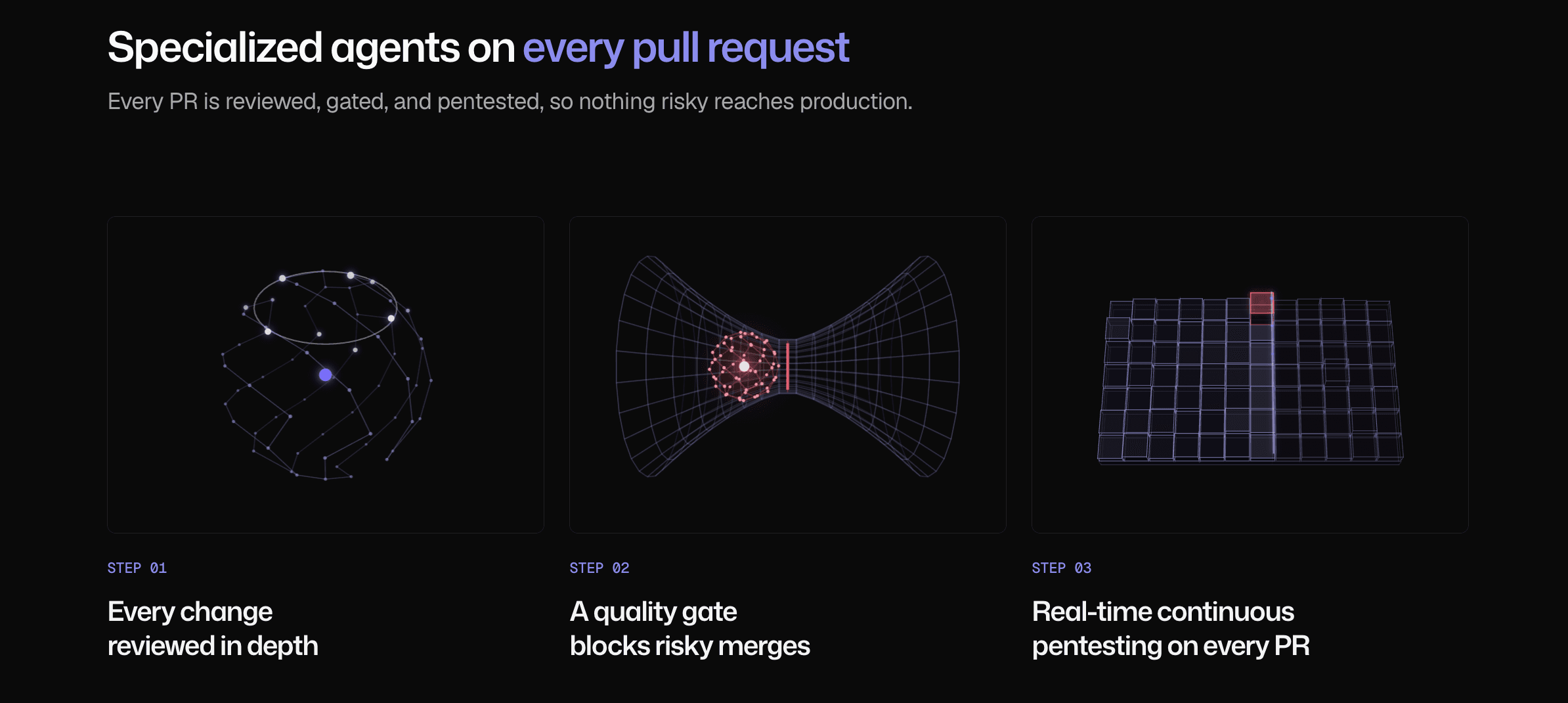
CodeAnt AI starts in the repository and extends into offensive testing. Its defensive layer runs SAST, SCA, secret scanning, and IaC analysis, surfaced through AI code review in the pull request.
The offensive layer runs black box, white box, and gray box tracks. The gray box track reads your source and authenticated context to reach the business-logic and authorization flaws that external testing misses.
Every confirmed finding ships with a working exploit, retests are free and unlimited, and the report maps to SOC 2 and ISO 27001. It runs continuously, so every release is covered.
What Is Doyensec?
Doyensec is a boutique application security firm founded in 2017. Its researchers co-authored the OWASP Testing Guide and have invented new classes of attacks, working across many languages and platforms.
Its signature method combines source code review with dynamic testing, and it favors depth on business logic, novel bug classes, and complex targets like GraphQL platforms, Electron applications, and LLM-based systems. Researchers get dedicated time for self-directed security research, which feeds the firm's reputation.
Engagements are scheduled, scoped, and point-in-time. A boutique bench delivers exceptional depth on a booked target, then hands over a prioritized written report with remediation steps.
Doyensec supports compliance programs, but as a testing firm rather than the attestation issuer. Buyers use it when they need a deep manual audit rather than continuous coverage.
CodeAnt AI vs Doyensec: Pentesting Features by Buyer Job
The comparison reads best by buyer job: how each tests, how deep it goes, how fast it starts, and how findings return.
Test an application with code context
CodeAnt documents black-box testing plus tests that use source and authenticated context. The SAST versus DAST guide explains why source and runtime reveal different defects, and gray-box code memory is where CodeAnt reaches authorization and logic flaws.
Doyensec's source-plus-dynamic method is genuinely deep on exactly these flaws, delivered by senior researchers. On a single complex target, a Doyensec researcher chasing a second-order logic bug is doing something automation still finds hard.
The honest gap is real but narrow. CodeAnt closes most of it with code memory and human revalidation, and it does so on every release rather than once per booking.
Start testing and get results
CodeAnt starts from a free scan with no scheduling. Findings stream in and a full report lands within 48 hours.
Doyensec engagements are booked weeks out against limited boutique capacity. That is the cost of scarce senior expertise, and it is the sharpest operational contrast between the two.
For a team shipping weekly, the wait is the deciding factor. Every release waits for the next available slot and the next proposal.
Prove findings and verify fixes
CodeAnt proves each finding with a working exploit and re-runs the attack through free unlimited retests. Findings carry steps of reproduction into remediation and land in a security dashboard. The sample report shows the evidence detail.
Doyensec delivers a detailed written report per engagement, prioritized by severity with remediation guidance. Retesting is handled as a new or extended engagement rather than a free unlimited feature.
Pricing and Packaging Comparison
CodeAnt publishes outcome-based terms, where low and medium findings are free and you pay only on confirmed high or critical findings, with free retests.
Doyensec quotes each engagement by custom proposal with no public price. Boutique engagements are priced on rare expertise and time, which rewards a deep annual audit and does not fit a weekly release cadence.
Attribute | CodeAnt AI | Doyensec |
|---|---|---|
Model | Outcome-based, pay per confirmed exploit | Fixed-scope consulting engagement |
Entry point | Free scan from a URL | Proposal and scoping |
You pay when | A working high or critical exploit is confirmed | The engagement is booked |
Retesting | Free and unlimited | Rescoped or rebooked |
Public price | Published | None |
The takeaway is cadence-versus-depth economics. Doyensec's model is right for a once-a-year deep audit. CodeAnt's is right for continuous testing priced on what is actually found. For market context, see how much a penetration test costs.
CodeAnt AI vs Doyensec: Which Should You Choose?
Pick CodeAnt AI when you ship continuously and want code-aware testing on every release, proven with exploits, priced on outcomes.
Pick Doyensec when you need a deep point-in-time manual audit of a complex or unusual target by senior researchers, and you can plan the booking ahead.
The two can coexist. CodeAnt handles the continuous release-by-release loop, and Doyensec runs a periodic deep audit of your most complex application.
Conclusion: CodeAnt AI vs Doyensec
CodeAnt AI and Doyensec solve different penetration testing problems. If you ship continuously and want proven, code-aware testing without a waitlist, start a free CodeAnt pentest from a URL. If you need a deep periodic manual audit of a complex target, Doyensec is built for that.
For the category context, read continuous versus annual pentesting and the best AI penetration testing tools of 2026.

