

CodeAnt AI pentesting connects offensive testing to source-to-runtime code security. Atredis Partners is a worker-owned research boutique known for bespoke, deep engagements against unusual targets. This comparison starts with the kind of testing you need, not a feature checklist.
CodeAnt fits a team shipping software continuously that wants code-aware testing on every release, self-serve. Atredis fits an organization that needs a bespoke research engagement, often against hardware, embedded systems, or an unusual architecture.
CodeAnt publishes outcome-based terms. Atredis quotes each engagement by proposal, written by the consultants who deliver the work. To compare them fairly, decide whether your target is standard application software or a specialized research subject.
What CodeAnt solves here: it delivers deep, code-aware application testing continuously and self-serve, proving each finding with a working exploit inside your pull request workflow. It is built for the application, cloud, and external surface, where most teams' risk lives, at a cadence and price a bespoke research engagement is not designed for.
TL;DR: CodeAnt AI vs Atredis Partners at a Glance
The two solve different testing problems. The fast read is below.
Decision point | CodeAnt AI | Atredis Partners |
|---|---|---|
Core model | Agentic, code-aware, continuous, self-serve | Research-driven manual engagements, worker-owned bench |
Best fit | Teams shipping software that want testing every release | Teams needing bespoke research on unusual targets |
How you start | Free scan from a URL, or a call | Scoping and a proposal from the delivering team |
Testing scope | Application, cloud, external surface | Application, plus hardware, embedded, red team, custom C2 |
Cadence | Continuous | Point-in-time per engagement |
Public pricing | Published outcome-based terms | None, custom proposal |
Pick it when | You want continuous, code-connected testing priced on outcomes | You need bespoke research on a specialized target |
How We Compared CodeAnt AI vs Atredis Partners for Penetration Testing
This comparison uses official public pages available in August 2026. It is not a detection benchmark.
The method follows how each tests and returns findings. For coverage language, the OWASP Web Security Testing Guide applies to the application overlap, and NIST SP 800-115 frames assessment planning.
The two overlap on application testing and diverge sharply elsewhere. Atredis reaches into hardware, embedded, and red team work that a code-connected platform does not, while CodeAnt runs the application loop continuously in a way a bespoke engagement does not.
What Is CodeAnt AI?
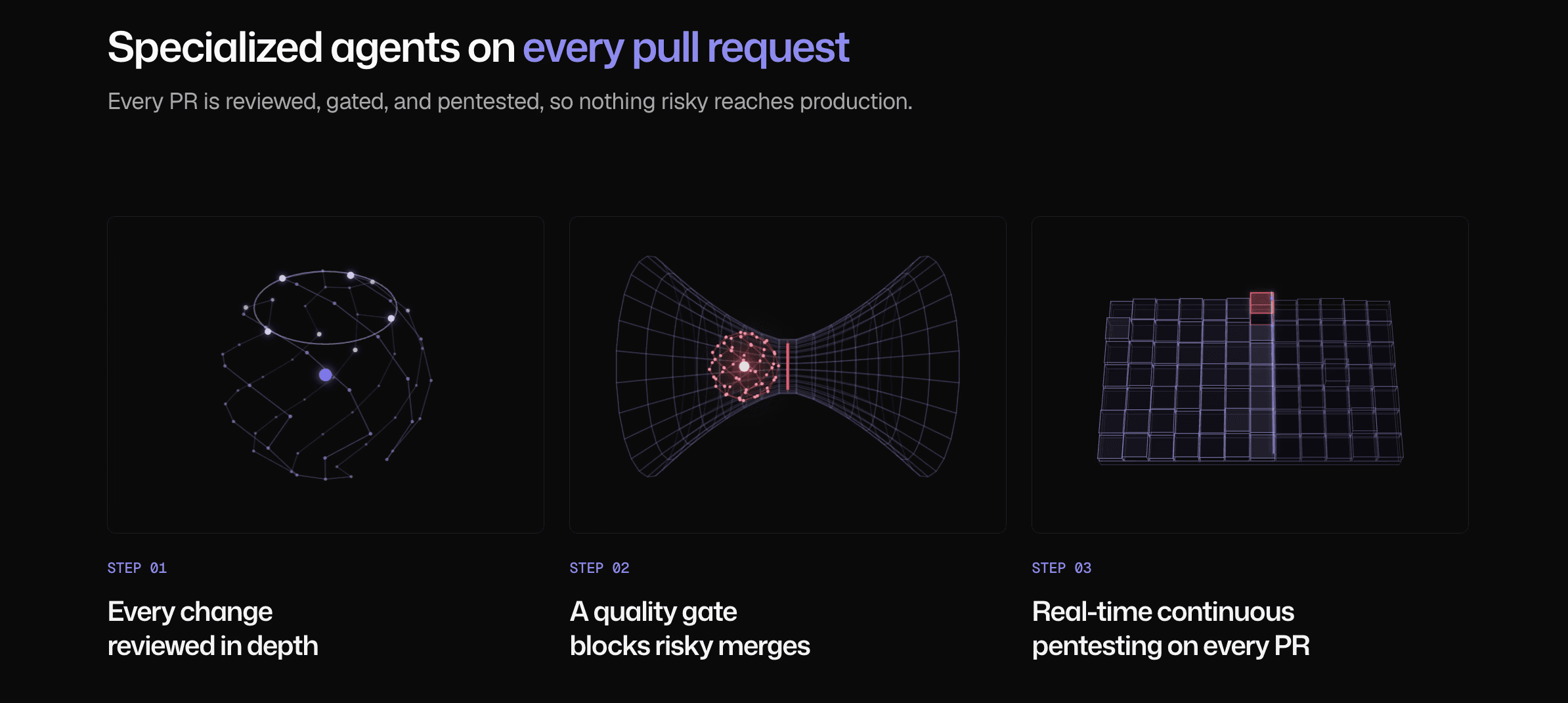
CodeAnt AI starts in the repository and extends into offensive testing. Its defensive layer runs SAST, SCA, secret scanning, and IaC analysis, surfaced through AI code review.
The offensive layer runs black, white, and gray box tracks, proves each finding with a working exploit, and re-runs the attack through free unlimited retests. It runs continuously across the application, cloud, and external surface.
The report maps to SOC 2 and ISO 27001 and is built for auditor handoff. The focus is the software delivery loop, from code to deployed testing.
What Is Atredis Partners?
Atredis Partners is a research-driven, worker-owned security boutique. It is independent with no outside investment, and it holds a notable research record, including DARPA grants and a placement in Qualcomm's Product Security Hall of Fame.
Its work spans bespoke research engagements, embedded and hardware reverse engineering, goal-oriented attack simulation, and custom command-and-control development. It is explicit that skilled humans stay in the driver's seat, with AI assisting delivery rather than replacing testers.
The consultants who deliver the work also write the proposals, so every engagement is scoped, scheduled, and point-in-time. The deliverable is a manually authored, peer-reviewed report.
The firm suits targets that need genuine research depth, hardware, embedded systems, or an unusual architecture, rather than a standard application on a continuous cadence.
CodeAnt AI vs Atredis Partners Feature Comparison by Buyer Job
The comparison reads best by buyer job: what each tests, how deep on which targets, how fast it starts, and how findings return.
Test application software
CodeAnt runs black-box plus source-aware and authenticated testing, continuously. The SAST versus DAST guide explains why source and runtime reveal different defects, and gray-box code memory reaches business-logic flaws on every release.
Atredis tests applications too, with source-assisted manual review by senior researchers. On a single application, its depth is real, delivered point-in-time.
For standard application software tested continuously, CodeAnt's cadence and code memory fit the release rhythm. For a one-time deep manual audit, Atredis brings senior research attention.
Test specialized targets
This is where Atredis pulls ahead. Hardware reverse engineering, embedded and IoT device testing, automotive and industrial systems, and full-scope red team operations sit inside its catalog and outside CodeAnt's repository-centered scope.
A team with a physical device, an embedded system, or a red team mandate needs exactly this kind of research shop. CodeAnt does not compete for that work and should not be presented as if it does.
The honest boundary is clear. CodeAnt owns the continuous application and cloud loop. Atredis owns bespoke research on specialized targets.
Start testing and prove findings
CodeAnt starts from a free scan with no proposal, returns a report in 48 hours, and proves each finding with a working exploit and free unlimited retests. Findings carry steps of reproduction into remediation.
Atredis engagements are scoped by proposal and booked against a small bench. The deliverable is a peer-reviewed report with proof of exploitability and remediation guidance, authored by the researchers.
Pricing and Packaging Comparison
CodeAnt publishes outcome-based terms, low and medium findings free, payment only on confirmed high or critical findings, with free retests.
Atredis quotes each engagement by proposal with no public price. A bespoke research engagement is priced on rare expertise and time, which fits a deep periodic assessment rather than a weekly release cadence.
Attribute | CodeAnt AI | Atredis Partners |
|---|---|---|
Model | Outcome-based, pay per confirmed exploit | Fixed-scope research engagement |
Entry point | Free scan from a URL | Scoping and proposal |
You pay when | A working high or critical exploit is confirmed | The engagement is signed |
Retesting | Free and unlimited | Rescoped or rebooked |
Public price | Published | None |
The takeaway is scope-and-cadence economics. Atredis prices bespoke research depth. CodeAnt prices continuous application testing on outcomes. For market context, see how much a penetration test costs.
CodeAnt AI vs Atredis Partners: Which Penetration Testing Approach Fits You?
Pick CodeAnt AI when you ship software continuously and want code-aware application testing on every release, proven with exploits, priced on outcomes.
Pick Atredis Partners when you need bespoke research on a specialized target, hardware, embedded, red team, or an unusual architecture, by an independent research bench.
The two can coexist. CodeAnt handles the continuous application and cloud loop, and Atredis runs a periodic research engagement on your specialized targets.
CodeAnt AI vs Atredis Partners: Which Should You Choose?
Atredis Partners is built for bespoke security research. If your organization needs hardware reverse engineering, embedded security testing, custom red team operations, or a deep manual assessment of an unusual architecture, its research-led model is designed for that problem.
CodeAnt AI is built for a different problem: continuous application and cloud security testing for teams shipping software regularly. It connects source-code context to offensive testing, runs black-box, white-box, and gray-box testing, proves findings with working exploits, and lets teams start without a traditional proposal and scheduling cycle.
If your primary risk is in the software you ship every week, the CodeAnt model is the more natural fit. Start a free CodeAnt pentest, and see what the platform finds across your application and external attack surface. For specialized hardware, embedded, or bespoke research, Atredis remains the specialist option.
For the category context, read continuous versus annual pentesting and the best AI penetration testing tools of 2026.

