

Bitbucket Cloud handles pull requests, inline comments, default reviewers, merge checks, and build-status controls. Rovo Dev adds Atlassian's own AI review on top of that.
Third-party tools still earn their place when a team needs security scanning, configurable quality gates, broader code-quality reporting, or support for Bitbucket Data Center, which Atlassian's native tooling doesn't fully cover yet.
We compared 10 AI-powered code review tools and security scanners by what they add to the native workflow: automated review, static analysis, security checks, deployment support, and where their findings actually show up in a pull request.
If AI for code review specifically is the gap you're closing, the table below sorts for that first.
Quick answer: For AI review and security in one place on Bitbucket, CodeAnt AI is the strongest pick at $24/user/month. Qodo Merge leads on automated test generation, CodeRabbit on fast PR summaries, and SonarQube on deep static analysis.
Where Bitbucket's Native Review Falls Short
Bitbucket covers the basics well: pull requests, inline comments, branch permissions, and Jira links for teams already in the Atlassian ecosystem. For small teams with simple requirements, that's often plenty.
The gaps show up at scale. No automated security scanning for OWASP Top 10 issues, exposed secrets, or vulnerable dependencies. Review quality gets inconsistent across a team of 20 or more developers. No AI PR summaries, so loading context on a large pull request eats real time. No code-health trends tracked over time.
A dedicated tool brings automated code review, layering bug and vulnerability detection, dependency and secret scanning, and risk prioritization on top of what Bitbucket already does, without replacing the native workflow entirely.
Quick Comparison Table
Tool | Best For | Review Type | Cloud | Data Center | Starting Price |
CodeAnt AI | Review, quality, and security in one platform | AI review, SAST, secrets, IaC | Yes | Yes | $10/user/mo (14-day trial) |
Rovo Dev | Native Atlassian AI review | AI quality, security, performance suggestions | Yes | Check current availability | Atlassian plan |
CodeRabbit | Fast, conversational AI review | AI comments and suggestions | Yes | Yes | Free tier; Pro $24/user/mo |
Qodo Merge | Ticket-aware review, test generation | Multi-agent AI review | Yes | Verify current support | $30/mo base + credits |
SonarQube | Quality gates at scale | Static analysis, SAST | Yes | Yes | Free tier; Team $50/user/mo |
Snyk | Dependency and code security | SCA, SAST, fix PRs | Yes | Yes | $25/dev/mo (products separate) |
Kodus | Policy-as-code, BYOK, self-hosted control | AI review with repo context | Yes | Yes, open source | Free tier; Teams $10/dev/mo |
Semgrep | Custom security rules in YAML | SAST, secrets, supply chain | Yes | Yes | Free ≤10 devs; Teams $30/dev/mo |
Greptile | Full-codebase context on large repos | Context-aware AI review | Yes | Via VPC | $30/dev/mo |
Codacy | Broad quality and coverage tracking | Style, duplication, coverage | Yes | Yes | Free tier; Team ~$21/dev/mo |
1. CodeAnt AI

CodeAnt AI combines AI-assisted pull request review with code quality and security checks for Bitbucket teams that want a consolidated workflow instead of stitching together a reviewer, a SAST tool, and a secrets scanner separately.
It's built as a defensive and offensive security platform: static findings get checked for real exploitability before they reach a developer, so review output and security proof live in the same place rather than two disconnected tools.
Key Features
PR-native AI review inside Bitbucket Cloud pull requests
Secret and vulnerability scanning: flags exposed tokens, SAST issues, third-party risk
Offensive validation confirming which findings are actually exploitable
Security dashboards tracking posture across repos, PRs, and teams
Custom rules for team-wide standards, plus Slack and email alerts
Cloud or on-prem deployment for sensitive code
Limitations
Review depth favors correctness and best practices over deep architectural analysis
Smaller integration ecosystem than legacy static-analysis vendors
Newer entrant with less long-form case-study history
Pricing
14-day free trial, then $10/user/month. Enterprise on request.
Best For
Teams that want review, quality, and security consolidated into one Bitbucket workflow instead of three separate tools.
The Data Center support is a real differentiator here beyond the AI review itself. Several competitors on this list simply don't run on Bitbucket's on-prem edition, which quietly rules them out for regulated teams before pricing even comes up.
2. Snyk
Snyk specializes in finding vulnerabilities in dependencies, containers, and infrastructure code, then blocking vulnerable builds before they merge.
Its DeepCode AI engine pairs symbolic analysis with a trained model, reasoning about how data actually flows through code rather than just matching known-bad patterns.
It embeds directly in Bitbucket Pipelines, gating risky builds at the CI/CD layer rather than only commenting after the fact.
Key Features
Dependency scanning identifying vulnerable packages with suggested upgrades
Container and IaC security scanning across Docker, Kubernetes, Terraform
CI/CD integration embedded in Bitbucket Pipelines
Fast scans with fewer false positives than legacy SAST tools
Limitations
Free-tier test counts are capped (100 Code/SAST tests per month)
Gets the most value inside a DevSecOps workflow the team has to set up
Not a general code review tool; no style or architecture feedback
Pricing
Team plan starts at $25/developer/month, products purchased separately.
Best For
Teams where dependency and application security specifically is the gap, not general review quality.
Teams that adopt Snyk alone and expect general code review tend to be disappointed by the first sprint. It's excellent at its one job and has no real interest in anything outside it.
3. CodeRabbit
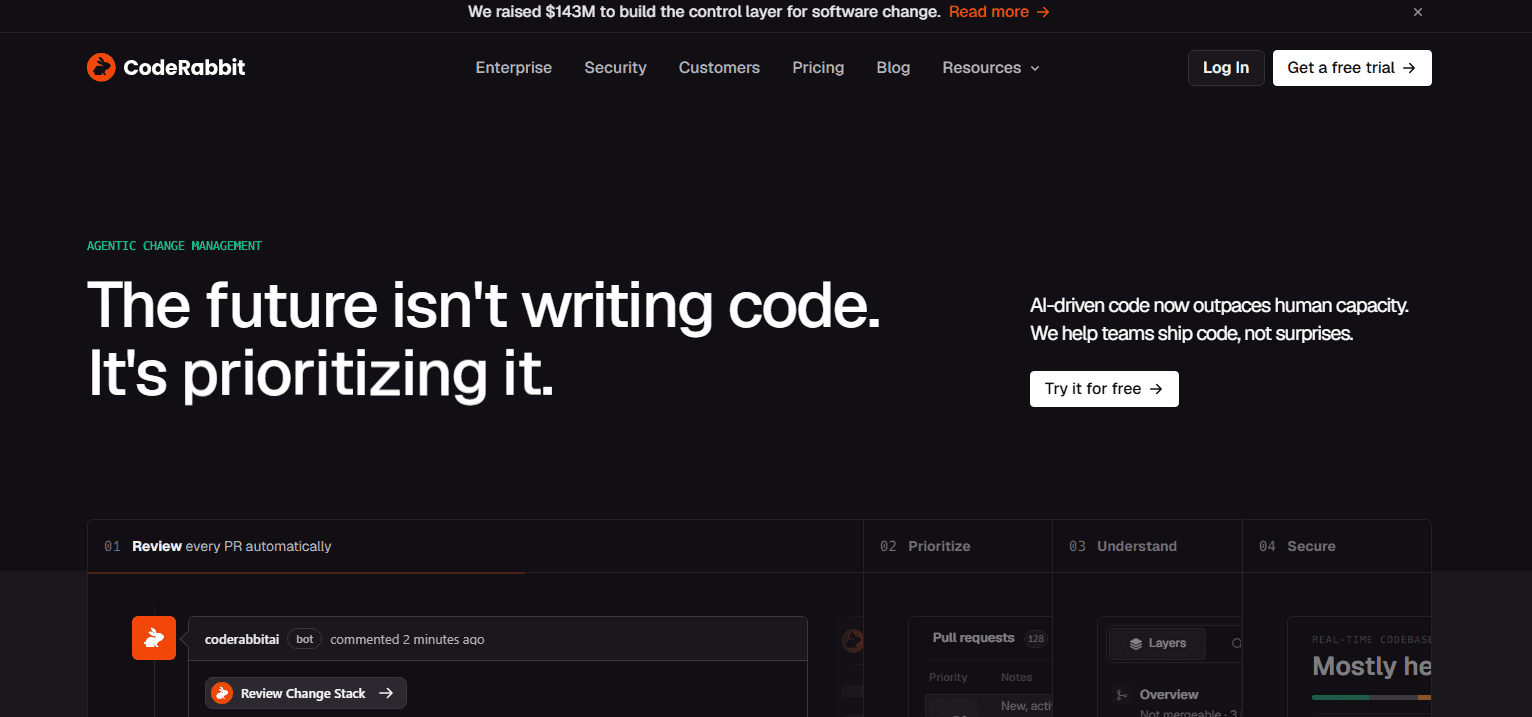
CodeRabbit is built for speed: conversational, line-by-line AI comments with a plain-English PR summary and file-by-file walkthrough at the top, generated from a code graph that maps how files in the repo reference each other.
Replying to any comment gets a revised suggestion instead of the same note repeated on the next commit, which is the detail that actually cuts down review fatigue over time.
Key Features
AI PR summaries with a full walkthrough of the change and affected files
Line-specific inline comments with explanations
Conversational interface: reply to ignore, explain, or apply a fix
Cross-file reasoning that single-file tools miss
Limitations
No dedicated SAST, secret detection, or IaC scanning
Best paired with a security scanner rather than used as one
Roughly half of flagged issues are noise by CodeRabbit's own reported acceptance data
Pricing
Free tier available. Pro is $24/user/month annually, Pro Plus $48/user/month annually. Enterprise on request.
Best For
Teams that want fast, well-liked AI review and are comfortable pairing it with a separate security tool.
The conversational format is the real differentiator over a static comment bot. Being able to reply "skip this, it's intentional" and have the next review respect that context cuts repeat noise more than any rule set could.
5. SonarQube
SonarQube focuses on static code analysis, backed by more than a decade of rule development and widespread adoption.
It has become a common benchmark for evaluating code quality and security tools, which naturally makes teams look for alternatives when its approach doesn’t fit their workflow.
It ties into Bitbucket for pull request decoration, adding comments summarizing issues with fix guidance, and enforces Quality Gates, a specific pass/fail rule set your team defines, that can block a merge outright.
Key Features
Static analysis detecting duplication, security issues, and maintainability problems
Pull request decoration with fix guidance directly in the PR
Quality gates and dashboards tracking project health over time
Cloud (SonarQube Cloud) or self-managed (SonarQube Server) deployment
Limitations
Self-managed Server setup takes more effort than cloud-native tools
Deeper security analysis sits behind higher-priced tiers
Rule-based at its core, so it doesn't reason about intent the way LLM-native tools do
Pricing
Free tier up to 50,000 lines of code and 5 users. Team plan around $50/user/month billed annually. Self-managed editions priced per lines of code.
Best For
Teams that want a deterministic, policy-enforcing quality gate with a long track record behind it.
Budget the tuning time, not just the license. Teams that skip the quality-profile setup phase tend to abandon SonarQube within a month, buried under noise it was fully capable of filtering out from day one.
4. Qodo Merge
Qodo Merge splits review into specialized agents rather than one model trying to do everything: Security Guard flags vulnerabilities, Bug Hunter chases logic errors, and Qodo Cover writes the missing tests for whatever the PR touches.
Qodo publishes its own benchmark claiming the top score among tools it tested, worth noting but not worth much on its own, since a vendor grading its own homework is exactly the kind of number that needs checking against your actual codebase before it means anything.
Key Features
PR summaries and risk scoring that flag likely regressions
Multi-agent architecture producing targeted, specific comments
Smart labels auto-classifying PRs by type and risk level
Qodo Cover generates unit tests to raise coverage on the change
Limitations
Bitbucket Cloud only, no Data Center support
The 60.1% F1 figure is Qodo's own benchmark and should be read as a vendor claim
Lighter security scanning than dedicated SAST tools
Pricing
Pro Team is $30/month base (up to 30 users) plus $0.012 per credit, pooled. Enterprise custom.
Best For
Teams that want test generation built into review, not just comments, and don't need Data Center support.
Read the 60.1% figure as a starting point for your own evaluation, not a settled fact. Vendor-run benchmarks are worth checking, but the only number that actually matters is what it flags on your last 10 merged PRs.
2. Rovo Dev
Rovo Dev is Atlassian's own AI code review option for Bitbucket Cloud, which makes it the most native tool on this list, the same way GitLab Duo or GitHub Copilot code review are native to their own platforms.
It flags quality, security, and performance issues directly on the diff, and its Jira acceptance-criteria checks validate a pull request against the linked work item's actual requirements, a genuinely useful feature for teams already living inside Jira.
Key Features
Automated PR reviews flagging quality, security, and performance issues
Inline fix suggestions for logic errors, anti-patterns, and readability
Jira acceptance-criteria checks tied to the linked work item
Custom instructions to enforce team review standards on the Standard plan
Limitations
Bitbucket Cloud is generally available, but Data Center support is still in beta
A general LLM reviewer with no dedicated SAST, secret, or IaC scanning
Credit-metered pricing is harder to predict at high PR volume
Pricing
Bundled into Atlassian plans; credit limits and pricing vary by tier and region, worth checking directly with Atlassian before committing.
Best For
Teams already deep in the Atlassian ecosystem who want zero-friction AI review tied to Jira without adding a new vendor.
Treat it as a starting point rather than a full solution. Since it has no dedicated SAST or secret scanning, teams still need a separate tool once security coverage becomes a real requirement instead of a nice-to-have.
7. Kodus
Kodus is open source and built around control: run it on your own infrastructure, bring your own LLM, and define review rules in a version-controlled kodus-config.yml file written in plain language rather than a proprietary DSL.
Its Decision Memory feature carries context from one review to the next, so it doesn't keep re-flagging something the team already discussed and dismissed, and its CLI can run inside a Bitbucket Pipeline directly.
Key Features
BYOK, connecting your own model provider and paying them directly
Self-hosted and open source at its core
Natural-language custom rules versioned alongside the codebase
Repository-level context rather than diff-only review
Limitations
Configuration-heavy compared to a zero-setup default bot
Smaller ecosystem and community than long-established competitors
No dedicated security scanning beyond what custom rules encode
Pricing
Free Community plan (BYOK, unlimited PRs, up to 10 rules). Teams plan at $10/developer/month, unlimited rules, still BYOK.
Best For
Teams with strict data-residency requirements or internal standards that off-the-shelf tools can't encode.
The CLI running inside a Bitbucket Pipeline is what separates Kodus from most competitors on this list. It can apply fixes and re-test in a loop, not just leave a comment and wait for a human to act on it.
8. Semgrep
Semgrep is a SAST scanner built around a lightweight pattern language instead of a proprietary rules engine.
A rule looks close to the actual code it's matching, with a placeholder like $X standing in for whatever varies, matched against the code's parsed structure rather than raw text.
Its supply-chain module prioritizes findings by whether the vulnerable function is actually reachable from your code, not just present somewhere in a dependency tree, and it's a genuine open source code scanner at its core.
Key Features
Custom detection rules in a simple, readable pattern syntax
Separate modules for code security, supply chain risk, and secrets detection
Free tier supports teams up to 10 contributors with no expiry
Enterprise adds air-gapped, on-prem deployment for regulated environments
Limitations
Language coverage is solid but narrower than SonarQube's enterprise tier
Writing effective custom rules takes a real learning curve at first
Less focused on AI-generated PR summaries than conversational competitors
Pricing
Free for teams up to 10 contributors. Semgrep Teams from $30/contributor/month. Enterprise custom.
Best For
Security teams that want direct control over detection logic without a six-figure SAST contract.
The pattern syntax is approachable for anyone who's read a bit of code, since a rule mostly just looks like the code it's matching. That's a lower bar than most SAST rule engines set, which is part of why small security teams punch above their weight with Semgrep specifically.
9. Greptile
Greptile reviews with awareness of your entire codebase, not just the current diff, built specifically for large, complex monorepos. It indexes and embeds the whole repository up front, so a review can pull in files that call or depend on the code being changed.
It catches more bugs than manual review alone by tracing how a change ripples into files nobody thought to check, and teams on large monorepos report merge times dropping as a direct result.
Key Features
Full-codebase context on every review, including cross-file dependencies
Self-hosting available in your own VPC
Cites the specific file and line when flagging a cross-file issue
Reported merge times up to 4x faster for teams using it consistently
Limitations
Some reviews surface as surface-level linting rather than deep logic catches
Claimed full-codebase context doesn't always show up clearly in output
No dedicated security scanning module
Pricing
$30 per active developer per month.
Best For
Teams on large monorepos where diff-only review keeps missing cross-file issues.
The VPC self-hosting option is what tends to tip security-conscious teams toward Greptile specifically. Full-codebase indexing sounds like a risk until the code never actually has to leave your own infrastructure.
10. Codacy
Codacy is an all-in-one quality dashboard across Bitbucket, GitHub, and GitLab alike, less about deep AI reasoning and more about consistent, automated enforcement across everything connected to it.
Every repo gets an A-through-F letter grade based on issue density, and coverage tracking is diff-aware: it tracks coverage on the new code in a given PR specifically, not one blended percentage for the whole repo.
Key Features
Automatic checks for style, complexity, duplication, and test coverage
AI-suggested fixes applicable directly in the pull request
Security dashboards prioritizing vulnerabilities by severity
One dashboard benchmarking health across every connected repository
Limitations
False positive rate is a common complaint, especially on legacy codebases
Full analysis can take 30+ minutes on large repos
Custom rule configuration is fiddlier to set up than competitors
Pricing
Free developer plan. Team plan starts around $21/developer/month.
Best For
Teams that want one dashboard tracking code health trends across many repos, not just per-PR feedback.
The 30-minute analysis window matters more than it sounds. Teams shipping several small pull requests an hour will feel that lag. Teams merging a handful of times a day probably won't notice it at all.
Comparing Bitbucket to Other Platforms
Running the same evaluation elsewhere?
See our comparable guides for GitLab code review tools and Azure DevOps code review tools. If CodeRabbit specifically is on your shortlist, our CodeRabbit alternatives comparison goes deeper on how it stacks up across platforms.
Several tools here, including CodeAnt AI, SonarQube, and Snyk, support all three.
How to Choose the Right Bitbucket Code Review Tool
Match the tool to the specific gap costing your team time or risk right now, not the longest feature list. There's no single best code review tool for every Bitbucket setup, whatever a ranked listicle title implies.
Start with your bottleneck:
Security gaps: Snyk or Semgrep
Already deep in Atlassian, want zero friction: Rovo Dev
Review, quality, and security consolidated: CodeAnt AI
Large monorepo, cross-file context missing: Greptile
Internal policy and data-residency requirements: Kodus
Portfolio-wide quality tracking: Codacy or SonarQube
Fast, conversational review with no security scanning needed yet: CodeRabbit
Then validate on real pull requests, not a demo. Run any shortlisted tool against your last 10 merged PRs for two weeks. Free code review tools and generous trials exist across this list (CodeAnt AI, CodeRabbit, SonarQube, Kodus, Semgrep) specifically so you don't have to decide from a sales page.
Check Cloud versus Data Center support before falling in love with a tool. Several options here, including CodeRabbit, SonarQube, Snyk, Kodus, and Semgrep, support Bitbucket Data Center. Rovo Dev's Data Center support is still in beta, and Qodo Merge is Cloud-only for now.
Don't underestimate stacking. Most mature Bitbucket setups end up running two tools, not one: a security specialist like Snyk or Semgrep alongside a general AI reviewer like CodeRabbit or CodeAnt AI. That's not redundancy, it's covering two genuinely different failure modes with tools actually built for each.
CodeAnt AI covers code review, code quality, and security, both defensive (catching issues before merge) and offensive (proving which of those issues are actually exploitable), in one platform instead of three separate tools. Start a 14-day free trial to see it against your own Bitbucket repos.
FAQs
Which Bitbucket code review tool is best for AI-powered review? CodeRabbit for fast, conversational review with minimal setup. CodeAnt AI if you want that AI review paired with SAST, secrets, and IaC scanning in the same platform.
Do Bitbucket code review tools work with Bitbucket Data Center, not just Cloud? Yes, several do. CodeAnt AI, CodeRabbit, SonarQube, Snyk, Kodus, and Semgrep all support Bitbucket Data Center. Rovo Dev's Data Center support is still in beta, and Qodo Merge is currently Cloud-only.
How do Bitbucket code review tools improve application security specifically? Dedicated tools add automated scanning Bitbucket doesn't do natively: OWASP Top 10 issues, exposed secrets, and vulnerable dependencies. Snyk and Semgrep focus on this specifically; CodeAnt AI adds an offensive validation layer on top that checks whether flagged issues are actually exploitable.
Is Rovo Dev enough on its own, or do teams still need a third-party tool? Rovo Dev covers a solid native first pass for teams on Atlassian plans, especially with its Jira acceptance-criteria checks. Teams add a specialist once they need dedicated SAST, secret, or IaC scanning, which Rovo Dev doesn't do natively.
What should a mid-sized Bitbucket team budget for a code review tool? For a 20-developer team, expect $200 to $600 a month for AI review tools (CodeAnt AI, CodeRabbit, Qodo Merge), $500 to $1,000 a month for dedicated security tools (Snyk, Semgrep Teams), and a wider range for SonarQube depending on codebase size.
CodeAnt AI covers code review, code quality, and security, both defensive (catching issues before merge) and offensive (proving which of those issues are actually exploitable), in one platform instead of three separate tools. Start a 14-day free trial to see it against your own Bitbucket repos.

