

Praetorian does not publish a price. If you are trying to budget for it, that is the first and most important fact, and it shapes everything below.
This guide explains how Praetorian's pricing model works, what drives the number, what buyers report paying, and how a quote-only managed program compares to an outcome-based model where you pay only for a confirmed exploit.
What you need to know first: Praetorian sells Chariot as an annual managed program, not a per-test purchase. The price is scoped to the size of your attack surface and the scope of the engagement, and it is delivered as a concierge service with a dedicated team. There is no free entry point and no self-serve scan.
Praetorian Pricing: What You'll Learn
This guide covers Praetorian's pricing model, the factors that drive the quote, the figures buyers report, why there is no public price, and how the managed-program model compares to outcome-based pentest pricing.
How Praetorian Pricing Works for Chariot
Praetorian's Chariot is sold as an annual subscription to a managed offensive security program. You are not buying a single test. You are buying a standing capability, delivered by a dedicated team, that runs continuously across your attack surface.
Because it is a managed program rather than a product tier, the price is quoted per engagement rather than listed. Two companies of different sizes will see different numbers for the same platform.
This is a common shape for managed offensive services. It contrasts with the transparent, published model used by platforms like CodeAnt AI, where the terms are on the page before you talk to anyone.
What Drives Praetorian Pricing and Chariot Cost?
Several factors move a Praetorian quote. Understanding them helps you predict roughly where you would land before the sales conversation.
Attack surface size. The larger your external footprint, the more there is to discover, monitor, and test, and the higher the program cost.
Scope of the engagement. A continuous ASM and pentest program prices differently from one that adds red team operations, purple teaming, or social engineering.
Number of assets and environments. More applications, cloud accounts, and network segments raise the effort and the quote.
Level of managed service. The concierge model, with a dedicated team and a zero-false-positive commitment, is priced for the human labor behind it.
These are effort drivers, not outcome drivers. You are pricing the size of the standing engagement, which is the defining feature of the managed model. For the wider market context, see how much a penetration test costs.
Praetorian Pricing: What Buyers Report Paying
Because there is no public price, the useful signal comes from buyer reports and the shape of the market for managed offensive programs.
Buyer reports place Praetorian's managed programs in the mid-five-figures per year and up, scaling with attack-surface size and the breadth of scope. Programs that add specialist engagements like red teaming run higher.
Treat any single figure as directional rather than a quote. The only way to get your number is to scope the engagement with their sales team, which is itself part of the model.
Why Praetorian Pricing Is Not Public
The absence of a public price is not an oversight. It follows from the product being a managed service rather than a self-serve tool.
A managed program is priced on labor and scope, both of which vary per customer, so a single list price would not describe what most buyers actually pay. This is standard for offensive-security consultancies and managed platforms. By contrast, self-serve and outcome-based pentesting platforms can publish pricing because the buyer is purchasing a defined testing capability rather than a dedicated team and variable consulting scope. CodeAnt AI is one example of this model, with published outcome-based terms rather than a quote-only annual retainer.
The trade-off for the buyer is slower budget comparison. You cannot shortlist on price the way you can with a published model, which is worth weighing if fast evaluation matters to your team.
Praetorian Pricing vs Outcome-Based Pentesting
The sharpest contrast is not a cheaper managed program. It is a different pricing philosophy. The table shows both.
Attribute | Praetorian | Outcome-Based Pentesting |
|---|---|---|
Pricing model | Annual managed program | Pay based on confirmed exploitable findings |
Public pricing | Quote-only | Published terms vary by provider |
Entry point | Sales consultation and onboarding | Often self-serve or low-friction |
You pay for | The managed security program | Confirmed exploitable risk |
Low/medium findings | Included in the engagement | May be included at no additional cost |
Retesting | Included according to engagement scope | Often unlimited or included, depending on provider |
What you are buying | Continuous managed offensive security | Proven vulnerability discovery and validation |
CodeAnt AI is an example of the outcome-based model. Its pricing is structured around confirmed exploitable findings rather than an annual managed retainer: low and medium findings are free, and payment applies when a high or critical exploit is confirmed. Retesting is free and unlimited.
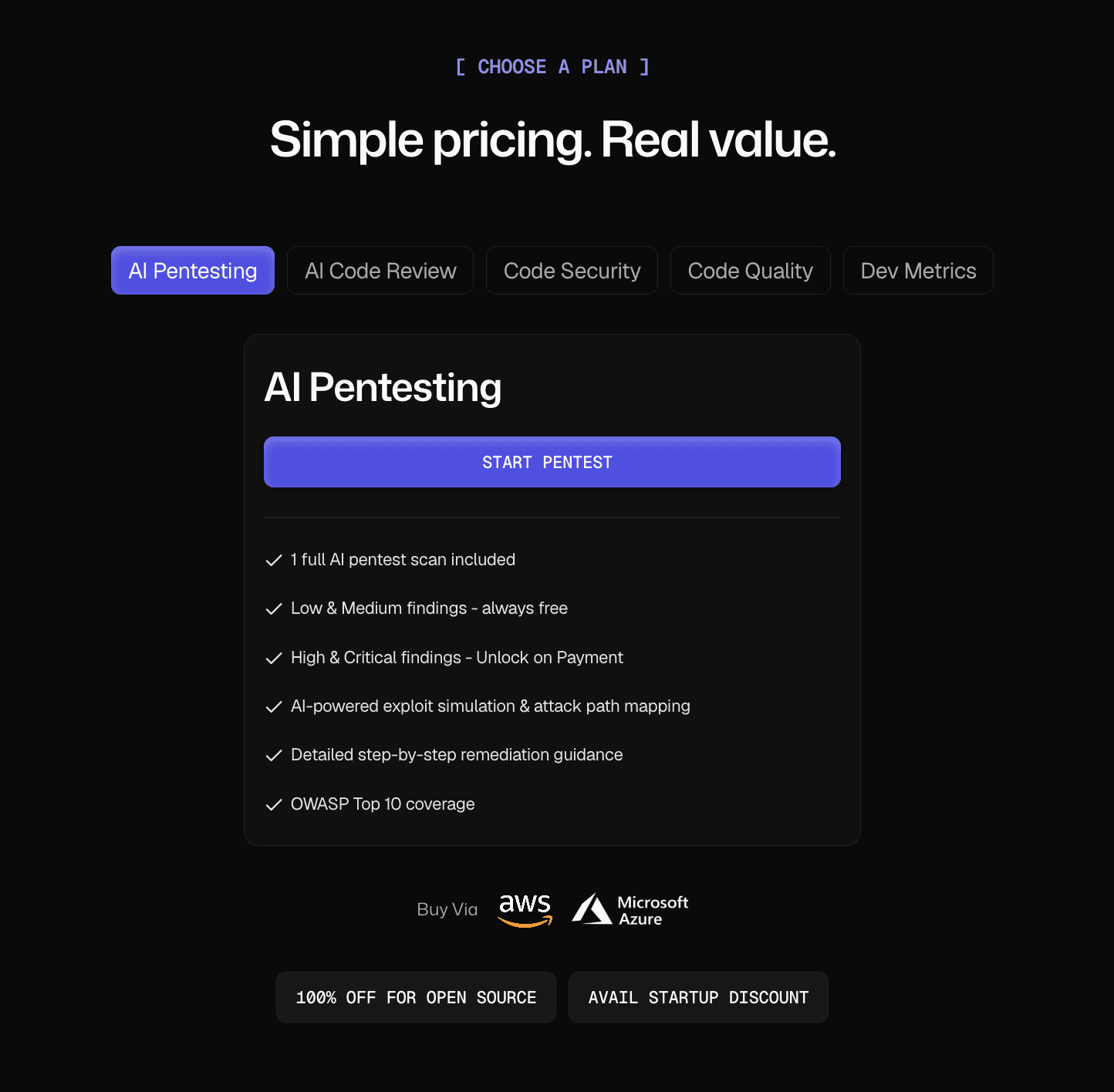
That creates a fundamentally different budgeting model from Praetorian. With Praetorian, the cost is determined upfront by the scope and size of the managed program. With CodeAnt, the cost is tied to the security issues the platform actually proves exploitable.
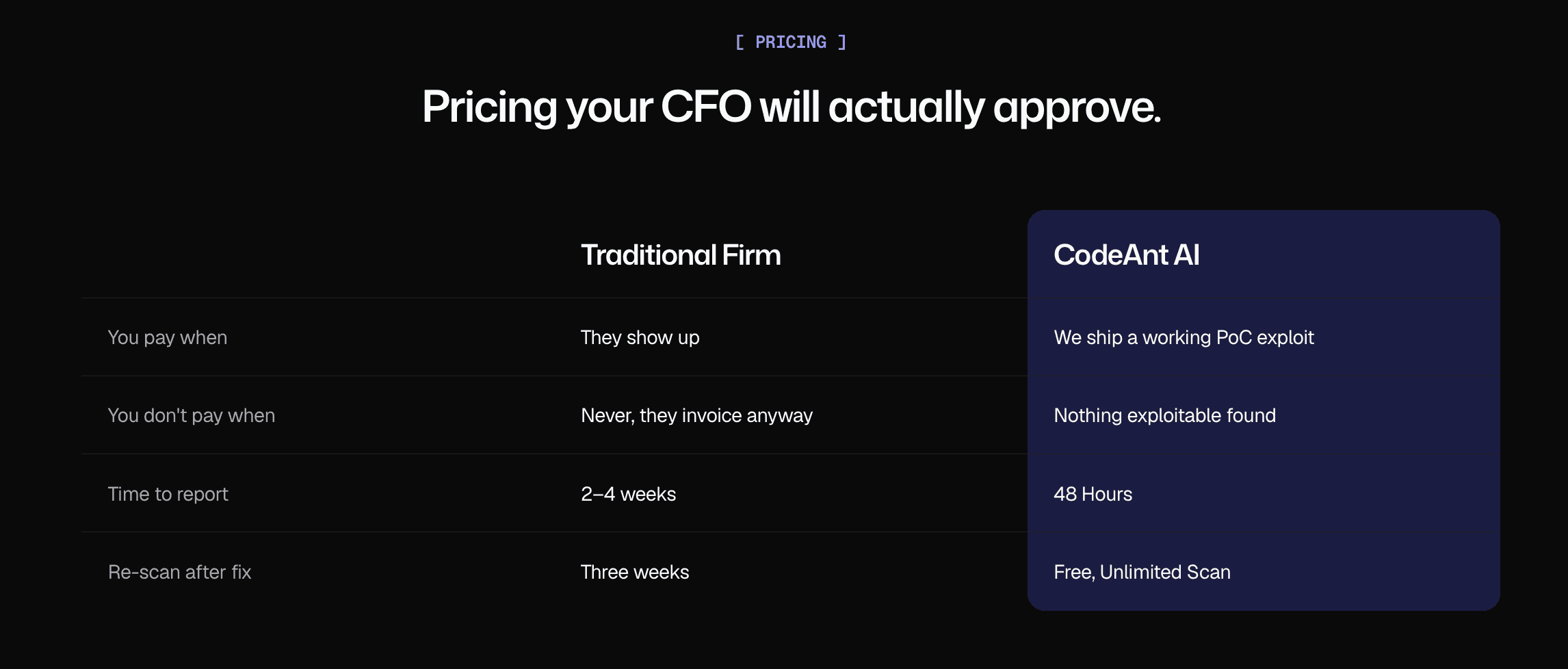
The distinction matters for teams evaluating penetration testing pricing because the cheaper model is not necessarily the better model. A managed program can make sense when a security team wants dedicated offensive expertise across a large attack surface. An outcome-based model can make more sense when the priority is lowering the cost and friction of testing applications continuously.
The takeaway is about what your budget buys. A managed program buys a standing team and continuous coverage regardless of what is found. Outcome pricing buys proven risk reduction, where nothing exploitable found means nothing owed. For the full model comparison, see CodeAnt AI vs Praetorian.
A managed program is the right shape for a mature security org with budget for a standing engagement across a wide estate. Outcome pricing is the right shape for a team that wants to know whether the thing it shipped this week is exploitable, without signing an annual contract first.
Is Praetorian Pricing Right for Your Security Program?
If you need a managed offensive security program across a large attack surface and want a dedicated team handling continuous testing, Praetorian's quote-based Chariot model may fit that operating model. Your price will depend primarily on attack-surface size, testing scope, environments, and the level of managed service required.
If your priority is more predictable, outcome-based pentesting pricing, a platform such as CodeAnt AI offers a different approach: run a free CodeAnt pentest from a URL. Here you can run without an annual managed retainer and pay based on confirmed exploitable findings. Also, feel free to compare the two models in CodeAnt AI vs Praetorian.
The important question is not simply which provider costs less. It is whether you want to pay for a standing offensive security capability or for validated security outcomes.

