

Praetorian is an offensive security company, and most buyers arrive already knowing that. The question this guide answers is narrower. What does the Chariot platform actually include, how is it delivered, and where does it stop.
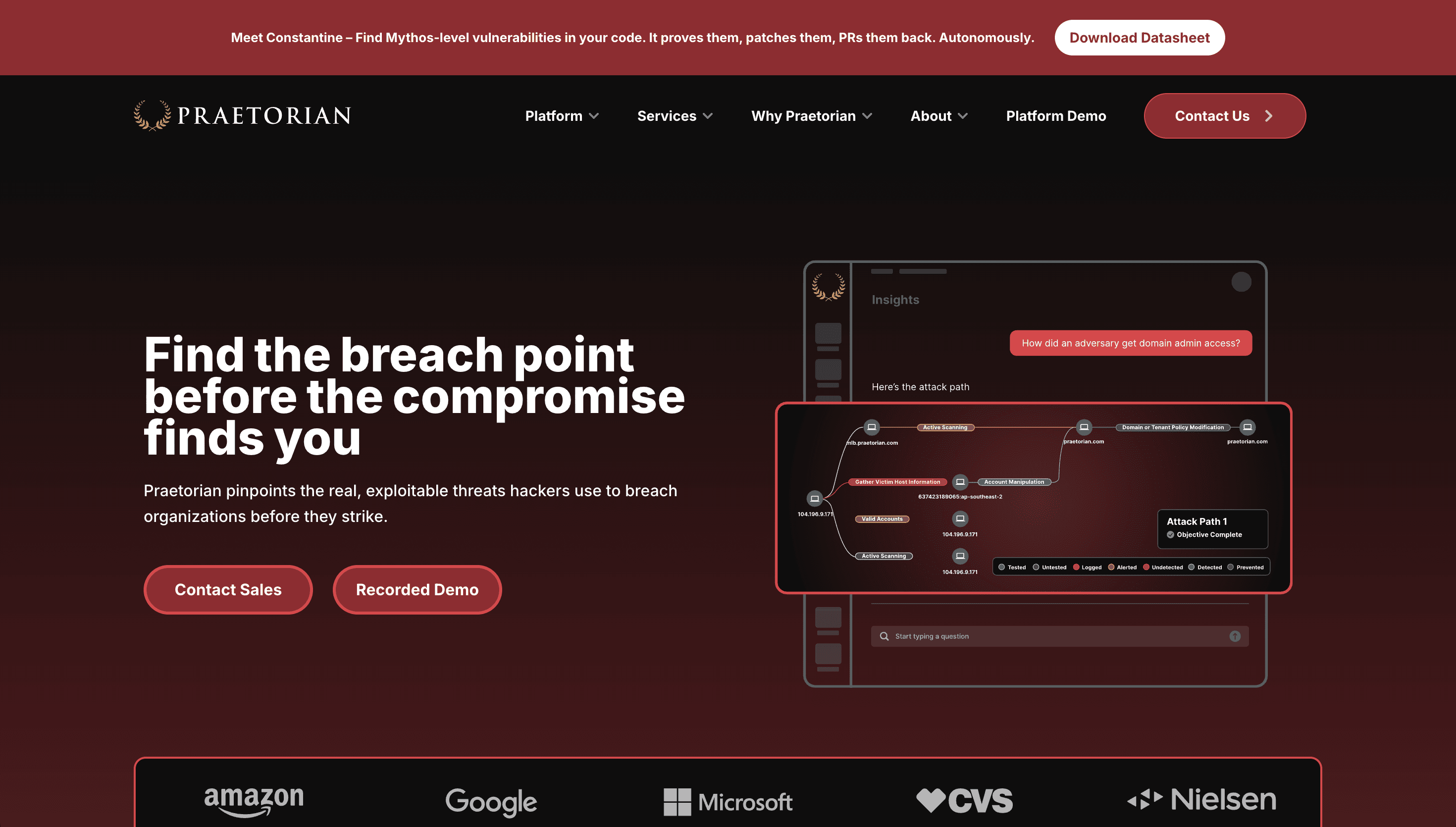
Most of Praetorian's capability runs inside a managed service, so the feature list reads differently from a self-serve tool. This guide names each capability, how it reaches you, and the one thing about the delivery model that shapes every feature below it.
What Praetorian solves here: it consolidates attack surface management, continuous penetration testing, breach and attack simulation, and exploit intelligence into one managed program, run by a dedicated team, so a security org gets a standing offensive function without hiring one. The trade is that the capability is delivered as a service, not handed to you as a tool you operate.
What You'll Learn
This guide covers the Chariot platform's core modules, the Attack Helix engine behind them, how findings are validated and reported, the integration and delivery model, the real limits, and how the same jobs look under an outcome-priced platform like CodeAnt AI.
Praetorian Chariot Platform: Core Features and Modules
Chariot is Praetorian's unified offensive security platform. It brings several capabilities that are often sold separately into one managed program.
The modules below are the platform's spine. Each is delivered inside the managed service rather than as standalone software you run yourself.
Praetorian attack surface management: What chariot ASM does
Chariot's attack surface management discovers and maps external assets, then keeps that inventory current. It is one of the platform's strongest components, aimed at the same problem the wider attack surface management category addresses: knowing what an attacker can reach before they reach it.
For a security team that has lost track of its external footprint across cloud accounts and forgotten subdomains, continuous discovery is the feature that earns the program its keep.
Praetorian continuous penetration testing: How it works
The continuous pentest module tests discovered assets on an ongoing basis rather than once a year. It is the part of the platform that maps most directly to the continuous versus annual pentesting decision, and it is run by Praetorian's team against your surface.
Continuous testing closes the gap that annual engagements leave open, where everything shipped between audits goes untested until the next window.
Breach and attack simulation: What it tests
Breach and attack simulation runs known adversary behaviors against your controls to see what your defenses actually catch. Praetorian maps this work to frameworks like MITRE ATT&CK, so the output ties to recognized adversary techniques rather than a vendor's private taxonomy.
This is a defensive-validation feature. It answers whether your detection and response would fire against real technique sequences.
Praetorian exploit intelligence: How chariot prioritizes risk
Exploit intelligence tracks which vulnerabilities are being weaponized in the wild and prioritizes accordingly. It is the feature that keeps the program's attention on what is actually exploitable rather than on a raw CVE count.
Prioritizing by real-world exploitation is the same principle behind EPSS-based scoring, which weighs the probability a vulnerability is exploited rather than its severity in isolation.
Praetorian Attack Helix: The AI Engine Behind Chariot
The Attack Helix is Praetorian's multi-agent autonomous engine. It combines several specialized agents that discover, analyze, and validate findings across the platform's modules.
Praetorian operates the Helix internally. It is not a console you drive. The agents do the machine-speed work, and Praetorian's engineers direct and validate that work as part of the managed service.
Praetorian Labs, the company's research arm, has published offensive research including AI-driven discovery of vulnerabilities in low-level systems. That research pedigree is real and is part of what buyers pay for.
The distinction that matters for a feature comparison is operational. An autonomous engine you run yourself and an autonomous engine run for you are different products, even when the underlying capability is comparable.
Validation and Reporting
Chariot carries a zero-false-positive commitment. A human validates each risk before it is submitted as a ticket, which is the platform's answer to the scanner-noise problem that buries security teams in unverified findings.
Findings are managed and reported inside the platform, with the managed team handling triage and status. For a team that cannot spend engineering hours confirming whether a finding is real, human pre-validation is a genuine feature, not a marketing line.
The reporting is built around the managed program rather than a standalone downloadable artifact. Buyers who need a specific compliance-mapped deliverable should confirm the exact report format and control mapping during scoping.
Integrations and Delivery Model
Chariot is delivered as a concierge managed service. A dedicated team of Praetorian offensive security experts is assigned to the account, which is the defining feature of the whole platform.
This shapes how every other feature reaches you. There is no self-serve scan from a URL and no free entry point. Engagement starts with a sales consultation and program onboarding.
For buyers comparing this to a platform they can start today, the delivery model is the single biggest difference, larger than any individual module. It is the reason Praetorian fits a standing security program better than a fast-moving engineering team that wants an immediate result.
Praetorian Chariot Limitations: What the Platform Does Not Do
Every platform has edges. These are Praetorian's, stated plainly so the evaluation is honest.
No self-serve entry. Testing begins after a sales consultation and onboarding, not from a URL. A team that wants a result this week feels this first.
Managed, not operated by you. The Attack Helix is run by Praetorian. You receive validated findings, you do not drive the engine.
Program-level, not pipeline-level. Chariot tests running systems and reports to the security team. It is not a control on the pull request, so it does not prevent an insecure change before release the way a CI/CD security workflow does.
No published pricing. The program is quote-only, scoped to attack-surface size, which makes fast budget comparison harder.
Source-level analysis is not the center. The program tests from the outside and validates by hand. It is not built around reading your repository the way a white box, code-aware pentest is.
Praetorian vs AI Pentesting Platforms: How the Same Security Jobs Differ
The features above map to jobs a buyer needs done. The table shows how those jobs look under a managed program versus an outcome-priced, self-serve platform.
Job to be done | Praetorian | CodeAnt AI |
|---|---|---|
Start testing | Sales consultation, then onboarding | Free scan from a URL, or a call |
Who runs the engine | Praetorian's team | You, self-serve |
Attack surface management | Chariot ASM, managed | Agentic ASM in the engagement |
Continuous pentesting | Managed continuous program | Continuous on every deployment |
Code-aware testing | Not the center, external and validated by hand | Gray box with code memory, native |
Proof of a finding | Human-validated, zero false positives | Working PoC exploit per finding |
Pricing | Annual managed program, quote-only | Outcome-based, pay on a confirmed exploit |
Fits | A standing managed offensive program | An engineering team that ships fast |
The takeaway is not that one is better in the abstract. It is that Praetorian's features are built for a managed program and CodeAnt's for a self-serve, code-connected loop. The right choice follows the operating model you actually want to run. For the head-to-head detail, see CodeAnt AI vs Praetorian.
Conclusion: Is Praetorian Chariot Right for Your Security Program?
Praetorian's feature set is coherent for one buyer: a security org that wants a managed offensive team and a standing program. If that is you, the platform is built for it.
If you want the same jobs, continuous testing, attack surface mapping, proven findings, delivered self-serve and priced on outcomes, run a free CodeAnt pentest from a URL, or compare the two directly in CodeAnt AI vs Praetorian.

