

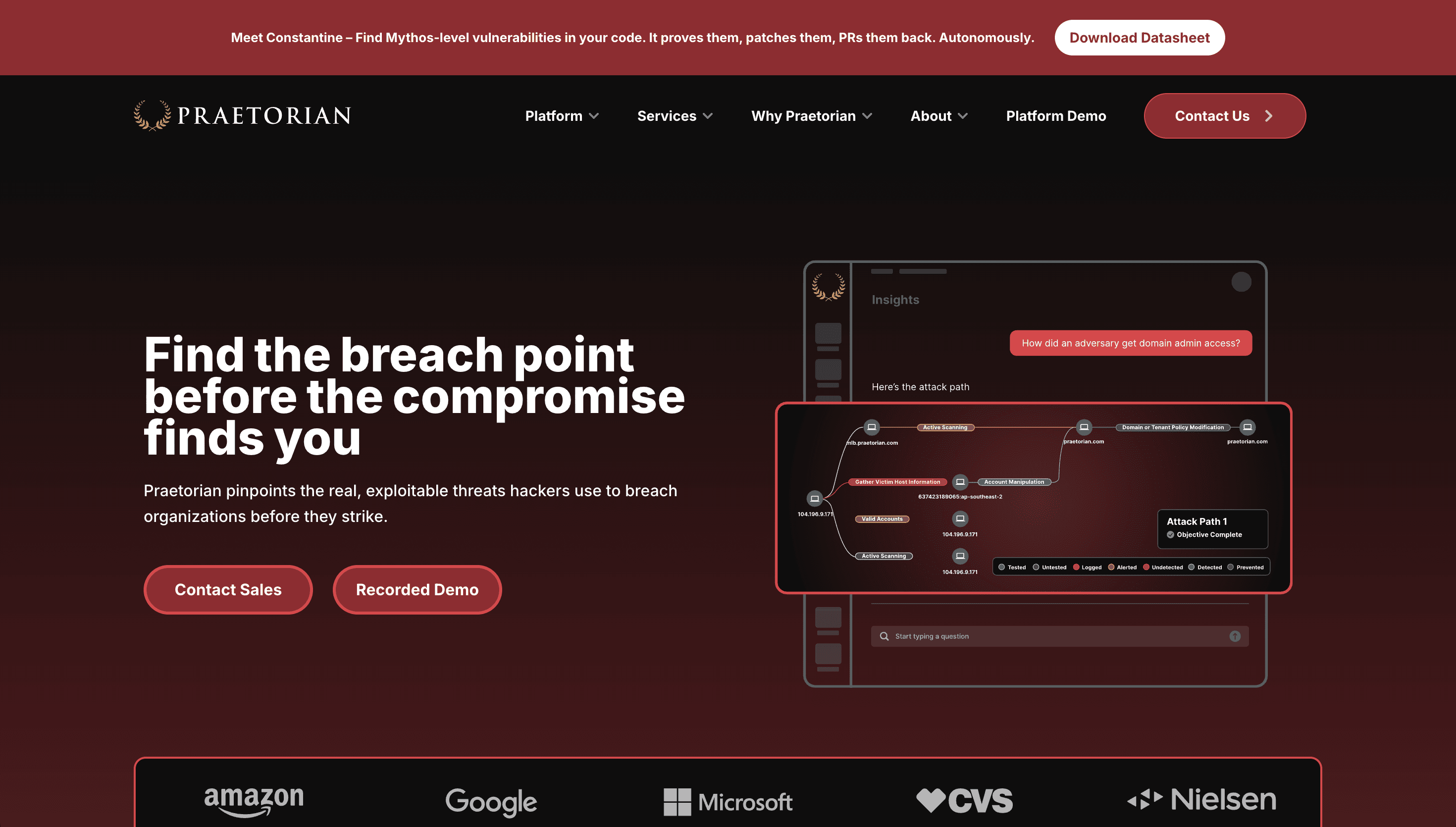
Praetorian runs a managed continuous offensive program through its Chariot platform. It is a strong fit for enterprises that want a dedicated offensive team, and a poor fit for teams that want to start testing today, operate the engine themselves, or pay on outcomes rather than an annual retainer.
This guide covers six alternatives worth shortlisting, what each does well, and where each stops. The goal is an honest map, not a ranking that pretends one tool wins every situation.
What to look for in an alternative: decide first whether you want a managed program or a platform you run yourself, whether your highest risk lives in application code or network infrastructure, and whether you can start from a URL or need a scoping call. Those three questions separate these six faster than any feature list.
Praetorian Alternatives: What You'll Learn
This guide maps six Praetorian alternatives across delivery model, testing depth, attack surface coverage, and pricing shape, then closes with an honest by-use-case verdict so the shortlist matches your actual program.
Praetorian Alternatives Compared: Features, Pricing, Testing Depth & Delivery
The six alternatives split along one axis first: whether the capability is delivered as a managed service or as a platform you operate. The table sets that up before the detail.
Platform | Delivery model | Core strength | Pricing shape |
|---|---|---|---|
CodeAnt AI | Self-serve platform | Code-aware pentesting plus code security | Outcome-based, pay on a confirmed exploit |
NodeZero (Horizon3.ai) | Self-serve platform | Autonomous internal network validation | Subscription |
Pentera | Self-serve platform | Continuous network security validation | Enterprise annual contract |
XBOW | Self-serve per test | Autonomous external web app testing | Per test |
Bishop Fox | Managed service | Expert-led offensive engagements | Custom SOW |
Cobalt | PtaaS platform | Human-led pentest as a service | Credit-based |
The takeaway from the table is that Praetorian's closest structural peers are the managed and continuous options, while the self-serve platforms trade a dedicated team for speed and price transparency.
The 6 Best Praetorian Alternatives for Penetration Testing
Here is each alternative in detail, with what it does well and where it stops.
CodeAnt AI: Praetorian Alternative for AI Pentesting
CodeAnt AI is a defensive and offensive security platform that unifies AI code review, SAST, and agentic pentesting on shared code intelligence. It is the strongest alternative for teams whose highest risk lives in application code rather than network infrastructure.
What it does well: it runs black box, white box, and gray box tracks at once, proves each finding with a working exploit, and returns results inside the pull request and CI/CD workflow. Attack surface mapping is included, retests are free and unlimited, and the report maps to SOC 2 and ISO 27001. Pricing is outcome-based, you start from a free pentest and pay only on confirmed high or critical findings.
Where it stops: it is focused on the application, code, cloud, and runtime loop. Red team operations, physical testing, and social engineering sit outside its scope. Teams that need those managed engagements will still want a consultancy for that specific work.
NodeZero: Praetorian Alternative for Autonomous Network Pentesting
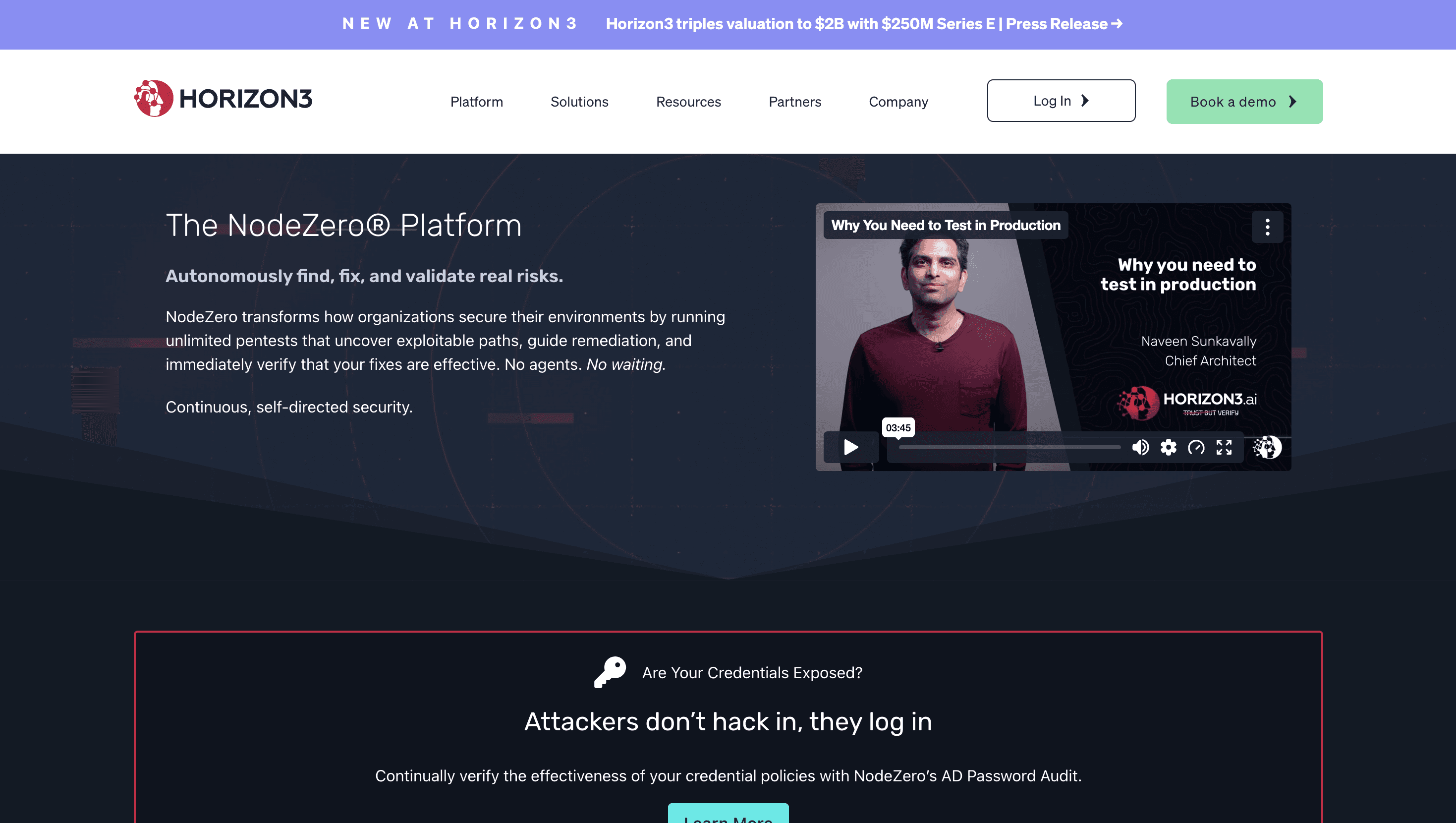
NodeZero is an autonomous pentesting platform focused on internal network validation. It is frequently cited in analyst roundups for enterprise infrastructure testing.
What it does well: autonomous network pentesting, credential-abuse simulation, and lateral-movement testing across internal infrastructure, plus external, cloud, and Kubernetes coverage. It is self-serve, which is a structural contrast with Praetorian's managed model.
Where it stops: no source-code analysis and no application-layer gray box testing. If your highest risk lives in authentication logic or business logic rather than network paths, it will miss it. It answers a different question than a code-aware platform.
Pentera: Praetorian Alternative for Automated Security Validation

Pentera is an automated security validation platform focused on network and external infrastructure.
What it does well: continuous validation that your perimeter matches your security policy, credential validation, and CVE coverage on external hosts at scale. It maps cleanly to infrastructure security programs.
Where it stops: no white box capability, no source-code analysis, and limited chain construction compared to source-aware platforms. Enterprise pricing is quote-only, with six-figure deals commonly reported, so it is not the budget-transparent option.
XBOW: Praetorian Alternative for AI Web Application Pentesting

XBOW is an AI-native offensive platform focused on autonomous external web application testing.
What it does well: external web application testing with genuine agentic reasoning and low false positives, with published per-test pricing and compliance-ready reports. For a team that wants a fast, autonomous external web test, it is a clean fit.
Where it stops: web applications only. No network or infrastructure coverage, no source-code analysis, and no defensive integration. Teams that need code-level findings still need a second platform.
Bishop Fox: Praetorian Alternative for Managed Penetration Testing

Bishop Fox is a long-established offensive security consultancy, and the closest peer to Praetorian's managed model on this list.
What it does well: expert-led engagements with a strong research bench, including red teaming, hardware and IoT testing, and application pentesting. For a board-mandated engagement that needs a named consulting team, it is a serious choice.
Where it stops: it is a managed service, priced per SOW with no public pricing, and the invoice clears whether the engagement finds a critical or zero. It is not a self-serve platform you run yourself. For the direct contrast, see Bishop Fox vs CodeAnt AI.
Cobalt: Praetorian Alternative for Pentest as a Service

Cobalt pioneered pentest as a service and runs it on a credit model.
What it does well: human-led PtaaS with a vetted tester community, a self-serve platform layer, and an autonomous option for speed. For a program built around scheduled point-in-time tests, the credit model maps cleanly.
Where it stops: the core product is point-in-time per credit spend, credits are sold in annual packages that can expire, and code-assisted testing is a separate option rather than native gray box. For the direct contrast, see Cobalt vs CodeAnt AI.
Best Praetorian Alternative by Security Use Case
No single alternative wins every situation. Here is the honest breakdown.
Best alternative for application and code security: CodeAnt AI, the only option here that combines external testing with white box source analysis and gray box business-logic testing on one intelligence layer, priced on outcomes.
Best alternative for internal network validation: NodeZero for autonomous internal testing and Active Directory attack paths, or Pentera for continuous infrastructure validation. Neither covers application-layer gray box.
Best alternative for external web application testing: XBOW for fast autonomous external web tests with low false positives. CodeAnt when you also need source context and a defensive loop.
Best alternative for a managed expert engagement: Bishop Fox, when you need a named consulting bench and scopes like red team and hardware testing. Cobalt when you want managed PtaaS on a credit model.
Best alternative for teams that want to start today: CodeAnt AI, which begins from a free scan with no sales call and pays on confirmed exploits. This is the sharpest contrast with Praetorian's onboarding model.
Conclusion: Which Praetorian Alternative Is Right for You?
The right Praetorian alternative follows your operating model. If you want a managed team, Bishop Fox or Cobalt sit closest. If you want a platform you run yourself, NodeZero, Pentera, and XBOW each own a slice.
If your risk lives in application code and you want to pay for proven exploits, start a free CodeAnt pentest from a URL, or read the full CodeAnt AI vs Praetorian comparison first.

