

Most SaaS teams do not go looking for a penetration testing alternative because they are curious. They go looking because the model they have stopped fitting, the annual test that is stale by the next sprint, the crowdsourced program that returns findings engineering cannot act on, the platform whose depth they cannot verify.
This guide maps the real alternatives for a SaaS company, organized by what you are leaving and the gap that pushed you to look. It names the options honestly and closes on the criteria that decide which alternative actually fits a multi-tenant, fast-shipping product.
Short answer: the alternatives to traditional SaaS pentesting are crowdsourced testing, first-generation PTaaS, automated validation, and code-aware continuous testing. Which one fits depends on the gap you are solving, cadence, multi-tenant depth, proof of exploit, compliance evidence, or predictable cost. For most fast-shipping SaaS, a code-aware continuous model closes the most gaps at once.
This is a documented comparison of categories, not a claim that I ran an assessment against any named vendor.
Questions SaaS Teams Ask Before Switching Pentest Providers
The search demand here is specific, and it maps to real switching decisions. Terms like penetration testing as a service draw roughly 1,600 monthly US searches, automated penetration testing around 1,000, and named queries like cobalt alternatives a few hundred, alongside practical questions like how much penetration testing costs.
Underneath those searches are five real questions this guide answers.
What replaces a slow, point-in-time traditional pentest for a product that ships weekly?
What is a good alternative to a crowdsourced platform like Cobalt or HackerOne?
Is automated or AI-driven testing a real alternative, or a downgrade?
What does an alternative need to do for a multi-tenant SaaS specifically?
How do you switch providers without leaving a window untested?
Why SaaS Teams Look For Penetration Testing Alternatives
The trigger is almost always a mismatch between the testing model and how SaaS actually works. Three patterns account for most switches.
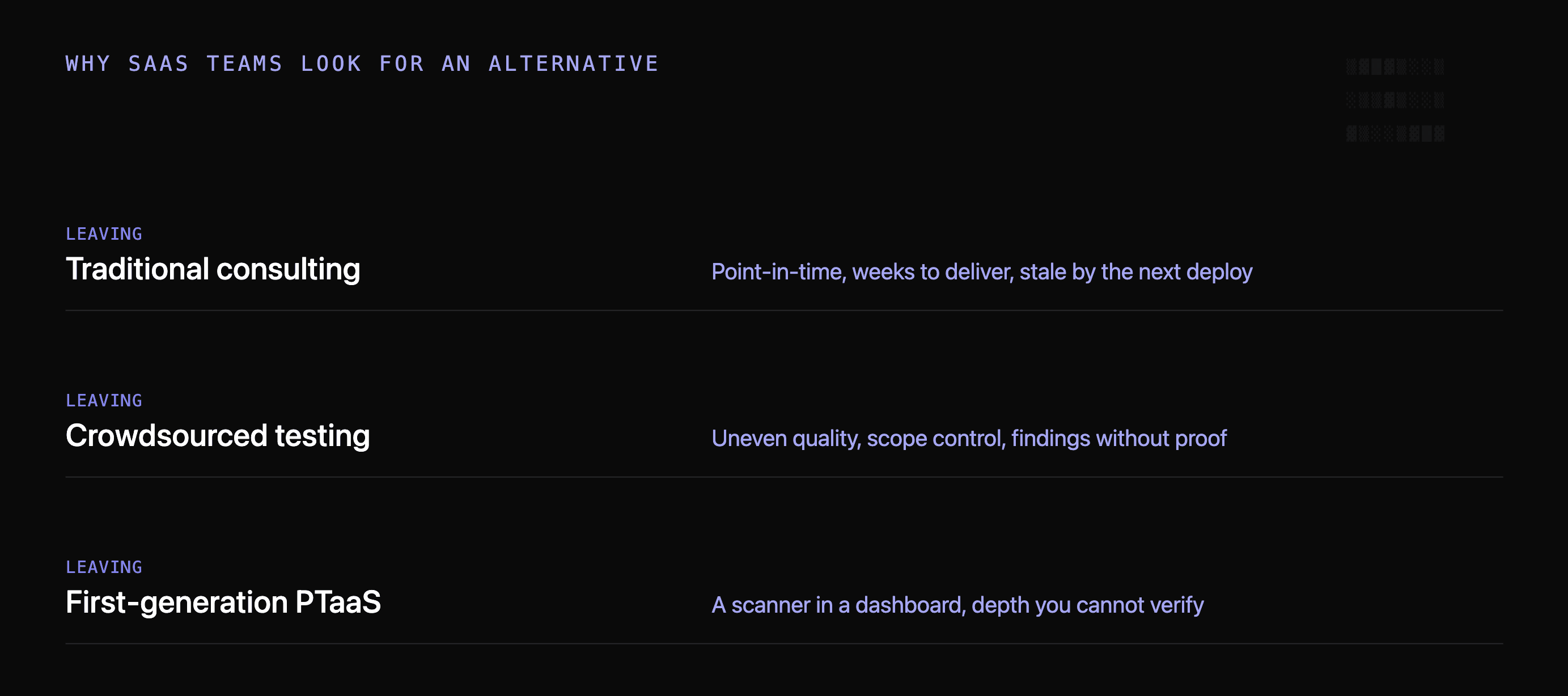
The first is cadence. A traditional engagement tests once and delivers a report weeks later, and a product that deploys weekly has moved on before the ink dries, leaving most of the year unevidenced.
The second is depth on the things that matter for SaaS. Crowdsourced breadth and automated scanning both tend to miss multi-tenant authorization and business-logic flaws, the exact issues that expose customer data.
The third is trust in the evidence, findings without a working proof of exploit, or a platform whose testing depth cannot be verified, which create triage work and audit friction rather than assurance.
Alternatives To Traditional Consulting Pentests For SaaS
If you are leaving an annual consulting engagement, you are usually solving for cadence and cost without losing depth. The alternatives split by how much human depth you still need.
A SaaS-focused consultancy keeps the manual depth but narrows it to SaaS, with methodology for multi-tenant authorization and APIs and reports mapped to SOC 2. Firms like Software Secured and Bishop Fox sit here, and this is the smallest change from what you have.
A code-aware continuous platform is the larger shift, trading a single deep engagement for depth that runs on every release. It reads the source to reach the same authorization logic a senior human would, and keeps the evidence current across the year rather than proving security on one day. Our comparison of automated, crowdsourced, and traditional testing breaks down the trade-offs in depth.
Alternatives To Crowdsourced Penetration Testing For SaaS
Teams leave crowdsourced platforms like Cobalt, HackerOne, and Bugcrowd for consistent reasons, uneven quality across researchers, difficulty enforcing scope on a multi-tenant product, findings that arrive without proof of exploitability, and cost that spikes when a program surfaces many issues.
The alternatives address those gaps directly. A consultancy trades breadth for a consistent, named team and repeatable methodology, which solves the quality-variance problem.
A code-aware continuous platform solves it differently, giving repeatable, tenant-aware coverage on every release with a working proof of exploit on every finding, so engineering triages proven issues rather than a queue of unvalidated reports.
For teams specifically weighing crowdsourced-style platforms, the Synack comparison covers where a managed researcher model helps and where it leaves gaps for a SaaS product.
Alternatives To First-Generation PTaaS Platforms
Pentest-as-a-service was itself the alternative to slow consulting, and it draws the most search demand of any term in this space. The catch is that the category varies widely, some platforms deliver real manual depth, and some are an automated scanner behind a dashboard or a crowdsourced pool with a slicker interface.
The alternative to a thin PTaaS platform is a model where the testing depth is verifiable. Code-aware testing reads the source and chains findings into a proven exploit, which is depth you can inspect, and autonomous validation platforms like Pentera and NodeZero prove exposure across the network and identity layer.
The PTaaS explainer covers what a genuine service model should include.
SaaS Penetration Testing Alternatives Mapped By Switching Reason
Every switch is really about closing a specific gap, and the alternative is defined by which gap you are solving. Mapping the two makes the decision concrete.
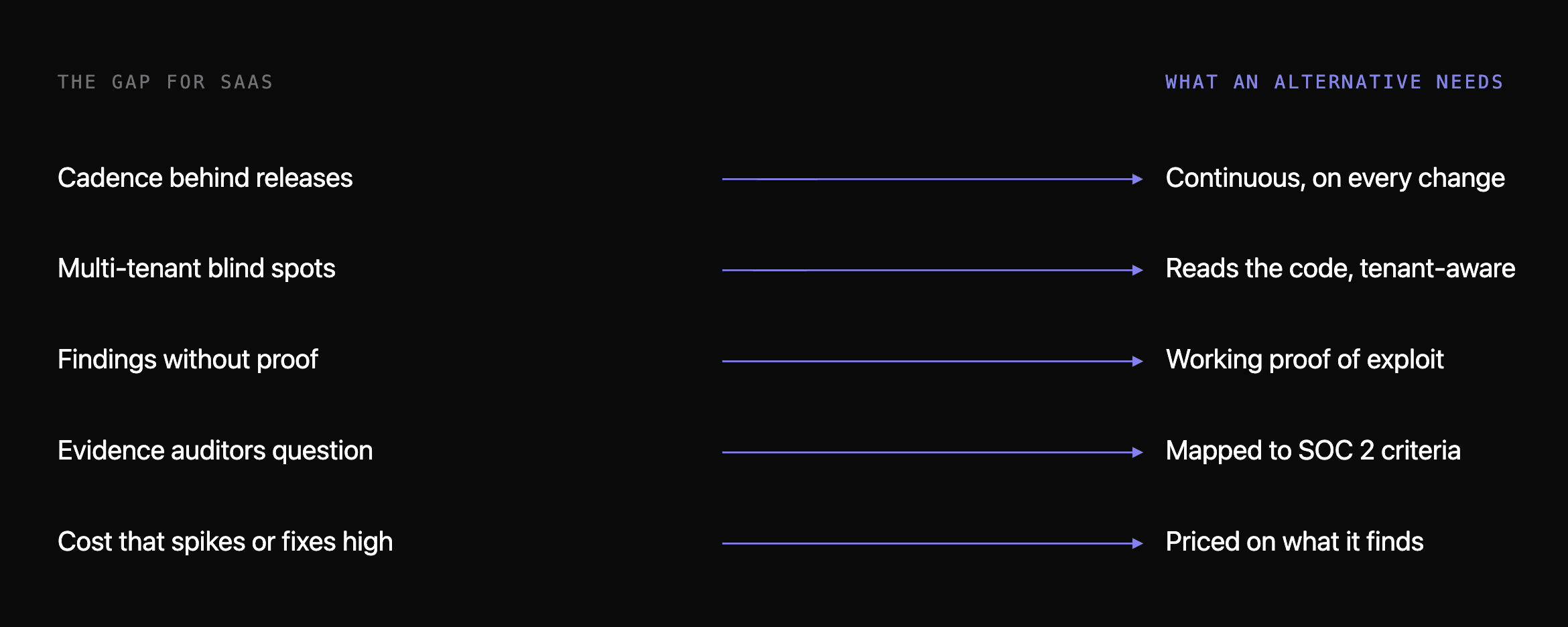
Cadence behind releases calls for continuous testing that runs on every change.
Multi-tenant blind spots call for a model that reads the code and tests tenant isolation directly.
Findings without proof call for a working proof of exploit on every finding.
Evidence auditors question calls for reports mapped to SOC 2 criteria with remediation and retest.
Cost that spikes or fixes high calls for pricing that tracks confirmed findings rather than researcher hours.
What A SaaS Pentest Alternative Must Actually Do
Not every alternative fits SaaS, and the criteria narrow the field fast. A credible SaaS alternative has to reach the parts of the product that hold customer data.
The non-negotiable is multi-tenant isolation. Cross-tenant exposure through broken object level authorization is among the most common causes of SaaS data leaks, and any alternative that cannot prove tenant A is unable to read tenant B's data leaves the core SaaS problem unsolved.
Beyond that, the alternative needs API and business-logic depth, a continuous cadence that matches deployment, SOC 2 evidence mapped to controls, and predictable pricing across a year of frequent testing. Reading the source is what ties these together, since the authorization logic that decides SaaS exposure lives in the code, not in the response a black-box scan sees.
Code-Aware Continuous Testing As A SaaS Pentest Alternative
For most SaaS teams the alternative that closes the most gaps at once is code-aware continuous testing, so it is worth seeing how it runs. It combines the cadence of automation with the depth of source-level analysis and human validation.
The workflow runs reconnaissance to map the exposed surface and leaked credentials, then service discovery and reachability to find which APIs an attacker can touch, then a chaining stage that links minor findings into a proven path to customer data. Human researchers revalidate every finding, and the output is a working proof of exploit with the code path behind it and a retest.
The depth comes from reading the code across black, white, and gray box modes, which is what surfaces the internal API reaching a customer database with no authorization check. The walkthrough of how AI penetration testing traces a data leak shows a full chain end to end.
How To Switch Pentest Providers Without A Coverage Gap
Switching models is where teams create accidental risk, a window where the old test has lapsed and the new one has not started. A short, deliberate transition avoids it.
Run the new model in parallel for one cycle. Keep the current provider through a single overlap period so nothing goes untested during the change.
Map scope to the system boundary first. Document what is in scope for SOC 2 and make the new test mirror it, so evidence covers the full control environment.
Seed multiple tenants and roles. Set up the accounts before testing so cross-tenant access can actually be exercised.
Confirm the report satisfies your auditor. Check that findings map to the criteria with proof of exploit and retest before you rely on the new provider for audit evidence.
Compare on verified findings. Rank the alternatives by reproducible high and critical issues and time to validate, using the provider evaluation framework.
SaaS Pentest Alternatives At A Glance
The table sorts the alternatives by the gap each one closes best.
If you are leaving | The gap | The fitting alternative |
|---|---|---|
Traditional consulting | Cadence, cost | Code-aware continuous, or SaaS consultancy |
Crowdsourced (Cobalt, HackerOne) | Quality, scope, proof | Code-aware continuous, or consultancy |
First-generation PTaaS | Unverifiable depth | Code-aware testing you can inspect |
Scanner-only tooling | No exploitation | Any real penetration test |
Network-only automation | App and tenant logic | Code-aware application testing |
The pattern is that most SaaS gaps point toward the same place, source-level depth on the authorization logic where customer data leaks, run continuously enough to match releases.
How CodeAnt AI Fits As A SaaS Pentest Alternative
CodeAnt is built to be the alternative that closes those gaps together. It reads your code alongside the live product, proves whether multi-tenant isolation and API authorization actually hold, and runs continuously so the new integration or endpoint shipped this week is tested this week.
Findings arrive as a proven chain with a working exploit, mapped to the SOC 2 criteria your buyers and auditors check, which is the evidence quality that crowdsourced and scanner-only models struggle to match. It pairs the offensive agents with AI code review, SAST, SCA, secrets, and IaC scanning, so a class of flaw gets caught in the pull request and again at the pentest.
The pricing is the part that changes the switching math. Testing is outcome-based, a zero engagement fee with payment only on confirmed critical findings, so moving to continuous coverage does not mean a larger fixed bill than the annual test you are leaving.
Conclusion: Choose The Pentesting Alternative That Fixes Your Current Gap
The right penetration testing alternative for a SaaS company depends on why the current model stopped working. If the annual consulting test is stale by the next sprint, the gap is cadence. If the crowdsourced program creates too much noise, the gap is proof and consistency. If the PTaaS platform feels like a scanner behind a dashboard, the gap is depth. If the testing report does not satisfy buyers or auditors, the gap is evidence.
For fast-shipping SaaS teams, those gaps often point in the same direction: source-level testing that understands authorization logic, proves multi-tenant isolation, validates real exploit paths, maps findings to SOC 2, and runs continuously enough to keep pace with releases. A SaaS pentest alternative should not just replace the old provider. It should fix the exact reason the team started looking.
The safest switch is deliberate. Run the new model in parallel for one cycle, match scope to the system boundary, seed tenants and roles, check auditor evidence requirements, and compare vendors by verified findings rather than demos. That way, the team avoids a coverage gap while moving to a model that fits the product better.
Do not choose a SaaS penetration testing alternative by category name alone. Choose it by the gap it closes: cadence, multi-tenant depth, proof of exploit, SOC 2 evidence, or predictable pricing. Then run a short pilot on your own stack before replacing your current provider. To compare the full field first, start with our best penetration testing tools for SaaS guide.

