

Intruder’s public prices are publicly available as below:
Free: $0.
Cloud: from $299 per month, or about $239 per month billed annually.
Pro: from $499 per month, or about $399 per month billed annually.
Enterprise: custom pricing.
AI application pentest: $3,500 per test for subscribers or $4,000 as a one-off.
The Cloud and Pro entry prices cover five infrastructure targets; authenticated web applications and APIs add application-license costs. Intruder sells recurring scanning across licensed assets, while an application pentest validates exploitability and produces a separate deliverable.
For application testing, compare the subscription against CodeAnt AI’s application-security scope and published pricing model. Then account for the different costs of continuous and annual pentesting.
TL;DR: Intruder pricing at a glance
Plan or service | Public USD price on July 31, 2026 | Entry scope | Use it when |
|---|---|---|---|
Free | $0 | 5 infrastructure targets; no authenticated application target | A small public footprint needs weekly baseline checks |
Cloud | $299 monthly, or about $239/month billed at about $2,870/year | 5 infrastructure targets; application targets extra | External, cloud, container, web-app, and API scanning belong in one portal |
Pro | $499 monthly, or about $399/month billed at about $4,790/year | 5 infrastructure targets; application targets extra | Internal devices and hybrid infrastructure are in scope |
Enterprise | Custom quote | Custom infrastructure and application scope | Unknown-asset discovery, all-port monitoring, or advanced access control is required |
AI pentest for a subscriber | $3,500/test | One white-box web-application pentest | The deliverable must be an application pentest report |
One-off AI pentest | $4,000/test | One white-box web-application pentest | A team wants the test without the scanner subscription |
These are the official calculator’s minimum paid configurations, not universal per-asset rates. The security vulnerability scanner market includes different licensing units, so separate recurring scanning costs from one-time pentest charges.
How much does Intruder cost?
For Cloud and Pro, the public calculator adds a plan-specific infrastructure amount to an application-license amount. The minimum paid configuration contains five infrastructure licenses.
Intruder counts an external IP address or domain as an infrastructure target. Container images use the same pool, while supported internal devices require Pro or Enterprise.
An application license covers infrastructure checks plus enhanced unauthenticated scanning. It also enables authenticated-page scanning and schema-driven API scanning.
Counting one application in both license pools overstates the required quantity.
Cloud-account scanning is a separate scope decision from cloud infrastructure security controls. CodeAnt’s cloud-configuration analysis checks code-to-cloud configurations rather than consuming an Intruder target license.
The annual toggle applies a 20% discount and displays both the effective monthly amount and annual charge. Monthly billing retains month-to-month cancellation; annual billing requires a yearly commitment.
Intruder plans and included features

Free: five infrastructure targets
Free is a permanent plan for five external infrastructure targets. It includes weekly external vulnerability scans and weekly checks for one connected cloud account.
The plan also scans two container images weekly and monitors ports 80 and 443. It allows three users and provides one AI issue-investigation credit per month.
Remediation scans and a cyber-hygiene score are included.
Free excludes authenticated web-app and API application targets. Its plan matrix lists weekly network scanning but limits scheduled scanning to one run per month, so verify the cadence for each target type.
Pre-deployment coverage requires separate controls. SAST checks source-code weaknesses, while software-composition analysis checks vulnerable dependencies.
Secret scanning covers exposed credentials before deployment.
Cloud: starts at $299 per month
Cloud starts at $299 per month for five infrastructure targets, or an effective $239 per month with annual billing. It adds custom scheduling and emerging-threat scans.
Cloud checks up to three cloud accounts daily and scans container images every day. Separate application licenses enable authenticated web-app or API testing.
The plan monitors the top 10 ports and supplies five AI issue-investigation credits each month. It also includes more than 15 integrations and unlimited users.
Cloud does not include agent-based internal-device scanning. Source-side infrastructure-as-code checks identify risky definitions before the deployed resources become scanner targets.
Pro: starts at $499 per month
Pro starts at $499 per month for five infrastructure targets, or an effective $399 per month annually. It raises the cloud-account allowance to 10 and the port-monitoring range to the top 50.
Pro adds agent-based scanning for supported internal servers and employee devices. The agents support Windows and macOS as well as Linux.
The $200 difference at the entry configuration buys internal-device coverage rather than more external licenses. Pro also raises the monthly AI issue-investigation allowance to 10.
Repository-level controls remain separate: a code-security dashboard consolidates code findings, while security gates enforce policy on code changes.
Enterprise: custom pricing
Enterprise is quote-priced. It adds unknown-asset discovery and all-port monitoring, supported by more than 1,000 attack-surface checks.
The tier includes unlimited cloud accounts and 50 monthly AI issue-investigation credits. Intruder also lists proactive threat response and custom checks.
Advanced access control is included.
The quote depends on the asset inventory and cloud organizations in scope. Application-license quantities and access-control requirements also affect the configuration.
Application security posture management can expose controls and data flows outside the scanner’s scope.
Intruder Free plan versus the 14-day free trial
Intruder advertises a permanent Free plan and a separate 14-day trial. The trial unlocks Cloud features with five licenses, including authenticated web-application scanning; the permanent plan retains five infrastructure targets but excludes authenticated application scanning.
Record whether each proof-of-concept result came from the trial or Free environment. The automated pentesting checklist provides a repeatable way to document the tested workflow.
How target licensing changes the Intruder bill
A scanned target holds a license for 30 days
Infrastructure and application licenses remain in use for 30 days after a scan, and rescanning resets the period. Deleting a target or cancelling a scan does not release the license early.
Removing authentication also leaves the license assigned. Deleting an API schema has the same result.
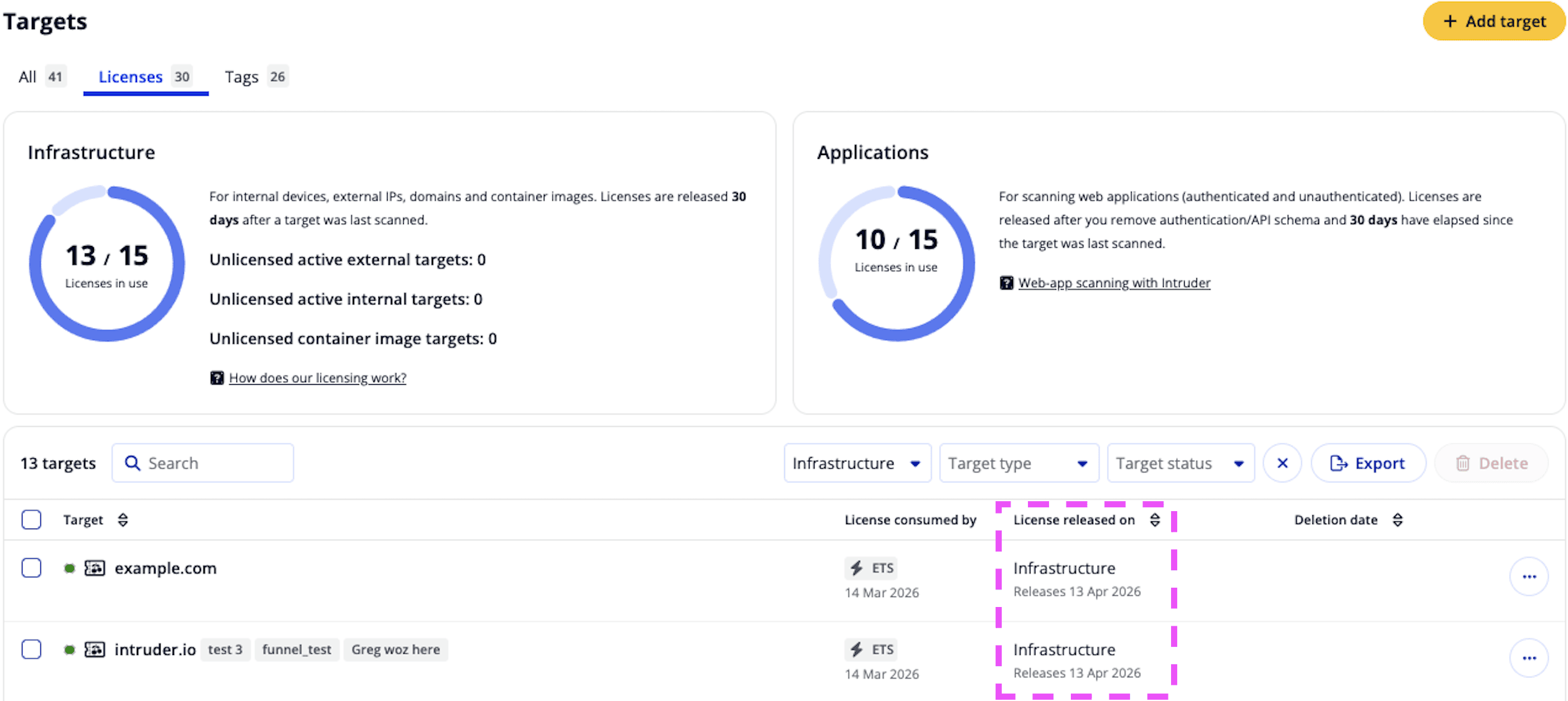
This rolling entitlement prevents a consultancy from rotating one license across a new customer asset each week. The official March 2026 Help Center image above also distinguishes infrastructure and application license pools.
Infrastructure and application counts are separate
The calculator adds the infrastructure and application totals. At the first public step, one application target adds about $73 monthly or about $59 to the annual-billing monthly equivalent; higher quantities use different increments.
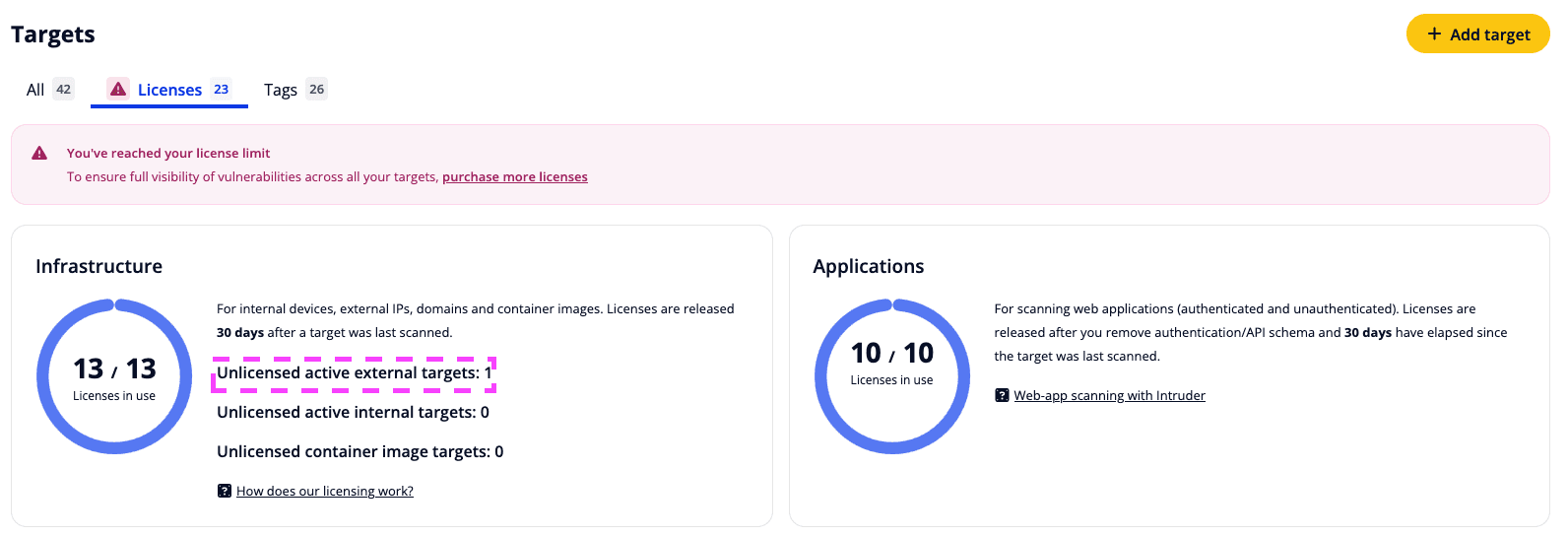
Reaching either pool’s limit can leave an intended target unlicensed. During a pilot, test the target mix against the requirements for continuous pentesting, not only the total asset count.
Monthly and annual terms behave differently
Monthly subscriptions can be cancelled at any time, with access continuing through the current paid period. Annual pricing receives the 20% discount.
In either billing mode, increases are prorated and decreases are credited until the next billing period. Public prices exclude VAT. AWS Marketplace offers only the Cloud plan and caps the configuration at two application licenses. It does not provide internal scanning.
Upgrading an annual Marketplace dimension can start a new 12-month agreement. Record the procurement route in the cloud pentest scope checklist before comparing the Marketplace configuration with a direct order.
AI investigation credits are not full pentests
Monthly AI issue-investigation credits rise from one on Free to five on Cloud. Pro includes 10, while Enterprise includes 50.
Investigating one occurrence consumes one credit. A full white-box AI pentest is separate at $3,500 per test for a platform subscriber or $4,000 one-off.
Intruder says the pentest requires a connectable GitHub or GitLab repository and produces a PDF report. Its Help Center labels the service early access for selected accounts, so confirm availability in the order form and use these questions for an automated pentesting provider to document the deliverable.
Intruder cost examples from the live calculator
The following figures reproduce the official USD dataset and its nearest-dollar display on July 31, 2026. They are calculations from first-party data, not third-party estimates.
Scenario | Monthly billing | Annual-billing equivalent | Approximate annual charge |
|---|---|---|---|
Cloud, 5 infrastructure, 0 applications | $299/month | $239/month | $2,870/year |
Pro, 5 infrastructure, 0 applications | $499/month | $399/month | $4,790/year |
Cloud, 10 infrastructure, 2 applications | $472/month | $378/month | $4,535/year |
Pro, 10 infrastructure, 2 applications | $682/month | $545/month | $6,545/year |
Cloud, 25 infrastructure, 5 applications | $773/month | $619/month | $7,423/year |
Build the recurring estimate from external infrastructure and internal devices. Add application targets and cloud-account requirements before pricing any full pentests separately.
If exposed cloud services create chains across several systems, include the affected assets after reviewing how cloud exploit chains alter scope.
What Intruder pricing gets right
The public calculator exposes infrastructure and application license quantities before a sales call and shows monthly and annual totals. Cloud and Pro allow unlimited users, so additional dashboard users do not increase the subscription.
The public tier boundaries map to specific scope changes. Cloud adds connected-cloud and application scanning, while Pro adds internal targets.
Enterprise expands discovery and access controls.
Intruder also uses exploitation context in prioritization. CISA recommends the Known Exploited Vulnerabilities catalog as a vulnerability-management input; CodeAnt provides EPSS-based prioritization and an attack-path view for ordering code-security remediation.
What to verify before signing
Use this order-form checklist:
Count licenses from scan behavior, not just asset inventory. A rescan resets the 30-day lock.
Separate infrastructure and application counts; application coverage adds a distinct calculator amount.
Record whether the proof of concept used Free or the Cloud-feature trial.
State the required deliverable. NIST SP 800-115 distinguishes vulnerability scanning from penetration testing, while the OWASP Web Security Testing Guide defines separate testing and reporting activities.
Reconcile plan naming. The visible July 2026 plan cards do not include “Essential,” but one pricing FAQ still uses that name; put the purchased plan and inclusions in writing.
Decide whether the security program needs defensive and offensive controls, rather than forcing one subscription to stand in for both.
Intruder pricing compared with CodeAnt AI
Intruder and CodeAnt AI expose different commercial units, so “cheaper” depends on the job.
Buyer question | Intruder | CodeAnt AI |
|---|---|---|
What starts the bill? | Recurring plan plus licensed targets | One full AI pentest scan is included; low/medium findings are free; confirmed high/critical findings unlock on payment |
Primary scope | Recurring external, cloud, container, web-app/API, and—on Pro—internal vulnerability scanning | Application pentesting with exploit simulation, attack-path mapping, and remediation evidence |
Variable cost | Infrastructure count, application count, tier, billing term, and separate full pentests | Confirmed high/critical findings unlocked for payment |
After a fix | Remediation scans are included in the platform | Exploit-validated application pentesting includes free, unlimited rescans after fixes |
Closer fit | Recurring exposure monitoring across an asset estate | An application pentest tied to validated exploit outcomes |
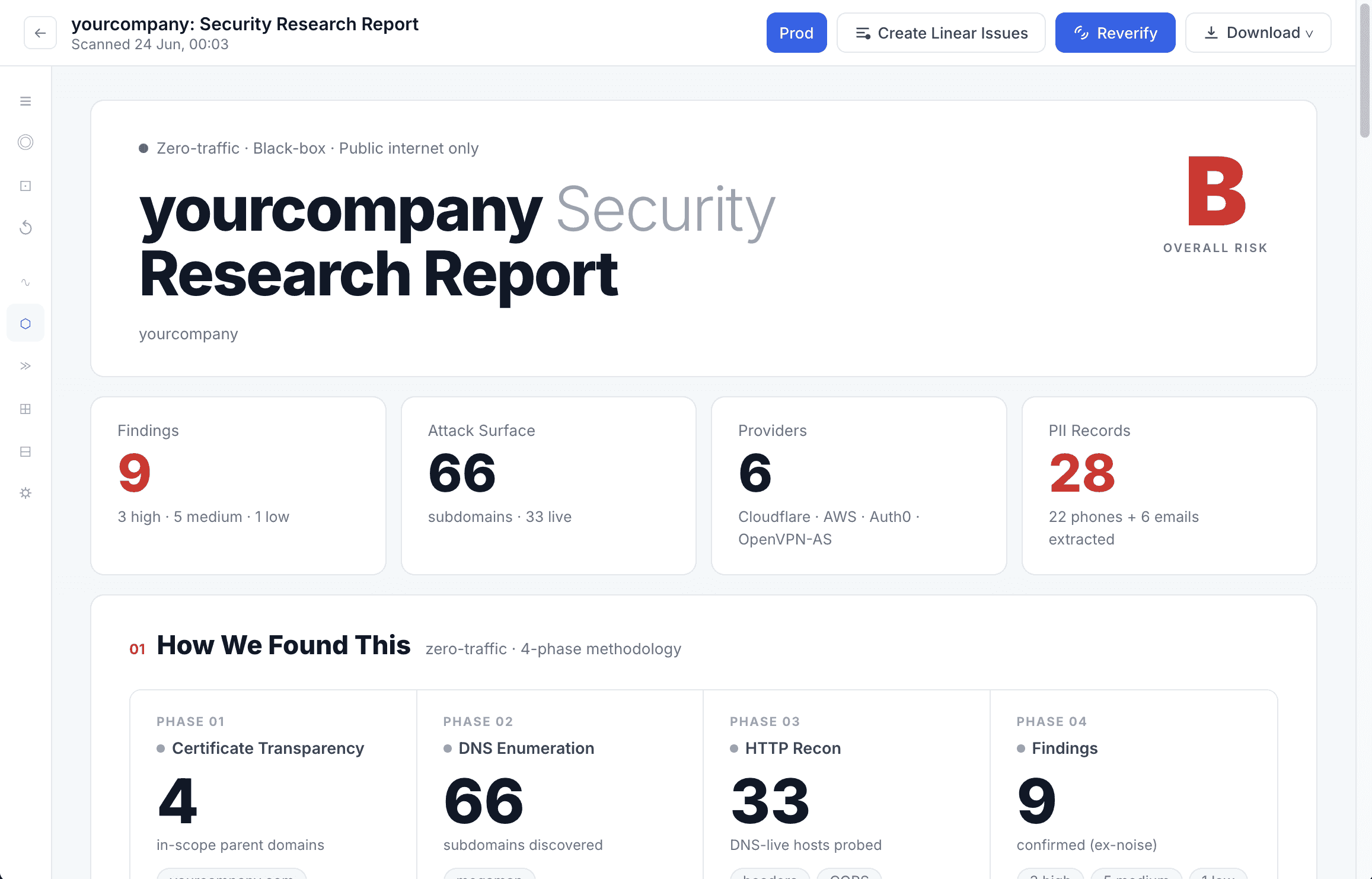
The CodeAnt screenshot is a first-party static asset from its public pentesting page; it shows the report and reverify workflow, not a test performed for this article. The pentest sample-report experience and confirmed-pentest workflow show the available output before access is requested.
Intruder’s recurring monitoring covers asset inventory and cloud accounts. Pro and Enterprise extend that coverage to supported internal devices.
CodeAnt AI prices application pentesting around validated exploit outcomes. Normalize the two models with a penetration-testing cost model and the comparison of AI pentesting with traditional DAST.
The guide to choosing an AI pentesting provider provides a process for checking scope before comparing the final quotes.
Intruder pricing checklist
Before approving a subscription or annual order, record:
External infrastructure.
Internal devices.
Application targets.
Cloud accounts.
Required scan cadence and port coverage.
Monthly flexibility versus the 20% annual discount.
VAT requirements.
Invoice requirements.
Marketplace procurement requirements.
Expected monthly AI issue investigations.
Whether an audit requires a separate pentest report.
Retest rights.
Report format.
Remediation evidence.
Ownership of each fix.
Complete the scope by reviewing the benefits and limits of AI pentesting and the boundary between SAST and DAST. Then map enforcement to AI code-review quality gates.

