

At 600 engineers, a pull request is a compliance artifact.
Someone will ask who approved it, against which policy, and whether the approval was recorded in a form an auditor accepts. GitHub's branch protection answers the first question. It does not answer the other two.
That is the shift enterprise teams run into. Below a few hundred engineers, code review is a quality practice. Above it, review becomes the control that evidences how change reaches production, and the tooling has to produce a record as well as a comment.
AI code review tools do the analysis work at that volume. The ones that survive procurement do something harder, which is fitting inside an identity provider, an audit trail, and a deployment model your security team has already signed off on.
Where this connects: CodeAnt AI runs AI code review and code security scanning against every repository through a native GitHub integration, with self-hosted deployment for teams that cannot send source to a vendor cloud.
This guide compares nine tools on the criteria that actually decide an enterprise purchase. If your organisation is smaller and your constraint is release cadence rather than governance, the SaaS team version of this comparison is the better starting point.
Key Facts at a Glance
Question | Short answer |
|---|---|
Who this guide is for | Engineering organisations past roughly 500 developers on GitHub |
Deployment models that matter | GitHub Enterprise Cloud, GitHub Enterprise Server, and self-hosted or customer VPC |
Identity requirements | SAML or OIDC single sign-on, role-based access control, provisioning |
Evidence requirements | Audit logs of findings and approvals, exportable for SOC 2 and similar |
Security depth | SAST, secrets detection, and dependency scanning built in, not bolted on |
The constraint most teams hit first | Analysis time on a large monorepo, not analysis quality |
What Changes About Code Review Past 500 Developers
Three things stop being optional.
Evidence. Someone outside engineering will eventually need to see that a given change was reviewed against a given standard. A comment thread is not an audit trail.
Identity. Every tool with repository access becomes an access-control question. If it does not federate with your identity provider, it becomes a manually maintained list of who can read your source.
Performance. A monorepo with hundreds of thousands of files breaks tools that were benchmarked on a fifty-file service. The failure mode is not bad output, it is analysis that times out or lands twenty minutes after the developer moved on.
Where GitHub's Native Review Falls Short Under Enterprise Governance
Branch protection enforces approval without recording rationale
GitHub can require a review before merge and can require it from a code owner. What it stores is the fact of an approval.
It does not store what was checked, which standard applied, or whether the reviewer looked at the security-sensitive file in the change set. When an auditor asks how you know a control is operating, the approval record alone is thin.
Default code scanning is narrower than dedicated SAST
GitHub's default scanning and Dependabot cover a real part of the surface. Dependency vulnerabilities and a set of common patterns get caught.
Dedicated static application security testing goes further into the source itself, following data from input to sink to find injection paths, unsafe deserialisation, and hardcoded credentials. For regulated workloads the difference between the two is usually the difference between passing and failing a control review.
Monorepo scale degrades review quality quietly
A pull request touching 400 files across a monorepo is not reviewable by a person in any meaningful sense. It gets approved on trust.
GitHub offers no risk-weighting to tell the reviewer which eight of those 400 files deserve the attention, so the review that happens is shallower than the approval record implies.
Tool sprawl fragments both workflow and evidence
The common pattern is one tool for security, another for quality, a third for coverage, a fourth for engineering metrics. Each has its own access model, its own report format, and its own renewal date.
Developers context switch across dashboards. Compliance teams reconcile four exports by hand.
What Enterprise Teams Should Evaluate Against
Deployment model. Cloud SaaS, GitHub Enterprise Server support, and fully self-hosted or customer-VPC options are three different answers. Air-gapped environments in financial services, healthcare, and government rule out most of this market immediately.
Identity and access. SAML or OIDC single sign-on, role-based access control mapped to your team structure, and audit logs covering both configuration changes and findings.
Security depth in the same pass. SAST, secrets detection, and dependency scanning built into the review rather than sold as separate products with separate contracts.
Custom rule enforcement. Generic rulesets produce noise at scale. The ability to encode standards specific to your organisation is what turns a review tool into an enforcement mechanism.
Performance on your largest repository. Test during the pilot on the monorepo, not on a sample service. Analysis time is the constraint that surfaces late and kills adoption.
Total cost of ownership. Per-seat pricing at 600 engineers is a large, predictable number. Usage-based pricing at the same scale is a large, unpredictable one. Self-hosted tools add infrastructure and maintenance headcount that rarely appears in the comparison spreadsheet.
For the compliance-specific version of this evaluation, see our guide to AI code review tools built for SOC 2 audits.
9 GitHub AI Code Review Tools for Enterprise Teams Compared
# | Tool | SSO and RBAC | Audit logs | Self-hosted | Security depth | Pricing model |
|---|---|---|---|---|---|---|
1 | CodeAnt AI | Yes | Yes | Yes, including customer VPC | SAST, secrets, dependencies, IaC | Per seat |
2 | GitHub Copilot Code Review | Via GitHub | Via GitHub | GHES only | Limited | Per seat, Copilot subscription |
3 | Snyk Code | Yes | Yes | Broker and on-prem options | Deep SAST, security-first | Usage based |
4 | SonarQube | Yes, Enterprise edition | Yes | Yes, self-managed | Deep SAST | Per instance |
5 | Codacy | Yes | Partial | Self-hosted available | SAST-lite | Per seat |
6 | CodeRabbit | Yes | Partial | Limited | Basic | Per seat |
7 | Qodo | Yes | Partial | Enterprise plans | Limited | Per seat |
8 | Amazon CodeGuru | Via AWS IAM | Via CloudTrail | AWS regions only | Security recommendations | Usage based |
9 | CodeScene | Yes | Yes | Yes | Technical debt focus | Per seat |
1. CodeAnt AI
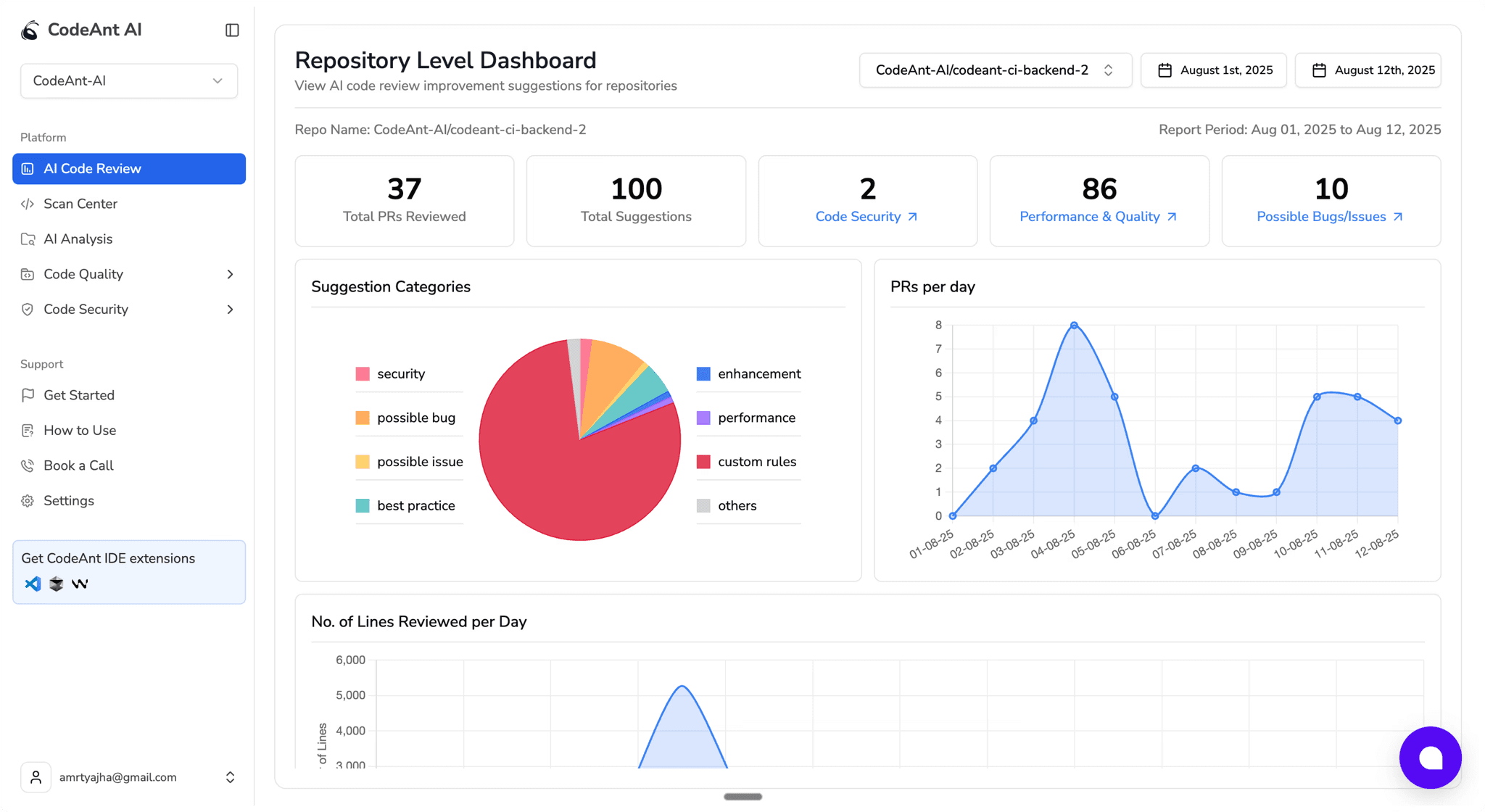
CodeAnt AI covers review, security, and engineering analytics from one platform, and scans existing code across every repository and branch rather than only the open pull request.
Governance. Single sign-on, role-based access control, and audit logs across findings and configuration. Deployment options run from cloud through to fully air-gapped on-premises and customer VPC, which is what makes it viable for financial services, healthcare, and government environments that cannot send source code out.
Security depth. SAST, secrets detection, dependency risk, and infrastructure-as-code misconfiguration in the same pass as the review, so findings arrive on the pull request rather than in a separate weekly report.
Enforcement. Custom rules encode organisation-specific standards, which is the difference between a tool that comments and a tool that enforces.
Beyond review. DORA metrics, developer-level analytics covering PR size and review velocity, and maintainability tracking. Coverage spans more than 30 languages.
Where it stops. It is a newer platform than SonarQube, so there is less institutional familiarity to lean on in a procurement conversation.
Best for. Enterprises consolidating four point tools into one platform, and any team with a self-hosted or air-gapped requirement.
Pricing. Per seat, starting at $10 per user per month, with a 14-day trial.
2. GitHub Copilot Code Review
Copilot's reviewer is native to GitHub, so it inherits your existing identity, access, and audit configuration without a separate integration.
Governance. Everything runs through GitHub itself, which is the strongest argument for it. No new vendor, no new access model, no new contract.
Where it stops. Security coverage is limited next to a dedicated SAST tool, and there is no custom rule enforcement. Its review comments do not satisfy a required reviewer under branch protection, so it adds analysis without changing your approval gate.
Best for. Organisations already standardised on Copilot who want a baseline layer under a dedicated scanner.
Pricing. Part of the Copilot subscription, per seat.
See our GitHub Copilot alternative comparison.
3. Snyk Code
Snyk Code is security-first static analysis, and it sits inside the wider Snyk platform covering open source dependencies and containers.
Governance. Enterprise identity and audit support, with broker and on-premises options for teams that cannot expose repositories directly.
Security depth. Among the strongest here, with fix examples drawn from real remediations.
Where it stops. It is a security tool rather than a code health platform. Maintainability, duplication, and engineering metrics need something else alongside it.
Best for. Security-led organisations, particularly those already running Snyk Open Source.
Pricing. Usage based, which needs modelling carefully at enterprise volume.
See our 13 Snyk alternatives breakdown.
4. SonarQube
SonarQube is the established quality gate, with an extensive rule library and the ability to block merges that fail a threshold.
Governance. The Enterprise edition carries single sign-on and audit support, and self-managed deployment is the default rather than an exception.
Security depth. Genuine SAST, backed by years of rule development.
Where it stops. Rule-based rather than AI-native, so it evaluates against patterns rather than reasoning about intent. Self-hosting at enterprise scale is a maintained service with real headcount attached, and analytics come as separate add-ons.
Best for. Organisations with existing SonarQube expertise and a hard quality gate requirement.
Pricing. Per instance, with Community, Developer, and Enterprise editions.
Read our SonarQube alternative guide.
5. Codacy
Codacy automates quality and style review across repositories and tracks how those measures trend at organisation level.
Governance. Single sign-on and self-hosted deployment are available. Audit coverage is lighter than the tools built compliance-first.
Where it stops. Security analysis is shallower than a dedicated SAST tool, and the default ruleset produces noise until it is tuned per repository.
Best for. Large organisations wanting consistent quality measurement across many repositories without heavy infrastructure.
Pricing. Per seat.
Compare it in our Codacy alternative guide.
6. CodeRabbit
CodeRabbit gives conversational review feedback, explaining findings in natural language and responding when a developer questions them.
Governance. Single sign-on is available. Audit and self-hosted coverage are thinner than the enterprise-first options above.
Where it stops. Security and quality metrics are limited, so it complements a scanner rather than replacing one.
Best for. Enterprises with a strong existing security stack who want better review feedback for developers.
Pricing. Per seat.
See our CodeRabbit alternative comparison.
7. Qodo
Qodo, previously CodiumAI, generates unit tests from the changed code alongside its review comments.
Governance. Enterprise plans cover single sign-on and expanded controls.
Where it stops. Test generation is the strength. Security scanning is limited, so it does not stand alone as the review layer for a regulated codebase.
Best for. Enterprises with a measured coverage gap and a mandate to close it.
Pricing. Per seat.
See our Qodo alternative comparison.
8. Amazon CodeGuru
CodeGuru is AWS's machine-learning code reviewer, tuned for workloads already running inside AWS.
Governance. Identity and audit run through AWS IAM and CloudTrail, which is clean if AWS is already your control plane and awkward if it is not.
Where it stops. Language coverage centres on Java and Python. Usage-based pricing scales unpredictably, and it is AWS-region bound, so it does not answer an air-gapped requirement.
Best for. AWS-native organisations with Java or Python codebases.
Pricing. Usage based.
9. CodeScene
CodeScene analyses how code and teams change over time, surfacing technical debt hotspots and coordination bottlenecks rather than reviewing diffs line by line.
Governance. Single sign-on, audit support, and self-hosted deployment.
Where it stops. It is a strategic analysis tool. Real-time pull request feedback is not the point, so it sits beside a review tool rather than replacing one.
Best for. Engineering leadership prioritising where to spend a refactoring budget across a large codebase.
Pricing. Per seat.
How to Run the Evaluation
Start with the deployment constraint. If your security team requires self-hosted or air-gapped, that eliminates most of this list before you compare features. Establish it first rather than discovering it in week six of a pilot.
Pilot on the monorepo. Analysis time on your largest repository is the number that determines whether developers keep the tool. A sample service tells you nothing about it.
Count actioned comments, not total comments. A tool posting 200 findings per pull request of which four get acted on is worse than one posting twelve of which nine do. Measure the ratio during the pilot.
Model total cost at your headcount, not today's. Per-seat pricing multiplies cleanly. Usage-based pricing needs a projection. Self-hosted adds infrastructure and the engineering time to maintain it.
Ask for the audit export before you sign. If the tool cannot produce evidence in a form your compliance team accepts, the governance case for buying it was never real.
If self-hosted GitHub is your constraint specifically, our guide to AI code review for GitHub Enterprise on-prem goes deeper on deployment.
Make Review an Enforceable Control, Not a Comment Thread
At enterprise scale the question stops being whether the code got reviewed. It becomes whether you can show what was checked, against which standard, by whom, and prove it a year later when someone asks.
GitHub's native review gives you the approval. It does not give you the evidence, the depth, or the enforcement. That gap is what the tools above are actually being bought to close, and the ones worth shortlisting are the ones that close it without adding a fifth dashboard and a fifth access model.
Where to start this week
Take your three largest repositories and pull the last month of merged pull requests. For each one, check whether you can answer two questions from the record alone: what security checks ran on this change, and which standard the approver was applying. Wherever you cannot answer both, that is a control gap with a date attached, and it is a far stronger internal case than any feature comparison.
Book a walkthrough with our team →
Related reading
Top AI Code Review Tools for GitHub Enterprise On-Prem: deployment-first guidance for self-managed GitHub.
GitHub AI Code Review Tools Built for SOC 2 Audits: the evidence and control-mapping version of this comparison.
Best AI Code Review Tools for Large GitHub Monorepos: what breaks at repository scale and which tools survive it.
7 GitHub AI Code Review Tools for SaaS Teams: the same question answered for smaller teams shipping daily, where cadence decides it rather than governance.

