

Doyensec is a strong boutique application security consultancy, but it is not the only credible option for source-code review, application penetration testing, cloud security, mobile and product assessment, or specialist research. The best Doyensec alternative depends on whether you want a continuous platform, an equally research-led boutique, a global consultancy, a penetration-testing-as-a-service program, or deep hardware expertise. The list is ordered by practical fit, not company size.
Best Doyensec Alternatives: A Quick Comparison
Alternative | Best for | Delivery model | Main tradeoff versus Doyensec |
CodeAnt AI | Fast, continuous, code-aware AI pentesting | Software platform with outcome-based pentesting | Less focused on open-ended boutique research |
Trail of Bits | Complex software assurance, cryptography, blockchain, and research | Specialist consultancy | Premium, highly selective scope and scheduling |
Cure53 | Manual web, app, library, and crypto audits | Boutique consultancy | Smaller service footprint and limited platform workflow |
Include Security | Source-assisted application and product assessments | Boutique consultancy | Less public research visibility than some peers |
Bishop Fox | Enterprise offensive security and technology-enabled programs | Global consultancy plus Cosmos platform | Broader organization and potentially heavier procurement |
Praetorian | Application, cloud, AI, IoT, and continuous exposure work | Consulting plus Praetorian Guard | Wider platform scope may be more than a focused audit needs |
IOActive | Hardware, embedded, silicon, vehicle, and full-stack product security | Research-led global consultancy | Not the simplest choice for a routine web-app assessment |
NetSPI | Enterprise PTaaS and scalable testing operations | Platform-assisted expert services | More standardized program model than a boutique research team |
Cobalt | Collaborative PTaaS with on-demand pentesters | PTaaS platform and tester community | Tester allocation model differs from a dedicated boutique team |
NCC Group | Global assurance, regulated enterprises, and broad cyber services | Large global consultancy | Less boutique continuity and more complex service catalog |
Why Look for a Doyensec Alternative?
Doyensec is compelling when source-assisted manual work, specialist targets, and direct researcher collaboration matter. Buyers typically look elsewhere for one of five reasons:
Cadence: A scheduled assessment cannot keep pace with frequent releases.
Pricing visibility: Doyensec does not publish a rate card or standard packages.
Scale: A global enterprise may need dozens of concurrent tests, regional procurement, or a consolidated vendor.
Workflow: Engineering may want a portal, integrations, tickets, dashboards, and rapid re-verification.
Specialization: A target may demand deeper cryptography, formal methods, silicon, vehicle, or large-scale red-team capabilities.
Define the gap before choosing a replacement. A PTaaS platform is not automatically better than a boutique consultancy; it solves a different operational problem.
1. CodeAnt AI: Best Doyensec Alternative for Continuous AI Penetration Testing
CodeAnt AI is the strongest Doyensec alternative when the primary need is speed and repeatability across web applications, APIs, and software delivery. It supports black-box, white-box, and gray-box testing and advertises an audit-grade SOC 2 or ISO 27001 report within 48 hours.
CodeAnt also connects pentesting with AI code review and code security, including SAST, SCA, secret scanning, IaC scanning, SBOM, and attack-path context. This makes it easier to carry a finding from exploit evidence to code, ticket, fix, and re-verification.
Why choose it over Doyensec
Faster start and advertised 48-hour reporting
Repeatable testing after releases
Free, unlimited re-scan advertised
Developer and code-security workflow
Public outcome-based pentest terms
Better fit for continuous application coverage
Tradeoffs
CodeAnt is a productized AI-native workflow, not a substitute for every research-heavy engagement. Doyensec remains a stronger default for native mobile, desktop, low-level reverse engineering, smart contracts, IoT, and highly bespoke security questions.
Doyensec | CodeAnt AI | |
|---|---|---|
Testing model | Manual research | AI-native continuous testing |
Primary strength | Deep specialist assessment | Continuous code-aware pentesting |
Cadence | Scheduled | Continuous |
Source awareness | Yes | Yes |
Self-serve | No | Yes |
Retesting | Engagement-dependent | Free/unlimited according to stated model |
Pricing | Quote-based | Outcome-based |
Best for | Complex specialist audits | Frequent application testing |
Pricing
CodeAnt advertises a $0 pentest engagement fee, payment when it ships a working proof-of-concept exploit, and no payment when nothing exploitable is found. Confirm the eligible scope and definition of a billable exploit. See the full CodeAnt AI versus Doyensec comparison.
2. Trail of Bits: Best Doyensec Alternative for Software Security Research
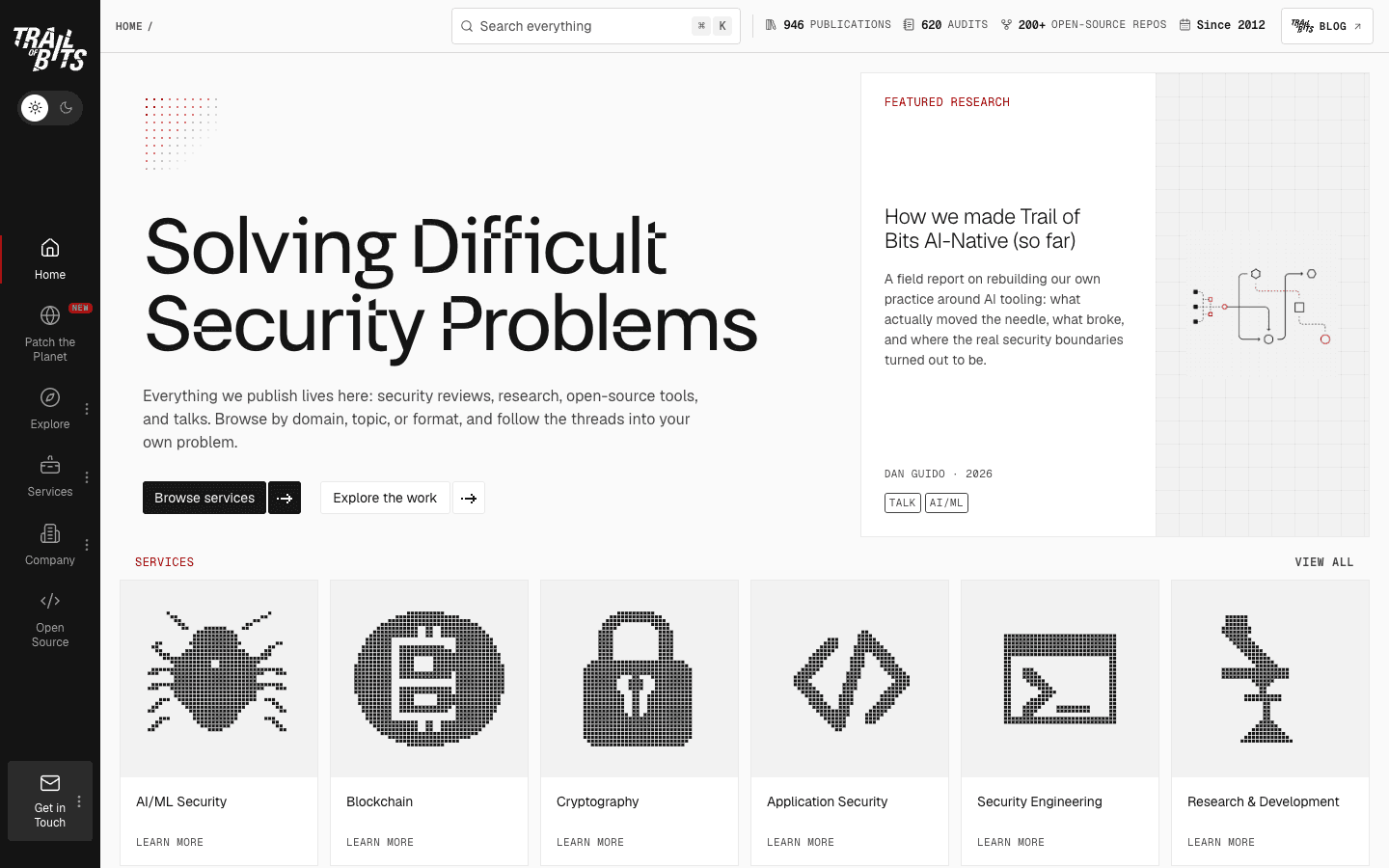
Trail of Bits is one of the closest alternatives for buyers who value security research, open-source tools, public reports, and deep software expertise. Its official service areas include software assurance, application security, blockchain, cryptography, AI and ML security, security engineering, and research and development.
The firm is particularly well known for static analysis, fuzzing, compilers, formal methods, cryptography, smart contracts, and software supply-chain work. Its public site makes reports and technical output unusually visible, which helps buyers evaluate the type of work it performs.
Why choose it over Doyensec
Exceptional depth in cryptography, blockchain, compilers, and formal methods
Large body of public audit reports and open-source tools
Multi-disciplinary teams for difficult software-assurance problems
Strong fit for foundational technology and high-consequence protocols
Tradeoffs
Trail of Bits may be excessive for a straightforward compliance-driven web pentest. Its highest-value work is specialized, and scheduling or pricing is still proposal-based. Buyers should ensure the proposed team matches the exact technology.
Best fit
Choose Trail of Bits for a complex protocol, cryptographic system, blockchain design, compiler, package ecosystem, AI/ML boundary, or security-sensitive infrastructure where research depth matters more than a standardized portal.
3. Cure53: Best Doyensec Alternative for Manual Web Application Security Testing
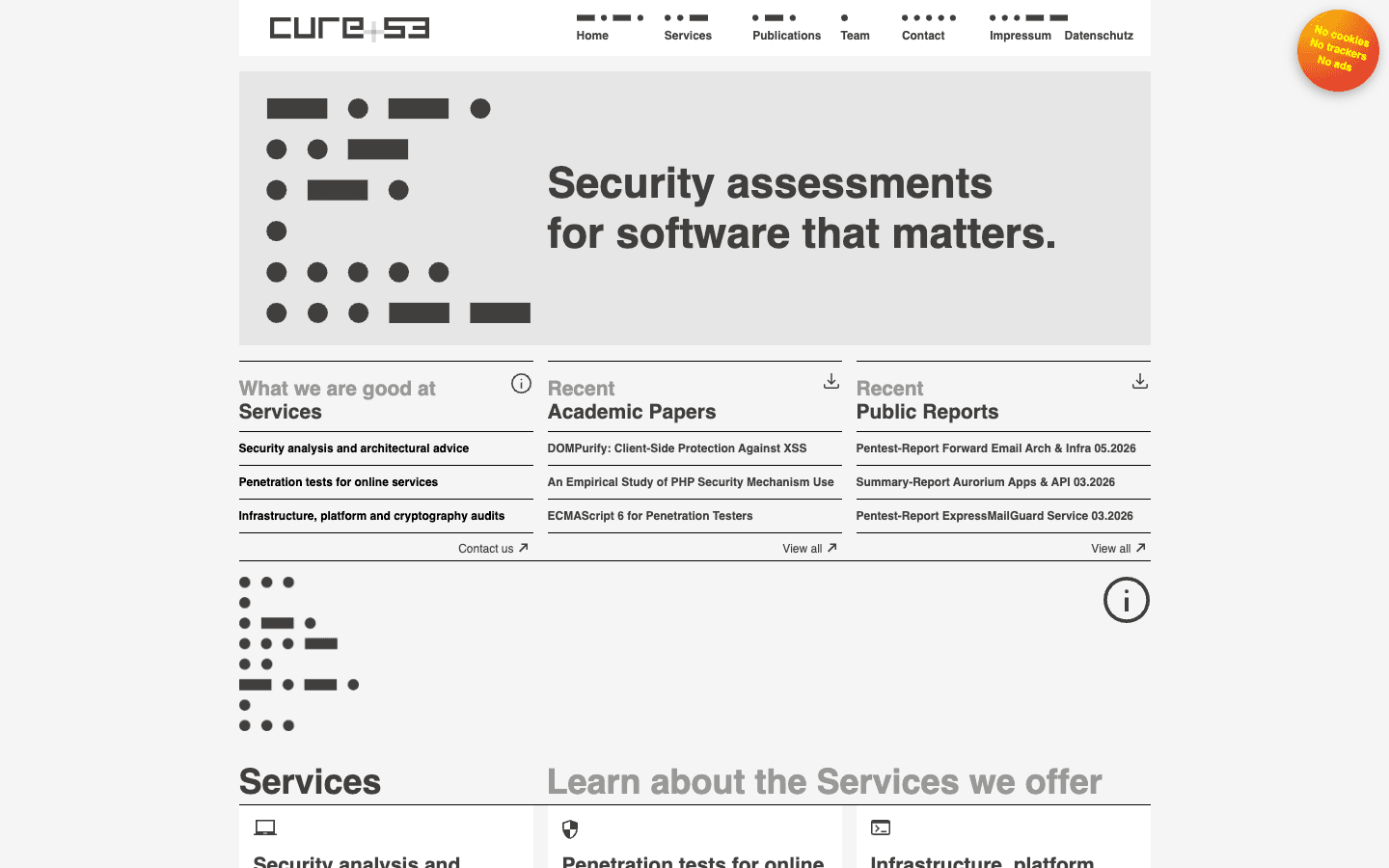
Cure53 is a highly relevant Doyensec competitor for manual application security. The company says it performs black-box penetration tests, white-box tests, and code audits across web applications, online services, hardware interfaces, mobile apps, libraries, and cryptographic tools.
Cure53 emphasizes manual, thorough testing, direct developer communication, and concise reports. Its public report archive is a major advantage for technical buyers because it shows real methodologies, findings, and writing quality.
Why choose it over Doyensec
Similar boutique and researcher-led culture
Long history of web and browser security work
Strong public report transparency
White-box, black-box, architecture, and cryptography capability
Direct communication and knowledge transfer
Tradeoffs
Cure53 does not present a continuous platform or extensive workflow dashboard. Like Doyensec, it requires scoping and scheduling. Its site is also deliberately concise, so exact coverage and commercial terms need discussion.
Best fit
Choose Cure53 for web applications, browser-adjacent technology, privacy tools, libraries, mobile apps, crypto components, and teams that want a compact, technically direct audit.
4. Include Security: Best Doyensec Alternative for Source-Assisted Security Assessments
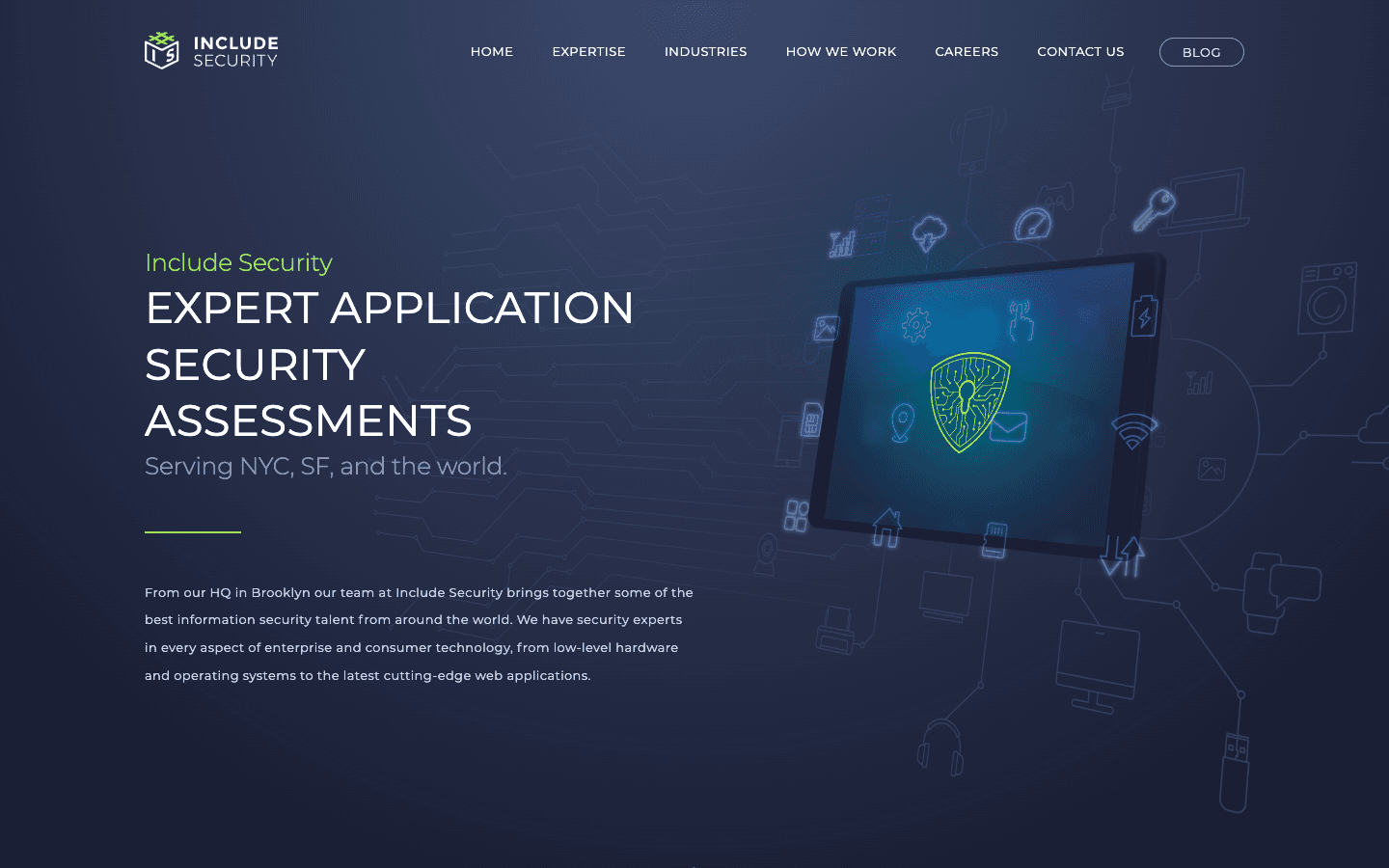
Include Security is another close boutique alternative. It specializes in application security assessments across mobile apps, web applications, IoT, server applications, client applications, web services, fuzzing, dynamic-analysis tool creation, reverse engineering, and exploit development.
The company says it right-sizes engagements based on codebase size, language, attack surface, and assurance requirements instead of placing every application into a fixed small, medium, or large box. It also emphasizes source-assisted work and staffing based on expertise rather than geography.
Why choose it over Doyensec
Very similar coverage of web, mobile, client, server, and IoT targets
Source-assisted approach
Custom fuzzing, reverse engineering, and exploit development
Clear description of assessment workflow
Technical report, reproduction steps, remediation, and readout
Tradeoffs
Include Security has less public branded search demand and a smaller visible research footprint than Trail of Bits or Cure53. Buyers should request a relevant sample report and references for the exact technology.
Best fit
Choose Include Security for product companies that want a small expert team, direct communication, code access, and a scope designed around the actual attack surface rather than a standard package.
5. Bishop Fox: Best Doyensec Alternative for Enterprise Penetration Testing
Bishop Fox offers application penetration testing, mobile assessments, secure code review, cloud and hardware security, red teaming, and continuous threat-exposure services. Its application testing combines automation with manual review and covers authentication, authorization, sessions, configuration, data validation, denial of service, and business logic.
The firm also operates the Cosmos technology platform. Bishop Fox says Cosmos supports continuous discovery, protocol-level verification, evidence-first scanning, expert validation, a living asset inventory, and findings workflows in its customer portal.
Why choose it over Doyensec
Ability to support large enterprise portfolios
Broad offensive-security catalog
Technology-enabled continuous exposure work
Portal, asset inventory, and managed workflows
Application, cloud, network, hardware, red-team, and AI/LLM services
Tradeoffs
A global provider can involve more procurement, account management, and standardized delivery than a boutique team. Confirm who actually performs the assessment, how much time is manual, and whether the same researchers stay with the program.
Best fit
Choose Bishop Fox when one enterprise vendor must support application testing, continuous attack-surface work, red teaming, hardware, and cloud across a large portfolio.
6. Praetorian: Best Doyensec Alternative for Continuous Exposure Management
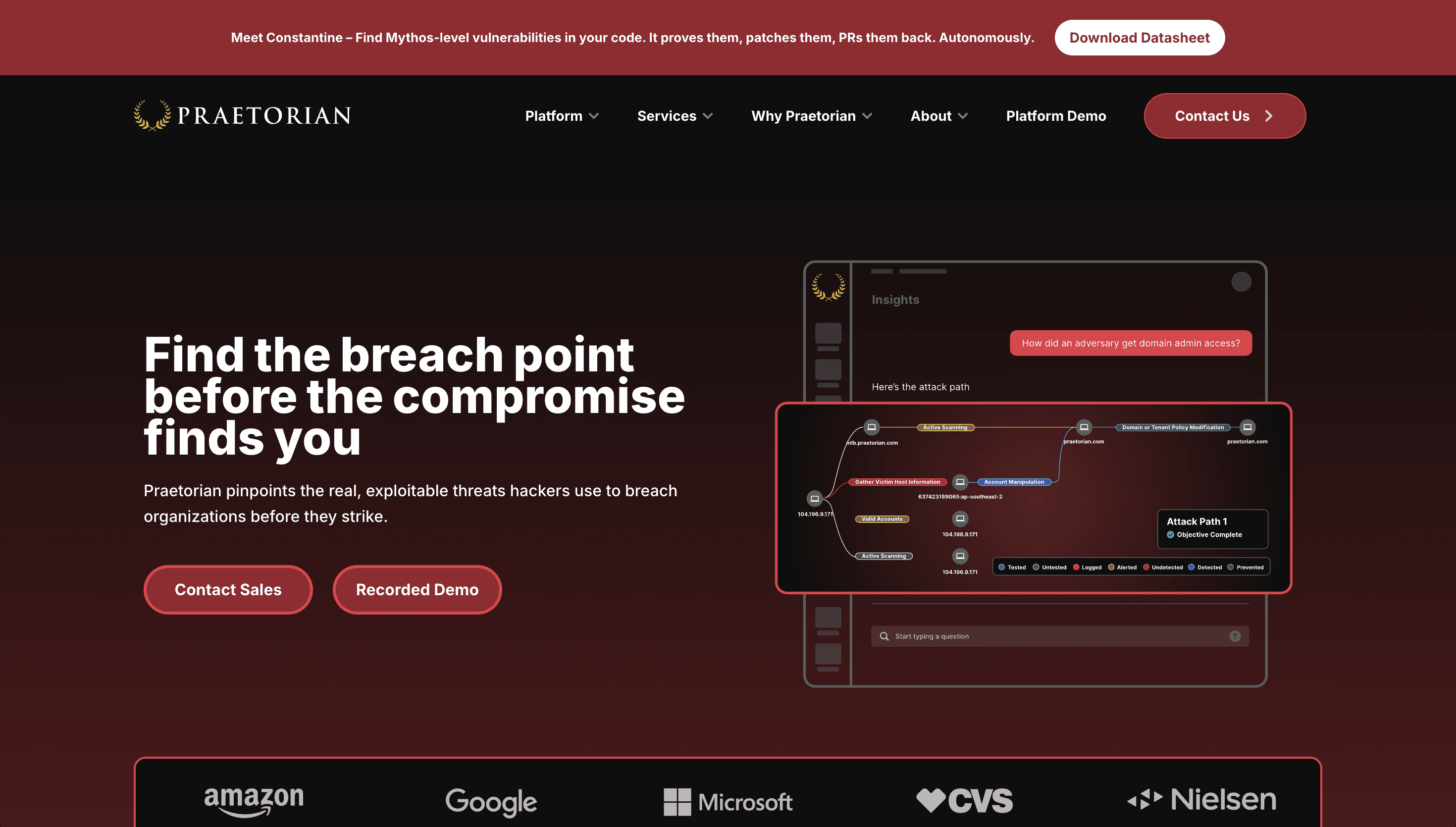
Praetorian combines professional services with the Praetorian Guard platform. Its official scope includes application, mobile, API, cloud, AI/ML, IoT, network, red-team, and CI/CD security work. Praetorian says application findings are expert verified and that its platform unifies attack-surface management, vulnerability management, continuous penetration testing, attack simulation, intelligence, and attack-path mapping.
Why choose it over Doyensec
Broad offensive and advisory services
Continuous managed program option
Human validation connected to a technology platform
Application, AI, cloud, automotive, and IoT coverage
Useful fit for exposure-management consolidation
Tradeoffs
Praetorian’s wider managed platform may add scope a buyer does not need for one focused code-assisted audit. Verify whether the proposed work is a dedicated assessment, ongoing managed service, or a combination.
Best fit
Choose Praetorian when security leadership wants a relationship that can start with a pentest and expand into attack-path mapping, continuous exposure management, red teaming, or specialized AI and product testing.
7. IOActive: Best Doyensec Alternative for Hardware and Embedded Security
IOActive is a strong Doyensec alternative for connected products and systems that extend below the application layer. The firm offers full-stack security assessments, secure development lifecycle work, red and purple teams, advisory services, and research spanning applications, cloud, wireless, embedded devices, hardware, and silicon.
Its penetration testing service explicitly covers mobile applications, infrastructure, wireless, cloud, embedded devices, and web services. IOActive also documents silicon-level work, side-channel analysis, reverse engineering, and supply-chain security.
Why choose it over Doyensec
Deeper public emphasis on hardware and silicon
Full-stack product view from physical systems to applications
Strong embedded, vehicle, industrial, and supply-chain fit
Long research history and attacker-focused consulting
Tradeoffs
IOActive can be broader and heavier than necessary for an ordinary SaaS assessment. Its most differentiated value appears when software interacts with hardware, devices, vehicles, industrial systems, or physical trust boundaries.
Best fit
Choose IOActive for an embedded product, semiconductor, vehicle, device fleet, wireless protocol, or supply-chain concern where a web-only assessment would miss the main risk.
8. NetSPI: Best Doyensec Alternative for Enterprise PTaaS
NetSPI is a prominent penetration-testing-as-a-service provider. Its model combines expert testing with a platform for scope management, findings, remediation workflows, reporting, and program visibility. Service coverage includes applications, cloud, networks, offensive security, and recurring testing programs.
NetSPI is less similar to Doyensec culturally than Cure53 or Include Security, but it solves a common scaling problem: coordinating many tests across a large enterprise without managing every report and retest through email and spreadsheets.
Why choose it over Doyensec
Mature PTaaS operating model
Centralized findings and program visibility
Enterprise scale and recurring testing
Broad application, cloud, network, and attack-simulation services
Better fit for vendor consolidation
Tradeoffs
Platform standardization can reduce the boutique feel and continuity that some teams want. Ask how testers are assigned, whether source-assisted manual review is included, how business logic is tested, and how long the same experts remain with an application.
Best fit
Choose NetSPI when a security team must manage a portfolio of tests, retests, findings, and compliance evidence across business units.
9. Cobalt: Best Doyensec Alternative for Flexible PTaaS
Cobalt popularized a PTaaS model that connects customers with a community of vetted pentesters through a collaborative platform. The service is designed to improve scheduling, communication, findings management, and retesting compared with traditional point-in-time consulting.
Why choose it over Doyensec
Faster access to a flexible tester pool
Platform-based collaboration and findings
Repeatable application, API, mobile, cloud, and network testing
Useful for recurring compliance and release-driven demand
Tradeoffs
A tester-community model is structurally different from hiring a small dedicated research consultancy. Quality depends on matching, continuity, scope, and leadership. Ask who leads the engagement, which specialists are assigned, and whether the same people can return for future work.
Best fit
Choose Cobalt when operational speed, a collaborative portal, and flexible access to human pentesters matter more than a long-term relationship with one boutique research team. CodeAnt’s existing Cobalt comparison provides another view of the AI-platform-versus-PTaaS decision.
10. NCC Group: Best Doyensec Alternative for Global Enterprise Security
NCC Group is a large global cybersecurity and software-resilience provider. Its broad portfolio includes application security, penetration testing, cloud, hardware and embedded security, cryptography, red teaming, incident response, managed services, and advisory work.
Why choose it over Doyensec
Global delivery and procurement support
Broad assurance and regulatory experience
Ability to combine technical assessment with wider cyber services
Large specialist bench across application, cloud, hardware, and cryptography
Suitable for multinational and highly regulated organizations
Tradeoffs
The breadth can make it harder to evaluate the exact team and method. Buyers should resist purchasing a brand name in place of a scoped technical plan. Meet the proposed testers, review relevant examples, and confirm senior oversight.
Best fit
Choose NCC Group when geographic coverage, enterprise contracting, regulated-sector experience, and a wide assurance portfolio are mandatory.
Which Doyensec Alternative Is Best for Your Security Team?
Choose by primary goal
Continuous web and API testing: CodeAnt AI
Cryptography, blockchain, compilers, or formal methods: Trail of Bits
Boutique manual web and software audit: Cure53
Source-assisted product assessment: Include Security
Large enterprise offensive-security program: Bishop Fox
Continuous exposure management plus consulting: Praetorian
Hardware, embedded, silicon, or vehicle security: IOActive
Enterprise PTaaS and portfolio management: NetSPI
Flexible collaborative PTaaS: Cobalt
Global regulated assurance: NCC Group
Choose by operating model
If you want… | Shortlist |
A software platform and frequent re-testing | CodeAnt AI |
A small research-led consultancy | Doyensec, Cure53, Include Security |
Elite software assurance and published audits | Trail of Bits |
A large managed offensive-security partner | Bishop Fox, Praetorian, NCC Group |
A PTaaS portal for many engagements | NetSPI, Cobalt |
Hardware-to-cloud product research | IOActive |
How to compare proposals fairly
A vendor can appear less expensive because it is testing less. Give every finalist the same written scope and require explicit answers:
Which applications, APIs, repositories, roles, and environments are included?
Is the test black-box, gray-box, white-box, or source-assisted?
How much work is manual, automated, and expert validated?
Who are the named testers, and what similar systems have they assessed?
Are business logic, authorization, and attack chains explicitly covered?
How are critical findings communicated?
What evidence, code references, and remediation guidance are delivered?
How many retests are included, and when do they expire?
What portal, ticketing, CI/CD, or API integrations are available?
How are source code, credentials, and customer data protected and deleted?
What creates a change order?
What is the total internal effort to coordinate and close findings?
For a procurement baseline, use the PTaaS provider SLA guide and automated pentesting checklist.
How to Evaluate Doyensec Alternatives Before Buying
Start with a representative application and one meaningful risk question. Include multiple roles, real APIs, and a recent architectural change. Do not use a deliberately vulnerable demo as the only pilot target; it rewards known-check coverage rather than understanding.
Score each provider on:
Confirmed exploitable findings
Novel business-logic or authorization insight
Time to first useful result
Developer effort to reproduce findings
Remediation specificity
Retest speed
Report usefulness for auditors and leaders
Researcher communication
Workflow integration
Total cost and internal coordination
Raw finding count should carry little weight. A provider that delivers twenty low-value observations may reduce less risk than one that explains a single cross-tenant exploit chain and helps prevent recurrence.
Doyensec Alternatives: Which One Should You Choose?
There is no universal Doyensec replacement because the alternatives solve different problems. CodeAnt AI is the best choice for continuous, fast, code-aware AI pentesting. CodeAnt connects AI penetration testing with source-code and application-security context, so security teams can test applications repeatedly, understand where a finding originates in the code, reproduce the risk, and move it into remediation rather than treating the pentest as a once-a-year report.
That makes CodeAnt less of a like-for-like replacement for Doyensec and more of an alternative for teams whose biggest problem is pentest cadence, speed, and continuous coverage.
Start with a free CodeAnt pentest, or compare the two approaches directly in CodeAnt AI vs Doyensec

