

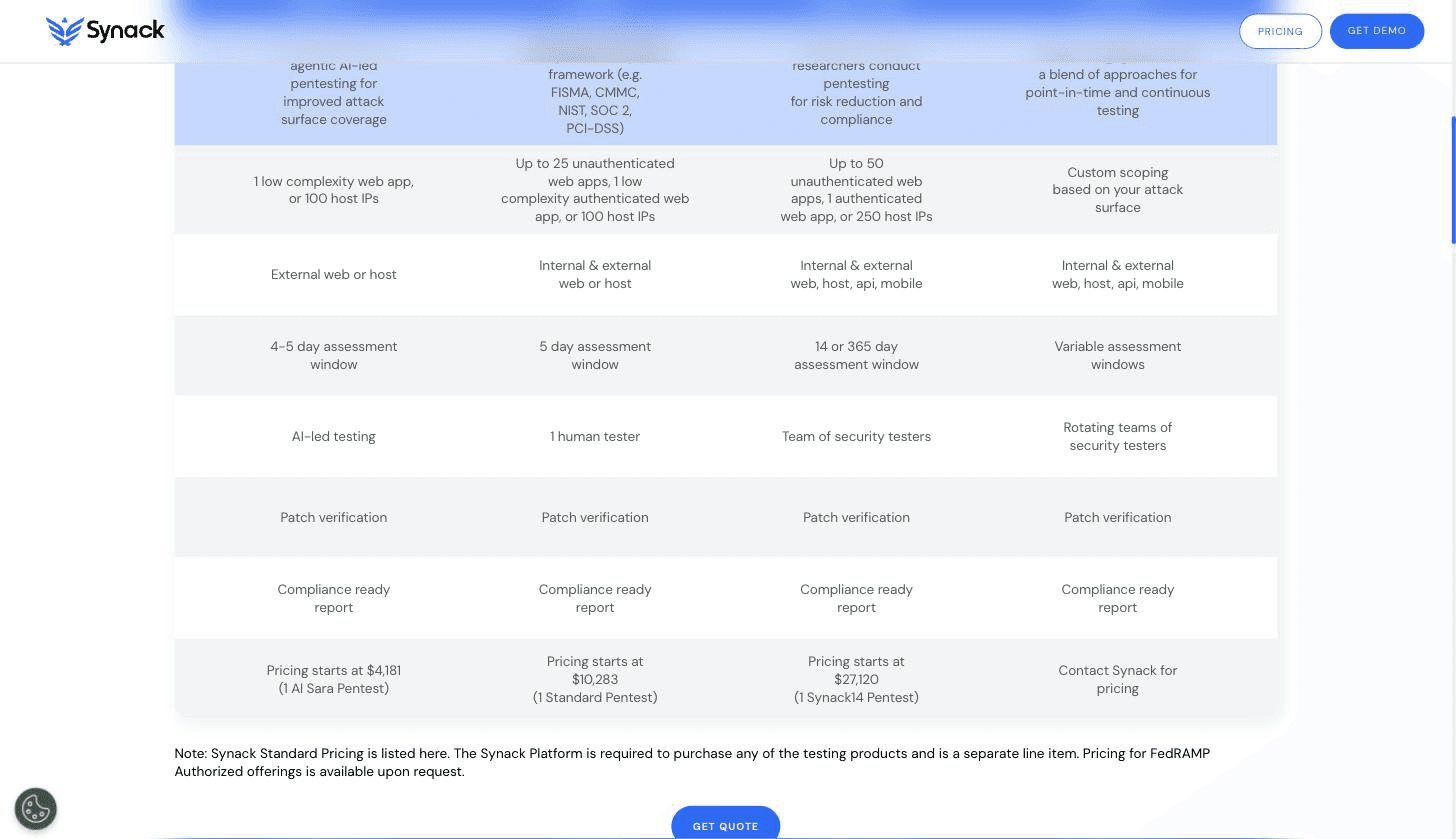
Synack does something almost nobody in penetration testing does. It prints starting prices on a public page, from $4,181 for an AI-led test to $27,120 for a 14-day human engagement.
Read the footnote before you budget, though. The platform subscription that every test requires is a separate line item with no published price, and Vendr pegs the median Synack contract at $105,600 a year.
Short answer: Synack publishes three starting prices on synack.com/pricing: Sara Pentest at $4,181, SynackST at $10,283, and Synack14 at $27,120. Each buys one test, purchased as credits that expire a year from purchase, and none includes the required Synack Platform subscription, which is quoted separately. Vendr’s contract data puts the median actual spend at $105,600 a year, ranging from $79,215 to $140,150.
How Much Does Synack Cost?
A single Synack test starts at $4,181 and climbs past $27,120 depending on who does the testing and for how long. The real annual figure lands much higher once the platform subscription and a year of testing cadence stack up.
Here is every published number, verified against the live pricing page as of July 2026.
Tier | Starting price | What it buys | Testing resource | Window |
|---|---|---|---|---|
Sara Pentest | $4,181 | 1 AI-led pentest, external web or host only | Sara, the AI agent | 4-5 days |
SynackST | $10,283 | 1 checklist-based compliance pentest | 1 human tester | 5 days |
Synack14 / 365 | $27,120 | 1 open vulnerability discovery engagement | Team of researchers | 14 or 365 days |
Enterprise | Custom | Blended point-in-time and continuous testing | Rotating teams | Variable |
Each figure prices one pentest, never a month or a seat. The page’s own note is the part that matters: “The Synack Platform is required to purchase any of the testing products and is a separate line item,” and that platform price is nowhere on the page.
What Buyers Actually Pay
Vendr, a procurement platform that logs real signed contracts, puts the median Synack deal at $105,600 a year. Its range runs from $79,215 at the low end to $140,150 at the high end.
Vendr adds that a typical entry-level buyer testing 5 to 10 assets budgets $75,000 to $150,000 annually. Set that against the $4,181 headline and the gap tells you how much the platform fee, test volume, and asset count add.
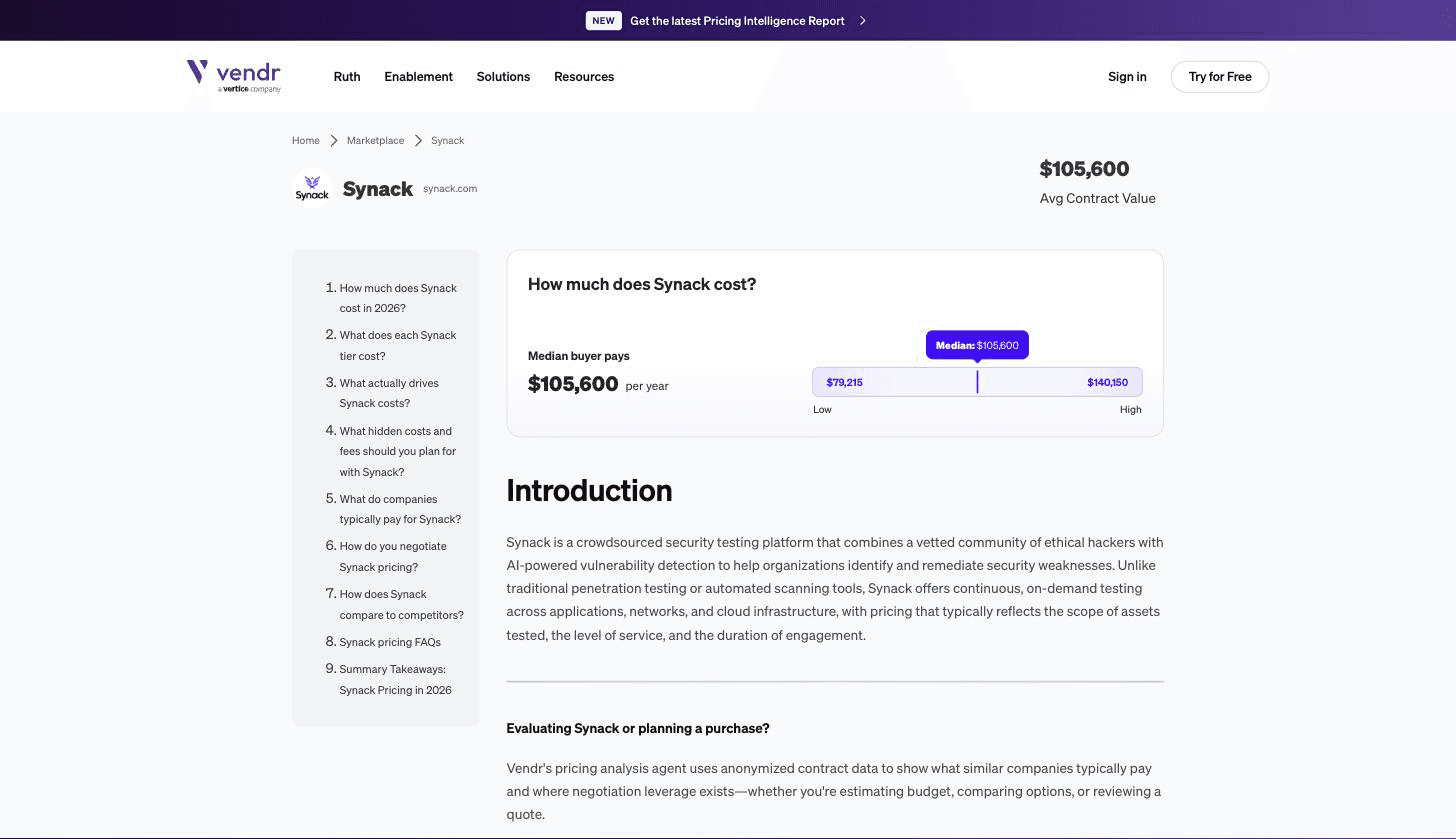
Treat the Vendr figures as planning anchors rather than quotes. Synack has never confirmed a platform price, and your total depends on how many credits you buy.
How Do Synack Credits Work?
Credits are the currency for everything except the platform subscription. You state a credit count on a statement of work or purchase order, the balance appears in the platform, and each test draws it down.
Three published rules shape the economics:
Credits expire one year from purchase. Synack’s own FAQ answers the expiry question with a flat “Yes, credits expire one year from purchase date.”
Anything but the platform is buyable with credits. A Synack365 continuous pentest and a one-off CVE test draw from the same pool.
Price follows methodology, duration, and asset count. Synack states it prices “based on the testing methodology, test duration and the number of assets tested.”
Prepaid, expiring credits reward accurate forecasting. Over-buy and the remainder evaporates at month twelve, under-buy and a mid-year launch means a new purchase order.
What Does the Free Option Include?
Synack’s Basic platform tier costs nothing, and it is easy to misread as a free trial. It is a free shell, since running any test still requires purchased credits.
Basic includes self-service test deployment, vulnerability management, patch verification, per-engagement reports, RBAC, and access to the Synack Red Team. The paid Synack Platform tier adds the pieces you would assume were standard: the Synack API, Jira and ServiceNow integrations, SSO, attack surface discovery, and analytics.
No free trial exists anywhere on the site. CodeAnt AI takes the opposite entry path, with a free black-box pentest scan on one URL, no card, and a bill that arrives only if a working exploit ships.
What Drives the Synack Bill?
Four levers set your total, and only the first carries a published number.
Testing tier and volume. Every test consumes credits at the $4,181 to $27,120+ rates, so cadence multiplies cost fast.
The platform line item. Required, unpublished, and quoted alongside your first credit purchase.
Add-ons. AI-Powered Vulnerability Triage, Continuous Attack Surface Discovery, and the managed Vulnerability Disclosure Program are all separately priced, all unpublished.
FedRAMP environments. The pricing page states that FedRAMP Authorized offering prices are “available upon request,” so public-sector buyers see nothing up front.
One structural note worth catching: the paid platform tier includes only point-in-time attack surface discovery. Continuous discovery, the thing the marketing leads with, sits in the add-on column.
What Synack Gets Right on Pricing
Credit where due, and in this category the bar is low.
Published starting prices. Pentera, Cobalt, and NodeZero publish zero dollar figures, so Synack’s three anchors are genuinely rare, as our Synack alternatives roundup shows tool by tool.
Flexible credits. One pool funds any mix of AI tests, human tests, and continuous engagements, so plans can change without converting past purchases.
A real cost story. Synack’s homepage claims 32% lower pentesting costs and 22 days saved per pentest versus traditional testing, as of July 2026.
Multiple procurement paths. AWS, Azure, and GCP marketplace listings, plus Carahsoft and GSA Advantage for U.S. federal buyers.
Anchored against a $30,000+ manual engagement, a $10,283 human-led test with platform tooling is a defensible trade.
What to Watch Before You Sign
Every item below comes from Synack’s own pages, and each one lands after the headline price has done its work.
The platform is mandatory and unpriced. You cannot buy a $4,181 test alone, and the required subscription’s cost only appears in your quote.
Credits are use-it-or-lose-it. Twelve months, then gone, with consumption tracked in a ledger you will want to actually watch.
Sara is external-only. The AI tier tests external web and host assets, with internal testing still on the roadmap, so the cheapest tier cannot see inside your network.
No MFA or CAPTCHA support for Sara. Synack’s FAQ lists both as unsupported today, which rules the AI tier out for a chunk of modern login flows.
No trial, no self-serve checkout. Everything moves through an SOW or purchase order, so procurement is in the loop from day one.
The Synack features breakdown maps what each tier’s spend actually buys, capability by capability.
How Does Synack Pricing Compare to CodeAnt AI?
The models sell different things. Synack sells tests, priced per engagement through credits, while CodeAnt AI sells a continuous platform priced per seat with a pentest that bills only on proven findings.
Dimension | Synack | CodeAnt AI |
|---|---|---|
Published prices | Starting prices only, from $4,181 per test | Yes, $24/user/month Premium, modules from $20 |
Typical annual cost | $105,600 median, per Vendr | Per seat, visible before you buy |
Entry point | Free Basic shell, tests need credits | Free one-URL scan, no card, plus a 14-day trial |
Billing unit | Credits per test, 1-year expiry | Per user, pentest pays only on high or critical findings |
Hidden line items | Platform subscription, add-ons, FedRAMP pricing | None published |
Retest cost | Patch verification included per engagement | Free unlimited re-scans |
What you are buying | Human + AI pentests of a scoped target | Code review, SAST, and code-aware pentesting, continuously |
Scope explains the price gap. Synack tests the running target from outside, while CodeAnt AI’s pentest reads your source in black, white, and grey box modes and ships with the code-security stack Synack does not offer.
The full CodeAnt AI vs Synack comparison walks the feature split in detail.
Is Synack Worth It in 2026?
Worth it when a vetted human red team and a compliance-grade report are the requirement, and a six-figure annual program fits the budget. Allianz Direct and Domino’s run exactly that playbook on Synack, and the FedRAMP Moderate authorization makes it a shortlist fixture for U.S. agencies.
Harder to justify when your risk lives in the code you ship weekly. A Synack engagement tests what is deployed at test time, and the per-test economics punish the cadence a fast-moving codebase demands.
The value question | Synack’s answer |
|---|---|
Cheaper than a traditional pentest firm? | Yes, its own claim is 32% lower costs |
Predictable to budget? | Partly, headline prices are public but the platform fee is not |
Provable before you buy? | No, there is no trial and no free test |
Worth it for continuous code-level coverage? | No, that layer is out of scope entirely |
Worth it for compliance and federal work? | Yes, that is the sweet spot |
CodeAnt AI answers the provability row differently. Point the free scan at one URL you own and read the findings before any money moves.
Where This Leaves You
Budget honestly and the Synack math looks like this: $4,181 to $27,120 per test, an unpublished platform fee on top, credits that die at twelve months, and a median real-world contract of $105,600 a year. Fair value for a human-validated, federally authorized testing program, and a lot of structure for a team that just needs to know what is exploitable this sprint.
CodeAnt AI is the call when you want spend tied to seats and findings rather than engagements, and a free scan today instead of a purchase order. Start with the number you can verify for free, then decide what the rest is worth.

