

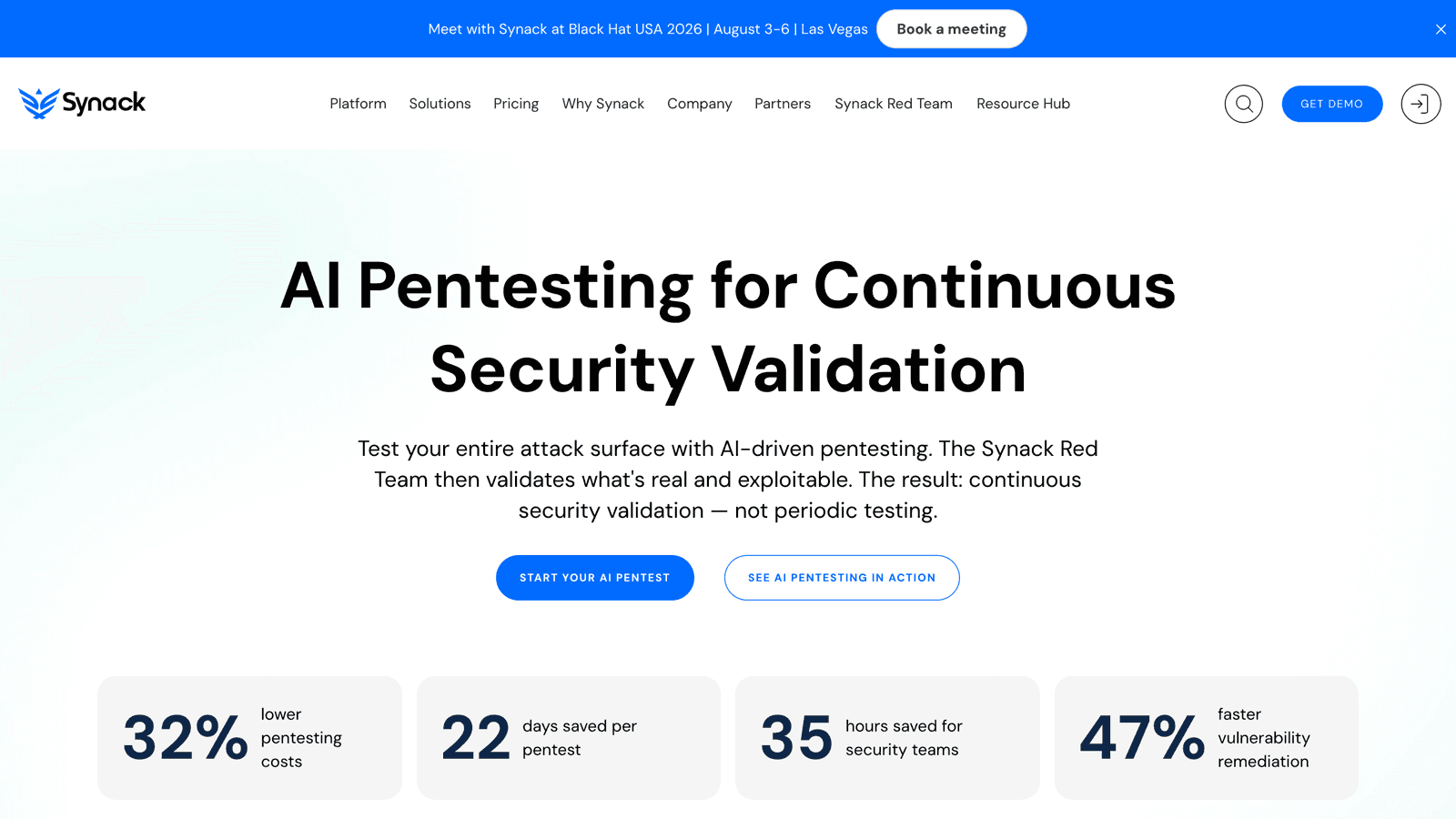
Synack is a penetration testing as a service platform that pairs an AI agent with a vetted human red team. Its homepage headline is “AI Pentesting for Continuous Security Validation,” and the model underneath is a three-part loop: Sara the AI expands coverage, the Synack Red Team validates what is real, and the platform delivers the results continuously.
The pitch lives in one section heading on synack.com: “AI Finds More. Humans Prove What Matters.” As of July 2026 the homepage stats bar claims 32% lower pentesting costs, 22 days saved per pentest, 35 hours saved for security teams, and 47% faster vulnerability remediation.
Everything Synack tests sits on the running, deployed side of your estate. CodeAnt AI, an exploit-based agentic security platform whose AI agents reason across code, infrastructure, and runtime, anchors the code-layer comparison this piece closes with.
TL;DR: Synack’s strength is human-validated offensive testing at scale. Sara deploys agent swarms against external web and host assets, a 1,500-strong vetted Red Team proves what is exploitable across web, host, API, cloud, mobile, and AI/LLM targets, and everything runs through the LaunchPoint VPN with full packet capture, backed by FedRAMP Moderate authorization.
>
The honest edges are just as clear. Sara cannot test internal assets, MFA logins, or CAPTCHA-protected flows yet, the platform has no SAST or code review, credits expire in a year, and the required platform subscription is a separate unpublished line item.
Synack Features at a Glance
Here is every core capability, what it does, and the limit or gate worth knowing first. Each row draws from Synack’s own product pages and pricing FAQ, checked July 2026.
Capability | What it does | Notable limit or gate |
|---|---|---|
Sara AI pentesting | Agent swarms explore, identify, prioritize, and simulate attacks | External web and host assets only, no MFA or CAPTCHA support |
Synack Red Team (SRT) | 1,500+ vetted researchers prove exploitability | Under 10% acceptance, engaged per credit-funded test |
Testing offerings | Sara Pentest through Synack365, plus API and mobile tests | Each consumes credits that expire in 12 months |
Sara Triage | Ingests Tenable and Qualys output, removes 99.98% of scanner noise | Paid add-on |
Attack surface discovery | Asset inventory and SmartScan suspected vulnerabilities | Continuous ASD is a paid add-on, platform tier is point-in-time |
LaunchPoint VPN | All researcher traffic gated, logged, full packet capture | LaunchPoint Plus is a separate variant |
Missions | Paid checklist tasks for OWASP and NIST compliance evidence | Discrete tasks, not continuous coverage |
Patch verification | Researchers confirm fixes closed the finding | Included per engagement |
Zero-day response | Tests emerging CVEs like Log4j within hours | Part of broader offerings, not a named tier |
Integrations and API | Jira, ServiceNow, Splunk, Microsoft, Synack API | Gated to the paid platform tier, not Basic |
FedRAMP Moderate | 325 NIST 800-53 controls, HHS-sponsored | FedRAMP High still under evaluation |
Managed VDP | CISA BOD 20-01 compliant disclosure program | Paid add-on |
Takeaway: the machine layer finds, the human layer proves, and the platform packages the evidence. Nothing in the table reads your source code, and the sharpest capabilities sit behind add-ons or the unpublished platform tier.
What Features Does Synack Actually Include?
Synack runs one core motion across many surfaces: scope a target, point AI and researchers at it through a controlled gateway, and hand back validated findings with compliance-ready evidence. Here is each piece the way you meet it in an engagement.
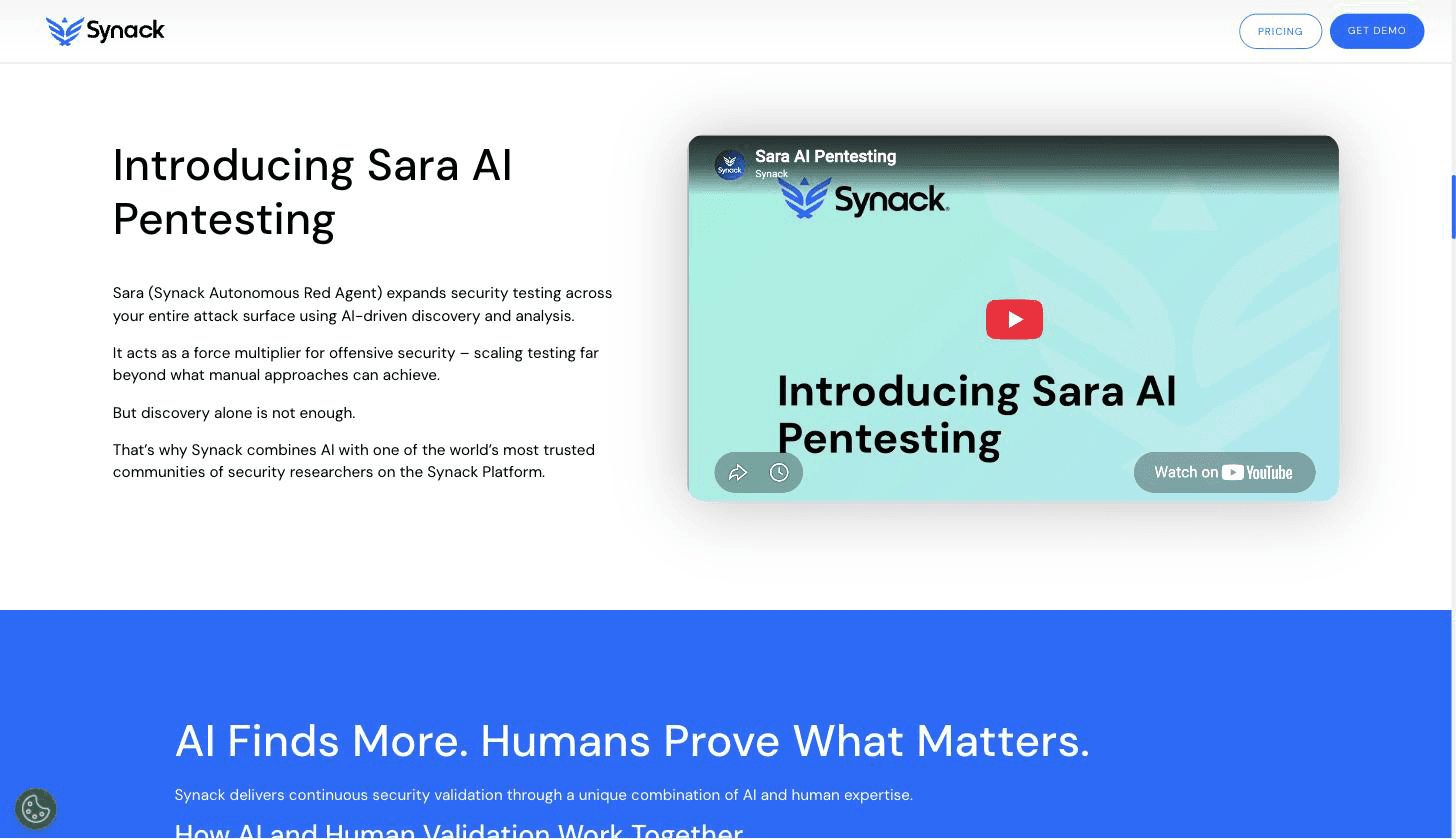
Sara, the autonomous red agent
Sara, short for Synack Autonomous Red Agent, “uses agentic AI to autonomously deploy swarms of agents” that explore attack surfaces, identify vulnerabilities, prioritize findings, and simulate attacker behavior. Its flow runs Discover, Analyze, Validate, Deliver.
Coverage spans SQL injection, XSS, IDOR, SSRF, and command injection on web targets, plus SSH, FTP, SMTP, and SMB weaknesses on hosts, including known exploits like EternalBlue. Synack runs Sara on Anthropic Claude through GCP Vertex AI, with Google Gemini handling scoping summaries, and states the underlying models neither retain nor train on customer data.
Guardrails are explicit and published. A Layered Validation Architecture blocks destructive commands across nine infrastructure categories, enforces scope boundaries technically, and prohibits denial-of-service testing, password brute-forcing, and uncontrolled post-exploitation.
The Synack Red Team
The SRT is a private, curated community of “over 1,500 of the world’s most skilled and trusted security researchers,” and Synack draws a hard line against the crowd model: “We are not a bug bounty program.” Vetting runs five steps, and the acceptance claim is under 10% of applicants, with government-grade background checks and individual NDAs.
Researchers work three modes: open vulnerability hunting, checklist-based missions, and patch verification. Skill coverage on the homepage cards spans web, network, cloud, OSINT, AI/LLM, Kubernetes, iOS, Android, and hardware.
Testing offerings, from Sara to Synack365
Synack packages testing as named offerings rather than one product. Each consumes credits and scales by who tests and for how long.
Sara Pentest and Sara Pentest+: AI-driven open vulnerability discovery in 2 to 3 days, with the plus tier adding mobile and LLM scope.
SynackST and ST+: a single researcher works a guided OWASP checklist over 5 to 10 days, built for compliance frameworks like FISMA, CMMC, and PCI-DSS.
Synack14, 90, and 365: researcher teams run open discovery for two weeks, a quarter, or a full year, with rotating testers and premium compliance checklists on the longer cadences.
API pentesting: headless testing of one API up to 25 endpoints against the OWASP API Top 10.
One staleness note from Synack’s own pages: the offering table gives Sara Pentest a 2 to 3 day duration while the pricing page says 4 to 5 days. Both are official, and Synack does not reconcile them.
Attack surface discovery and SmartScan
Attack Surface Discovery inventories external assets under the framing “You can’t test what you don’t know,” and SmartScan overlays suspected vulnerabilities on confirmed assets. Assets under active testing show exploitable findings from the SRT instead.
Read the packaging fine print here. The ASM product page says continuous ASD “is included with the Synack Platform,” while the pricing page lists the platform tier as point-in-time discovery and sells Continuous Attack Surface Discovery as a paid add-on. Trust the pricing page.
Sara Triage for scanner noise
Sara Triage ingests output from Tenable and Qualys and “removes 99.98% of scanner noise automatically.” Scope that number correctly, since it describes triage of third-party scanner output rather than a general false-positive rate for Synack findings.
Sold as the AI-Powered Vulnerability Triage add-on, it is the piece aimed at the vulnerability-management backlog rather than the pentest itself.
LaunchPoint and testing control
Every researcher tests through the LaunchPoint VPN gateway, signed in for all activity, which gives you “full packet capture of all testing.” You can watch traffic and hours in real time, and pause an assessment with one click.
Control is the actual product here. The gateway is what lets a bank or federal agency put outside researchers on production systems without losing auditability, and LaunchPoint Plus extends the model for stricter trusted-testing requirements.
Missions and patch verification
Missions are discrete, paid checklist tasks researchers execute against OWASP Top 10 and NIST 800-53 items, generating proof-of-work your auditor can consume. Patch verification closes the loop, with researchers confirming a fix actually resolved the finding in every testing tier.
Zero-day response and specialized offerings
Synack’s catalog runs deeper than pentests. Zero-day Response mobilizes testing “within hours of a new zero day emerging” against the likes of Log4j and Spring4Shell, and Comprehensive Penetration Testing puts up to 100 SRT members on a pre-scoped environment.
Social engineering campaigns cover phishing, smishing, and vishing at scale. Red Team Operations, Purple Team Assessments, ASVS benchmark testing, and per-update Microtests round out the list.
Platform, integrations, and the API
The free Basic tier covers self-service test deployment, vulnerability management, patch verification, reports, and RBAC. The paid Synack Platform tier holds the operational glue: the Synack API, bi-directional Jira and ServiceNow, Splunk, Microsoft Sentinel and Defender, SSO, and analytics like the attacker resistance score.
Unlimited users come with every product, so seat math never gates access. The integration wall between Basic and paid matters more, since findings cannot flow to your ticketing stack on the free shell.
FedRAMP and compliance posture
Synack is FedRAMP Moderate authorized, sponsored by HHS, with 325 NIST 800-53 controls enforced, and it supports DoD work at impact levels 4, 5, and 6. FedRAMP High is under evaluation, and NodeZero currently holds that higher bar among autonomous competitors.
Platform certifications include ISO 27001:2022, TX-RAMP Level 2, and CREST. Testing maps to customer frameworks like PCI DSS, HIPAA, SOC 2, FISMA, and CMMC, and the managed VDP add-on satisfies CISA BOD 20-01 for federal agencies.
What’s Good About Synack’s Feature Set?
Human validation at researcher quality is the headline strength. Findings arrive proven by a vetted expert rather than flagged by a scanner, which is why Domino’s runs the internal rule “if an app is going to impact the business before it goes live, it must be Synacked.”
Continuity beats the annual-pentest calendar. Anton Göbel, Information Security Officer at Allianz Direct, says “continuous pentest programs like the one from Synack are the only way to securely deliver customer value at the pace we want.”
Access to testers outlasts the test. Sal Dazzo, Director of Engineering at Varo Bank, valued “being able to interact with researchers on our schedule,” where a traditional firm disappears when the report lands.
Control and auditability close the case for regulated buyers. Full packet capture, one-click pause, FedRAMP Moderate, and IL4 to IL6 support form a compliance posture few offensive-security vendors match.
Where Are the Limits?
None of this is a knock on what Synack builds well. Each point below is the documented boundary of the platform, and the pattern is that everything left of deployment sits outside it.
The structural miss is code. Synack has no SAST, no SCA, no secret scanning, and no code review, and its own competitive pages dismiss code-level fuzzing as outside the multi-surface pipeline it sells. The vulnerability introduced in this morning’s pull request stays invisible until it ships somewhere a tester can reach.
Sara’s boundaries are published and material. The FAQ states internal assets are roadmap-only, MFA and OTP support “is not available now,” and CAPTCHA “remains a challenge,” which together exclude a large share of modern production login flows from the AI tier.
Commercial mechanics carry friction. Credits expire a year from purchase, the mandatory platform subscription has no public price, and integrations plus the API sit above the free tier, as the Synack pricing breakdown documents line by line.
Depth varies with the drawn researchers. A 5-day single-tester SynackST is a different product from a 100-researcher comprehensive engagement, and the offering table rather than the platform decides which you get.
How Do Synack’s Features Compare to CodeAnt AI?
The overlap is one phrase, AI pentesting, and the platforms diverge underneath it. Synack tests deployed targets from the outside with humans proving impact, while CodeAnt AI reads the source behind the app and tests from code outward.
Where Sara stops at external black-box scope, CodeAnt AI’s pentest runs black, white, and grey box modes, reads your repository, and chains findings into attack paths with a working proof of concept per high or critical result. Fixes verify through free unlimited re-scans rather than a credit-funded retest.
CodeAnt AI then covers the entire defensive layer Synack omits: SAST, SCA, secret scanning, and IaC checks in one report, AI code review on every pull request, and DORA delivery metrics for the engineering org.
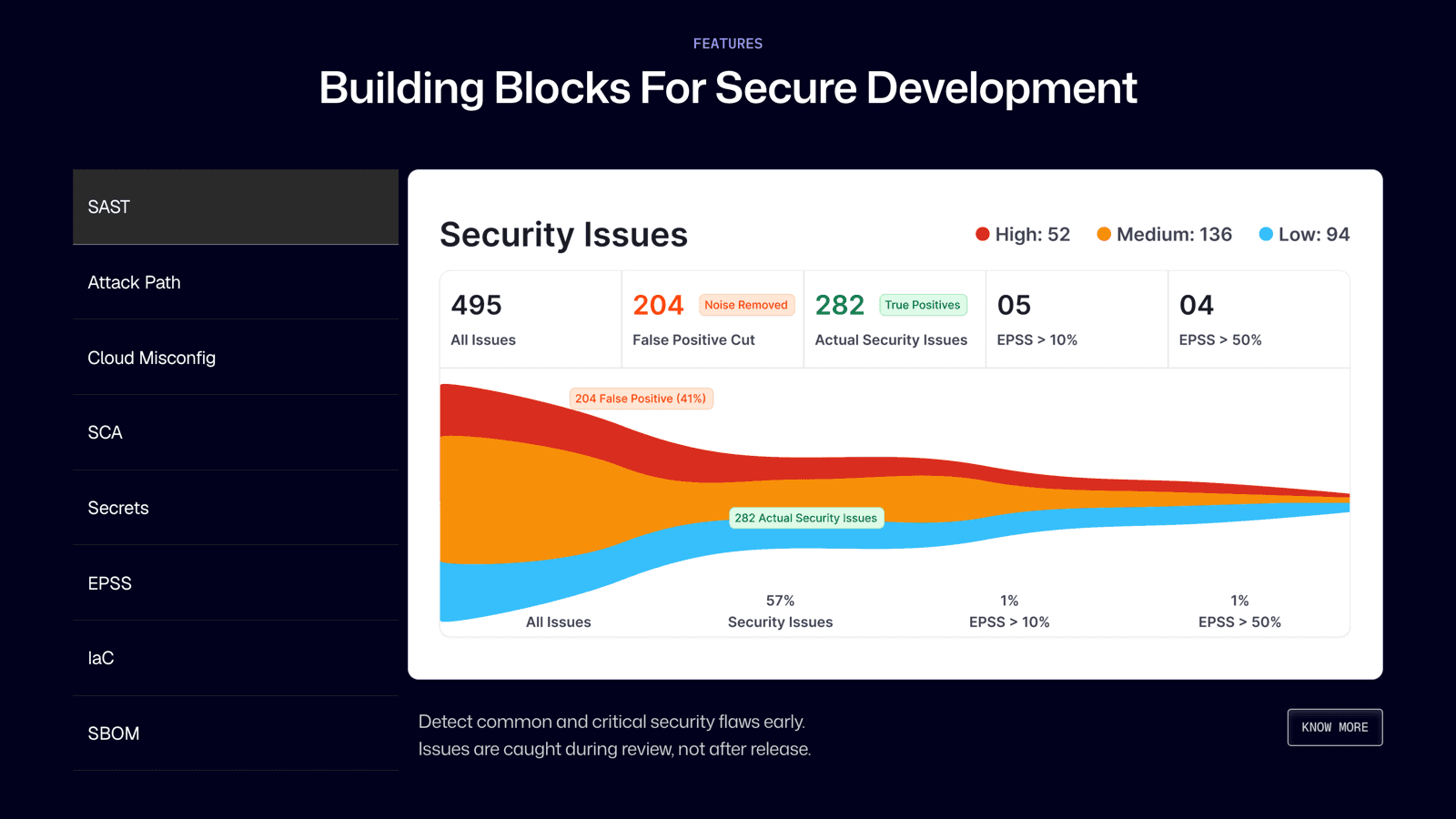
Here is where each platform’s coverage falls, capability by capability.
Capability area | CodeAnt AI | Synack |
|---|---|---|
Code-aware pentest that reads source | Yes, black, white, grey box, free first scan | No, black and grey box on deployed targets |
Human red team validation | Not offered, exploit agents validate with PoCs | Yes, 1,500+ vetted researchers |
SAST, SCA, secrets, IaC | Yes, one unified report | Not offered |
AI code review on pull requests | Yes, unlimited reviews | Not offered |
Internal asset testing by AI | Yes, reads code and infrastructure | No, Sara is external-only today |
Compliance evidence | CWE and OWASP tagged findings, SOC 2 and VAPT mapped | Compliance-ready reports, FedRAMP Moderate, IL4-6 |
Free start | Yes, free one-URL scan, pay only on findings | No trial, free Basic shell requires credits to test |
Takeaway: reach for Synack when human-proven testing of deployed systems and federal-grade compliance evidence are the requirement. Lead with CodeAnt AI when the code you ship needs continuous offensive and defensive coverage from the first commit, and read the full CodeAnt AI vs Synack comparison for the head-to-head.
Where This Leaves You
Synack’s feature set is a controlled human-plus-AI testing operation, strongest where a vetted researcher’s proof and a federal authorization decide the purchase. The honest caveats are the external-only AI tier, the missing code layer, expiring credits, and the unpublished platform fee.
Weighing other vendors is easier with the Synack alternatives roundup, which maps nine options against the same gaps. And if the layer you need covered is the code itself, CodeAnt AI is the one you can point at a URL for free today.

