

Two of the most important activities in HIPAA compliance get confused constantly, and the confusion is expensive. A HIPAA risk assessment and a penetration test are different things, they answer different questions, and treating one as a stand-in for the other is a mistake OCR has flagged repeatedly.
This guide draws the line clearly, what a HIPAA risk assessment actually is, what a penetration test actually is, why you cannot substitute one for the other, and how they work together in a compliant program.
A HIPAA risk assessment is the broad, required analysis of risks to ePHI across every system, and a penetration test is a deep, adversarial assessment that proves which vulnerabilities are exploitable. The test feeds the assessment, it does not replace it, and submitting a pentest report as your risk analysis is a documented way to fail an OCR review.
I reviewed the HIPAA Security Rule, OCR guidance and enforcement data, and current healthcare security guidance on July 27, 2026. This is a practical overview, not legal advice.
Common Questions About HIPAA Risk Assessment Vs Penetration Testing
The demand around this topic is large and consistent, and it reflects real uncertainty in health-tech teams.
Is a HIPAA risk assessment the same thing as a penetration test?
Does the risk assessment require a pentest?
Can a pentest report serve as my risk analysis?
How is a risk assessment different from a compliance gap check?
How do the two fit together, and what does OCR actually want?
HIPAA Risk Assessment, Gap Assessment, And Penetration Testing: What Is Different?
The root of the problem is that HIPAA involves three distinct assessments that sound similar and get used interchangeably. They are not the same, and OCR treats them differently.
The first is the risk analysis, which asks how secure you are. The second is a compliance or gap assessment, which asks how compliant you are against the rule, a non-technical review.
The third is technical testing, such as a vulnerability scan or a penetration test, which produces evidence about specific exposures.
The consequence of confusing them is concrete. OCR has found that instead of conducting a risk analysis, some organizations submit their technical testing or their compliance gap assessment, because they do not understand the distinct differences between the three, and OCR treats that as a failure to meet the requirement.
Keeping the three straight is the first step to a defensible program.
What A HIPAA Risk Assessment Actually Is
The HIPAA risk assessment, more precisely the risk analysis, is the backbone of the Security Rule. It is required under 164.308(a)(1)(ii)(A) as an accurate and thorough assessment of the potential risks and vulnerabilities to the confidentiality, integrity, and availability of ePHI.
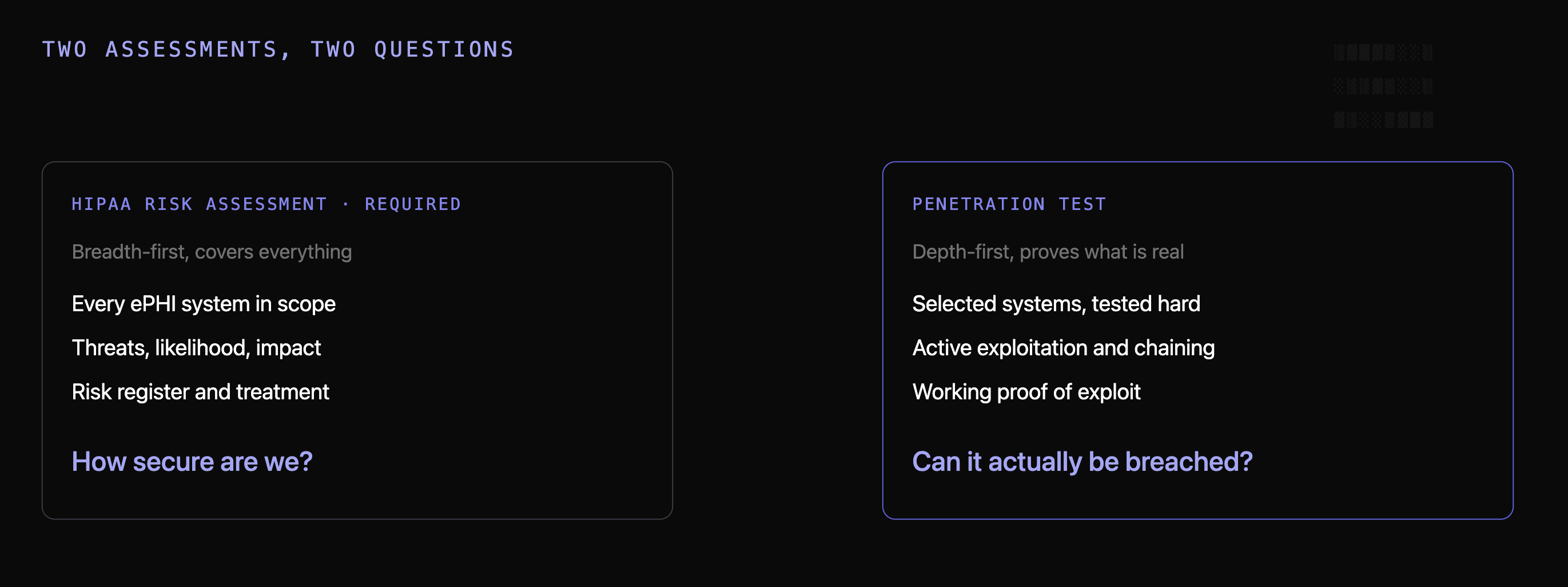
It is a breadth-first exercise. You define scope across every system that creates, receives, maintains, or transmits ePHI, build an asset inventory, map data flows, identify threats and vulnerabilities, and estimate the likelihood and impact of each.
The output is a risk register and a set of risk treatment decisions compared against the organization's risk appetite.
The defining question it answers is how secure are we, across the whole environment. It is systematic and wide, and on its own it is an analysis rather than a demonstration, which is exactly where a penetration test comes in.
What a Penetration Test Actually Is
A penetration test is the opposite shape, narrow and deep. It is an adversarial, human-driven simulation of attack techniques against systems that store, transmit, or process ePHI, and its purpose is to prove what an attacker could actually do.
Where a risk assessment catalogs potential vulnerabilities, a test attempts to exploit them, chains findings together, and demonstrates real-world impact. It does not try to cover every asset on paper, it goes deep on selected targets and shows whether the controls hold under a real attack.
The question it answers is whether the environment can actually be breached, and how. That evidence, a working proof of exploit against a real system, is something a paper analysis cannot produce, which is why the two are complementary rather than redundant.
See our guide to HIPAA penetration testing requirements.
HIPAA Risk Assessment Vs Penetration Test: Side-By-Side Comparison
The two differ on almost every axis, and seeing them together makes the relationship clear.
Dimension | HIPAA risk assessment | Penetration test |
|---|---|---|
Purpose | Map all risk to ePHI | Prove exploitability |
Shape | Breadth-first, all systems | Depth-first, selected targets |
Method | Analysis and documentation | Active exploitation |
Question | How secure are we | Can it actually be breached |
Output | Risk register and treatment | Proof of exploit and impact |
HIPAA role | Required analysis | Evidence that feeds it |
The pattern is that the assessment defines the risk landscape, and the test verifies which parts of it are real, so a strong program runs both and connects them.
Why A Pentest Cannot Replace A HIPAA Risk Assessment
This is the mistake that turns into an OCR finding, and it runs in both directions. Neither activity can stand in for the other, because they produce different things.
A penetration test cannot serve as your risk analysis, because it does not cover the full scope of ePHI systems or produce the risk register the rule requires, and OCR explicitly treats a submitted pentest in place of an analysis as non-compliant. A risk analysis with no technical testing has the opposite weakness, it rests on assumptions about which vulnerabilities matter, and OCR has repeatedly found paper analyses inadequate because they never validated real exposure.
The defensible position uses each for its job. The risk analysis provides the required breadth and structure, and the penetration test provides the technical evidence that the analysis is grounded in reality rather than guesswork.
How Penetration Testing Feeds A HIPAA Risk Assessment
The connection between them is direct, and it is where the value compounds. A penetration test is one of the most important inputs to a HIPAA risk analysis.
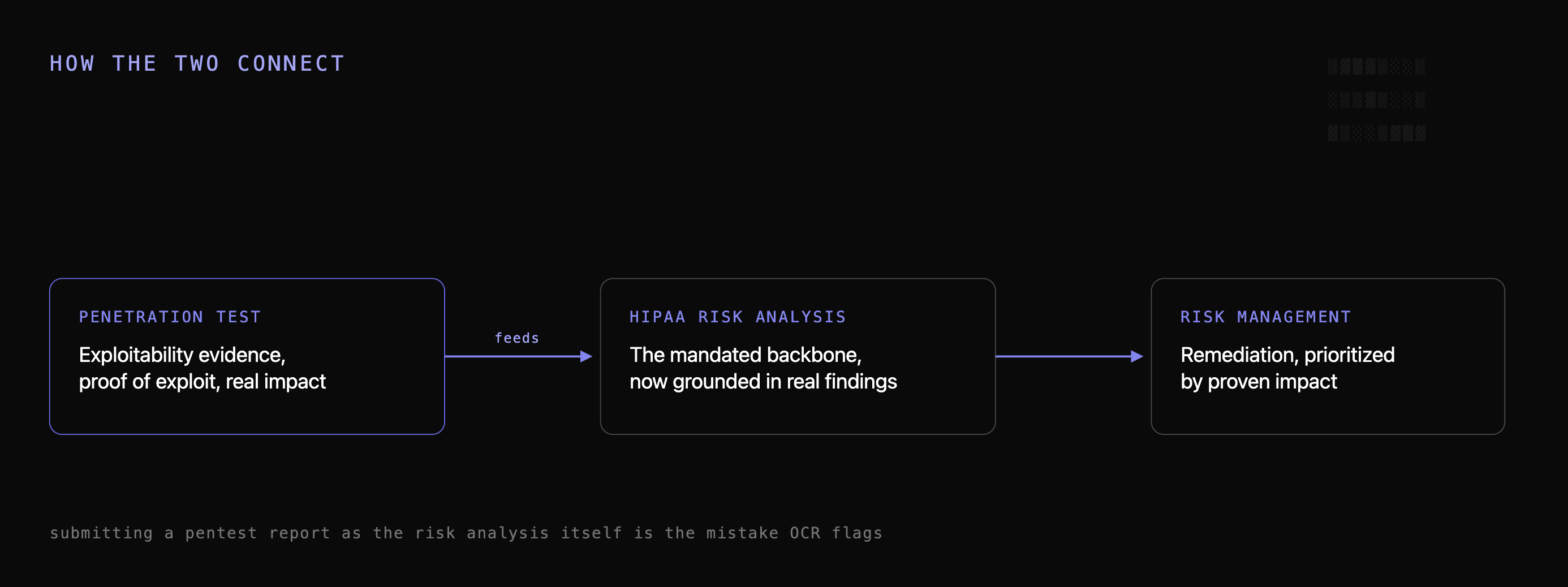
The test proves which vulnerabilities can actually be used to reach ePHI, and those findings feed straight into the risk analysis, grounding its likelihood and impact ratings in demonstrated exploitability rather than estimates. From there they flow into risk management, where remediation gets prioritized by proven impact.
The practical rule is to integrate penetration test findings into your risk analysis and risk management, and to retain the reports for any OCR investigation.
Done this way, the pentest makes the risk analysis defensible. When a breach investigation asks whether the organization understood its real exposure, a recent test with proof of exploit and evidence of remediation is the strongest answer available.
What OCR Looks For In A HIPAA Risk Analysis
The stakes here are set by enforcement, and OCR's record is pointed. In its Phase 2 audits, most of the covered entities and business associates reviewed failed to implement the Security Rule requirements for risk analysis and risk management, and inadequate risk analysis is among the most frequently cited violations in enforcement actions.
The financial exposure is real. OCR has settled or imposed penalties in scores of cases totaling well over one hundred million dollars, and in landmark matters like the Anthem settlement, the failure to identify known vulnerabilities and the lack of technical controls were central to the findings.
In breach investigations, OCR frequently finds the organization had no risk analysis, an outdated one, or one that failed to account for all systems containing ePHI.
The through-line is that OCR wants a real risk analysis backed by real technical evidence. A penetration test is the most direct way to show that the exposures were understood and tested rather than assumed.
Where Vulnerability Scanning Fits In HIPAA Risk Analysis
A third activity sits alongside these two, and it is worth placing. A vulnerability scan is automated detection of known weaknesses across many assets, breadth-first and non-intrusive, and it usually stops short of exploitation.
Its role is to feed the risk analysis with timely, repeatable data on known issues and patch hygiene, which complements a penetration test. The distinction matters because the 2025 proposed HIPAA rule would require both, vulnerability scanning at least every six months and penetration testing at least every twelve, treating them as separate obligations.
A scan finds the missing patch, and a test proves whether that patch can be used to reach patient data.
What To Test To Strengthen A HIPAA Risk Assessment
For a software-driven health company, the testing that feeds the risk analysis focuses on the application and cloud layer, where patient data is most exposed. The scope follows the ePHI.
The priorities are the multi-tenant data model and the APIs on top of it, where the most damaging failure is broken object level authorization, an endpoint returning another patient's or study's records without checking who is asking. Alongside that sit the patient and researcher portals and their authentication, the bulk data export paths, and the cloud identity and storage configuration.
The full workflow runs these across black, white, and gray box modes.
One honest scope note. Code-aware testing covers the software, cloud, API, and portal layer thoroughly, and it does not replace specialized hardware or firmware testing for physical medical devices, which belongs in the risk analysis as a separate line handled by a different discipline.
How Code-Aware Testing Makes HIPAA Risk Analysis Defensible
The evidence a risk analysis needs is only as current as the testing behind it, and health-tech platforms change constantly. A single annual test gives the analysis one data point, while the environment it describes keeps moving.
Continuous, code-aware testing keeps the analysis grounded. It re-examines the ePHI-handling surface on every change, so the exploitability evidence feeding the risk register reflects the platform as it is now, and each new portal or API is validated as it ships.
The walkthrough of how AI penetration testing traces a data leak shows the depth behind each finding.
The human element matters for defensibility. Combining autonomous, code-aware testing with human researcher revalidation produces the adversarial evidence, with a working proof of exploit, that grounds a risk analysis and satisfies an OCR reviewer, across black, white, and gray box modes.
How CodeAnt AI Feeds HIPAA Risk Analysis With Exploit Evidence
CodeAnt is the penetration test that feeds a HIPAA risk analysis. It reads the code alongside the live product, proves whether patient and study data stays isolated across tenants, and ships a working proof of exploit with the remediation and retest evidence a risk analysis and an OCR investigation both expect.
Because it runs continuously, the exploitability evidence stays current, so the risk analysis reflects real exposure on an ongoing basis rather than at a single yearly snapshot. Findings map cleanly into your risk analysis and risk management process and into overlapping frameworks like SOC 2 and HITRUST.
The pricing suits a regulated, growth-stage platform. Testing is outcome-based, a zero engagement fee with payment only on confirmed critical findings, so keeping the risk analysis grounded in current evidence does not mean a large fixed bill.
Conclusion: Use Pentesting As Evidence, Not A Substitute For Risk Analysis
A HIPAA risk assessment and a penetration test do two different jobs in one program. The mistake is treating one as the other. A penetration test does not replace the risk assessment because it does not cover the full ePHI environment or produce the full risk register. A risk assessment without technical testing can also be weak because it may rely on assumptions about which vulnerabilities matter. The defensible approach is to connect them: use the risk assessment for structure and the penetration test for real exploitability evidence.
For health-tech, biotech, and healthcare SaaS teams, that means testing the software and cloud systems that handle ePHI, including APIs, patient portals, researcher portals, identity systems, export paths, storage, and multi-tenant data boundaries. Code-aware continuous testing strengthens the risk analysis because it keeps exploitability evidence current as the platform changes.
Do not submit a pentest report as your HIPAA risk assessment. Use the risk assessment to map every ePHI risk, then use penetration testing to prove which risks are exploitable, prioritize remediation, and keep defensible evidence ready for OCR review. For the full requirements picture, start with our guide to HIPAA penetration testing requirements.

