

A marketing platform is a personal-data business whether or not it thinks of itself that way. Every email list, tracking pixel, and CRM record is personal data under GDPR and personal information under CCPA, which means both regimes and their security duties apply.
This guide answers whether those laws require a penetration test for your platform, grounded in the actual statutory text, then covers what to test and how often. The short version is that the obligation is real, even though only one of the two laws names the test outright.
If your marketing platform processes EU personal data, GDPR Article 32(1)(d) requires regular testing of your security measures, and a pentest is the accepted method. If it processes California personal information at scale, the CCPA cybersecurity audit effective in 2026 lists penetration tests as a component. For most platforms, both apply.
I reviewed the text of GDPR Article 32, the CCPA and CPRA, and the CPPA cybersecurity audit regulations on July 27, 2026. This is a practical overview, not legal advice.
Why Marketing Data Falls Under GDPR And CCPA
The threshold question is whether these laws even apply to a marketing platform, and the answer is almost always yes. GDPR governs the processing of personal data of people in the EU, and CCPA governs the personal information of California residents, and marketing data is exactly that.
A marketing platform holds names, email addresses, and phone numbers, and it adds behavioral data on top, opens, clicks, page views, and inferred interests, which are personal data under both regimes. Tracking identifiers and cookies count too, which pulls the platform into scope even for anonymous-looking visitor data.
Scale then decides how heavy the obligations get. CCPA applies to a business processing the personal information of 100,000 or more California residents or households, a threshold a mid-sized marketing platform crosses easily, and higher volumes trigger the annual cybersecurity audit discussed below.
What GDPR Article 32 Requires For Penetration Testing
GDPR is technology-neutral, so it never uses the words penetration test, vulnerability scan, or security audit. What it does is set an outcome and a process, and the process is the part that maps to testing
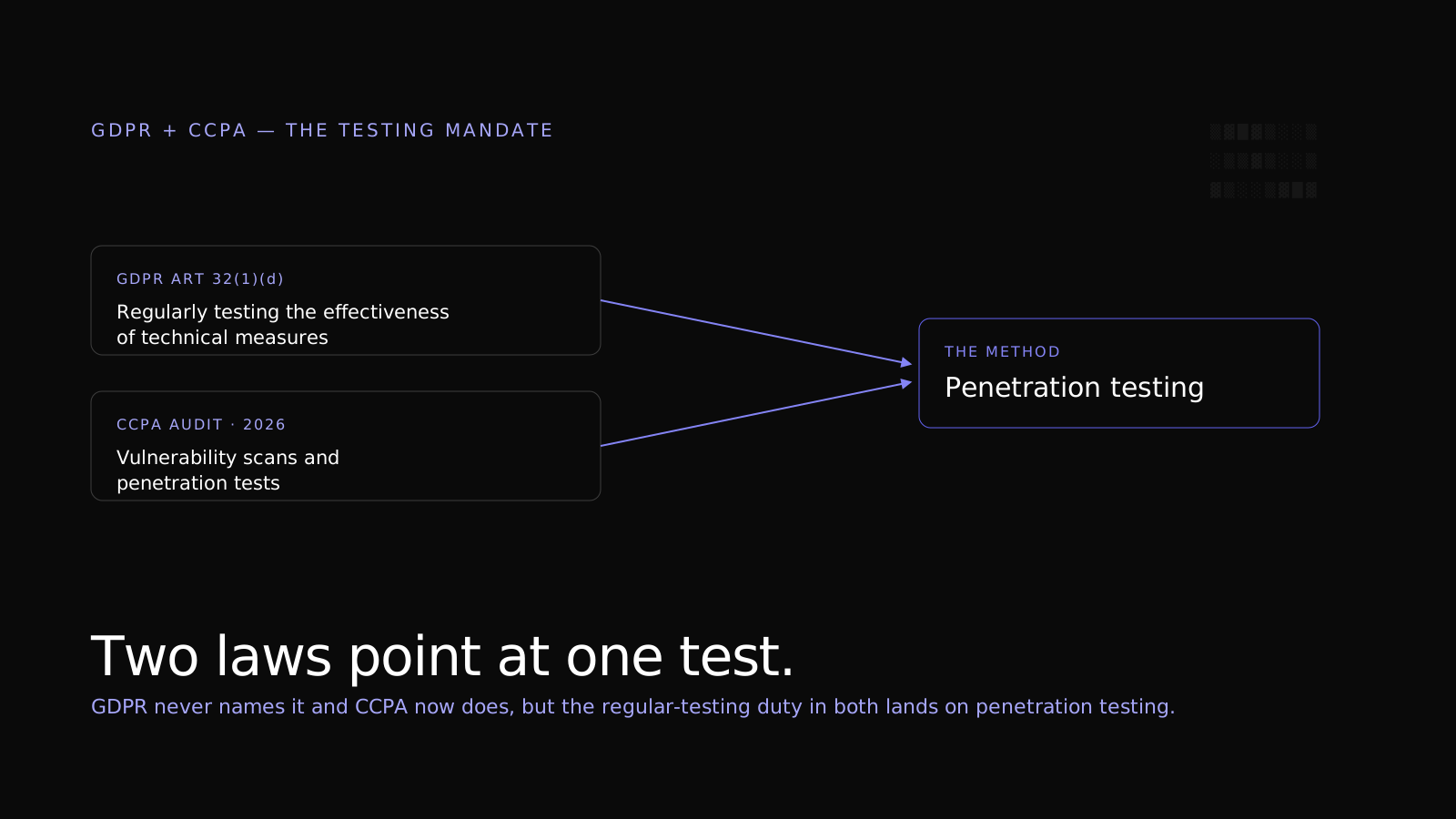
Article 32(1) requires appropriate technical and organizational measures to secure processing, and it names specific ones, including the confidentiality, integrity, and availability of systems under 32(1)(b). The clause that matters most for testing is Article 32(1)(d), which requires a process for regularly testing, assessing, and evaluating the effectiveness of those measures.
That phrasing is the whole argument. A control that is designed but never tested cannot be shown to be effective, so regular testing of effectiveness is the duty, and a penetration test is the recognized way to produce that evidence.
A test that proves access control and authorization hold under attack is the kind of evidence Article 32 asks for, which a policy document alone cannot supply.
What CCPA And CPRA Require For Cybersecurity Audits And Pentesting
CCPA started with a general duty of reasonable security, and CPRA sharpened it. The baseline is that a business must implement reasonable security procedures and practices for the personal information it holds, and a documented risk analysis aligned to a standard like NIST or ISO 27001 is how that reasonableness gets demonstrated.
CPRA then added a specific mechanism. It created the California Privacy Protection Agency and directed it to require annual cybersecurity audits for higher-risk processing, and those regulations are now real.
The agency approved them on July 24, 2025, the Office of Administrative Law cleared them on September 22, 2025, and they became effective on January 1, 2026 with a phased compliance schedule running into 2027.
The audit names the test. Its components explicitly include vulnerability scans, penetration tests, and vulnerability disclosure and reporting, and the audit requires disclosure of the testing performed, the weaknesses found, and the remediation plan.
Businesses processing the personal information of 250,000 or more consumers, or sensitive information of 50,000 or more, fall in scope on a revenue-phased timeline, which puts many marketing platforms squarely inside it.
When A Marketing Platform Needs A GDPR Or CCPA Pentest
The two regimes point at a cadence, not a one-time event. Reading them together gives a practical testing schedule for a marketing platform.
At least annually. The default baseline under both the GDPR regular-testing duty and the CCPA annual audit.
After any major change. A new integration, a re-architected API, or a claims-data migration resets what was last proven.
When a DPIA or incident signals risk. A data protection impact assessment that surfaces elevated risk, or a security incident, is a trigger to test.
Continuously, if you ship often. Article 32 asks for regular testing of effectiveness, and a platform deploying weekly cannot show effectiveness with a single annual test.
What A Pentest Proves For GDPR And CCPA Compliance
This is where the compliance language becomes concrete. Both regimes expect specific technical measures, and a penetration test is what demonstrates each one actually holds rather than merely existing on a control matrix.
Requirement | Regulation hook | What a pentest evidences |
|---|---|---|
Confidentiality of personal data | GDPR 32(1)(b), CCPA reasonable security | Access controls and authorization hold under attack |
Integrity of processing | GDPR 32(1)(b) | Data cannot be tampered with across tenants or APIs |
Resilience of systems | GDPR 32(1)(b) | Services withstand realistic attack conditions |
Regular testing of effectiveness | GDPR 32(1)(d) | Documented, repeated proof the controls work |
Vulnerability management | CCPA audit component | Scans plus exploitation, weaknesses, remediation |
Secure development | CCPA reasonable security | Code-level flaws found before release |
The pattern is that the regulations describe outcomes, and a penetration test supplies the evidence those outcomes are met. Our SOC 2 penetration testing requirements guide covers how the same test evidences overlapping frameworks, since a SOC 2 report is a strong foundation for a CCPA audit.
What To Test In A Marketing Platform Pentest
Scope decides whether the test is evidence or theater. A marketing platform has a specific technical attack surface, and a credible test for GDPR and CCPA has to reach the parts that hold personal data.
The core targets are the multi-tenant data model and the APIs on top of it. The failure that exposes personal data at scale is broken object level authorization, where an endpoint returns another tenant's records without checking ownership, so proving tenant isolation holds is the single most important test for a platform with many customers.
Beyond that, the test should cover the data export and reporting endpoints that move personal data in bulk, the consent and preference management that governs lawful processing, the tracking and tag infrastructure that collects behavioral data, and the token and integration handling that recent breaches turned into cross-platform exposure. The full workflow runs these across black, white, and gray box modes, and reading the code is what surfaces authorization gaps a black-box scan cannot see.
Encryption and data-in-transit protections round it out, since GDPR 32(1)(a) references encryption directly, and a test confirms it is applied where personal data actually flows rather than assumed.
How Continuous Pentesting Meets GDPR And CCPA Testing Duties
The word regularly in Article 32(1)(d) is doing quiet work. A single annual test proves effectiveness on one day, and a marketing platform that ships weekly has changed many times before the next test, which leaves most of the year unevidenced against a duty that asks for ongoing assurance.
Continuous, code-aware testing answers that directly. It re-examines the surface on every change, so each new API, integration, and export endpoint is validated as it ships, and the evidence of effectiveness stays current for a regulator or an auditor rather than being reconstructed once a year.
The walkthrough of how AI penetration testing traces a data leak shows the depth behind each finding.
Reading the code is what keeps that cadence meaningful. Across black, white, and gray box modes, code-aware testing finds the authorization and isolation flaws that decide whether personal data stays contained, which are the exact measures both laws ask you to prove effective.
How CodeAnt AI Supports GDPR And CCPA Pentesting Evidence
CodeAnt produces the evidence GDPR Article 32 and a CCPA cybersecurity audit both require, and it produces it continuously. It reads the code alongside the live surface, proves whether authorization and multi-tenant isolation hold, and ships a working proof of exploit with the remediation and retest an auditor expects.
Because it runs on every change, the platform's evidence of effectiveness reflects the product as it is now, which is what the regular-testing duty is really asking for. Findings map to the technical measures the regulations name, from confidentiality and integrity to vulnerability management.
The pricing suits a growth-stage platform. You pay for confirmed critical exposure rather than researcher hours, so continuous coverage stays affordable while producing compliant evidence, the model behind paying only when the test finds something real.
Conclusion: Use Pentesting To Prove GDPR And CCPA Security Effectiveness
For marketing platforms, the GDPR and CCPA question is not only whether the laws apply. They usually do, because marketing platforms process personal data through email lists, CRM records, tracking pixels, cookies, behavioural analytics, customer segments, exports, and integrations. The real question is whether the platform can prove that the security measures protecting that data actually work.
GDPR Article 32 does not name penetration testing, but it does require regular testing, assessment, and evaluation of security effectiveness. CCPA and CPRA go further for higher-risk businesses, with the 2026 cybersecurity audit naming penetration tests among the audit components. Together, they create a clear evidence need: marketing platforms should be able to show that access controls, authorization, encryption, vulnerability management, and multi-tenant isolation were tested, weaknesses were remediated, and fixes were validated.
The scope matters. A credible marketing platform pentest should not stop at a generic web scan. It should test the multi-tenant data model, APIs, export flows, consent systems, tracking infrastructure, token handling, integrations, and cloud paths where personal data actually moves. Continuous, code-aware testing is especially strong here because it keeps evidence current as the platform changes.
Treat GDPR and CCPA pentesting as evidence of security effectiveness, not just a compliance checkbox. Start with the APIs, export endpoints, consent workflows, integrations, and tenant boundaries that expose personal data, then test continuously enough to prove those controls still work as the platform changes. For the procurement side of compliance, start with our guide to SOC 2 for martech and enterprise procurement.

