

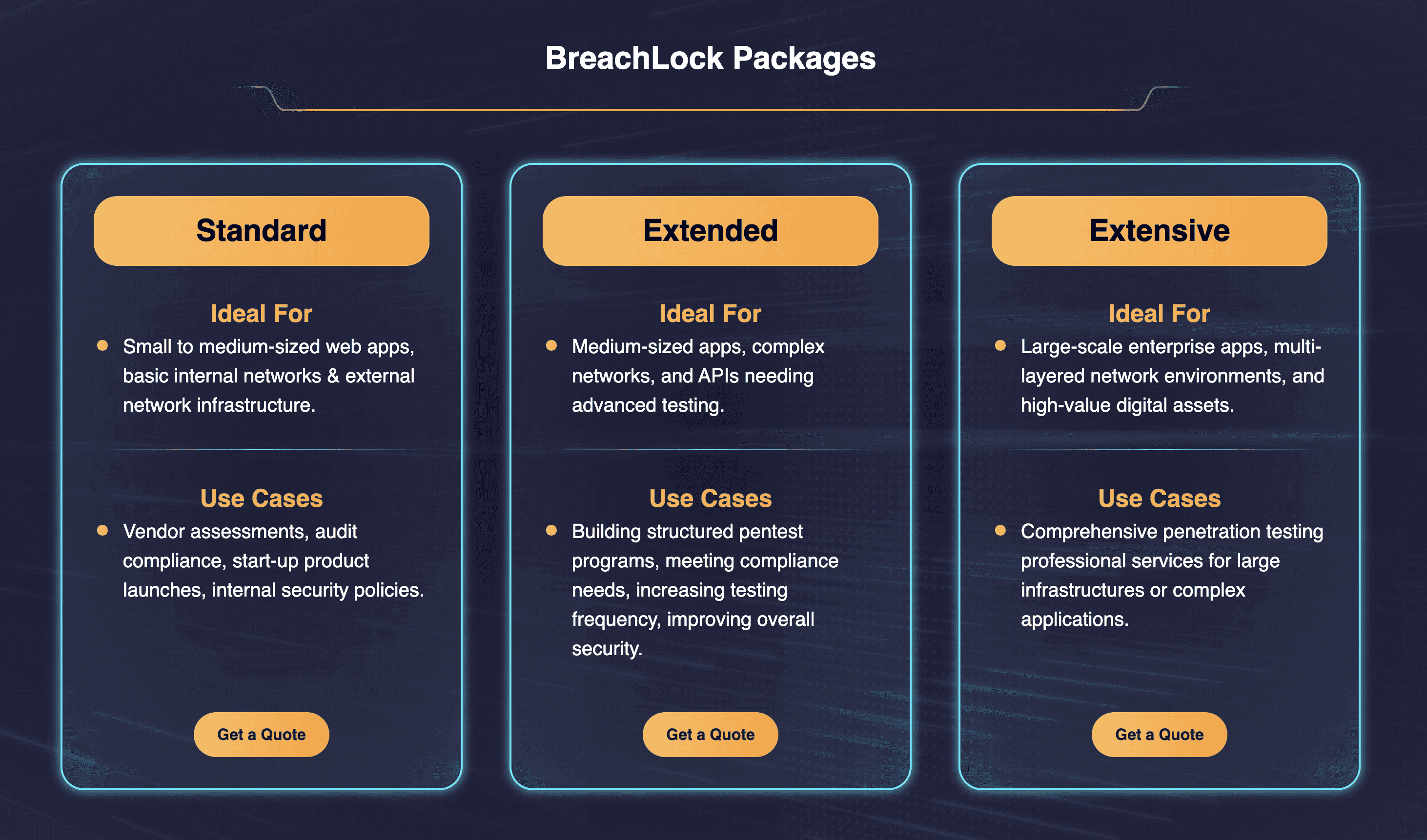
BreachLock pricing is quote-based. The company does not publish a current penetration testing pricing rate card: its official pricing page sends buyers to sales, its PTaaS cost depends on scope and complexity, and its autonomous AEV product is priced by contracted IPs or URLs.
Buyer data gives us a more useful budget benchmark. Vendr’s BreachLock marketplace page reports a $13,491 median annual price, with observed prices ranging from $8,320 to $26,285. G2 separately lists older starting prices of $2,500 for one-time security validation and $5,000 for annual security validation, last updated on October 10, 2024.
TL;DR
Vendr reports a $13,491 median annual BreachLock price, with an observed $8,320 to $26,285 range.
G2’s older public package floors are $2,500 for one-time validation and $5,000 for annual validation.
Current PTaaS pricing is custom and varies by scope, complexity, test type, and frequency.
AEV pricing is subscription-based by contracted IPs or URLs, with unlimited runs inside that scope.
Treat the public figures as pentest cost floors, not complete 2026 contract prices.
This guide to BreachLock pentest pricing separates the current official model from the older public starting figures, explains what each package includes, and shows when a different pricing model may fit better. For product context, keep the complete BreachLock features guide open beside it.
BreachLock product or package | Public price | Current pricing basis |
|---|---|---|
Vendr buyer benchmark | $13,491 median annually; $8,320–$26,285 observed range | Anonymized buyer pricing shown by Vendr, not a BreachLock list price |
One-Time Security Validation | Starts at $2,500 on G2 | Historical starting figure, last updated October 2024 |
Annual Security Validation | Starts at $5,000 on G2 | Historical starting figure, last updated October 2024 |
Continuous Security Validation | Contact sales | Testing volume, recurring scope, services, and enterprise requirements |
PTaaS | Custom quote | Environment size, complexity, test type, scope, and desired frequency |
Adversarial Exposure Validation | Custom subscription | Number of IPs or URLs contracted |
Attack Surface Management | Contact sales | Size and complexity of the attack surface and selected coverage |
What Does BreachLock Cost in 2026?
The most accurate 2026 answer is quote-based. Like most enterprise penetration testing services, BreachLock separates a small starting price from the final scoped engagement cost.
BreachLock’s official PTaaS page says pricing is determined by the size and complexity of the environment, the organization’s unique testing requirements, and the desired testing frequency. Its Adversarial Exposure Validation page describes AEV as a subscription priced by the number of IP addresses or URLs in scope.
What Does Vendr Data Say BreachLock Buyers Pay?
Vendr currently shows three annual pricing benchmarks for BreachLock:
Median annual price: $13,491
Low observed price: $8,320
High observed price: $26,285

This is the best available buyer-side benchmark because it reflects observed purchase data rather than an old vendor package floor. It suggests that a realistic annual BreachLock budget often lands in the low five figures, while broader or more demanding scopes can move above $25,000.
The range still needs careful interpretation. Vendr’s public page does not normalize every transaction by target count, testing method, authenticated roles, human tester days, AEV asset allowance, or bundled ASM coverage. An $8,320 application engagement and a $26,285 multi-product contract may represent materially different purchases.
Use $13,491 as a planning anchor, not a target quote. Ask BreachLock to separate PTaaS, AEV, ASM, reporting, and optional services in the proposal, then compare your annualized total against Vendr’s $8,320 to $26,285 observed band.
The public $2,500 and $5,000 figures come from G2’s BreachLock pricing page, where they are explicitly labeled as starting prices and dated October 2024.
That creates three important caveats:
The figures are floors. A complex authenticated web app, cloud environment, or internal network will not price like a small external validation.
The figures predate the current product packaging. BreachLock now presents ASM, AEV, and PTaaS as connected pillars of one platform.
The quote can mix products and services. Autonomous testing, human testing, asset discovery, report requirements, and support can sit in the same proposal.
The honest way to use the public figures is as an initial budget check. They tell you BreachLock is not a $99 self-serve scanner. They do not tell you what a 2026 enterprise contract will cost.
What Is Included in the $2,500 One-Time Security Validation Plan?
G2 describes the one-time package as a point-in-time assessment for vendor reviews, product launches, and similar projects.
The listed inclusions are:
CREST-certified, audit-ready reporting
a 100% certified in-house pentesting team
one free manual re-test
unlimited online remediation support
a security-posture dashboard
unlimited automated re-tests
six months of BreachLock platform access
The package is attractive when the problem is bounded. A startup may need an external application test before a launch. A vendor may need evidence for one customer review. A team may need a clean report after fixing a known issue.
The starting price is less useful when the scope is not bounded. Multiple authenticated roles, APIs, mobile clients, internal services, third-party integrations, or cloud resources can expand tester time quickly.
Ask BreachLock to define four things in the statement of work:
The exact assets and roles included.
The manual testing hours or time box.
The distinction between automated re-tests and the one included manual re-test.
The report and attestation documents delivered after closure.
Without those details, two “$2,500 pentests” can be completely different products. The penetration-testing process gives you a phase-by-phase baseline for checking what a quote actually includes.
What Is Included in the $5,000 Annual Security Validation Plan?
G2 positions annual security validation for compliance programs such as SOC 2, PCI DSS, ISO 27001, HIPAA, GDPR, and NIST-aligned internal policies.
The older public package adds more program support:
two free manual re-tests
a dedicated project manager through phone, video, and email
12 months of platform access
real-time alerts
monthly automated vulnerability scans
unlimited automated re-tests
a pentest checklist
DevSecOps integrations
an attack-surface-management scan covering asset discovery, dark-web exposure, and common vulnerabilities
on-demand expert report-review sessions
This package is closer to a yearly security-validation program than a single report. The extra $2,500 historical starting gap buys continuity, coordination, and monitoring around the human engagement.
The important word is starting. A $5,000 floor is plausible for a small annual scope. It is unlikely to cover a complex estate with multiple production applications, APIs, internal networks, cloud accounts, and repeated certified testing.
The package can still be good value if it replaces several separate purchases. Compare the quote against the combined cost of:
an external attack-surface scanner
one human penetration test
monthly vulnerability scanning
a remediation portal
a project manager
compliance reporting
The bundle is expensive only if you do not use the bundle. Our comparison of compliance automation and real penetration testing helps separate evidence collection from actual exploit validation.
How Is BreachLock Continuous Security Validation Priced?
BreachLock does not publish a number for Continuous Security Validation.
G2 describes the plan as suitable for high testing volumes, recurring application testing, continuous posture management, and vendor consolidation. The listed capabilities include custom manual re-test allowances, monthly automated scans, ASM, DevSecOps integrations, SSO, customized reports, red teaming, and expert report reviews.
That package has too many variables for one meaningful list price. A small SaaS company testing two applications is not comparable to an enterprise validating hundreds of IPs, several cloud environments, and an internal network.
Expect the quote to move with:
the number and type of assets
the number of web apps and authenticated roles
API endpoint count and protocol complexity
internal and external network size
cloud accounts and environments
testing cadence
manual PTaaS depth
red-team or social-engineering requirements
SSO, data residency, and procurement requirements
reporting and compliance frameworks
Continuous validation also changes the purchasing unit. You are no longer buying a report. You are buying the right to keep asking whether the current environment is exploitable. Before paying for that promise, check the six requirements for continuous pentesting.
How Does BreachLock AEV Pricing Work?
BreachLock AEV uses a subscription model based on the number of IPs or URLs under contract.
Within that contracted scope, BreachLock says buyers can run unlimited autonomous tests. The system can be deployed agentlessly through Linux, OVA, or Docker and covers both web and network environments.
This model has a simple economic advantage: the marginal cost of another run can approach zero. A team can validate after a firewall change, a new release, or a remediation without buying another engagement. The trade-offs between this model and scheduled testing are covered in our continuous versus annual pentesting guide.
But “unlimited” needs a denominator. The contract still defines:
which IPs and URLs count
whether temporary or ephemeral assets consume scope
how quickly scope can be reassigned
whether development, staging, and production count separately
whether web and network testing share one allowance
which AEV features or environments are included
Ask for the effective annual cost per covered asset, then model how often you will actually run the platform. A $60,000 subscription used weekly across 100 assets has different unit economics from the same subscription used twice against 20 assets.
How Does BreachLock PTaaS Pricing Work?
PTaaS remains a scoped human service, even when AI accelerates parts of the work.
BreachLock says every PTaaS engagement includes:
results from certified in-house pentesters
a CREST-certified audit-ready report
one comprehensive manual re-test
unlimited online remediation support
access to the BreachLock Unified Platform
Test types include web application, API, network, cloud, mobile, IoT, DevOps, and other specialized scopes across black, gray, and white box methods.
The quote therefore follows tester effort and risk. A black-box test of one marketing site is small. A white-box test of a multi-tenant financial application with several roles, mobile clients, and payment flows is not.
BreachLock says engagements range from a few days to a couple of weeks depending on scope and technology. That time box is one of the best price predictors. Ask how many tester days the proposal assumes and what triggers a change order.
For more context on the model, read our guide to penetration testing as a service, then use the PTaaS SLA checklist to compare retest windows and support.
What Hidden Costs Should You Expect?
BreachLock’s quote should capture most delivery work, but the invoice is not the only cost.
Scoping and access preparation
Your team must inventory assets, create test accounts, document roles, whitelist traffic, prepare a safe environment, and identify contacts. Poor preparation either wastes the test window or expands it. A signed pentest authorization letter should also define targets, timing, and permitted actions.
Internal remediation time
A validated finding still requires engineering work. Business-logic issues can cross several services and teams. Budget for reproduction, design, code changes, review, deployment, and evidence collection.
Manual re-test limits
PTaaS includes one comprehensive manual re-test. If fixes miss the window, introduce a new issue, or require another manual cycle, confirm whether the additional work is billable. Automated and autonomous re-tests are not the same as more certified tester time. Our penetration-test retest guide shows what valid closure evidence should contain.
Scope growth
An ASM scan may discover assets that were not in the original contract. That is valuable, but deeper testing of those assets may require a larger AEV scope or another PTaaS engagement.
Procurement requirements
SSO, customized reporting, data handling reviews, security questionnaires, regional delivery, and special insurance terms can push a buyer toward enterprise packaging.
Opportunity cost
The slowest cost is waiting for the next engagement. If your team ships daily but validates annually, the report ages much faster than the contract. Price continuous options against the cost of untested releases, not just against the last pentest invoice.
What Would a Real BreachLock Budget Look Like?
Because BreachLock does not publish a 2026 calculator, any worked example must stay directional.
Scenario 1: Small external launch test
A startup with one public web application and a simple unauthenticated scope might use the historical $2,500 one-time starting point as a budget floor. Authenticated roles, an API, or source review would push the quote higher.
Scenario 2: Annual SOC 2 evidence
A small SaaS company could start from the historical $5,000 annual figure. If the auditor expects a manual application test, API coverage, a clean re-test, and a mapped report, the final price depends on application complexity and tester days.
Scenario 3: Continuous enterprise validation
An enterprise covering many IPs, networks, applications, and cloud environments should ignore the $5,000 floor. The meaningful calculation is annual subscription cost per contracted asset, plus the number of PTaaS projects and specialist services required.
Scenario 4: Application-only continuous testing
A software team may not need ASM, internal network validation, or a human pentester bench. In that case, a code-aware platform can remove unused categories from the bill.
The penetration testing cost guide provides wider market benchmarks for each scenario. For vendor-specific comparisons, see our breakdowns of NodeZero pricing, Pentera pricing, and XBOW pricing.
How Does BreachLock Pricing Compare to CodeAnt AI?
BreachLock prices an offensive-security program. CodeAnt AI prices around application evidence and developer workflow.
CodeAnt AI publishes a $0 engagement fee for its pentest entry point. A buyer can run a free black-box scan against one URL. Low and medium findings remain free, while payment is triggered when CodeAnt delivers a working high or critical proof-of-concept. Re-scans are free and unlimited.
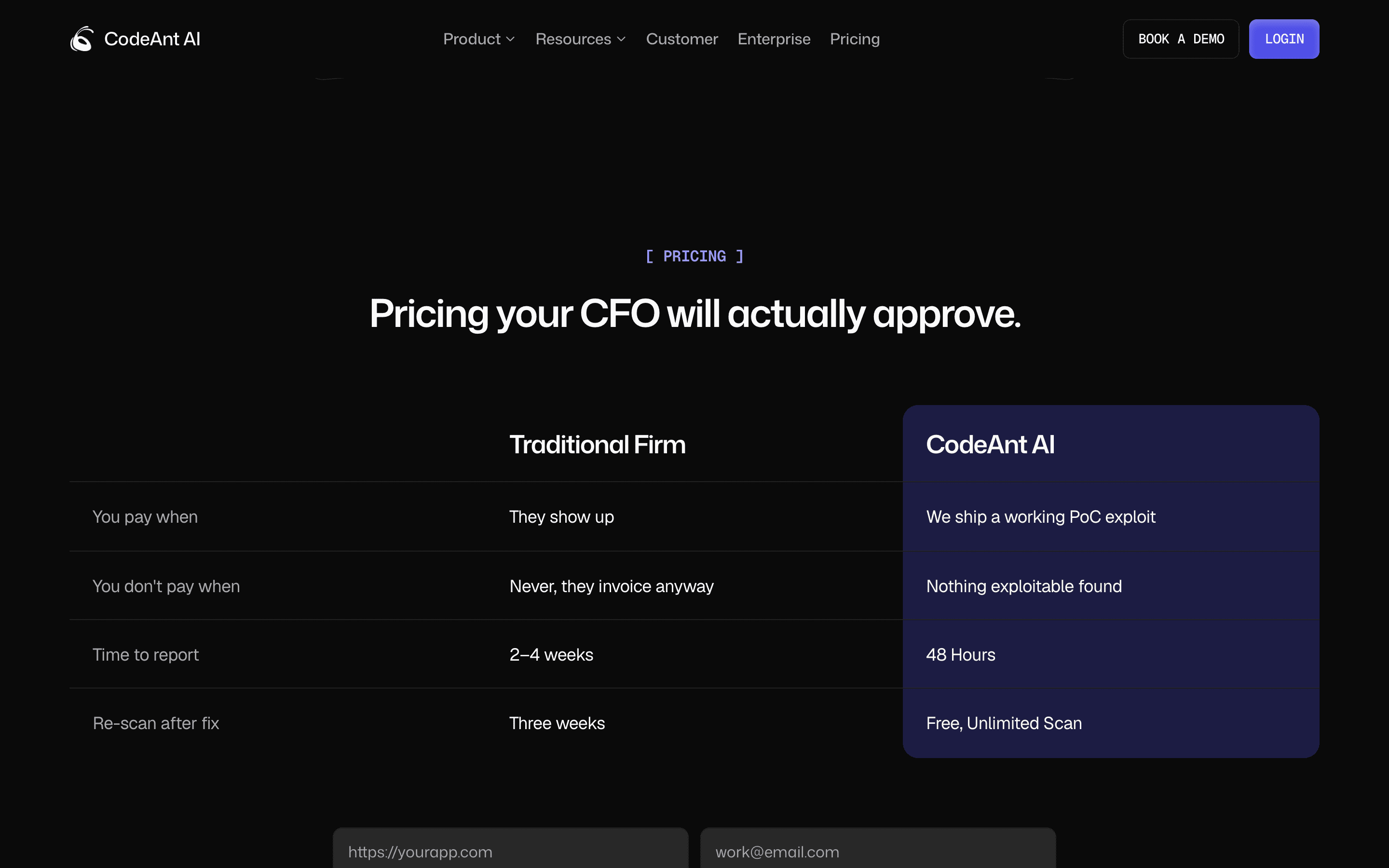
Pricing question | BreachLock | CodeAnt AI |
|---|---|---|
Free entry | No published self-serve tier | Free one-URL black-box scan |
Upfront engagement fee | Determined by quote | $0 |
Main pricing unit | PTaaS scope; AEV contracted IPs or URLs | Verified exploit severity and test depth |
Human pentesters | Included in PTaaS | Not the central unit |
Unlimited testing | AEV on contracted assets | Free unlimited re-scans |
Current list price | Not published | Outcome mechanics published; deeper scopes vary |
Best economic fit | Broad enterprise exposure program | SaaS application and API security |
The cheaper platform is the one that matches the work.
BreachLock can replace separate ASM, AEV, human PTaaS, and reporting vendors. CodeAnt can replace separate SAST, SCA, secret scanning, AI code review, application pentesting, and remediation handoff tools. Buying the wrong bundle creates shelfware even when the unit price looks good.
Read the full CodeAnt AI vs BreachLock comparison for the architectural trade-offs, or use the BreachLock alternatives guide to compare pricing models across ten competitors.
Is BreachLock Worth the Price?
BreachLock is worth considering when three conditions are true.
First, your scope genuinely spans more than one application. The platform earns its keep when ASM, network and web AEV, human PTaaS, and reporting share evidence.
Second, you will test repeatedly. Unlimited autonomous runs only improve the economics when teams use them after changes and fixes.
Third, certified human testing matters. BreachLock’s in-house team, direct communication, report reviews, and compliance mapping are valuable when a customer, auditor, or risk committee expects human accountability.
It is harder to justify when the need is narrow:
one SaaS application
a developer-owned remediation workflow
code-level root cause
rapid validation after each release
a transparent, low-friction starting point
In that case, start with CodeAnt’s free application scan and compare the evidence before entering a broader contract. If human-led PTaaS is still required, compare the published mechanics in our Synack pricing, Cobalt pricing, and Astra Security pricing guides.
Questions to Ask Before Signing a BreachLock Contract
Use these questions to turn a quote into a comparable unit:
Which exact IPs, URLs, applications, roles, and environments are included?
How many certified tester days are included in each PTaaS project?
Which activities are autonomous, automated, and manual?
Does “unlimited retesting” refer to AEV, automated scanning, or manual PTaaS?
How many manual re-tests are included, and how long is the window?
Can contracted IPs or URLs be reassigned when infrastructure changes?
Which reports, attestations, and compliance mappings are included?
Are ASM, AEV, PTaaS, SSO, and integrations separate line items?
What triggers an out-of-scope fee or change order?
What does renewal cost after the first year?
A good vendor should answer each question in writing.
The Bottom Line on BreachLock Pricing
BreachLock pricing is deliberately scoped rather than self-serve.
The only widely accessible numbers are historical G2 starting points: $2,500 for one-time validation and $5,000 for annual validation, last updated in October 2024. Current official pricing is custom, with PTaaS tied to scope and complexity and AEV tied to contracted IPs or URLs.
That opacity is not automatically a red flag. Human testing across complex environments cannot be reduced to one universal price. The problem is using an old starting figure as if it represents the complete 2026 platform.
Get the quote, convert it into cost per asset and tester day, separate autonomous from manual entitlements, and compare it with the work your team actually needs.
If the work is application-centric, run the CodeAnt AI free pentest before committing to a broader offensive-security bundle. The application-security buying guide provides a practical evaluation checklist.

