

Bishop Fox is best understood as a managed offensive-security company with a technology platform, not as a single penetration testing tool. Its features span expert-led application testing, AI-powered testing packages, secure code review, cloud and network assessments, hardware testing, AI and LLM security, continuous threat exposure management, and red-team services.
The technology layer is called Cosmos. Bishop Fox operates it on the customer’s behalf to discover external assets, collect evidence, validate exposures, manage findings, and support continuous testing. Cosmos AI also powers Bishop Fox’s current application penetration testing packages.
This guide examines the Bishop Fox features that matter in a buying decision, what each capability is designed to do, and where the platform differs from a developer-native security product such as CodeAnt AI.
Bishop Fox features at a glance
Capability | What Bishop Fox offers | Best suited to |
|---|---|---|
Application penetration testing | AI-powered and human-driven web, API, thick-client, e-commerce, and SPA testing | Finding exploitable application risk |
Cosmos AI | AI-augmented application discovery and vulnerability testing | Scaling application coverage |
Secure code review | SAST, SCA, expert validation, manual review, and threat modeling | High-assurance source review |
Cosmos platform | Continuous external asset discovery, evidence, validation, and portal workflows | Attack-surface management and CTEM |
Cloud penetration testing | Objective-based testing for AWS, Azure, GCP, and Kubernetes | Cloud control-plane and identity risk |
Internal and external testing | Network, perimeter, identity, segmentation, and assumed-breach work | Enterprise infrastructure assurance |
Mobile testing | Security assessment of mobile applications and supporting APIs | iOS and Android risk |
Hardware testing | Physical, firmware, wireless, protocol, and embedded-system analysis | Connected products and devices |
AI and LLM assessments | Testing of AI applications, models, data flows, and agent behavior | GenAI and agentic application risk |
Red teaming | Adversary simulation, social engineering, and defensive validation | Measuring detection and response |
Readiness services | Ransomware readiness and incident-response tabletop exercises | Operational resilience |
Research and tools | Public vulnerability research and open-source security tooling | Technical credibility and community value |
The breadth is the main Bishop Fox advantage. A single relationship can cover product security, enterprise infrastructure, cloud, external exposure, and adversary simulation.
1. AI-powered application penetration testing
Bishop Fox announced an expanded AI-powered application penetration testing offer in February 2026. Cosmos AI is embedded in expert workflows to automate discovery and vulnerability testing while human testers validate results or conduct deeper manual work.
The three published package levels are:
Baseline: AI-powered discovery, vulnerability identification, and testing, followed by one day of human validation and exploitation.
Standard: AI-accelerated discovery plus human-driven penetration testing, exploitation, and attack chaining.
Advanced: Deeper, human-driven analysis of critical applications, specific features, and selected risk areas.
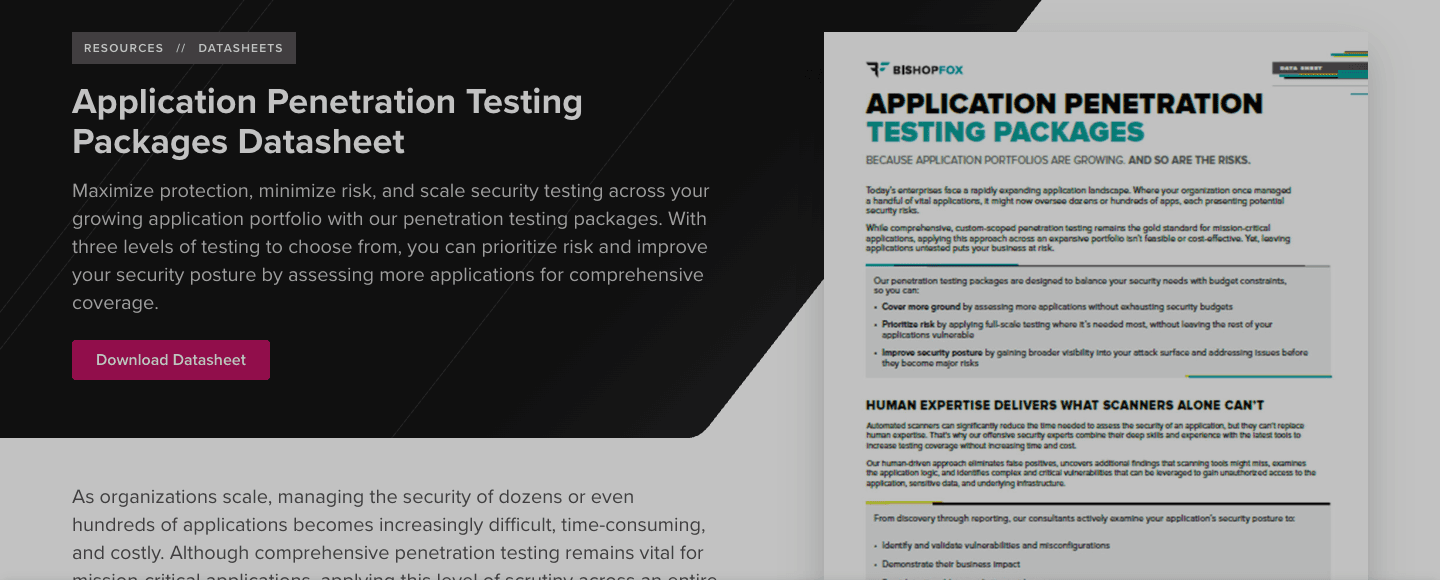
This tiering lets security leaders match testing depth to application risk. A large portfolio can receive faster Baseline coverage, while a payment platform or sensitive administrative plane receives Standard or Advanced attention.
The limitation is commercial transparency. Bishop Fox publishes package contents but not prices, target limits, route allowances, or a universal retesting entitlement. These details must be negotiated.
2. Expert-led application penetration testing
Bishop Fox says it has conducted more than 10,000 application security assessments. Its application penetration testing service covers:
Web applications
Application programming interfaces
Single-page applications
Thick clients
E-commerce platforms
Applications built in diverse programming languages
The methodology includes reconnaissance, attack-surface mapping, authentication, authorization, session management, configuration, encryption, data validation, file transfer, denial-of-service considerations, and application-logic circumvention.
Human testers can follow unexpected behavior, adapt hypotheses, and chain separate weaknesses into a higher-impact path. This matters for multi-step business logic, authorization boundaries, and application-specific trust assumptions.
Bishop Fox says most traditional application engagements include one to two weeks of scoping and preparation, one to three weeks of fieldwork, and one to two weeks of reporting and remediation support. That schedule supports concentrated expert work but may not match a deployment cadence measured in hours or days.
3. Cosmos AI
Cosmos AI is Bishop Fox’s offensive-security AI engine. In application testing, it extends the reach of expert teams by automating discovery, vulnerability identification, and testing.
The practical value is capacity. Human testers do not need to spend every hour rediscovering common attack surfaces or repeating standard checks. They can focus on validation, exploitation, attack chaining, and the workflows that require judgment.
Buyers should still ask:
Which test classes are performed by Cosmos AI?
How does it authenticate and switch roles?
What application context is supplied?
How are hallucinated or low-confidence findings suppressed?
What evidence is required before a result reaches the report?
How much human time is included in each package?
Can testing be repeated after every release?
“AI-powered” describes an operating model, not a standardized level of coverage. The package and statement of work determine the real depth.
4. Secure code review
Bishop Fox’s secure code review combines automated analysis with expert validation and optional manual work.
Its public tiers are:
Review level | Included work |
|---|---|
Baseline | Static application security testing and expert validation |
Targeted | SAST, expert validation, and manual code review |
In-depth | SAST, expert validation, manual code review, and threat modeling |
The methodology can include:
Architecture analysis
Software composition analysis
Static application security testing
Manual source review
Attack-surface mapping
Threat modeling
Framework and standard alignment
Remediation and secure-coding guidance
This service is well suited to a security-critical component, major release, acquisition, or independent assurance requirement. It is less suited to reviewing every pull request because it is a scoped professional engagement.
For continuous repository feedback, compare Bishop Fox with CodeAnt AI code security, which combines SAST, SCA, secrets, IaC, SBOM, and code context in a developer workflow.
5. Cosmos external attack-surface management
Bishop Fox Cosmos is a cloud-native platform operated and managed by Bishop Fox. It continuously discovers internet-facing assets, determines reachability and protocols, collects screenshots and service evidence, and maintains a living external inventory.
Publicly described capabilities include:
Continuous asset discovery
Domain and infrastructure mapping
Reachability and protocol validation
Screenshots and evidence collection
Cloud connectors for AWS, Google Cloud, Azure, Cloudflare, and Oracle
Expert validation of exposures
Verified findings in the Bishop Fox Portal
Jira and ServiceNow integrations
Remediation and collaboration workflows
This reduces two common attack-surface management problems: noisy asset inventories and unverified scanner alerts. Bishop Fox combines automated evidence with an expert validation pipeline.
Cosmos is not marketed as software that customers deploy and administer independently. Bishop Fox operates the platform as part of its managed services. That lowers operational burden but creates more dependence on the provider.
6. Continuous threat exposure management
Continuous threat exposure management, or CTEM, is broader than scanning. It creates a repeatable cycle of scoping, discovering, prioritizing, validating, and mobilizing remediation around likely attack paths.
Bishop Fox can combine Cosmos asset discovery with offensive testing and expert validation. The intended outcome is not a long list of theoretical vulnerabilities. It is a current view of which exposed assets and weaknesses are reachable, exploitable, and relevant to the organization.
CTEM is most useful when:
External infrastructure changes frequently
Cloud accounts and subsidiaries create visibility gaps
Acquisitions add unknown assets
Annual penetration tests age quickly
Security teams struggle to prioritize scanner output
Executives want exposure trends rather than isolated reports
Ask how often assets are rediscovered, how testing is authorized, what constitutes a verified exposure, and how remediation progress is measured.
7. Cloud penetration testing
Bishop Fox provides cloud penetration testing for AWS, Microsoft Azure, Google Cloud, Kubernetes, and related environments.
Cloud testing should be objective-driven. Simply enumerating misconfigurations does not reveal how identities, workloads, metadata services, secrets, network paths, and control-plane permissions combine.
Useful objectives include:
Escalating from a compromised workload to cloud control-plane access
Crossing account, subscription, project, or namespace boundaries
Abusing overprivileged identities and trust policies
Accessing sensitive storage or secrets
Testing isolation between tenants or environments
Evaluating Kubernetes service accounts and admission controls
Determining whether external application compromise reaches cloud resources
Bishop Fox’s broader application and network capability helps when an attack path crosses layers. Confirm provider authorization rules, prohibited techniques, production constraints, account scope, and cleanup responsibilities.
8. External and internal network penetration testing
External testing evaluates internet-facing services from an attacker’s perspective. Internal testing begins inside the environment or from an assumed foothold and examines identity, segmentation, privilege escalation, lateral movement, and access to sensitive systems.
Bishop Fox offers dedicated services for both. The company’s offensive-security focus is valuable when the goal is exploitation and impact rather than a configuration checklist.
An effective scope should specify:
IP ranges and domains
Cloud-hosted and on-premise assets
Assumed credentials or access
Identity providers and directories
Segmentation objectives
Social engineering permissions
Production safety limits
Detection-team involvement
Retesting and reporting
Network testing is a clear differentiator from developer-native application platforms. Code security products can identify unsafe infrastructure code or secrets, but they do not replace a live assumed-breach test of enterprise identity and segmentation.
9. Mobile application penetration testing
Bishop Fox provides mobile security assessments that can cover the client, local storage, authentication, cryptography, inter-process communication, platform controls, backend APIs, and application-specific workflows.
A mobile engagement should not stop at the binary. Many consequential findings live in the supporting API: broken object-level authorization, weak device binding, token abuse, replay, and hidden administrative functions.
Ask whether the proposal includes:
iOS, Android, or both
Production and test builds
Jailbroken or rooted device testing
Certificate pinning and bypass
Local data and keychain or keystore analysis
Deep links and exported components
Backend API testing
Reverse engineering and tamper resistance
Retesting after fixes
10. Hardware and embedded-system testing
Hardware penetration testing is another Bishop Fox differentiator. Connected products can expose physical interfaces, debug ports, firmware, boot chains, wireless protocols, companion applications, cloud services, and supply-chain dependencies.
This work may require electronics, radio, reverse-engineering, and exploit-development expertise that ordinary web testing providers do not maintain.
Good scopes identify the exact device revisions, accessories, firmware, update mechanisms, manufacturing interfaces, wireless technologies, physical access assumptions, and destructive-testing constraints.
Organizations building medical, industrial, automotive, consumer, or security devices should prioritize a provider with demonstrable hardware research rather than treating the assessment as an application pentest.
11. AI and LLM security assessments
Bishop Fox offers a dedicated AI and LLM security assessment service.
AI applications create risks across several layers:
Prompt injection and instruction conflicts
Retrieval poisoning and sensitive context
Model or system prompt leakage
Insecure output handling
Excessive agent permissions
Unsafe tool invocation
Cross-user or cross-tenant data exposure
Authentication and authorization failures in the surrounding application
Training and telemetry data handling
Dependency and model supply-chain risk
The most important tests are application-specific. A chatbot that only summarizes public documents has a different threat model from an agent that can issue refunds, modify cloud infrastructure, or query private customer records.
Define the model, retrieval sources, tools, identities, data classifications, and business consequences before testing. Generic prompt lists are not a substitute for an end-to-end attack model.
12. Red teaming and adversary simulation
Bishop Fox offers red-team services designed to measure whether defensive controls can detect and contain a realistic attacker. These engagements may involve external access, identity, cloud, endpoint controls, social engineering, lateral movement, and sensitive objectives.
Unlike a penetration test, a red team is not primarily a search for every vulnerability. It tests a path toward a defined objective under agreed rules and evaluates people, process, and technology together.
Useful program outputs include:
Attack narrative and timeline
Detection and response observations
Control bypasses
Identity and segmentation weaknesses
Evidence for defensive engineering
Joint purple-team exercises
Executive lessons
Red teams require careful authorization, deconfliction, safety controls, and executive sponsorship. Ask Bishop Fox how it coordinates with the trusted control group and how evidence is converted into defensive improvements.
13. Social engineering, ransomware readiness, and tabletop exercises
Bishop Fox’s broader readiness services can test human and operational resilience. Social engineering may cover phishing, vishing, pretexting, or physical objectives. Ransomware readiness examines how an adversary could gain access, expand privileges, reach critical systems, and disrupt recovery. Tabletop exercises evaluate decision-making without executing a real attack.
These services are valuable when the organization wants to move beyond prevention and test whether teams can identify, escalate, communicate, contain, and recover from a serious event.
Define whether the goal is measurement, training, control validation, or executive rehearsal. The safest and most useful engagement is designed around the organization’s maturity rather than maximum surprise.
14. Reporting, portal, and integrations
Bishop Fox provides technical findings, executive communication, remediation guidance, and a customer portal. Cosmos supports a living asset inventory and evidence. Jira and ServiceNow integrations connect findings to existing work-management systems.
Buyers should review a redacted deliverable and ask:
Are proof-of-concept steps reproducible?
Does each finding show affected assets and roles?
Are exploit chains preserved?
Are fixes specific enough for developers or infrastructure owners?
Can risk be filtered by business unit or application?
How are accepted risks and false positives handled?
Is report export suitable for auditors and customers?
How quickly is the report updated after retesting?
A polished portal is useful, but evidence quality and remediation clarity determine whether the work changes risk.
15. Security research and open-source tools
Bishop Fox publishes technical research, vulnerability advisories, and open-source tools. Its researchers have contributed work in exploit development, cloud, application security, hardware, and emerging technologies.
Public research is not a product feature in the narrow sense, but it is relevant when buying expertise. It shows whether a provider’s practitioners can investigate unfamiliar systems, develop new techniques, and communicate technical evidence.
Evaluate the proposed team, not only the corporate research archive. Ask which specialists will work on the engagement and whether they have experience with the target architecture.
Bishop Fox limitations
The broad catalog comes with tradeoffs:
Pricing is not public.
Scope and delivery require discovery and procurement.
Traditional engagements can take several weeks.
Secure code review is scoped rather than continuously applied to every pull request.
Cosmos is managed by Bishop Fox rather than independently operated by the customer.
Package names do not reveal exact route, role, or retest allowances.
Service quality depends on the assigned team and statement of work.
These are not necessarily flaws. They are consequences of a managed professional-service model. They matter most to teams seeking self-service testing, instant retesting, or predictable published pricing.
Bishop Fox versus CodeAnt AI features
CodeAnt AI centers security around repositories, pull requests, applications, and fast remediation. Bishop Fox centers security around managed offensive-security outcomes across a wider attack surface.
Feature area | CodeAnt AI | Bishop Fox |
|---|---|---|
Application pentesting | AI-native black-box, white-box, and gray-box testing | AI-powered and human-driven package options |
Public turnaround | 48-hour report advertised | Findings in days for Baseline; traditional projects take longer |
Code security | Continuous SAST, SCA, secrets, IaC, SBOM, and code review | Scoped secure code review |
Retesting | Unlimited rescans advertised | Confirm per engagement |
External attack surface | Application-oriented | Cosmos discovery and CTEM |
Cloud and network testing | Code and application context | Dedicated expert-led services |
Hardware, mobile, and red teams | Not core public categories | Dedicated services |
Operating model | Product-led and repeatable | Managed service |
Choose CodeAnt when continuous developer feedback, source context, and release velocity dominate. Choose Bishop Fox when human-led depth and broad offensive-security coverage dominate. Read CodeAnt AI vs Bishop Fox for a complete decision framework.
How to evaluate Bishop Fox
Use a representative pilot and define measurable success:
Supply an application with multiple roles and meaningful APIs.
Document known asset and route counts.
Include at least one recent architectural change.
Measure time to first confirmed critical result.
Review exploit evidence and reproduction quality.
Measure developer time to understand and fix findings.
Retest the changes.
Review executive and audit usability.
Calculate internal coordination effort.
Compare total price and renewal exposure.
For Cosmos, evaluate asset accuracy, evidence freshness, duplicate control, validation quality, integration workflow, and the time from discovery to remediation.
Final verdict
Bishop Fox combines a mature offensive-security service portfolio with Cosmos, Cosmos AI, expert validation, and a customer portal. Its strongest features are breadth and managed execution: one provider can test applications, source code, cloud, networks, mobile systems, hardware, AI applications, external exposure, and defensive readiness.
The AI-powered Baseline, Standard, and Advanced packages make application testing more scalable without pretending that every target needs the same human depth. Cosmos extends that model into continuous discovery and verified exposure management.
The main tradeoffs are quote-only pricing, professional-services lead time, and less self-service control. Engineering teams that primarily need continuous application and repository feedback should compare Bishop Fox alternatives. Enterprises seeking a broad, expert-led offensive-security partner should place Bishop Fox on the shortlist.

