

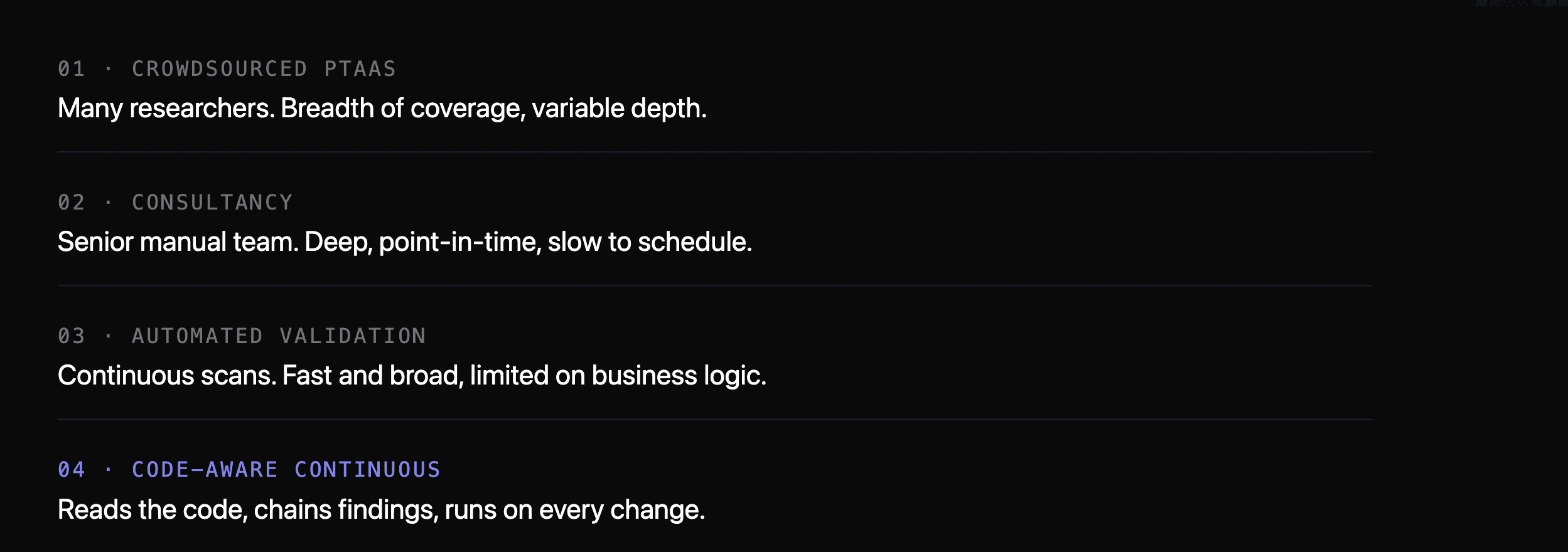
A SaaS team choosing how to run penetration testing is really choosing between four models, not three, and each answers a different question. Traditional testing goes deep but slow, crowdsourced testing goes broad but uneven, automated testing goes fast but shallow on logic, and a newer code-aware autonomous model tries to combine depth and cadence.
This guide compares them in full for a SaaS product, on the axes that actually decide a program, depth, cadence, cost, and compliance, then walks which model fits which stage and how leading teams combine them. It is long on purpose, because picking wrong here is expensive.
What CodeAnt AI solves here: CodeAnt AI is the code-aware, autonomous model in this comparison. It reads your source, chains findings into a proven exploit, runs continuously on every release, and prices on outcomes, covering the multi-tenant and API depth SaaS needs without the cost and cadence limits of a purely manual engagement.
What SaaS Teams Ask Before Choosing A Penetration Testing Model
Before the models, the questions. These are the ones SaaS teams and their auditors raise most often, and this guide is structured to answer each.
Is automated testing as good as manual, and can it replace pentesters?
What is the real difference between PTaaS, traditional, automated, and crowdsourced?
Is crowdsourced testing safe, and can it enforce scope on a multi-tenant product?
Which models satisfy SOC 2, and which leave an auditor wanting more?
What does each cost, and how does the billing model change behavior?
Which model fits a startup clearing its first SOC 2 versus an enterprise?
Automated Vs Crowdsourced Vs Traditional Pentesting At A Glance
The models sit at different points on depth, speed, and cost. None is universally better, and the fit depends on how your SaaS ships and what you must prove.
Model | Who tests | Cadence | Depth on logic | Proof of exploit | Compliance fit | Cost shape |
|---|---|---|---|---|---|---|
Traditional manual | Senior humans | Point-in-time, weeks | High | Strong | Strong | Per engagement |
Crowdsourced | Independent researchers | Open-ended | Variable | Often weak | Weaker | Per vulnerability plus platform |
Automated | Rule-based engine | Continuous | Low | Where exploit fires | Weak alone | Subscription |
Code-aware autonomous | AI agents plus human revalidation | Continuous, on change | High, reads source | Strong, chained | Strong | Outcome-based or subscription |
Traditional Manual Penetration Testing For SaaS
Traditional testing is where most security programs began, and in some contexts it still sets the bar. It is human-led, with a security consultant manually simulating real-world attacks against a scoped set of assets over a fixed window.
How it works. A team scopes the engagement, tests over a few weeks, and delivers a static report ranking findings by severity. The tester reasons like an attacker, chaining weaknesses and probing business logic that no script anticipates.
What it catches. This is the model that finds the cleverest issues, blind SQL injection, subtle logic flaws, access-control bypasses, and multi-step chains that require human intuition. For a complex authorization model, senior human creativity still leads.
The limits for SaaS. It is slow, expensive, and point-in-time, so the report is accurate on delivery day and starts aging with the next deploy. A SaaS team shipping weekly cannot run a manual engagement on every release, which leaves most of the year untested. Enterprise web app engagements commonly run 10,000 to 30,000 dollars, and complex environments exceed 100,000, with retests billed extra.
Best for. A deep annual assessment, a compliance artifact with named human attestation, and genuinely novel logic that automation cannot reason about yet. Consultancies like Software Secured and Bishop Fox occupy this space for SaaS.
Crowdsourced Penetration Testing For SaaS
Crowdsourced testing puts a network of independent researchers on your target, coordinated through a platform. It includes manual testing, but the testers are a distributed pool paid per vulnerability found, plus a platform fee.
How it works. You scope a program, and researchers probe it, in theory continuously, with the incentive to find as much as possible. The bug-bounty dynamic rewards thoroughness and brings a global diversity of skill and perspective.
What it catches. Breadth. Many eyes on a wide surface surface a range of issues a single tester might not, and the creativity of a large pool is a genuine advantage on sprawling external attack surface.
The limits for SaaS. The trade-offs are real and specific. Quality is uneven across researchers, scope boundaries are harder to enforce, and there are licensing and liability complexities in letting an open pool test a multi-tenant product holding customer data. Critically, findings often lack proof of exploitability, so development teams spend time triaging non-critical issues, and the model is frequently described as less suitable for strict compliance requirements. Cost can also spike if a program surfaces a large number of findings.
Best for. Organizations comfortable with external testers and flexible scoping, and as a complement to a formal test rather than the compliance backbone. Cobalt and HackerOne are the reference platforms.
Automated Penetration Testing For SaaS
Automated testing removes the human from the execution loop and lets a rule-based engine run attack sequences itself, on demand and repeatably. It is the model built for speed and scale.
How it works. The engine enumerates the attack surface from a defined scope and a library of techniques, then uses the result of each step to pick the next, building an attack chain incrementally, discovering, exploiting, and validating exposures across hosts and identities to capture proof of compromise.
What it catches. Known techniques, fast. Weeks of routine work compress into minutes, run often enough that the picture stays current, which is exactly what a SaaS release cadence needs. Autonomous validation platforms like Pentera and NodeZero lead here for network and identity.
The limits for SaaS. Automation is capable but bounded. It depends on being able to safely fire real exploits, which works on assets a tool can reach and far less well elsewhere, and it historically produced high false-positive rates that flood teams with theoretical issues. Most importantly, a rule engine lacks the contextual reasoning to reliably find nuanced business-logic and multi-tenant authorization flaws, the ones that expose SaaS customer data. A scanner alone is generally not sufficient for compliance.
Best for. Broad, frequent coverage of large or fast-changing environments, and continuous regression checking in a CI/CD pipeline, ideally paired with a model that reaches business logic.
Code-Aware Autonomous Penetration Testing For SaaS
A newer category has emerged to close the gap between automated speed and manual depth. Instead of a rule engine picking from branches an engineer wrote in advance, an AI agent reasons through each step in real time, and the engagement can scope itself the moment a signal arrives, a new CVE, fresh threat intel, or a code change.
How it works. Code-aware autonomous testing reads the source alongside the live product, so it does not only see the response an endpoint returns, it sees the middleware, the authorization decorator, and the query behind it. It chains findings into a proven exploit and, in a mature workflow, hands them to human researchers for revalidation before anything ships.
What it catches. This is the model that combines the axes. Reading the code reaches the multi-tenant and authorization logic that pure automation misses, the autonomous cadence keeps pace with releases, and the chaining plus revalidation produces the proof of exploit that crowdsourced findings often lack. The evolution here has been from automation, running a script faster, to autonomy, reasoning and adapting.
The limits. It is still not a full substitute for a human on genuinely novel, creative logic or specialized red team work, which is why the strongest programs keep a periodic manual engagement in the mix. The honest framing is that it covers far more of the routine, multi-tenant, and API work than before, not that it replaces every human test.
Best for. SaaS teams that ship frequently and need depth on authorization and multi-tenant risk with a cadence and cost a manual engagement cannot match. This is where CodeAnt sits, and the defensive and offensive security breakdown covers how the offensive agents pair with the wider platform.
How SaaS Penetration Testing Models Compare On Depth, Cadence, Cost, And Compliance
Comparison Axis | Traditional Manual Testing | Crowdsourced Testing | Automated Testing | Code-Aware Autonomous Testing |
|---|---|---|---|---|
Depth | Strong for complex business logic, chained attacks, and unusual authorization flaws. | Variable. Depends on which researchers test the target and how deeply they understand the SaaS logic. | Good for known issues, but weaker on nuanced business logic and tenant isolation. | Strong for SaaS because it reads the source, understands authorization paths, and validates exploit chains. |
Cadence | Point-in-time. Best for annual or periodic deep assessments. | Flexible and ongoing in theory, but coverage depends on researcher activity. | Continuous or on-demand. Good for frequent regression testing. | Continuous and change-aware. Best fit for SaaS teams shipping weekly or daily. |
Cost | Fixed engagement fee, often higher for complex scopes and retests. | Platform fee plus per-vulnerability payouts, which can become unpredictable. | Subscription-based, usually predictable but paid regardless of finding quality. | Subscription or outcome-based, with cost tied more closely to confirmed exploitable risk. |
Compliance Evidence | Strong when scope, proof, remediation, and retest are documented clearly. | Can support evidence, but may need extra validation and formatting for audits. | Weak alone if it produces scan results without proven exploitability. | Strong when it includes proof of exploit, clear scope, remediation, retest, and control mapping. |
Best Fit | Deep annual review, novel logic, board assurance, and named human attestation. | Broad external surface testing and supplementary researcher coverage. | Fast, repeatable checks across large or changing environments. | SaaS products that need multi-tenant depth, release cadence, SOC 2 evidence, and exploit validation together. |
The at-a-glance table is the summary. Here is the reasoning behind each axis, because the axis you weight most should decide your model.
Depth, what each actually catches
Depth is about business logic and authorization, and it separates the models sharply. Traditional and code-aware testing both reach deep, one through human intuition and one through reading the source, while pure automation and crowdsourced coverage are less reliable on the multi-tenant authorization flaws that expose SaaS data.
The specific SaaS failure is broken object level authorization, where an API returns another tenant's record without checking ownership. A scanner sees a normal response and moves on, a crowdsourced tester may or may not seed the accounts to catch it, a senior human will, and a code-aware test reads the handler and knows.
For a multi-tenant product, that difference is the whole ballgame.
Cadence, keeping pace with releases
Cadence is where traditional testing struggles most against a SaaS cycle. The window of exposure is the problem: test in January, ship new code in February, and you are flying blind on that code until the next annual test.
Automated, code-aware, and platform-delivered models all narrow that window by testing continuously or on demand, which matters more in 2026 than it used to, because new CVEs are weaponized in hours and attackers can move through an environment in under 30 minutes. A model that only proves security once a year cannot keep up with either your releases or the threat.
Cost, the real economics
The models price in fundamentally different ways, and the billing unit shapes behavior. Traditional testing is a lump-sum engagement fee, crowdsourced pays per vulnerability plus a platform fee, automated and PTaaS charge a subscription, and outcome-based testing charges only when a confirmed critical exploit is found.
The per-vulnerability model can spike unpredictably on a noisy target, the subscription smooths cost but pays regardless of what is found, and the outcome-based model aligns payment with a proven critical finding. Our penetration testing cost guide breaks the models down, and the PTaaS explainer covers the subscription structure.
Compliance and evidence
For SOC 2 and similar frameworks, the deciding factor is proof and scope. An auditor wants evidence that exploitable findings were tested and remediated, which is why a raw scanner output is generally not sufficient and crowdsourced findings that lack proof of exploit create friction.
Traditional and code-aware testing both produce the evidence an auditor accepts, a working exploit, a clear scope, remediation, and a retest, and code-aware testing adds the continuous record that a SOC 2 Type 2 observation window rewards. Our SOC 2 penetration testing requirements guide maps what the criteria actually expect.
The full workflow behind code-aware testing
Because the code-aware model is the one built for SaaS, it is worth seeing how it actually runs, since the workflow is what separates it from a scan with a chatbot on top.

Reconnaissance maps the exposed surface, open ports, reachable services, and the credentials already leaking on the open internet. Service discovery identifies what is actually running behind each endpoint, and reachability works out which paths lead toward customer data. Chaining is where a data leak gets proven, linking individually minor findings into one path that ends at exfiltrated records, which is the stage that separates a pentest from a scan.
Then the human layer. Revalidation puts researchers in the loop to confirm every finding against the live system and push the chain further than automation reached, and evidence collection packages a working proof of exploit, the code path behind it, severity, remediation, and a retest, mapped to SOC 2 and the frameworks an auditor checks.
The depth comes from reading the code across black, white, and gray box modes. White box inspects every API and database call and builds a threat model of dependencies, secrets, and infrastructure, gray box takes that internal knowledge back outside the perimeter, and the combination is what finds the internal API reaching a customer database with no authorization.
The walkthrough of how AI penetration testing traces a data leak shows a full chain.
Which Penetration Testing Model Should Your SaaS Use?
The right model depends on your stage, your cadence, and what you must prove. This maps the common situations.
Your situation | Model | Reason |
|---|---|---|
Early-stage SaaS clearing a first SOC 2 | Code-aware continuous, or hybrid | Current evidence, multi-tenant depth, predictable cost |
Shipping code daily in a DevOps pipeline | Code-aware or automated, in CI/CD | Cadence a manual engagement cannot match |
Complex, novel authorization logic | Add a periodic manual engagement | Human creativity still leads on novel logic |
Wide external attack surface | Crowdsourced as a complement | Breadth of many researchers |
Large internal network and identity estate | Automated validation | Frequent proof across hosts and identities |
Strict compliance and audit evidence | Code-aware or traditional | Proof of exploit and clear scope |
Enterprise with a mature program | Combine continuous plus annual manual | Depth and cadence together |
For most SaaS teams with a modern, fast-changing stack, a code-aware continuous model is the strongest default because it covers both the multi-tenant depth and the cadence that decide SaaS risk. A mature program layers a periodic manual engagement on top for novel logic and a named human artifact.
How SaaS Teams Combine Automated, Manual, And Crowdsourced Testing
The sophisticated answer in 2026 is rarely a single model. Most strong programs run continuous automated or code-aware testing on every release for cadence and coverage, then commission a periodic deep manual engagement for novel logic and a compliance deliverable.
The automation keeps the picture current and catches regressions the moment they ship, the human engagement goes deep where creativity still wins, and crowdsourced testing can extend breadth across a wide external surface. The mistake is treating any one model as the whole program, since each answers a different question and leaves the others open.
How To Choose A SaaS Penetration Testing Model
A structured evaluation beats a vendor pitch. A few moves clarify the decision quickly.
Weight your axes first. Decide whether depth, cadence, cost, or compliance matters most for your stage, then let that pick the model.
Test on your own stack. Run a short pilot that seeds multiple tenants and roles, and count reproducible high and critical findings, not alert volume.
Demand proof of exploit. A finding without a working exploit costs your team triage time and does not satisfy an auditor.
Model a full year of cost. Include retests and after-change testing, not a single quote.
Check the platform is real testing. Confirm a PTaaS platform is deep testing and not an automated scanner or crowdsourced pool behind an interface.
The provider evaluation framework and PTaaS SLA guide give you a scorecard, and the best tools for SaaS guide covers the specific vendors in each model.
Conclusion: Choose The SaaS Pentesting Model That Matches Your Risk
For SaaS teams, the penetration testing model matters because the product changes constantly, the data is multi-tenant, and enterprise buyers expect evidence that security controls actually work.
Traditional manual testing gives deep human review, but it is slow and point-in-time.
Crowdsourced testing brings breadth, but can be harder to scope and validate.
Automated testing gives speed and repeatability, but can struggle with business logic and tenant isolation.
Code-aware autonomous testing is built to combine cadence with source-level depth.
The deciding factors are depth, cadence, cost, and evidence. The strongest SaaS programs rarely rely on one model alone. They run continuous automated or code-aware testing on every release, then layer in periodic manual testing for creative logic review, specialized risk, and board-level assurance. That combination gives teams the cadence of automation, the depth of human review, and the evidence needed for enterprise security reviews.
So, our take is that choose your SaaS penetration testing model by weighting what matters most: multi-tenant depth, release cadence, SOC 2 evidence, cost predictability, and proof of exploit. Then run a short pilot on your own stack and pick the model that finds reproducible high-impact issues, retests fixes, and keeps evidence current as your product ships. For the full field of vendors in each model, start with our best penetration testing tools for SaaS guide.

