

Astra Security has five main features: expert-led pentesting, a DAST scanner, an API security platform, a cloud vulnerability scanner, and a new autonomous pentest engine. Not one of them reads your source code to find problems, and that boundary shapes everything below.
The scale claims come from Astra itself: 2 million+ vulnerabilities uncovered, 3,000+ pentests completed, 1,000+ engineering teams, plus CREST approval, CERT-In empanelment, PCI-DSS ASV status, ISO 27001, and SOC 2 Type II. Its homepage calls it “The only platform that performs continuous offensive pentests across your apps, APIs & cloud.”
You will see Astra Security features compared throughout against CodeAnt AI, the exploit-based agentic security platform whose AI agents reason across code, infrastructure, and runtime.
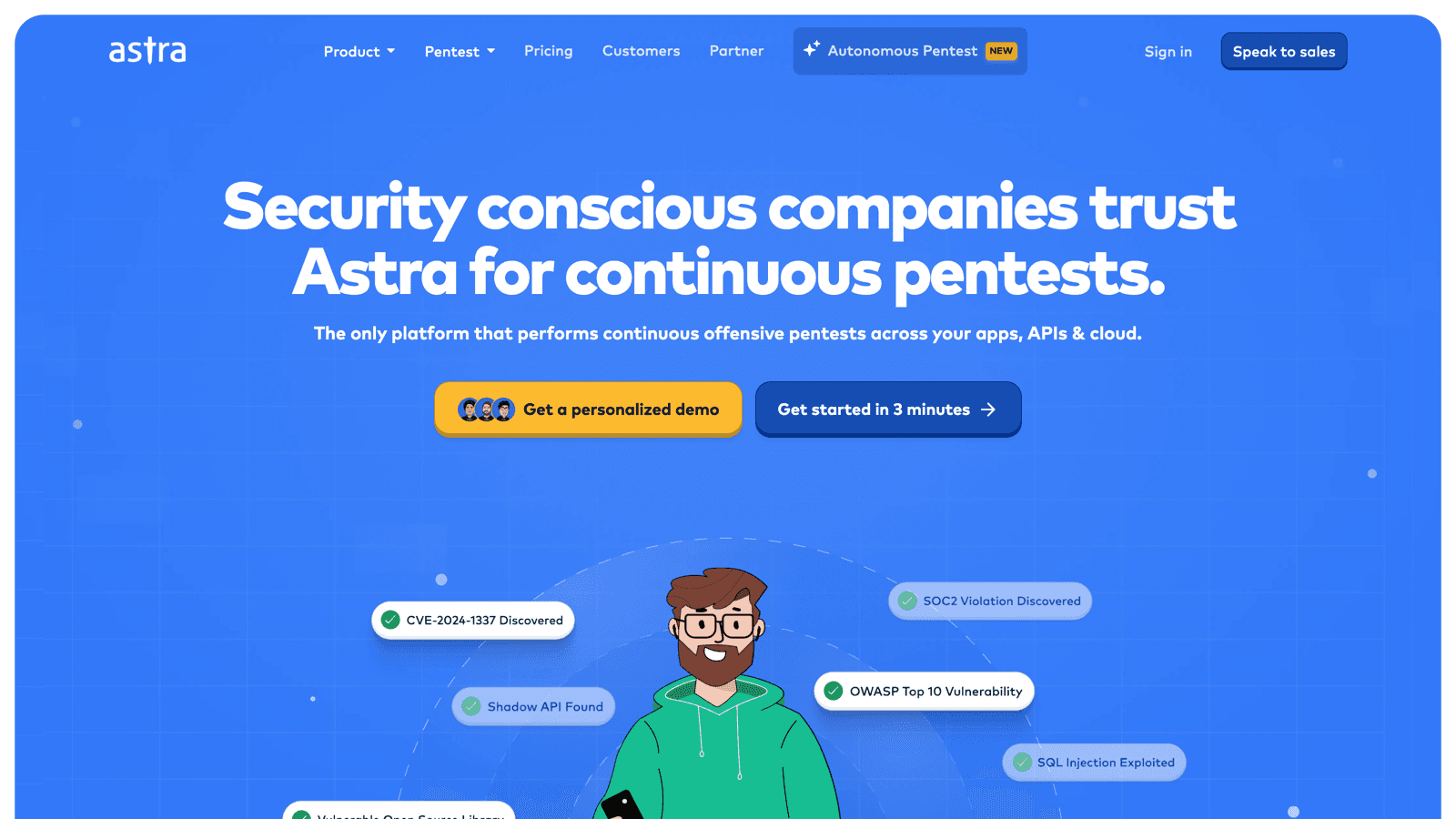
TL;DR: Astra covers the runtime side broadly, with certified human pentesters, continuous DAST, API discovery, cloud scanning, and autonomous agents reporting into one dashboard. Compliance-mapped reports, a public Trust Center, and MCP-delivered fixes into your IDE ship with every pentest plan.
The limits: no SAST, code review, or repo scanning of any kind, a flagship autonomous product that is waitlist-only, a $5,999 Expert tier behind a sales call, and vendor pages that disagree with each other on key counts. Human fix verification caps at one or two re-scans per year.
Astra Security Features at a Glance
Every capability below comes from getastra.com and its documentation, checked in July 2026, each with its most important limit or gate.
Capability | What it does | Notable limit or gate |
|---|---|---|
PTaaS | Manual pentests by certified experts plus automated scanning on one dashboard | Manual tests take 10 to 15 working days, sold per target per year |
Pentest coverage | Web, mobile, API, cloud, network, and AI/LLM testing in black, grey, or white box modes | Mobile counts iOS and Android as separate targets |
DAST scanner | 10,000+ tests behind login, including TOTP-based MFA flows | Product page says 15,000+, so Astra’s own count varies by page |
API security | Discovers shadow, zombie, and orphan APIs, 15,000+ authenticated test cases | Pricing tab not purchasable |
Cloud scanning | 400+ agentless misconfiguration detectors across AWS, Azure, GCP | Deep manual cloud review sits in the custom Enterprise tier |
Autonomous Pentest | Two AI agent strategies that chain real exploits continuously | Waitlist only, credit pricing unpublished |
AI validation | Independent agent confirms true positives, human layer re-checks meaningful findings | No published precision or false-positive statistics |
MCP auto-fix | Codebase-specific fixes delivered into Cursor, VS Code, Claude Code, Claude Desktop, ChatGPT | Fixes runtime findings, performs no static analysis |
Re-scans | Human verification that fixes hold | 1 per year on Auto, 2 on Expert |
Compliance | Reports mapped to SOC 2, ISO 27001, HIPAA, PCI-DSS, GDPR, plus a public Trust Center | CREST, PCI-ASV, CERT-In formats ship on Expert only |
Integrations | GitHub, GitLab, Jira, Slack, and CI/CD from GitHub Actions to Azure DevOps | SCM integration triggers scans, never reads code |
Everything tests the deployed application, and the one place Astra touches your source code is when it writes a fix.
What Features Does Astra Actually Include?
Astra’s five products share a dashboard, a vulnerability-management view, and a compliance layer.
PTaaS, the expert-led core
The pentest product blends automated scanning with manual testing by pentesters certified in OSCP, CEH, CCSP, and more, working to OWASP, APTS, SANS, and PTES standards. Scans start immediately on request, experts perform threat modeling and manual testing, and findings stream into the dashboard in real time.
After you remediate, you request a re-scan and experts verify the fix holds, with one re-scan on the $1,999 Pentest Auto plan and two on the $5,999 Pentest Expert plan.
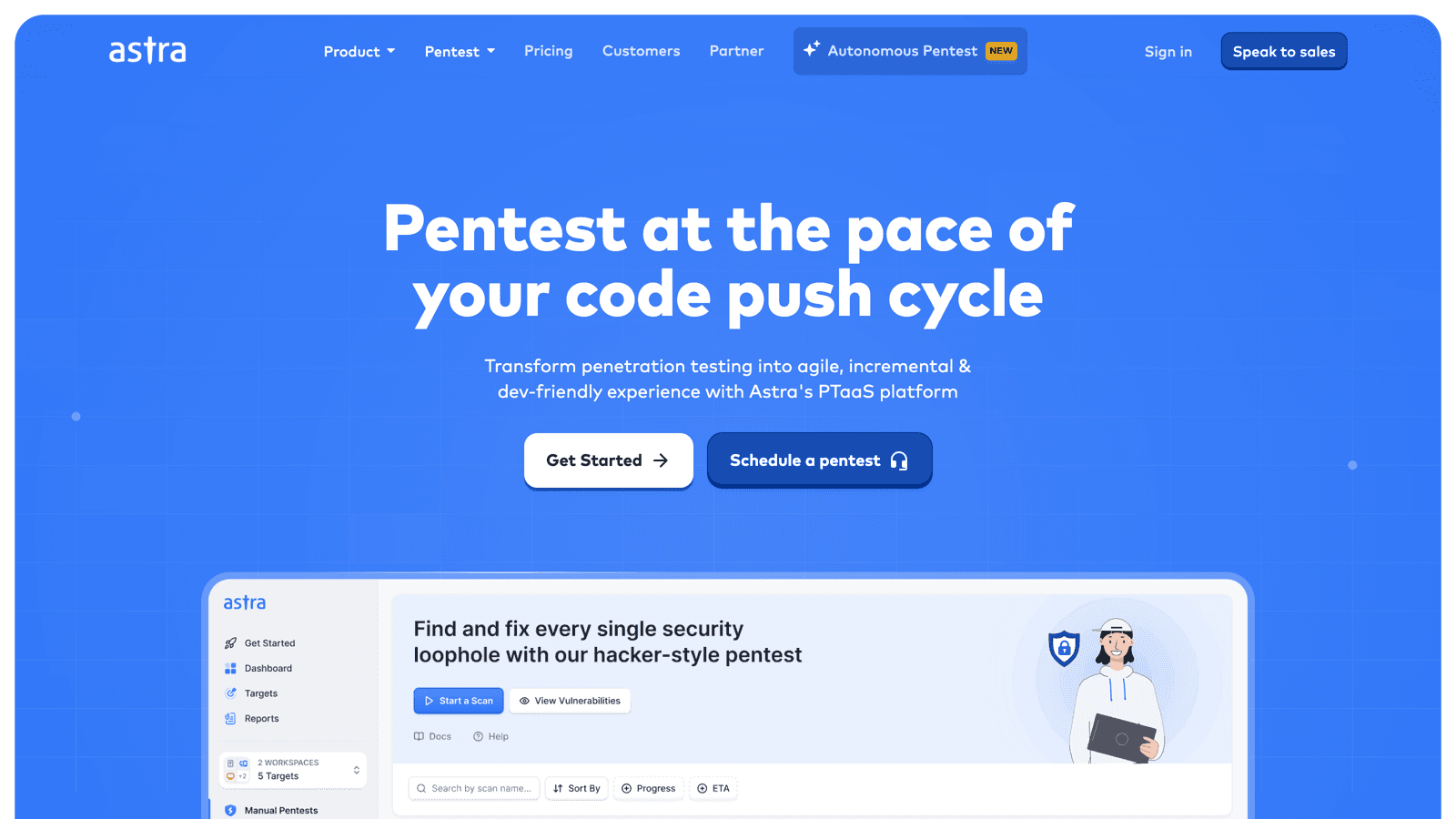
Coverage spans web apps, mobile apps, APIs, cloud, networks, and AI/LLM targets, in black, grey, or white box modes. Manual engagements run 10 to 15 working days per Astra’s own FAQ, and every plan ends in compliance-mapped reports plus a publicly verifiable Trust Center page.
The DAST scanner
Astra’s DAST scanner runs 10,000+ tests covering OWASP Top 10, SANS, and known CVEs, using browser-based crawling that handles JavaScript-heavy apps. It stands out on authenticated scanning, with support for TOTP-based MFA logins via custom login scripts, static OTPs, and manual auth headers.
Secret scanning rounds out the engine, catching exposed API keys and tokens with custom detection rules. Astra’s own pages disagree on the test count, with the DAST product page advertising 15,000+ cases while the pricing page and homepage say 10,000+, so ask which number applies before you cite one.
API security
The API platform discovers what your team forgot it shipped, flagging shadow, zombie, and orphan APIs and marking endpoints that handle sensitive data. Testing runs 15,000+ authenticated cases against OWASP API Top 10 risks across REST, SOAP, and GraphQL.
Traffic flows in through connectors for AWS API Gateway, Apigee, Nginx, Kong, Istio, Postman, Burp, and cloud traffic mirroring. Check the buying path before you budget for it, because the API line’s pricing tab cannot be selected on the live pricing page, and purchasing means talking to sales.
Cloud vulnerability scanning
The cloud product runs 400+ misconfiguration detectors across AWS, Azure, and GCP with an agentless setup, catching open buckets, over-privileged IAM, exposed databases, and compliance drift. Astra frames the filter as offensive validation, so findings are checked for exploitability rather than dumped as raw posture alerts.
Paid tiers start at $99 per month, and the custom Enterprise tier adds a manual cloud pentest and review by cloud security experts. Full numbers live in our Astra Security pricing breakdown.
Autonomous Pentest, the waitlisted flagship
The newest product runs what Astra calls an army of AI agents, built on insights from 5,000+ real pentests and 10M+ vulnerabilities. The two agent strategies run together by design, with a structured swarm that tests every surface systematically and a single bounty-hunter agent free to chase promising paths the way an offensive researcher would.
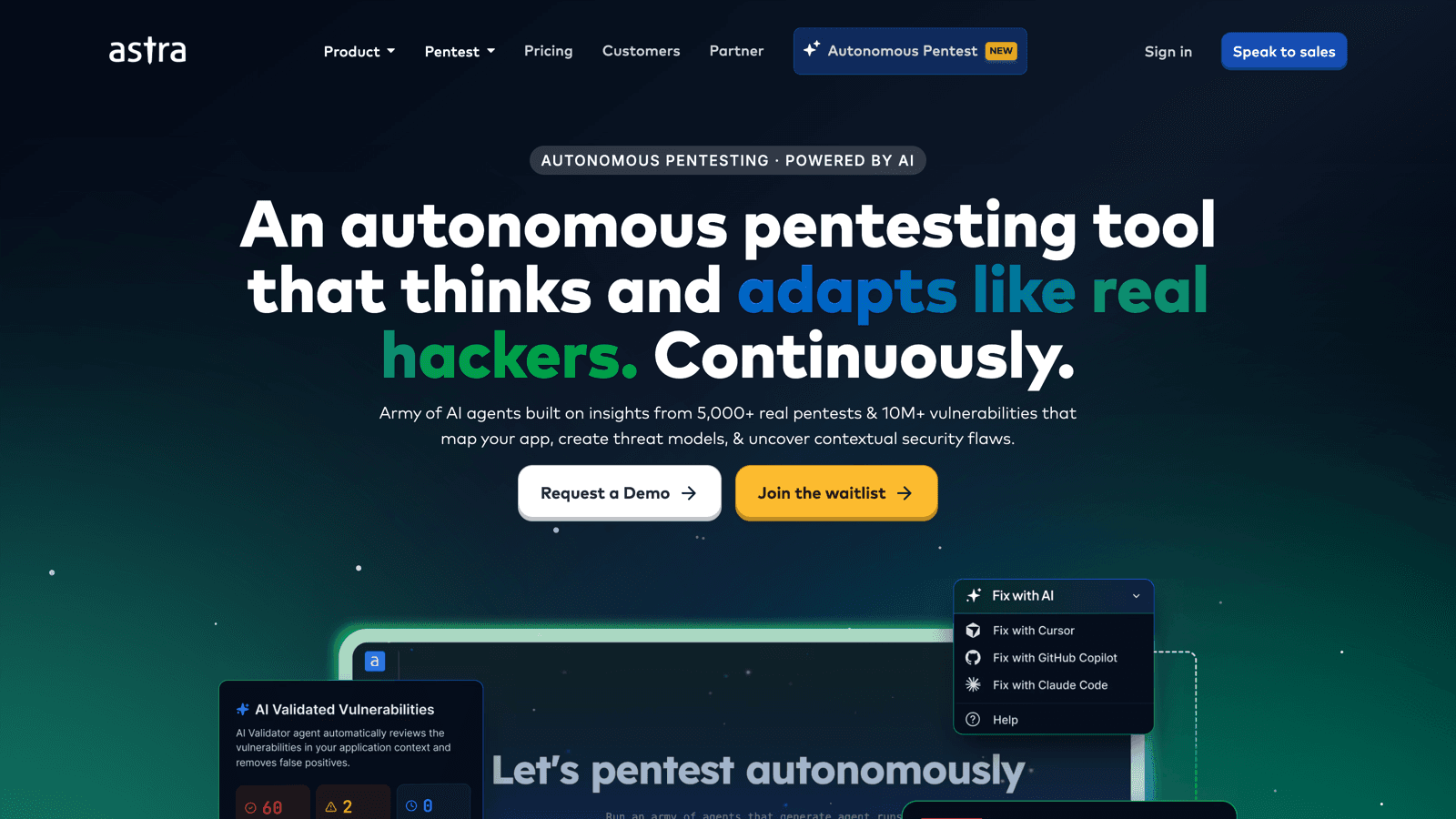
Published results read like pentest war stories: a weak CSP chained with XSS into full account takeover, a developer-owned domain loaded in production as a supply-chain risk, and privilege escalation through a specific API call sequence. Speed claims are aggressive, with a first finding in 5 minutes against two weeks for manual testing, an 80× multiplier by Astra’s math.
Buying it is the catch, because the product carries a Join the Waitlist CTA and credit-based pricing with rates unannounced. The autonomous depth you can purchase today is the version already bundled into Pentest Auto and Expert.
Astra also took the category’s definition problem to OWASP, co-authoring the Autonomous Penetration Testing Standard now live at version 0.1.0. Astra’s own framing was that every vendor called its tool autonomous while nobody agreed on what that meant, and the open standard gives you something to hold those claims against.
AI auto-fix into your IDE via MCP
Astra’s MCP integration delivers fixes where developers already work, with a four-stage flow: find the vulnerability with proof of exploit, validate it with an independent agent, generate a fix written for your specific codebase, and deliver a ready-to-paste prompt into your IDE. Supported clients cover Cursor, VS Code with GitHub Copilot, Claude Code, Claude Desktop, and ChatGPT, with one browser-based authentication.
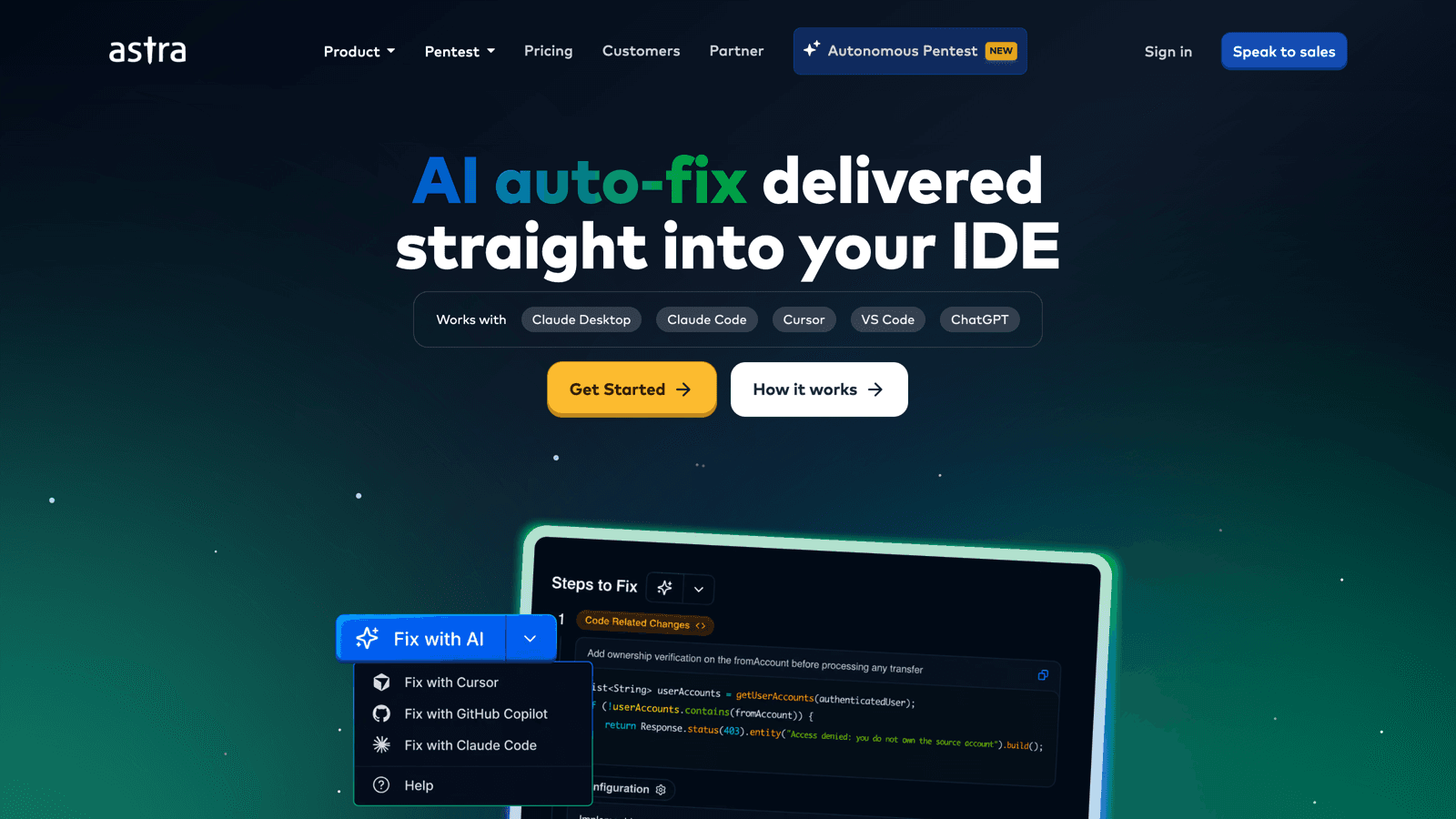
The marketing line about reading your actual codebase deserves a precise reading, because it can sound like static analysis. The engine reads code only to write a fix for a vulnerability its runtime testing already found, never to discover issues in a repository, and that difference against SAST decides which half of the problem you have covered.
Integrations and compliance reporting
CI/CD hooks exist for GitHub Actions, GitLab CI, Jenkins, Bitbucket, CircleCI, and Azure DevOps, so scans can gate deploys in the pipelines covered by our continuous pentest tooling guide. Jira creates tickets automatically, and pentest plans include a shared Slack channel with the testing team.
Reports map to SOC 2, ISO 27001, HIPAA, PCI-DSS, and GDPR, backed by Astra’s own CREST, CERT-In, PCI-ASV, ISO 27001, and SOC 2 Type II credentials. The public Trust Center turns the pentest into a sales asset, and one CTO testimonial on Astra’s own site calls the certificate the most impressive part of the product.
What’s Good About Astra’s Feature Set?
You can run your compliance pentest, continuous DAST, API discovery, and cloud scanning in one place. Fewer contracts and fewer dashboards is a real saving when your security team is small.
Certified pentesters test, validate, and re-check fixes, with an AI validator filtering noise before findings land. Astra’s own words make the augmentation stance explicit, with “The future of pentesting is augmentation, not replacement.”
Fixes arrive in your editor with context preloaded, which cuts the delay between a finding existing and an engineer acting on it. The same MCP flow ships on the $1,999 plan, so the best developer-facing feature is not enterprise-gated.
Where Are the Limits?
Every limit below comes from Astra’s own pages. Weigh each one against the gap you need covered.
The code layer is absent. No SAST, no dependency scanning, no secrets-in-repo detection, no code review. Astra’s five products all test deployed targets, so the pull request that introduces a vulnerability ships unexamined.
The flagship is waitlisted. The autonomous agents that headline the marketing cannot be bought today, and their credit-based pricing is unpublished.
Human re-scans are capped. A single verification cycle on Auto and two on Expert cover a clean remediation, and a messy quarter can use both up before your fixes settle.
Astra’s published counts disagree. The homepage claims 2 million+ vulnerabilities across 3,000+ pentests while the autonomous page cites training on 10M+ vulnerabilities from 5,000+ pentests, and test counts and pentester CVE counts also vary between pages. Cosmetic, until a stat needs citing to an auditor.
The best tiers are sales-gated. Expert requires a call at $5,999, Enterprise is custom, and the API line cannot be purchased from the pricing page at all.
Per-target economics. The pentest, DAST, and cloud lines all meter by target, so sprawling estates multiply cost in ways per-user pricing does not, as our pentest cost guide works through.
How Do Astra’s Features Compare to CodeAnt AI?
The overlap is offensive testing of running applications with validated findings. Everything else splits cleanly along the code-versus-runtime line.
Capability | Astra Security | CodeAnt AI |
|---|---|---|
Pentest with human-validated findings | Yes, certified experts plus AI validation | Yes, exploit-verified agentic pentest in black, grey, and white box modes |
Continuous automated testing | Yes, DAST plus autonomous engine | Yes, continuous scans of code and running apps |
SAST and code security | Not offered | Yes, Code Security with SAST, secrets, and IaC in one platform |
AI code review on pull requests | Not offered | Yes, with fix suggestions at the PR and in the IDE |
Finds issues in source code | No, runtime only | Yes, code and runtime both |
Fix delivery | MCP prompts into the IDE for runtime findings | Fixes at the PR and IDE, tied to the offending code |
API and cloud posture | Yes, dedicated products | Cloud and API covered within pentest scope |
Compliance evidence | Mapped reports, Trust Center, CREST/CERT-In/PCI-ASV | Auditor-ready reports, sample available |
Buy and try | $7 scanner trial, no pentest trial | Free first black-box scan, pay when a working exploit is proven |
Takeaway: choose Astra when your requirement is an accredited, human-led pentest program with continuous runtime scanning around it. Lead with CodeAnt AI when the gap runs from the pull request outward, since it proves exploits at runtime and prevents the next one at the code layer in the same platform.
The full CodeAnt AI vs Astra Security comparison runs this matchup line by line.
Where This Leaves You
Astra’s feature set delivers what its homepage promises, continuous offensive testing of apps, APIs, and cloud with humans in the loop and compliance evidence at the end. The boundaries are just as clear: nothing here reads your code to find problems, the autonomous flagship is still behind a waitlist, and verification cycles are metered.
A compliance-driven runtime program lands naturally on Astra, alongside the field covered in our Astra Security alternatives guide. A gap spanning code and runtime points at CodeAnt AI, whose attack-path analysis connects source-level context to runtime proof.

